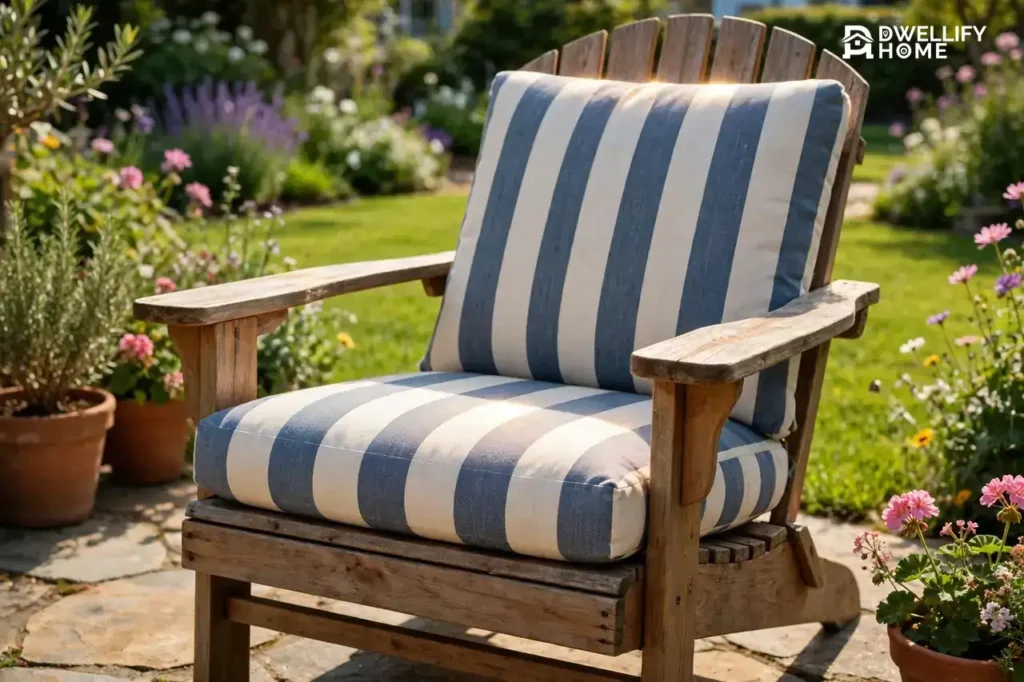
Adirondack chair cushions are high-back pads made for the Adirondack chair’s deep reclined seat and steeply angled back, and the most common size is about 44 inches long by 19 to 20 inches wide and 2 to 4 inches thick — but there is no universal standard, so you must measure your own chair before you buy. A generic rectangular cushion slides, bunches, and leaves your lower back hanging, while a cushion matched to your chair’s seat width, seat depth, and backrest curve turns a hard wooden chair into the best seat on the patio.
One measurement mistake causes most cushion returns, and it has nothing to do with length or width. It sits in the measuring section below, and it is the reason a cushion that “fits” on paper still slides off the chair. First, you need to know why Adirondack chairs reject ordinary cushions in the first place.
What Makes Adirondack Chair Cushions Different?
Adirondack chair cushions are different because the chair itself is different: a deep reclined seat, a steeply angled backrest, and a seat that is wider at the front than at the back. A generic dining-chair pad is built for a flat, upright seat, so on an Adirondack chair it slides forward, bunches at the curve, and leaves your lumbar unsupported.
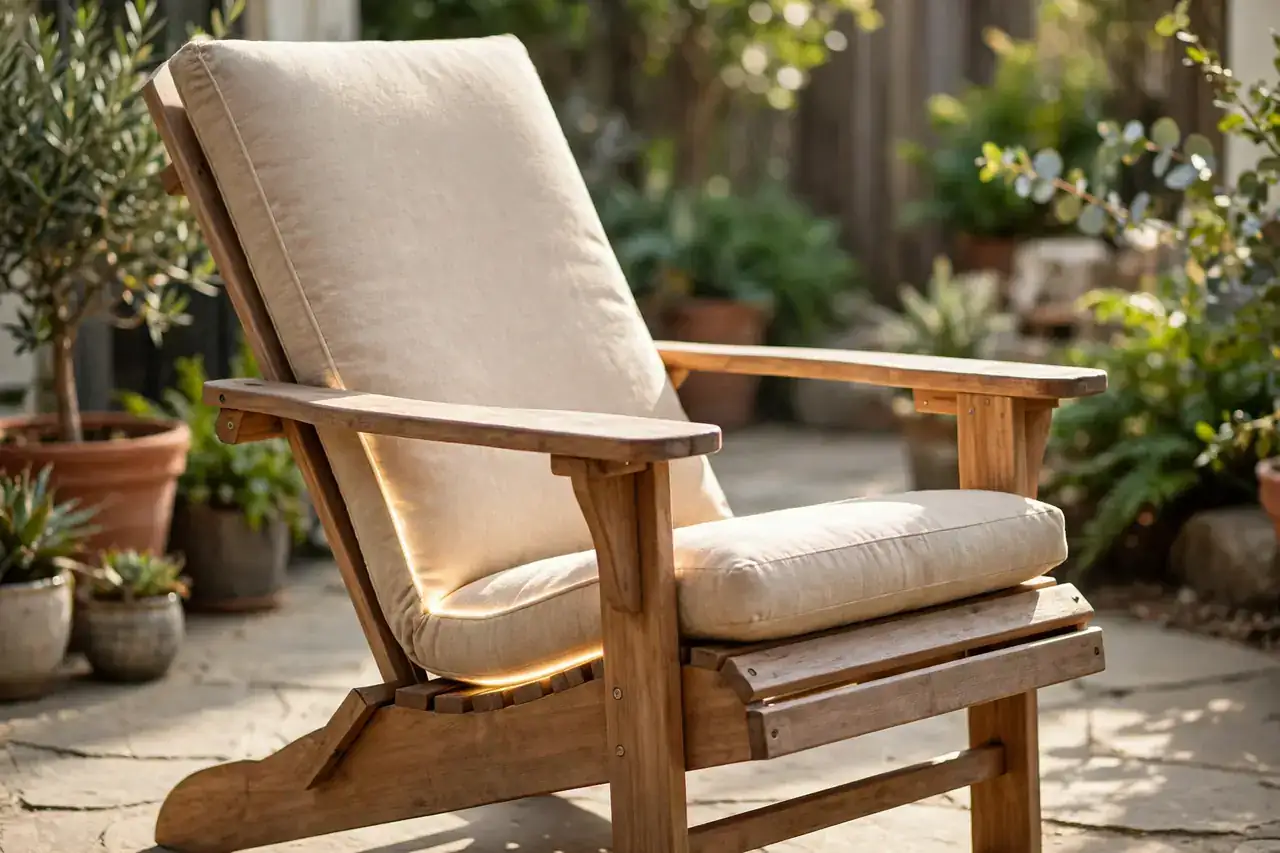
The right cushion matches three variables at once: seat width, seat depth, and the distance between the seat and the backrest curve. Most Adirondack cushions are one continuous piece that covers the seat and the high back together, usually 40 to 50 inches long in total, with the seat portion about 17 to 19 inches deep and the back portion about 28 inches tall. Some buyers prefer two separate pieces — a seat pad and a back pad — which fit tapered chairs better and let you replace one piece at a time.
Thickness is a comfort choice, not a size. A 2-inch cushion keeps you low in the chair and suits a chair you climb in and out of often. A 4-inch cushion feels like an armchair and suits long reading sessions, but it raises your seat height by 4 inches, so check that your knees still bend comfortably and your feet still reach the ground. Most buyers land at 2.5 to 3 inches, which cushions the slats without changing the chair’s geometry.
Foam density is the hidden spec that decides whether the cushion lasts. A density rating of 1.8 pounds per cubic foot or higher indicates foam that resists sagging for three to five years, while cheap low-density foam flattens within a single season. If the listing does not state a density, treat that as a warning, not a detail.
Match the chair’s curve, not just its length. Three measurements decide the fit.
What Size Are Adirondack Chair Cushions?
There is no standard size for Adirondack chairs, so there is no standard cushion size either. The most common high-back cushions run 44 inches long by 19 inches wide, 48 to 50 inches long by 20 inches wide for oversized chairs, and 41 to 42 inches long by 20 to 21 inches wide for compact rockers, with thickness from 2 to 4 inches.
Real listings show the range. An Aegisun high-back cushion lists at 44 by 19 by 4 inches, a Crestlive set of two lists at 50 by 20 by 2.4 inches with 30D memory foam, and a Lucresta high-back cushion lists at 48.8 by 20.4 by 4.3 inches, all checked November 16, 2026. An ARDEN outdoor cushion at Target measures 21.5 inches wide by 45.5 inches high by 2.25 inches thick, with a seat of 20 by 17 inches and a back of 21.5 by 28.5 inches. The numbers overlap, but no two brands measure the same way, which is exactly why measuring matters.
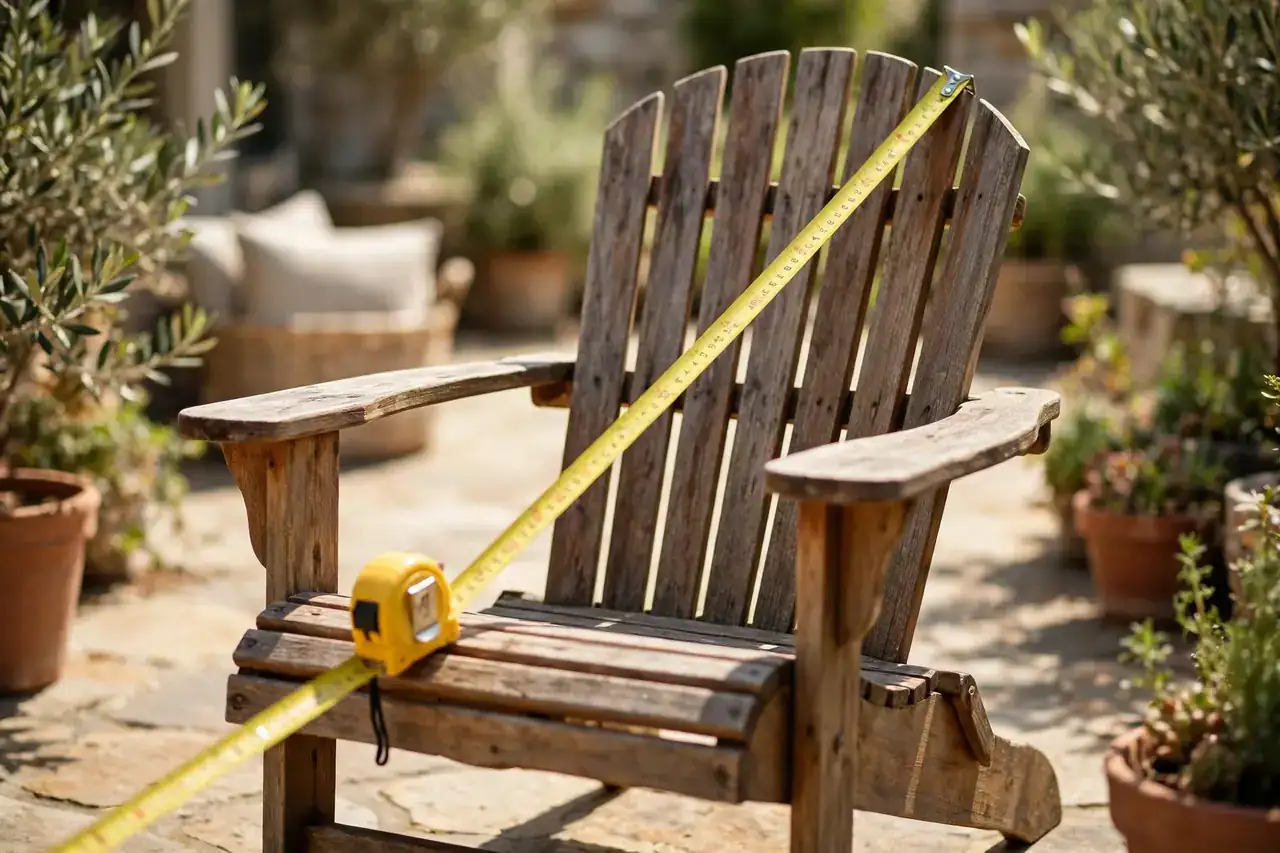
Here is how to measure, and here is the mistake: measure the frame, not the old cushion. Old cushions flatten, shrink, and lose their shape after a few seasons outside, so copying them copies the problem. Measure the seat width side to side and the seat depth front to back, at the front and at the back, and use the smaller number. Then measure the backrest from the seat joint to the top, and note any taper, rounded corners, or notches for posts. Round to the nearest quarter inch.
Fabrica Kraft’s cushion size chart gives the same rule in one line: an Adirondack chair seat and back runs about 20 inches wide and 40 to 45 inches in total length, at 2 to 3 inches thick — but always measure your own frame, because brands vary. Read the full chart at Fabrica Kraft’s standard outdoor cushion sizes chart.
When the seat is wider at the front than at the back, you have a trapezoid, and a rectangular cushion will always bunch on one side. Measure the front width and the back width separately, and either order a tapered cushion or pick a two-piece set. If your chair is oversized — a wide rocker or a deep Adirondack lounger — a 48-inch cushion covers what a standard 44-inch cushion cannot.
Measure the frame, not the old cushion. The old cushion is the wrong template.
Are Adirondack Chair Cushions Waterproof?
Most Adirondack chair cushions are water-resistant, not waterproof: the fabric sheds light rain and dries fast, but the foam inside absorbs water if the cushion sits in a storm. Truly waterproof cushions exist, but they use a TPU coating or a sealed cover, and even those should come inside in heavy rain.
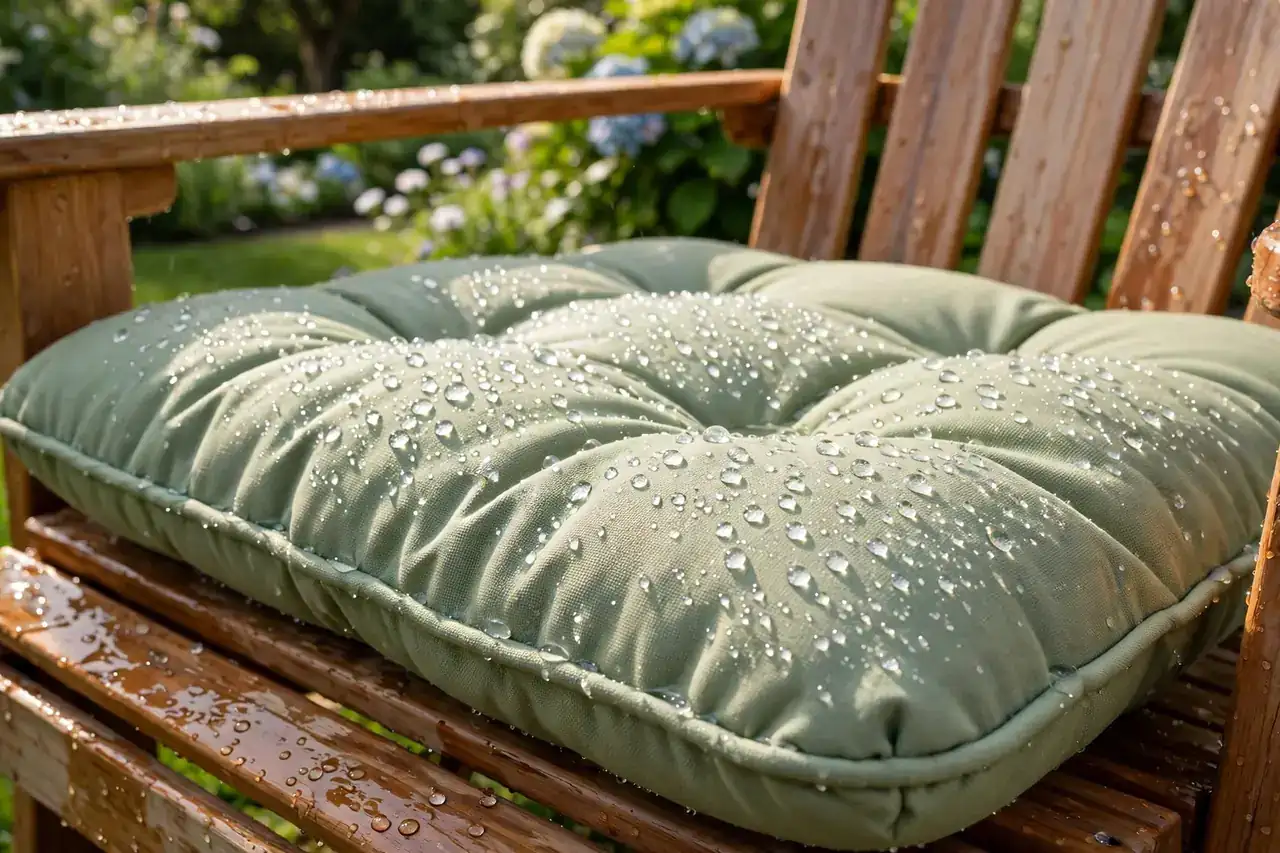
The fabric is the first line of defense. Solution-dyed acrylic, sold under names like Sunbrella, embeds color into the fiber rather than coating it on top, so it resists fading for years and sheds moisture without a chemical top coat. Polyester with a PFAS-free C0 water-repellent finish is the budget-friendly version: it resists rain and fading, dries fast, and costs far less. Standard polyester breaks down after roughly two hundred hours of direct summer sun, so the finish matters more than the fiber name.
The fill is the weak point. Most cushions use polyurethane foam or polyester fiber fill, and neither is waterproof: once water soaks through the seams or the zipper, the fill holds it, and mold follows. Quick-dry foam with an open-cell structure and a mesh bottom panel drains faster, but it still needs to dry. Wayfair’s outdoor cushion guide says it plainly: cushions can get wet as long as they are made from the right material and properly cared for, but you do not want to leave them in the rain on a regular basis. Read it at Wayfair’s guide to whether outdoor cushions can get wet.
The honest answer to the rain question is a habit, not a product: bring the cushions in before a storm, or tip them on their sides with the zipper facing down and unzipped so water drains out. A cushion left soaked on a chair for a week will smell before it dries, and no fabric treatment fixes that.
Water-resistant is not waterproof. The fabric sheds rain; the foam remembers it.
How to Keep Adirondack Cushions From Sliding Off
Adirondack cushions slide because the chair reclines steeply and the seat is smooth wood, so you need fastening, not friction. Look for ties, elastic straps that wrap around the back slats, or a full anti-slip silicone dot pattern on the bottom — and the best cushions combine all three.
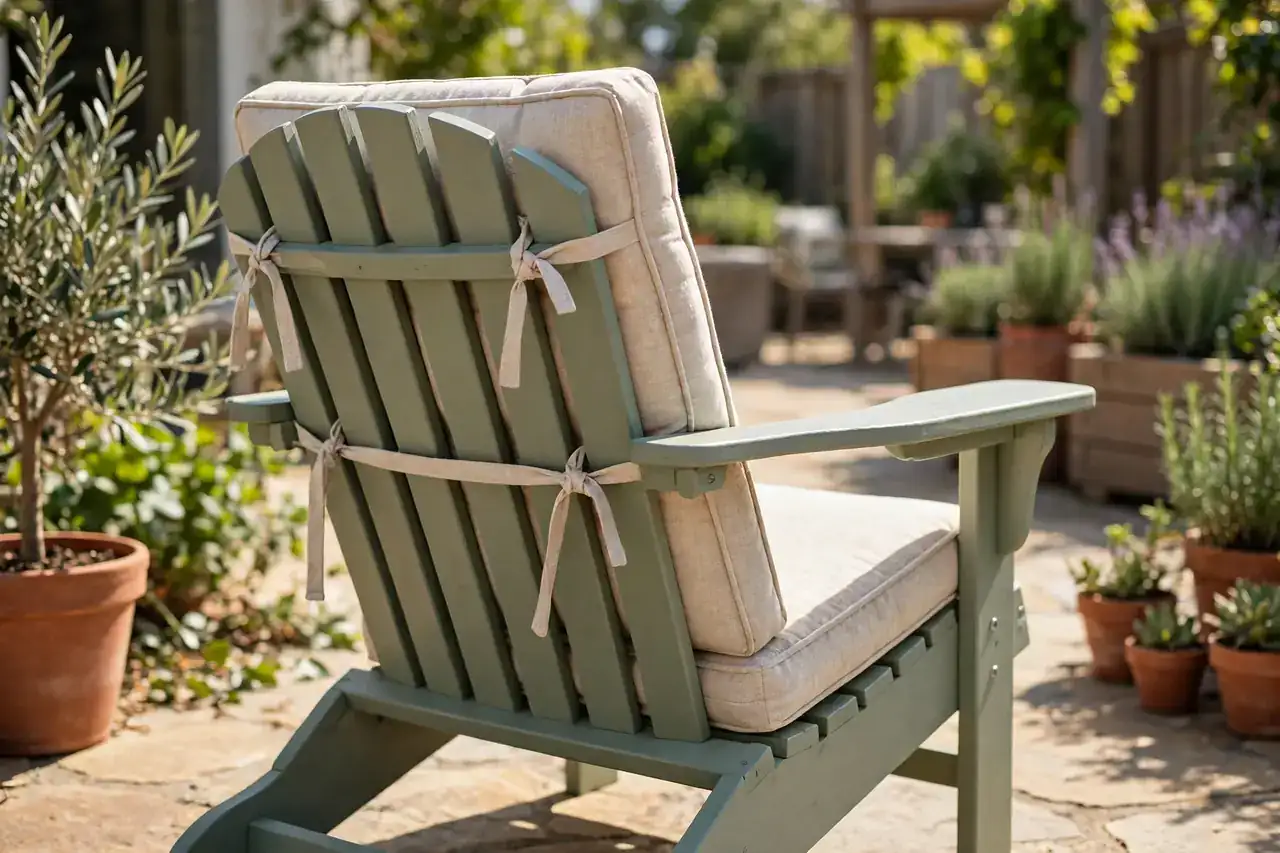
Ties are the simplest fix and the weakest on their own: two fabric ties at the top of the backrest keep the cushion from sliding forward, but they loosen over a season and they do nothing for the seat. Elastic straps that wrap around the back slats hold firmer than simple ties, because they grip the wood instead of hanging from it. A silicone dot pattern on the bottom adds grip across the whole seat, and triple-fastening designs — straps, silicone backing, and a spring belt — are the gold standard for high-wind porches.
Fit is the other half of the fix. A cushion that is too narrow for the seat slides sideways; a cushion that is too short leaves the top of the backrest bare, so the top edge curls forward and pulls the whole pad down. Measure the seat width at the front and the back, and buy the size that matches the smaller number, not the larger one.
If a cushion you already own slides, add grip instead of replacing it. A strip of non-slip shelf liner under the seat portion costs a few dollars and works immediately, and a pair of elastic straps sewn or clipped to the back corners holds the top in place. Check the ties once a season: sun-rotted ties snap without warning, usually the first windy day of spring.
Ties alone are not enough on a steep chair. Straps plus grip is the combination that holds.
How Much Do Adirondack Chair Cushions Cost?
Adirondack chair cushions cost $25 to $120 each, with budget polyester cushions at $25 to $50, mid-range tufted cushions with ties at $50 to $80, and premium Sunbrella-fabric cushions at $80 to $120 or more, all checked November 16, 2026. Sets of two or four usually cost less per cushion than singles, and custom-sized cushions cost the most.
The price follows the fabric and the foam, not the size. A $25 cushion uses thin polyester and low-density foam that flattens in one season. A $60 cushion uses tufted polyester with a water-repellent finish and foam dense enough to hold its shape for three years. A $100-plus cushion uses solution-dyed acrylic like Sunbrella, a 5-year fabric warranty, and foam rated at 1.8 pounds per cubic foot or higher. HomeToSight’s roundup of seven Adirondack cushions shows the same ladder, with premium picks carrying a 5-year fabric warranty and budget picks carrying a 1-year warranty, at HomeToSight’s best Adirondack chair cushion guide.
Two buying traps are worth knowing. First, a set of four at a low price is often four thin cushions, not four good ones: check the thickness and the foam density before you celebrate the price. Second, a cushion without a removable, machine-washable cover costs you more over time, because a stained cover you cannot wash is a cushion you replace.
Compare the cost per season, not the price on the tag. A $30 cushion that flattens in one summer costs $30 a season. A $90 cushion that holds its shape for four summers costs about $22 a season, and it is more comfortable every single day. The expensive cushion is the one you buy twice.
Cost per season beats price per cushion. Foam density is the number that decides it.
How to Clean and Store Adirondack Chair Cushions
Clean Adirondack chair cushions with mild soap and warm water, a soft brush, and a rinse, then let them dry fully in the sun before you put them back on the chair. Store them indoors or in a dry, ventilated bin over winter, never in a sealed plastic bag or under a plastic tarp.
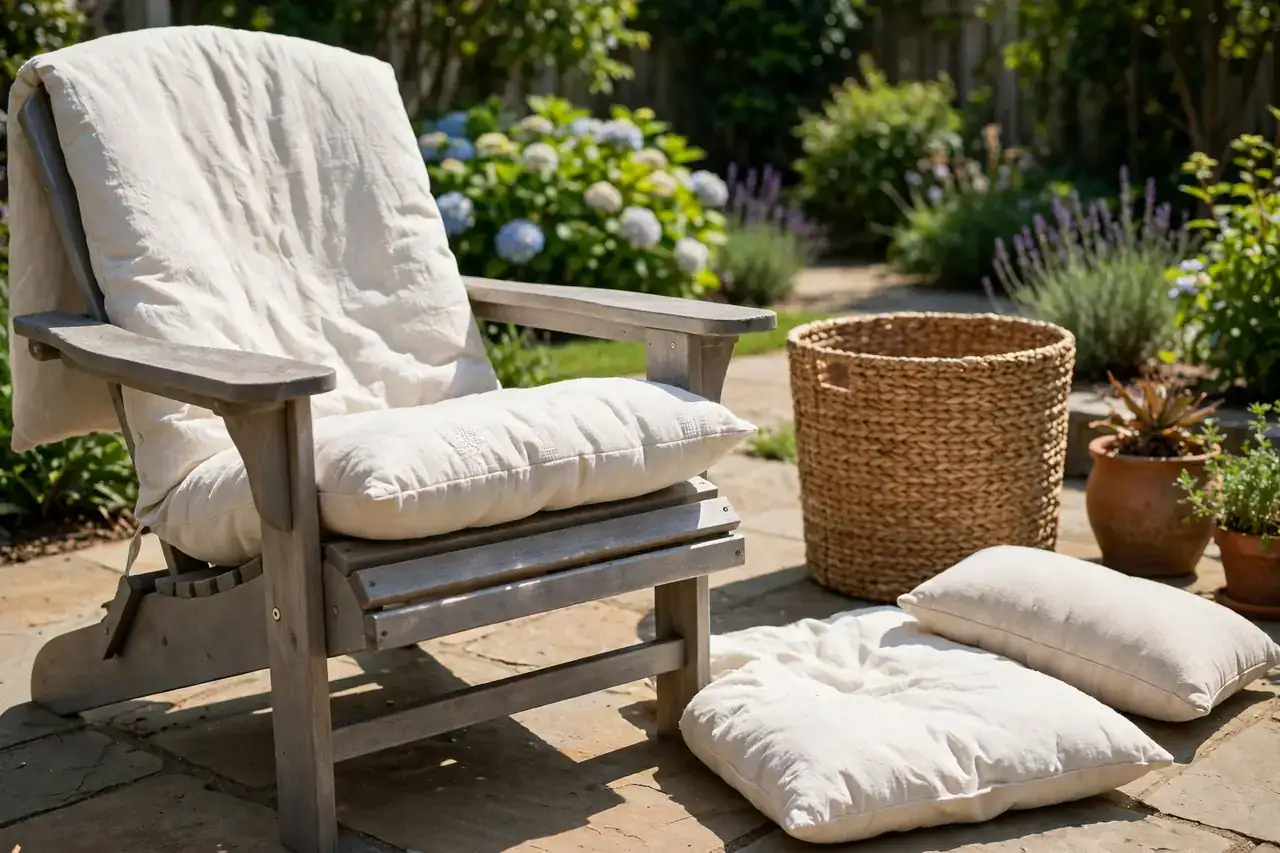
For everyday dirt, brush off loose dust, wash with mild soap and water, and rinse. For mildew spots, use a mix of one part white vinegar to four parts water, scrub gently, and rinse well; never use bleach on solution-dyed acrylic, because it strips the color the fiber was built with. If the cover is removable, machine-wash it on gentle and air-dry it — a dryer shrinks the cover and the cushion never fits the same way again.
After unpacking a vacuum-sealed cushion, allow 48 to 72 hours for it to fully regain its fluffiness, or put it in the dryer at a low temperature for 30 minutes before normal use. A cushion that looks flat on arrival is usually just compressed, not defective.
Winter storage decides whether the cushion lasts two seasons or five. Clean and dry the cushions completely, then store them indoors or in a ventilated outdoor storage bin. Our outdoor storage bin guide shows which bins keep cushions dry without trapping damp, and our how to store outdoor furniture guide covers the full winter routine for the chairs underneath them. If you have no indoor space, a breathable cover over the whole chair helps; our balcony cover ideas guide shows covers that breathe instead of trapping moisture.
When the chair itself needs a cushion refresh across the whole patio, our replacement cushions for patio furniture guide walks through fit, fabric, and price for every seat type, not just Adirondack chairs.
Dry before you store, always. A damp cushion in a closed bin is a mold farm by spring.
Related Guides
If you are planning the whole outdoor space, these guides pick up where this one leaves off:
- Replacement Cushions for Patio Furniture — get the fit, fabric, and price right the first time.
- How to Store Outdoor Furniture — keep it clean, dry, and ready for spring.
- Outdoor Storage Bin — stash cushions where they stay dry.
- Balcony Cover Ideas — stay dry and cool on a small balcony.
- Outdoor Furniture for Small Spaces — seven layouts that make a tiny patio feel big.
- Outdoor Bench With Storage — sit down, stash the clutter, and reclaim your patio.
- Outdoor Sectional Couch — deep seating for the lounge corner.
- Patio Garden — pair your chairs with plants that earn their place.
Frequently Asked Questions
What size are Adirondack chair cushions?
There is no standard size for Adirondack chairs, so the best way to determine cushion size is to measure the depth and height of your specific chair. Use a tape measure to check the depth of the seat and the height of the backrest, plus the width of both, and use those measurements to pick or make a cushion that fits.
Can I use regular indoor cushions on my Adirondack chair?
Yes, you can use regular indoor cushions on your Adirondack chair. However, it is recommended to use cushion materials suitable for outdoor use for better durability and resistance to weather conditions, because indoor foam and fabric soak up rain and grow mold outdoors.
Are there waterproof cushions available for Adirondack chairs?
Yes, you can find waterproof cushions for your Adirondack chair. They come in various materials and colors and require minimal maintenance. Not only will they protect your chair from moisture, but they will also provide added comfort, though even waterproof cushions should come inside in heavy rain.
Can I leave the cushions on my Adirondack chair outside in the rain?
Yes, you can leave cushions on your Adirondack chair in light rain, but to keep them dry, consider using rain protection covers or bringing them inside. Regular cleaning and maintenance will also help prolong their lifespan, and a soaked cushion should be tipped on its side to drain.
Is it okay to leave outdoor furniture cushions outside in the rain?
While metal and plastic furniture frames can generally withstand rain, cushions and upholstery should not be left out in the rain. Cushions can become waterlogged, leading to mold, mildew, and rapid deterioration of the fill and fabric, so always store them in a dry place when not in use or during wet weather.
Disclaimer: This guide gives general advice for choosing and caring for outdoor cushions, not professional upholstery or furniture-repair instructions. Check the care label on your own cushions before washing, and hire a qualified pro for any structural chair repair.
Measure the frame, pick the foam density, and buy the fabric for your weather. A cushion that matches your chair’s curve, holds its shape for three to five years, and comes inside before a storm turns the hardest wooden chair on the patio into the seat everyone fights over. Do that, and the cushion you buy this year is still comfortable four summers from now.