Replacement cushions for patio furniture are the fastest way to make old patio chairs feel new again, and the right set costs far less than new furniture. Measure the bare frame, not your old flattened cushions, pick a solution-dyed acrylic fabric like Sunbrella, and choose high-density foam at 1.8 to 2.5 pounds per cubic foot for seats. A ready-made deep-seat set runs about $50, while custom cushions cost $100 to $300 per cushion.
This guide walks you through measuring, standard versus custom sizes, foam versus fiber fill, fabric that survives sun and rain, where to buy, and real 2026 prices. Follow it in order, and your new cushions will fit the first time, sit comfortably for years, and still look good after a full summer in the sun.
Replacement Cushions for Patio Furniture at a Glance
Most patio frames outlast their cushions by years. Aluminum, steel, and all-weather wicker frames often stay sound for 10 to 15 years, while cushions usually need a refresh every 2 to 4 years, depending on sun and fabric quality. That gap is good news: new cushions rescue a solid frame instead of sending it to the curb.
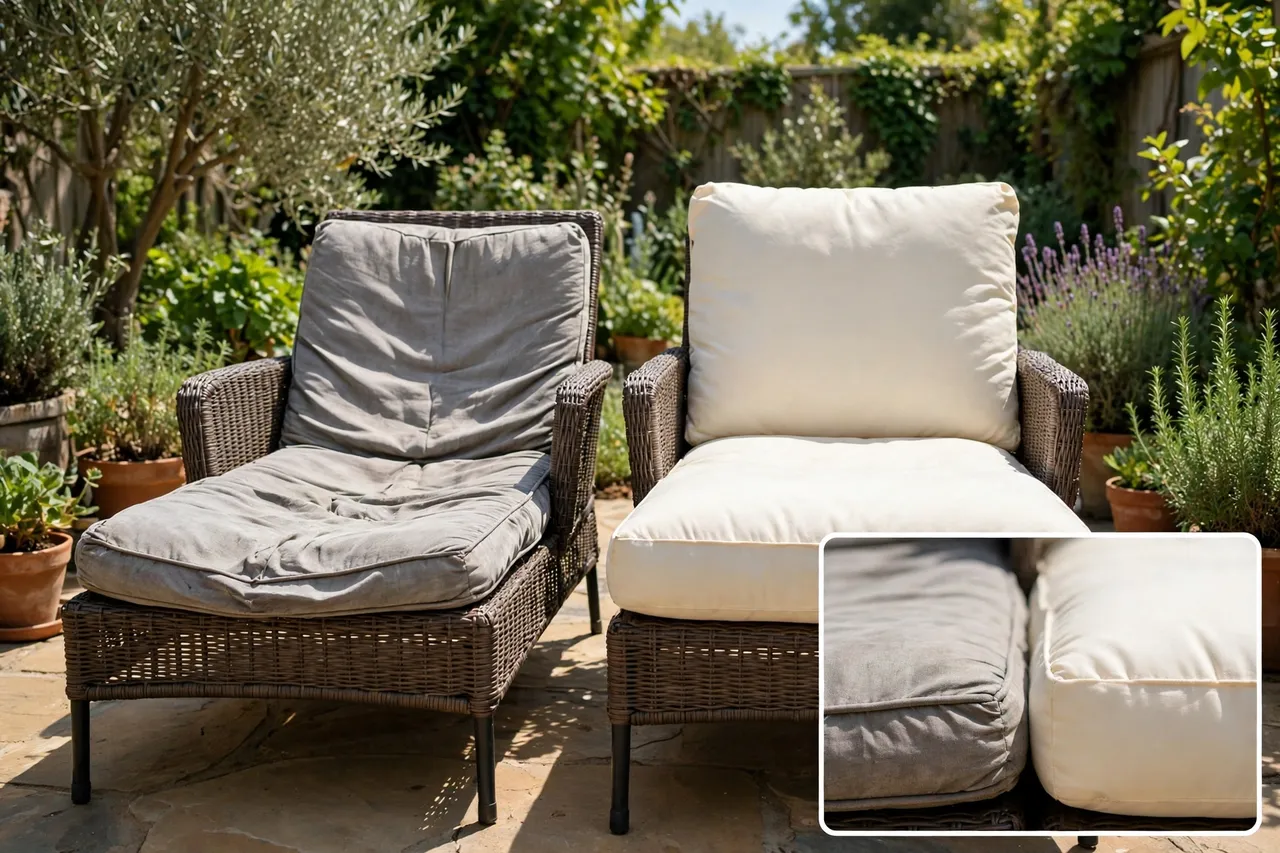
Three routes cover almost every patio. Ready-made cushions fit standard frames and ship at once. Custom cushions are cut to your exact measurements for odd shapes or favorite old sets. Covers-only replacement keeps your foam and swaps just the worn fabric. The table below shows how they compare.
Replacement cushion options compared
| Option | Best for | Typical cost | Wait time |
|---|---|---|---|
| Ready-made set | Standard dining chairs, deep-seat chairs, sectionals | About $25 to $70 per set | Ships at once |
| Custom cushions | Odd sizes, curved backs, chaise lounges, beloved old sets | $100 to $300 per cushion (estimate) | 2 to 4 weeks |
| Covers only | Foam still firm, fabric faded or torn | Less than full cushions | 1 to 3 weeks |
| Brand-matched replacements | Matching the original set exactly | $300 to $1,100+ per cushion (estimate) | Weeks to months |
Start with the frame, not the catalog. Your measurements decide which route works, so measure first and shop second. A cushion that is half an inch too wide will never sit right, no matter how good the fabric is.
How to Measure Your Patio Furniture for Replacement Cushions
Measuring is the single most important step in this whole job, and it takes ten minutes with a metal tape measure. Old cushions compress, sag, and lose their shape over time, so measuring them gives you the wrong numbers. Strip the frame bare, then measure the flat, usable seat area where the cushion will actually sit.
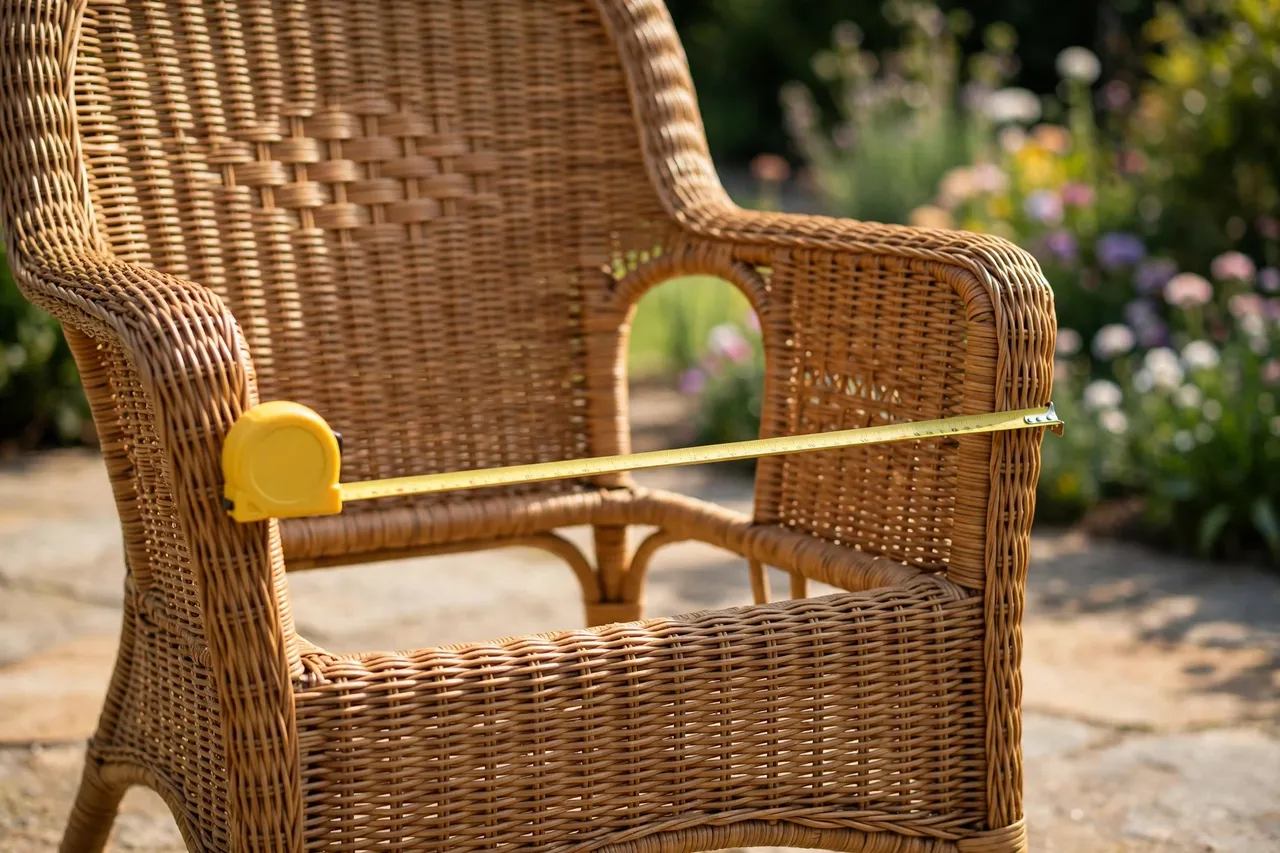
Work through these steps for every piece, and write each number down as you go:
- Remove the old cushions and clean the frame so the tape sits flat.
- Measure the seat width inside the arms, from the left inner edge to the right inner edge.
- Measure the seat depth from the front edge of the frame to the backrest.
- Measure the backrest height from the seat surface to the top of the frame.
- Measure the thickness gap: the space between the seat frame and the underside of the arms or back rail.
- Measure twice, at the front and the back, because many seats taper toward the back.
- Note the shape: square, rectangular, T-shaped, L-shaped, or curved, and sketch it if it is not a plain rectangle.
- Note how the old cushion attached: ties, Velcro strips, or buttons, and where those fixings sat.
For a tailored look, order cushions about a quarter to a half inch smaller than the frame opening in both width and depth. That small gap stops the cushion from bulging against the frame and stressing the seams. If you want a slightly overhanging, plush look instead, order exact size or a touch larger, but never more than half an inch over.
Measure the back cushion separately. Many loveseats and sectionals use a narrower back than seat, and a matched pair that assumes equal widths leaves a back cushion hanging off one side. For a chaise lounge, measure the seat, the back, and the foot areas as three separate pieces. For a deep-seat chair, remember that a thick back cushion eats into the seat depth, so subtract the back cushion thickness from the total depth before you order the seat cushion.
Check the listing the same way you measured. Compare your longest measurement to the product’s longest listed dimension, because catalogs often list length and width in a different order than your seat. If your numbers sit within about an inch of a standard size, a ready-made cushion will usually work. If they sit further out, go custom.
Standard vs Custom Replacement Cushions
Standard cushions are pre-sized, mass-produced, and sold at big retailers like Target, Walmart, and The Home Depot. Common seat sizes run 18 by 18 inches up to 24 by 24 inches, with seat depths between 18 and 22 inches and widths in 24, 26, or 30 inch steps. They cost less, ship fast, and come in the season’s colors, but they only fit frames built to those common sizes.
Custom cushions are built to your exact measurements by makers like Fabrica Kraft, FoamOrder, and ZIPCushions. Fabrica Kraft cuts most cushions to within a quarter inch of the size you order and remakes them free if one arrives outside its tolerance, with a lead time of 2 to 3 weeks for most orders. See Fabrica Kraft’s replacement cushion guide for its builders, fabrics, and fit guarantee.
Choose standard cushions when your frame matches a common size, you want cushions this week, and you are happy with the retailer’s fabric and color range. Choose custom cushions when your furniture has odd dimensions, a curved or T-shaped seat, a chaise or daybed, or real sentimental or money value that makes a perfect fit worth waiting for. Choose covers only when the foam still bounces back within about 10 seconds of pressing it, and only the fabric is faded, stained, or torn.
Custom is worth it for the set you love. A $200 custom cushion that fits perfectly and lasts five years beats three $50 ready-made cushions that slide, gap, and get replaced every season.
Foam vs Fiber: What Goes Inside Your Cushions
The fill decides whether a cushion feels good in year two or goes flat by August. Two fills dominate outdoor cushions: foam and polyester fiber, and many good cushions use both, with a foam core wrapped in fiber for softness.
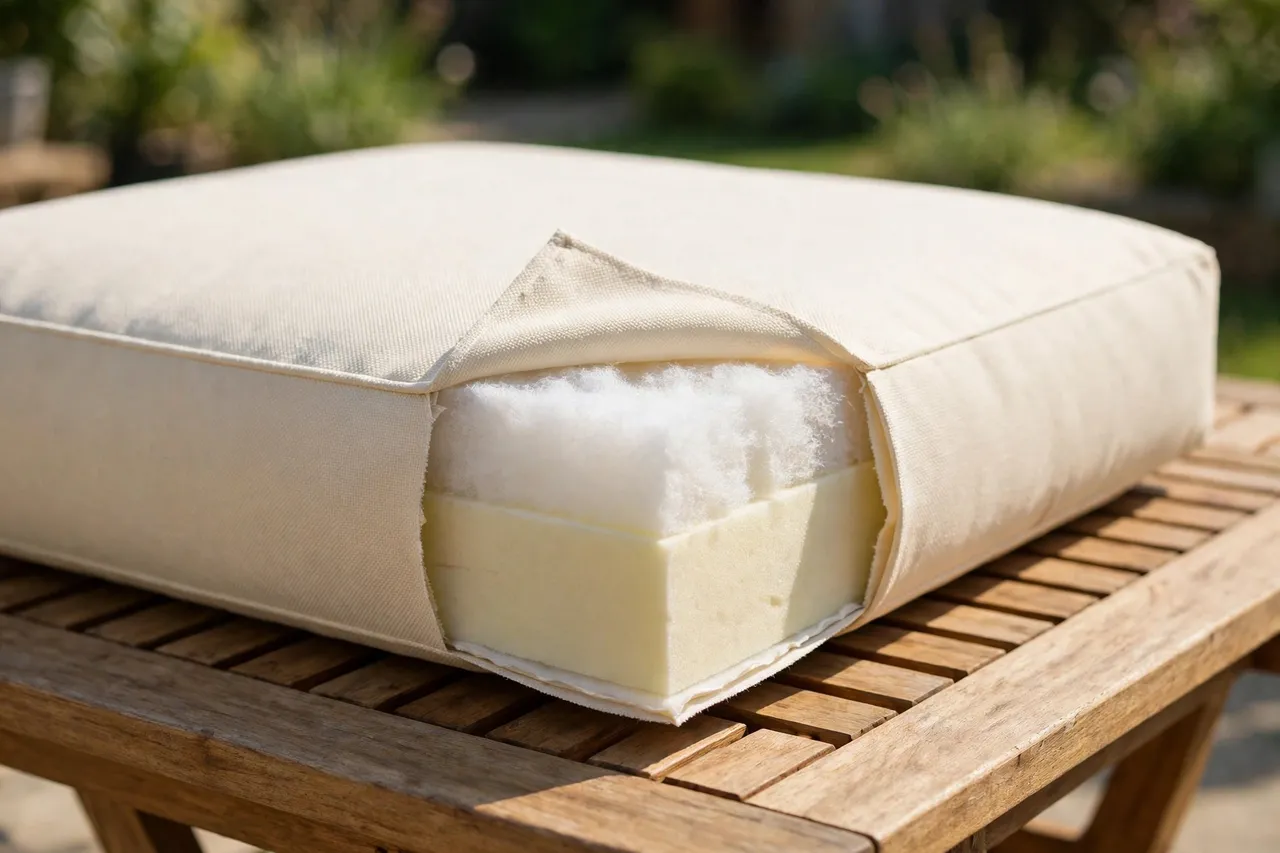
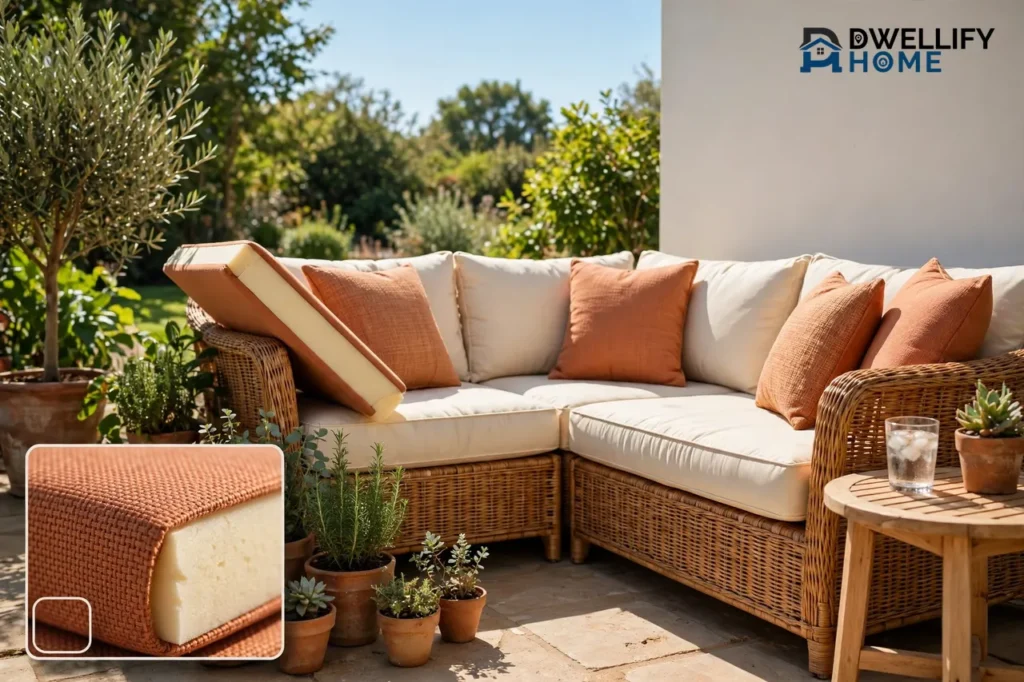
High-density polyurethane foam is the workhorse. For seat cushions, look for foam density of 1.8 to 2.5 pounds per cubic foot, and for back cushions, 1.5 pounds per cubic foot is enough. Denser foam holds its shape longer, supports your weight without bottoming out, and resists the permanent dent that cheap foam develops. Quick-dry foam, an open-cell foam that lets water drain through instead of soaking it up, is the best pick for cushions that sit out in the rain, because it dries fast and starves mildew of the damp it needs.
Polyester fiberfill feels soft and plush at first, and it costs less than foam. The trade-off is that it flattens faster under daily sitting, and once it compacts, no amount of fluffing brings it back. Fiber works well as a wrap around a foam core, where it adds softness without carrying the load, and it suits back cushions and throw pillows better than seats.
Pick your thickness by furniture type. Dining chair seats feel right at 2 to 3 inches thick, firm enough for upright sitting. Benches and porch swings suit 3 to 4 inches. Deep-seat lounge chairs, sectionals, and chaise lounges need 4 to 6 inches for real comfort, and back cushions usually run 3 to 5 inches. Thicker is not always better: a cushion over 6 inches can make a chair feel unstable and push you too high above the armrests.
Test the foam before you commit when you can. Press it firmly and watch it spring back within a few seconds. If it stays dented, walk away. And ask whether the fill is CertiPUR-US certified, which means the foam was made without certain harmful chemicals, a useful check for cushions your family sits on all summer.
Cushion Fabric That Survives Sun and Rain
Fabric is where cheap cushions fail first. Sun fades color, rain feeds mildew, and spills stain, so the fabric has to fight all three at once. The best outdoor fabrics do this by building the color into the fiber itself, not printing it on the surface.
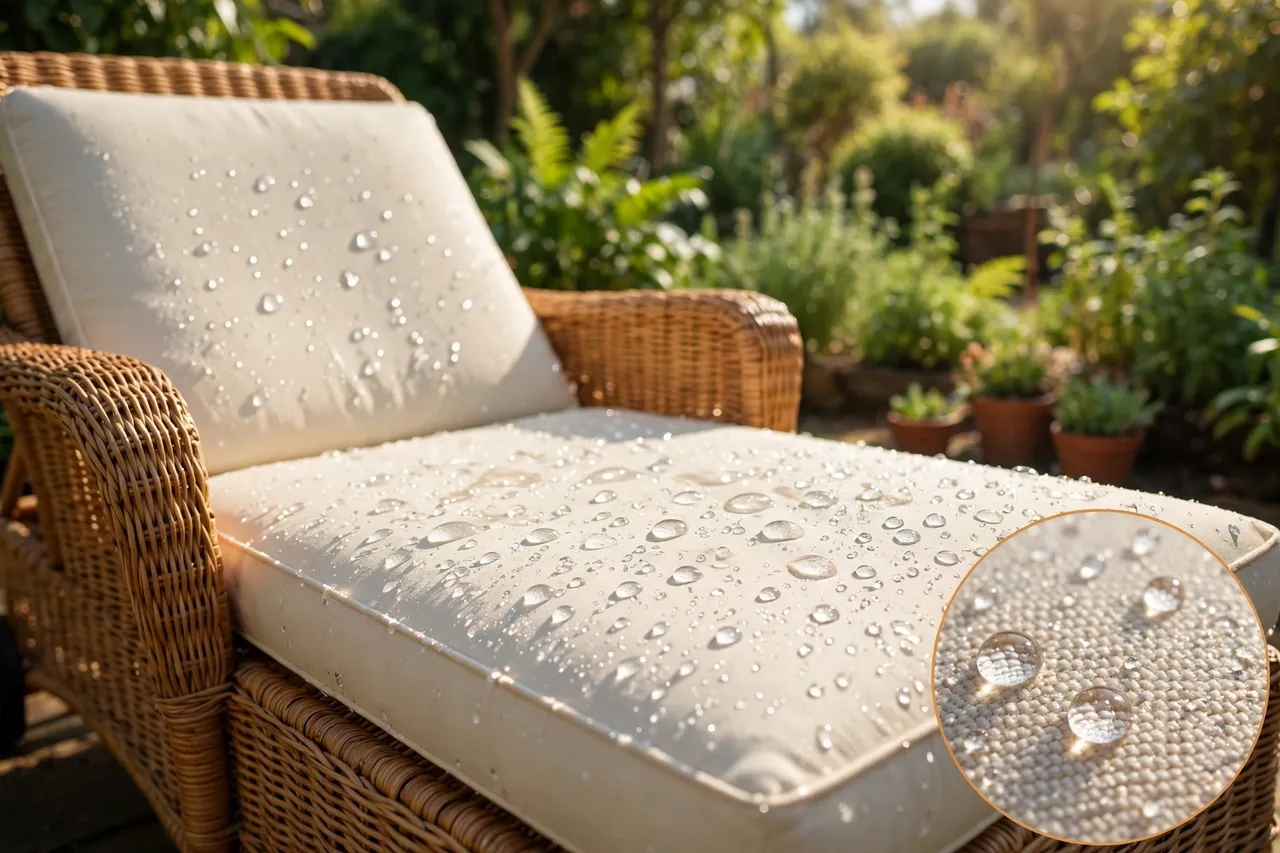
Solution-dyed acrylic, sold most famously as Sunbrella, leads the field. The color pigment is mixed into the liquid polymer before the fiber is made, so the color runs through the whole thread and resists fading far longer than surface-dyed fabric. Sunbrella fabrics are rated for over 1,000 hours of accelerated UV exposure without significant color change, and the fabric is naturally water-repellent and mildew-resistant. Read more on LOOMLAN’s Sunbrella outdoor cushion guide, which compares Sunbrella with standard outdoor fabrics on UV, water, and mildew resistance.
Solution-dyed olefin, also called polypropylene, is the strong budget rival. It resists fading and mildew nearly as well as acrylic, dries fast, and costs less. It feels a little stiffer and less soft than acrylic, so it suits seat cushions and high-use spots better than back cushions you lean on bare-armed.
Polyester is the cheapest common outdoor fabric, and it shows. Standard polyester blends fade within a season or two in full sun, hold damp longer, and grow mildew more easily in humid climates. Coated or solution-dyed polyester performs much better, so check the label: if it only says “weather-resistant” with no test or certification behind it, treat that as marketing, not proof. Look for explicit labels like solution-dyed acrylic, UV-rated, or ASTM D4355 UV resistance rated at 1,500 hours or more.
Removable, washable covers are worth paying for. A zip-off cover you can machine-wash on cold and air-dry doubles a cushion’s useful life, because dirt and pollen left on fabric are what mildew actually grows on. Check the ties and zippers too: sturdy zippers, ties, or Velcro straps keep cushions from sliding off the frame in wind.
Where to Buy Replacement Cushions for Patio Furniture
Buy ready-made cushions where you can see the size chart, the fabric label, and the return window before you pay. Target, Walmart, The Home Depot, Lowe’s, and Wayfair all stock standard deep-seat and dining sets, and Amazon carries the widest range of third-party sets. Big-box sets are the fastest route when your frame is a standard size and you want cushions this weekend.
Buy brand-matched cushions from the furniture maker or its authorized dealer when you want the original fabric and exact fit, for brands like Lloyd Flanders, Brown Jordan, and Summer Classics. Expect the highest prices and the longest waits here, and confirm the model number from the tag under the seat before you order, because one collection often has several cushion shapes.
Buy custom cushions from a made-to-order maker when your frame is unusual or your set is worth the investment. Makers like Fabrica Kraft, FoamOrder, ZIPCushions, and PatioHQ cut to your measurements, offer Sunbrella and other performance fabrics in hundreds of colors, and usually ship in 2 to 4 weeks. Send a photo of the frame with your measurements if the maker allows it, and double-check the return and remake policy before you pay, since custom sizes are rarely returnable for a refund.
Shop early in spring for the best selection. Retailers stock the widest cushion range from March through May, and popular sizes and colors sell out by June. If you shop in late summer, expect clearance prices on what is left, but do not count on finding your exact size.
How Much Do Replacement Cushions Cost?
Replacement cushion prices swing widely by size, fabric, and whether the cushion is ready-made or custom, so think in ranges and check the current listing before you buy. The prices below were checked on November 13, 2026, at the retailers named, and they cover the cushion set only, not the frame.
Replacement cushion prices, checked November 13, 2026
| Cushion type | Example price | Where checked |
|---|---|---|
| Deep-seat set, seat plus back | $49.99 | Target, Arden Outdoor Deep Seat Cushion Set, 22 by 24 in |
| Deep-seat set, seat plus back | $55.00 | Target, Room Essentials Reversible Piping Deep Seat Cushions |
| Set of 4 seat cushions | From $56.69 | Bed Bath and Beyond, Solid Outdoor Patio Seat Cushion Set of 4 |
| Custom cushion, per cushion | $100 to $300 (estimate) | Reported range in cushion buying guides |
| Brand-matched cushion, per cushion | $300 to $1,100+ (estimate) | Reported range in cushion buying guides |
See the Target listing for the Arden set at Target’s Arden Outdoor Deep Seat Cushion Set, listed at $49.99 on November 13, 2026. That price is a useful anchor: a mid-tier ready-made set with weather-proof, fade-resistant polyester fabric. Premium Sunbrella-covered sets run about $80 to $135 per set at the same retailers, and a full sectional refresh with six or more cushions can run $300 to $600 ready-made, or $600 to $1,800 custom.
Three things push the price up: Sunbrella or another solution-dyed acrylic fabric, custom sizing and shapes, and thick quick-dry foam. Three things keep it down: standard sizes, polyester fabric, and buying a full set instead of single cushions. Always add the cost of covers-only replacement to your math too: if the foam is still good, new covers alone can refresh a set for a fraction of full replacement.
How to Clean and Care for Outdoor Cushions
Clean cushions last years longer than neglected ones, and the routine is simple. Brush off loose dirt and pollen first, before it works into the weave, then wash with mild soap and water, rinse well, and air-dry fully before you sit on them or store them. Never store a damp cushion: mildew starts within about 12 hours on a stacked, wet cushion.
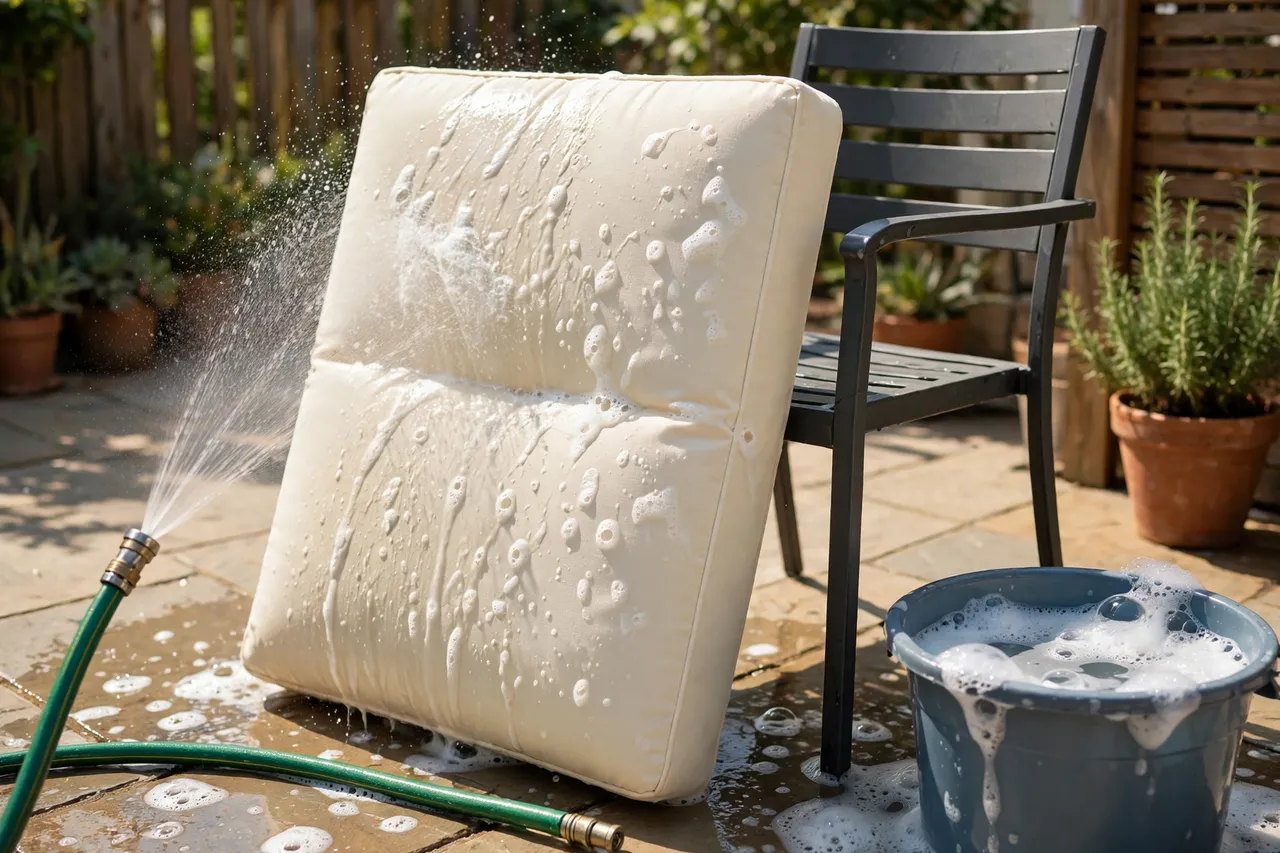
Sunbrella gives the clearest cleaning guide in the business, and it works as a default for solution-dyed acrylic. For everyday dirt, soak or sponge the fabric in a mix of a quarter cup of mild soap per gallon of lukewarm water, scrub gently with a soft brush, rinse until the water runs clear, and air-dry. For mold or mildew, Sunbrella recommends 1 cup of bleach plus a quarter cup of mild soap per gallon of water, soaked for 15 minutes, then scrubbed and rinsed thoroughly. Sunbrella’s own support page answers the most common care questions, including machine washing and mold removal, at Sunbrella’s consumer support page.
Check your care tag before you use bleach on any other fabric. Chlorine bleach is safe on Sunbrella’s solution-dyed acrylic, but it fades and weakens most polyester and printed fabrics. For non-Sunbrella cushions, use oxygen bleach instead, and never mix bleach with vinegar or ammonia. Machine-wash removable covers only if the maker says the cover comes off: close the zippers, wash cold on delicate with mild detergent, and air-dry. Never put cushion covers in a hot dryer, because heat shrinks the fabric and damages its water-repellent finish.
Store cushions indoors or in a deck box over winter and through long rainy spells. A patio with a roof or a covered patio keeps cushions drier, but even there, bring them in before snow. Stand stored cushions on edge with air gaps between them, not stacked flat, so air moves around each one. If you leave cushions out all summer, give them a quick rinse once a month: five minutes of rinsing stops the dirt film that mildew grows on.
7 Mistakes to Avoid When Buying Replacement Cushions
Most cushion regrets come from a short list of avoidable mistakes. Check your plan against this list before you order anything.
- Measuring the old cushion instead of the bare frame. Compressed foam gives you numbers that are too small.
- Buying by color before fit. A beautiful cushion that slides off the chair is money wasted.
- Picking thin foam for a deep-seat chair. Two inches of foam on a lounge chair bottoms out on the frame.
- Choosing cheap polyester for a full-sun patio. It fades in one season and grows mildew in humid air.
- Skipping the attachment check. Cushions without ties or Velcro blow off and slide around.
- Forgetting the back cushion thickness. A thick back eats seat depth and leaves you perched on the edge.
- Storing damp cushions stacked flat. Mildew starts within about 12 hours, and the smell rarely leaves.
The cheapest cushion is the one you buy once. A mid-tier set with solution-dyed fabric and dense foam costs about twice an entry set and lasts three times as long in full sun.
Related Guides
If you are refreshing the whole patio, these guides pick up where this one leaves off:
- Patio Ideas — layouts, styles, and features for every size of patio.
- Small Patio Designs — seven layouts that make a tiny patio feel bigger.
- Covered Patio Ideas — roofed patios where cushions and furniture stay dry.
- Indoor Outdoor Rugs — sizes, materials, and care for rugs under your refreshed seating.
- Paver Patio Renovation Cost — what a paver project really costs, line by line.
- Outdoor Furniture for Small Spaces — small-space sets whose cushions wear out first.
- Outdoor Bench With Storage — bench seating with built-in room to stash cushions.
- Patio Shade Ideas — shade that slows the fading that forces cushion replacement.
- Small Patio Decorating Ideas — fresh cushions are the fastest refresh for a small patio.
Frequently Asked Questions
How do I measure for outdoor furniture replacement cushions?
Measure the bare furniture frame, not your old cushions, because old foam compresses and gives wrong numbers. Record the seat width inside the arms, the seat depth from front to back, the backrest height, and the thickness gap under the arms. Order cushions a quarter to a half inch smaller than the frame opening for a tailored fit.
How thick should outdoor cushions be?
Dining chair seats feel right at 2 to 3 inches thick, benches and porch swings at 3 to 4 inches, and deep-seat lounge chairs, sectionals, and chaise lounges at 4 to 6 inches. Back cushions usually run 3 to 5 inches. Thicker is not always better: over 6 inches can make a chair feel unstable and push you too high above the arms.
How long do outdoor patio cushions last?
Quality outdoor cushions with solution-dyed acrylic fabric and quick-dry foam typically last 5 to 7 years with regular care, and premium Sunbrella cushions can reach 8 to 10 years. Budget polyester cushions may only last 1 to 2 seasons in full sun. Storage indoors over winter and monthly rinsing stretch any cushion’s life.
Can I leave outdoor cushions outside all year?
You can, but it shortens their life. Sun, snow, and standing damp break down fabric and foam faster than seasonal use. In areas with snow, ice, or heavy rain, store cushions indoors or in a deck box over winter. In mild climates, a covered patio and a monthly rinse keep year-round cushions in good shape.
How do you clean outdoor replacement cushions?
Brush off loose dirt, then wash with a quarter cup of mild soap per gallon of lukewarm water, scrub gently with a soft brush, rinse until the water runs clear, and air-dry fully. For mold on Sunbrella fabric, use 1 cup of bleach plus a quarter cup of mild soap per gallon of water, soak 15 minutes, and rinse. Never machine-dry cushion covers.
Do outdoor cushions fade in the sun?
All outdoor fabric fades a little over years of sun, but solution-dyed acrylic like Sunbrella resists fading far longer than standard fabric because the color runs through the whole fiber. Sunbrella fabrics are rated for over 1,000 hours of accelerated UV exposure without significant color change. Cheap polyester blends can show visible fading within one season.
New cushions are the smallest spend with the biggest payoff on a patio. Measure the frame, pick a fabric built for sun and rain, and buy the foam density your furniture actually needs. Start with one cushion if you are unsure of the fit, sit on it for a week, and then order the rest of the set with confidence.