Father Christmas outdoor decorations work best when one Santa figure leads the whole yard. Pick a Santa that fits your space, place him where the street can see him, anchor him against wind, and power him safely, and you get a warm, welcoming display instead of a lawn full of clutter. This guide covers Santa-figure displays only, from blow-up Santas and solid statues to sleigh scenes, so you can choose with confidence and keep your Santa standing through wind, rain, and busy December nights.
In short, start with the figure, not the extras. A single strong Santa, lit well and tied down well, reads as Christmas from the sidewalk. Ten small pieces with no clear star read as noise, however much money they cost.
Pick Your Santa: Inflatables, Statues, and Sleigh Scenes
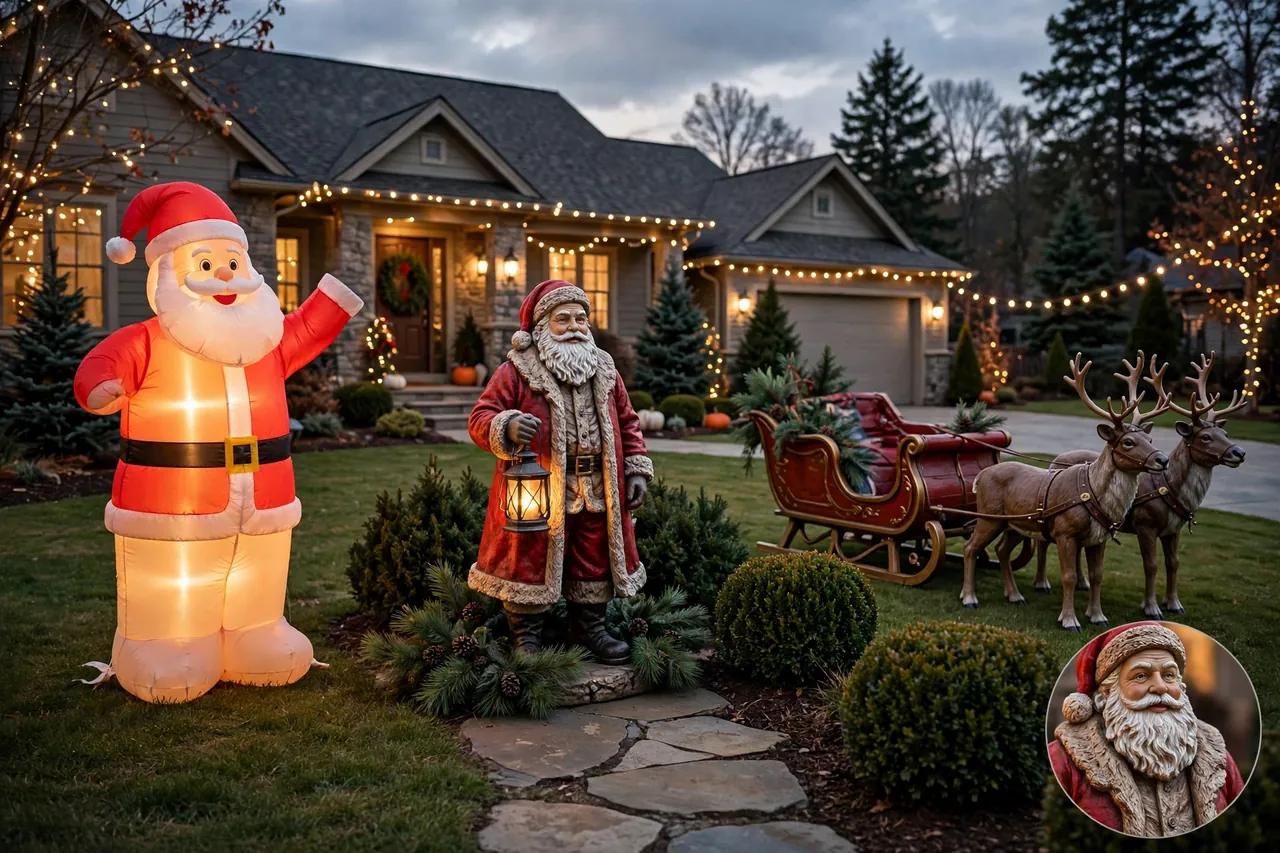
Every Santa lawn decoration, whether you search for santa claus outdoor decorations or outdoor santa claus decorations, falls into one of three families, and each one suits a different yard, budget of effort, and level of wind. Inflatables give you size for little storage space. Statues give you weight, detail, and a display that needs no power to hold its shape. Sleigh scenes give you a story, with Santa, his sleigh, and often reindeer arranged as one picture. Choose the family first, and the shopping gets much easier.
Inflatable Santas: Big Impact, Small Storage
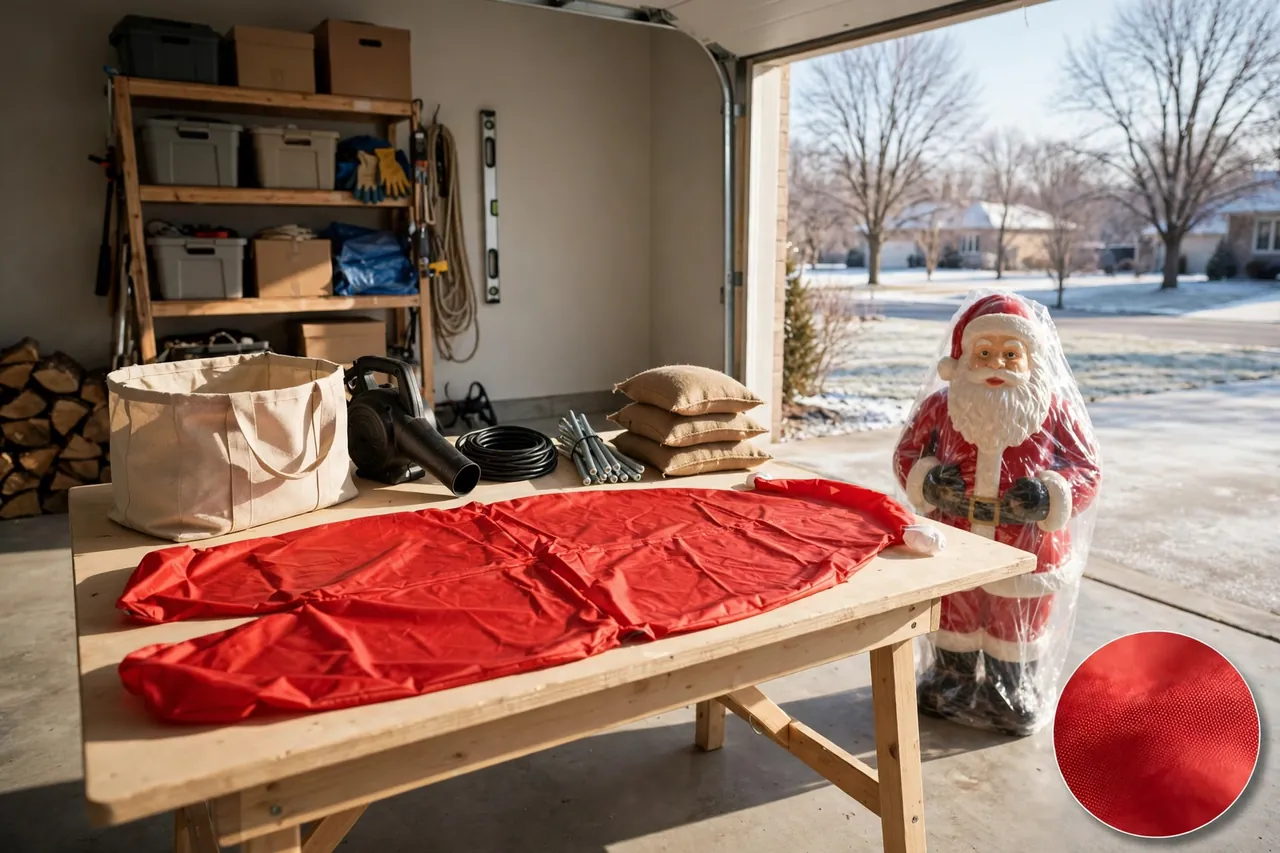
An inflatable Santa stays full because a small built-in blower keeps pushing air into the fabric. Plug it in, and most models rise in under a minute. Unplug it, and the figure sinks flat within minutes, which is normal, not a defect. That is why inflatables suit beginners so well: you get an eight-foot Santa that folds into a bag in January.
Look for an outdoor-rated model with built-in lights, sturdy tether loops, and a blower that does not sound strained on a calm night. A waving Santa, a Santa climbing a ladder, or a Santa popping out of a chimney all read well from the street, because movement catches the eye. Keep the design simple, though. A Santa with one clear pose beats a crowded inflatable that tries to tell three stories at once.
Inflatables do have one honest weakness: wind. A tall, hollow figure acts like a sail, so anchoring matters more here than with any other Santa type. If your yard is open and windy, plan for stronger stakes and sandbags from day one, and accept that you will deflate the figure on the worst nights. That trade is worth it for most homes, because no other Santa gives you this much presence for this little storage space.
Statues and Solid Figures: Heavy, Detailed, and Always Ready
A solid santa claus outdoor decoration, made from resin or fiberglass, stands on its own weight and needs no blower, no nightly inflation, and no worry about a power cut flattening the display. He looks best up close, where guests can see the folds of the coat, the sack of gifts, and the detail in the face. A life-size seated Santa beside the door, a standing Santa greeting guests at the walkway, or a Santa holding a lantern all work beautifully as the single star of a porch or garden bed.
Solid figures cost more effort to store, because they do not fold flat, and they need a dry, protected spot in January. They also need a level base. A statue that leans on soft, wet soil will slowly tilt, so set it on a flat paver, a firm garden bed, or a level patch of lawn, and check it after the first rain. In return, you get a display that never sags, never needs a fan, and looks just as good on a still night as on a windy one.
For a small yard, a solid Santa is often the smarter pick. One four- to six-foot figure near the walkway gives guests a close-up moment, while a giant inflatable can crowd a small lawn and block the path. Match the figure to the space, not to the biggest box in the store.
Sleigh Scenes: Santa With a Story
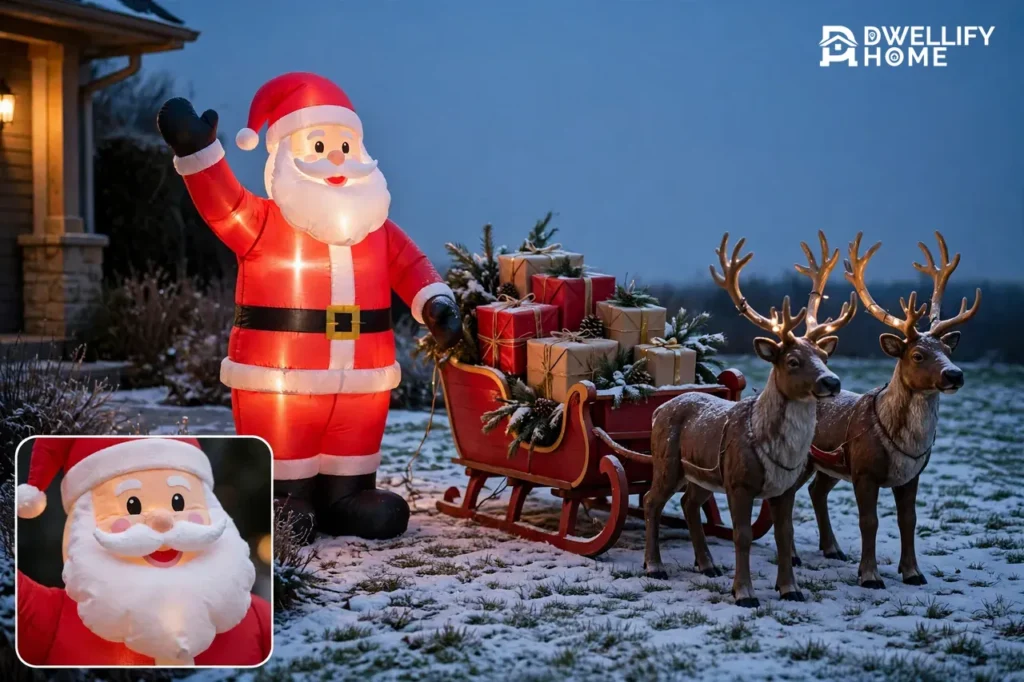
A sleigh scene turns one figure into a small story. Santa sits in his sleigh, gifts piled beside him, with reindeer in front, and suddenly your lawn has a beginning, a middle, and an end. Visitors do not just see Santa. They see Santa on his way, and that story is what makes people slow down, smile, and take a photo.
Sleigh scenes need more room than a single figure, so measure before you buy. A compact sleigh with two reindeer fits a medium lawn, while a full team needs a wide, open stretch. Keep the whole scene together as one group, with Santa as the tallest and brightest point, and leave clear grass around it. A scene squeezed against a fence loses its magic, because the reindeer have nowhere to run.
Mix materials with care. An inflatable Santa in a solid sleigh, or a solid Santa beside light-up reindeer, can work, but keep one style in charge. If Santa is classic red and white, let the sleigh and reindeer share those colors and that mood. A scene with three different styles feels like three separate purchases, not one Christmas story.
Choose the Right Santa for Your Yard
Use this comparison before you shop, because the right Santa for a wide, windy lawn is not the right Santa for a small, sheltered porch. Read across the row that matches your yard, and let it narrow your choice to one family.
Table: Santa figure types compared
| Santa type | Best for | Watch out for |
|---|---|---|
| Inflatable Santa | Big presence, easy storage, low cost of effort | Wind, power needs, nightly blower running |
| Solid statue Santa | Close-up detail, no power to hold shape, windy yards | Heavy storage, needs level ground |
| Sleigh scene | A story display, photo moments, wide lawns | Needs the most space and planning |
| Climbing or chimney Santa | Humor, a talking point, a plain wall or roofline | Needs safe, secure fixing, never a loose ladder job |
Size deserves a second thought. A Santa that looks perfect in a store aisle can look lost on a wide lawn or huge on a small porch. As a rule, a front lawn seen from the street suits a six- to nine-foot inflatable or a life-size statue, while a porch or small garden suits a three- to five-foot figure that guests meet up close. When in doubt, go one size smaller. A Santa with breathing room around him looks grander than a giant squeezed into a corner.
Where to Place Your Santa So the Street Can See Him
Placement decides whether your Santa outdoor decor shines or hides. The best spot is rarely the middle of the lawn. It is the spot where three things meet: a clear view from the street, shelter from the worst wind, and power within safe reach. Walk your yard at dusk before you place anything, and look for that meeting point.
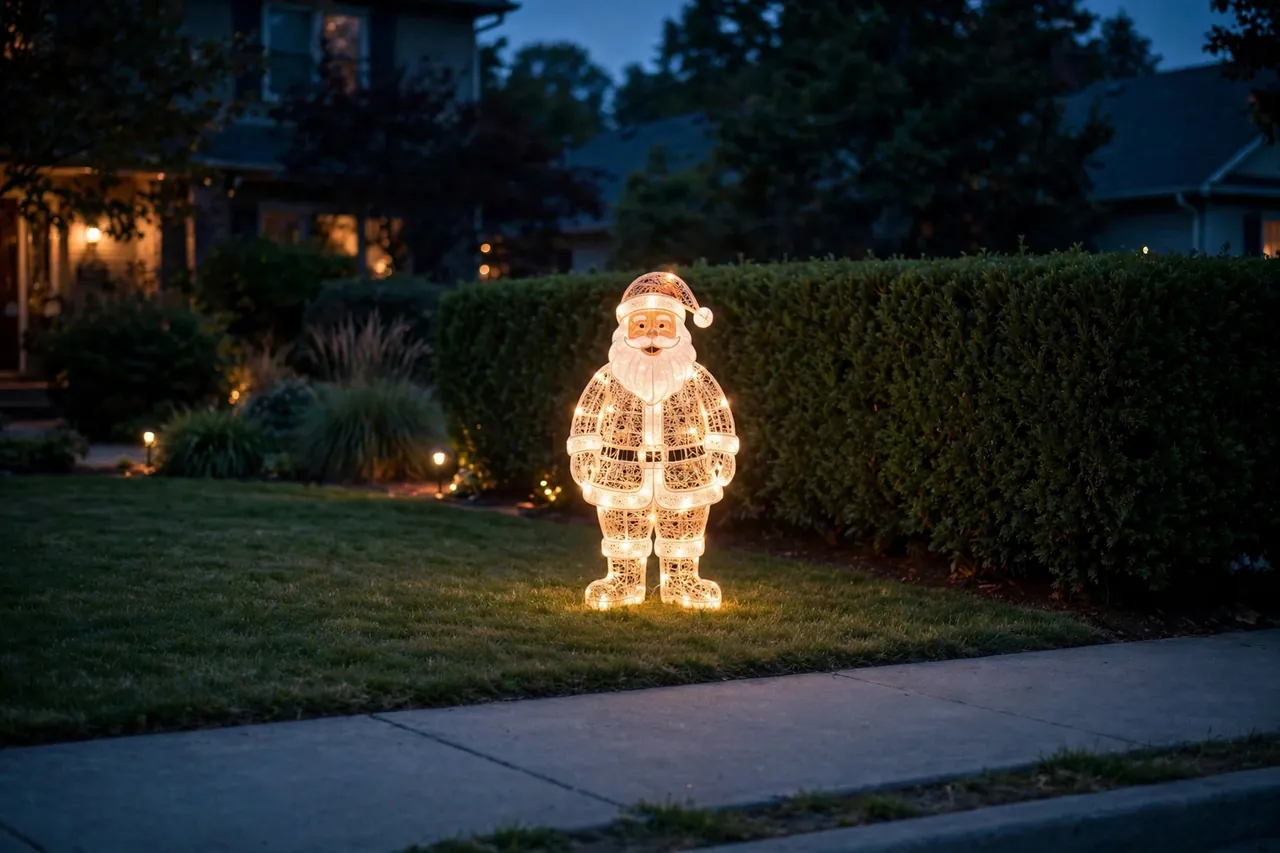
Start with the sightline. Stand on the sidewalk and find the first thing your eye lands on. That is your natural stage. If it is a bare stretch of lawn near the walkway, your Santa belongs there. If it is a dark corner by the garage, move the Santa, or add light to that corner, because a Santa no one can see is just a Santa in storage with extra steps.
Next, use shelter. A fence, a hedge, a garden wall, or the side of the house can cut wind sharply, and a Santa placed just inside that shelter will stand far steadier than one alone in the middle of an open lawn. Keep at least a few feet between the figure and the shelter, though, so air can move around it and you can walk behind it to check anchors and cords. A Santa pressed flat against a fence looks trapped, and you cannot reach his tethers when they loosen.
Keep walkways clear. Santa decorations for outside should welcome guests, not trip them. Leave the full width of paths, steps, and driveways open, and keep guy lines, cords, and sleigh runners out of every walking surface. A display that forces guests to step around a rope is a display that needs moving, however pretty it looks from the car.
Finally, test at night. Santa outdoor Christmas decorations live after dark, and a spot that looks perfect at noon can vanish at night if a tree shadows it or a porch light glares behind it. Switch the lights on, walk to the street, and look again. If Santa glows clearly against a darker background, you found his spot.
How to Anchor a Santa Display Against Wind
Wind is the quiet enemy of every outdoor santa decoration, and anchoring is the skill that separates a display that lasts all season from one that ends up in a neighbor’s hedge. The rule is simple: use every anchor point the maker gave you, then add weight and tethers until the figure stops swaying. Do this on a calm day, not during the first storm, because calm setup days are when good anchoring is easy.
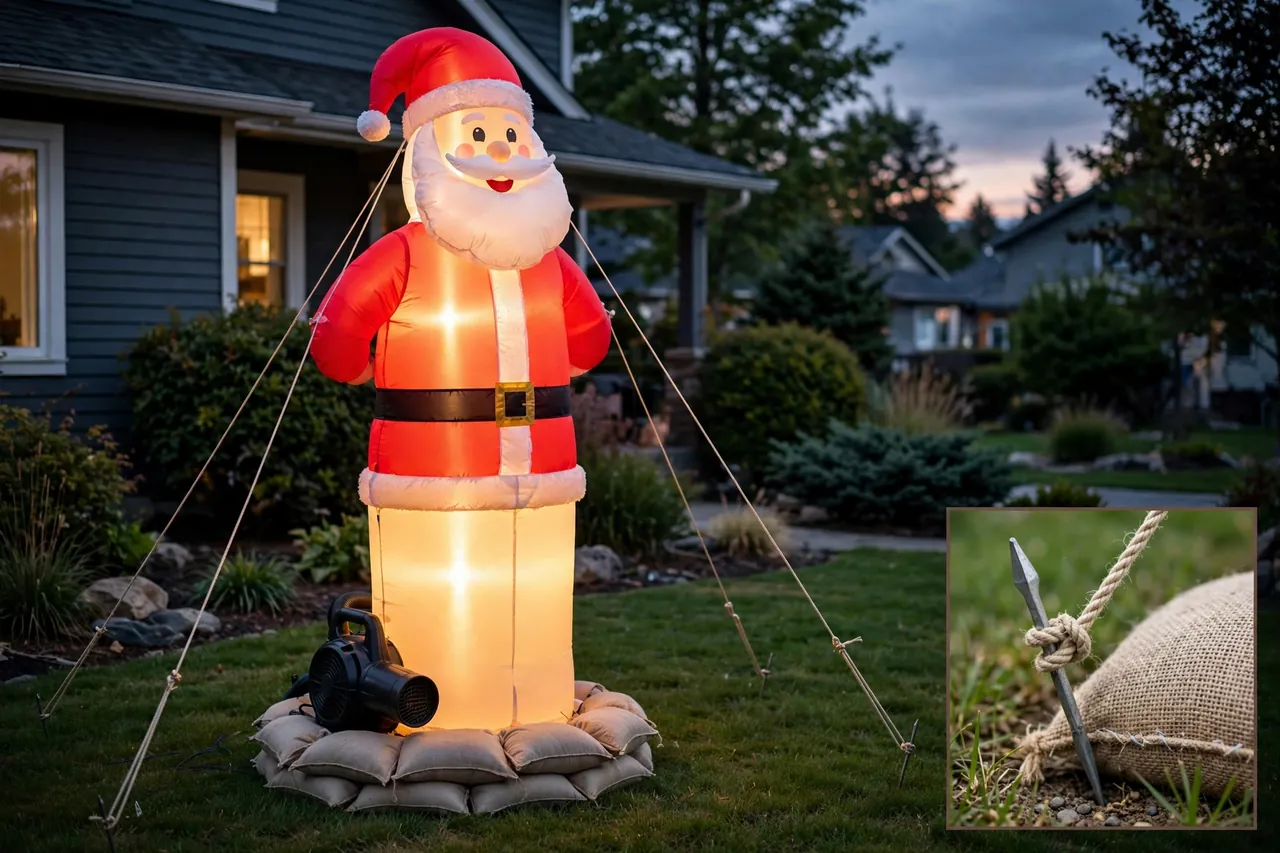
Start with stakes. The small plastic stakes in the box often fail on tall figures or in soft soil, so upgrade to metal tent stakes at least eight to ten inches long for a standard inflatable, and longer for a tall one. Drive each stake at about a 45-degree angle, pointing away from the figure, and use every loop around the base. One stake holds a little. Every stake together shares the load, the way guy ropes share the load on a tent.
Next, add tethers. Tall Santas need upper tie-downs, not just base stakes. For figures under nine feet, use at least three upper tethers. For figures over ten feet, use four or more. Attach each rope to a loop on the figure, run it outward and downward to its own stake, and keep the line taut without pulling the fabric out of shape. A good guide from inflatable manuals is to place each stake about as far from the figure as the loop is high, which gives a roughly 45-degree rope angle. Two side tethers should also angle forward by at least 30 degrees, so the figure cannot twist sideways in a gust.
Then add weight. Sandbags, gravel bags, or sealed water jugs at the base give a figure ballast that stakes alone cannot match, and they are the best answer on hard ground, frozen soil, or a patio where stakes will not grip. Place weights inside the base where the design allows, or tight around the outside base where it does not, and never block the blower intake. A blocked intake starves the fan, and a starved fan lets the figure sag, which only makes wind damage worse.
For solid statues and sleigh scenes, anchoring looks different but matters just as much. Set heavy figures on level ground, weigh light hollow figures with sandbags hidden inside or behind the base, and tie sleigh runners to ground anchors on windy lots. A statue that rocks when you push it gently will rock much harder in a December gust, so fix the wobble now.
Know your limit. Even the best anchoring has a limit, and good guides agree that sustained winds around 20 to 25 miles per hour call for deflating an inflatable until the weather passes. Check the forecast each evening, check ropes and stakes after every storm, and retighten anything that has loosened. Wet soil loosens stakes fast, and a five-minute check after a storm saves a long chase down the street. For a fuller anchoring method, see this guide to keeping Christmas inflatables from blowing away.
Power Your Santa Safely Outdoors
Power is where a joyful display can turn risky, so treat it as part of the design, not an afterthought. Every lighted Santa, every blower, and every spotlight belongs on an outdoor-rated circuit, with connections kept dry, cords kept out of walkways, and a timer doing the late-night switch-off for you.
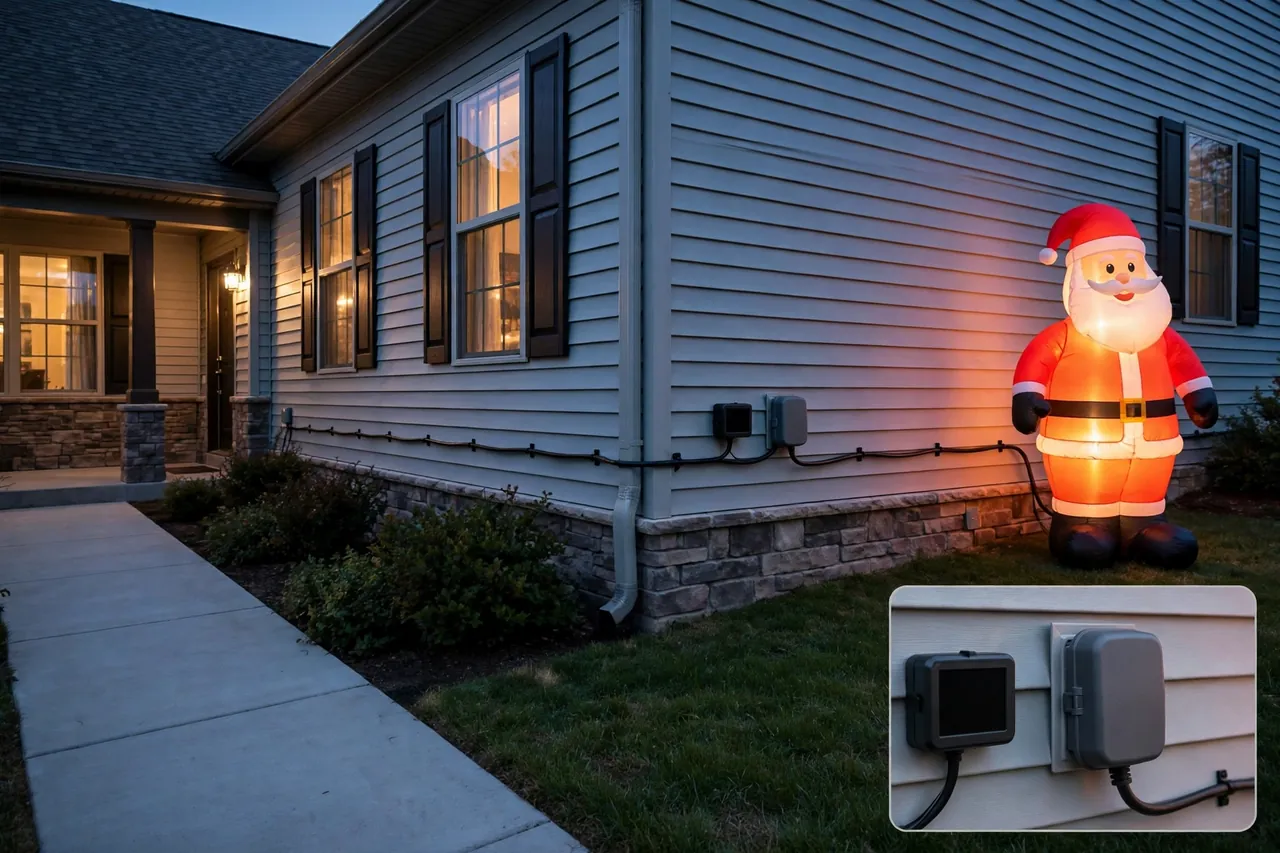
First, plug into a ground-fault protected outlet, known as a GFCI outlet, which shuts off power fast if water gets into the circuit. If your outdoor outlet is not GFCI protected, ask a qualified electrician to fit proper protection before the season starts. This is the single most important electrical step for any Santa outdoor decoration, and it is not a place to improvise.
Second, use only cords rated for outdoor use. Indoor cords lack the jacket that resists rain, snow, cold, and sun, and covering an indoor cord with a tarp does not make it safe. Choose an outdoor-rated, grounded cord of the right length, so you never need to join two cords to reach the Santa, and never run a cord across a walkway or driveway where feet, wheels, or a snow shovel can damage it. Route cords along walls or under a proper cord cover, and keep every plug connection raised off the ground and inside a weatherproof cover, clear of puddles and snowbanks.
Third, respect the load. A blower plus built-in lights plus spotlights can add up, so read the labels, do not overload one outlet, and do not daisy-chain power strips outdoors. If a breaker trips, that is a warning, not an annoyance. Split the load across outlets, or ask an electrician, rather than forcing the same circuit to carry more.
Fourth, use a timer. Set Santa to switch on at dusk and off when the house goes quiet, and you save energy, rest the blower, and never have to remember the switch in the cold. As a safer habit, switch the display off when you go to bed or leave the house, unless your model’s manual clearly allows overnight running. A timer makes that habit automatic.
Finally, inspect before you plug in. Check every cord for cracks, frayed wires, and damaged plugs, and throw away any cord or strand that looks worn. Keep cords away from heat sources, never staple or nail through a cord, and keep the blower intake clear of fabric, leaves, and snow. For the wider holiday safety picture, see the U.S. Consumer Product Safety Commission’s holiday decorating safety guidance.
Make Your Santa Look Good After Dark
Santa claus outdoor christmas decorations earn their keep after dark, when lights turn a daytime figure into a glowing welcome. The trick is to light Santa himself, not just the yard around him. A bright lawn with a dark Santa reads as a mistake, while a well-lit Santa on a calm lawn reads as a postcard.
Start with the lights Santa already carries. Most inflatable Santas have built-in LEDs, and most solid figures pair well with one warm white spotlight aimed up from the ground, set back far enough that it washes the whole figure instead of glaring on one boot. Test the angle at night, and move the light until Santa’s face, coat, and sack all read clearly from the street. A light placed too close creates harsh shadows, and a light placed too far leaves him dim.
Then add one supporting layer, not five. A string of warm white lights along the nearby hedge, a pair of low lanterns flanking the walkway, or a soft wash on the house wall behind Santa gives depth without stealing focus. Keep one bulb color across the Santa scene, usually warm white, so the whole group feels planned. Mixed colors around Santa make him look like an afterthought in someone else’s display.
Keep lights out of eyes and off the road. Aim spotlights at Santa, not at drivers, and keep flashing or chasing modes gentle. A calm, steady glow feels warm and timeless, while frantic flashing feels noisy and tires the eye fast. If your Santa has an animated wave or a moving arm, let that motion be the excitement, and keep the lights steady behind it.
Keep Your Santa Looking New Season After Season
A Santa that lasts five seasons is not luck. It is drying, cleaning, and careful storage, repeated every January. Inflatables, statues, and sleigh scenes all age differently, but they share one rule: never store a wet, dirty figure in a sealed bag or box and expect it to forgive you.
For inflatables, deflate on a dry day, wipe the fabric with a soft, damp cloth, and let it dry fully in fresh air before folding. Check seams, loops, and tether points while it is flat, and patch small tears now, when a repair kit and a calm afternoon are at hand. Fold loosely, keep the blower and stakes in the same bag, and store the bag indoors, away from sun, damp, and sharp edges. Never leave an inflatable Santa outside all year, because sun, rain, snow, and temperature swings break down fabric and damage the fan within months.
For solid figures, wash with mild soap and water, dry fully, and touch up small paint chips before storage, so damp cannot creep under the paint over winter. Wrap delicate parts, such as a lantern, a sack strap, or a reindeer antler, so they cannot rub or snap in the box. Store statues upright where possible, off a damp floor, and cover them against dust.
For sleigh scenes, store the pieces together, labeled, with a photo of the finished scene taped to the box. Next December, that photo turns a puzzle back into a ten-minute setup, and it stops the classic mistake of finding the sleigh in one box, Santa in another, and the reindeer nowhere at all. Coil cords loosely, never wound tight, and keep all stakes, ropes, and sandbags with the figure they belong to.
Quick Reference: Santa Display at a Glance
Use this module as your one-page checklist when you plan, shop, or set up. Each row states one decision, the best choice for most homes, and the condition that changes it.
Table: Santa display quick reference
| Decision | Best choice for most homes | Change it when |
|---|---|---|
| Santa type | One clear star figure, inflatable or solid | Choose a sleigh scene for a wide lawn and a story display |
| Size | Six to nine feet on a street-facing lawn | Drop to three to five feet on a porch or small garden |
| Placement | Clear street view, near shelter, near power | Move it if walkways, sightlines, or cords suffer |
| Anchoring | Every stake, every tether, plus sandbags | Add anchors on open, windy, or frozen ground |
| Power | GFCI outlet, outdoor cord, weatherproof cover, timer | Ask an electrician if no GFCI outlet exists |
| Bad weather | Deflate inflatables in high wind or heavy storms | Bring soft pieces inside during a severe warning |
Santa Display Troubleshooting
Most Santa problems have small, fast fixes. Work through this list in order, and check the simplest cause first.
- Santa leans or sways. Retighten every tether, add a sandbag to the leaning side, and move a stake farther out for a wider base. If the ground is soft, add a second stake at each loose point.
- Santa sags halfway. Check that the bottom zipper is fully closed, the blower intake is clear of fabric and leaves, and no seam has split. Clear the intake first, because a starved fan is the most common cause.
- Santa will not rise at all. Check power, the GFCI outlet, and the timer, then check for a tripped breaker. If power is fine, look for a torn seam or an open zipper letting air escape faster than the blower can replace it.
- Lights glow but the blower sounds strained. Switch off, clear snow, leaves, and fabric from the intake, and check the cord for damage. Do not run a strained blower all night in the hope that it recovers.
- Stakes pull out of the ground. Drive longer metal stakes at a 45-degree angle away from the figure, add sandbags, and move the display nearer shelter. On frozen ground, skip stakes and rely on weights.
- Cords cross the walkway. Reroute along a wall or under a cord cover, or move Santa closer to the outlet. Never leave a loose cord across a path, even for one night.
- Santa looks dim or patchy at night. Move the spotlight back, aim it at his face and coat, and remove any tree branch or porch glare that shadows him. Test from the street, not from the porch.
Safety First, Then the Fun
Santa displays mix electricity, wind, ladders, and dark winter nights, so safety comes before style. Use only outdoor-rated figures, cords, and lights, plug into a GFCI-protected outlet, and keep plug connections dry and off wet ground. Stake and tether every figure against wind, and deflate inflatables during high winds, heavy rain, or heavy snow. Keep cords and guy lines out of walkways so nobody trips, and never climb a ladder alone to fix a high Santa in wind or darkness. If a cord looks damaged, a blower sounds wrong, or a figure keeps pulling free, switch it off and fix it before the next display, because a dark lawn for one night beats a damaged figure or an injured guest.
Disclaimer: This guide gives general home decorating advice, not electrical or structural advice for your specific home. Follow your figure’s manual, your local codes, and a qualified electrician’s advice where they differ from this guide, and keep children and pets clear of blowers, cords, and guy lines while the display runs.
Related Guides
For the wider outdoor plan around your Santa, see Christmas Decor Exterior Ideas for a Glowing Yard, which plans the whole outside in three light layers. For a Santa placed near the door, see Christmas Decor on Porch, which layers wreath, greenery, light, and planters into one warm welcome.
Frequently Asked Questions
How to make inflatable Santa stay up?
Use every stake and tether in the box, drive metal stakes deep at a 45-degree angle away from the figure, and add sandbags on windy lots or hard ground. Keep the blower intake clear, keep tethers taut, and deflate the figure during high-wind warnings, because no anchor beats a severe storm.
Is it okay to leave Christmas inflatables on all the time?
Most inflatables run only while plugged in, but the safer habit is to run Santa on a timer through the evening and switch him off when you go to bed or leave the house. Always follow your own model’s manual, since run-time guidance differs by brand, and rest the blower overnight.
How to tether a Christmas inflatable?
Attach ropes to the built-in loops on the figure, run each rope outward and downward to its own ground stake, and keep lines taut without distorting the fabric. Use at least three upper tethers under nine feet, four or more over ten feet, and angle side tethers forward so the figure cannot twist.
What to use to hold down inflatables?
Use metal tent stakes at least eight to ten inches long, strong rope or tethers, and sandbags or sealed water jugs for ballast. On hard or frozen ground where stakes will not grip, rely on weights and weighted bases instead of forcing stakes into ground that cannot hold them.
Can I use an extension cord for my inflatable Santa?
Yes, but only an outdoor-rated, grounded cord of the right length, plugged into a GFCI-protected outlet, with connections raised off the ground inside a weatherproof cover. Never use an indoor cord outside, never run a cord across a walkway, and never join cords to stretch a short run.
Can I leave my inflatable Santa outside all year?
No. Sun, rain, snow, and temperature swings break down the fabric and damage the fan within months, and colors fade fast in direct sun. Deflate Santa after the season, clean and dry him fully, and store him indoors, so he returns in good shape next December.
Start with one Santa, place him where the street can see him, anchor him well, and light him warmly. Do those four things, and your Santa lawn decoration will do what Santa himself does best: make people smile, slow down, and feel that Christmas has truly arrived at your home.