To organize a junk drawer, empty it fully, sort everything into keep, toss, and relocate piles, and put back only small items you use often in that room. Then give each group its own divider or small container, and run a quick five-minute reset once a week. That simple system turns a catch-all drawer into a tool you can trust.
The drawer does not fail because you lack discipline. It fails because it has no clear job and no fixed spots. Once you set both, the drawer stops filling up on its own.
What a Junk Drawer Is Really For
A junk drawer works best as a home for small, useful items that have no better spot in that room. Think scissors, tape, a pen that works, and a small screwdriver. It is not a second toolbox, a filing cabinet, or a place to hide things you cannot decide about.
Most homes need only one main catch-all drawer. When you spread small odds and ends across three or four drawers, you lose track of all of them. Pick the drawer closest to where you use these items most, usually the kitchen, and make that one the official drawer.
Give the drawer a short job description in your head. For example, you can call it the small kitchen tools drawer. That one line makes every later choice easier, because you can ask a simple question: does this item fit the job?
Empty and Sort: Keep, Toss, and Relocate
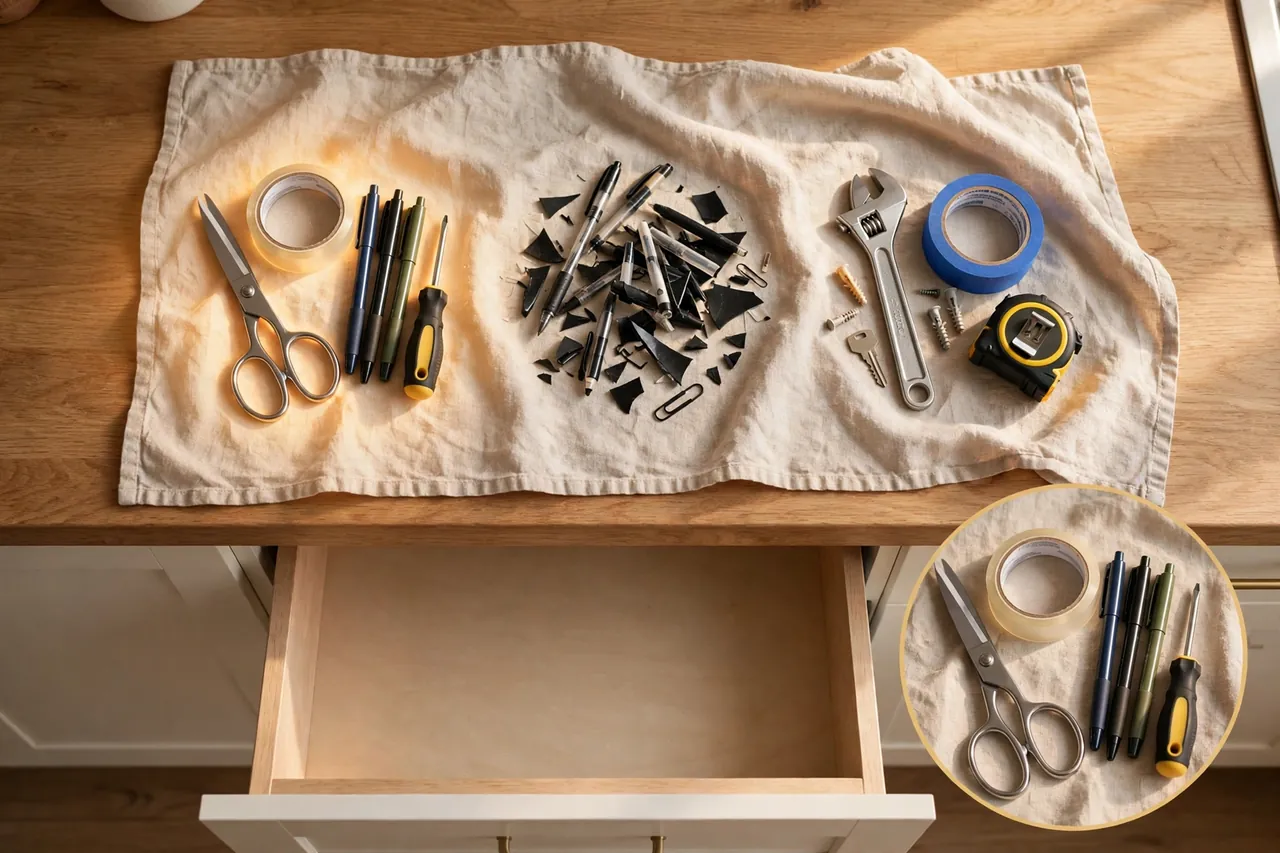
Start by taking everything out. Do not try to sort inside the drawer, because you cannot see what you own when items hide under each other. Spread everything on a towel or an old sheet on the counter so small screws and batteries do not roll away.
Next, wipe the empty drawer with a damp cloth and let it dry. Check the corners for crumbs, dust, and sticky spots. A clean, dry drawer also helps containers sit still instead of sliding around.
Now sort every item into three piles. Work fast, and trust your first answer for most items.
-
Keep: Put an item here only if you use it in this room, you can name its job, and it fits the drawer without crowding other items.
-
Toss or recycle: Put broken items, dead pens, dried-out glue, expired coupons, and mystery cords here. If you do not know what a cord fits, you likely do not need it.
-
Relocate: Put items here if they belong in another room, a toolbox, a desk, or a file. Do not let this pile drift back into the drawer.
Handle leaking batteries with care. Do not touch leaked material with bare hands, and place the battery in a bag for proper disposal. Wash your hands after you handle it, and wipe the drawer before you put anything back.
Test pens as you sort. Keep only two or three pens that write well, plus one marker if you use one often. A drawer full of dead pens looks full, but it helps no one.
What Belongs in a Junk Drawer
A good junk drawer holds a short list of everyday helpers. You do not need every small item in the house. You need the few items you reach for again and again in that room.
In a kitchen drawer, that list often includes scissors, one roll of clear tape, a pen, sticky notes, rubber bands, twist ties, a small flashlight, batteries, a tape measure, and a mini screwdriver. Add spare keys only if you use that drawer as your key spot and you can keep the keys in one small section.
Keep quantities small. One roll of tape beats three half-used rolls. One small container of screws beats a loose pile that mixes with paper clips. Limits keep the drawer useful, because each item still has room to breathe.
Use the table below as a quick check before you put anything back. If an item fails the test, it belongs in another pile.
Keep, Toss, or Relocate at a Glance
| Item type | Keep in the junk drawer | Move it elsewhere or toss it |
|---|---|---|
| Writing tools | Two or three working pens, one marker, sticky notes | Dead pens, dried markers, a full pen collection |
| Small tools | Scissors, mini screwdriver, tape measure | Full tool sets, power tools, loose blades |
| Power and light | Good batteries in a small container, small flashlight | Leaking or dead batteries, tangled mystery cords |
| Paper and mail | One small notepad | Bills, important papers, old menus, expired coupons |
| Health and safety | A few bandages for quick kitchen nicks | Medicine, loose pills, sharp items with no cover |
What Does Not Belong in a Junk Drawer
Some items cause more trouble than they solve in a loose drawer. Important papers can crumple, tear, or go missing. Medicine can spill, and it needs a safer, more private spot. Passports, financial records, and other sensitive papers need a secure file, not an unlocked drawer.
Keep food out of the drawer too. Loose condiment packets can burst, gum can melt or stick, and crumbs invite pests. Store those items in the pantry instead, where you can see them and use them before they expire.
Watch out for bulk. A full tool set, a stack of manuals, or a pile of old electronics turns the drawer into storage, not a helper. Give bulky items their own home, even if that home is a shelf in another room.
Finally, remove anything broken. A broken charger, a cracked case, or a tool with a missing part will not fix itself in a drawer. Toss it, recycle it where your area allows, or repair it now and put it in its real home.
Choose Dividers and Small Containers
Containers do the real work after you sort. Without them, small items drift each time you open and close the drawer. With them, each group stays in its own spot.
Measure the inside of the drawer before you buy anything. Measure the width from side to side, the depth from front to back, and the height from the bottom to the lowest rail or frame above it. Write the numbers down, and shop with that list in hand. A tray that looks right can still jam the drawer if it sits too tall.
Shallow trays work well for most junk drawers, because most junk drawer items lie flat or sit low. Deep bins hide small items at the bottom and make you dig. Choose a mix of long, narrow sections for pens and scissors and small square sections for batteries, clips, and screws.
You do not need a full matching set. A store-bought tray, an adjustable divider, or a clean small box can all work, as long as the pieces fit snugly and do not slide. If a container slides, add a thin non-slip liner under it. That small step stops a lot of daily mess.
If your junk drawer shares space with cutlery, a two-tier tray can help, because it stacks a shallow top layer over a deeper base. Dwellify Home’s guide to 14×18 cutlery tray two tier layouts shows how to measure width, depth, and height before you buy, so the tray does not stick when you close the drawer.
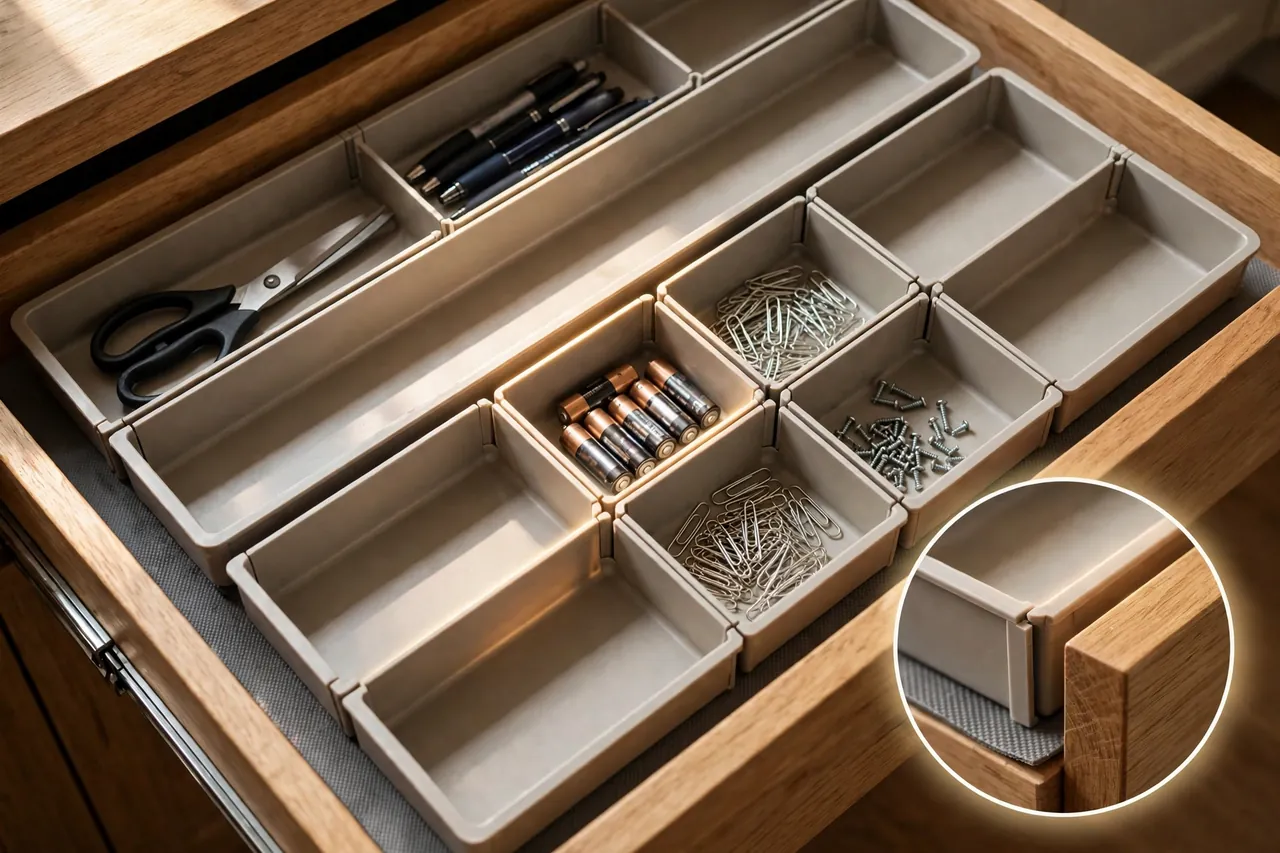
A Simple Zone Layout That Works
A zone layout just means you give each part of the drawer one job. You do not need six perfect zones. Four or five clear zones beat ten tiny ones that no one can remember.
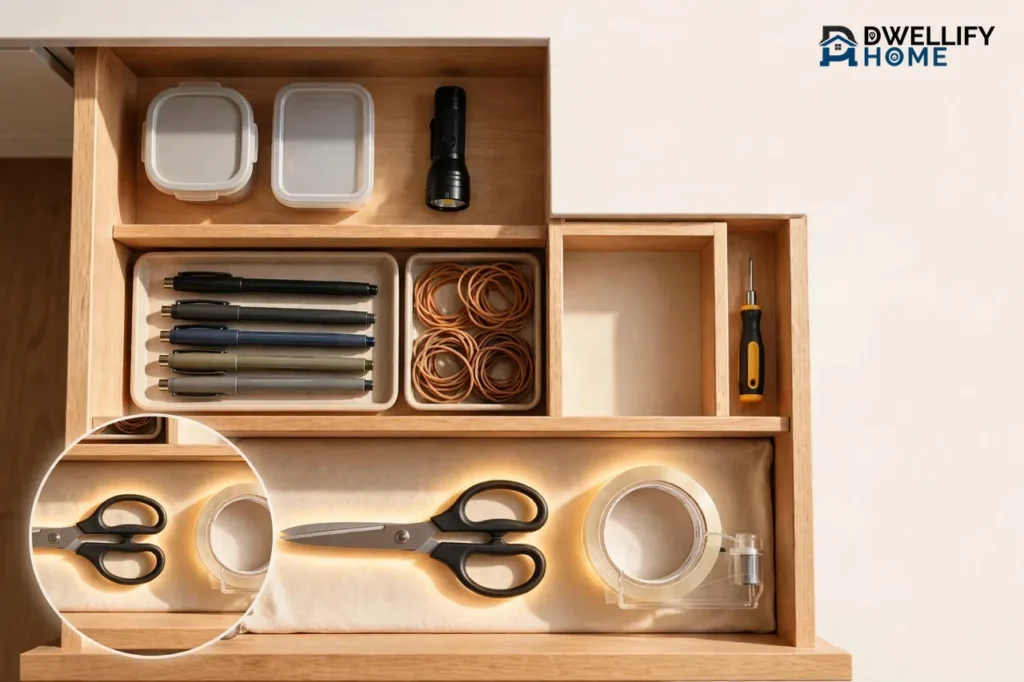
Put the items you grab most at the front of the drawer. Scissors and tape often earn the front spot in a kitchen drawer, because you reach for them with one hand while you hold something with the other. Put items you use less often, such as a spare battery container or a sewing kit, toward the back.
Try this layout as a starting point, then adjust it to fit your habits:
-
Front zone: scissors, tape, and pens you use daily.
-
Middle zone: sticky notes, rubber bands, twist ties, and paper clips.
-
Back zone: batteries in a lidded container, a small flashlight, and a tape measure.
-
Side zone: a mini screwdriver and a small container for screws and wall hooks.
-
Catch zone: one small open section, about a fifth of the drawer, for undecided items.
The catch zone matters more than it looks. Every home has items that need a short-term landing spot, such as a spare key or a single screw from a new shelf. Without a small catch zone, those items land on top of everything else. With one, they stay contained until your weekly reset.
Keep cords short and neat. Coil each cord, secure it with a twist tie or a small band, and stand it in its own section. If you cannot name the device a cord fits, do not give it a permanent spot. Put it in the catch zone and decide by your next reset.
Small kitchens need the same zones, just in less space. If you live in a studio or a small apartment, Dwellify Home’s smart kitchenette ideas for small spaces show how drawer organizers, slim pull-outs, and hooks can work together, so one small drawer does not have to carry the whole kitchen.
Labeling Without Overdoing It
Labels help when two sections look alike. Batteries, screws, and small hooks can mix fast, and a short label stops that mix. Label only the sections that cause confusion, not every single tray.
Keep labels short and plain. Write “Batteries,” “Screws,” or “Tape” in clear print. A label should help a family member put an item back without asking you. If a label needs a sentence to explain it, the section is too vague.
Use labels you can change. Painter’s tape, a small sticker, or a label maker all work, as long as you can swap the label when the section changes. Your drawer will change over time, and your labels should change with it.
Skip labels for items that only you use and that sit in a clear spot. Scissors in a long front tray do not need a label. Over-labeling makes a simple drawer feel fussy, and fussy systems are easy to quit.
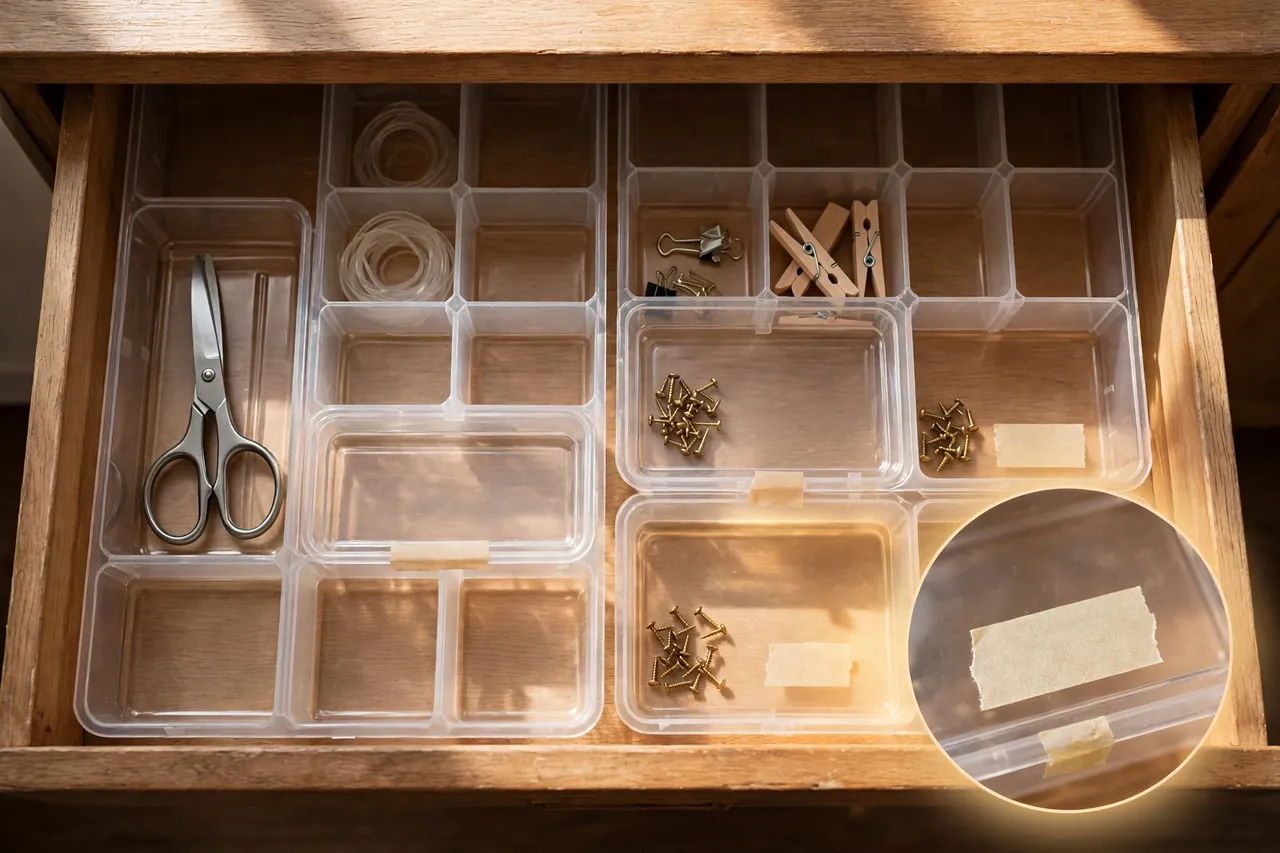
The 5-Minute Reset Habit
A junk drawer stays organized because of a habit, not because of a perfect first sort. Set a weekly five-minute reset, and tie it to something you already do, such as taking out the trash or starting a load of laundry.
During the reset, open the drawer and do only four things. First, toss trash and dead batteries. Second, move relocated items to their real homes. Third, empty the catch zone and decide on each item: keep it in a labeled zone, relocate it, or toss it. Fourth, push each container back into place and close the drawer.
Do not turn the reset into a deep clean. If you make it long, you will skip it. Five minutes keeps the job small enough to repeat, and repetition keeps the drawer from sliding back into a pile.
Once every three months, run a longer check. Pull out each container, wipe the drawer, test pens and batteries, and remove anything you have not touched since the last check. This seasonal pass catches slow drift, such as a section that quietly grew from three pens to twelve.
💡 Practical Home Tip: Keep a small trash bag or a paper bag near the counter on reset day, so tossing takes seconds instead of a trip across the house. When the easy choice is also the tidy choice, the reset sticks.
When the Drawer Fills Up Again
Every junk drawer fills up again at some point. That does not mean the system failed. It means something changed: a new hobby, a move, a busy season, or a family member who uses the drawer differently.
Start with the catch zone. If it overflows, you likely skipped a few resets, or you let undecided items stay too long. Empty it fully, decide on each item, and leave it empty for a day if you can. An empty catch zone gives you room to think.
Next, check for duplicates. Count pens, rolls of tape, and batteries. If one group fills its container, you have too many of that item, not too little space. Keep the best few and move the rest to their main supply spot or out of the house.
Then check for drift. Look for items that belong in another room, such as office supplies, craft tools, or garage parts. Drift happens slowly, one item at a time. Moving those items back to their homes often frees more space than buying a bigger organizer.
If the drawer still overflows after those three checks, the drawer may hold the wrong job. A kitchen drawer cannot also serve as a desk drawer and a toolbox. Split the job: keep kitchen helpers in the kitchen drawer, and give office or tool items a small home where you actually use them.
Public Storage’s junk drawer guide makes the same core point in plain terms: empty the drawer, sort by type, clean it, and give each category a set place, and keep only items you use regularly. Reader’s Digest’s eight-step guide follows a similar path, with a clear warning to re-home items through the house before you buy organizers. Both guides agree that sorting comes before shopping, and that order saves money and frustration.
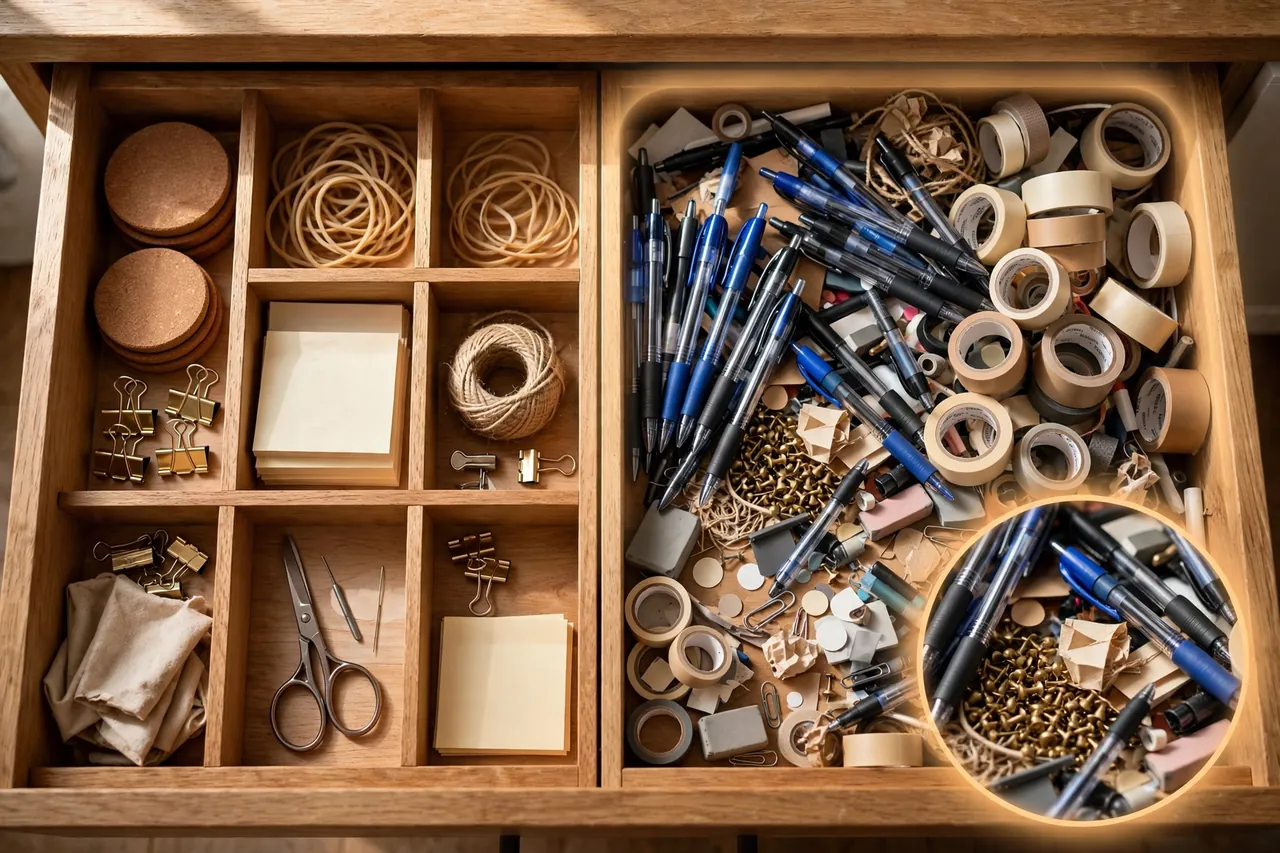
Mistakes That Undo a Good Drawer
The most common mistake is buying organizers before you sort. A pretty tray cannot fix a drawer full of items you do not need. Sort first, count what survives, and then buy or reuse containers that fit those groups.
Another mistake is making too many tiny sections. Tiny sections look neat in a photo, but they frustrate daily use. A section should hold its group with a little room to spare. If you fight to fit scissors back in, the section is too small.
A third mistake is keeping a second junk drawer “just in case.” Two catch-all drawers soon become two piles, and neither one stays useful. Keep one main drawer, and give other small items a named home, even if that home is a small box on a shelf.
Finally, do not hide the drawer from the people who use it. Show family members or roommates where each zone lives, and agree on the catch zone rule: undecided items go there, and nothing else lands on top of a labeled zone. A system only works when everyone who opens the drawer knows it.
Related Guides
Decluttering Checklist: A Room-by-Room Guide for Your Whole Home · Cleaning the House: A Simple Room-by-Room System That Works · How to Organize a Small Apartment
Frequently Asked Questions
What belongs in a junk drawer?
A junk drawer should hold small, useful items you reach for often in that room, such as scissors, tape, working pens, sticky notes, rubber bands, batteries, a small flashlight, and a mini screwdriver. Keep quantities small, and keep only items with no better home elsewhere in the house.
What should not go in a junk drawer?
Keep medicine, passports, financial papers, bills, and other important documents out of a junk drawer, because they can spill, crumple, or go missing. Also remove broken electronics, leaking batteries, loose food packets, and bulky tool sets, since they cause mess or crowd out useful items.
What is the best way to organize a junk drawer?
The best way is to empty the drawer, sort items into keep, toss, and relocate piles, clean the drawer, and then put back only regular-use items in divided sections. Measure the drawer before you choose containers, place daily items at the front, and run a short weekly reset to keep it working.
How do you organize a junk drawer without buying fancy dividers?
Use small containers you already own, such as clean food tubs, small cardboard boxes, mint tins, or zip-top bags, and trim boxes so lids and tall sides do not catch. Give each group its own container, keep daily items at the front, and leave one small open catch section for undecided items.
How often should you reset a junk drawer?
Run a five-minute reset once a week to toss trash, empty the catch zone, and return drifted items to their homes. Then run a longer check every three months to wipe the drawer, test pens and batteries, and remove anything you have not used since the last check.
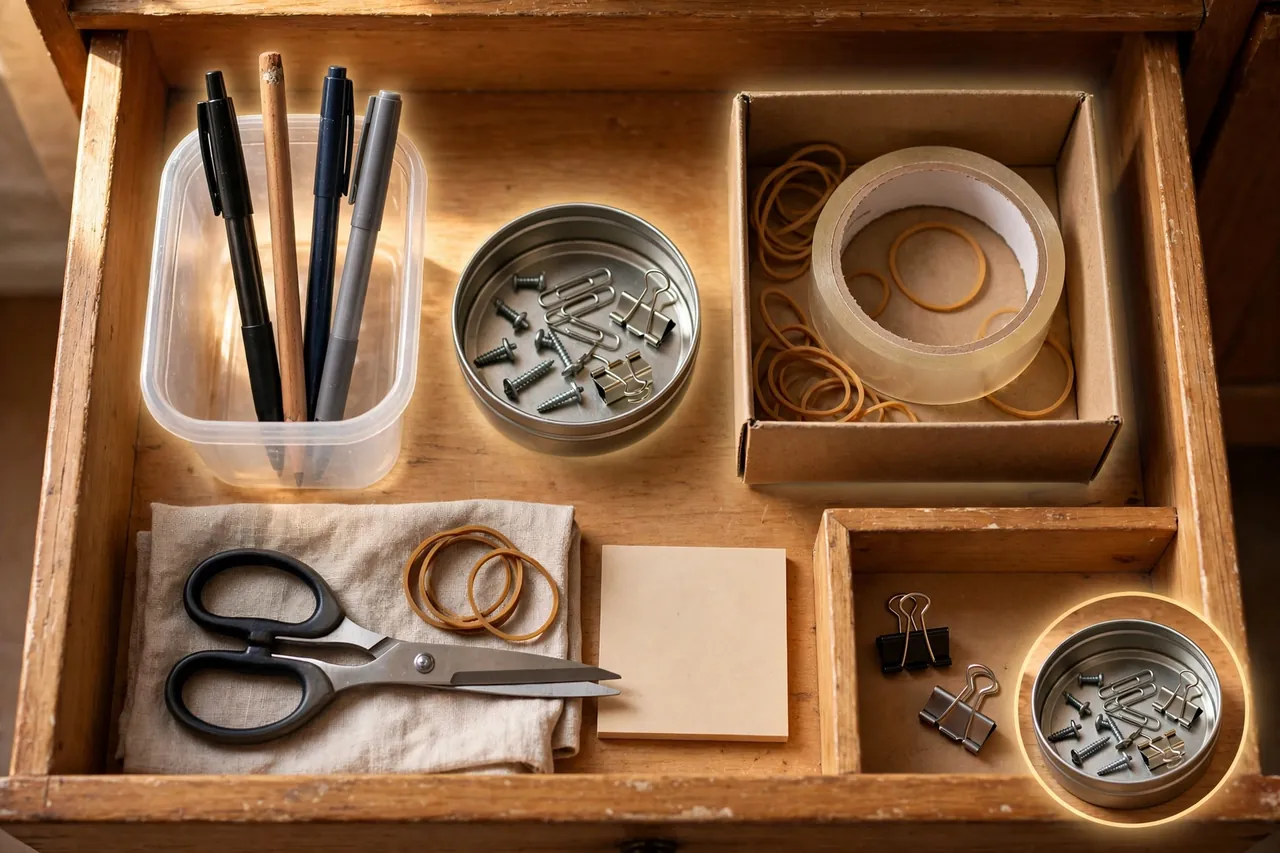
A Drawer You Can Find Things In
You do not need a perfect drawer. You need a drawer with a clear job, a few labeled zones, and a five-minute habit that keeps it honest. Sort once, set the zones, and let the weekly reset do the quiet work.
Start today with the drawer you open most. Empty it, keep only what earns its spot, and enjoy the small win of finding the scissors on the first try.