A Christmas porch leaner is a tall, narrow wooden sign that leans against the wall beside your front door and carries a festive greeting, such as “Merry Christmas” or “Let It Snow.” It gives your porch instant holiday charm with almost no setup: you lean it in place, add a planter or a string of lights beside it, and your entry looks finished.
Most leaners stand four to six feet tall and about a foot wide, so they read clearly from the walkway without blocking the door. You can buy one ready-made, or you can build one from a single board in a weekend. Either way, a good leaner needs the right size for your porch, a weatherproof finish, and a steady spot where wind cannot tip it over.
What Is a Christmas Porch Leaner?
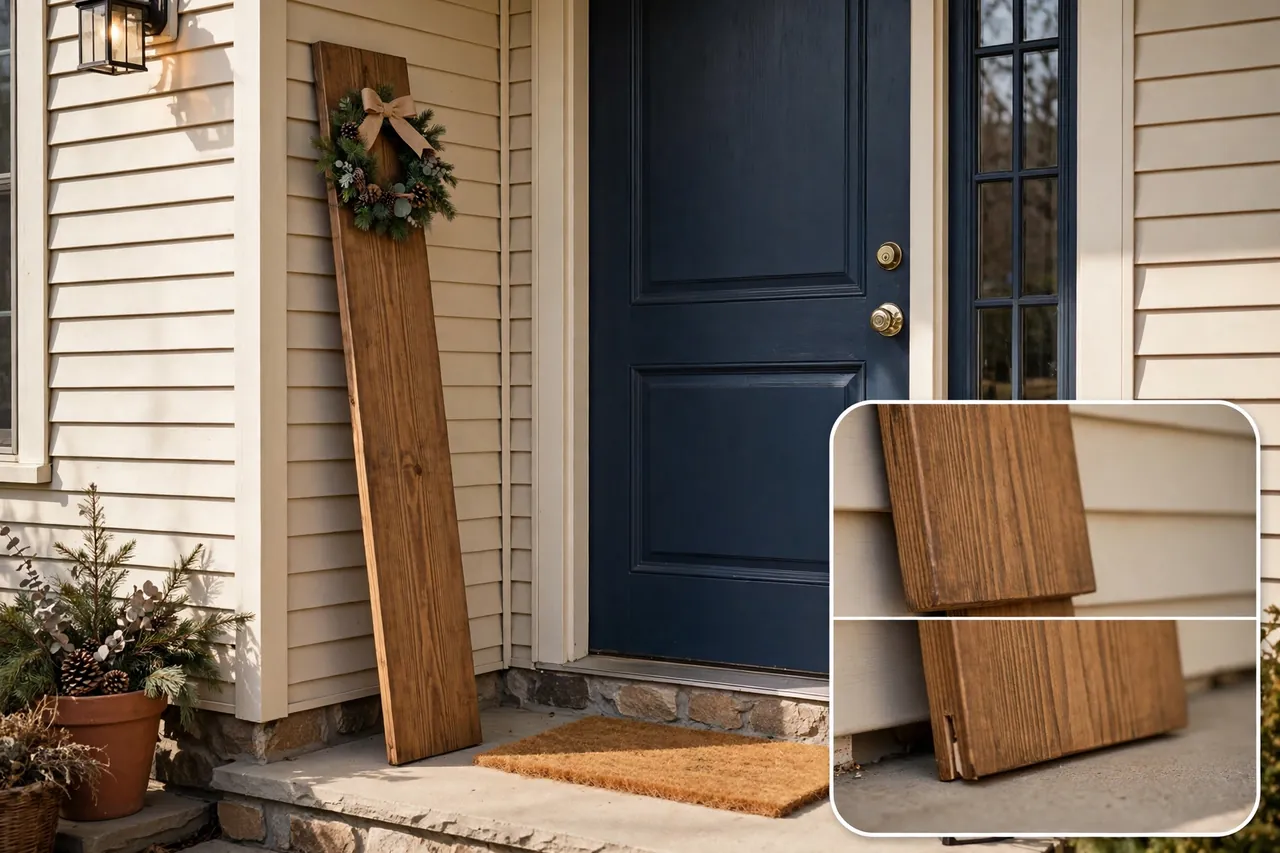
A porch leaner is simply a long, flat board made to lean, not hang. It rests against your house at a slight angle, with its bottom edge a few inches out from the wall. That angle is what keeps it upright, and it is also what makes it so easy to move: you can slide it to a new spot, swap it for a different season, or bring it inside in seconds.
At Christmas, the board usually carries a vertical greeting that reads from top to bottom. Classic choices include “Merry Christmas,” “Joy,” “Believe,” and “Let It Snow.” Some leaners add a painted tree, a snowflake, a star, or a small wreath at the top. Others keep it plain and let the wood grain do the talking.
Many leaners work on both sides. One side might say “Merry Christmas” while the other carries a plain winter greeting, so you can flip the board after the holidays and keep using it into January. Reversible leaners like these give you two looks for the price of one, and they save storage space too.
A Christmas porch leaner suits almost any home style. A rough, stained board fits a farmhouse porch, a crisp white board with black letters suits a modern entry, and a painted board in deep red or green feels right on a classic colonial. The board itself is simple, so the color, the lettering, and the decorations around it set the tone.
Choose the Right Size and Style
Size matters more than most people expect. A leaner that is too short disappears beside a tall door, while one that is too tall can look top-heavy and catch more wind. Start by measuring your door and your porch wall, then match the board to the space you actually have.
As a rule, the top of the leaner should sit below the top of your door frame and well below any porch light or hanging basket. A five-foot leaner hits the sweet spot for most standard porches: tall enough to see from the street, but not so tall that it towers over the door. Smaller stoops do better with a four-foot board, and a wide, covered porch can handle a six-foot board with ease.
Width matters too. Most leaners run about ten to twelve inches wide, which gives the letters room to breathe without eating up floor space. A very narrow board can look lost on a wide porch, and a very wide board can crowd a small entry and block the walkway.
| Porch type | Leaner height | Leaner width |
|---|---|---|
| Small stoop | 3 to 4 feet | 10 to 12 inches |
| Standard porch | 4 to 5 feet | 10 to 12 inches |
| Wide or covered porch | 5 to 6 feet | 12 to 18 inches |
Next, pick a style that matches your home. Rustic leaners show off knots, grain, and a weathered stain, and they pair beautifully with real greenery and galvanized buckets. Painted leaners in white, cream, or black look clean and crisp, and they make red bows and green garland pop. If you love sparkle, look for a leaner with a few raised wooden cutouts, such as a star or a tree, which catch light and add depth.
Think about the words as well. A short word like “Joy” reads clearly from the street, even in low light. A longer greeting like “Merry Christmas” needs a taller board so the letters do not feel cramped. Before you buy or build, read the greeting out loud as a visitor would see it, and ask yourself whether it still feels warm and clear from the sidewalk.
Finally, check the back of the board. A plain back keeps your options open, since you can paint a second greeting on it later. A finished back looks better if guests can see both sides, for example on a porch with glass panels or an open railing. Either way, the back should feel smooth, with no rough splinters to snag coats or scratch the wall.

Buy or Make Your Own Christmas Porch Leaner
You have two good paths here, and neither one is wrong. Buying saves time and gives you a polished finish, while making your own costs less and lets you pick the exact words, colors, and size. The right choice depends on your budget, your schedule, and how much you enjoy a weekend project.
Buying a Ready-Made Leaner
When you shop, look past the pretty photo and check three things: the material, the finish, and the display advice. Solid pine and cedar hold up well outdoors, and a sealed finish matters far more than a fancy design. If the listing says “covered porch only,” believe it. Boards made from medium-density fiberboard, often called MDF, can warp badly once they soak up rain, so keep those under a roof or indoors.
Read the size list with care, because sellers measure in different ways. Some list the full board length, while others list only the visible height once the board leans. If you are unsure, ask the seller or choose a board a few inches shorter than your ideal height. A slightly shorter leaner still looks great, while one that towers over the door looks awkward.
Also check how the leaner arrives. Some ship flat with a hanging rope or a small stand, while others ship fully assembled. A rope loop gives you a second display option indoors, but it does not help outdoors, where the board should lean on the wall rather than hang and swing in the wind.
Build a Simple DIY Leaner in a Weekend
A homemade leaner needs only a board, some paint, and a free afternoon. Pine works well because it is cheap, light, and easy to cut, and a one-by-ten or one-by-twelve board gives you plenty of room for lettering. If you have an old fence picket or a scrap board at home, that works too, as long as it feels straight and solid.
Gather your supplies before you start:
- One pine board, about 4 to 5 feet long and 10 to 12 inches wide
- Sandpaper in medium and fine grits
- Exterior paint or wood stain, plus a brush
- Letter stencils, vinyl letters, or a paint pen
- An outdoor sealer rated for exterior wood
- A bow, a sprig of greenery, or a small wreath for the top
Then follow these steps:
- Sand the board smooth on the front, the edges, and the back, then wipe away all the dust with a damp cloth.
- Paint or stain the background color and let it dry fully. Dark walnut stain and crisp white paint both look lovely at Christmas.
- Pencil your greeting lightly from top to bottom, spacing the letters evenly before you commit to paint.
- Paint the letters with a stencil or a steady hand, then let the paint dry completely.
- Seal the whole board, front, back, and edges, with an outdoor sealer so rain and snow cannot soak in.
- Tie a bow or a sprig of greenery near the top, and lean the board beside your door.
Take your time with the lettering, because it is the part everyone reads first. If a letter goes wrong, wait for the paint to dry, sand that spot lightly, and paint over it. Small flaws disappear once the board stands beside a planter and a string of lights, and a handmade leaner carries a warmth that no store-bought board can quite match.
If you want more rustic wooden ideas for the season, our guide to wood Christmas decorations outside shows how timber pieces hold up through winter. And if you love the handmade route in general, our ideas for DIY Christmas wreaths pair nicely with a leaner at the door.

Weatherproof Your Leaner for Winter Outdoors
Winter is hard on bare wood. Rain soaks in, snow sits on the top edge, and freeze-and-thaw cycles open up tiny cracks that grow each season. A good sealer stops most of that damage before it starts, so sealing is not an optional extra. It is the step that decides whether your leaner lasts one Christmas or ten.
Start with a dry board. If you paint on a damp day, moisture gets trapped under the finish and the paint may peel by January. Pick a dry, mild day for sealing, work in a garage or under cover if you can, and let each coat dry fully before you add the next one.
For exterior wood, Minwax recommends three coats of its Helmsman Spar Urethane on exterior surfaces or previously unfinished wood, with at least four hours of drying time between coats and a light sanding with very fine sandpaper before each new coat. That guidance also stresses sealing open joints, edges, and end grain on unfinished wood, which is exactly where a porch leaner soaks up water first. Pay special attention to the bottom edge and the top edge, since those two spots take the most weather.
Seal the back of the board too. Rain often blows against the wall and runs down behind a leaning board, so an unsealed back can swell and warp even on a covered porch. A quick coat on the back costs almost nothing and saves you from a board that no longer sits flat against the wall.
Once the season starts, check the finish now and then. If water stops beading on the surface, or if the finish looks dull and rough, plan a fresh coat after Christmas when you take the leaner down. A light sanding and one new coat each year keeps the board looking fresh far longer than a single heavy coat ever will.
Covered porches still need sealing, just less of it. A roof keeps direct rain off, but damp air, blowing snow, and morning frost still reach the board. An uncovered porch, on the other hand, needs the full treatment: a strong sealer, sealed edges, and a plan to bring the board inside during heavy storms.
Style Your Leaner With Planters, Garland, and Lights
A leaner on its own looks nice, but a leaner styled with the rest of your porch looks magical. The trick is to build a small scene around it, not to pile on every decoration you own. Pick two or three companions, keep them close, and let the leaner stay the star.
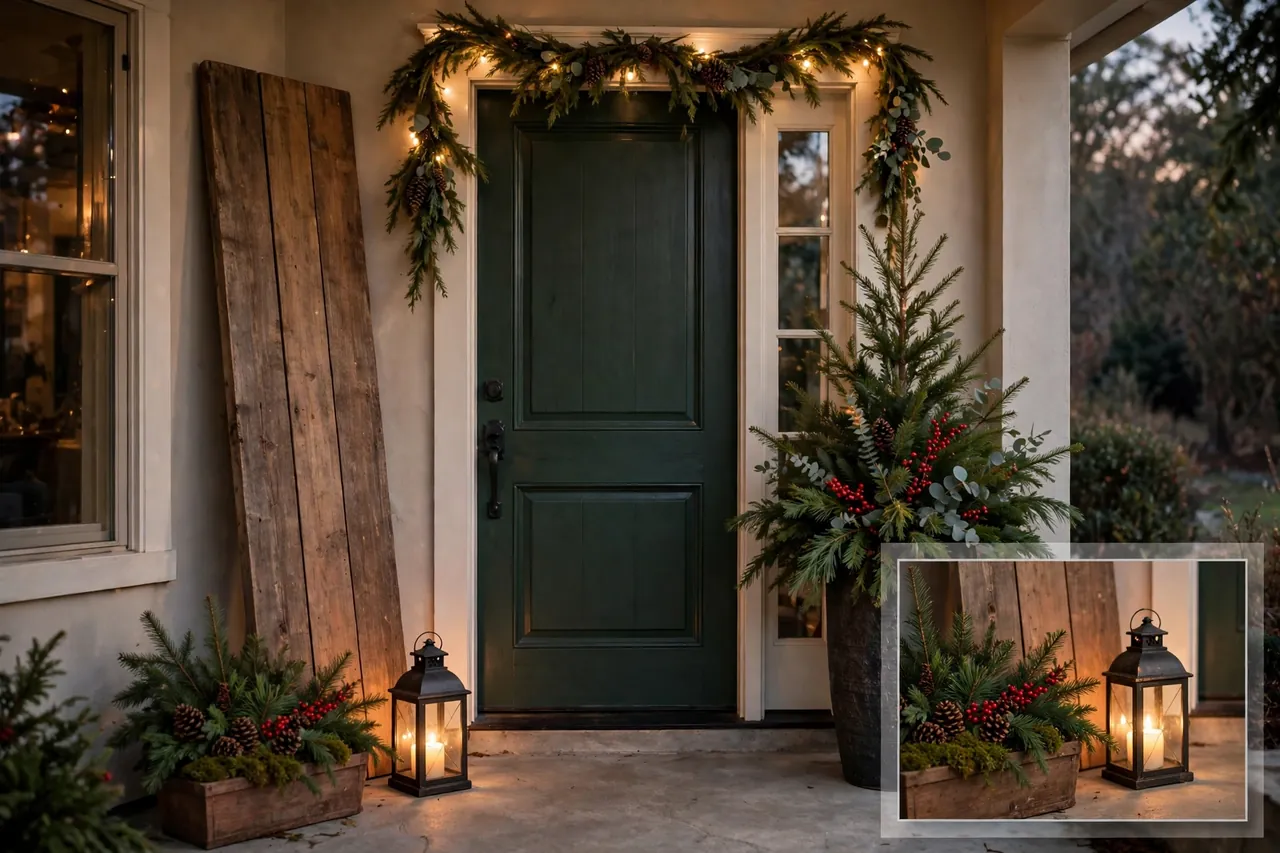
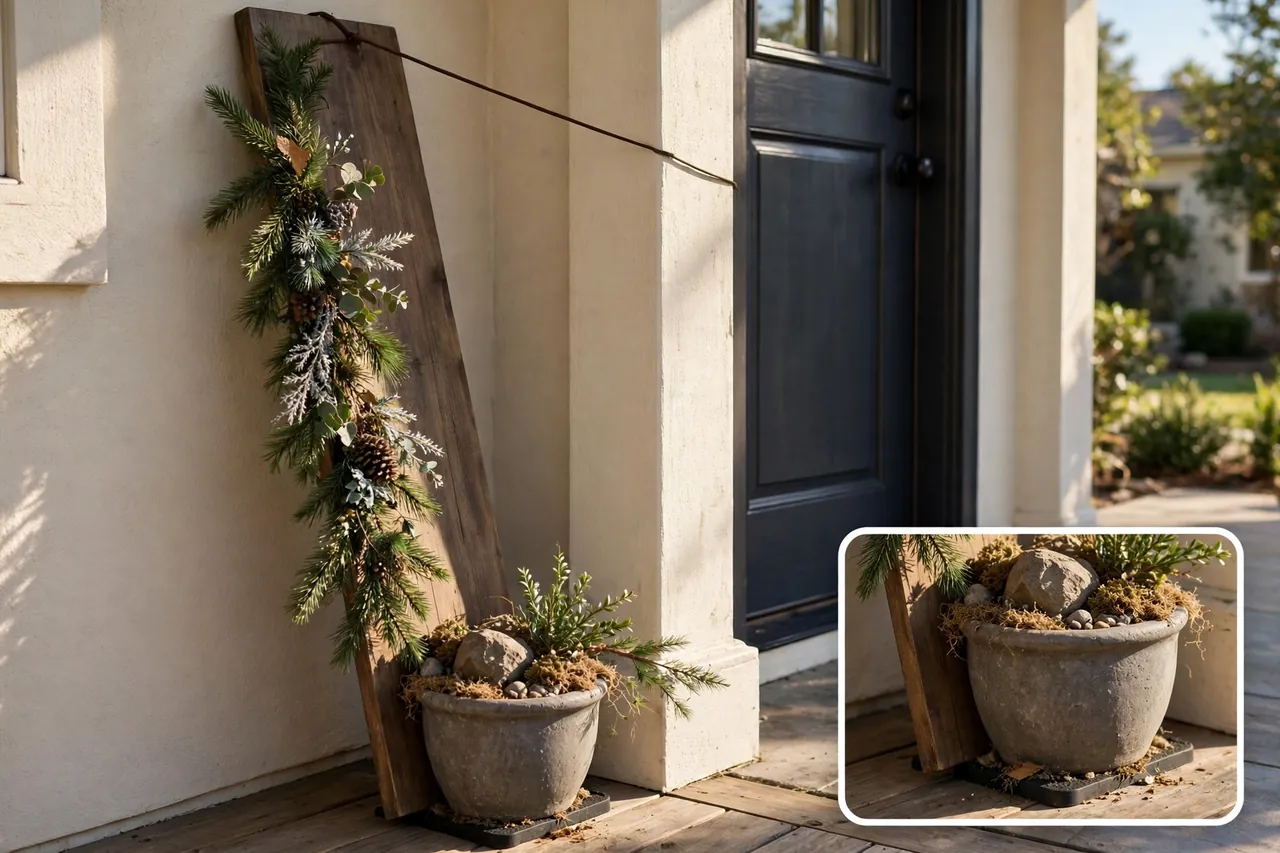
Start with a planter. A tall planter on the other side of the door balances the leaner and frames the entry, while a low planter at the base of the leaner softens the bottom edge and hides the gap where the board meets the floor. Fill planters with evergreen branches, pinecones, and red berries for a classic look, or add a small lantern for a warm glow at night. Our Christmas decorating entrance way guide walks through the whole walk-to-the-door look if you want to plan the full entry.
Next, add garland. A swag of garland draped across the top of the door, or looped loosely around the top of the leaner, ties the board into the rest of the porch. Keep the garland light, so it does not pull the leaner forward, and fasten it to the wall or the door frame rather than to the board itself. A heavy garland hanging on a leaning board can shift its balance and send it sliding.
Lights bring the whole scene to life after dark. A string of warm white lights along the garland, a lantern beside the leaner, or a soft spotlight aimed at the board all work well. Keep the light gentle: the goal is a warm welcome, not a glare that washes out the lettering. Battery lights work nicely if you have no outdoor outlet nearby, and a timer saves you from switching them on and off each night.
Safety matters when you add lights. The U.S. Consumer Product Safety Commission advises using only lights certified for outdoor use outside, checking each set for frayed wires or cracked sockets, and using no more than three standard-size sets of lights per single extension cord. Follow that advice around your leaner too, and keep cords out of the walkway where guests could trip.
Finally, step back and look at the scene from the street. Can you read the greeting clearly? Does the leaner stand out, or does it vanish behind planters and lights? Move one piece at a time until the greeting reads at a glance. A porch that looks good from the sidewalk will look even better up close, and that first glance is what makes guests smile before they even reach the door.
Keep Your Leaner Safe and Steady in Wind
A tall, flat board catches wind like a sail, so stability deserves real attention. A leaner that falls can scratch your siding, break a planter, or trip a guest, and a gusty night can send an unsecured board sliding across the porch. The good news is that a few simple habits keep it firmly in place all season.
First, get the lean angle right. The bottom of the board should sit about six to eight inches out from the wall for a five-foot board, with the top resting flat against the wall. Too steep an angle, with the bottom too close to the wall, makes the board easy to knock forward. Too shallow an angle, with the bottom too far out, makes it easy for wind to push the board sideways.
Second, pick a sheltered spot. A corner beside the door, shielded by the house on one side, catches far less wind than an open railing or an exposed step. Avoid placing the leaner where it faces the prevailing wind head-on, and never place it where it blocks the walkway, the steps, or the handrail. Guests should always have a clear, well-lit path to the door, even in the dark.
Third, anchor it on windy days. A discreet cord or zip tie from the top of the board to a porch column or railing stops the board from pulling away from the wall, and a heavy planter at the base stops the bottom from sliding. If a storm is coming, the safest move is also the simplest: bring the leaner inside until the wind passes. No decoration is worth a broken window or a hurt guest.
Watch out for slippery surfaces too. A board resting on icy steps or a wet, smooth porch floor can slide even without wind. A small rubber pad or a piece of grip tape under the bottom edge adds friction and keeps the board where you put it. Check the pad now and then, since grit and ice can wear it down over the season.
If you have small children or pets, give the leaner a gentle push test after you place it. If it wobbles or slides with a light push, a running child or a jumping dog will move it easily. Shift it to a corner, add a planter at the base, or tie the top until it passes the push test without budging.
For a bigger-picture plan, our outdoor Christmas displays guide covers layouts that stay put through winter weather, and our Christmas lantern decorations guide shows how to add glow beside a leaner without adding clutter to the walkway.
Store Your Leaner After Christmas
When the season ends, a little care at takedown time pays off next year. Start by wiping the board clean with a dry cloth, brushing off dust, cobwebs, and any salt or grit from winter weather. If the board feels damp, let it dry indoors for a day before you store it, since trapped moisture can stain the finish or warp the wood over the summer.
Store the leaner upright, not flat under a pile of boxes. Lean it against a garage or basement wall, with a soft cloth between the board and the wall so the finish does not scratch. Keep it away from damp floors and direct sunlight, both of which age wood faster than a winter on the porch ever will.
Label the board if you own more than one seasonal sign. A small piece of tape on the back, marked “Christmas leaner,” saves you from unwrapping every board next December to find the right one. If your leaner is reversible, note both greetings on the label so you remember what you have.
Use takedown day as inspection day too. Look for peeling finish, loose paint, or small cracks, and make a quick note of what needs fixing. A ten-minute touch-up in January, or a fresh coat of sealer on a warm spring day, means your leaner will be ready to lean beside the door the moment next Christmas arrives. Our Christmas decor boxes guide covers storage for the rest of your decorations, so the whole collection stays organized together.
Please note: this guide shares general decorating advice for a typical home porch. If your porch has an unusual surface, a steep slope, or a loose railing, use extra care with placement, and bring the leaner inside during storms. When in doubt, choose the safer spot over the prettier one.
Related Guides
Outdoor Christmas Decorations Wall · Whoville Outdoor Christmas Decorations · Streetlight Christmas Decorations
Frequently Asked Questions
How Tall Are Porch Leaners?
Most porch leaners stand between four and six feet tall, with five feet the most popular choice for a standard porch. That height reads clearly from the street without towering over the door. Small stoops suit a three- to four-foot board, while wide, covered porches can carry a six-foot board.
What Kind Of Wood Do You Use For Porch Signs?
Pine and cedar are the most common choices, because both are light, easy to work with, and hold paint and stain well. Pine costs less and suits most porches, while cedar resists weather a little better on uncovered porches. Avoid MDF boards outdoors unless the porch is fully covered, since MDF warps once it gets wet.
What do you make a porch sign out of?
You can make a porch sign from almost any flat board, including pine, cedar, reclaimed wood, or a fence picket. A one-by-ten or one-by-twelve board cut to four or five feet long gives you plenty of room for lettering. Whatever board you pick, it should feel straight, solid, and smooth enough to paint.
Should I seal my DIY porch sign?
Yes, seal any porch sign that will stand outside, even on a covered porch. A sealer protects the paint from rain, snow, sun, and damp air, and it keeps the wood from warping. Without a sealer, paint peels faster and the board may not survive a second season.
How do you seal a wooden sign for outdoor use?
Sand the board smooth, wipe away the dust, and apply thin, even coats of an outdoor sealer, letting each coat dry fully before the next. Seal the front, the back, and all edges, especially the end grain, since that is where water soaks in first. Recoat when water stops beading on the surface.
What’s the difference between a porch leaner sign and a door hanger?
A porch leaner is a tall vertical board, usually ten to twelve inches wide and four to six feet tall, that leans against the wall beside your door. A door hanger is much smaller and hangs on the door itself, often from a hook or knob. Leaners make a bigger statement from the street, while hangers suit small entries.
A Warm Welcome, All Season Long
A Christmas porch leaner is one of the simplest decorations you can own, and one of the most welcoming. Pick the right size, seal it well, style it with a planter and a soft light, and anchor it against the wind. Then step back, enjoy that first glance from the street, and let your porch do the greeting for you all season long.