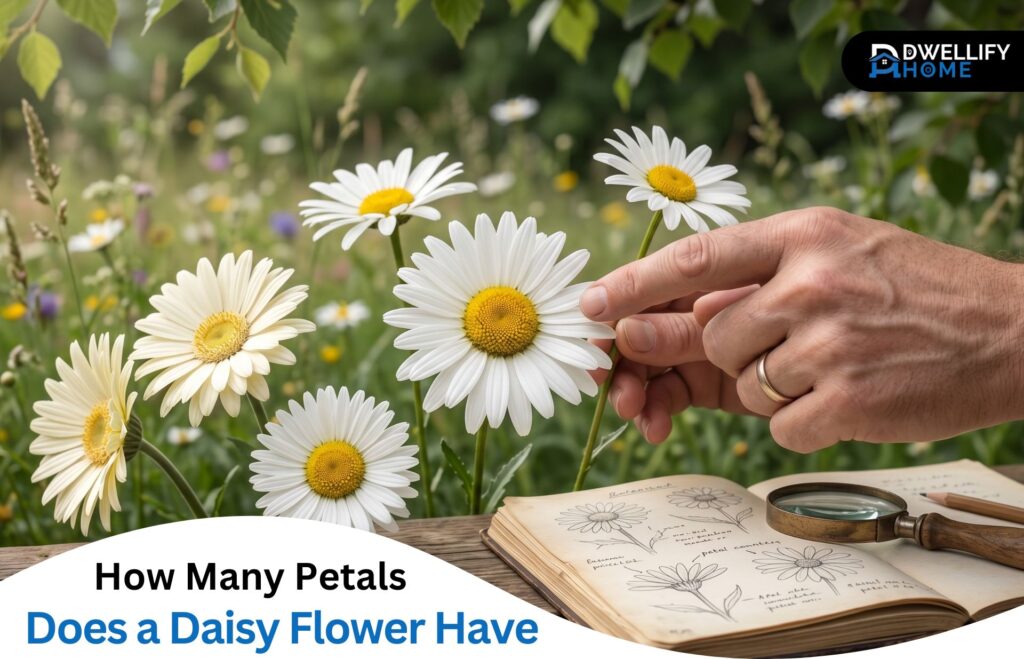
Pluck a daisy from a sunny patch of grass, lay it flat, and start counting around the rim. By the time you reach the last petal, you’ll usually land somewhere between 20 and 40. Pick another from the same patch, and the number shifts again. That small bit of variation is exactly what makes daisies so interesting — and exactly why so few people get a clean answer when they ask the question.
After years of pressing daisy heads in field journals and helping kids count petals at nature workshops, I can tell you the answer depends entirely on which daisy you’re holding.
Snippet-Ready Definition
A common daisy typically has 15 to 30 white “petals,” which are actually individual ray florets. The exact count varies by species — Shasta daisies carry 20 to 40, while prairie daisies can reach 100.
About Dwellify Home
Dwellify Home is built to help homeowners make practical, stylish, and well-informed decisions about their living spaces, gardens, and outdoor areas. From modern home solutions to garden insights and lifestyle guidance, every piece of content is written to give clear, dependable answers — without the noise.
How Many Petals Does a Daisy Flower Have? The Direct Answer
The common daisy you see in lawns and meadows — the little white-and-yellow one — usually carries somewhere between 15 and 30 petals. That’s the answer most people are after.
But that range only fits one species. A Shasta daisy in a flower bed can carry 40. A prairie daisy out in open grassland can run past 70. And a chocolate daisy, which most people have never met, has only eight.
So how many petals does a daisy flower have? It depends. The number is tied to species, cultivar, and sometimes even the conditions the plant grew in.
Quick Reference Table — Petal Count by Daisy Variety
| Daisy Variety | Typical Petal (Ray Floret) Count |
| Common Daisy (Bellis perennis) | 15–30 |
| Shasta Daisy (Leucanthemum × superbum) | 20–40+ |
| Oxeye Daisy (Leucanthemum vulgare) | Around 20 |
| Gerbera Daisy | 25–100+ (varies by cultivar) |
| Prairie Daisy | 40–100 |
| Chocolate Daisy | 8 |
| Singapore Daisy | 8–13 |
| Wild Field Daisies | Often 34, 55, or 89 |
Key Things to Know
- A daisy’s “petals” are technically ray florets, each one a complete flower
- Petal count changes by species, cultivar, and growing conditions
- Wild daisies often follow Fibonacci numbers (13, 21, 34, 55, 89)
- Double-flowered cultivars carry far more petals than single-flowered types
- Daisies don’t have traditional sepals — they have a ring of bracts instead
Why a Daisy’s “Petals” Aren’t What They Seem
Here’s where things get interesting. What we call a “petal” on a daisy isn’t actually a single petal. It’s a complete flower on its own, called a ray floret.
A daisy is what botanists call a composite flower. The flower head you see is really a tightly packed cluster of dozens — sometimes hundreds — of tiny individual flowers. The white strap-like ones around the edge are the ray florets. The yellow centre is made up of disc florets, each one its own miniature flower with five tiny fused petals.
So when a child plucks a “petal” off a daisy chain, they’re actually plucking a whole flower. That’s the part most gardening books skip over, and it’s the reason a single fixed petal count never quite works.
Daisy Petal Counts by Variety
The clearest way to answer the question is variety by variety. Here’s what I’ve counted in the field, in nurseries, and in pressed specimens over the years.
Common Daisy (Bellis perennis)
The lawn daisy most of us grew up with. Usually 15 to 30 white ray florets, often tipped with pink as they age. They sit in three or four neat rings around the yellow disc.
Shasta Daisy (Leucanthemum × superbum)
A garden classic. Single Shastas typically run 20 to 40 ray florets, with bigger cultivars stretching higher. Doubles can carry far more. I’ve counted 21 on a clean Becky Shasta — a number that pops up so often it’s worth remembering.
Oxeye Daisy (Leucanthemum vulgare)
The tall white daisy you see in road verges and meadows. Around 20 ray florets is the usual count, sometimes a few more on robust plants.
Gerbera Daisy
This one’s a wildcard. Gerberas are bred for show, so petal counts swing widely between cultivars — anywhere from 25 on a single-flowered type to well over 100 on a fully double cultivar. Florists prize them for that variation.
Prairie Daisy
A bigger, denser bloom. Prairie daisies often carry 40 to 100 narrow ray florets surrounding the central disc. The fuller cultivars look almost like pom-poms.
Chocolate Daisy
A small yellow daisy from the American Southwest with just eight ray florets — and a faint cocoa scent if you crush the flower. A favourite when people ask what flower has 8 petals.
Singapore Daisy
A spreading groundcover daisy with 8 to 13 yellow ray florets per head. Compact, low, and easy to identify.
Wild Field Daisies
In open meadows, you’ll often find daisies with 34, 55, or 89 ray florets. Those numbers aren’t random — and we’ll get to why in a moment.
How to Count Daisy Petals the Right Way
Counting daisy petals sounds easy until you actually try it. Here’s what I’ve learned the slow way.
Wait until the flower is fully open. A half-opened daisy still has ray florets tucked inside, and you’ll undercount every time. Mid-morning on a sunny day is best, once the head has spread.
Work in one direction, and pick a fixed starting point — a slightly larger ray floret or one with a small mark. It’s surprisingly easy to lose your place on a dense head.
Pluck or mark each petal as you go. On thicker daisies like prairie or double Shastas, two rings of ray florets can sit so close together that they look like one. Lifting the outer ring gently with a pin or fingernail helps you see the inner row clearly.
The most common mistake is counting the disc florets in the centre by accident. Those tiny yellow dots are flowers too, but they’re not the ray florets you’re after.
Daisy Petals Compared to Other Popular Flowers
A useful way to anchor the daisy’s petal count is to compare it to flowers people search for in the same breath.
A sunflower, which sits in the same family as the daisy, often has 34 ray florets, sometimes 55, sometimes 89 — the same Fibonacci-friendly numbers you see in field daisies.
A classic garden rose has five true petals on a single bloom, though hybrid roses bred for fullness can carry 30, 40, or even more. A lily typically shows six tepals, which look like petals but are actually three petals and three sepals that look identical. A tulip works the same way — six tepals, not six petals.
A gerbera daisy, as mentioned earlier, can carry anywhere from 25 to over 100 ray florets depending on the cultivar.
When people ask what flower has 8 petals, the chocolate daisy and cosmos are the cleanest examples. Clematis and some cosmos cultivars commonly carry eight as well.
The Fibonacci Pattern Hidden in Daisy Petals
Pull apart enough wild daisies and you’ll start to notice the same numbers turning up: 13, 21, 34, 55, 89. These belong to a sequence where each number is the sum of the two before it. It’s called the Fibonacci sequence, and it shows up in nature far more often than coincidence allows.
For daisies, the reason comes down to packing efficiency. As a flower head develops, each new ray floret rotates a fraction of a turn from the last one. That fraction is closely tied to the golden ratio, which lets the florets pack together with the smallest possible gaps and the best exposure to sunlight and pollinators.
The catch is that nature isn’t a calculator. A single daisy might end up with 33 instead of 34, or 56 instead of 55. The pattern is a tendency, not a rule. But when you press a hundred wild daisies and tally the counts, those Fibonacci numbers come up again and again.
Single vs Double-Flowered Daisies
If a daisy looks unusually fluffy, you’re probably looking at a double-flowered cultivar.
Single-flowered daisies have one ring — sometimes two — of ray florets around the central disc. That’s the wild form, and it’s what almost all field-counted petal numbers refer to.
Double-flowered daisies have been bred so that many of the central disc florets develop into ray florets instead. The result is a flower that looks denser and rounder, with significantly higher petal counts. Cultivars like Marshmallow Shasta and Goldfinch Shasta are good examples — counts can easily double or triple compared to wild types.
So if you’re counting petals on a garden daisy and getting numbers in the 60s or 70s, there’s a good chance you’re holding a double cultivar.
Does a Daisy Have Sepals?
This is one of the most common follow-up questions, and the answer surprises people. A daisy doesn’t have sepals in the traditional sense.
In most flowers, sepals are the small green leaf-like parts that protect the bud before it opens. In daisies and the wider Asteraceae family, those sepals have been modified into something different — either a tuft of fine hairs called a pappus, which helps the seed disperse on the wind, or they’ve been replaced by a ring of small green bracts that sit beneath the flower head. That ring is called the involucre.
So when someone asks how many sepals a daisy has, the honest answer is none in the usual sense. What looks like a green collar under the flower is the involucre, not a row of sepals.
The Truth Behind “He Loves Me, He Loves Me Not”
The old game of plucking petals one by one to settle a romantic question has more maths in it than most people realise.
Because so many wild daisies land on Fibonacci numbers, and because most of those numbers are odd, the chant tends to end the same way more often than not. A daisy with 13, 21, 55, or 89 petals will always finish on whichever phrase you started with.
That’s not a guarantee, of course. Pick a daisy with 34 petals and the result flips. But the next time someone says the game feels rigged, they’re not entirely wrong. Nature stacks the odds without anyone noticing.
Conclusion
The simplest way to think about it is this: how many petals a daisy flower has depends less on a fixed number and more on the pattern the species follows. Common daisies sit comfortably in the 15 to 30 range, Shastas push higher, prairie types climb past 70, and a few outliers like the chocolate daisy stop at eight. The numbers shift, but the pattern is steady — and once you know what you’re looking at, every daisy you pick up tells you a little more about how nature organises itself.
Frequently Asked Questions
Do all daisies have the same number of petals?
No. The number changes by species and cultivar. Common daisies typically have 15 to 30, while prairie daisies can carry close to 100. Even within a single species, individual blooms can vary by a few petals.
How many petals does a Gerbera daisy have?
It depends on the cultivar. Single-flowered gerberas usually carry 25 to 35 ray florets, while fully double cultivars can have over 100. They’re bred specifically for that range of variation.
How many petals does a wild daisy usually have?
Wild oxeye and field daisies most often land on 21, 34, or 55 ray florets. Common lawn daisies tend to fall between 15 and 30.
What flower has 8 petals?
The chocolate daisy is a clear example, along with many cosmos cultivars and some clematis varieties. Eight is a common Fibonacci-related count in nature.
Do daisy petals follow the Fibonacci sequence?
Often yes, especially in wild daisies. Counts of 13, 21, 34, 55, and 89 turn up regularly. The reason is rooted in how the flower head packs its florets during development.
Are the white “petals” on a daisy real petals?
Not quite. Each white “petal” is actually a complete flower called a ray floret, with its own internal structure. That’s why the daisy is described as a composite flower.
How many petals does each flower have?
It depends on the species. Lilies usually have six tepals, buttercups five, common daisies 15 to 30, and sunflowers often 34 or more. Most flowers tend to settle on Fibonacci-related numbers.
Which flower has 7 petals?
True seven-petalled flowers are uncommon in nature because seven isn’t part of the Fibonacci sequence. Starflowers (Trientalis) are one of the few that genuinely produce seven petals fairly consistently.
Do daisies have 13 petals?
Some can. Smaller wild daisies and certain cultivars settle on 13 ray florets, which is a Fibonacci number. The common daisy usually has more, but 13 isn’t unusual on younger or smaller blooms.
What is a fun fact about daisies?
A single daisy isn’t really one flower — it’s a cluster of dozens of tiny flowers grouped into one head. The white “petals” and the yellow centre are all individual flowers working together.
Are the white petals on a daisy real petals?
Not in the traditional sense. Each white “petal” is actually a separate flower called a ray floret. That’s why daisies are classified as composite flowers.
Disclaimer
The information in this article is provided for general informational purposes only. Botanical details such as petal counts can vary based on species, cultivar, and growing conditions, so individual observations may differ from the typical ranges discussed here. Readers are encouraged to use this content as a helpful reference rather than a definitive scientific record.