
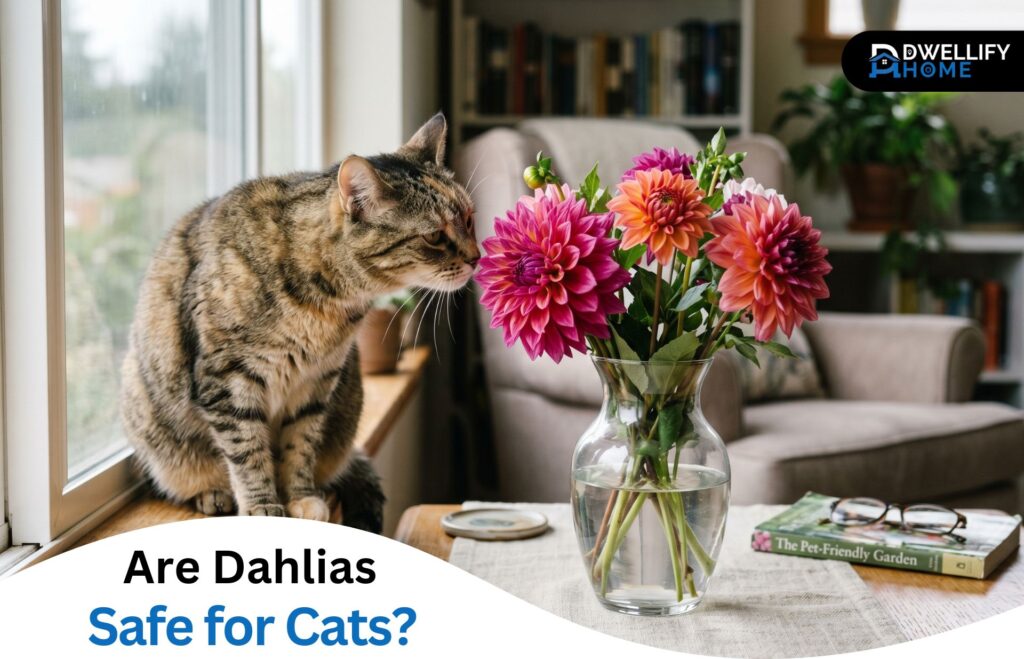
Walking into the kitchen and finding shredded petals on the floor, a guilty-looking cat in the corner, and a half-chewed dahlia stem on the rug is a moment most cat owners remember vividly. I’ve taken that exact phone call hundreds of times over the years, usually from someone whose voice is shaking a little. So let me settle the worry first and then walk you through everything you actually need to know about whether dahlias are safe for cats, what symptoms to watch for, and what you should do next.
The Short Answer
No, dahlias are not safe for cats. The ASPCA classifies them as mildly toxic, causing vomiting, diarrhea, drooling, and skin irritation if chewed or eaten. All parts of the plant — petals, leaves, stems, and tubers — pose a risk.
Mission Statement
At Dwellify Home, we help homeowners create spaces that are beautiful, practical, and safe for the whole household — pets included. From décor choices to garden picks, our guides are written to help you make confident, well-informed decisions about the home you live in every day.
Are Dahlias Safe for Cats? The Short Answer
No, dahlias are not safe for cats. The ASPCA lists them as toxic to cats, dogs, and horses, though the toxicity is generally classified as mild to moderate rather than life-threatening. The exact toxic compounds haven’t been fully identified, but they’re believed to be phototoxic polyacetylene substances common to plants in the daisy family.
In practical terms, that means most cats who chew or nibble a dahlia end up with an upset stomach or some skin irritation, not a medical emergency. That said, “mild” doesn’t mean “ignore it” — every cat reacts a little differently, and a few specific situations do warrant a vet call. I’ll walk you through those below.
Quick Risk Comparison: Dahlias vs. Other Common Flowers
| Flower | Toxicity to Cats | Severity |
| Lilies | Toxic | Severe — can cause kidney failure |
| Tulips | Toxic | Moderate — bulbs most dangerous |
| Hydrangeas | Toxic | Moderate |
| Dahlias | Toxic | Mild to moderate |
| Chrysanthemums | Toxic | Mild to moderate |
| Roses | Non-toxic | Safe |
| Sunflowers | Non-toxic | Safe |
| Zinnias | Non-toxic | Safe |
Key Things to Know at a Glance
- All parts of the dahlia plant are toxic, including tubers
- Symptoms are usually mild — vomiting, drooling, and skin irritation
- Most cats recover within 48 hours with basic care
- Smelling dahlias is far less risky than chewing them
- Lilies are far more dangerous than dahlias for cats
A Quick Look at Dahlias and Why Cats Are Drawn to Them
Dahlias belong to the Asteraceae family, which puts them in the same broad group as chrysanthemums, daisies, sunflowers, and zinnias. They bloom from mid-summer through the first frost and come in just about every color and shape imaginable — pom-poms, spiky cactus types, dinner-plate giants, and small button blooms.
Why do cats keep going after them? A few reasons I’ve seen play out over and over. The petals move with the slightest breeze, which triggers the same instinct that makes cats chase string. The leaves have a texture cats seem to enjoy mouthing. And the scent, while subtle to us, gives off enough plant-oil notes to interest a curious nose. Indoor cats are especially drawn to cut bouquets because something new just appeared in their territory, and they’re going to investigate it the way they investigate everything else — with their teeth.
Which Parts of the Dahlia Are Toxic to Cats?
All parts of the plant are considered toxic. That includes:
- Petals and flower heads — the part most often nibbled from indoor bouquets
- Leaves and stems — common with potted plants or garden-grown dahlias
- Tubers (the underground roots) — the part most owners don’t think about, but the most concerning for cats who dig
The tubers are worth flagging. They look a little like small, fingerlike potatoes, and dig-happy cats can absolutely uncover them in a garden bed. The concentration of plant compounds tends to be higher in the root structure, and they’re harder to spot if a cat has been chewing on one outside.
Indoors, the petals and leaves are what you’ll deal with. Outdoors, keep an eye on the soil too.
Are Dahlias Safe for Cats to Smell or Be Near?
This is one of the most common questions I get, and the answer is reassuring. Smelling a dahlia or sitting near a vase of them is not the same kind of risk as ingestion. Dahlias don’t release a toxic pollen the way lilies do — and lilies are in a completely different danger category, where even pollen on the fur or a sip of vase water can cause kidney failure in cats. Dahlias are nowhere near that level.
A cat sniffing a bouquet will be fine. A cat brushing past a flower bed will usually be fine too. What you want to avoid is direct skin contact with the sap (which can cause mild dermatitis in sensitive cats) and any chewing or licking. If your cat just wandered over to inspect the flowers and walked away, you don’t need to do anything. If they actually put their mouth on the plant, that’s a different story.
Symptoms of Dahlia Poisoning in Cats
If your cat has chewed or eaten part of a dahlia, symptoms usually show up within a few hours — sometimes within thirty minutes, sometimes closer to six or eight hours later. Here’s what to watch for:
- Vomiting, often the first sign
- Mild diarrhea
- Drooling or pawing at the mouth
- Loss of appetite or refusing food
- Lethargy or unusual quietness
- Skin redness, itching, or a rash around the mouth, paws, or face
- In rare cases, a slightly unsteady walk or mild loss of coordination
Most cats show one or two of these signs, not the whole list. The severity depends on how much was eaten, what part of the plant, the size of your cat, and how sensitive they are individually. A 12-pound adult cat who took one chomp of a petal is going to fare very differently from a 5-pound kitten who chewed through a leaf.
What to Do If Your Cat Eats or Chews a Dahlia
Here’s the action plan I give clients on the phone, in this order:
- Calmly remove any plant material from your cat’s mouth and wipe their fur, paws, and face with a damp cloth.
- Take the plant away and put it somewhere your cat absolutely can’t reach.
- Do not try to make your cat vomit at home. I know it feels like the right instinct, but home methods like hydrogen peroxide are dangerous in cats and can cause more harm than the plant itself.
- Make a quick mental note of how much was eaten, which part (flower, leaf, stem, or tuber), and roughly when it happened.
- Call your vet, the ASPCA Animal Poison Control Center at 888-426-4435, or the Pet Poison Helpline at 855-764-7661. A small consultation fee may apply, but it’s worth it for the peace of mind and a clear plan.
- Watch your cat for the next 12 to 24 hours for any of the symptoms above.
That’s it. Most cats need nothing more than a quiet evening of observation.
When to Call the Vet and When You Can Monitor at Home
Here’s the honest line I draw in practice. A healthy adult cat who took one or two nibbles of a petal and is acting completely normal can usually be monitored at home with a phone consult. A cat who ate a significant amount, especially of the leaves or tubers, should be seen.
You should call the vet right away if:
- Your cat is a kitten, a senior, or has a chronic illness like kidney disease or diabetes
- Vomiting happens more than once or twice
- Your cat refuses food or water for more than 12 hours
- Lethargy is getting worse instead of better
- There’s visible swelling around the mouth or face
- The skin irritation is spreading or your cat is scratching to the point of injury
When in doubt, call. A two-minute phone conversation with a vet is always cheaper and less stressful than a delayed emergency visit.
How Vets Diagnose and Treat Dahlia Poisoning
There isn’t a specific test for dahlia toxicity — diagnosis is based on the history you provide and a physical exam. This is why bringing a piece of the plant or a clear photo to the appointment helps so much. It speeds up the entire process.
Treatment is supportive rather than aggressive. For mild cases, that often means anti-nausea medication and a quiet day or two of bland food. For cats showing more pronounced symptoms, IV fluid therapy helps flush the system, replace what’s been lost from vomiting, and dilute any remaining plant compounds. Skin reactions are treated with a gentle bath and sometimes a short course of anti-inflammatory medication.
Most cats are back to themselves within 48 hours, with full recovery inside a week. Treatment costs typically run somewhere between $200 and $500 depending on whether your cat needs in-hospital care, fluids, or just an exam and meds. Pet insurance, if you have it, usually covers this kind of visit.
Are Dahlias Poisonous to Dogs as Well?
Yes. The ASPCA lists dahlias as toxic to dogs and horses too, with the same general clinical picture — mild gastrointestinal upset and possible dermatitis. Dogs tend to eat larger quantities than cats when they get into something, so symptoms can be a bit more pronounced, but the overall risk profile is similar. The same first-aid steps apply: remove the plant, call your vet or a poison helpline, and monitor.
Dahlias vs. Other Common Flowers: How Risky Are They Really?
This comparison helps put dahlias in perspective:
- Lilies — Severe. Even pollen or vase water can cause kidney failure in cats. Never bring these home if you have a cat.
- Tulips — Toxic, with the bulb being the most dangerous part. Symptoms can be more intense than dahlia exposure.
- Hydrangeas — Toxic. Contain compounds that can cause vomiting, diarrhea, and lethargy.
- Chrysanthemums — Mildly to moderately toxic. Same plant family as dahlias, with similar symptoms.
- Dahlias — Mildly toxic. Usually self-resolving with monitoring.
- Zinnias — Considered non-toxic to cats by the ASPCA. A safer choice that gives you a similar garden look.
So while dahlias aren’t safe for cats, they’re nowhere near the most dangerous flower you could have in your home. Lilies are the ones that genuinely scare me as a vet.
Cat-Safe Flowers You Can Grow or Display Instead
You don’t have to give up flowers to have a cat. These are all listed as non-toxic to cats by the ASPCA:
- Roses
- Sunflowers
- Gerbera daisies
- Snapdragons
- Marigolds
- African violets
- Zinnias
- Orchids
One honest caveat — even non-toxic plants can cause mild stomach upset if your cat eats a lot of them. “Non-toxic” means it won’t poison your cat, not that it’s a salad. If your cat is a determined plant chewer, supervise even the safe options.
How to Keep Your Cat Safe Around Dahlias at Home and in the Garden
Prevention is honestly the easiest part of this whole topic. A few practical setups that work:
Indoors:
- Keep cut dahlia bouquets in rooms your cat doesn’t have access to — a home office or guest room works well.
- Use hanging planters or wall-mounted vases for any potted dahlias.
- Place arrangements on high, narrow surfaces where a cat can’t comfortably perch.
- If you receive a mixed bouquet with dahlias, consider pulling those stems out and giving them to a flower-loving friend.
Outdoors:
- Plant dahlias in raised beds or fenced sections of the garden.
- Cover the soil around tubers with a layer of mulch or decorative stones to deter digging.
- Supervise outdoor time, especially during planting season when fresh soil is most tempting.
- Grow a small pot of cat grass or catnip nearby — giving your cat something safe to chew redirects the urge beautifully.
This last tip is one I share constantly. Most cats who chew plants aren’t being destructive, they’re satisfying a real instinct. Give them their own plant to demolish, and the dahlias suddenly become much less interesting.
Final Thoughts
Are dahlias safe for cats? No, but the worry most people feel when they search this question is usually bigger than the actual risk. Dahlia exposure is rarely an emergency. Most cats who get into one need nothing more than a damp cloth, a quiet evening, and a watchful eye. The cases that do need a vet are the ones where a small, sick, or senior cat has eaten a meaningful amount, or where symptoms are clearly getting worse instead of better.
Keep the ASPCA Poison Control number saved in your phone, store any cut bouquets out of reach, and consider swapping in some of the cat-safe alternatives for your next garden season. A pet-friendly home doesn’t mean a flowerless one — it just means making thoughtful choices about which blooms get to share the space.
Frequently Asked Questions About Dahlias and Cats
Are dahlia tubers more dangerous than the flowers?
The tubers tend to have a higher concentration of plant compounds, so a cat that chews on a tuber may show more pronounced symptoms than one that nibbled a petal. They’re also harder to clean off and easier to swallow whole.
How much dahlia is dangerous for a cat to eat?
There’s no exact threshold because it varies by cat size and sensitivity. As a general rule, a small nibble usually causes mild symptoms at most, while eating a substantial portion of leaves or tubers warrants a vet call.
Will my cat be okay if it just chewed one petal?
In almost all cases, yes. Watch for drooling, vomiting, or appetite changes over the next several hours, but a single petal rarely causes more than a brief stomach upset.
Can dried or pressed dahlias still affect cats?
Yes, though the risk is lower. Drying reduces moisture but doesn’t necessarily neutralize the irritant compounds. Keep dried arrangements out of reach.
Are dahlias safe around kittens?
Kittens are smaller, more curious, and more sensitive to plant toxins than adult cats. I’d skip dahlias entirely in a kitten household.
Can dahlias cause long-term health problems in cats?
For a one-time mild exposure, no. Cats recover fully. Repeated chronic exposure isn’t well studied, but it’s not something any reasonable owner would intentionally allow.
Are dahlias expensive compared to cat-safe alternatives?
Dahlia tubers run anywhere from a few dollars for common varieties to $20+ for rare cultivars, and cut bouquets are mid-range florist prices. Cat-safe alternatives like zinnias, marigolds, and sunflowers are generally cheaper and easier to grow from seed.
Can cats be in the same room as dahlias?
Yes, being in the same room is generally safe. Dahlias don’t release toxic pollen or fumes the way lilies do. The risk only becomes real if your cat chews, licks, or makes direct skin contact with the plant.
Are all dahlias poisonous to cats?
Yes. The ASPCA lists the entire Dahlia genus as toxic to cats, dogs, and horses. Color, size, or variety doesn’t change that — every type carries the same mild toxicity.
What’s the most toxic flower for cats?
Lilies are the most dangerous. Even pollen on the fur or a sip of water from a vase containing lilies can cause acute kidney failure in cats. Dahlias are nowhere near that level of risk.
Disclaimer
This article is provided for general informational purposes only and is not a substitute for professional veterinary advice. Every cat reacts differently, and individual situations may vary. If you suspect your cat has been exposed to a toxic plant, contact your veterinarian or a pet poison helpline right away.