Ask three gardeners what creeping myrtle is, and you’ll likely get three slightly different answers. One will call it periwinkle. Another will call it vinca. A third will swear myrtle is something else entirely. After years of standing in front of confused homeowners holding plant tags they can’t quite decode, the truth is simpler than most realize. The whole creeping myrtle vs periwinkle question comes down to common names that grew up in different regions and stuck around long after botany caught up.
This guide walks through what these names actually mean, how to tell the plants apart in your yard, and how to decide which one belongs in your garden.
Snippet-Ready Definition
Creeping myrtle and periwinkle are common names for the same plant, Vinca minor, a low-growing evergreen ground cover with violet-blue flowers. It’s chosen for shaded areas, slope erosion control, and low-maintenance year-round greenery.
Mission Statement
At Dwellify Home, we help homeowners make practical, stylish, and informed decisions about their living spaces, gardens, and outdoor environments. From modern home solutions to garden and lifestyle guidance, our goal is to deliver clear, trustworthy advice that turns everyday homes into better places to live.
Are Creeping Myrtle and Periwinkle the Same Plant?
In almost every case, yes. Creeping myrtle and periwinkle are two common names for the same plant: Vinca minor. It’s the low, glossy ground cover with violet-blue flowers that you’ve probably seen carpeting shaded yards or spilling over old stone walls.
The slight catch is this. “Periwinkle” sometimes refers to a close cousin called Vinca major, which is bigger, taller, and more aggressive. So when someone says periwinkle, they usually mean creeping myrtle. But not always. That small distinction is where most of the confusion starts, and it’s worth keeping in mind before you buy anything labeled simply as “periwinkle” at a garden center.
Quick Comparison Table
| Feature | Creeping Myrtle (Vinca minor) | Greater Periwinkle (Vinca major) |
| Mature Height | 3–6 inches | 12–24 inches |
| Leaf Size | Up to 1.5 inches | 2–3 inches |
| Flower Size | About 1 inch | 1.5–2 inches |
| USDA Zones | 4–8 | 7–9 |
| Aggressiveness | Steady, manageable | More aggressive |
| Best For | Cold climates, shaded yards | Warmer areas, larger spaces |
Key Benefits and Uses
- Stays evergreen year-round, even in cold winters
- Thrives in shaded spots where grass struggles
- Controls erosion on slopes and embankments
- Resists deer and most browsing animals
- Needs minimal care once established
- Works as a low-growing companion for spring bulbs
Why the Names Get Mixed Up
Plants picked up nicknames the same way people did, slowly and locally. Vinca minor has been called creeping myrtle, common periwinkle, lesser periwinkle, dwarf periwinkle, running myrtle, and just plain myrtle depending on where you grew up. Older gardeners in the Midwest and South tend to lean on “myrtle.” Northeastern and West Coast gardeners often default to “periwinkle.” Plant nurseries usually list it as vinca.
None of these names are wrong. They’re just regional habits layered over a single plant. The reason it matters today is that “periwinkle” is also used for Vinca major, the larger species. So the same word covers two different plants depending on who’s saying it. Once you know that, the whole creeping myrtle vs periwinkle puzzle starts to make sense.
Meet Vinca Minor: The Plant Behind Both Names
Vinca minor belongs to the dogbane family and is native to central and southern Europe. It came to North America as an ornamental ground cover and quickly became a favorite for shaded yards, slopes, and woodland borders. It’s a trailing evergreen subshrub, which is a fancy way of saying it stays low, stays green year-round, and spreads sideways instead of growing tall.
You’ll often find it carpeting the base of old trees, blanketing forgotten cemetery plots in the South, and softening the edges of stone paths. It’s tough, undemanding, and once it settles in, it doesn’t need much from you.
Creeping Myrtle vs Periwinkle: The Real Comparison That Matters
Here’s where the real comparison lives. When people ask about differences, they’re almost always comparing Vinca minor (creeping myrtle) with Vinca major (greater periwinkle), even if they don’t know it yet.
Leaf Size and Shape
Vinca minor has small, glossy, oval leaves about an inch and a half long. They feel leathery and have smooth edges. Vinca major has noticeably larger leaves, often two to three inches, with a more heart-shaped base and tiny hairs along the margins. If a leaf looks too big to belong on a low ground cover, it’s probably Vinca major.
Flower Size and Color
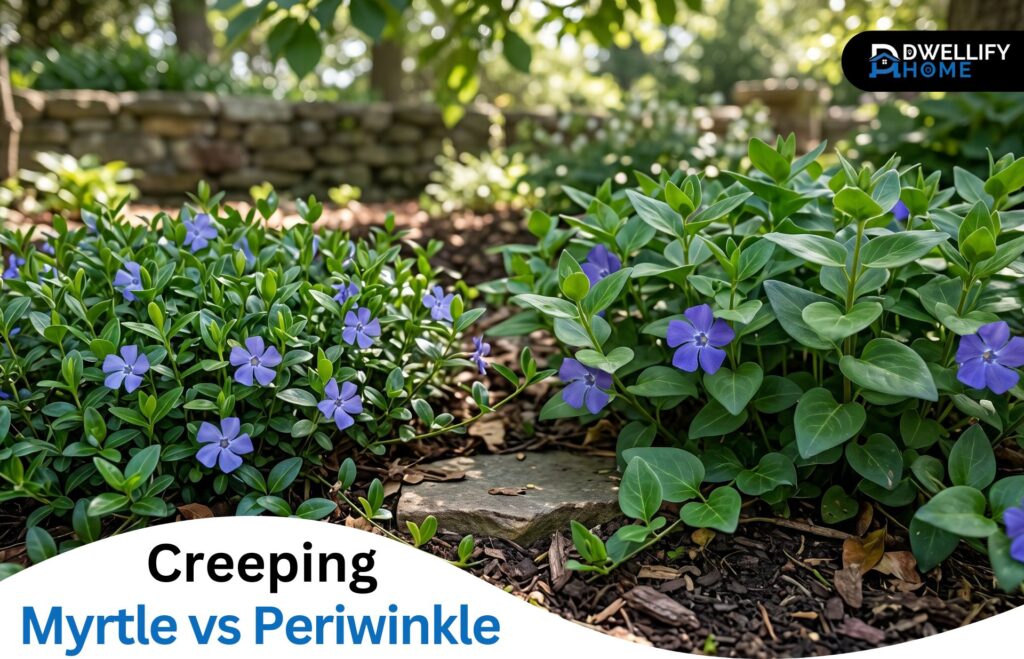
Both produce five-petaled, pinwheel-shaped flowers in shades of violet, blue, and occasionally white. Vinca minor flowers are about an inch across. Vinca major flowers are nearly twice that size and tend to bloom slightly later. The color is similar enough that flower size becomes the easier tell.
Mature Height and Growth Habit
Creeping myrtle stays low, usually three to six inches off the ground. It hugs the soil and roots wherever its stems touch down. Vinca major can climb to twelve, eighteen, even twenty-four inches before flopping over, giving it a much bushier, looser look.
Spread and Aggressiveness
Both spread. There’s no quiet version of vinca. But Vinca major is the more aggressive of the two and can swallow a flower bed in a season or two if it’s happy. Vinca minor spreads steadily but with more restraint, which is part of why it’s the more common pick for home landscapes.
Cold Hardiness and Sun Tolerance
Vinca minor handles cold winters far better and grows reliably from USDA zones 4 through 8. Vinca major prefers warmer climates, generally zones 7 and up, and tolerates more direct sun. In a cold-winter region, Vinca minor is almost always the right choice.
Quick Side-by-Side Comparison Table
| Feature | Creeping Myrtle (Vinca minor) | Greater Periwinkle (Vinca major) |
| Mature Height | 3–6 inches | 12–24 inches |
| Leaf Length | Up to 1.5 inches | 2–3 inches |
| Flower Size | About 1 inch | 1.5–2 inches |
| Leaf Edge | Smooth, no hairs | Slightly hairy margin |
| USDA Zones | 4–8 | 7–9 |
| Growth Aggressiveness | Steady, manageable | More aggressive |
| Best For | Shaded yards, cold climates | Larger areas, mild climates |
How to Identify Creeping Myrtle in Your Garden
Once you’ve seen creeping myrtle a few times, it’s hard to miss. Look for low, glossy, dark green leaves that stay on the plant through winter. Snap a stem and you’ll see a milky white sap, which is a quick giveaway for the dogbane family. In early spring, small violet-blue flowers with five overlapping petals open up across the mat.
The plant moves outward in long horizontal stems that root wherever they touch moist soil. That rooting habit is the reason it forms such a thick carpet over time and the reason it’s so hard to remove once it settles in.
Where Creeping Myrtle and Periwinkle Grow Best
These plants are forgiving, but they have clear preferences. Partial shade is the sweet spot. Full shade works too, especially under mature trees where grass refuses to grow. They’ll tolerate sun in cooler northern climates but tend to fade or scorch in hot southern afternoons.
Soil-wise, they’re easygoing. Rich, moist, well-drained soil gives the fastest growth, but they handle clay, sandy, and even rocky ground once established. Vinca minor reliably overwinters in zones 4 through 8. The one thing they genuinely dislike is constantly soggy ground, where the roots can rot out.
Planting and Spacing Guide
Spring or early fall is the ideal planting window. The soil is workable, the temperatures are mild, and the plants have time to root before stress hits.
For a thick cover within a single season, plant about 8 inches apart. For larger areas where you don’t mind waiting a year or two, 12 to 18 inches works fine and saves money. A common mistake is spacing them too far apart and then giving up when the bed looks bare in year one. Patience pays off here.
A quick checklist that holds up in real planting jobs:
- Loosen the top few inches of soil before planting.
- Water deeply right after planting, not just a sprinkle.
- Add a 2-inch layer of mulch to hold moisture and slow weeds.
- Skip fertilizer for the first season unless soil is genuinely poor.
Care and Maintenance Made Simple
Once vinca is established, it’s about as low-maintenance as ground covers get. Water through the first season to help roots settle in, then let nature take over. After that, it handles drought far better than people expect.
Pruning is mostly about control. A quick trim along bed edges every spring keeps it from creeping into lawns or paths. Some gardeners run a mower over large patches at the highest setting in early spring to refresh growth, though this only works for Vinca minor and only when you actually want it to thicken up rather than shrink back.
In winter, the leaves stay on. They may look a bit tired by February, but new growth covers the old by late spring without any effort from you.
Best Landscaping Uses for Modern Homes and Gardens
Vinca minor earns its keep in the spots where most other plants struggle. The most reliable uses include:
- Ground cover under mature trees where grass thins out.
- Erosion control on shaded slopes that are too steep to mow.
- Soft borders along woodland edges and stone paths.
- Underplanting for spring bulbs like daffodils and tulips, which push up cleanly through the mat.
- Rock garden filler where you want green between stones year-round.
It also works well in narrow side yards and shaded courtyards where modern home designs leave awkward strips of bare soil. The trailing habit softens hard edges and makes small spaces feel finished.
Popular Cultivars Worth Knowing
Most homeowners just buy whatever generic vinca the nursery has, but a few cultivars are worth asking for by name.
- Bowles is the most popular improved variety, with larger blue flowers and stronger blooming.
- Illumination has bright gold-centered leaves that brighten dark corners.
- Wojo’s Gem offers cream and green variegation and a softer growth habit.
- Atropurpurea produces deep plum-purple flowers instead of the typical blue.
- Argenteovariegata carries creamy white leaf margins and a slightly slower spread.
The variegated cultivars also tend to be less aggressive, which makes them a better fit for smaller, more controlled spaces.
Is Creeping Myrtle Invasive? What Homeowners Should Know
This is the part that often gets glossed over, and it shouldn’t. Vinca minor is officially listed as invasive in several U.S. states, particularly in the Midwest and Northeast. It escapes home gardens by sending stems into nearby woodlands, where it forms dense mats that block native wildflowers and tree seedlings.
If you live next to a wooded area, a creek, or any natural land, plant it carefully. Keep it surrounded by hard edges like sidewalks, lawns, or stone borders that block its spread. Pull stray runners before they root. And don’t dump yard waste containing vinca into the woods, which is one of the most common ways it escapes in the first place.
Pros and Cons at a Glance
Strengths that hold up across real garden conditions:
- Stays evergreen through harsh winters.
- Tolerates deep shade and poor soil.
- Resists deer and most browsing animals.
- Holds slopes against erosion better than turf grass.
- Needs almost no input once established.
Drawbacks worth weighing honestly:
- Spreads aggressively and can be hard to remove later.
- Considered invasive in several regions.
- Mildly toxic to dogs, cats, and livestock if eaten.
- Does poorly in hot afternoon sun.
- Can shade out smaller perennials planted within it.
Native Alternatives Worth Considering
For gardeners in regions where vinca is invasive, or for anyone wanting to support local wildlife, a few native ground covers deliver similar coverage without the ecological baggage:
- Pachysandra procumbens (Allegheny spurge) for similar shade tolerance and texture.
- Phlox divaricata (woodland phlox) for spring blue flowers and a softer look.
- Mitchella repens (partridge berry) for a low, evergreen creeper with red berries.
- Sedum ternatum (wild stonecrop) for shaded rocky areas where vinca might overgrow.
- Mahonia repens (creeping mahonia) for a sturdier evergreen with yellow blooms.
These won’t match vinca’s sheer coverage speed, but they hold their own and they belong in the local ecosystem.
How to Choose the Right Ground Cover for Your Garden
The right pick comes down to honest answers to a few questions.
What’s your climate? In zones 4 through 6, Vinca minor wins easily. In zones 8 and 9, Vinca major may handle the heat better.
How much sun does the area get? Both prefer shade, but Vinca minor takes more sun in cooler climates. Hot afternoon sun in southern states burns the leaves on either species.
Is the area near a natural woodland? If yes, lean toward a native alternative or commit to active containment.
How much space do you need to fill? For small, contained beds, Vinca minor or a less aggressive cultivar like Wojo’s Gem is ideal. For sprawling slopes where you actually want fast coverage, Vinca major may justify itself.
How much maintenance do you actually want to do? If the answer is “almost none,” vinca delivers. Just go in knowing that “almost none” still means pulling back the edges once a year.
Frequently Asked Questions
Is creeping myrtle the same as common periwinkle?
Yes. Both are common names for Vinca minor. The name varies by region, but the plant is the same.
How tall does creeping myrtle grow?
Most plants stay between 3 and 6 inches tall, occasionally reaching 8 inches in rich soil with partial shade.
How far apart should I space creeping myrtle plants?
Plant 8 inches apart for full coverage in one season. Use 12 to 18 inches for larger areas if you can wait two seasons.
Can creeping myrtle grow in full sun?
It can, but only in cooler climates. In hot southern summers, full sun scorches the leaves and slows growth.
Is creeping myrtle toxic to pets?
Yes, mildly. The leaves and stems contain alkaloids that can cause stomach upset in dogs, cats, and livestock if eaten in quantity. It’s worth keeping in mind for households with curious pets.
Does creeping myrtle stay green in winter?
Yes. The leaves remain on the plant year-round, though they may look slightly worn by late winter before new spring growth takes over.
Can I mow creeping myrtle to control its spread?
Mowing rarely kills it because the plant resprouts from stem fragments. A high mower setting can refresh growth, but for actual control, hand-pulling and edging work better.
What’s the main difference between Vinca minor and Vinca major?
Vinca minor is smaller, lower, hardier in cold climates, and less aggressive. Vinca major has bigger leaves and flowers, grows much taller, and prefers warmer regions.
Conclusion
The whole creeping myrtle vs periwinkle question is less about two different plants and more about one plant with too many names, plus a larger cousin that occasionally borrows the same nickname. Once you understand that Vinca minor is the low, well-behaved version and Vinca major is the larger, more aggressive one, the choice becomes straightforward.
Match the plant to your climate, your light conditions, and your willingness to manage its spread. Done thoughtfully, it’s one of the most reliable ground covers you can put in the ground. Done carelessly, it becomes the plant you spend years trying to remove. The difference, like most things in gardening, comes down to planting it on purpose and not by accident.
Disclaimer
The information shared in this article is provided for general informational purposes only. Plant behavior, growing conditions, and results may vary based on climate, soil, region, and individual care practices. Readers are encouraged to verify local invasive species regulations and consult regional gardening resources before planting.