A fruit tree that earns its garden space in three seasons out of four is rare. Most fruit trees give you a brief window of blossom, a short harvest, then nothing of visual interest until next year. The Asian pear is different: white flowers on bare wood in early spring, a dense, fruit-laden canopy through summer, and a warm flush of orange-red foliage before dormancy. And then there’s the fruit itself — crisp, juicy, and nothing like the European pears most gardeners already know.
Pyrus pyrifolia is the botanical name you’ll see on the nursery label. If you’ve found this guide because you’re trying to work out what that name means, or because you’ve been growing one of these trees for a season and wondering why things aren’t going quite as expected, you’re in the right place. This guide takes you from identification and cultivar selection through planting, pruning, thinning, and the harvest cues that catch first-time growers off guard.
Snippet-Ready Definition
Pyrus pyrifolia is a deciduous pear tree native to East Asia, producing crisp, firm fruit commonly called the Asian pear or nashi. Unlike European pears, it ripens fully on the tree, stays firm when ready, and is eaten fresh rather than cooked.
Mission Statement
Dwellify Home is built for people who want their homes and gardens to work as well as they look. We cover modern home living, garden and outdoor design, practical home solutions, and property decisions with research-backed content written for real homeowners and outdoor enthusiasts. Our goal is to give you the clarity and confidence to make decisions you won’t regret.
What Is Pyrus Pyrifolia?
Pyrus pyrifolia is a species of deciduous pear tree in the family Rosaceae, native to southern China and northern Indochina. It produces round to slightly flattened fruit commonly known as the Asian pear, nashi, or apple pear. Unlike European pears, the fruit ripens fully on the tree, remains firm when ready to eat, and can be eaten directly from harvest without further ripening on the bench.
Pyrus Pyrifolia Common Names — Nashi, Sand Pear, Apple Pear, and More
The number of names attached to this tree reflects how widely it has been grown — and how long it has been grown — across very different regions.
In Japan and across Australasia, the fruit is called nashi, a word that simply means “pear” in Japanese. In the older UK and American horticultural literature, “sand pear” was the standard name, a reference to the slightly gritty texture caused by stone cells in the flesh. Supermarkets in the UK and US now commonly use “apple pear,” which describes the shape well enough. In Korea it’s the bae, Chinese regional names vary, and “papple” emerged at some point as a Western marketing invention.
All of these names refer to the same plant species. The variety you find in a Japanese orchard, a Korean market, or a California nursery catalogue is Pyrus pyrifolia — or a cultivar derived from it.
Pyrus Pyrifolia var. Culta — What This Designation Means for Gardeners
If you’ve encountered “Pyrus pyrifolia var. culta” on a plant label or in a research paper and assumed it was a different species, it isn’t.
Var. culta is the botanical designation for the cultivated form of the wild species — the improved, selected, named varieties developed through thousands of years of orchard cultivation in East Asia. It distinguishes garden-grown cultivars from the wild ancestral species. When you purchase a named variety such as Hosui or Nijisseiki from a nursery, you are buying Pyrus pyrifolia var. culta. The term appears most frequently in scientific literature and on specialist nursery labelling; for practical growing purposes, it changes nothing about how you manage the tree.
Botanical Classification — Rosaceae Family and Its Significance
The genus Pyrus belongs to the family Rosaceae — the same family as apples (Malus), quinces (Cydonia), and European pears (Pyrus communis). This connection has practical implications: Rosaceae family members share certain disease vulnerabilities, particularly fire blight, and the cultural requirements across the group — soil pH, drainage, full sun — follow broadly similar principles.
Key synonyms you may encounter in older literature: Pyrus serotina and Pyrus sinensis refer to this same species.
The Pyrus Pyrifolia Tree — Growth Habit and Physical Characteristics
The Asian pear is a deciduous tree that reaches 7–15 metres in its wild state but typically grows to 3–8 metres on grafted garden stock, depending on the rootstock selected. It has a moderate growth rate, a broadly spreading canopy, and a productive lifespan of 30–60 years under reasonable management. White blossoms appear in early-to-mid spring before or alongside leaf emergence, followed by round to oblate fruit that ripens from late summer into autumn. The tree is fully deciduous, leafless through winter, and tolerates cold dormancy temperatures down to approximately -15°C.
Size, Spread, and Lifespan — What to Expect in a Home Garden
Standard-grafted trees in home gardens typically reach 4–6 metres in height with a similar canopy spread. On dwarfing rootstock — such as Pyrus betulaefolia or compatible quince selections — 2.5–4 metres is a realistic expectation, which is manageable for most gardens and still capable of a genuinely productive harvest.
Expect the first meaningful crop in year 3–4 after planting grafted stock, with full production developing by year 5–7. Seed-grown trees take considerably longer to bear and won’t replicate the characteristics of the parent variety — always plant grafted stock for the home garden.
The productive lifespan is one of the most underappreciated qualities of this tree. Well-maintained specimens routinely reach 40–50 years of productive fruiting. The investment in a good grafted tree pays over decades, not seasons.
Pyrus Pyrifolia Flowers — Ornamental Value and Timing
The flowers appear in clusters on spur wood, typically between late February and mid-April depending on climate and cultivar. They’re white, five-petalled, and fragrant — and early-blooming varieties produce them on bare wood before the leaves have emerged, which makes a mature tree genuinely striking in a late-winter garden.
The ecological timing matters too. Early-flowering Asian pear cultivars provide nectar for emerging queen bumblebees and other early pollinators at a point in the season when very little else is open. This is worth factoring into where you site the tree.
Fruit Appearance — Skin Types, Stone Cells, and What They Mean
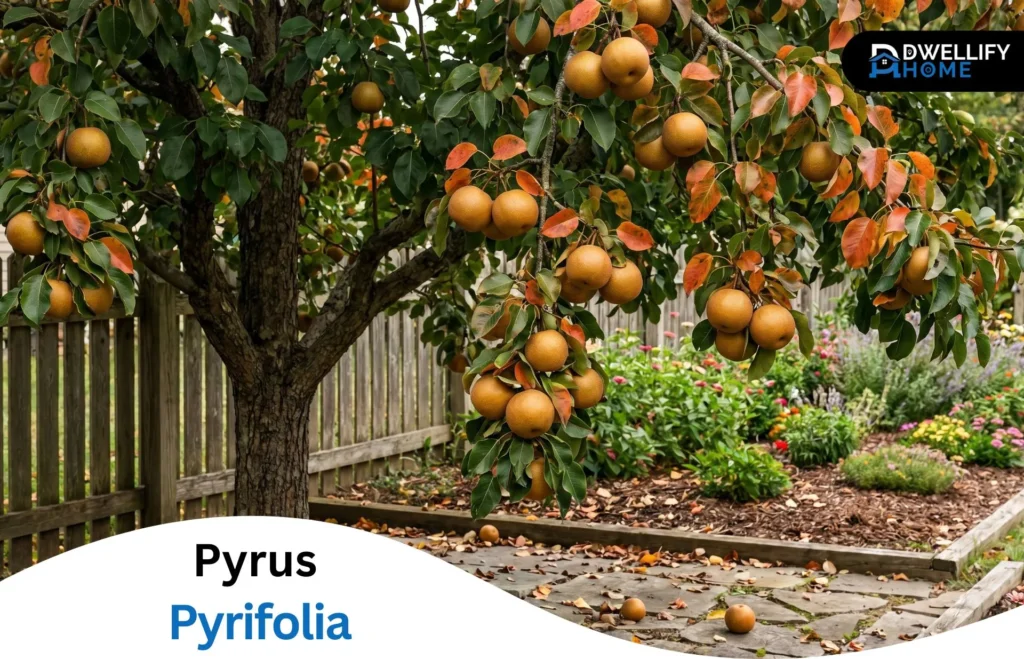
Asian pear fruit falls into two broad skin categories: rough-skinned (russet, bronze-brown) and smooth-skinned (green to yellow). The rough-skinned types carry the gritty quality that gave the sand pear its name — this is caused by stone cells (sclereids), which are clusters of lignified cells in the flesh that persist through ripening.
Both categories produce crisp, juicy, white-to-cream flesh that stays firm at peak ripeness. The shape ranges from round and apple-like in most Japanese types to slightly elongated in some Chinese varieties. That persistent crunch is not a sign of underripeness; it is the defining characteristic of the fruit.
Pyrus Pyrifolia vs. Asian Pear vs. European Pear — What Is the Difference?
Pyrus pyrifolia and Asian pear are the same thing — Pyrus pyrifolia is the scientific name for the plant that produces the fruit commonly called Asian pear, nashi, or apple pear. These terms are fully interchangeable. European pears (Pyrus communis) are a distinct species with different growing requirements, different ripening behaviour, and different culinary applications.
How Pyrus Pyrifolia Differs from European Pear
The most important practical difference is how the fruit ripens. European pears are harvested before they reach full ripeness and left to soften at room temperature — that softening is the signal they’re ready to eat. Asian pears ripen completely on the tree and remain firm when they’re at their best. Waiting for them to soften the way a Conference or Williams pear would is waiting for something that simply won’t happen.
The texture difference is just as significant. European pears develop smooth, buttery flesh at peak ripeness. Asian pear flesh stays crunchy because of its stone cells — this is the defining quality, not a deficiency.
The culinary consequence: European pears hold their structure under heat, poach into a silky texture, and have sufficient natural pectin for jam-making. Asian pears have too much water content and too little structural pectin for most of these applications. They are a fresh-eating fruit first and foremost.
Japanese-Type vs. Chinese-Type Asian Pears — Key Differences
Japanese varieties are the direct descendants of the Pyrus pyrifolia species: round, apple-shaped, russet or golden-brown skin, sweet and juicy with that characteristic crisp bite. These are the varieties most commonly available from Western nurseries.
Chinese varieties — most commonly Pyrus x bretschneideri hybrids or Pyrus ussuriensis crosses — are more elongated, tend toward yellow skin, carry a slightly tarter flavour, and are generally more cold-hardy. They bloom later than Japanese types, which directly affects which varieties can cross-pollinate them. For most home gardens in temperate Europe, the UK, and temperate North America, Japanese-type Asian pear varieties are the practical starting point.
Best Pyrus Pyrifolia Cultivars for the Home Garden
Choosing the right cultivar for your climate is the single most consequential decision you make before planting. A well-matched variety will fruit reliably year after year. The wrong one — most often a variety that requires more chill hours than your winters reliably provide — will grow, look healthy, and produce almost no fruit. The variety list below covers the options worth considering for most home gardens.
Rough-Skinned Cultivars — Hosui, Chojuro, and Shinko
Hosui is the variety I recommend most consistently for home gardens in milder temperate climates. Golden-brown russet skin, sweet and floral with a full pear flavour, heavy-cropping from year 3–4. Chill hours required: 300–450. Widely available from UK and US nurseries, and the cultivar that most often converts people who weren’t previously Asian pear enthusiasts.
Chojuro has a distinctly richer flavour — butterscotch is the description most tasters reach for, and it’s accurate. Russet-brown skin, slightly firmer flesh than Hosui, and an excellent storage life after harvest. Chill hours: 350–450. Bloom timing overlaps closely with Hosui, making them a reliable pollination pair.
Shinko is a late-season variety: large, coppery-russet skin, and notably the best storage performance of the three — up to 5 months refrigerated. Chill hours: 450–500. It shows partial self-fertility but performs significantly better with a cross-pollinator in place.
Smooth-Skinned Cultivars — Twentieth Century (Nijisseiki) and Olympic
Nijisseiki, sold as Twentieth Century in many markets, is the most widely grown smooth-skinned Asian pear globally. Green to yellow skin, mild and sweet, with flesh that is notably lighter and less gritty than the rough-skinned types. Chill hours: 300–400. It’s often the better entry point for gardeners or household members unfamiliar with the Asian pear’s texture.
Olympic (also known as Korean Giant) suits cooler gardens where chill accumulation exceeds 600 hours. The fruit is notably large — some specimens reaching 700–900g — with yellow skin and a milder flavour than Hosui. A good choice where Shinko or Hosui may be insufficient for the available chill hours.
Choosing a Cultivar Based on Your Climate and Chill Hours
Chill hours are the accumulated hours below 7°C (45°F) that the tree experiences during winter dormancy. This cold exposure triggers the hormonal process that enables proper flowering and fruit set the following spring. A tree that consistently falls short of its variety’s requirement will flower poorly and set little or no fruit — regardless of how well everything else is managed.
Practical guide: under 400 chill hours — Hosui or Nijisseiki. Between 400 and 600 hours — Chojuro and Shinko. Above 600 hours — Olympic performs well, and Shinko becomes excellent. Exceeding a variety’s chill requirement is no problem. Consistently falling short is the issue, and it’s not one you can compensate for with better pruning or more fertiliser.
Climate, Hardiness, and Where the Asian Pear Will Grow
The Asian pear grows reliably in USDA Hardiness Zones 5–9, tolerating dormant temperatures down to approximately -15°C. It requires a period of winter cold to fruit properly and performs poorly in subtropical climates where winters are too warm to provide this. High humidity during the growing season increases fire blight risk. The tree performs best in climates with cool, dry springs and warm summers — conditions broadly typical across temperate Europe, the Pacific Northwest, and most of temperate Australia and New Zealand.
USDA Hardiness Zones, Cold Tolerance, and Temperature Limits
Zone 5–9 is the reliable growing range. Some cultivars extend into Zone 4 when well established on cold-hardy rootstock, though late frost damage to early spring blossoms remains a genuine risk in these colder positions.
The upper limit is more frequently the practical constraint. Zones 10 and above rarely accumulate sufficient chill hours for reliable fruiting. High temperatures during fruit development can also compromise flesh quality, producing soft, mealy texture rather than the crispness Asian pears are known for. Coastal and highland microclimates in warm regions can sometimes compensate — it’s worth checking local chill hour data rather than assuming zone rating alone tells the full story.
Is Pyrus Pyrifolia Self-Pollinating?
Most Asian pear varieties are not self-fertile. They require cross-pollination from a second Asian pear variety that flowers at the same time to produce a reliable crop. A single tree planted in isolation will typically produce little or no fruit, regardless of how well the tree is maintained. Shinko shows partial self-fertility but produces noticeably better yields when a compatible pollinator is present. Plan for two trees from the outset — treating this as optional will cause unnecessary frustration.
Choosing a Pollination Partner — Bloom-Time Compatibility
Match varieties by bloom period: early bloomers with early bloomers, mid-season with mid-season. Hosui and Chojuro are one of the most consistently reliable pairings available in temperate gardens — their bloom windows overlap closely, both are widely stocked, and their different flavour profiles give you two distinct harvests from a single season.
European pears can cross-pollinate Asian pears where bloom times overlap, but compatibility varies and this shouldn’t substitute for a dedicated Asian pear pollinator. Keep your two trees within 50 metres of each other — closer is meaningfully better, particularly in cool, wet springs when bee activity is reduced.
Soil, Sunlight, and Site Selection for Pyrus Pyrifolia
Ideal Soil Type, pH, and Drainage
Well-draining loam is the ideal soil — fertile, well-structured, and neither waterlogged nor drought-prone. Clay soils are workable if drainage is improved at planting with organic matter and, where necessary, a rubble or gravel layer beneath the root zone. Avoid low-lying ground that holds water after rain; root rot risk increases substantially in poorly drained conditions, and fire blight pressure rises alongside it.
Target soil pH is 6.0–6.8, with 6.3–6.5 giving the best nutrient availability. Test before planting — it takes five minutes and avoids years of unexplained poor performance. Correct with lime if the pH is too low, sulphur if too high. Add garden compost to the backfill to improve soil structure, but don’t overload nitrogen at planting stage.
Sun, Frost Risk, and Wind Exposure
Full sun is non-negotiable for fruiting. Less than 6 hours of direct sunlight daily and the tree will grow well but disappoint consistently at harvest. Eight or more hours through the growing season produces the best fruit quality and meaningfully reduces disease pressure by keeping the canopy dry.
Frost pockets — low-lying areas where cold air drains and pools on still nights — are a specific hazard because Asian pears bloom early in spring. A single late frost event on open blossoms can remove an entire season’s crop. A sheltered, south- or west-facing position in the Northern Hemisphere gives the best combination of warmth accumulation and frost protection.
Spacing — Between Trees and from Structures
Standard-grafted trees need 4–5 metres between them. Dwarfing-rootstock trees can be planted 2.5–3.5 metres apart. For cross-pollination, keep your two trees close — within 10–15 metres if possible. Bees will travel further, but shorter distances give reliable pollination even in poor spring weather when bee activity is limited.
Avoid planting within 2 metres of walls or structures unless you’re deliberately training the tree as an espalier — a training form that works well with Asian pears and keeps the tree productive in a smaller footprint.
How to Plant a Pyrus Pyrifolia Tree — Step by Step
The single most common planting mistake is burying the graft union. It happens because it feels instinctively natural to plant a tree flush with the surrounding soil — but doing so causes the scion wood to root, which overrides the rootstock and loses the size-controlling and soil-tolerating benefits you purchased.
When to Plant — Dormant Bare-Root vs. Container
Bare-root trees are planted during dormancy: late autumn through early spring, before bud swell begins. This is the better option when available — bare-root stock is cheaper, establishes faster, and suffers less transplant stress than container-grown trees.
Container-grown trees can go in at any point outside peak summer heat, with spring and autumn preferred. Never plant into waterlogged ground, hard-frozen soil, or during a sustained hot period. All three scenarios stress the root system before the tree has had any chance to establish itself.
Planting Depth, Graft Union Placement, and Backfilling
- Dig a hole twice the width of the root ball and the same depth.
- Loosen the subsoil at the base of the hole to improve drainage and encourage downward root penetration.
- Position the tree so the graft union — the visible swollen knuckle near the base of the stem — sits 5–10 cm above the final soil level.
- Backfill in two or three stages, firming each layer by hand to remove air pockets without compacting the soil around the roots.
- On exposed sites, stake with a low post reaching one-third of the tree’s height, secured with a rubber tree tie — firm enough to prevent rocking, loose enough to allow natural trunk movement.
Mulching, Initial Watering, and the First Season
Apply 5–8 cm of organic mulch (composted bark or garden compost) in a 60 cm radius around the base of the tree. Keep the mulch clear of the trunk by 10 cm to prevent collar rot. Water deeply at planting, then twice weekly for the first month. Once per week through the second month, unless conditions are unusually dry.
Do not apply fertiliser in the first growing season. Root establishment is the tree’s priority at this stage, and added nitrogen can do more harm than good before the root system is developed enough to use it.
Caring for Pyrus Pyrifolia Through the Seasons
This is not a demanding tree once established. The majority of problems in home garden Asian pears trace back to three specific mistakes: excess nitrogen fertiliser, inconsistent watering in the first two seasons, and leaving diseased winter material in place around the base of the tree.
Watering — Young Trees vs. Established Trees
Young trees in their first two to three seasons need consistent moisture — approximately 25–38 litres per week in dry periods, delivered slowly enough to penetrate the full root zone. Surface sprinkling does very little useful work here; deep, infrequent watering encourages the root system to grow downward and establishes a more drought-resilient tree for the long term.
Established trees are far more tolerant of dry spells. Water when the top 5 cm of soil is dry — roughly once per week through the summer months on most soil types. Maintaining a mulch layer significantly reduces how often this is needed.
Fertilising Without Triggering Fire Blight
Apply a balanced granular fertiliser (10-10-10 or equivalent) in early spring, before the buds break open. Once the tree begins fruiting — typically year 3 or 4 — reduce the nitrogen component. Excess nitrogen produces exactly the kind of lush, soft new growth that fire blight bacteria (Erwinia amylovora) exploit most effectively. This is one of those causal links that home gardeners often miss: a well-fertilised tree that consistently gets fire blight may simply be receiving too much nitrogen.
In mid-summer, switch to a fertiliser with a higher potassium ratio. Potassium at this stage improves fruit flavour, skin development, and the tree’s ability to harden off properly before winter dormancy.
Winter Dormancy — What to Do and What to Avoid
When the leaves drop in autumn, apply a copper-based fungicide spray to the bare branches and the ground directly beneath the canopy. This measurably reduces the overwintering spore load for fire blight and other fungal diseases.
Remove all fallen fruit and leaf debris from around the base — both act as direct inoculant sources into next season’s growing cycle. Do not dig around the root zone in winter; tree roots remain active even when the top growth appears completely dormant, and unnecessary disturbance causes stress that shows up in spring performance.
How to Prune Pyrus Pyrifolia — and When
Pruning Asian pears correctly is what separates gardens that produce fruit worth eating from gardens that produce large quantities of small, unremarkable pears. The technique differs from European pear management in one important respect, and getting it wrong is a persistent source of disappointment for home growers who otherwise do everything right.
The Best Time to Prune — Why the Dormant Window Matters
Prune in late winter: February–March in the Northern Hemisphere, August–September in the Southern. The tree should be fully dormant, buds closed, and ideally a dry stretch of weather forecast for the days following your cuts.
Fire blight bacteria are inactive in cold dormant conditions. Pruning during active growth, or in wet weather at any time of year, creates open wound surfaces that the pathogen can enter through directly. This is a common infection pathway in home gardens where timing is treated as flexible — it isn’t.
Spur Pruning — The Method That Directly Improves Fruit Size
Spur pruning is the core annual technique for productive Asian pear management. Each winter, shorten the laterals on established spur systems back to 2–4 buds. This limits the number of fruiting positions on each spur and concentrates the tree’s carbohydrate reserves into the fruit that does set — producing fewer but substantially larger, better-flavoured pears than an unpruned tree on the same site will ever achieve.
Remove overcrowded, crossing, and downward-growing spurs entirely. The goal is an open canopy where light reaches every productive spur, airflow is good, and the tree’s energy is directed precisely rather than dispersed across every available bud.
Training Young Trees — Central Leader vs. Open-Centre Form
In the first 3–5 years, choose a training form and build it consistently. Open-centre (vase form) is generally the better choice for home gardens: remove the central leader, select 3–5 main scaffold branches at wide, near-horizontal angles, and develop the canopy outward from these. The resulting open structure improves light distribution and airflow throughout the canopy — both of which meaningfully reduce fire blight incidence.
Central leader form suits more formal garden settings and works well for espalier training against a wall or fence. Where fire blight pressure is historically high in your area, allowing 2–3 leaders from low on the stem reduces the risk of a single infection event causing permanent structural damage to the whole tree.
Fruit Thinning — The Step That Most Home Gardeners Skip
An Asian pear tree that is allowed to carry every fruitlet it sets will produce a quantity of small, flavourless pears — and may damage itself in the process. The tree doesn’t regulate its own crop load; that is the grower’s responsibility.
Why Skipping Thinning Damages Both Fruit and Tree
An unthinned spur on a productive Asian pear tree can carry 8–15 developing fruitlets. Those fruitlets compete directly for the same photosynthate from the same section of canopy. Left to develop, the majority will stall at golf-ball size. The few that grow larger will be pale, bland, and not remotely representative of what the variety is capable of producing.
Beyond fruit quality, the weight of a full unmanaged crop puts genuine mechanical stress on lateral branches. Limb damage in mid-summer is a significant setback for a productive tree — and it’s entirely preventable.
When and How to Thin — Timing, Spacing, and What to Remove
Thin 14–40 days after petal fall, once the developing fruitlets have reached approximately the size of a large grape. Wait for natural fruit drop (commonly known as “June drop”) to occur first — some fruitlets will fall without intervention, and removing them before this happens means doing unnecessary work.
Target one fruitlet per spur, or one fruit every 15 cm along a lateral where fruitlets aren’t on distinct spur systems. Remove the smallest, most misshapen, and most blemished fruitlets first. Pinch or snap off by hand — no tools needed. On an established tree, this takes 20–30 minutes and pays for itself many times over at harvest.
Pests, Diseases, and Common Problems
Asian pears are more disease-resistant than European pears in most garden conditions, but fire blight is a serious threat requiring specific, proactive management. The other problems you’re likely to encounter are considerably more manageable.
Fire Blight — How to Identify It, Prevent It, and Respond
Fire blight (Erwinia amylovora) is a bacterial disease specific to the Rosaceae family. Symptoms are distinctive: new shoot tips blacken and curl into the characteristic shepherd’s crook form, as though the growth has been scorched. Blossoms turn brown and remain attached to the tree rather than dropping naturally.
Prevention takes priority because response is not always fully effective. Avoid excess nitrogen. Prune only in dry dormant conditions. Apply copper-based fungicide after harvest and before autumn rains. In areas with persistent disease pressure, prioritise fire blight-tolerant cultivars and train in open-centre form to maximise airflow.
When infection is identified: cut infected wood at least 30 cm below the last visible symptom. Sterilise pruning tools between every single cut — methylated spirits or a 10% bleach solution both work reliably. Do not compost affected material; remove it from the garden entirely.
Pear Slug and Other Common Insect Pests
Pear slug (Caliroa cerasi) — the larva of a sawfly — is the most frequently encountered insect pest on Asian pears. Dark, slug-like larvae appear on the upper leaf surface in summer and skeletonise the leaves, leaving a papery, brownish membrane behind. They look considerably worse than they are; a healthy established tree tolerates moderate infestation without meaningful yield impact.
Control: dislodge by hand or with a firm jet of water; apply kaolin clay as a physical barrier on young trees; use pyrethrum-based spray for heavy infestations. Also watch for codling moth damage inside developing fruit — entry holes near the calyx are the tell — and aphid colonies on new growth in spring.
Physiological Problems and What They Signal
Root rot presents as sudden, widespread canopy dieback that can initially be confused with fire blight. The distinction: fire blight progresses from shoot tips inward; root rot causes generalised collapse. Prevention is straightforward — adequate drainage at planting.
One note that almost no gardening source addresses: pear seeds, like seeds across the Rosaceae family, contain trace quantities of cyanogenic glycosides. This presents no risk when eating the fruit normally. Simply don’t consume pear seeds in significant quantities — there is no practical reason to do so.
When and How to Harvest Pyrus Pyrifolia
Harvesting Asian pears at the right moment is where a lot of careful growing work either pays off or gets quietly wasted. The rules that apply to European pears are exactly wrong here, and applying them is the most common reason a home-grown Asian pear ends up disappointing.
How to Know When Asian Pears Are Ready to Pick
Asian pears do not soften at peak ripeness. Waiting for softness as a harvest cue won’t work — the fruit stays firm throughout, and if it eventually feels noticeably soft, it’s past its best texture.
Use these cues instead:
- Skin colour: Russet varieties reach a warm, uniform golden-brown. Smooth-skin types turn bright yellow or yellow-green.
- Ease of separation: A ripe fruit lifts away from the spur with a gentle upward-and-twist motion. No force should be needed; if you’re pulling, the fruit isn’t ready.
- Fragrance: Ripe Asian pears develop a distinct, sweet aroma that’s entirely absent in underripe fruit.
- Drop test: A ripe fruit dropped from knee height onto a hard surface lands without visible skin damage. Skin that splits on impact indicates the fruit is marginally overripe.
Harvest window for most varieties: late August through early October in the Northern Hemisphere, depending on the cultivar and season.
Harvesting Technique — Avoiding Bruising
Asian pears bruise more readily than their firmness suggests — the flesh is dense but the skin marks easily. Harvest in the morning before heat builds. Use a gentle lift-and-twist rather than pulling downward. Carry padded harvesting bags so both hands remain free, and transfer fruit to lined baskets carefully.
In Japan and Korea, wrapping individual fruits in foam or paper bags on the tree for the final 2–3 weeks of ripening is standard practice. It prevents surface blemishes, reduces insect damage, and produces the unmarked, presentation-quality fruit seen in specialist markets. Worth adopting for any pears you plan to store or give as gifts.
Storage — How Long Do Asian Pears Last?
At room temperature, Asian pears hold for 1–2 weeks before quality begins to decline noticeably.
Refrigerated at 2–4°C, most varieties keep for 2–3 months with no meaningful loss of texture or flavour — a storage life that surprises most people on first encounter. Shinko and other late cultivars extend this to 4–5 months under the same conditions. Ensure fruit is fully dry before refrigerating; surface moisture at storage temperatures accelerates rot. Store away from apples and bananas in the refrigerator — the ethylene gas these fruits produce softens Asian pear flesh and shortens storage life.
Pyrus Pyrifolia Edible Uses — From Garden to Table
Fresh Eating, Salads, and Culinary Pairing
At their best, Asian pears need nothing done to them. Slice, core, eat skin-on or peeled — the flesh doesn’t oxidise quickly, so a cut fruit holds its appearance and texture for longer than most. The mild sweetness and firm crunch work well alongside strong flavours: aged cheese, cured meats, bitter salad leaves. A common application in East Asian cooking is a fresh slaw or dressed salad where the pear provides texture and freshness without wilting under dressing.
They can also be pressed into juice, blended into smoothies, or cooked slowly into Asian pear butter — a preserve that works because the process is low-temperature rather than rapid jam-making.
Using Asian Pear as a Meat Tenderiser — The Bulgogi Connection
This is one application that makes Asian pear genuinely irreplaceable in the kitchen. The fruit contains proteolytic enzymes that break down protein bonds in meat — operating similarly to bromelain in pineapple but with a milder, sweeter flavour contribution. Grated or blended into a marinade, Asian pear tenderises beef, pork, or poultry within 30–60 minutes more effectively than most fruit-based tenderisers manage.
Korean bulgogi — thinly sliced, marinated beef — uses Asian pear as a core marinade ingredient, not merely for sweetness but specifically for this enzymatic tenderising action. The pear’s mild flavour balances soy, sesame, and garlic without competing with them. One practical note: don’t marinate for more than 2 hours. Extended contact breaks the meat structure down past tenderness into mush.
What Asian Pears Are Not Suited For — Baking and Jam
The high water content — approximately 87–88% — that makes fresh Asian pears so refreshing works against them in the oven. Under sustained heat, the flesh collapses and releases liquid rather than holding its structure. A tarte tatin or crumble made with Asian pears will be wet and structurally disappointing compared to the same dish made with European pears.
Jam is achievable with added pectin, but natural pectin content is insufficient for a reliable set. For most home preservers, the effort isn’t proportionate to the result. Treat Asian pears as a fresh or lightly cooked ingredient, not a cooking pear, and they’ll rarely disappoint.
Pyrus Pyrifolia Medicinal Uses and Health Benefits
The Asian pear has a documented nutritional profile and a growing body of research identifying bioactive compounds with measurable activity. The fruit is not a medicine, but the research is further along than most garden-focused content acknowledges — and for a tree you’re already growing, it’s worth understanding what the fruit actually contains.
Nutritional Profile — Fibre, Vitamins, and Mineral Content
Per 100g of fresh Asian pear: approximately 42 kcal, 10.7g carbohydrate, 3.6g dietary fibre, 4mg vitamin C, 121mg potassium, and 4.5μg vitamin K. The fibre content — a combination of pectin and lignin — supports digestive health and contributes to satiety. The fruit is relatively low in sugar compared to most tree fruit, and its high water content (approximately 88%) makes it both hydrating and low-calorie for its volume.
Bioactive Compounds — Arbutin, Chlorogenic Acid, and Phenolic Content
Pyrus pyrifolia var. culta contains a range of documented bioactive compounds: arbutin (a phenolic glycoside associated with antioxidant activity and investigated for skin-lightening applications in cosmetic research), chlorogenic acid (a hydroxycinnamic acid derivative with anti-inflammatory properties), quercetin, rutin, catechin, and epicatechin.
These compounds are concentrated in the skin — which is one good practical reason to eat the fruit unpeeled where growing conditions and variety permit. Research has also documented gentisic acid and leupirol in wild-sourced specimens, compounds with distinct biological activities not present in all Pyrus species.
Antioxidant, Anti-inflammatory, and Metabolic Health Research
Published research on Pyrus pyrifolia var. culta documents DPPH free radical-scavenging activity (a standard antioxidant measurement), anti-inflammatory potential, and preliminary findings related to anti-obesity and anti-diabetic pathways. A 2017 study in the Tropical Journal of Pharmaceutical Research found callus extract showing 78.7% free radical-scavenging activity — equivalent in that particular assay to 500μM ascorbic acid. A registered clinical trial (NCT02742688) investigated peel extract effects on body fat and blood lipid parameters in human subjects.
Most of this research is preclinical or early-stage. The fruit is a nutritious, well-composed food with a genuine bioactive profile — it is not a therapeutic agent, and it should not be framed as one.
Pyrus Pyrifolia as an Ornamental Tree — Blossom, Autumn Colour, and Landscape Value
A fruit tree that contributes nothing visual for most of the year is a difficult case in a garden with limited space. Asian pear is not that tree.
Spring Blossom — Timing, Fragrance, and Wildlife Value
Early-blooming cultivars produce white flowers on bare wood before leaf emergence — a display that reads well in the late-winter garden precisely because it arrives when everything else is still dormant. Bloom period in temperate climates runs from late February in mild years to mid-April in cooler ones, varying by cultivar and local microclimate.
The blossoms are fragrant and ecologically valuable. Early-season nectar sources for emerging bumblebee queens and solitary bees are genuinely scarce in most managed gardens, and a mature Asian pear in full early bloom provides a resource that many spring-flowering ornamentals cannot match.
Autumn Foliage and Winter Structure
Autumn colour is cultivar-variable but consistently warm — orange to red in most Japanese-type varieties before leaf fall. Hosui produces a particularly vivid display. The winter silhouette is clean and architectural, especially on espalier-trained specimens or those allowed to develop a multi-stemmed habit, which retain structural interest through the bare months.
This is not the most dramatic autumn-colouring tree available, but it contributes meaningfully as part of a mixed planting.
Food Forest Planting — Companions and Understory Use
Asian pear works well as a mid-canopy layer in a productive food garden or food forest planting. Useful understory companions: comfrey as a dynamic accumulator (cut-and-drop mulch under the canopy), nasturtium as a trap crop for aphids, and chives around the base as a mild aphid deterrent.
One important caution: avoid planting in close proximity to other Rosaceae hosts of fire blight — apples (Malus), hawthorns (Crataegus), and ornamental Pyrus species all carry and transmit the pathogen. In a mixed productive garden, spacing and airflow between Rosaceae members is a disease management decision as much as an aesthetic one.
Conclusion
Growing Asian pears well comes down to a small number of decisions made correctly at the start, followed by an annual routine that isn’t particularly demanding once the pattern is established. Match your cultivar to your local chill hours. Plan for two trees — the cross-pollination requirement is real, and treating it as optional will guarantee disappointment. Plant with the graft union clear of the soil. And from year 3 or 4 onwards, when the tree is ready to fruit, commit to spur pruning and fruit thinning together — these two practices determine the difference between a mediocre crop and one that justifies growing the tree.
The harvest cue is worth holding onto: firm is ripe. Look for colour, fragrance, and an easy release from the spur rather than softness that will never arrive. Get that right and the first bite of a home-grown Asian pear — crisp, sweet, and nothing like the supermarket version — is reason enough to plan where the second tree is going.
Disclaimer: The content on Dwellify Home is provided for general informational purposes only, and reflects guidance appropriate for typical conditions — individual results, plant performance, and growing environments vary. For complex or high-stakes decisions in gardening, home improvement, or property, consulting a qualified professional is always the right step.