
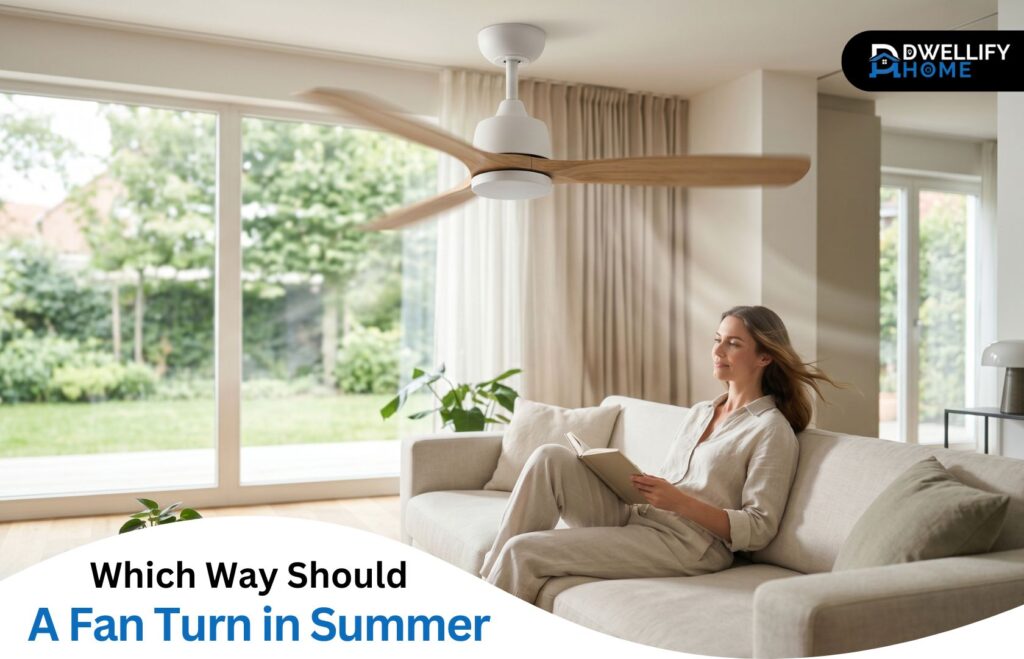
After nearly two decades of wiring ceiling fans into homes, cabins, offices, and back porches, I can tell you that the same question lands in my inbox every spring. Someone notices their fan isn’t cooling the room the way it used to, and they start wondering whether the blades are spinning the wrong way. More often than not, they are.
Getting this right takes about fifteen seconds once you know what to look for. Let me walk you through exactly what I tell my clients when they ask.
The Short Answer: Which Way a Fan Should Turn in the Summer
Your ceiling fan should spin counterclockwise in the summer, as you look up at it from below. That direction pushes air straight down toward you, creating the breeze that makes a warm room feel bearable. Anything else, and you’re just moving air around the ceiling without getting the cooling benefit you’re paying for in electricity.
Mission Statement
Dwellify Home is dedicated to helping homeowners make practical, stylish, and well-informed décor decisions through clear guidance, honest advice, and real-world insight — so every room feels as good as it looks.
Why Counterclockwise Rotation Keeps You Cooler
Here’s something a lot of people don’t realize: a ceiling fan doesn’t actually lower the temperature in the room. Not by a single degree. What it does is move air across your skin, and that’s a completely different thing.
When air flows over sweat and moisture on your body, it speeds up evaporation. Evaporation pulls heat away from your skin, and your brain reads that as “cooler.” This is the wind chill effect, and it’s the entire reason ceiling fans exist.
With the blades turning counterclockwise at a reasonable speed, most people feel somewhere between 4 and 10 degrees cooler than the actual thermostat reading. That’s a significant difference when the room is sitting at 78°F and you don’t want to crank the AC any lower.
Key Benefits of Running Your Fan Counterclockwise in Summer
- Creates a direct downward breeze that makes you feel 4–10°F cooler
- Lets you raise the thermostat by around 4°F, cutting cooling costs by up to 30%
- Improves air circulation in stuffy or humid rooms
- Helps deter mosquitoes and flies on outdoor patios
- Reduces reliance on air conditioning during milder summer days
Summer vs Winter Ceiling Fan Direction at a Glance
| Season | Direction (viewed from below) | Best Speed | Purpose |
| Summer | Counterclockwise | Medium to High | Push cool air down, create wind chill effect |
| Winter | Clockwise | Low | Pull warm air up and redistribute it along walls |
How to Tell Which Way Your Ceiling Fan Is Currently Spinning
Stand directly under the fan and turn it on at medium speed. Look up at the blades and watch the leading edge — the edge that’s cutting into the air first. If that edge is moving from your right to your left, the fan is turning counterclockwise. That’s the summer setting.
There’s an easier test that skips the visual confusion. Just stand underneath and wait a few seconds. If you feel a clear column of air blowing straight down on you, the rotation is correct. If the air feels faint or seems to be pulled up and out toward the walls, the fan is spinning clockwise and needs to be reversed.
I always recommend the breeze test first. Clockwise versus counterclockwise gets confusing fast when you’re staring up at moving blades, and your skin doesn’t lie.
How to Change Your Ceiling Fan Direction for Summer
Most ceiling fans reverse in one of three ways, depending on how old the fan is and what came with it.
Older and mid-range fans usually have a small toggle switch on the motor housing, right above the blades or tucked near the light kit. Flipping that switch reverses the direction. On most vertical switches, the down position corresponds to summer rotation, but not every manufacturer follows that rule, so always verify with the breeze test afterward.
Newer fans often include a reverse button on the remote control or wall switch. Press it, and the blades will slow to a stop before starting up in the opposite direction.
Smart fans connected to apps like Google Home, Alexa, or the manufacturer’s own platform usually let you reverse direction with a voice command or a tap. Very convenient, especially for fans mounted on high ceilings.
One safety step most people skip: turn the fan off completely and let the blades come to a full stop before flipping any switch. Doing it mid-spin can wear out the reverse mechanism over time, and on older fans, it can actually strip the switch.
The Right Fan Speed for Maximum Summer Cooling
High speed is usually what you want in summer. The faster the blades move, the stronger the downward airflow, and the more noticeable the wind chill effect becomes. On hot afternoons, I always set my own fans to the highest setting.
That said, there are a couple of situations where medium speed works better. At night, high speed can feel drafty and dry out your eyes or throat while you sleep. In smaller bedrooms, medium is usually plenty. On humid days when the air feels heavy, high speed can actually feel oppressive rather than refreshing, and dropping it down a notch gives you a gentler breeze.
The rule I follow is simple: match the speed to what your skin is telling you, not to what the season says.
Room-by-Room Exceptions to the Counterclockwise Rule
Counterclockwise is the standard summer direction, but a few rooms play by different rules.
Vaulted and high ceilings. In rooms with ceilings above 10 feet, some installers recommend leaving the fan on counterclockwise year-round because warm air has so much space to rise that a strong downward push is helpful even in cooler months. If your ceiling is that tall, this is worth testing.
Low ceilings. Ceilings under 8 feet put the blades close to your head, and the downward breeze can feel uncomfortably strong. In these spaces, some homeowners prefer running the fan in clockwise mode at low speed in summer, just to get gentle air movement without the forceful wind tunnel effect.
Dining rooms and kitchens. A strong downdraft cools food faster than you’d like and can blow napkins around. Clockwise at low speed circulates air without disturbing the table.
Outdoor patios, porches, and covered decks. Keep these on counterclockwise at high speed. Beyond the cooling benefit, fast-moving air makes it harder for mosquitoes and flies to land and hover, which is a welcome side effect during summer evenings outside.
Pair Your Fan With Your Thermostat to Cut Cooling Costs
This is where ceiling fans quietly earn their keep. According to the U.S. Department of Energy, running a ceiling fan lets you raise your thermostat setting by about 4°F without losing comfort. Over a full cooling season, that adjustment can trim roughly 30% off your air conditioning costs.
The logic is straightforward. Since the fan makes you feel cooler without actually lowering room temperature, you can let the AC work a little less hard. I’ve had clients cut a noticeable chunk off their summer electric bill just by making this one habit change and turning off the fans when they leave the room.
Summer vs Winter Ceiling Fan Direction: The Quick Comparison
Summer calls for counterclockwise rotation at medium to high speed so the fan pushes cool air downward onto the people in the room.
Winter flips the script. You want clockwise rotation at low speed. Warm air naturally rises and collects near the ceiling, where it does nobody any good. A slow clockwise spin pulls that warm air up the middle of the room and pushes it gently down the walls, redistributing heat without creating a cold draft. Done right, your heater runs less often too.
Understanding both directions makes the seasonal switch a two-minute job every six months.
Common Ceiling Fan Direction Myths to Ignore
A few stubborn myths keep circulating, and they’re worth putting to rest.
- A fan lowers the room temperature. It doesn’t. It cools people through airflow. An empty room with a running fan stays exactly as warm as one without a fan.
- Leaving the fan on in an empty room keeps the house cooler. Same problem. If nobody’s in the room, all you’re doing is running up the electric meter.
- Every ceiling fan has a reverse setting. Most modern fans do, but budget fans and some older models don’t. Always check before you assume.
- Bigger fans are always better. Fan size should match room size. An oversized fan in a small room creates uncomfortable turbulence, and an undersized fan in a big room barely moves air. Blade span should generally match the room’s square footage.
Troubleshooting: Fan Is Spinning the Right Way but the Room Still Feels Hot
Sometimes the direction is correct and the room still isn’t comfortable. A few usual suspects:
The speed is set too low. Bump it up to high and give it a few minutes.
The blades are dirty or unbalanced. Dust buildup along the leading edge kills airflow efficiency. Wipe the blades down with a damp cloth every few months. If the fan wobbles, that’s another sign you’re losing performance.
The fan is the wrong size for the room. A 42-inch fan can’t cool a 400-square-foot living room properly no matter which way it spins.
The fan is mounted too close to the ceiling. For good airflow, the blades should sit at least 8 to 10 inches below the ceiling. Flush-mount fans in low rooms can feel weak for this reason.
When You Should Turn the Fan Off (Even in Summer)
Since the cooling effect only happens when moving air touches skin, a fan running in an empty room is just wasted electricity. I always tell homeowners the same thing: if you’re leaving the room for more than a few minutes, flip the fan off.
The same logic applies at night if you sleep with the fan directly over the bed and wake up feeling chilled or stuffy. Fans are tools for comfort, not background noise, and running them nonstop doesn’t make the house cooler. It just adds to the power bill.
Frequently Asked Questions
How can you tell if a fan is going clockwise or counterclockwise?
Stand directly under the fan and watch the leading edge of the blades. If that edge moves from your right to your left, the fan is spinning counterclockwise. An easier method is the breeze test — if you feel air blowing straight down on you, it’s set correctly for summer.
What is the best fan direction to cool a room?
Counterclockwise is the correct direction for cooling. It drives air downward in a steady column, which speeds up evaporation on your skin and creates that familiar cooling sensation. Clockwise rotation pulls air upward and doesn’t deliver the same cooling effect.
Which way should a ceiling fan run with AC?
Counterclockwise, paired with a slightly higher thermostat setting. Because the fan makes you feel cooler, you can raise the AC by around 4°F without losing comfort, which reduces how often the system cycles on and trims your cooling bill.
Can a ceiling fan help with allergies?
Indirectly, yes. A fan keeps air moving so dust and particles don’t settle as heavily on surfaces, and it helps with ventilation when paired with open windows or an air purifier. Just clean the blades regularly, since a dusty fan will blow allergens around the room instead of helping.
Should I leave my ceiling fan on all day in summer?
No. Ceiling fans cool people, not rooms, so running one in an empty space only adds to your electric bill. Turn it on when you’re in the room and off when you leave — that small habit is where most of the real savings come from.
Conclusion
The answer to which way should a fan turn in the summer is counterclockwise when viewed from below, spinning at medium or high speed to push air straight down and create a real cooling breeze on your skin. That single detail, combined with a small thermostat adjustment and the habit of turning fans off in empty rooms, is usually enough to make a home feel noticeably more comfortable through the hottest months without adding to your energy costs.
Take a minute today to stand under your fan and check the rotation. If it’s wrong, the fix takes less than a minute — and you’ll feel the difference the moment you sit back down.
Disclaimer
This article is intended for general informational purposes only. For electrical repairs, ceiling fan installation, or any work involving wiring, please consult a licensed electrician or qualified professional.