Walk into almost any renovated home these days and you’ll notice something has shifted. That heavy, solid door between the kitchen and dining room is gone. In its place, a pair of glass-paneled doors that let light spill from one room into the next. That’s the quiet magic of indoor French doors, and after spending the better part of two decades helping homeowners choose, install, and live with them, I can tell you they’re one of the few upgrades that genuinely changes how a home feels.
This guide walks you through everything I wish every homeowner knew before picking up the phone to order a set. We’ll cover the types, the materials, the glass choices that matter more than people realize, where they actually work best, what they cost, and the mistakes I see repeated almost weekly.
The Short Answer
Indoor French doors are paired interior doors with glass panels that let light flow between rooms while still offering separation. Homeowners choose them to open up dark spaces, improve flow, and add style without removing walls.
Mission Statement
Dwellify Home is built to help homeowners make practical, stylish, and well-informed décor decisions. Our guides focus on real-world advice that makes your home feel more comfortable, more functional, and more yours.
What Are Indoor French Doors?
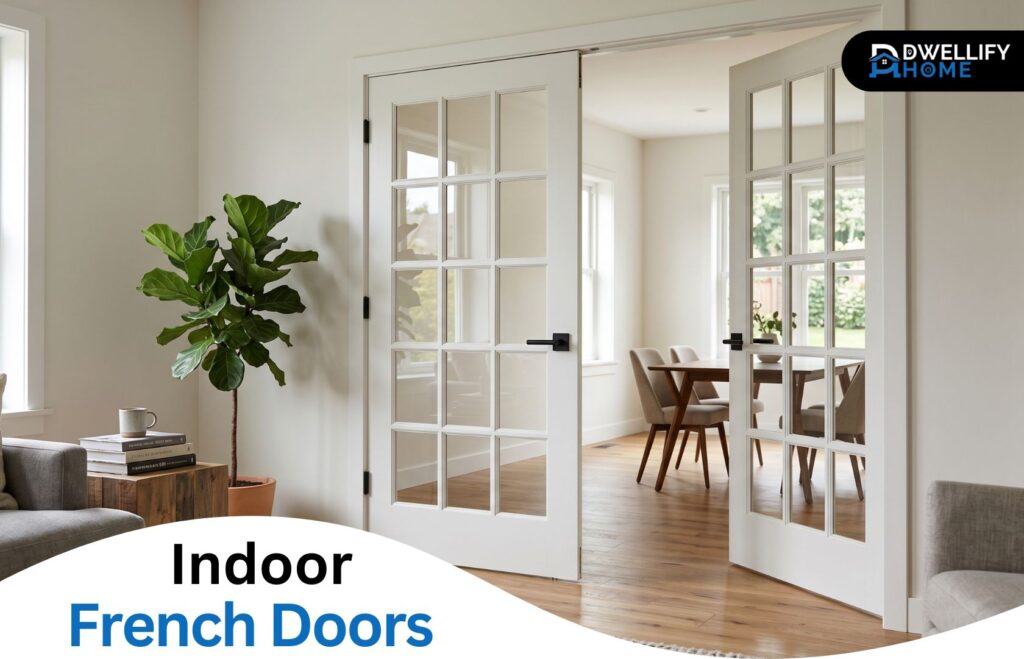
At their core, indoor French doors are a pair of doors hung side by side, each fitted with one or more glass panels. Traditionally they swing open from the middle, though modern versions slide, fold, or pocket into the wall.
The defining feature isn’t really how they open. It’s the glass. A proper French door is mostly glass, framed by narrow rails and stiles, which is what gives it that open, airy character. They trace back to 17th-century France, where architects paired tall casement windows to flood interiors with light. The name stuck, the design evolved, and here we are.
Compared to a standard panel door, a French door does two jobs at once. It separates spaces when you need quiet or privacy, and it opens them up visually the rest of the time.
Key Benefits at a Glance
- Bring natural light into darker interior rooms
- Separate spaces without closing them off visually
- Work in nearly any home style, from traditional to modern
- Offer flexible privacy through different glass choices
- Add resale appeal and a higher-end finish
- Available in hinged, sliding, pocket, and bifold versions
Quick Comparison: Types of Indoor French Doors
| Type | Best For | Space Needed | Relative Cost |
| Double Hinged | Living, dining, office | High (needs swing room) | Moderate |
| Single Panel | Small offices, pantries | Moderate | Low to moderate |
| Sliding | Tight hallways, small rooms | Low | Moderate |
| Clean, minimalist look | Low (but needs wall work) | High | |
| Bifold | Closets, wide openings | Low | Low to moderate |
Why Homeowners Choose Indoor French Doors
The reason I get called in for these installations almost always comes down to one thing: a dark room that feels closed off. French doors fix that without requiring any structural change to the wall itself.
Beyond the light, there are a few practical reasons they keep showing up in remodels:
- They soften the boundary between rooms without fully removing it
- They add a noticeable bump in resale appeal, especially in older homes
- They work in nearly any style of home, from century-old cottages to new builds
- They give you the option to close things off when guests arrive or kids need to nap
The other thing nobody mentions until they live with them: they make small homes feel bigger. When you can see through a door, your eye reads the space behind it as part of the same room.
Indoor vs. Exterior French Doors: Knowing the Difference
This trips up a lot of first-time buyers. Someone will find a beautiful set of french doors exterior style online at a great price, assuming they’ll work indoors too. They technically can, but you’d be paying for features you don’t need.
Exterior French doors are built to handle weather. They have thicker frames, weatherstripping, tempered insulated glass (usually double or triple pane), and heavier hardware for security. A set of double french doors exterior grade will typically cost two to three times more than the indoor equivalent.
Interior versions are lighter, simpler, and use single-pane glass. The frames are usually softwood, MDF, or engineered materials rather than solid hardwood clad in aluminum. That lighter build is actually a good thing indoors, it’s easier on your hinges, simpler to install, and easier on your budget.
Popular Types of Indoor French Doors
Not every French door swings the way people picture. Here are the configurations you’ll actually run into.
Double (Hinged) French Doors. The classic. Two doors meeting in the middle, each on its own hinge, opening inward or outward. This is what most people mean when they say double french doors interior. They need clearance on whichever side they swing, so measure your furniture layout carefully before committing.
Single-Panel French Doors. One door with glass panels, used when the opening isn’t wide enough for a pair. Perfect for home offices, pantries, or small bedrooms.
Sliding Indoor French Doors. Glass-paneled doors that slide on a track instead of swinging. Great for tight hallways or rooms where you can’t spare the swing space. They give you the look without the clearance headache.
Pocket French Doors. These disappear into the wall when open. Beautiful, but they require opening up the wall during installation, so it’s a bigger project. Worth it if you want doors that vanish completely.
Bifold French Doors. Hinged in the middle so each door folds against itself. Handy for closets or wider openings where a full swing isn’t practical.
Materials That Shape Performance and Style
The material affects how the door looks, how long it lasts, and how much you’ll spend.
Solid Wood. Still the gold standard. Solid wood french doors interior installations hold up for decades, take paint and stain beautifully, and feel substantial when you close them. Oak, maple, cherry, mahogany, and pine are common. The downside is cost and weight, so make sure your frame is reinforced.
Engineered Wood and MDF. Most mid-range French doors fall here. They’re stable, don’t warp the way solid wood can in humid rooms, and cost significantly less. A good MDF door with a quality primer paints up so well you’d never know the difference. These are my usual recommendation for bedrooms, offices, and closets.
Vinyl and Composite. You’ll find these mostly in budget-friendly lines. They resist moisture, which makes them decent for laundry rooms, but they don’t feel as solid and the finish options are limited.
Steel and Aluminum Frames. A newer trend, these slim black-framed doors give you that industrial or modern loft look. The frames are thinner, so you get more glass and more light. They’re not cheap, but in the right home they’re striking.
Glass Options for Indoor French Doors
This is where most buyers spend the least time thinking and later wish they’d spent the most. The glass decides everything, how much privacy you get, how much light passes through, and the overall mood of the doors.
Clear Glass. Maximum light, zero privacy. Best for spaces where the whole point is openness, like a formal living room that connects to a dining area.
Frosted and Satin-Etched Glass. The go-to for privacy without sacrificing light. You get silhouettes, not detail. These are what I usually specify for bedrooms, offices on Zoom-heavy schedules, and bathrooms that open to a hallway.
Reeded and Ribbed Glass. The current favorite, especially in modern and transitional homes. The vertical lines distort anything behind them while still letting light through. It’s a softer, more stylish take on privacy glass.
Textured and Decorative Glass. This category includes rain glass, seedy glass, glue chip, and pinhead patterns. Each has its own character. Rain glass mimics water drops, seedy has tiny bubbles, glue chip creates a crystalline frost pattern. These suit craftsman, cottage, or vintage homes particularly well.
Divided-Lite and Grille Patterns. Instead of one large pane, the glass is divided into smaller sections with muntins or grilles. Traditional homes, colonials, and farmhouses often lean this way. It’s a classic look that holds up year after year.
A quick practical tip: if you’re torn between clear and privacy glass, think about what’s behind the door when it’s closed. Will you be comfortable with visitors seeing that view?
Design Styles That Suit Indoor French Doors
French doors are remarkably adaptable, but the style you pick should echo what’s already happening in your home.
Traditional homes lean toward white or stained wood doors with divided lites or textured glass. Modern and contemporary spaces look sharp with black steel-framed doors and clear or reeded glass. Farmhouse and rustic interiors work well with chunky wood doors, sometimes with exposed grain and iron hardware. Transitional homes, which blend old and new, do beautifully with simple five-lite or full-lite doors in soft neutrals.
The worst thing you can do is pick a door style that fights the rest of the house. A heavily ornate French door in a minimalist home looks out of place, and vice versa.
Best Rooms for Indoor French Doors
This is usually where homeowners start dreaming, and it’s where I try to keep them grounded in what actually works.
Living and Dining Rooms. A natural fit. French doors here let you entertain with flow or close things off when the meal gets long.
Home Office. One of the strongest use cases I’ve seen grow since remote work became permanent. Indoor french doors for office use give you privacy for calls while keeping the room visually connected to the rest of the home. Frosted or reeded glass is almost always the right call here.
Bedroom and Master Suites. Lovely for bedrooms that open to sitting rooms or private balconies. Stick with privacy glass, and consider an astragal between the doors to cut noise.
Pantry and Kitchen. A beautifully glazed pantry door is one of those small upgrades that guests always comment on. It also makes it easier to find what you’re looking for without opening the door.
Laundry Room. French doors soften the look of a utility space. Frosted glass hides the mess while letting you peek in to check the dryer.
Closets and Wardrobe Spaces. Bifold or sliding French doors turn an ordinary closet into a feature. Use mirrored or textured glass if you want the illusion of more space.
How to Choose the Right Indoor French Doors for Your Home
Step one is always measuring. Measure the rough opening, not the existing door, because your current door may be trimmed or shimmed. Most standard openings for a pair of French doors run 60, 64, or 72 inches wide.
Then decide the swing. Which way do the doors open? Into which room? Will they hit furniture, a light switch, or another door? I’ve walked into plenty of homes where someone ordered beautiful doors that slammed into a couch every time they opened.
Match the glass to the room’s privacy needs, not to what looks best in the showroom. Align the door style with your existing interior doors, your trim, and your flooring. Consistency matters more than drama.
Hardware and Finishing Details That Matter
Hardware is where a good installation becomes a great one. For French doors that don’t need to lock, like a room divider, dummy knobs on each door work fine. For anything that needs privacy or security, use a mortise lock or a standard lockset on the active door and a flush bolt on the passive one.
An astragal, that thin vertical strip where the two doors meet, matters more than people think. It seals the gap, reduces sound transfer, and makes the doors look like a single unit when closed.
Finishes that age well without looking dated: matte black, brushed brass, oil-rubbed bronze, and satin nickel. Skip anything too shiny or too trendy, you’ll regret it in five years.
How Much Do Indoor French Doors Cost?
Prices vary more than you’d expect. A basic MDF slab set runs around 300 to 600 dollars. A quality prehung set with decent glass usually lands between 600 and 1,500 dollars. Solid wood or custom-built doors can easily climb to 2,000 to 4,000 dollars or more.
Installation is separate. A straightforward swap into an existing opening might cost 300 to 700 dollars in labor. Opening up a wall, framing a new opening, or installing pocket hardware can push the total project well past 2,000 dollars.
Glass type, door height, and custom sizing are the biggest cost multipliers. Standard sizes are always cheaper than custom.
Installation: What to Know Before You Buy
Prehung doors come already hung in a frame, which makes installation faster and cleaner. Slab doors are just the door itself, and you’ll need to mortise hinges and cut for hardware. For most homeowners, prehung is worth the extra cost.
Check the rough opening dimensions against the door spec sheet before ordering. A tight fit is a nightmare to install, and a loose fit means shimming and caulking you didn’t plan for.
DIY is doable if you’re comfortable with trim carpentry. If you’re opening up a wall, dealing with load-bearing headers, or installing a pocket door, call a pro. The cost of fixing a bad install always exceeds the cost of hiring someone right the first time.
Care and Maintenance Tips
French doors aren’t high-maintenance, but small habits keep them looking new. Clean the glass with a streak-free cleaner every few weeks. Wipe the frames with a damp cloth, avoiding harsh chemicals on painted or stained wood. Lubricate hinges once a year with a light silicone spray.
For wood doors in humid rooms like laundries or bathrooms, inspect the finish yearly and touch up any chips before moisture can seep in. Tighten hardware screws annually, they loosen more than you’d expect with regular use.
Common Mistakes to Avoid When Buying Indoor French Doors
A few patterns come up over and over:
- Ignoring swing clearance and ending up with doors that hit furniture or walls
- Choosing clear glass for rooms that actually needed privacy
- Underestimating sound transfer, especially in bedrooms and offices
- Picking a style that clashes with the rest of the home’s interior doors
- Forgetting about the astragal, which leaves a visible gap between the doors
- Ordering exterior-grade doors for indoor use and overpaying for features they’ll never use
- Not checking whether the handles will clear baseboards or adjacent walls
Most of these are fixable with a few minutes of planning before you order.
Where to Buy the Best Indoor French Doors
There are three main paths, and the right one depends on your budget and patience.
Big-box retailers like Home Depot and Lowe’s carry a decent range of in-stock and special-order options. Home depot french doors interior selections lean toward budget to mid-range, with mostly standard sizes. Good for fast projects where style is secondary to timing.
Specialty door suppliers and local millwork shops offer better quality, more glass choices, and actual expertise behind the counter. Pricing is higher but so is the product. If you want the best indoor french doors for your specific home, this is usually where you’ll find them.
Direct-to-consumer and online door brands have exploded in recent years. Companies like TruStile, Simpson, JELD-WEN, and Masonite sell through distributors, while newer online retailers ship prehung sets directly. Read reviews carefully, and confirm return policies before ordering.
Frequently Asked Questions
Are indoor French doors soundproof?
Not entirely. Standard French doors with single-pane glass transmit sound fairly easily. Adding an astragal, weatherstripping, and thicker glass helps, but if total soundproofing is the goal, a solid-core panel door is a better choice.
Can I add blinds or curtains to indoor French doors?
Yes. Between-the-glass blinds exist for higher-end doors, and simple rod-mounted fabric panels work on any door. Roman shades and café curtains are common add-ons for privacy without giving up light completely.
What’s the standard size for a double interior French door?
Most pairs run 60, 64, or 72 inches wide, with a standard height of 80 inches. Custom sizes are available but cost more and take longer to deliver.
Do indoor French doors work well in a bedroom?
They can, if you use privacy glass and pay attention to sound. Frosted or reeded glass with an astragal between the doors handles most bedroom needs comfortably.
Can an existing doorway be converted to French doors?
Often yes, though it depends on the width of the existing opening. A 30-inch doorway usually needs to be widened to accommodate a proper pair. That means cutting drywall and possibly adjusting the header, so budget accordingly.
Are sliding or hinged French doors better for small spaces?
Sliding, without question. Hinged doors need swing clearance, which small rooms rarely have. A sliding French door gives you the same look without eating into your usable space.
Conclusion
Few changes to a home deliver as much visual impact for the effort as a well-chosen set of indoor French doors. They bring light where there wasn’t any, connect rooms without erasing them, and add a layer of character that flat panel doors simply can’t match. The key is slowing down long enough to pick the right type, the right material, and especially the right glass for how you actually live.
Measure twice, think about privacy honestly, and don’t get talked into features you won’t use. Do that, and you’ll end up with doors that quietly improve your home every day you’re in it.
Disclaimer
The information shared in this article is for general guidance only. Product availability, pricing, and installation requirements vary by location and supplier. Always consult a qualified professional before starting any home improvement project.