The first time I walked a client through a brutalist-inspired home, she stopped in the living room and said it felt like standing inside a sculpture. That’s the reaction I’ve come to expect. Over nearly two decades of designing homes across this aesthetic, I’ve watched people arrive skeptical of concrete walls and leave asking where to source board-formed panels for their own bedroom. Brutalism gets misread constantly, and most of what you read online barely scratches the surface of what makes it work in a real home.
So let’s talk about it properly.
The Short Answer
Brutalist interior design is a bold style built around raw materials like exposed concrete, steel, and unfinished wood, paired with blocky, sculptural furniture and a muted palette. People choose it for its honest textures, architectural feel, and restrained, clutter-free character.
Mission Statement
Dwellify Home helps homeowners make practical, stylish, and well-informed décor decisions — with clear guidance, honest insights, and ideas that actually work in real homes.
What Is Brutalist Interior Design?
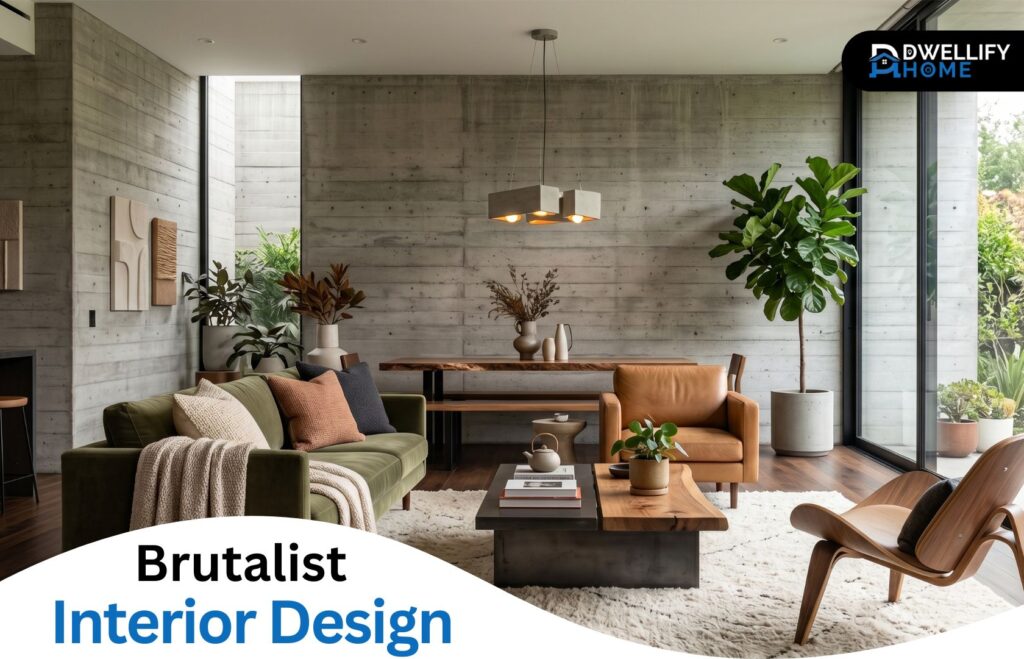
Brutalist interior design is a style built around raw, unfinished materials — concrete, steel, stone, and unpolished wood — arranged into bold, sculptural forms with almost no decoration. Nothing hides. The beams stay exposed. The concrete stays as-poured. The furniture looks like it was carved rather than assembled.
The name throws people off. It comes from the French phrase béton brut, which simply means raw concrete. It has nothing to do with being brutal or harsh, though the rougher examples certainly earn that reputation. What brutalism really prizes is honesty — letting materials look like what they are, and letting structure be part of the story.
In a home, that translates to spaces where texture does the heavy lifting instead of ornament.
Key Features of Brutalist Interior Design
- Exposed concrete, steel, and raw wood as primary materials
- Blocky, sculptural furniture with strong geometric silhouettes
- Muted palette built around grey, charcoal, bone, and earthy tones
- Exposed structural elements like beams and formwork lines
- Warm lighting and soft textiles used to balance hard surfaces
- Minimal decoration, with texture carrying the visual weight
A Brief History of Brutalism: From Post-War Architecture to Modern Homes
Brutalism started as an architectural movement in post-war Europe during the late 1940s and early 1950s. Le Corbusier was building his Unité d’Habitation in Marseille in 1952 and used raw, exposed concrete throughout. That choice — practical, economical, and philosophically deliberate — became the seed of an entire style.
British architects Alison and Peter Smithson coined the actual term “New Brutalism” around 1953, partly as a nod to béton brut and partly as a design ethic. Their argument was simple: buildings should show their construction, not hide it. Through the 1960s and 70s, brutalism spread globally — London’s Trellick Tower, Boston City Hall, Paul Rudolph’s work at Yale, and countless government buildings.
By the 1980s, public opinion had turned. The style was dismissed as cold and oppressive. But designers like Paul Evans, Tom Greene, and later Kelly Wearstler kept the brutalist spirit alive through furniture and interior work. Today it’s firmly back, softened and reinterpreted for how people actually want to live.
Defining Characteristics of Brutalist Interior Design
Every brutalist space I’ve designed shares a core set of traits. If a room is missing more than two or three of these, it’s drifting into industrial or minimalist territory rather than true brutalism.
- Raw, unfinished materials that show their natural texture and imperfections
- Blocky, monolithic silhouettes in both architecture and furniture
- Exposed structural elements — beams, pipes, concrete formwork lines
- Deep textural contrast carrying the visual weight instead of color
- A restrained, muted color palette
- Function-first design where every piece earns its place
Get those right, and the space reads as brutalist even before you add a single accessory.
The Signature Material Palette
Concrete is the anchor. In residential work, I usually specify polished concrete for floors, board-formed concrete for feature walls (those linear wood-grain imprints are worth the extra cost), and cast concrete for countertops or built-in seating. True poured-in-place concrete is rare in homes because of weight and cost, so concrete-faced panels and microcement finishes have become standard workarounds that still read authentic.
Steel comes next — blackened steel, raw hot-rolled panels, and iron fixtures with natural patina. Wood plays the warming role, but only in its rougher forms: reclaimed oak beams, rough-hewn walnut, or burned-finish cedar. Natural stone, particularly travertine and heavily veined marble in matte finishes, rounds out the palette. Glass is used sparingly, almost always without frames, to keep sightlines clean.
One thing beginners miss — brutalism isn’t about using all these materials at once. Pick two or three and commit fully.
Brutalist Furniture: Sculptural, Solid, and Unapologetic
Brutalist furniture should feel like it was quarried rather than manufactured. I tell clients to think weight, mass, and presence. A good brutalist sofa has a low, blocky profile. A good dining table looks immovable. Shelving is either built-in or heavy enough that you wouldn’t want to rearrange it.
The reference points here matter. Paul Evans defined brutalist furniture in the 1960s and 70s with his sculpted steel cabinets and patchwork metalwork. Tom Greene’s torch-cut chandeliers remain benchmark pieces for lighting. C. Jeré’s wall sculptures still appear in high-end interiors. Modern designers like Kelly Wearstler and Amoia Studio carry that same sculptural sensibility into contemporary collections.
For practical sourcing, vintage 1970s pieces from auction houses give you authenticity, while newer brands offer solid reproductions at a fraction of the price.
Color Palette and Lighting in Brutalist Interiors
The color story stays tight — charcoal, warm grey, concrete grey, bone, beige, and the earthy tones you already get from the materials themselves. I rarely add a true accent color. If anything pushes beyond neutral, it’s usually a deep oxblood, forest, or ochre, and only in small doses like a single piece of art or one upholstered chair.
Lighting is where a lot of brutalist rooms either succeed or collapse. Hard overhead lighting flattens concrete and makes the whole space feel institutional. What works is layered lighting — recessed fixtures for overall wash, directional track heads to graze textured walls (this is the trick that makes board-formed concrete sing), and warm 2700K bulbs throughout. Industrial-style pendants in blackened steel anchor the ceiling plane.
Natural light matters enormously. If you have large windows, don’t cover them with heavy treatments. Linen sheers or nothing at all.
How to Achieve a Brutalist Interior at Home
Here’s the sequence I follow on real projects, and it works whether you’re renovating fully or just reworking a room.
Start with the architecture. Expose what’s already there — strip back drywall to find brick or concrete, lift carpet to check the subfloor, look at the ceiling for beams worth revealing. You’re often closer to a brutalist shell than you think.
Next, commit to one hero material. Usually a single concrete wall or a large concrete countertop. This becomes the room’s anchor, and everything else supports it. Build out the palette with two complementary materials — commonly raw wood and blackened steel.
Then edit the furniture. Remove anything ornamental, spindly, or overly upholstered. Replace with blockier, heavier pieces. Keep walkways generous and the floor plan open. Finally, add your softening layer — a wool rug, linen throws, one or two large plants. This is where a brutalist home stops feeling like a gallery and starts feeling livable.
Don’t rush any step. Brutalist rooms look thin when they’re half-finished.
Brutalist Interior Design Room by Room
Living room. Concrete feature wall, a low-profile sectional in neutral fabric, a heavy wood or stone coffee table, and one sculptural light. Textiles are essential here — a thick wool rug, two or three linen cushions.
Kitchen. Concrete or honed stone countertops, handleless cabinetry in dark wood or matte black, exposed steel shelving, and industrial pendants over the island. Keep small appliances off the counter entirely.
Bedroom. A board-formed concrete headboard wall works beautifully. Platform bed frame, linen bedding in bone or stone tones, minimal nightstands. One oversized artwork is usually enough.
Bathroom. This is where brutalism shines. Microcement walls, a monolithic stone or cast concrete basin, blackened brass fixtures, and a single large mirror. Heated floors are worth the investment — concrete is cold in more ways than one.
Entryways and hallways. Great places to introduce the aesthetic without committing the whole house. A textured concrete accent wall, a simple steel bench, and a single piece of sculptural art sets the tone immediately.
How to Balance Rawness With Warmth
This is the part most articles skip, and it’s the single biggest reason brutalist rooms fail. Raw materials without softening feel like parking garages. I always build in warmth through three layers: textiles, organic forms, and lighting temperature.
Wool rugs, linen curtains, bouclé cushions, and leather accents add tactile relief against concrete. Live plants — especially larger sculptural ones like fiddle leaf figs, olive trees, or snake plants — introduce movement and organic shape. And lighting temperature, as mentioned, must stay warm. Cool white LEDs in a concrete room is a mistake I see constantly.
One more thing: don’t forget scent and sound. Brutalist rooms with hard surfaces echo. A rug and a few soft furnishings fix the acoustics, and that alone changes how the room feels.
Modern Variations: Soft, Warm, and Eco-Brutalism
Pure 1970s brutalism isn’t for everyone, and honestly, it isn’t practical for most modern homes. Three variations have emerged that keep the spirit but adjust the volume.
Soft brutalism rounds the edges. You keep the materials but swap sharp corners for curved concrete plinths, arched doorways, and rounded furniture. It’s warmer and more forgiving.
Warm brutalism leans harder on wood and earthy tones. Concrete is still present but takes a supporting role to walnut, oak, travertine, and deeper browns.
Eco-brutalism integrates heavy greenery, living walls, and sustainable material choices like recycled concrete and reclaimed timber. It’s become a favorite among younger homeowners who want the look without the environmental weight.
Most projects I work on now blend two of these. Pure brutalism is rare outside of architectural showpieces.
Industrial vs. Brutalist Interior Design: Where the Styles Meet
People often conflate the two, and the overlap is real. Both use exposed materials, steel, and a muted palette. But they differ in intent.
Industrial design celebrates the factory and the workshop — visible pipes, Edison bulbs, wheeled furniture, reclaimed industrial artifacts. Brutalism celebrates monumental form and structural mass. An industrial loft feels like a converted workspace. A brutalist home feels like a sculpted shell.
You can absolutely blend them — industrial brutalist interior design is its own recognized subcategory. The key is letting brutalism lead. Use industrial elements sparingly as accents, not as the main vocabulary.
Connecting Interior and Exterior in Brutalist Design
The strongest brutalist homes don’t stop at the front door. Material continuity between exterior and interior is what makes a space feel architecturally resolved. Concrete that begins outside and flows into an entry hall. Stone cladding that wraps from façade to fireplace. Steel-framed windows matching steel shelving inside.
Even without a brutalist exterior, you can create this feeling through landscape choices — gravel courtyards, concrete planters, and minimalist plantings that echo the indoor palette. Clients with standard suburban homes have pulled this off convincingly just by reworking their entry and immediate outdoor zones.
Real-World Brutalist Interior Design Examples
Some of the strongest examples to study are Tadao Ando’s residential work in Japan, the interiors of the Barbican Estate in London, Chahan Minassian’s own Paris apartment, and newer projects from Studio KO and Vincent Van Duysen. For furniture specifically, the Paul Evans retrospectives and catalogs from David Gill Gallery are invaluable.
Walk through enough of these and patterns become obvious. The best brutalist rooms always have one generous softening element and never more than three dominant materials.
Common Mistakes to Avoid
After years of this work, the same errors keep coming up.
- Using too much concrete, which turns the space into a bunker
- Ignoring scale — brutalism needs ceiling height and room to breathe
- Skipping textiles, which ruins both acoustics and warmth
- Choosing cool-temperature lighting that flattens texture
- Treating minimalism as emptiness rather than editing
- Mixing brutalist furniture with ornate traditional pieces, which reads as confused rather than eclectic
Most of these come down to restraint and intention. Brutalism punishes half-measures.
Is Brutalist Interior Design Right for Your Home?
Honestly, it isn’t for every home or every person. Small, low-ceilinged rooms struggle with monolithic forms. Humid climates require careful material selection because certain concrete finishes mildew if untreated. And resale can be an issue in traditional markets — buyers who love brutalism are enthusiasts, not a broad audience.
That said, it works beautifully for people who value texture over color, who prefer a few excellent pieces over many decorative ones, and who want a home that feels architectural rather than decorated. Renters can still capture the feeling through furniture, lighting, textile choices, and microcement panels that don’t require permanent installation.
Budget varies wildly. You can achieve the look starting around a modest furniture refresh, or spend six figures on full architectural reworking. Most meaningful transformations sit somewhere in between.
Recommended Brutalist Interior Design Books
If you want to go deeper, these are the titles I keep on my own shelf and recommend to clients.
- This Brutal World by Peter Chadwick (Phaidon) — the essential visual encyclopedia
- Concrete Concept by Christopher Beanland — accessible history and key buildings
- Raw Creation by Anthony DeCurtis — on outsider and brutalist decorative arts
- Carlo Scarpa by Robert McCarter (Phaidon) — for the master of textural detail
- Paul Evans: Designer and Sculptor by Todd Merrill — the definitive brutalist furniture reference
A good brutalist interior design book collection is worth more than a hundred Pinterest boards.
Frequently Asked Questions
Is brutalist interior design suitable for small spaces?
It can work, but scale matters. Use one concrete feature rather than full coverage, and keep furniture proportions in check. Light colors in the neutral palette help open the room.
What’s the difference between brutalism and minimalism?
Minimalism prioritizes absence and clean surfaces. Brutalism prioritizes raw texture and structural honesty. You can have a minimalist brutalist space, but they’re not the same thing.
How do I make a brutalist room feel inviting?
Warm lighting, wool and linen textiles, live plants, and at least one genuinely comfortable seating piece. Hard materials alone feel unwelcoming.
Can I do brutalist style on a budget?
Yes. Microcement finishes, secondhand mid-century pieces, blackened steel from metal fabricators, and DIY concrete accents go a long way. The aesthetic rewards patience more than spending.
How is industrial different from brutalist interior design?
Industrial celebrates machinery and function. Brutalism celebrates sculptural mass and material truth. They share a palette but come from different philosophies.
Conclusion
Brutalist interior design rewards homeowners who want their space to feel grounded, sculptural, and genuinely honest about what it’s made of. It asks for restraint and commitment in equal measure, and when those two things come together, the result is a home that feels completely unlike anything else.
Start small if you’re unsure. One concrete wall, a few carefully chosen pieces, and the right lighting can shift a room’s entire character. The raw, bold aesthetic of brutalism isn’t about making a statement — it’s about removing everything that was getting in the way of the space speaking for itself.
Disclaimer
This article is for informational purposes only and reflects general design guidance. Always consult a qualified interior designer, architect, or structural professional before making significant material or renovation decisions in your home.