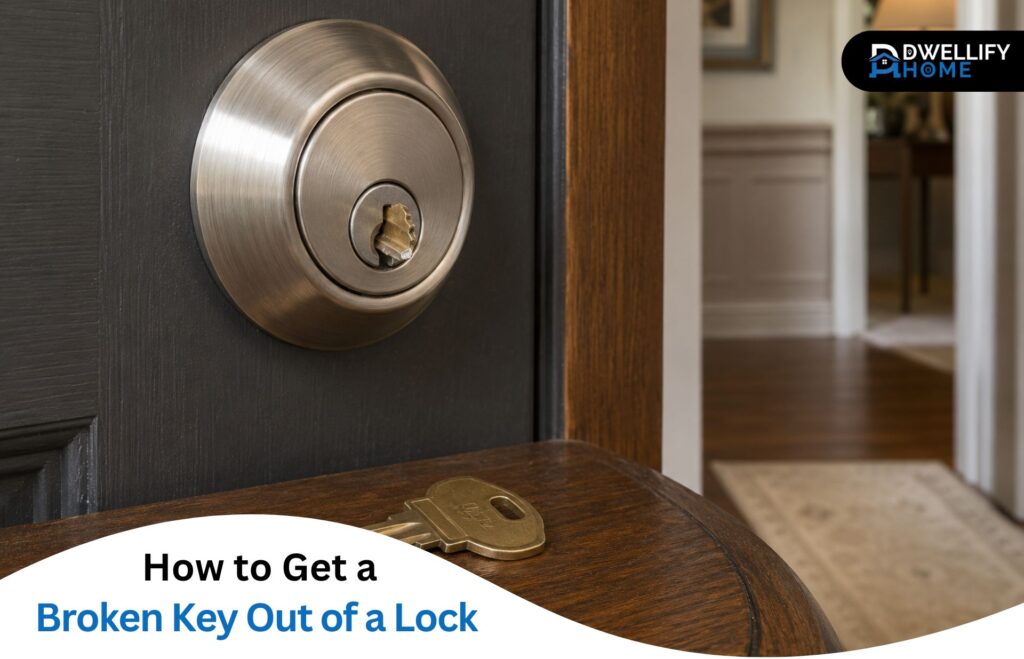
That sharp snap at the door can turn an ordinary moment into a stressful lockout. Learning how to get a broken key out of a lock starts with resisting the urge to pull, twist, or push harder.
The safest method depends on whether the fragment is sticking out, sitting flush with the keyway, or trapped while the cylinder is partly turned. Start with the least-force option, and stop if the fragment moves deeper or the lock begins to resist.
Short Definition
Getting a broken key out of a lock means carefully extracting the lodged fragment without pushing it deeper or damaging the cylinder, using a suitable tool or professional help when needed.
Mission Statement
DwellifyHome helps homeowners, renters, and home lovers create practical, stylish, and comfortable spaces through clear, trustworthy guidance.
Quick Broken-Key Removal Checklist
- Stop turning the lock and don’t reinsert the broken half.
- Check whether the fragment is exposed, flush, or deeply lodged.
- Return the cylinder to its normal key-removal position without force.
- Use thin pliers for exposed metal or an extractor for recessed fragments.
- Stop if the fragment moves deeper or the cylinder remains jammed.
What to Do Immediately After the Key Breaks
Stop turning the key and remove your hands from the lock for a moment. Don’t reinsert the broken handle section, as it can drive the trapped fragment farther into the cylinder. Use a flashlight to inspect the keyway—the slot where the key enters—before choosing a tool or applying lubricant.
Take these immediate precautions:
- Leave the door open if it’s already open. Don’t close it and risk becoming locked out.
- Save the broken section in your hand. A locksmith may be able to use both pieces when making a replacement.
- Don’t force the rotating part of the cylinder back into position.
- Avoid sticking thick tweezers, screwdrivers, or other random objects into the keyway.
- Don’t add glue or flood the lock with lubricant.
A fragment near the opening is usually easier to remove than one that has been pushed behind the lock’s internal pins.
Check the Key Fragment and Lock Position
Look closely at both the fragment and the cylinder plug, which is the inner part that rotates with the key. These two details determine whether a simple DIY attempt is reasonable.
| What you see | Best first approach | Reason to stop |
| Metal protruding beyond the keyway | Thin pliers or tweezers | The tool slips or pushes the fragment inward |
| Fragment sitting flush | Broken-key extractor | There’s no clearance beside the key |
| Fragment deep inside | Extractor or locksmith | You can’t see or hook the fragment |
| Cylinder partly turned | Gently return it to its normal removal position | The plug won’t move without force |
Part of the Key Is Sticking Out
An exposed fragment offers the best chance of straightforward removal. There must be enough metal to grip without inserting the tool deeply into the lock.
Check that narrow pliers or tweezers can close around the fragment—not behind it. Thick jaws may press against the broken edge and push it inward instead of pulling it out.
The Fragment Is Flush or Deep Inside
A flush fragment has no exposed edge for pliers. Look for a narrow space beside the key where a proper extractor might fit.
A fragment that’s barely visible or sits beyond the first set of pins is more difficult. Repeatedly probing for it can damage the pins or move the key beyond reach, so this situation calls for a much lower DIY threshold.
The Lock Is Half Turned or Binding
Many keyed cylinders release the key only when the plug is in its normal withdrawal position. That position is often—but not always—vertical.
Gently return the plug to the position where the key would normally come out, but only if it moves freely. Don’t wrench it around with a screwdriver or pliers. A jammed, partly turned plug is a sensible reason to call a locksmith.
Prepare the Lock and Choose the Right Tools
Good visibility matters more than having a large collection of tools. Gather a flashlight, clean cloth, narrow needle-nose pliers or thin tweezers, and a broken-key extractor if one is available.
A small amount of lubricant may reduce friction, but use a product approved by the lock manufacturer. Graphite, silicone, oil-based sprays, and PTFE lubricants aren’t universally recommended for every lock. Apply only a light amount along the keyway and wipe away excess.
Match the tool to the problem:
- Use pliers or tweezers only for an exposed fragment.
- Use a purpose-built extractor for a flush or slightly recessed fragment.
- Consider an improvised thin hook only when there is visible clearance.
- Leave a deeply buried or tightly bound fragment to a locksmith.
How to Remove a Broken Key That Is Sticking Out
Needle-nose pliers or thin tweezers can remove an exposed key fragment, provided their jaws can grip it without entering deeply into the keyway.
- Confirm that the cylinder is in its normal key-removal position.
- Apply a small amount of approved lubricant if needed.
- Grip the exposed metal firmly but without squeezing hard enough to make the tool slip.
- Pull straight outward along the keyway.
- Use a slight up-and-down movement if necessary, but avoid aggressive twisting.
- Stop if the fragment becomes less visible.
The jaws should remain mostly outside the lock. If they must be forced beside the fragment, they’re probably too thick for the job.
How to Remove a Broken Key That Is Flush or Deep Inside
A recessed fragment requires a tool that can slide beside the key, catch one of its cuts or grooves, and draw it outward. The deeper the fragment sits, the greater the risk of damaging the cylinder.
Use a Purpose-Built Broken-Key Extractor
A broken-key extractor is a thin tool with a small hook, spiral, or toothed edge designed to grip a key fragment.
Follow the tool manufacturer’s directions. In general, the extractor is inserted carefully beside the key where clearance exists. Its hook catches a cut or groove, allowing the fragment to be pulled outward.
Don’t force the extractor past an obstruction. Several controlled attempts may be needed, but repeated slipping or inward movement means it’s time to stop.
Try a Thin Hook Only When There Is Enough Clearance
A stiff paperclip or thin wire can sometimes act as a hook, but it’s less reliable than an extractor.
Form a very small hook, slide it gently beside the fragment, and try to catch one of the key’s cuts. Pull outward without levering against the lock’s internal components. Stop immediately if the wire bends, catches on the lock, or pushes the key farther inside.
Push From the Other Side Only When the Lock Allows It
Some removable locks or accessible cylinders have an open path behind the fragment. In those limited cases, a thin pin may push the key outward from the opposite side.
Most installed residential cylinders don’t provide simple straight-through access. Don’t dismantle door hardware or force a tool through the back unless the lock’s instructions specifically support that approach.
Removal Methods That Can Make the Problem Worse
A broken key is usually recoverable until adhesive, sharp tools, or excessive force damage the keyway. Viral shortcuts may appear convenient, but their risks are often greater than their chances of success.
Superglue and Heated Glue Sticks
Superglue can run around the fragment and bond it to the cylinder or internal pins. Heated glue sticks may fail to grip the small metal surface, while the heat source creates a burn risk and can damage nearby finishes.
Neither method should be a first-line solution. Once adhesive enters the lock, professional extraction may become more difficult or require replacement hardware.
Serrated Blades, Thick Tweezers, and Random Metal Tools
A narrow jigsaw or hacksaw blade can sometimes catch a key groove, but its sharp teeth may score the keyway, damage pins, or injure the person holding it. Thick tweezers often close behind the fragment and drive it inward.
Avoid forcing screwdrivers, knives, pins, or several tools into the lock at once. A purpose-built extractor or locksmith is safer than an improvised tool that doesn’t fit.
Why Magnets and Other Shortcuts Are Unreliable
A magnet works only when the key material responds strongly enough and the fragment isn’t trapped by friction. Many common key blanks are made from brass or nickel-silver alloys that may not respond usefully to a magnet.
Even a magnetic fragment won’t slide out if the plug is turned or the internal pins are binding it. A magnet is therefore a limited test, not a dependable extraction method.
When to Stop and Call a Locksmith
Stop DIY removal when the fragment moves deeper, tools repeatedly slip, the cylinder won’t return to its normal position, or the keyway shows damage. Professional help is also the safer choice when the lock protects the home’s only usable entrance or continued attempts could leave the property unsecured.
Signs Your DIY Attempt Is Making Things Worse
Put the tools down when:
- Less of the fragment is visible than before.
- The extractor can’t pass beside the key without force.
- The plug is jammed or partly turned.
- A tool has broken or become stuck in the keyway.
- Glue or another contaminant has entered the lock.
- The lock face, keyway, or internal components appear damaged.
- The key broke because the lock was already unusually stiff.
A locksmith may be able to extract the fragment and diagnose why the key broke before full lock replacement becomes necessary.
Car Ignitions, Smart Locks, and Other Higher-Risk Cases
Vehicle ignition cylinders can contain delicate wafers and may be connected to electronic anti-theft systems. Unless the broken piece is clearly exposed and easy to grip from outside, contact an automotive locksmith.
Use the same cautious approach with smart-lock override cylinders, commercial hardware, and high-security locks. Renters should contact their landlord or property manager before dismantling or replacing any lock.
What to Ask Before Hiring an Emergency Locksmith
Before authorizing work, confirm:
- The business name and technician’s identification.
- The estimated extraction and service charges.
- Whether after-hours or travel charges apply.
- Whether non-destructive extraction will be attempted first.
- Why drilling, rekeying, or replacement is being recommended.
- Whether the estimate will change if additional damage is discovered.
Ask for the proposed work and price in writing whenever possible.
What to Do After the Broken Key Comes Out
Removing the fragment doesn’t automatically mean the lock is ready to use. The original problem may have been a worn key, dirty cylinder, damaged pins, or a misaligned door.
Inspect and Test the Lock Without Forcing It
Inspect the keyway under good light and check for remaining metal or visible damage. Test the lock with an undamaged spare while the door remains open. This prevents another lockout if the cylinder jams.
The key should insert, turn, and withdraw smoothly. Stop testing if it catches, requires extra pressure, or produces scraping sounds.
Replace the Key and Address Any Remaining Lock Problem
Don’t glue the broken key together or continue using a bent spare. Keep both pieces and ask a locksmith or key-cutting service whether they can produce an accurate replacement. Some controlled or vehicle keys require specialized equipment or authorization.
A lock that remains stiff may need cleaning, adjustment, repair, rekeying, or replacement. Correct the cause before using a new key regularly.
Why Keys Break—and How to Prevent It From Happening Again
Keys commonly break because the metal has become worn or bent, the cylinder is dirty or corroded, or the user is applying extra force to overcome resistance. A sagging door can also press the deadbolt against the strike plate, making the lock feel faulty even when the cylinder is working.
Replace Worn Keys and Service Stiff Locks Early
Replace a key that is bent, cracked, badly worn, or becoming difficult to turn. Don’t use keys as package openers, pry tools, or makeshift screwdrivers.
A key that suddenly needs more pressure is a warning—not an invitation to twist harder. Have the key and lock inspected before either one fails.
Check Door Alignment and Maintain the Lock Correctly
Test whether the lock operates more easily while the door is open. If it does, the latch or deadbolt may be binding against the strike plate when the door closes.
Correct loose hinges or alignment problems and maintain the cylinder according to the lock manufacturer’s instructions. Keep an undamaged spare available so a worn everyday key can be retired promptly.
Frequently Asked Questions
Can You Remove a Broken Key Without Tools?
Sometimes, but only when enough of the fragment protrudes to grip securely with your fingers or when the lock has safe, manufacturer-supported access from behind. A flush or recessed fragment normally requires an extractor or another thin tool. Avoid using fingernails or teeth, and don’t push the broken key inward.
Can a Paperclip Remove a Broken Key?
A paperclip may work when there is space beside a shallow fragment and the key isn’t tightly bound. Bend a tiny hook, slide it alongside the fragment, catch a key cut, and pull gently. Stop if the paperclip bends, catches on internal parts, or moves the fragment deeper.
Can a Locksmith Make a New Key From the Broken Pieces?
A locksmith can often use the pieces as a reference, decode the lock, or work from an available key code. The exact option depends on the lock and key type. Restricted and electronic vehicle keys may require authorization or programming, so retain both pieces and any undamaged spare.
Does the Lock Need to Be Replaced Afterward?
Not necessarily. A lock may remain usable when the fragment is removed without damage and an undamaged spare operates smoothly. Repair or replacement should be considered if the cylinder remains stiff, the keyway is damaged, internal parts are binding, or the same lock has already broken more than one key.
Can These Methods Be Used on a Car Ignition?
Only the simplest exposed-fragment method should be considered. A car ignition is more damage-sensitive than a basic household cylinder, and inserting hooks, blades, or adhesives can harm its wafers or other components. Contact an automotive locksmith when the fragment is flush, deep, or difficult to grip.
Final Takeaway
The safest answer to how to get a broken key out of a lock is to inspect first and use the least-force method suited to the fragment’s position. Grip exposed metal carefully, use a proper extractor for recessed pieces, and stop when resistance increases. A timely locksmith visit is usually less costly than replacing a cylinder damaged by repeated DIY attempts.
Disclaimer
DwellifyHome content is for general informational purposes only. Homes, needs, preferences, budgets, and situations vary; consult a qualified professional for safety-sensitive installation or repair and for legal, structural, electrical, plumbing, HVAC, or major property decisions.