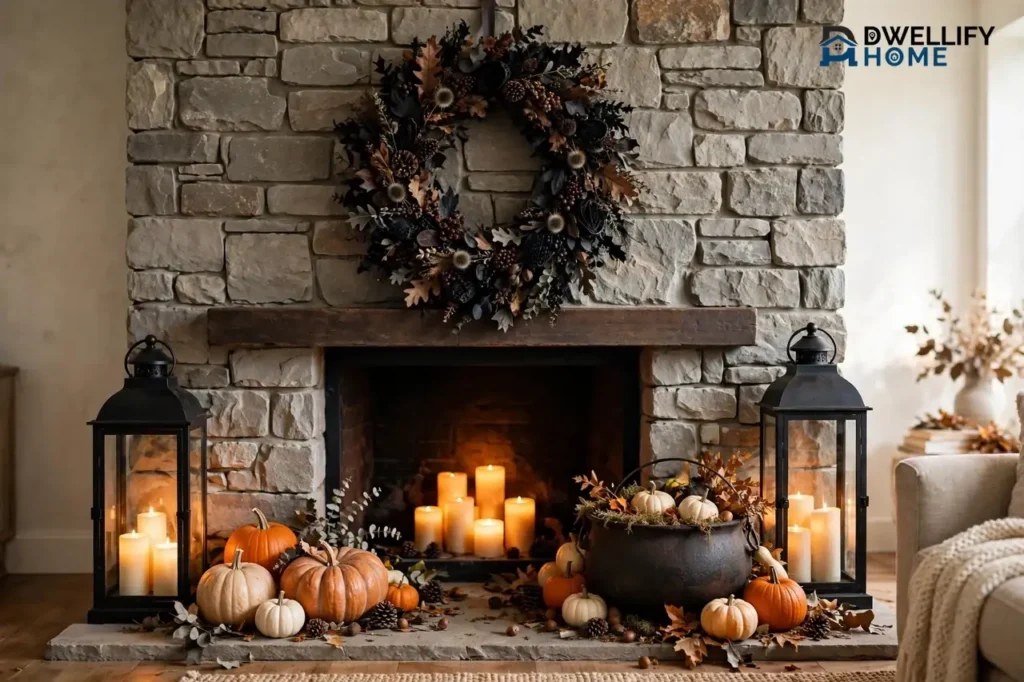
The best halloween fireplace decor treats the fireplace as one scene with four connected zones: the chimney breast or wall above, the surround, the hearth, and the firebox. Start by deciding whether the fireplace will be used. If it will, keep the firebox empty, choose flameless glow, and keep anything that can burn at least 3 feet from the heat source, the minimum given by the U.S. Fire Administration. If the fireplace is genuinely out of service for the display period, the firebox can hold flameless candles, pumpkins, or a small scene.
The mantel shelf is only the ledge between those zones. Shelf-only styling often leaves the wall floating, the hearth empty, and the opening looking like a black gap. For the shelf layered step by step, use the sibling guide to halloween mantel decor. This guide covers everything around it.
You do not need to fill every surface. Repeat one theme and two or three colors, leave some surround visible, and let each area do a different job: backdrop, frame, base, centerpiece.
Start by Deciding Whether the Fireplace Will Be Used
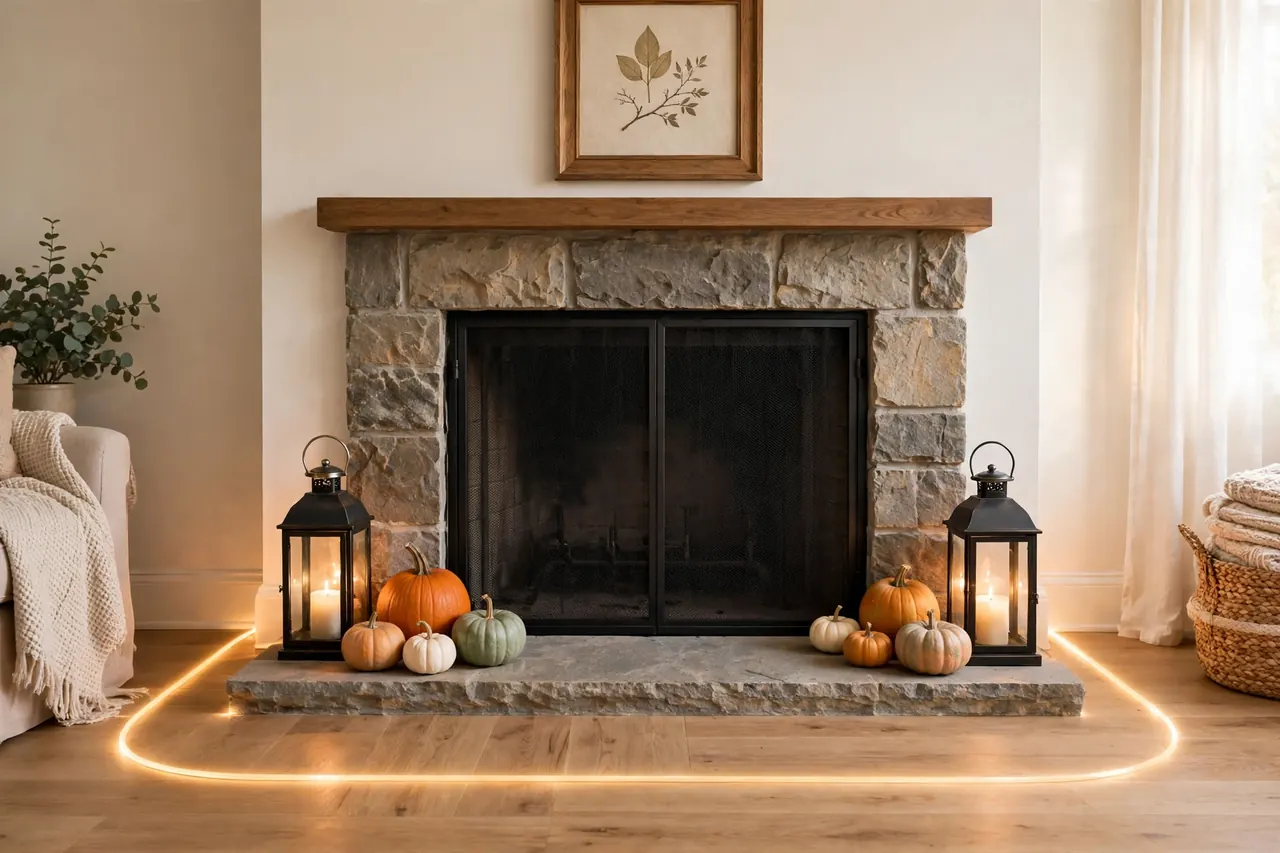
Decide this before you buy or unpack anything. “We have not lit it lately” does not make a fireplace non-working. Treat it as working if anyone might light it while the display is up, or if you do not know the state of the chimney, damper, gas valve, or insert.
What the fireplace status allows
| If the fireplace is… | What you can decorate | What to avoid |
|---|---|---|
| Going to be lit | Wall, outer surround, and floor outside the safety zone, with pieces you can remove completely before a fire. | Anything in the firebox; burnable decor within 3 feet of the heat source; blocked vents, controls, screen, or doors. |
| Out of service for the whole display period | All four zones, including flameless candles, pumpkins, or props in the firebox. | Packing the opening so the damper, cleanout, valve, or controls cannot be reached. |
| Permanently non-working or decorative | The firebox as a seasonal niche, plus the wall, surround, and hearth. | Covered access panels or vents, blind drilling into masonry, or hidden damage. |
The 3-foot rule is a minimum, not a target. The manual and local code may require more, and those instructions win. Dried flowers, cornstalks, and crepe paper are especially flammable, so paper and fabric belong on an out-of-service display or well outside the safety zone.
For gas or electric models, do not block air intakes, vents, sensors, switches, a gas key, or glass doors. If you cannot identify those parts, keep the firebox empty.
See the Fireplace as Four Decorating Zones
A whole-fireplace display looks balanced when each zone has a role. Without that structure, it is easy to crowd the mantel, leave the hearth empty, and drop a pumpkin in the opening.
- Chimney breast or wall: the backdrop. Use one large anchor, such as framed art, a mirror, a wreath, or silhouettes.
- Surround: the frame. Add height at the sides with lanterns, branches, or candlesticks, but leave enough fireplace material visible to define the opening.
- Hearth: the base. Pumpkins, a cauldron, baskets, and lanterns keep the display from looking top-heavy.
- Firebox: the centerpiece, only when the fireplace will not be operated. When it will be used, a clean opening and properly placed screen are the finished look.
Link the zones by repeating something at three heights: matte black in a wall frame, hearth lantern, and firebox backdrop, or rust-orange in a wreath accent, hearth pumpkins, and one faux pumpkin inside an unused opening. Two repeats are enough; matching sets look staged.
Judge the result from the main seat, not from two feet away. The wall anchor should be readable, the firebox should not vanish unless darkness is the effect, and the hearth should connect to the surround.
Pick a Theme That Matches Your Surround
A theme is a filter. Once you choose one, each piece has to match its mood, color, or material. This is the fastest way to use decorations you already own.
Classic Haunted or Gothic
Use black, charcoal, ivory, and one metallic accent such as aged brass. Ravens, bats, potion bottles, black branches, and flameless tapers suit brick, dark stone, and traditional wood. On a black surround, add pale pumpkins so shapes do not vanish; on white brick, black pieces supply contrast.
Cozy Harvest With a Halloween Turn
Start with rust, cream, natural wood, and pumpkins, then add fewer, unmistakably Halloween pieces: a bat silhouette, crow, spell-book stack, or dark lantern. The Halloween layer can come off first if you want the fall base to stay into November.
Playful or Modern Minimal
Friendly ghosts, smiling pumpkins, and a limited palette keep the fireplace welcoming for young children. Modern fireplaces need fewer, larger shapes: one graphic wall piece, two oversized pumpkins, and simple flameless glow. Repeat one accent color so a black-and-white scheme does not feel cold.
Let the fireplace set the scale. A tall chimney breast can carry a large wreath or portrait; a low, wide opening needs width at the hearth more than wall height. Busy stone needs plain shapes and space between them; a plain surround can handle pattern.
Use the Chimney Breast as the Backdrop
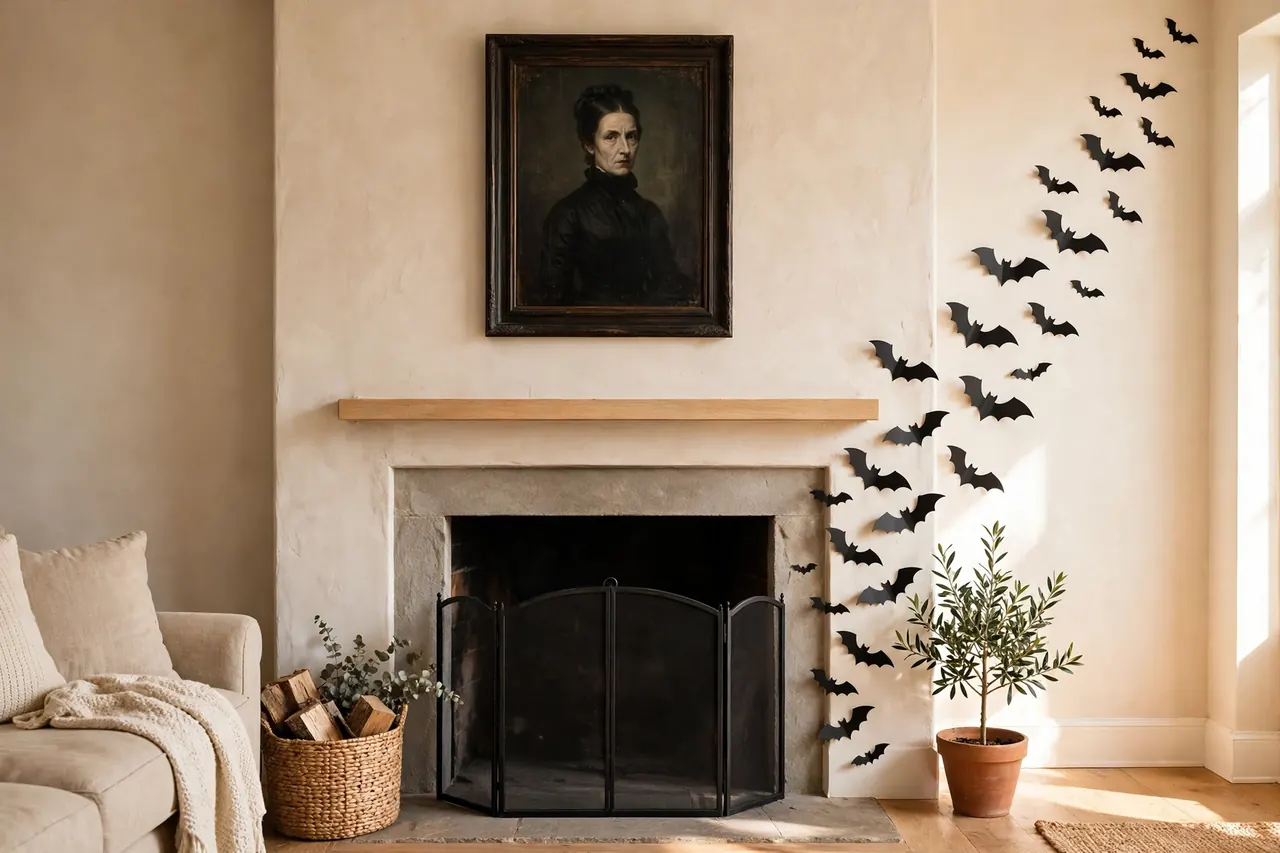
The wall above the fireplace is the largest uninterrupted surface in the display, so give it one clear idea. A haunted portrait, dark mirror, wreath, or group of bat silhouettes sets the theme before the smaller pieces below. One strong anchor beats a row of small frames competing with the mantel.
For an out-of-service fireplace, paper shapes fill this tall area easily. Our guide to halloween crafts using construction paper includes bats and silhouettes that can climb diagonally from one side of the surround toward a corner of the chimney breast. Keep the movement loose; leave gaps so each shape reads.
If the fireplace will be lit, paper is not harmless just because it is on the wall. Keep burnable wall decor outside the 3-foot safety zone and remove anything questionable before the fire. Noncombustible framed art or a metal mirror is simpler for a working fireplace.
Use an existing picture hook where you can. Removable strips must be rated for the weight and surface, and belong on a cool wall, not a hot surround. Do not drill into stone, tile, or a chimney breast unless you know what is behind it. If a television sits above the fireplace, keep the screen clear and never drape anything over the top.
Leave breathing room between the wall anchor and mantel shelf. If art nearly touches the shelf decor, the layers merge into one crowded band; empty wall makes the anchor look deliberate.
Frame the Surround, Do Not Bury It
The surround is the picture frame around the firebox. Decorate its edges and the floor just outside it, not the opening itself. Tall pieces on each side add height without hiding the fireplace material. Black branches in a heavy crock, a tall lantern, or flameless tapers in sturdy holders work if stable and clear of the screen or doors.
The sides do not need to match. A tall branch arrangement can balance a shorter stack of books and a lantern if their visual weight feels close. Matching pairs suit formal fireplaces; uneven pairs suit rustic brick and stone.
Be careful with garlands and faux cobwebs. They soften hard edges, but they are burnable, they slip, and a loose end can fall toward the opening. Use them only on an out-of-service display, on the outer mantel or upper surround, and never stretch webbing across the firebox. On a working fireplace, skip the drape entirely.
Do not attach decor to vents, air intakes, a damper handle, a gas valve, maker labels, or glass that needs to open. Do not use tape or adhesive on a warm surface unless the manual allows it; on a narrow surround, one vertical accent each side is enough.
Build the Hearth From the Floor Up
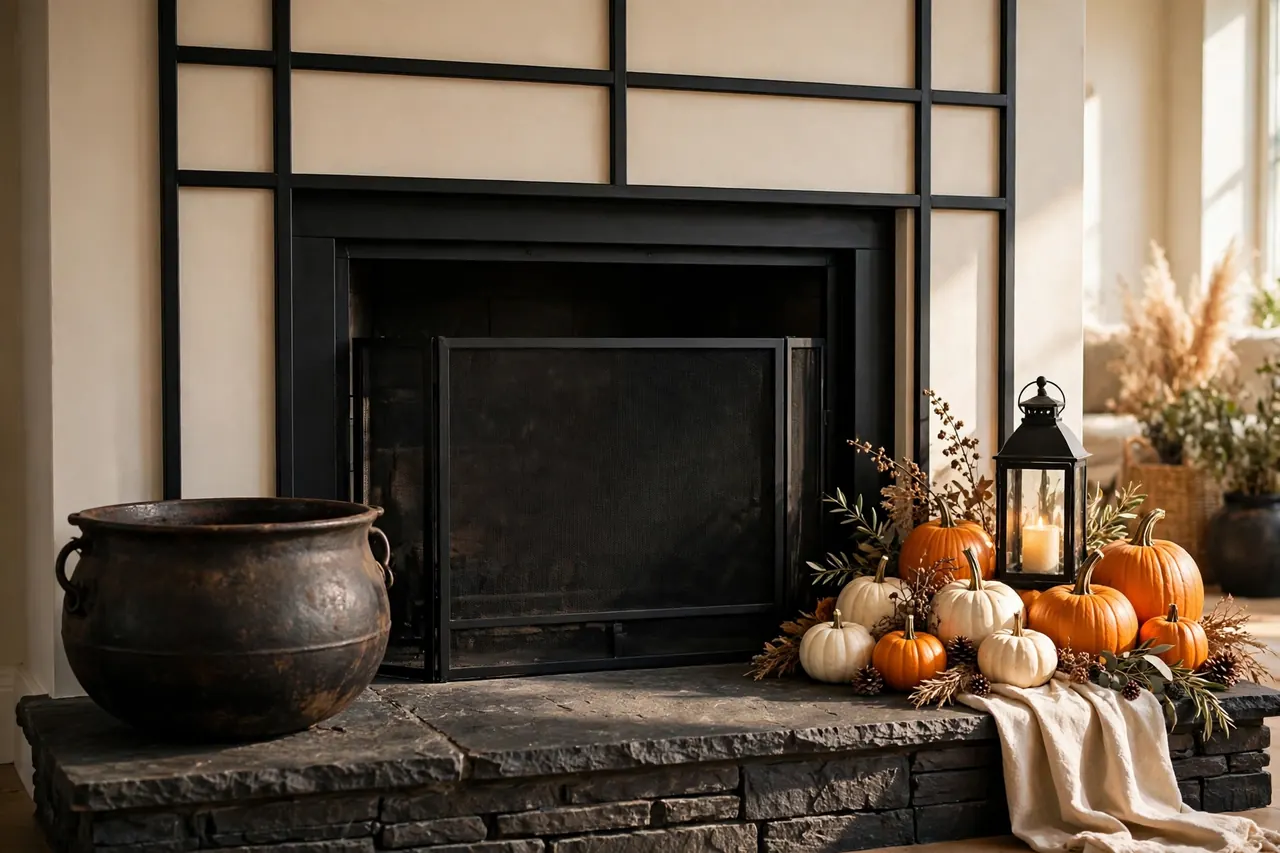
The hearth is where the display meets the room. Start with the largest floor piece, then add two or three supporting shapes instead of lining up small pumpkins. A wide cauldron, basket, lantern, or stack of faux pumpkins can anchor one side while a smaller group balances the other. For scale, depth, and clutter-free arranging, see styling a hearth.
Keep the center working area clear so you can move the screen, open glass doors, reach the controls, and walk past. A deep hearth can hold back and front layers; a shallow or flush hearth needs taller, narrower pieces. With no raised hearth, use a flat arrangement against the wall instead of a deep group projecting into the room.
Mix heights and materials, but repeat one finish from above: a black lantern can echo a black wall frame, while natural pumpkins soften both. Put real pumpkins where you can check them, and remove any that soften, leak, or develop mold. Warmth speeds that change, so choose faux for spots you will not check often.
On a working fireplace, the hearth is not a safety pass. Burnable pieces still need to stay at least 3 feet from the heat source. Noncombustible pieces must be stable and outside the area where ash, sparks, doors, or tools are handled. When in doubt, move the display farther out.
Turn a Non-Working Firebox Into the Centerpiece
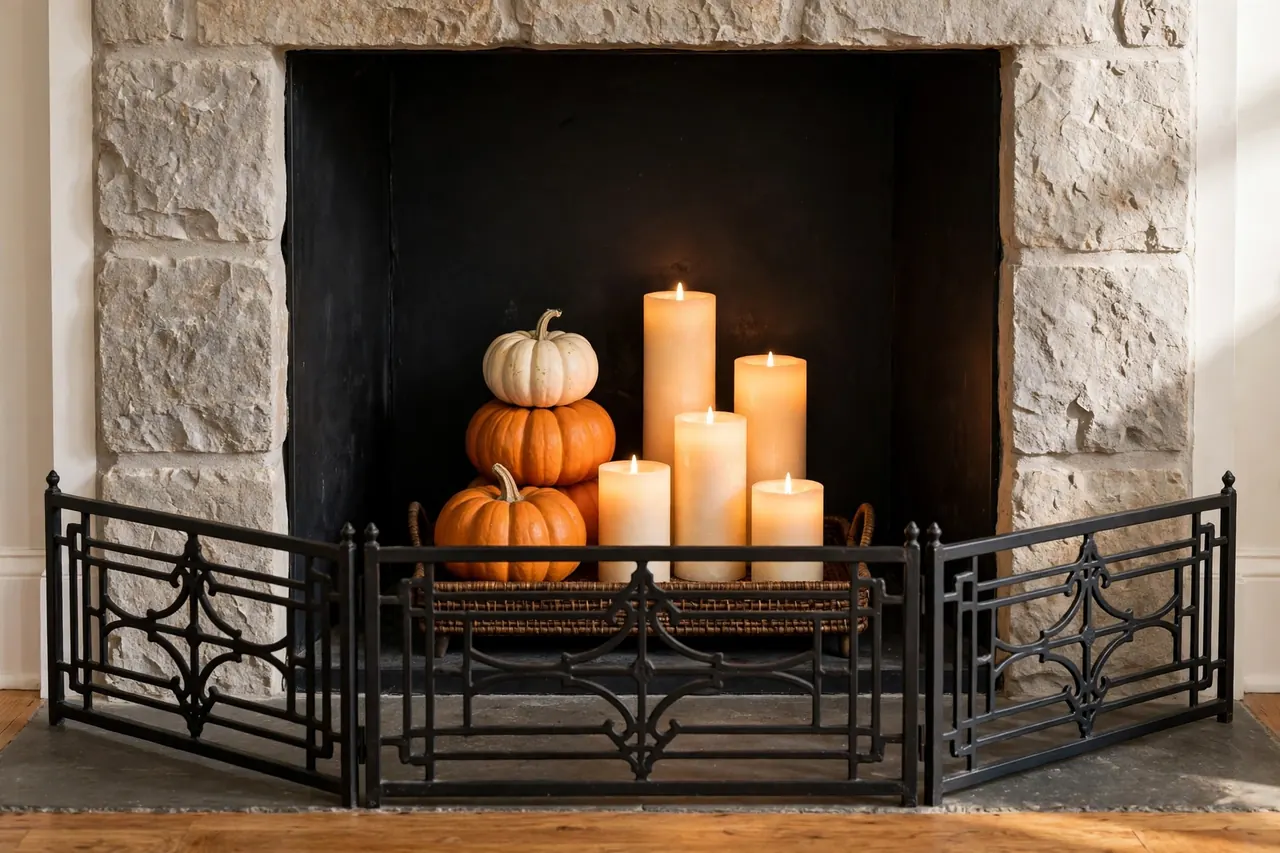
An unused firebox has depth a shelf cannot copy. It can hold a candle cluster, pumpkin stack, or miniature scene, and the dark opening makes pale shapes and warm flameless light stand out. First confirm “non-working” is the real status for the whole display period, not an assumption that nobody will light one.
Clean out loose ash and debris, and leave the damper, cleanout, gas valve, and controls reachable. Do not pack decor against a gas line or access panel. A low tray holds a grouping together and makes it faster to remove if the status changes.
Three Firebox Set-Ups That Work
- Flameless candle crypt: Put battery-operated pillars at several heights on a tray, tallest at the back. A matte-black board or dark fireback deepens the effect without loose fabric.
- Pumpkin stack: Use two or three large pumpkins as the base and one battery-lit jack-o’-lantern as the face. Leave gaps so it looks arranged, not stuffed.
- Witch’s store room: Group a crate, old-looking books, potion-style bottles, and one larger prop. Standalone pieces from do it yourself halloween props can fill this scene and move to a table or porch later.
Keep loose cobwebs, trailing fabric, and dry leaves out of the opening even on an out-of-service fireplace. They collect dust, hide the shapes, and make the reset harder. A screen in front finishes the edge, signals the opening is closed, and keeps pets out.
If children or pets can reach the firebox, choose soft, lightweight, unbreakable pieces. Skip small parts, glass bottles, and anything with button batteries that can be pulled loose.
Add Glow Without Adding an Open Flame
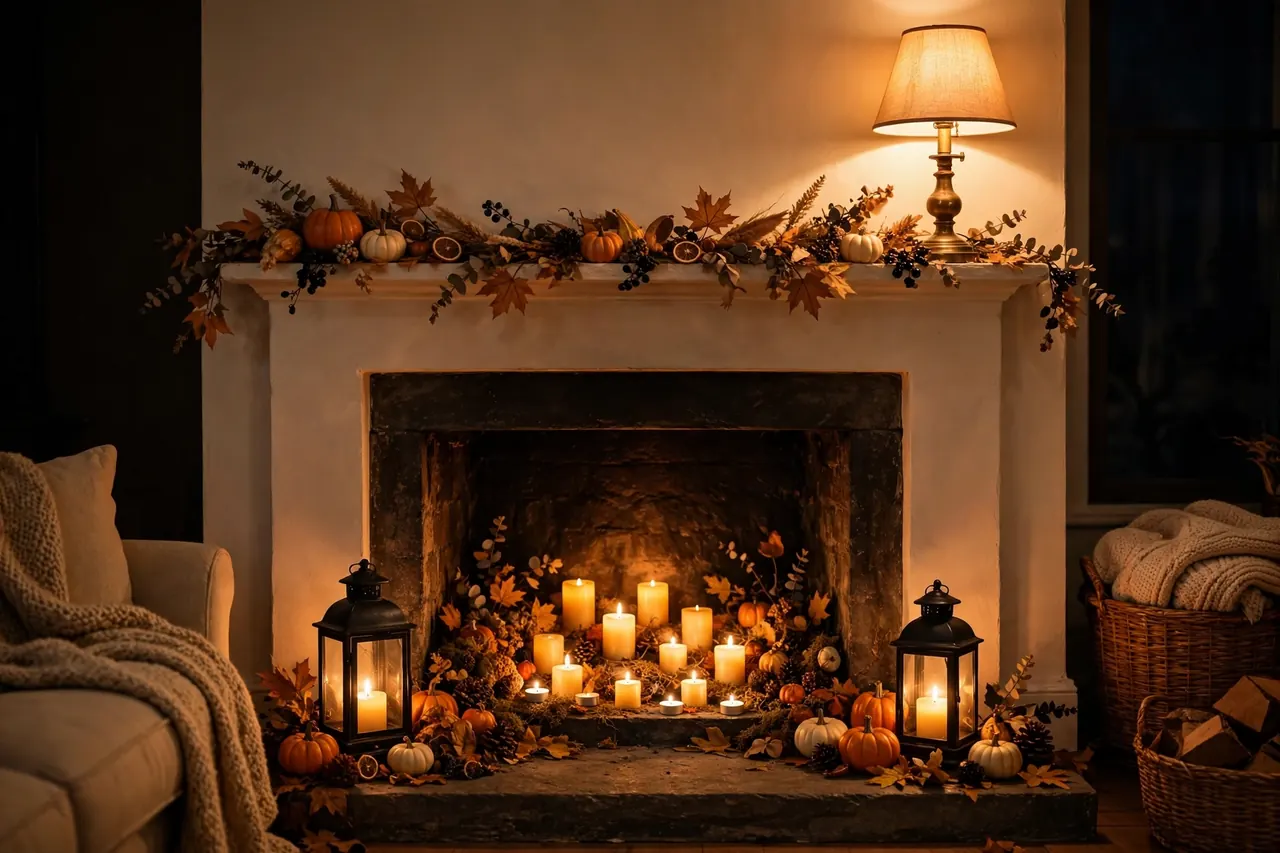
Light turns separate decorations into a scene after dark. Build it in layers: a low glow in an unused firebox, lanterns at hearth level, and one nearby lamp. Warm amber looks closest to firelight. Purple or green makes a haunted display feel colder, but use one accent color at a time.
Battery-operated candles can sit inside pumpkins, lanterns, and an out-of-service firebox where a real flame should not go. The CPSC recommends battery-operated lights or glow sticks instead of candles in jack-o’-lanterns; the same choice removes an open flame from paper, fabric, and dried decorations. For realistic flames, timers, and groupings, use the archive guide to battery candles. A timer also avoids reaching into the opening every evening.
For colored light without another prop, change a nearby lamp instead of putting an unrated bulb inside the fireplace. A color changing light bulb can wash the wall in amber, orange, or purple while the pieces stay simple. Keep it dim enough that shapes and details still read clearly.
Use only plug-in decorative lights tested for safety by a recognized testing laboratory. The CPSC advises checking for broken sockets, frayed wires, and loose connections, then discarding damaged sets. Route cords behind furniture or along the back edge, never across the hearth, under a rug, or where screens and tools move.
Check the result at night from where people sit. If the firebox is far brighter than the hearth, the upper zones disappear. If the wall is bright and the opening is black, add flameless light or raise a lantern, not more objects.
Three Whole-Fireplace Looks to Copy
Whole-fireplace looks at a glance
| Look | Wall and surround | Hearth | Firebox, only if out of service |
|---|---|---|---|
| Classic haunted | Dark portrait or bat silhouettes; black branches at one side. | Black lanterns with orange and ivory pumpkins. | Flameless pillars of different heights. |
| Elegant gothic | Oval mirror or framed art; brass or black holders outside the safety zone. | Ivory pumpkins, a dark basket, and one lantern. | A neat log stack with a flameless candle group in front. |
| Cozy harvest | Wreath with one black Halloween accent; wood or stone left visible. | Rust and cream pumpkins in two uneven groups. | Faux pumpkins around a battery-lit jack-o’-lantern. |
Each look uses the same structure: one wall anchor, restrained surround accents, a grounded hearth, and one firebox idea. Swap the theme pieces without changing the structure to reuse the plan for another season.
What Changes If Your Fireplace Has No Mantel
A fireplace without a mantel is not missing a required surface. The wall anchor does the visual work a shelf would do, while the surround edges and hearth carry the rest. Choose one larger piece of art, a mirror, or a wreath above the opening, then use two floor groups for width.
Do not add a shelf over a working fireplace as a quick decorating project. Shelf material, depth, mounting, and heat clearance belong to the fireplace design and manufacturer’s instructions. A picture ledge belongs on a nearby wall only if it stays outside the safety zone.
For a flush modern fireplace, keep the arrangement low and graphic: one oversized pumpkin or lantern on each side, a strong wall piece, and nothing competing with the clean surround. An out-of-service firebox display matters even more here because it supplies the middle layer a shelf would provide.
Mistakes That Make the Display Look Off or Unsafe
- Decorating only the shelf: The top looks full while the hearth and opening stay empty. Move one color or material down to floor level.
- Treating “not used lately” as non-working: If anyone may light it, the firebox stays empty and the display must be fully reset first.
- Draping decor across the opening: Garlands, webs, and fabric can slip and are burnable. Keep them off the firebox.
- Blocking the working parts: Vents, valves, damper handles, controls, screens, and doors must stay reachable and able to move.
- Using many tiny hearth pieces: Small items read as clutter from across the room. Choose fewer, larger groups with space between them.
- Running cords across the hearth: Cords are a trip hazard and can be damaged by tools or doors. Use battery lights or route cords behind the display.
- Leaving real pumpkins too long: Remove any that soften or leak before they stain the hearth.
Before Anyone Lights a Fire
If the plan changes and the fireplace will be used, remove the seasonal display first. Do not light around it or assume stone and brick make nearby decorations safe.
- Take every seasonal item out of the firebox, including trays, backdrops, batteries, cords, and faux pumpkins.
- Remove all burnable decor within at least 3 feet of the heat source, including garlands, paper, fabric, dried plants, baskets, and pumpkins.
- Restore the screen or glass doors and clear vents, valves, damper controls, and tools.
- Check the inspection status. The Washington State Fire Marshal recommends having the chimney and fireplace inspected and cleaned annually by a professional and using a sturdy screen or glass doors to contain sparks and embers.
- If you find damage, a faulty damper, an unfamiliar gas part, or anything you do not understand, do not light the fire; have a qualified professional check it first.
Disclaimer: Fireplace clearances and operating rules vary by appliance, fuel, manufacturer, and local code. This guide is general decorating information, not a substitute for the fireplace manual, a chimney inspection, or professional advice. When instructions conflict, follow the stricter safety rule.
Related Guides
- Halloween Mantel Decor — layer-by-layer styling for the mantel shelf.
- How to Make a Halloween Wreath — a wall or chimney-breast anchor with a Halloween theme.
- Do It Yourself Halloween Props — standalone props for a firebox scene, hearth, or porch.
- DIY Scary Halloween Decorations — lighting, webs, and silhouettes for the room around the fireplace.
- Styling a Hearth — scale, balance, and layering formulas for the hearth.
- Battery Candles — flameless picks, timers, remotes, styling.
- Cozy Fireplace Suggestions — fireplace types, styling, safety, maintenance.
Frequently Asked Questions
How do I keep my Halloween fireplace mantel from looking cluttered?
Use fewer, larger pieces and leave space between groups. Pick one theme and repeat two or three colors across the mantel, hearth, and wall. If it still looks busy, remove the smallest items first and keep one tall piece, one low group, one focal point.
Is it safe to use real candles on a Halloween fireplace mantel?
Flameless candles are safer, especially near paper, fabric, garlands, or dried decorations. A working fireplace already adds heat and flame, so do not introduce open candle flames in or around the display. Battery-operated candles give the glow without another ignition source to supervise.
What are the best items to put inside the fireplace opening for Halloween?
Only decorate the opening when the fireplace will not be operated. Use a tray of flameless pillar candles, two or three large pumpkins, a battery-lit jack-o’-lantern, or a small prop scene. Keep controls reachable and remove everything before the fireplace returns to use.
Can I decorate a fireplace for Halloween if I do not have a mantel?
Yes. Use the wall above the opening as the backdrop with art, a mirror, or a wreath. Frame the surround with a taller piece on each side and ground the display with pumpkins or lanterns on the hearth. Use the firebox layer only if it is out of service.
Can Halloween fireplace decor work safely with a real working fireplace?
Yes, if the firebox stays empty and anything that can burn stays at least 3 feet from the heat source, or farther if the manual requires it. Choose flameless light, keep vents and controls clear, and remove the display from the safety zone before lighting.
Are there Halloween mantel ideas that work well for small fireplaces?
Yes. Use one wall anchor, one tall side accent, and one low hearth group instead of filling every surface. Two or three larger pieces look better than many miniatures. Leave part of the surround visible so the fireplace remains the focal point.
Can Halloween fireplace decor be adapted for renters who cannot make modifications?
Yes. Use an existing picture hook, freestanding art, pumpkins, lanterns, and battery candles. Use removable hooks only where the surface and rating allow. Avoid drilling, painting, adhesive on hot surfaces, and anything attached to vents or controls.