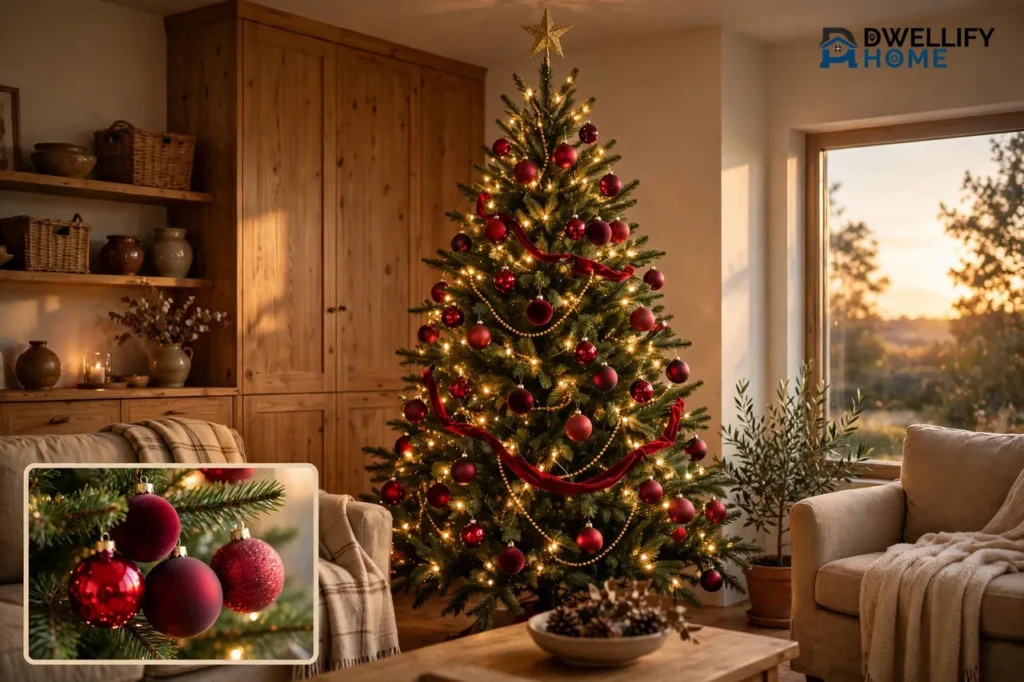
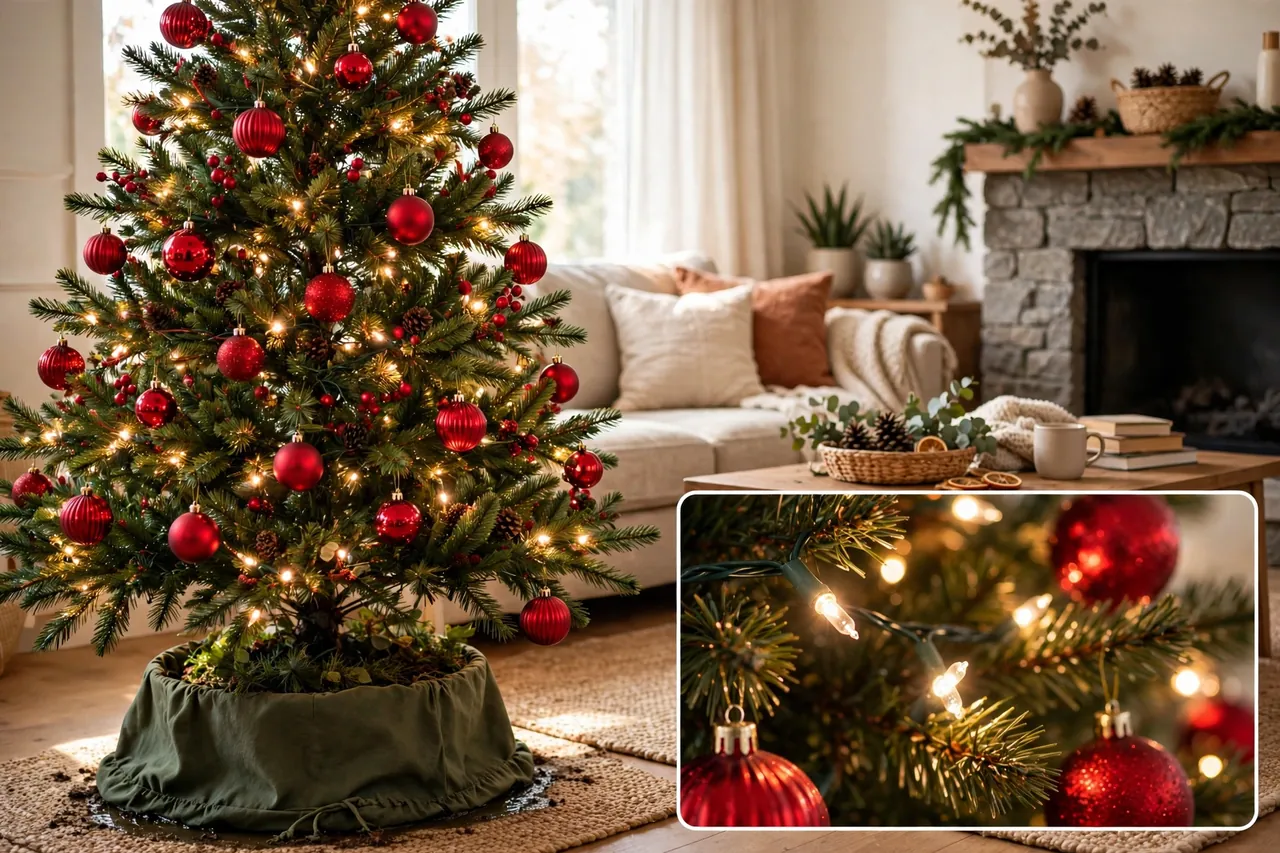
Red Christmas tree decorations work best when red leads the whole look: warm white lights, two or three shades of red, one calm partner color, and a mix of matte, shiny, and soft textures. Start with the lights, add ribbon and large ornaments deep in the branches, then finish with small shiny pieces near the tips and one clear topper. That order keeps a red tree rich and joyful instead of flat or busy.
If you love the classic Christmas feeling, red is the easiest color to get right. It pops against green branches, glows under warm light, and ties the whole room together, from the tree skirt to the gifts underneath. This guide shows you how to build that look step by step, pick the right reds for your tree, and avoid the mistakes that make a red tree look crowded or dull.
Why Red Leads a Christmas Tree So Well
Red feels like Christmas because it has done the job for centuries. Early Christmas trees carried red apples, and glass ornaments later took their place, so a red decorated Christmas tree still reads as the traditional tree at first glance. That history is why red rarely looks like a passing trend. It looks like home.
Red also does real visual work. On a green tree, red creates strong contrast, so the eye finds the ornaments fast. On a white tree, red pops even harder, which means you can use fewer pieces and still make a statement. The trick is to let red stay the star and keep every other color in a supporting role.
Think of your tree in three layers. The deep reds sit inside the branches and give the tree depth. The bright reds sit on the outside and catch the light. The soft touches, like velvet ribbon or faux berries, connect the two layers so the tree looks full instead of spotty. When one layer goes missing, the tree often looks either flat or messy.
Pick Your Red Story Before You Shop
Do not buy random red things and hope they match. Pick one red story first, then buy only pieces that fit it. Your story sets the ribbon, the second color, and the mood of the room.
Classic Red and Green
Classic red and green Christmas tree decorations feel nostalgic, cozy, and instantly familiar. Bright red baubles, deep green branches, plaid ribbon, and pinecones give you the tree most of us grew up with. Keep the greens natural and let the reds do the talking, so the tree feels warm rather than dark.
This look loves a living room full of wood, plaid throws, and warm lamps. If you want the whole room to match, carry the same red and green onto your mantel and stairs, but keep the tree as the clear centerpiece. For mantel ideas that sit well beside a classic red tree, see these Christmas ideas for decorating a fireplace mantel.
Red and Gold for a Dressier Tree
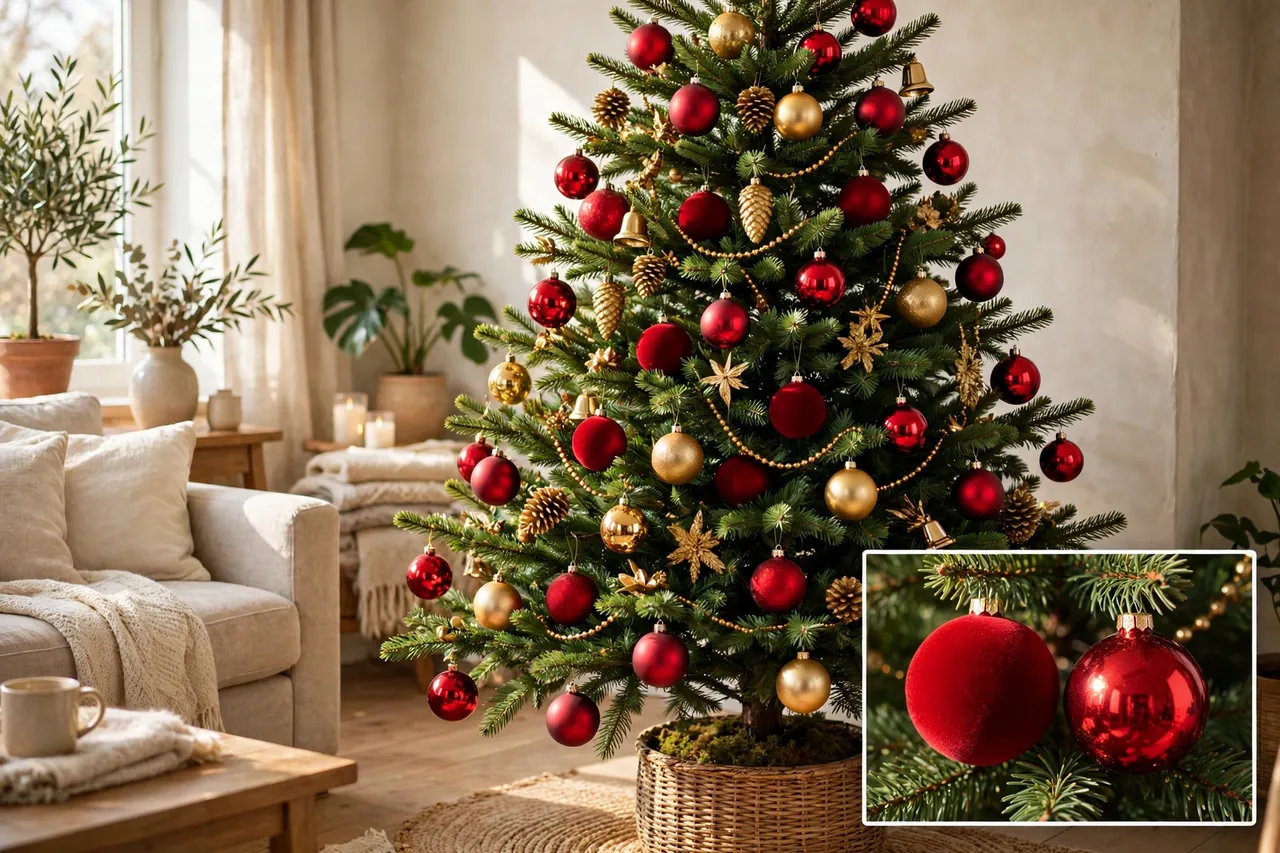
Red and gold feels richer and a little more formal. Deep red velvet, polished gold balls, gold bead garland, and a gold star topper turn the same tree into something fit for a holiday dinner party. Use gold as an accent, not a rival, so red still leads.
A good rule is to keep gold to about one piece in every four or five decorations. Place gold near the top and along the ribbon lines, where it catches light and draws the eye upward. Too much gold makes the tree look busy, while a light hand makes it look expensive.
Red and White for a Crisp, Cheerful Tree
Red and white Christmas tree decorations feel fresh, bright, and playful. Candy cane stripes, white snowflakes, white ribbon, and glossy red balls give you a look that works in modern rooms, small apartments, and family homes alike. White opens the tree up, so it never feels heavy.
This pairing also forgives a lot. If your reds do not match perfectly, white pieces between them smooth out the differences. Add white gift wrap under the tree and the whole display pulls together without extra shopping.
Red on a White Tree
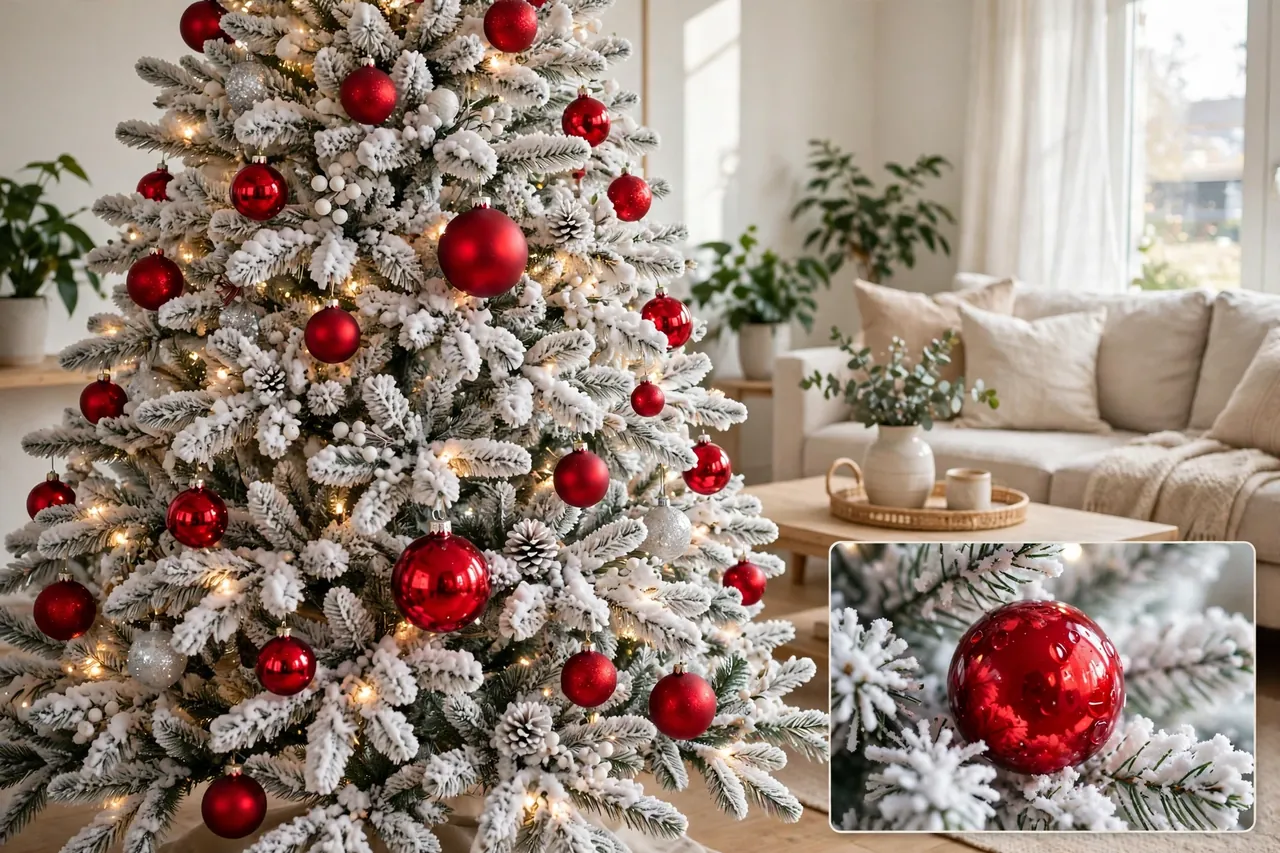
A white Christmas tree with red decorations makes the boldest statement with the fewest pieces. The white branches act like snow, and every red ornament stands out sharply against them. This is the best choice if you want drama without buying a huge ornament collection.
Because mistakes show more on a white tree, place ornaments evenly and step back often to check for bare spots. Warm white lights keep the tree cozy instead of cold, and a few white or silver pieces soften the contrast. For more white-tree styling ideas, explore these white Christmas tree decorations.
How Many Red Decorations Do You Actually Need?
Most beginners buy too many small red balls and too few large pieces, and the tree ends up looking thin in the middle and cluttered at the edges. A simple count helps. A retailer guideline recommends 10 to 15 ornaments per foot of tree height for a balanced look, so a 6-foot tree needs about 60 to 90 ornaments in total, not 60 to 90 red balls alone.
Count every decoration in that total: balls, picks, florals, and special ornaments. Then split the total by role. Large ornaments anchor the tree, medium pieces fill the middle, and small shiny pieces finish the tips. The quick-reference table below turns that rule into a shopping plan.
Ornament Counts by Tree Height
| Tree Height | Balanced Total | Red Share |
|---|---|---|
| 4 feet | 40 to 60 | About half, rest in partner color |
| 6 feet | 60 to 90 | About half, rest in partner color |
| 7.5 feet | 75 to 115 | About half, rest in partner color |
| 9 feet | 90 to 135 | About half, rest in partner color |
Use these numbers as a starting point, not a strict rule. A full, wide tree needs more pieces than a slim tree of the same height, and large statement ornaments replace several small ones. If you add wide ribbon or large poinsettia picks, buy fewer hanging ornaments, because those big pieces already fill space.
Shop in this order: one set of large red balls, one set of medium balls in a second red shade, one partner-color set, ribbon, and then picks or florals. Stop when the tree looks full from across the room. You can always add a few special ornaments later, but a tree that starts overfull rarely gets better.
Decorate Your Red Tree in the Right Order
Order matters more than talent. Decorators who follow the same steps every year get a balanced tree faster, with fewer bare spots and less rehanging.
- Fluff and light the tree first. Shape every branch, then wrap warm white lights from the trunk outward so light glows from inside the tree, not just on the surface.
- Add ribbon next. Drape wide ribbon in loose swoops or vertical cascades, and tuck it into the branches so it looks woven in, not draped on top.
- Hang large ornaments deep inside. Place the biggest red balls near the trunk and low on the tree, where they add depth and weight.
- Fill the middle with medium ornaments. Space red and partner-color pieces evenly around the tree, and turn each one so its best side faces out.
- Add picks, berries, and poinsettias. Push floral picks into gaps at an angle, so they look like they grow out of the branches.
- Finish with small shiny pieces. Hang glitter balls, icicles, and tiny ornaments near the branch tips, where they catch the light.
- Top the tree last. Add the star, angel, or bow, then step back and fix only the spots that still look empty.
Work in sections, top to bottom, and finish one side before you move around the tree. Step back after every section. A tree that looks perfect from two inches away can still look patchy from the sofa, and the sofa view is the one that counts.
Choose Reds That Work Together
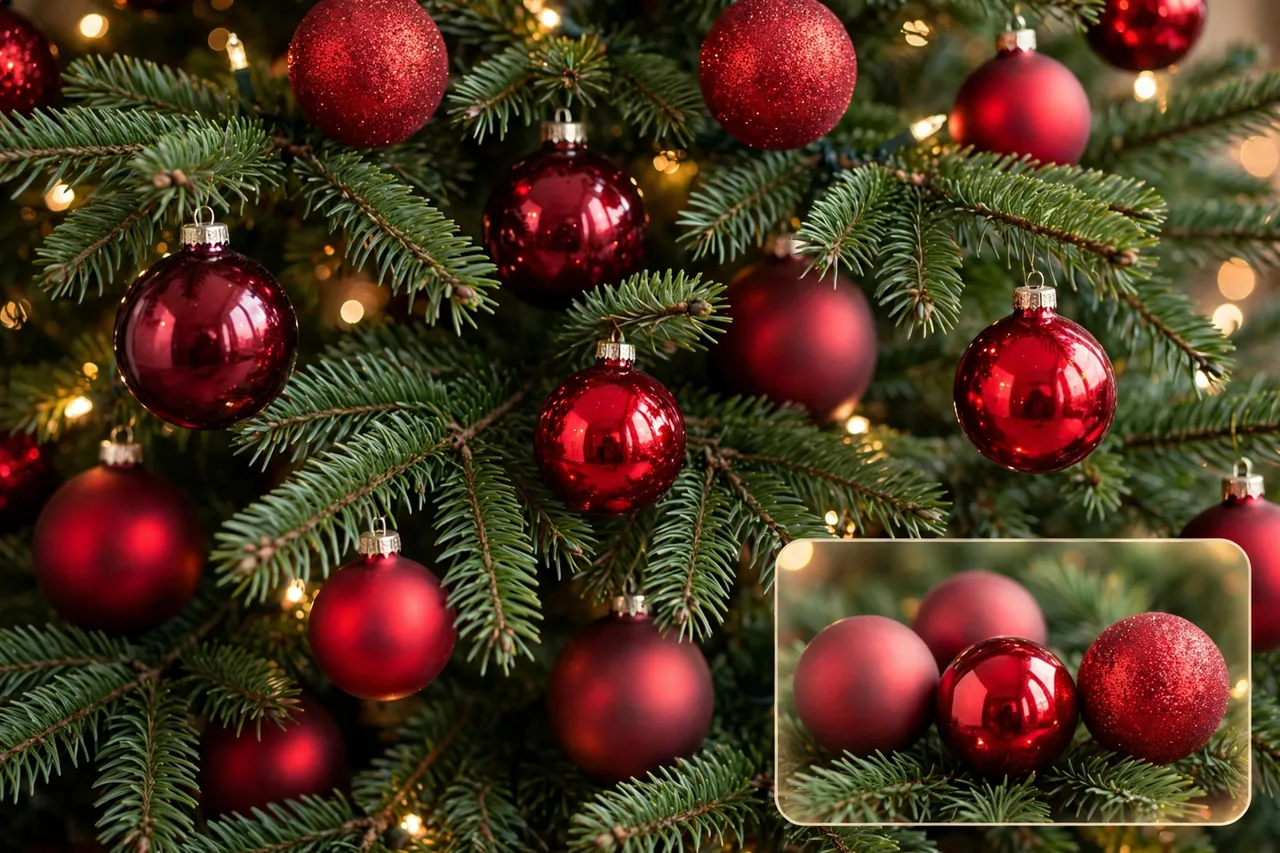
One flat shade of red makes a tree look like a store display. Two or three reds make it look designed. Mix a bright cherry red, a deep burgundy or wine red, and one soft or muted red, then repeat that mix all the way around the tree.
Finishes matter just as much as shades. Matte red balls sit deep in the tree and give it richness. Shiny red balls catch light on the outer branches. Glitter red balls add sparkle but can shed, so use them higher up, away from little hands and pets. Mercury glass and crackle glass add an old-fashioned glow that suits heirloom ornaments well.
Test your reds under your own lights before you commit. Cool white lights can make red look brownish or dull, while warm white lights make red look rich and traditional. If your tree already has cool lights, add more gold or white pieces to soften the effect, or swap the light strings for warm white ones before you hang a single ornament.
Ribbon, Garland, and Picks: The Pieces That Make Red Look Finished
Ornaments alone rarely make a red tree look finished. Ribbon, garland, and picks fill the gaps between ornaments and give the tree its shape.
Ribbon That Flatters Red
Wide wired ribbon works best, because you can shape it into loops and bows that hold their form all season. Red velvet ribbon feels elegant, plaid ribbon feels rustic, and red-and-white striped ribbon feels playful. Pick one ribbon style and repeat it, rather than mixing three patterns that fight each other.
For a classic cascade, cut the ribbon into long lengths and drape them from the top down in gentle curves, tucking each curve into a branch. For a softer look, make large loops and place them deep in the tree like bows. Either way, keep the ribbon lines spaced evenly so the tree does not lean to one side.
Berries, Pinecones, and Floral Picks
Red berry clusters add the natural pop that plain balls cannot. Tuck them into gaps near the outer branches, where they read like fruit on a tree. Pinecones, especially ones dusted with faux snow, ground the reds and keep a bright tree from looking too sweet.
Floral picks do the heavy lifting on a sparse tree. A few large picks fill a bare patch faster than a dozen small balls, and they cost less than a full ornament set. Angle each pick outward and vary the heights so the tree looks full from every angle.
Poinsettia Christmas Tree Decorations
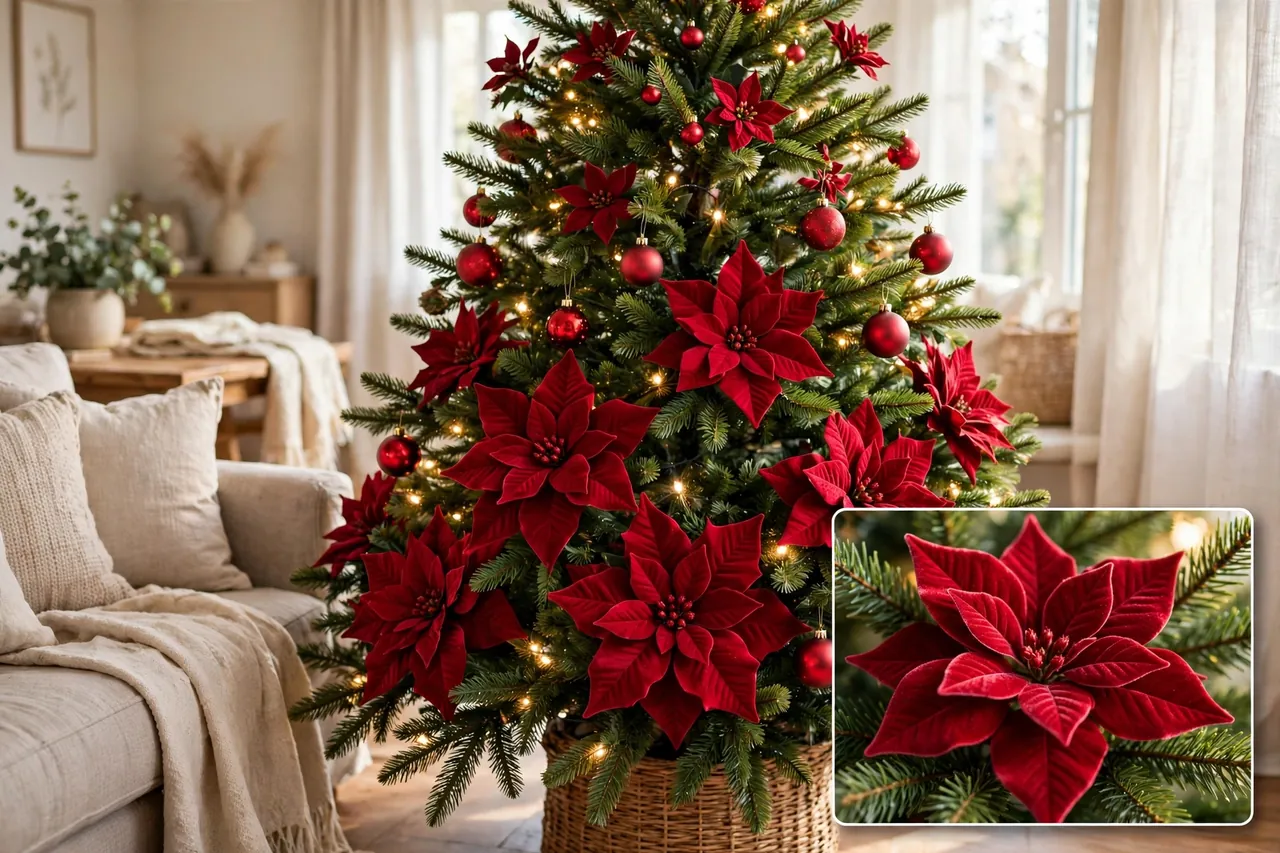
Poinsettia Christmas tree decorations give you the biggest red impact for the least effort. A few large faux poinsettia blooms tucked into the branches create instant focal points, and they fill space that would otherwise need many small ornaments. Choose blooms in two sizes, large ones for the lower two-thirds of the tree and smaller ones near the top, so the scale feels natural.
Real poinsettias carry a long Christmas story. The plant comes from Mexico, where it is called Noche Buena, meaning Christmas Eve, and legend ties its red bracts to a humble gift left at a church altar in 16th-century Mexico. As the University of Illinois Extension explains, Joel Robert Poinsett, the first United States ambassador to Mexico, brought the plant to the United States in the early 1800s, and it took his name. That history makes poinsettias feel meaningful on a tree, not just decorative.
For the tree itself, use faux poinsettia picks, not live plants. Live poinsettias dry out fast near warm lights, drop leaves, and need water you cannot easily give them on a branch. Faux blooms keep their shape all season, survive storage, and cost less over time. Save live poinsettias for the base of the tree, the mantel, or a table, where you can water them and enjoy them up close.
Pet owners often worry about poinsettias, and the worry is larger than the risk. The ASPCA notes that poinsettias cause only mild to moderate stomach upset in pets, not the severe poisoning many people fear, but keeping plants and small ornaments out of pets’ reach is still wise. If a pet nibbles a leaf, watch for vomiting or drooling and call your vet if symptoms last or worsen.
Red Decorating Ideas for Every Room and Budget
A red tree should fit the room it lives in. The same ornaments can feel elegant in one home and overwhelming in another, so match the scale and style to your space.
Small Trees and Small Rooms
On a tabletop or apartment tree, red works best when you go bold but spare. Use fewer, larger ornaments, one ribbon, and no garland at all, so the small tree keeps its shape. A red tree in a small room also needs a calm backdrop: plain walls, simple gift wrap, and one red accent elsewhere in the room, like a throw or a wreath, keep the look intentional.
Rustic and Farmhouse Red
For a rustic red tree, pair matte red balls with burlap ribbon, wooden ornaments, red-and-black buffalo plaid, and natural pinecones. Dried orange slices tied with red twine add a handmade touch, and a simple wooden star topper finishes the look without fuss. This style suits cabins, farmhouses, and any room with lots of wood and warm light.
Carry the rustic red story beyond the tree for a fuller room. A plaid runner, red candles in safe holders away from branches, and simple greenery on the mantel all echo the tree without copying it exactly. For living room ideas that pair well with a rustic tree, browse these decorating ideas for the living room for Christmas.
Elegant Red for a Formal Room
An elegant red tree uses fewer pieces, but each one earns its place. Deep red velvet, gold accents, glass finials, and a single dramatic topper beat a crowded tree every time in a formal room. Keep the tree skirt simple, like deep red velvet with a plain edge, so the base looks like part of the design rather than an afterthought.
Kid-Friendly Red Trees
Kids and red trees go together beautifully, as long as you plan for breakage. Use shatterproof or fabric ornaments on the lower branches, where little hands reach, and save glass heirlooms for the upper branches. When buying red ornaments for kids, choose shatterproof or fabric pieces with smooth edges, no small detachable parts, and non-toxic materials.
Let kids own one part of the tree, like the candy cane ornaments or a special section at their eye level. They feel proud of their contribution, and you keep the overall design intact. A tree that children helped decorate also becomes a memory, not just a display.
Common Red Tree Mistakes and How to Fix Them
Most red trees go wrong in the same few ways, and every one of them has a fast fix.
- All one shade of red. Add a deeper burgundy and a brighter cherry red, plus a matte finish, so the tree gains depth.
- Red only on the outside. Push large matte balls deep into the branches so the tree glows from within.
- Too many competing colors. Remove everything except red and one partner color, then add back only one accent, like gold, if the tree still feels flat.
- Cool white lights. Switch to warm white lights, which make red look rich instead of dull or brownish.
- Ornaments clustered on one side. Turn the tree slowly, mark bare patches with a ribbon scrap, and move pieces until every side looks full.
- A bare base. Add a full tree skirt, wrapped gifts, or a basket that hides the stand and grounds the whole display.
If your tree still feels off after these fixes, remove five ornaments instead of adding five more. Overdecorated trees rarely need more stuff. They need breathing room, so the reds you love can actually stand out.
Light It Right and Keep It Safe
Warm white LED lights suit red decorations best. They run cooler than old incandescent strings, use less energy, and give red ornaments a cozy glow. Check every string for frayed wires or broken bulbs before you hang it, and throw away damaged strings instead of trying to repair them.
Keep the tree at least three feet from fireplaces, radiators, and candles, and never place real candles on or near the tree. Turn the lights off when you leave the house or go to bed, and use a timer so you never have to remember. For a real tree, water it daily so the branches stay fresh and less flammable, and keep the stand covered so pets do not drink the tree water.
After the holidays, store red ornaments by color and size in divided boxes with tissue paper between glass pieces. Faux poinsettias keep their shape best in a box of their own, not crushed under heavier ornaments. Good storage is what makes next year’s tree faster and cheaper, and these Christmas tree storage bags help protect the whole tree and its decorations between seasons.
Carry the Red Story Through the House
A red tree looks even better when the room echoes it lightly. You do not need to redecorate the whole house. A few repeated touches do the job.
Repeat red in three places beyond the tree: the mantel, the front door, and the table. A garland with red berries on the mantel, a wreath with a red bow on the door, and red napkins or candles on the table tie the rooms together. Keep each echo smaller than the tree itself, so the tree stays the star.
If you decorate the stairs, use the same ribbon as the tree and add red berries sparingly, so the staircase feels connected rather than separate. These ideas for how to decorate stairs for Christmas show how one ribbon can link two spaces. Outside, keep the palette just as simple, with red bows or berries on porch greenery, as in these Christmas decor ideas for the porch.
For a full-house plan, start with the tree theme and then choose one room at a time. A broad guide to indoor Christmas decorations helps you spread red through the house without repeating the tree exactly in every room.
Related Guides
If you want to build a full red Christmas look, these guides pair naturally with this one: Christmas tree themes for picking your overall style, white Christmas tree decorations for the white-tree version of this look, Christmas ideas for decorating a fireplace mantel for the room around the tree, and Christmas tree storage bags for packing it all away in January.
Frequently Asked Questions
How should I begin decorating a white and red Christmas tree?
Start with a snowy base, meaning flocked or white branches and warm white lights, then add red ornaments sparingly so they read as accents, not clutter. Place large red pieces first, step back often, and leave some branches clear for balance.
Should I opt for matte or glossy ornaments?
Use both, because each does a different job. Matte ornaments sit deep in the branches and give the tree richness and depth, while glossy ornaments catch light on the outer branches and add sparkle. A mix of both keeps a red tree from looking flat.
How many red ornaments do I need for a 6-foot tree?
Plan for 60 to 90 ornaments in total on a 6-foot tree, based on 10 to 15 ornaments per foot of height, and make roughly half of them red. Fill the rest with your partner color, ribbon, and picks, and adjust for a slim or very full tree.
Can I mix red ornaments with other colors?
Yes, and red pairs well with green, gold, silver, white, and even black. Keep red as the lead color, pick one main partner color, and use any third color only as a small accent, so the tree stays calm and coordinated.
Do red ornaments and gold ornaments go together for Christmas?
Yes, red and gold ornaments give a traditional and classic Christmas look. Keep gold to a light accent, placed near the top and along ribbon lines, so the pairing feels elegant and warm rather than loud, busy, or crowded at all.
A Red Tree Worth Coming Home To
A great red Christmas tree does not need the most ornaments or the priciest ones. It needs a clear red story, warm light, varied reds and textures, and a calm partner color that lets red lead. Start with the lights, build from large to small, and step back often to see the tree the way your guests will see it.
This weekend, pull out your reds, sort them by shade and finish, and pick your one partner color before you hang a single ball. Your tree will come together faster, look fuller, and feel like the Christmas you remember, only a little more polished. That is the whole point of red: familiar, warm, and impossible to miss.