American-made outdoor furniture means the piece was built in the United States, and the strongest version of that claim means it was all or virtually all made here. The Federal Trade Commission sets that bar: final assembly in the US, all significant processing in the US, and all or virtually all parts and materials of US origin. This guide names 14 brands verified as US-made at write time, explains what each one builds and where, and shows you how to check any “made in USA” claim before you spend a dollar.
That check matters because the label gets stretched. Some brands build everything here. Others build frames overseas and sew cushions in North Carolina, then sell the whole set under a stars-and-stripes story. Both can be fine purchases, but they are not the same thing, and the price difference between them is real. Read the label the way the FTC does, and you will know exactly what you are paying for.
What Does “Made in USA” Actually Mean?
“Made in USA” is a legal claim before it is a marketing line. Under the FTC’s standard, a product can carry the unqualified claim only when it is all or virtually all made in the United States. That means the final assembly happens here, all significant processing happens here, and all or virtually all of the ingredients or components are made and sourced here. A chair bolted together in a US workshop from an imported frame and imported cushions does not clear that bar, even though the last step happened on American soil.
The FTC also recognizes qualified claims, which are honest when they are specific. “Assembled in USA with imported components” tells you exactly what happened. “Designed in USA, made overseas” tells you something else again. The honest version of the claim always names the limit, so look for the second half of the sentence. A brand that only says “American-made” and never says where the frame, fabric, or hardware comes from is asking you to trust the flag instead of the facts.
There is one more distinction worth knowing. The FTC does not pre-approve claims and does not publish a list of approved brands. That means every “made in USA” statement on a patio set is the maker’s own claim, and the check falls on you. The good news is that the real American manufacturers are proud of the details. They name the town, the factory, and the material, because those details are the whole point. Read how the FTC draws the line between unqualified and qualified claims at the FTC’s guide to complying with the Made in USA standard.
All or virtually all is the test. If a brand cannot show US assembly, US processing, and mostly US parts, its honest label is a qualified one.
Why American-Made Outdoor Furniture Costs More, and When It Pays Off
American-made outdoor furniture usually costs more than mass-produced imports, and the gap is not small. A domestic deep-seating set can run two to three times the price of a similar-looking import. The money goes to US labor, tighter quality control, heavier materials, and warranties a factory an ocean away cannot match. The question is not whether it costs more. The question is whether the extra money comes back to you over the life of the piece.
It comes back in three ways. First, lead times are shorter and steadier. Domestic custom orders typically run four to eight weeks from order to delivery, while overseas orders can stretch to three to six months, and that gap widens whenever shipping or tariffs turn unpredictable. Second, warranty claims move faster, because the call goes to the people who built the piece, not to a distributor working through a translation. Third, the furniture lasts longer. A POLYWOOD lumber frame carries a 20-year residential warranty, and an O.W. Lee fire pit frame carries 20 years too. When a set lasts 15 to 20 years instead of five to seven, the cost per year of use often lands lower than the cheaper import.
The payoff is weakest when the furniture will live a hard, short life anyway, for example on a rental property or a patio you plan to redo in three years. It is strongest on the patio you will sit on every evening for the next decade, in a climate that punishes cheap frames. Sun, salt air, snow load, and wind all separate the two tiers fast. Our how to care for outdoor furniture guide shows what even the best frames need from you each season.
Judge the price per year, not per purchase. A set that lasts 20 years at twice the price costs less per summer than one replaced every five.
Recycled HDPE Brands: POLYWOOD, Highwood, Seaside Casual, and Nags Head Hammocks
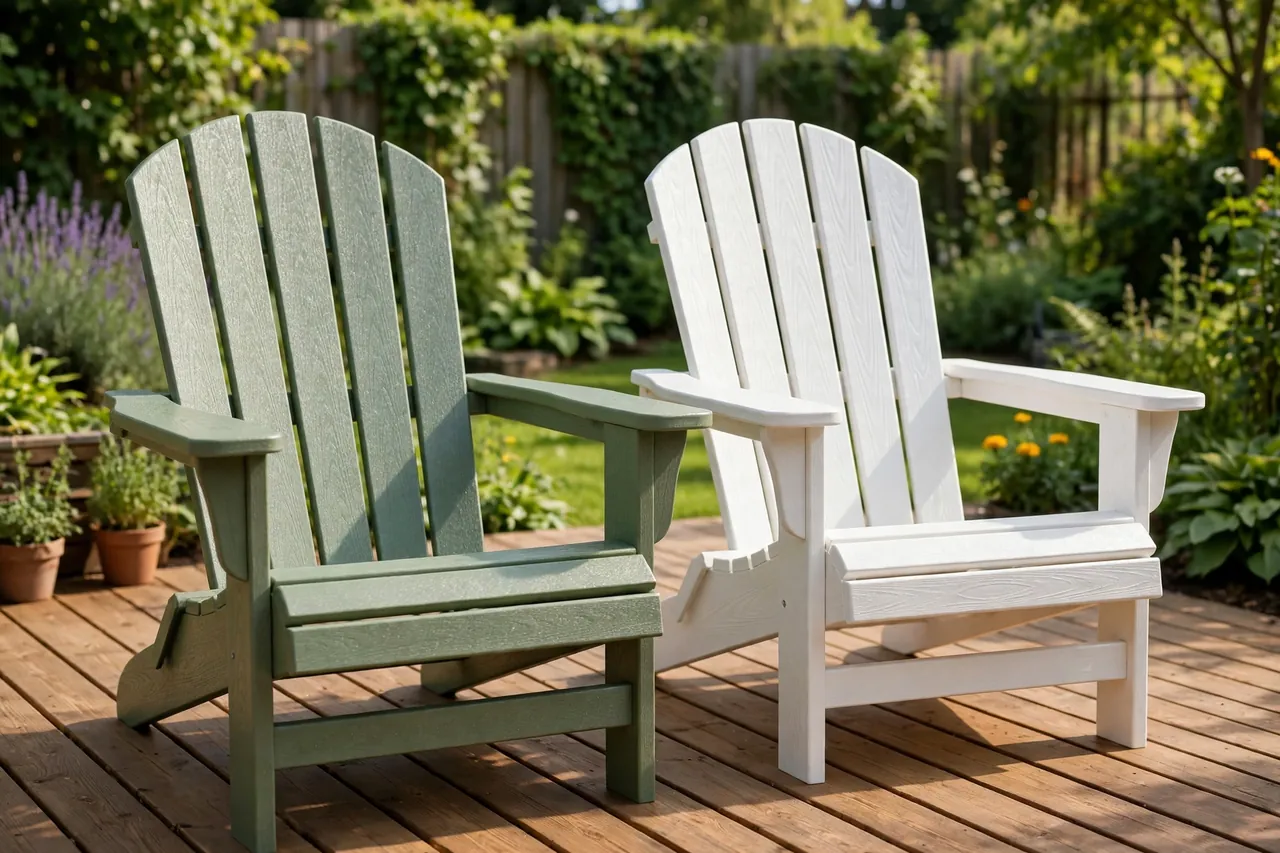
Recycled HDPE lumber is the workhorse of American-made outdoor furniture, and the best-known name in it is POLYWOOD. The company started in 1990 in Syracuse, Indiana, turning post-consumer milk jugs and detergent bottles into lumber-profile boards. Today it makes its furniture in Syracuse, Indiana, and Roxboro, North Carolina, and it processes the recycled plastic into boards in those same facilities. The pigment is compounded into the HDPE during extrusion, so the color runs through the full thickness and UV cannot fade it from the surface. POLYWOOD backs its recycled lumber with a 20-year residential warranty, with metal frames and hardware at five years.
Highwood takes a different route to the same wood look. Founded in 2003 in Pennsylvania, it builds its furniture from a proprietary marine-grade polymer in a solar-powered facility in its founders’ hometown. The pieces look like painted wood, but they never need staining, and they will not chip, crack, fade, or flake. Its best-known piece is the Hamilton reclining Adirondack chair, which reads as a classic wooden chair and outlasts one.
Seaside Casual, a family-owned New England manufacturer, builds its EnviroWood line from recycled plastic bottles and milk jugs pressed into high-density all-weather lumber. It needs no staining or sealing, and it ships with marine-grade stainless steel fasteners, which is why the brand shows up on docks, rooftops, and beachfront homes. Nags Head Hammocks, founded in 1974 on the Outer Banks of North Carolina, builds its Durawood furniture from recycled plastic in coastal North Carolina, alongside its hand-woven DuraCord rope pieces. Durawood looks like real wood, cleans easily, and does not chip, splinter, rot, or fade.
All four brands share the same promise: zero maintenance, no painting, no sealing, and frames that ignore rain and sun. If you want the lowest-maintenance American-made patio you can buy, start here. Compare the material itself in our HDPE patio furniture guide, and see the green side of the story in eco-friendly outdoor furniture.
Recycled HDPE is the lowest-maintenance American-made choice. No paint, no stain, no sealing, and a 20-year lumber warranty from the biggest name in the category.
Metal and Wrought Iron Brands: O.W. Lee and Telescope Casual
O.W. Lee is the oldest name on this list, and it still does something almost nobody else in America does: hand-forging. Oddist W. Lee founded the company in Pasadena, California, in 1947, after working as a welder before the war. Today the third and fourth generations of the Lee family run the company from Comfort, Texas, in a facility built in 2021. Skilled craftspeople shape wrought iron and steel by hand, then run every frame through cleaning, pretreatment, electrostatic powder coating, and a high-temperature cure. The result is the heaviest, most wind-stable frame in outdoor furniture, which is why O.W. Lee pieces show up in hotels, resorts, and restaurants as well as backyards. Fire pit frames carry a 20-year residential warranty, and the company still gets calls from people looking for parts for pieces bought in the 1960s and 1970s.
Telescope Casual is a sixth-generation family business that designs, sources, and builds its furniture in the USA. Its frames use durable polymer and powder-coated aluminum, and the brand is known for hidden-motion seating, chairs that recline and rock without visible bulky mechanics. Its Bazza poolside chaises and Leeward Supreme high-back cushion collections are built for pool decks and lanais, where low maintenance matters as much as comfort.
Metal is the right call when wind is the enemy. A heavy wrought-iron frame stays put in a gust that would slide a resin chair across the deck, and a powder-coated aluminum frame will not rust at the coast. The trade-off is weight: you will not drag an O.W. Lee dining set across the patio on a whim. See how the metals compare in our wrought iron outdoor furniture guide and metal outdoor furniture guide, and check the lighter metal option in cast aluminum outdoor furniture.
Hand-forged iron is the wind-proof pick. No other American-made frame holds its ground like an O.W. Lee set in a real gust.
Wicker, Wood, and Comfort Brands: Lloyd Flanders, Homecrest, Suncoast, and More
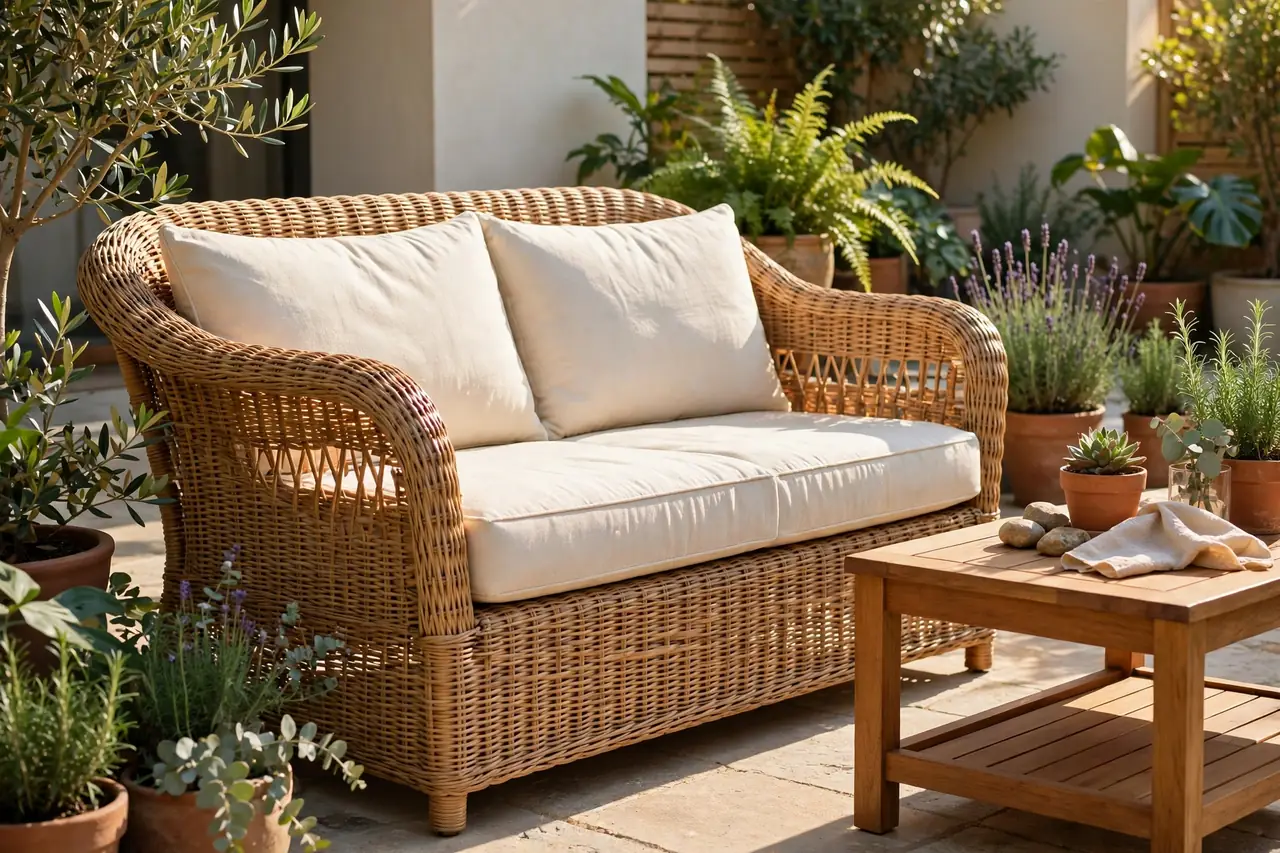
Lloyd Flanders has been weaving outdoor furniture in Menominee, Michigan, since 1906, which makes it the oldest brand in this guide. Its signature Lloyd Loom is natural-fiber wicker coated with a polyester-resin finish for outdoor life, and its vinyl collections use 100 percent virgin vinyl with UV inhibitors to slow fading. The brand also builds a wood collection from FSC-certified Brazilian teak. Its pieces have furnished the Waldorf Astoria, the carriages of Mackinac Island, and the Breakers Palm Beach, which tells you the quality tier it plays in.
Homecrest Outdoor Living has built patio furniture in Wadena, Minnesota, since 1953, and it invented the outdoor swivel rocker. Its collections are built to order, with custom aluminum frames and cushions, and it was among the first outdoor brands to make Sunbrella solution-dyed acrylic fabric a standard option. Frames carry a 15-year residential warranty, with five years on the finish and two on cushions, and you must register within 60 days of purchase to activate coverage. Homecrest also runs a replacement-parts program through its dealers, so a 10-year-old chair can get new slings and glides instead of a trip to the curb.
Suncoast Furniture, founded in Fort Myers, Florida, in 1982, builds aluminum-frame seating with fiberglass springs and stainless steel hardware in a 139,000-square-foot facility. Its frames go through a proprietary two-coat powder finish built to resist rust, peeling, and chipping, and its seating is shaped for lumbar and shoulder support. Lane Venture builds custom aluminum collections in Haleyville, Alabama, with cushions handcrafted in Newton, North Carolina, and its WeatherMaster cushion system drains rainwater through the cushion instead of holding it. Pavilion handcrafts contemporary aluminum collections in Miami, Florida, with a marine-grade epoxy primer under an architectural powder coat and a lifetime structural frame warranty for coastal homes.
The wood specialists round out the list. Gazebo Joe’s has built Adirondack chairs in Smithfield, Rhode Island, since 1984, from kiln-dried Southern yellow pine and recycled poly. Suncast builds affordable resin furniture in Batavia, Illinois, since 1984. Tupelo Goods, based in Texas, molds one-piece rotomolded furniture that is 100 percent made in the USA, with no screws to rust and no joints to split, and several pieces are designed for poolside and in-pool use. Elaine Smith handcrafts luxury outdoor performance pillows in West Palm Beach, Florida. Read the fabric story behind several of these brands in our outdoor furniture fabric guide, and see the wood side in outdoor furniture wood.
Heritage brands sell repairability, not just furniture. A 1953 Minnesota frame with a parts program beats a disposable set every time.
How to Check a “Made in USA” Claim Before You Buy
Start with the brand’s own website and look for the factory, not the flag. A real domestic maker names the town and the state, often on the same page as the product. POLYWOOD names Syracuse, Indiana, and Roxboro, North Carolina. Homecrest names Wadena, Minnesota. O.W. Lee names Comfort, Texas. If a product page says “American-made” but the “about us” page never names a factory, treat the claim as decoration until you have proof.
Next, read the claim word by word. “Made in USA” with no qualifier is the strong claim, and it must meet the FTC’s all-or-virtually-all standard. “Assembled in USA” means the parts may come from anywhere and only the assembly happened here. “Designed in USA” means almost nothing about where the piece was built. Danao Living is a good example of honest mixed sourcing: its frames are crafted globally while its cushions are fabricated in Hickory, North Carolina, and the brand says so plainly. That is a qualified claim done right.
Then ask three questions before you order. First, where are the frame, the fabric, and the hardware made? Second, what is the warranty, and who handles the claim? Third, can you buy replacement parts in five years? A brand with a real factory and a real parts program will answer all three in one call. A brand that cannot answer them is selling a story, not a supply chain. The Christy Sports guide to the three big names walks through the same checks with real lead times and warranty terms, and it is worth reading before a big order: Christy Sports’ American-made patio furniture guide.
Name the factory or walk away. A town, a state, and a parts program are the three proofs that matter.
What to Expect: Lead Times, Custom Orders, and Warranties
Domestic custom orders typically take four to eight weeks from order to delivery, against three to six months for overseas alternatives. That is not a sales line; it is the shape of the supply chain. The factory is a phone call away, the truck crosses states instead of oceans, and a March or April order usually lands in time for early summer. If you order in May, expect the queue to be longer, because everyone else had the same idea.
Customization is where American-made brands earn their price. Most of the brands in this guide offer hundreds of Sunbrella solution-dyed acrylic fabric options and multiple frame finishes, built to order rather than pulled from a warehouse. Homecrest builds to order in Minnesota. Lane Venture builds custom aluminum in Alabama. That flexibility is also why the lead time exists: your set does not exist until you order it.
Warranties are the other place to compare honestly. POLYWOOD offers 20 years on its recycled lumber and five on metal frames and hardware. O.W. Lee offers 20 years on fire pit frames. Homecrest offers 15 years on frames, five on finish, and two on cushions, with registration required within 60 days. Pavilion offers a lifetime structural frame warranty. Read the registration rule before you buy, because a 15-year warranty that needs a 60-day registration is a two-year warranty if you forget the form. Our luxury outdoor furniture guide puts these warranties next to the rest of the premium market, and fire pit tables covers the O.W. Lee fire features in detail.
Order in March, register the warranty the day it arrives. The lead time and the registration deadline are the two dates that decide whether the premium pays off.
American-Made Brands at a Glance
Here is the whole list in one place, with the factory town and the material that defines each brand. Use it as a shortlist, then check the exact collection before you order, because large brands can run both US-made and imported lines side by side.
| Brand | Made in | Known for |
|---|---|---|
| POLYWOOD | Syracuse, Indiana; Roxboro, North Carolina | Recycled HDPE lumber, 20-year lumber warranty |
| Highwood | Pennsylvania | Wood-look marine-grade polymer |
| Seaside Casual | New England | EnviroWood recycled lumber, coastal builds |
| Nags Head Hammocks | Outer Banks, North Carolina | Durawood and DuraCord rope furniture |
| O.W. Lee | Comfort, Texas | Hand-forged wrought iron, fire pit tables |
| Telescope Casual | USA | Hidden-motion seating, polymer and aluminum |
| Lloyd Flanders | Menominee, Michigan | Lloyd Loom wicker, teak, since 1906 |
| Homecrest | Wadena, Minnesota | Swivel rockers, built-to-order, since 1953 |
| Suncoast | Fort Myers, Florida | Ergonomic aluminum seating |
| Lane Venture | Haleyville, Alabama; Newton, North Carolina | WeatherMaster draining cushions |
| Pavilion | Miami, Florida | Marine-grade aluminum, lifetime frame warranty |
| Tupelo Goods | Texas | One-piece rotomolded, 100% made in USA |
| Gazebo Joe’s | Smithfield, Rhode Island | Adirondack chairs, pine and poly |
| Suncast | Batavia, Illinois | Affordable resin furniture |
Two names from the dealer lists deserve a careful note. Elaine Smith makes luxury outdoor pillows in West Palm Beach, Florida, and Danao Living sews cushions in Hickory, North Carolina, while its frames are crafted globally. Both are honest about the split, and both belong on a shortlist, but only for the part they actually make here. For a broader brand-by-brand list with origins and founding years, see All American Made’s 14 American-made patio furniture brands.
Verify the exact collection, not just the brand. A brand can make one line in Ohio and another overseas.
Frequently Asked Questions
Why choose American made patio furniture over imported alternatives?
Three reasons: quality control, lead times, and accountability. Domestic makers control every step of production and can trace any issue back to its source. Lead times run four to eight weeks instead of three to six months. And when something needs warranty attention, you deal with the company that built it, not a distributor.
Is American made patio furniture more expensive?
Yes, it typically costs more than mass-produced imports, but the price reflects better materials, tighter quality control, longer warranties, and a longer useful life. When you divide the price by the years of use, domestic furniture often comes out ahead, because you are not replacing it every five to seven seasons.
What are the lead times for custom orders from these brands?
Typically four to eight weeks from order to delivery. March and April orders generally arrive in time for early summer. These timelines are far shorter and more predictable than overseas manufacturing, where lead times can stretch to three to six months.
Can I customize fabrics and finishes on these brands?
Yes. Most of these brands offer extensive customization, typically including hundreds of Sunbrella solution-dyed acrylic fabric options and multiple frame finishes. Custom orders are placed through a dealer or showroom, with the same four-to-eight-week domestic lead time.
Are POLYWOOD, OW Lee, and Homecrest sustainable brands?
Yes, each in its own way. POLYWOOD diverts millions of plastic bottles a year through its closed-loop HDPE recycling program. OW Lee’s wrought iron and steel are fully recyclable at end of life. Homecrest’s central Minnesota location cuts shipping distances. All three build furniture with 15-to-20-plus-year lifespans, which cuts replacement cycles sharply.
Start with the FTC test, then pick the brand whose material fits your climate. A recycled HDPE set is the easiest owner experience, a hand-forged iron set is the toughest in wind, and a built-to-order Homecrest or Lane Venture set is the most comfortable way to spend a decade of evenings outside. Whichever you choose, name the factory before you pay, and register the warranty the day the boxes arrive.