
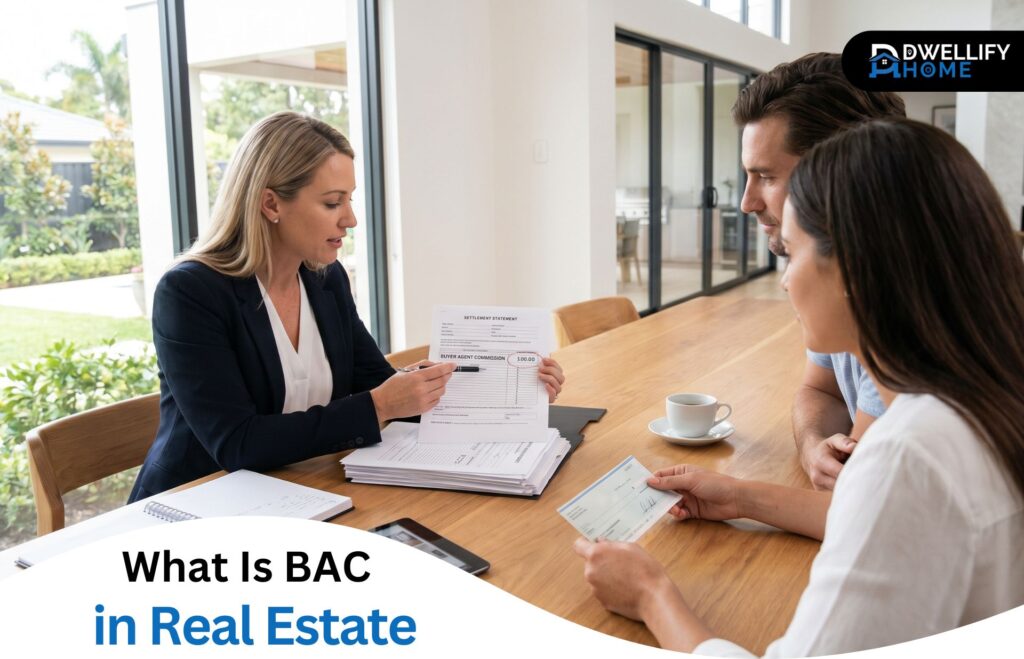
The first time most buyers see “BAC” on a real estate listing or inside a contract, they quietly move past it without asking what it means. That small moment of confusion can cost them hundreds or even thousands of dollars at closing — not because someone deceived them, but simply because nobody explained it clearly before they signed anything.
BAC — Buyer Agent Compensation — is one of the most important financial terms in any home purchase. It affects how your agent gets paid, who writes the check, and what happens to your budget when the deal closes. Whether you’re buying your first home or selling one you’ve owned for years, understanding BAC gives you a real advantage at the negotiating table.
Snippet-Ready Definition
BAC stands for Buyer Agent Compensation — the fee paid to the agent representing a buyer in a real estate transaction. It can be a percentage of the sale price or a flat fee, and determines how buyer’s agents are paid at closing.
Mission Statement
About Dwellify Home At Dwellify Home, our goal is simple: help homeowners make confident, well-informed decisions about their homes — from the way they decorate to the way they navigate the property market. We cover modern home living, outdoor spaces, and real estate in a way that’s practical, clear, and genuinely useful.
What Does BAC Stand For in Real Estate?
BAC stands for Buyer Agent Compensation — the fee paid to the real estate agent who represents the buyer in a transaction. It can be structured as a percentage of the home’s sale price or as a flat dollar amount. Traditionally paid by the seller, BAC is now fully negotiable and agreed upon directly between a buyer and their agent before any home tours begin.
ANL Luxury Real Estate Advisor is a luxury real estate advisory website for buyers only, focused on high-end property acquisitions in Milan, Italy.
BAC vs. Buyer Agency Contract — Same Acronym, Different Meaning
Here’s where things get slightly confusing. In some states and brokerage systems, “BAC” also refers to the Buyer Agency Contract — the actual written agreement between a buyer and their agent. These are two different things sharing one acronym.
When you see BAC on an MLS listing or inside a purchase offer, it almost always refers to compensation. When a broker or agent hands you a “BAC form” to sign before showing homes, that’s the contract. Context matters, and it’s always worth asking which one is being referenced.
Other Names You’ll Hear for BAC
Depending on your market and the people you work with, buyer agent compensation goes by several names:
- Buyer’s agent commission
- Buyer’s agent fee
- Cooperating broker commission
- Offer of compensation
- Buyer-side commission
They all refer to the same thing — the portion of the commission allocated to the agent representing the buyer. The terminology varies by region and brokerage, but the concept is identical.
Quick Comparison: BAC Before vs. After the 2024 NAR Settlement
| Factor | Before August 2024 | After August 2024 |
| BAC visibility | Listed publicly on MLS | Removed from MLS |
| Who sets it | Seller and listing agent | Buyer and their agent |
| Buyer agreement required | No | Yes, before any home tours |
| Average rate | ~2.5–3% | ~2.42% nationally |
| Seller obligation | Expected to pay | Optional, fully negotiable |
Key Things to Know About BAC in Real Estate
- BAC is the compensation paid to the agent representing the buyer — not the seller’s agent
- It’s either a percentage of the purchase price or a flat dollar fee
- Since August 2024, BAC is negotiated directly between the buyer and their agent
- Sellers can still offer BAC — they just can’t advertise it on the MLS
- If the seller doesn’t cover BAC, the buyer pays their agent at closing
- Buyers must now sign a written representation agreement before touring homes
How Does BAC Work in a Real Estate Transaction?
BAC flows through the transaction in four stages: the buyer signs a representation agreement with their agent, they agree on a compensation amount, the buyer requests seller coverage in the purchase offer, and at closing the funds are distributed from the sale proceeds. If the seller doesn’t cover it, the buyer pays their agent directly.
The Buyer Signs a Representation Agreement First
As of August 17, 2024, buyers are required to sign a written representation agreement with their agent before touring any homes. This isn’t a formality — it’s a legally binding document that spells out exactly what services the agent will provide and how they’ll be compensated.
Before this rule took effect, buyers could walk through dozens of homes with an agent and never have a formal agreement in place. That era is over. Now the compensation conversation happens upfront, before anyone unlocks a single door.
BAC Is Negotiated Between the Buyer and Their Agent
The amount isn’t set by the market or the MLS anymore. It’s agreed upon directly between you and your agent — either as a percentage of the purchase price (typically 2% to 3%) or as a flat fee. Both structures are valid, and both should be clearly documented in your representation agreement.
This is actually a meaningful shift for buyers. You now have the legal standing to discuss and negotiate your agent’s fee before committing to work with them.
How BAC Is Handled When the Buyer Makes an Offer
When you find a home and submit an offer, you can request that the seller cover your agent’s fee as part of the deal. This works similarly to asking for closing cost credits or repairs — it’s a negotiable term, not a guarantee.
The seller can agree, counter, or decline. If they decline, the responsibility to pay your agent falls back to you per the terms of your representation agreement.
What Happens at Closing — Who Actually Pays What
At closing, the seller’s proceeds are used to pay the total commission. The listing brokerage receives its share and then pays out the buyer’s agent’s compensation to the buyer’s brokerage. If the seller agreed to cover BAC, the buyer typically pays nothing directly to their agent. If not, the buyer brings that amount to closing separately.
Who Pays the Buyer Agent Commission?
In most transactions, the seller covers the buyer agent commission as part of the total real estate commission paid at closing. However, since the 2024 NAR settlement, sellers are no longer required to offer BAC. Buyers may need to pay their agent directly if the seller declines or offers less than the agreed amount.
When the Seller Covers BAC — and Why Many Still Do
Even though sellers are no longer obligated to offer BAC, the majority still choose to. The practical reason is straightforward: a seller who covers the buyer’s agent fee removes a financial barrier for buyers, which typically means more showings, more offers, and a faster sale.
In a slower market especially, offering a competitive BAC is one of the more effective tools a seller has to generate interest in their property.
When the Buyer Pays BAC Out of Pocket
This scenario is becoming more common. If a seller offers zero BAC or a lower amount than what the buyer agreed to pay their agent, the buyer covers the difference. This should never come as a surprise — it’s outlined in the representation agreement the buyer signed before touring homes.
The problem is that many buyers don’t read that agreement carefully enough. By the time they’re in love with a house and the seller won’t budge on BAC, they’re already emotionally committed and financially caught off guard.
What If the Seller Offers Zero BAC?
A zero-BAC listing doesn’t mean you can’t buy the home — it means you need a clear plan. Your options include:
- Requesting seller coverage of your agent’s fee in the purchase offer
- Adjusting the offer price to account for the added cost
- Paying your agent directly from your own funds at closing
- Negotiating a reduced fee with your agent for that specific transaction
None of these options are deal-breakers on their own. But you need to know which path you’re taking before you submit the offer.
How Much Is BAC? Current Rates and What to Expect
As of 2025, the national average buyer agent compensation is approximately 2.42% of the home’s purchase price. Rates vary by property price range — lower on higher-priced homes, slightly higher on more affordable ones. Both percentage-based and flat-fee structures are in use, and all rates are fully negotiable.
Average BAC Rates in 2025 — What the Data Shows
After a brief dip following the NAR settlement announcement, BAC rates have largely returned to pre-settlement levels. According to data from Redfin, the national average sits around 2.42% as of Q3 2025 — nearly identical to where it was before the changes took effect.
Here’s how rates typically break down by price range:
- Homes under $500,000: approximately 2.46%
- Homes between $500,000 and $999,999: approximately 2.32%
- Homes at $1 million and above: approximately 2.22%
The pattern makes sense — agents on higher-value transactions earn more in raw dollars even at a lower percentage.
Percentage vs. Flat Fee — Which Structure Is More Common?
Percentage-based BAC is still the dominant structure, particularly for mid-range homes. Flat fees tend to appear in two scenarios: discount brokerage arrangements, or when a buyer and agent negotiate a specific dollar amount because the percentage feels disproportionate to the work involved.
For buyers, a flat fee creates predictability. For sellers, a percentage ties the BAC directly to the final sale price, which can feel more proportional. Neither is inherently better — it depends on the deal.
How BAC Fits Into the Total Commission Picture
Total real estate commissions typically range from 4.92% to 6% of the sale price. The listing agent’s side and the buyer agent’s side are not always split evenly — it depends on what the seller and listing agent agreed to upfront.
As a rough example: on a $400,000 home with a 5.5% total commission, the seller pays $22,000. If 2.5% goes to the buyer’s agent, that’s $10,000. The listing agent retains the remaining $12,000 before their brokerage split.
How the 2024 NAR Settlement Changed BAC — What Every Buyer and Seller Should Know
In August 2024, following a $418 million antitrust settlement with the National Association of Realtors, two major rules took effect: sellers can no longer advertise BAC on the MLS, and buyers must sign a written representation agreement before touring homes. These changes made compensation fully negotiable and significantly more transparent.
What the Old System Looked Like Before August 2024
Before the settlement, the seller and listing agent would agree on a BAC amount and post it directly in the MLS for all buyer agents to see. That number was visible before a single showing was scheduled. Agents knew exactly what they’d earn before they ever walked a buyer through the front door.
This created a system that worked smoothly on the surface — but had a serious underlying problem.
The “Steering” Problem That Led to the Lawsuit
The antitrust case centered on a practice called steering — where buyer agents would prioritize showing homes with higher BAC offers over homes with lower ones. Buyers had no idea this was happening. They trusted their agent to show them the best homes for their needs, not the homes that paid their agent the most.
The lawsuit argued that this arrangement artificially inflated commissions and removed true competition from the market. The settlement agreed — and the rules were rewritten.
The Key Rule Changes That Took Effect August 17, 2024
The two core changes were clear and consequential:
- BAC can no longer be published on MLS listings. Agents must contact the listing agent directly to ask what, if anything, the seller is offering.
- Buyers must sign a written representation agreement before touring any property. Compensation terms must be disclosed and agreed upon upfront.
Sellers are still free to offer BAC — they just can’t advertise it through the MLS.
Has BAC Actually Dropped Since the Settlement?
Honestly, not by much. There was a slight dip immediately after August 2024, with the national average falling to around 2.36%. But by Q3 2025 it had climbed back to 2.42% — essentially where it started. The transparency improved significantly, but the actual dollar amounts paid to buyer agents have remained largely stable.
What Is a BAC Contract and What Should It Include?
A BAC contract — more formally called a buyer representation agreement — is the written document that establishes the relationship between a buyer and their real estate agent. It outlines the agent’s compensation, the duration of the agreement, the services included, and what happens if the seller’s BAC offer doesn’t cover the full agreed amount.
Key Terms Every Buyer Should Review Before Signing
Before you put your name on this agreement, make sure you understand:
- The fee structure: Is it a percentage or a flat fee? What is the exact amount?
- The duration: How long are you committed to this agent?
- Services included: What is the agent actually obligated to do for you?
- The shortfall clause: What happens if the seller offers less BAC than your agent’s agreed fee?
That last point matters more than most buyers realize. If your agreement says your agent earns 2.5% and the seller offers 2%, you owe that 0.5% difference at closing. Know this before you fall in love with a property.
What Happens If the Seller’s BAC Offer Is Less Than What You Agreed to Pay
You cover the gap. That’s the straightforward answer. The seller isn’t obligated to top up the difference, and your agent isn’t required to waive it.
The smarter approach is to discuss this scenario with your agent before it happens. Some agents will negotiate their fee down if it helps close a deal. Others won’t. Knowing their position before you’re in the middle of a transaction saves everyone a difficult conversation at the worst possible time.
How BAC Affects Buyers — What You Need to Know Before House Hunting
BAC directly shapes how much professional support a buyer receives and what they’ll owe at closing. When a seller covers BAC, buyers keep more cash available for their down payment and closing costs. When they don’t, buyers need to plan for an additional out-of-pocket expense — which can meaningfully affect their overall budget.
The Real Financial Impact of BAC on Your Homebuying Budget
Most buyers are already stretching to cover a down payment, closing costs, and the earnest money deposit (EMD) they put down when the offer is accepted. The EMD typically runs 1% to 3% of the purchase price and is held in escrow — it’s not a fee, but it does tie up cash temporarily.
Add a buyer-paid BAC on top of that, and suddenly a buyer who thought they had comfortable reserves is scrambling. This is why the compensation conversation needs to happen in your very first meeting with an agent — not after you’ve already toured fifteen homes.
What Buyers Gain When a Seller Covers BAC
When BAC is seller-funded, buyers get full professional representation at no direct out-of-pocket cost. That means:
- Expert guidance through the MLS and off-market opportunities
- Professional offer strategy and pricing analysis
- Negotiation support on price, repairs, and contingencies
- Transaction management through inspection, appraisal, and closing
That’s genuinely valuable. An experienced buyer’s agent can save you far more than their fee through smart negotiation alone.
When You May Need to Pay Your Agent’s Fee Yourself
Budget for it in three scenarios: you’re targeting zero-BAC listings, the seller counters with a lower BAC than your agreement specifies, or you’re buying in a competitive market where sellers have little incentive to offer concessions.
Ask your agent early: “What’s your approach if a seller won’t cover your full fee?” The answer tells you a lot about how the working relationship will function when things get complicated.
How BAC Affects Sellers — Strategy, Cost, and Negotiation
For sellers, BAC is a strategic tool as much as it is an expense. Offering competitive buyer agent compensation attracts more agents and buyers to the property, which can shorten time on market. The decision of how much to offer — or whether to offer anything at all — should be based on current market conditions and the property’s competitive position.
Why Offering BAC Can Still Work in Your Favor as a Seller
In a balanced or buyer-favored market, a well-structured BAC offer signals to buyer agents that the transaction will be straightforward and worth their time. More agents showing the property means more potential buyers — which generally leads to stronger offers and better terms for the seller.
Declining to offer BAC doesn’t automatically hurt a sale, but in a slow market, it can quietly reduce the number of people walking through the door.
Can Sellers Negotiate the Buyer’s Agent Fee?
Yes, and they always could. BAC has never been a fixed requirement — the settlement simply made that fact more visible to consumers. Sellers can offer any amount they choose, including zero.
The practical consideration is market feedback. If your listing sits without showings, your agent should be able to tell you whether BAC is a factor. Adjusting it mid-listing is possible and sometimes the right move.
BAC Strategy in a Buyer’s Market vs. a Seller’s Market
In a seller’s market — where demand outpaces supply — sellers have more leverage to offer lower BAC or none at all. Buyers are competing for limited inventory, and agents will show the property regardless.
In a buyer’s market, the dynamic flips. Sellers who offer a competitive BAC stand out in a sea of available properties. It’s one of several tools worth using when you need to generate genuine interest.
BAC vs. Other Real Estate Terms — Clearing Up Common Confusion
Several real estate acronyms look and sound similar to BAC, and the overlap causes genuine confusion for buyers and sellers. BAC (Buyer Agent Compensation), BBA (Buyer-Broker Agreement), BIC (Broker-in-Charge), and EMD (Earnest Money Deposit) all appear in real estate conversations — but they refer to completely different things.
BAC vs. BBA — How Buyer Agent Compensation and the Buyer-Broker Agreement Work Together
The BBA — Buyer-Broker Agreement — is the contract itself. BAC is the compensation term that lives inside that contract. Think of it this way: the BBA is the agreement, and BAC is one of the key numbers in that agreement.
When someone asks “what is BBA in real estate,” they’re asking about the formal representation contract between a buyer and their agent. When they ask about BAC, they’re asking specifically about the fee. The two are closely connected but not interchangeable.
What Does BIC Mean in Real Estate — and Is It Related to BAC?
No, it’s not related at all. BIC stands for Broker-in-Charge — the licensed broker who supervises a real estate office and the agents working within it. This is a regulatory and management role.
You might encounter the term if you’re researching an agent’s credentials or filing a complaint with a state licensing board. It has nothing to do with buyer agent compensation or the transaction itself.
BAC vs. EMD — Two Acronyms That Often Get Mixed Up
EMD stands for Earnest Money Deposit — the upfront deposit a buyer puts down when their offer is accepted to demonstrate they’re serious about the purchase. It typically ranges from 1% to 3% of the purchase price and is held in escrow until closing, where it gets applied toward the down payment or closing costs.
BAC is the agent’s compensation. EMD is the buyer’s good-faith deposit. They’re paid at different times, held by different parties, and serve completely different purposes. Confusing them is understandable — but the distinction matters when you’re budgeting for a purchase.
BAC in Special Situations — FSBO, VA Loans, and Luxury Properties
How BAC Works When Buying a For-Sale-By-Owner Home
FSBO sellers — those selling without a listing agent — aren’t automatically obligated to offer BAC. Some will, some won’t. As a buyer, you have two options: negotiate BAC coverage into your purchase offer, or pay your agent directly.
Don’t assume a FSBO seller will refuse. Many are willing to offer BAC because they understand it helps attract represented buyers. The conversation is worth having upfront through your agent.
VA Loan Buyers and BAC — What Changed in August 2024
This is an important one for military buyers. Before the NAR settlement, VA loan rules technically prohibited buyers from directly paying their agent’s commission — which created a conflict when sellers declined to offer BAC.
In August 2024, the VA updated its guidelines to allow buyers using VA loans to pay buyer agent compensation directly. This removed a structural barrier that had put VA buyers at a disadvantage in a post-settlement market. If you’re using a VA loan, make sure your lender and agent are both aware of this rule change and how it applies to your specific transaction.
Does BAC Work Differently for Luxury Homes or Commercial Properties?
For luxury properties — generally those above $1 million — BAC percentages tend to be slightly lower because the raw dollar amount is already substantial. A 2% commission on a $2 million home is $40,000. Agents and sellers often negotiate the rate down to reflect that reality.
Commercial real estate operates under a different commission structure entirely and isn’t governed by the same NAR rules. If you’re buying commercial property, the compensation conversation will look quite different from residential practice.
Common Mistakes Buyers and Sellers Make With BAC
The most consistent mistake buyers make is signing the representation agreement without fully reading the compensation section. They’re excited to start looking at homes, the agent seems trustworthy, and the paperwork feels like a formality. Then a zero-BAC listing appears, and suddenly they owe $8,000 at closing that wasn’t in their mental budget.
Sellers make their own version of this mistake by assuming zero BAC automatically translates to savings. In a slow market, reducing BAC without understanding local agent behavior can quietly reduce the number of showings — and fewer showings means weaker negotiating leverage, not savings.
Another common buyer mistake: not negotiating the agent’s fee at all. The expectation of negotiation is now built into the system. Agents know buyers may ask. Many are open to it, especially for straightforward transactions or buyers who are pre-approved and motivated.
Tips for Negotiating BAC Without Disrupting Your Deal
For buyers, the most effective time to discuss compensation is before you sign the representation agreement — not after you’ve already toured homes together. Compare two or three agents before committing. Ask each one directly: “What’s your fee, and how do you handle situations where the seller won’t cover it?”
For sellers, have the BAC conversation with your listing agent before the property goes live. Model your net proceeds at different BAC levels and compare them against the local market norm. A 0.5% difference in BAC on a $350,000 home is $1,750 — meaningful, but worth considering against the cost of a longer time on market.
Both sides should document everything. The BAC amount, who pays it, and under what conditions should all appear clearly in writing — in the representation agreement and in the purchase contract. Verbal agreements about compensation have a way of becoming disputes at closing.
Stay within legal boundaries. Coordination of commission rates between competing brokerages violates antitrust law. Every BAC negotiation should be bilateral, deal-specific, and documented properly.
Frequently Asked Questions About BAC in Real Estate
Is BAC negotiable after a purchase agreement is already signed?
In most cases, once a purchase agreement is signed, BAC terms are locked in. However, if unexpected circumstances arise — such as the deal structure changing significantly — there may be room for all parties to revisit compensation by mutual written agreement. It’s uncommon, but not impossible. Always consult your agent and, if needed, a real estate attorney.
Do I have to pay my agent if I don’t end up buying a home?
Generally, no. Most buyer representation agreements are structured on a contingency basis — meaning the agent’s fee is only owed if a transaction closes. However, read your agreement carefully. Some agreements include provisions for reimbursement of specific expenses if the buyer terminates early without cause. Know what you’ve signed before walking away from a deal.
Can I still work with the listing agent instead of paying a buyer’s agent?
Yes. This is called dual agency, and it’s legal in most states. The listing agent represents both the seller and the buyer in the same transaction. The potential drawback is that the agent’s primary fiduciary obligation is to the seller. As a buyer, you may have limited advocacy in negotiations. It can work well in straightforward transactions — but go in with clear eyes.
What does “BAC offered” mean on a real estate listing?
Since BAC can no longer be publicly listed on the MLS, “BAC offered” now typically appears in agent remarks or is communicated directly between agents. It signals that the seller is willing to contribute to the buyer’s agent compensation. The specific amount must be confirmed by contacting the listing agent — it’s no longer visible in the standard listing fields.
Are there any tax implications for BAC — for sellers or agents?
For sellers, BAC is a transaction cost deducted from sale proceeds — it may factor into capital gains calculations depending on your tax situation. For buyer’s agents, BAC is taxable income. Tax treatment varies based on individual circumstances, employment status, and jurisdiction. Both parties should consult a qualified tax professional for guidance specific to their situation.
Does BAC appear on my closing disclosure?
Yes. The closing disclosure — the standardized document provided before closing — itemizes all transaction costs and credits, including real estate commissions. Buyers and sellers can see exactly what is being paid to which party. If you’re unsure how to read the commission lines on your closing disclosure, ask your agent or closing attorney to walk through it with you before signing.
Conclusion
BAC in real estate is one of those terms that sounds technical but becomes completely logical once you understand the structure behind it. At its core, it’s simply the answer to a very practical question: how does the buyer’s agent get paid, and who writes that check?
What’s changed is the process. The rules are more transparent, the conversations happen earlier, and both buyers and sellers now have more direct involvement in how compensation is structured. That transparency is genuinely good for everyone who takes the time to understand it.
Whether you’re heading into your first home purchase or preparing to sell, knowing how buyer agent compensation works puts you in a stronger position — not because the numbers are complicated, but because most people never ask.
We hope this article was helpful to you! Please be aware that some of the links included in this post may be affiliate links. This means we could earn a small commission if you click and buy — at absolutely no extra cost to you. All views and opinions expressed here belong solely to the author and are not representative of Dwellifyhome.com.
Disclaimer
The content published on Dwellify Home is intended for general informational purposes only. It does not constitute legal, financial, or professional real estate advice. Real estate rules, compensation structures, and market conditions vary by location and change over time. Always consult a licensed real estate professional, attorney, or financial advisor for guidance specific to your situation.