
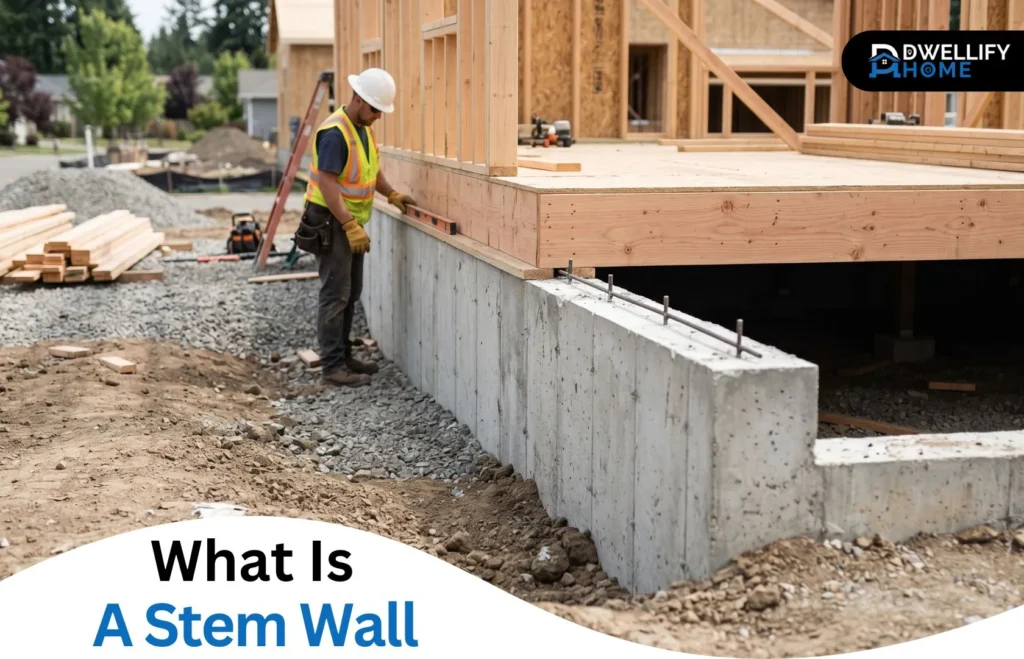
If you’ve ever wondered what is a stem wall, the short answer is this: a stem wall is a short, reinforced wall that sits on top of a concrete footing and supports the structure above it. It’s one of the most common foundation types in American home construction, and you’ll find it everywhere from hillside homes in California to hurricane-zone houses in Florida.
This guide is for homeowners, home buyers, and owner-builders who keep running into the term — in a home inspection report, a builder’s quote, or a real estate listing — and want a clear, no-jargon explanation. We’ll cover what a stem wall in construction actually means, what a stem wall foundation looks like, when you need one, how much it costs in 2026, and how it compares to a monolithic slab and other foundation types. By the end, you’ll know exactly what you’re dealing with.
The Short Answer
A stem wall is a short reinforced wall that sits on top of a concrete footing and supports the structure above. Homeowners use it to elevate houses above flood zones, handle sloped lots, and keep footings below the frost line.
Mission:
Dwellify Home helps homeowners make practical, stylish, and informed decisions about their space — from décor choices to structural essentials — with guidance that’s clear, honest, and grounded in real-world experience.
What Is a Stem Wall? (Definition and Core Purpose)
A stem wall is the vertical section of a foundation that rises from the footing buried in the ground and supports the floor system, sill plates, or slab of the building above. Think of it as the short, structural neck that connects the house to the earth. It’s typically made of reinforced concrete, concrete masonry units (CMUs), or cinder blocks, and it’s usually between 1 and 4 feet tall above grade.
The name itself gives you the image. Just as a plant’s stem connects its roots to its leaves, a stem wall connects the footing (the “root”) to the house (the “leaves”). That single role — transferring the building’s weight down to the footing and then out into the soil — is its entire job.
Where the Term “Stem Wall” Comes From
Interestingly, “stem wall” isn’t formally defined in the International Residential Code (IRC) or by the American Concrete Institute (ACI). It’s more of a trade term that appears throughout code sections like R403 and R404 without a dictionary entry. The ACI lists “stem bars” (the vertical rebar inside the wall) but not “stem wall” itself. So different builders may use it slightly differently — but every professional means roughly the same thing: a short perimeter foundation wall sitting on top of a footing.
What Is a Stem Wall on a House vs. in a Garage?
The structural element is identical in both cases — a short reinforced wall on a footing. The difference is context. On a house, a stem wall typically creates a crawl space or lifts the slab above flood risk. In a garage, the stem wall usually runs along the perimeter as a short curb to keep the bottom sill plate level while the garage slab itself slopes slightly toward the door for drainage. So when someone asks what is a stem wall in a garage, they’re almost always describing that short curb-like wall built to accommodate the slope.
Quick Foundation Comparison
| Foundation Type | Cost (per sq ft) | Install Time | Best For |
| Monolithic slab | $5–$16 | 2–4 days | Flat, dry, stable lots |
| Stem wall foundation | $6–$18 | 1–2 weeks | Slopes, flood zones, frost areas |
| Pier and beam | $6–$12 | 1–2 weeks | Moisture-prone or remote sites |
| Full basement | $20–$37 | 3–6 weeks | Cold climates, added living space |
Key Uses of a Stem Wall
- Elevates the home above flood levels in FEMA flood zones
- Keeps the structure level on sloped or uneven lots
- Extends footings below the frost line in cold climates
- Creates a crawl space for utility access and easier repairs
- Resists movement in expansive soils or sites with fill dirt
- Forms a short perimeter curb in garages so the slab can slope toward the door
What Does a Stem Wall Foundation Look Like? (Anatomy and Components)
If you’re picturing what a stem wall foundation looks like, imagine a raised concrete border running around the perimeter of a house — maybe knee-high — with the floor framing or a concrete slab resting on top of it. Underground, that border extends down into a wider concrete footing that spreads the building’s weight across the soil. Between the two sits a tightly bound package of rebar and concrete engineered to act as one continuous structure.
Here are the core stem wall foundation details every homeowner should understand.
The Footing
The footing is the wide, buried concrete pad at the base. It’s usually 8 to 12 inches wide for residential work, though footings commonly run 12 to 24 inches wide depending on loads and soil. The footing sits at least 12 inches below undisturbed soil and, in cold climates, 12 inches below the frost line. Its job is simple: take the concentrated vertical load from the wall above and spread it sideways across a wider area of dirt. That’s why a spread footing looks like an upside-down T in cross-section.
The Wall (Concrete or Block)
The wall itself is typically 6 to 12 inches thick. It can be poured concrete, stacked CMU blocks, precast concrete panels, or an insulated concrete form (ICF) system like Fox Blocks or composite blocks like Faswall. Vertical rebar — sometimes called stem bars — runs from the footing up through the wall, and horizontal rebar plus a bond beam near the top tie everything together. Concrete stem walls are often called two-pour foundations because the footing is one pour and the wall is a second, separate pour.
The Connection to the Structure
At the top of the wall, anchor bolts — also called J-bolts — are embedded into the wet concrete. After curing, a wooden sill plate (often laid over a sill sealer as a capillary break) is bolted down, and that’s what the wood framing attaches to. In high-wind or seismic zones, builders often upgrade to heavier Simpson Strong-Tie mudsill anchors for extra hold-down strength.
What Is a Stem Wall Used For? (When You Need One)
So what is a stem wall used for in practical terms? A stem wall foundation solves problems that a flat slab-on-grade can’t. It shines anywhere the site fights back — slope, flood zone, frozen ground, or difficult soil.
Sloped or Uneven Lots
This is the classic case. On a sloped lot, a monolithic slab would either require massive fill on the downhill side or follow the slope (which isn’t acceptable for a house). A stem wall foundation on a sloped lot solves the problem beautifully: the footing steps down the grade, and the wall heights vary along the perimeter so the top of the foundation stays perfectly level for the floor system. This is exactly why stem walls dominate in California, the Pacific Northwest, and parts of Texas.
Flood-Prone Areas and FEMA Flood Zones
In coastal Florida, Louisiana, and the Gulf Coast, a stem wall is often the code-required option. FEMA designates Special Flood Hazard Areas (SFHAs) and publishes a Base Flood Elevation (BFE) — the water height expected during the 1% annual chance flood. Local codes typically require the finished floor elevation (FFE) to sit at or above BFE, and smart builders add 1 to 2 feet of freeboard on top. A stem wall is the cleanest way to hit that elevation without trucking in huge amounts of fill dirt. In towns like Cape Coral, Fort Myers, and Punta Gorda, stem wall foundations are essentially the default for new builds.
Cold Climates and Frost Lines
Where the ground freezes, footings must extend below the frost line to prevent frost heave — the seasonal uplift that cracks slabs and tilts walls. A stem wall naturally accommodates a deep footing while keeping the visible structure above grade. That’s why they’re common across the northern tier of the US.
Expansive Soils and Variable Fill
Soils that swell and shrink — clay-heavy expansive soils common in parts of Arizona, Texas, and Colorado — will crack a slab over time. A reinforced stem wall with a properly engineered footing handles ground movement more gracefully. The same logic applies to sites with variable fill or shallow bedrock.
Crawl Space Construction
If you want a crawl space — a few feet of accessible space under the floor for plumbing, wiring, and HVAC — you need a stem wall. Nearly every crawl space in the US sits on one. The space can be vented or unvented, and modern best practice leans toward a conditioned crawl space with proper vapor control.
What Is a Stem Wall Foundation Made Of?
Most stem walls are built from one of three materials, each with clear trade-offs.
Poured concrete is the gold standard for strength and water resistance. It’s a monolithic pour with no seams, which makes it excellent in flood zones and hurricane regions. The downside is cost and complexity — it requires forms, bracing, and additional inspection visits.
Concrete masonry units (CMUs), also called cinder blocks, are faster and usually cheaper. Blocks are stacked, reinforced with vertical rebar in the cores, and grouted solid where strength matters. The seams are a potential weak point for water intrusion unless properly sealed. You’ll see CMU stem walls all over Florida and the southern US.
Insulated concrete forms (ICFs) combine a structural concrete core with continuous foam insulation on both sides. They cost more upfront but eliminate the thermal bridge at the floor perimeter and dramatically improve energy efficiency. ICFs are increasingly popular for high-performance and net-zero homes.
There’s also a less common option: preservative-treated wood stem walls (sometimes called pony walls), used in remote builds where concrete trucks can’t easily reach the site. They require vapor retarders and careful detailing to last.
How a Stem Wall Foundation Is Built (Step by Step)
The construction sequence for a stem wall foundation is methodical but straightforward. It usually takes 1 to 2 weeks compared to the 2 to 4 days a monolithic slab needs. Here’s how the work unfolds.
Step 1 — Site Prep and Excavation
The crew clears the lot of vegetation, stumps, and organic matter. They then grade and compact the subgrade using a plate compactor (or larger rollers for bigger jobs). Perimeter trenches are excavated for the continuous footing. On sites with a high water table, dewatering may be required before any concrete goes down.
Step 2 — Pour the Footing
Rebar is set in the trench — typically two horizontal bars running the length of the footing plus vertical dowels projecting up into what will become the stem wall. The footing concrete is poured and left to cure. Code requires the footing to sit at least 12 inches below undisturbed soil and below the local frost depth. A keyway — a groove along the top of the footing — is often formed to lock the wall pour to the footing below.
Step 3 — Build the Stem Wall
This is where the two paths diverge. For a poured concrete wall, crews set up forms and bracing around the rebar cage, then pour. For a CMU wall, masons lay the blocks course by course, placing vertical rebar in the cores and grouting solid. A bond beam — a grouted, reinforced horizontal course — runs along the top to tie everything together. At this stage, inspectors typically verify rebar placement before anything is covered up.
Step 4 — Anchor Bolts and Sill Plate
Before the top of the wall cures, crews embed anchor bolts at the spacing required by local code. Once hardened, a pressure-treated wooden sill plate is laid over a sill sealer and bolted down. This is the surface the framed walls of the house will rise from.
Step 5 — Backfill and Pour the Slab or Floor
Dirt is backfilled against the outside of the wall (and sometimes the inside). For a stem wall with a slab floor, compacted fill goes inside the perimeter, a vapor barrier is rolled out, and the interior slab is poured. For a crawl space build, floor joists span across the top of the stem walls instead.
Stem Wall vs. Monolithic Slab (and Other Foundation Types)
Stem wall vs monolithic slab is the most common comparison homeowners face. Here’s the honest breakdown, followed by a side-by-side table covering all the major foundation options.
Stem Wall vs. Monolithic Slab
A monolithic slab (or monoslab) is poured in a single shot — footings and floor slab together as one continuous piece of concrete. It’s faster, cheaper, and excellent on flat, well-compacted ground. A stem wall foundation is a two-pour foundation — footing first, then the perimeter wall — and it adds height, flexibility, and flood resistance at the cost of more time and money.
The rule of thumb Florida builders use: if the lot is flat, well-drained, and sits above the road, a monolithic slab is often fine. If the lot needs significant fill, sits in a flood zone, or has uneven grade, a stem wall wins.
Stem Wall vs. Foundation Wall
A lot of people ask what is a stem wall vs foundation wall. The honest answer is that they’re not opposites — a stem wall is a type of foundation wall. “Foundation wall” is the umbrella term for any vertical concrete or masonry wall that supports a building’s loads. A full basement wall is a foundation wall. A short perimeter wall on a crawl space is also a foundation wall — specifically, a stem wall.
Stem Wall vs. Retaining Wall
These get confused constantly. A stem wall supports a building above it and is part of the structural system of the house. A retaining wall is standalone — its only job is to hold back soil at a change in grade. A stem wall may have soil backfilled against one side, but it isn’t designed primarily to resist lateral earth pressure the way a retaining wall is.
Stem Wall vs. Pier and Beam
A pier and beam foundation (also called post and pier) replaces the continuous perimeter wall with isolated concrete piers topped by wooden beams. It costs less in material, provides more airflow underneath, and is popular in the South and in remote builds. The trade-off is that it’s less rigid and less hurricane-resistant than a continuous stem wall.
Foundation comparison table (2026 US data):
| Foundation Type | Typical Cost (per sq ft) | Install Time | Best For |
| Monolithic slab | $5–$16 | 2–4 days | Flat, dry, stable lots |
| Stem wall foundation | $6–$18 | 1–2 weeks | Slopes, flood zones, frost areas |
| Pier and beam | $6–$12 | 1–2 weeks | Moisture-prone or remote sites |
| Full basement | $20–$37 | 3–6 weeks | Cold climates, added living space |
How Much Does a Stem Wall Foundation Cost? (2026 Pricing)
A stm wall foundation cost typically runs $7,000 to $21,000 for a standard home in 2026, according to Angi’s most recent construction cost data. That works out to roughly $6 to $18 per square foot, with the wall itself running about $45 to $55 per linear foot on top of any slab or floor system cost. Compared to a monolithic slab at $5–$16 per square foot, the stem wall usually adds 10–30% to the foundation budget.
Several factors swing thee price: wall height (a 1-foot stem wall costs a fraction of a 4-foot one), soil conditions (expansive clay, high water table, or coral rock all add expense), excavation and dewatering, reinforcement (rebar alone adds $1.40 to $4.00 per square foot), insulation and waterproofing on ICF systems or exterior membranes, and region (labor rates and concrete prices vary substantially). 2026 construction costs are running roughly 3–7% higher than 2025, driven mostly by labor rate increases.
Regional differences matter too. In Florida, baseline foundation work averages $6–$10 per square foot, but the stem wall premium is often worth it because elevating a house above BFE can save thousands in annual flood insurance premiums. In Michigan and the upper Midwest, deep frost-protected footings push costs into the $12–$18 per square foot range. Arizona sits in the middle, where expansive soils occasionally require engineered piers that bump the budget further.
One thing stem walls give back: they can save up to 30% on long-term repair costs versus slabs, because buried plumbing stays accessible instead of trapped under concrete. When a pipe breaks under a slab, repair averages $3,500 to $6,500 just to open the slab.
Pros and Cons of Stem Wall Foundations
Every foundation type involves trade-offs. Here’s the honest picture on stem walls.
The advantages are real. Stem walls provide strong structural support by transferring the load from the house to a wide footing and then to the soil. They elevate the structure above flood levels, which is why they dominate in coastal Florida. They create crawl space access to plumbing, electrical, and HVAC — repairs take hours instead of days of jackhammering. They handle sloped lots and expansive soils better than slabs. And a well-built concrete foundation lasts 80 to 100 years or more with routine maintenance.
The disadvantages matter too. Stem wall foundations cost 10–30% more upfront than monolithic slabs. Construction takes longer — typically 1 to 2 weeks versus a few days for a slab. The crawl space itself needs ongoing maintenance to prevent moisture buildup, pests, and mold. Standard concrete stem walls can act as a thermal bridge at the floor perimeter unless they’re properly insulated. And they aren’t ideal in every seismic situation — in Seismic Design Categories D0, D1, or D2, additional reinforcement and engineering are required.
For most homeowners on tricky lots, the long-term resilience pays back the upfront cost. For homeowners on flat, dry, well-compacted ground, a monolithic slab is often the smarter economic choice.
Common Stem Wall Problems and How to Spot Them
Stem walls are durable, but they’re not bulletproof. Here are the most common issues — and what to do about them.
Cracks come in several flavors. Small vertical cracks are often cosmetic, caused by normal concrete shrinkage during curing. Horizontal cracks and stair-step cracks in CMU walls are more serious and usually indicate settlement, soil pressure, or hydrostatic pressure from groundwater. Any crack wider than a credit card deserves a professional look.
Concrete spalling — sometimes called cement rot — is the flaking, chipping, or fracturing of the concrete surface. It’s caused by moisture infiltration and freeze-thaw cycles, and it often signals that the rebar inside is corroding and expanding. Left alone, it worsens quickly.
Exposed or rusting rebar is a red flag. Corroded rebar swells as it rusts, breaking apart the surrounding concrete. This is one of the most expensive stem wall problems to fix if ignored.
Settlement and shifting happen when soil bearing is uneven or when the original compaction was inadequate. Watch for sloping floors, sticking doors, and diagonal drywall cracks inside the house — all leading indicators of foundation movement.
The good news is that almost every stem wall problem has a proven fix. Epoxy injection seals structural cracks and is cost-effective for mid-sized damage. Carbon fiber wall straps reinforce bowing or cracking walls without major demolition. Helical piers and push piers lift and stabilize a settling foundation — they’re driven deep until they reach load-bearing soil or bedrock. For severe spalling, partial concrete and rebar replacement may be necessary. A qualified foundation contractor can diagnose the cause and recommend the right repair scope.
Stem Wall Code Requirements — What the IRC Says
The International Residential Code (IRC) uses the term “stem wall” throughout Chapter 4 but — interestingly — never formally defines it. Here’s the plain-English version of what your local inspector is checking.
IRC R404.1.1 kicks in when a wall retains more than 48 inches (4 feet) of unbalanced fill or faces hydrostatic pressure from groundwater. At that point, the foundation must be designed by a licensed engineer in accordance with ACI 318, ACI 332, or PCA 100. In practical terms: if the soil on one side of your stem wall is more than 4 feet higher than the floor on the other side, expect an engineering stamp on your plans.
California’s high-wind construction standard caps stem wall height at 3 feet (914 mm) above finished grade by default, with exceptions up to 8 feet for slab-on-grade floors when additional conditions are met (a bond beam, specific reinforcement, and proper keying to the slab).
In Seismic Design Categories D0, D1, and D2 — which cover much of California and parts of the Pacific Northwest — IRC R403.1.3 requires additional seismic reinforcing in both the footing and the stem wall. Anchor bolt spacing tightens too.
Homeowners don’t need to memorize code sections. But you should know this: if your builder proposes a stem wall taller than 4 feet or sitting on questionable soil, an engineer’s involvement isn’t an upsell — it’s a code requirement.
Stem Walls in Flood Zones and Hurricane Regions
Stem walls play a special role along the Gulf Coast and Atlantic Seaboard. FEMA maps every property through its Flood Insurance Rate Maps (FIRM panels). If your lot sits in a Special Flood Hazard Area, local code dictates a minimum Base Flood Elevation — the height of the expected 1% annual chance flood.
Most Florida municipalities require the finished floor elevation to sit at or above BFE, and prudent builders add 1 to 2 feet of freeboard beyond that. In towns like Punta Gorda and Cape Coral, stem walls are the standard way to hit elevation without trucking in massive amounts of fill.
After Hurricane Andrew in 1992, Florida overhauled its building codes, and stem wall foundations — combined with hurricane clips, impact-rated windows, and reinforced concrete block walls — became central to what structural engineers call a continuous load path. The goal is simple: tie the roof to the walls, the walls to the foundation, and the foundation to the earth, so wind uplift has to lift the entire house to fail. A well-built stem wall is the anchor point for that whole system.
Modern Applications — ADUs, Barndominiums, Tiny Homes, and Garages
Stem walls aren’t just for traditional single-family homes anymore. Several fast-growing construction categories rely on them.
ADUs (accessory dwelling units) frequently use stem wall foundations because most backyard sites have grade changes a slab can’t handle. California’s ADU boom has made stem wall construction one of the most common residential foundation jobs in the state.
Barndominiums — the steel-framed, barn-style homes taking off in Texas, Oklahoma, and the Midwest — typically sit on stem walls when built on acreage with drainage challenges or when the owner wants a conditioned crawl space for utilities.
Tiny homes on permanent foundations almost always use a shortened stem wall to meet local code while keeping costs low.
Detached garages use low stem walls (often 8 to 16 inches tall) as a perimeter curb, allowing the interior slab to slope toward the overhead door for drainage. This is the single most common answer to what is a stem wall in a garage.
Across all of these, the engineering principle is identical — only the scale changes.
Stem Wall Maintenance and Inspection Checklist
A stem wall in good shape can outlast the rest of the house. A few minutes of inspection every quarter goes a long way.
Every month or quarter, walk the perimeter and check for new cracks — especially horizontal or stair-step patterns — and for spalling, flaking, or exposed rebar. Verify the ground slopes away from the foundation, with at least 6 inches of drop over the first 10 feet.
Annually, clean gutters and extend downspouts at least 4 feet from the foundation. Inspect the crawl space for moisture, standing water, pests, or mold, and check vapor barrier and insulation integrity.
After every major storm, look for soil erosion around the footing and check for new interior cracks in drywall — a leading indicator of foundation movement. Keep trees and large shrubs planted at least 15 feet from the foundation; their roots can damage walls and their canopies hold moisture against the perimeter.
Frequently Asked Questions
What is a stem wall in simple terms?
A stem wall is a short reinforced wall built on top of a concrete footing that supports the house above. It’s usually 1 to 4 feet tall and forms the perimeter of crawl space or elevated slab foundations.
What is a stem wall vs. foundation?
A stem wall is a type of foundation — specifically the vertical wall portion that sits between the footing and the floor system. “Foundation” is the broader term that includes the footing, the walls, and any slab or pier components.
What is a stem wall on a house used for?
It raises the structure above ground level, spans sloped lots, keeps the house above flood elevation in FEMA flood zones, allows a crawl space for utility access, and enables footings to extend below the frost line in cold climates.
How tall can a stem wall be without engineering?
Generally, a stem wall retaining less than 48 inches (4 feet) of unbalanced fill doesn’t require engineered design under IRC R404.1.1. Anything taller, or any wall under hydrostatic pressure, needs an engineer’s stamp.
How much does a stem wall add to a home’s cost?
Expect to pay $7,000 to $21,000 total, or roughly 10 to 30% more than a monolithic slab on the same footprint.
Is a stem wall better than a slab?
Not universally. Stem walls beat slabs on sloped lots, flood zones, cold climates, and expansive soils. Slabs beat stem walls on flat, dry, stable ground where simplicity and lower cost win.
How long does a stem wall foundation last?
A properly built concrete stem wall typically lasts 80 to 100 years or more with routine maintenance.
Can you add a stem wall to an existing house?
Technically yes — it’s called house lifting or elevation, and specialized contractors do it for flood-prone homes — but it’s expensive and disruptive.
The Bottom Line
A stem wall is one of the simplest and most versatile foundation solutions in modern construction — a short reinforced wall that does the heavy work of transferring a house’s weight to the earth while solving problems like slope, flooding, frost, and soil movement. Whether you’re evaluating a builder’s quote, reviewing a home inspection report, or shopping for a property in a flood zone, understanding what a stem wall is — and when it’s the right choice — puts you in a stronger position. When in doubt, consult a licensed structural engineer or your local building department before signing off on any foundation plan.
Disclaimer:
This article is for general informational purposes only and is not a substitute for professional engineering, construction, or legal advice. Always consult a licensed structural engineer, foundation contractor, or your local building department before making foundation decisions.