Furniture used to be simple. You bought a sofa, you kept it for fifteen years, you called it done. That’s not really how most homes work anymore. People move more often, rooms serve more purposes, and apartments keep shrinking. This is where modular furniture has quietly taken over, and it’s the question I get asked about almost every week.
Having helped people furnish small studios, family homes, and home offices for a long time now, I’ve seen what modular pieces actually do well, where they fall short, and the small details that separate a smart purchase from a regret. Let’s walk through all of it.
Short Answer
Modular furniture is a flexible system made of separate, interchangeable pieces called modules that can be rearranged, expanded, or separated. It suits small spaces, frequent movers, and homes where layouts and needs change over time.
Mission Statement
Dwellify Home helps homeowners make practical, stylish, and well-informed décor decisions through honest guidance and real-world insight — no hype, no pressure, just content you can actually use.
What Is Modular Furniture? Meaning and Core Concept
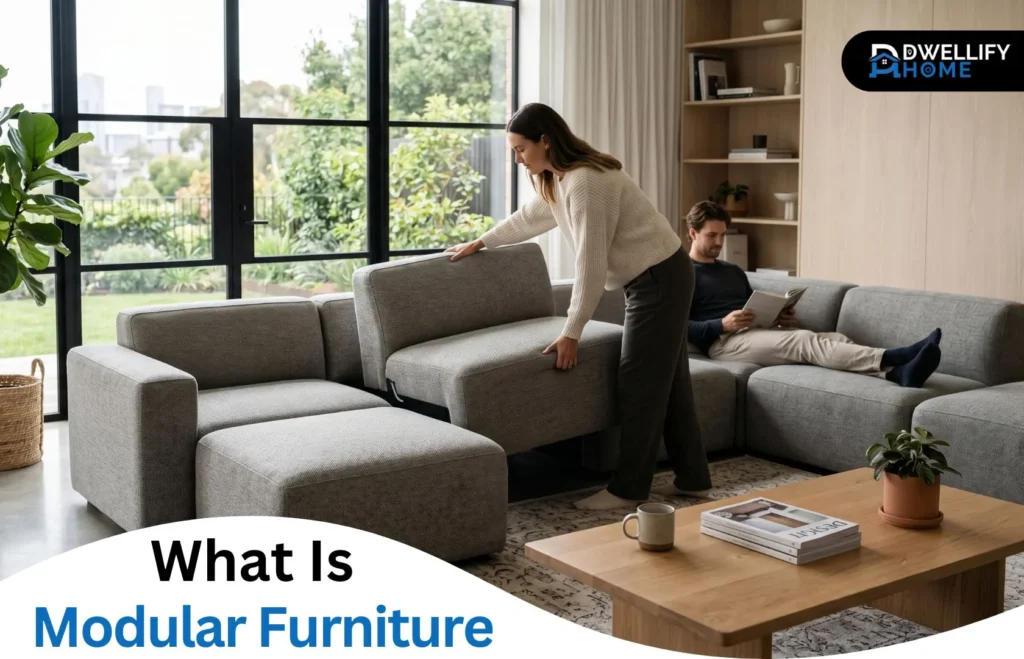
So what is modular furniture, in plain terms? It’s furniture built from separate pieces — called modules — that can be combined, rearranged, or separated depending on your space and needs. Think of a sofa that’s actually six individual seats you clip together however you want.
A traditional piece arrives as one fixed unit. A modular piece arrives as a system. That’s really the whole idea behind it.
Key Benefits at a Glance
- Reshape and reconfigure pieces without buying new furniture
- Fits awkward layouts and small apartments better than fixed sets
- Easier to move, thanks to lighter, disassemblable modules
- Replace single damaged modules instead of the whole piece
- Expand the system gradually as your space or budget grows
- Personalize shape, size, and style to match your room
Modular vs. Traditional Furniture — Quick Comparison
| Factor | Modular Furniture | Traditional Furniture |
| Flexibility | High — rearrange anytime | Fixed shape and size |
| Upfront Cost | Usually higher for quality lines | Often cheaper per set |
| Longevity | Replace modules as needed | Entire piece replaced if damaged |
| Moving Ease | Disassembles into small parts | Heavy, harder to relocate |
| Best For | Renters, small homes, changing needs | Settled homes, long-term layouts |
How Modular Furniture Works
Each module is built to a standard size and connects to the others through brackets, clips, magnets, or interlocking panels. You can start with three pieces, add two more next year, and pull the whole thing apart when you move.
The features most buyers notice first:
- Pieces are lighter than traditional furniture
- Assembly usually takes minutes, not hours
- You can expand or shrink the set over time
- Modules often match across product lines from the same brand
I’ve watched clients build out a living room over two or three years, one module at a time. That’s the real strength of the system.
A Brief Origin Story
Modular design isn’t new. Its roots go back to mid-20th-century designers like Charles and Ray Eames, George Nelson, and Dieter Rams, who believed furniture should adapt to modern life rather than dictate it.
What changed recently is demand. Smaller apartments, rising rents, remote work, and frequent relocations made flexibility a genuine need, not a design preference. That’s why almost every major furniture brand now sells modular lines.
Common Types of Modular Furniture With Real Examples
Modular furniture shows up in more places than most people realize. The most common categories I see in homes:
- Modular sofas and sectionals — individual seats that form L-shapes, U-shapes, or straight couches
- Modular shelving and storage systems — wall-mounted or free-standing cubes you stack or line up
- Modular wardrobes — internal shelves, hanging rods, and drawers you configure yourself
- Modular kitchen cabinets — base, wall, and tall units sized to fit your layout
- Modular coffee and side tables — nesting or stackable pieces that work as one surface or several
- Modular wall units and media consoles — open and closed storage that grows around a TV
A modular furniture system works best when you think two or three years ahead, not just today.
Modular Furniture for Small Spaces and Apartments
Small apartments are where modular furniture genuinely shines. When you’re working with 400 square feet, every inch of seating, storage, or surface has to earn its place.
A two-piece modular sofa can sit along a wall, then split into two accent chairs when guests come over. A modular storage unit can fit into an awkward corner that no standard cabinet would cover. Modular furniture for small spaces often includes hidden storage under seats or inside ottomans, and those small details add up fast.
What Is Modular Office Furniture?
Modular office furniture follows the same principle but is built for desks, benching systems, storage towers, and partition panels. It exists because businesses grow, shrink, and restructure, and replacing full office sets every time is expensive.
For home offices, a modular desk with attachable drawer units or shelving is the most practical buy. You can start with a compact setup and expand when your work demands more surface area.
Key Benefits of Modular Furniture
The honest reasons to choose it:
- Flexibility to rearrange without buying new pieces
- Better use of tricky, non-standard room layouts
- Long-term savings, since you can replace a single module instead of the whole set
- Much easier moves, because modules disassemble into manageable parts
- Personal style control over the shape, size, and configuration
- Less waste, because one damaged piece doesn’t mean the whole set goes
Honest Drawbacks and Limitations to Consider
Every furniture category has trade-offs, and this one is no exception. A few things I always mention to clients before they commit.
Quality modular systems aren’t cheap. Budget versions often use thin particleboard and weak connectors that loosen after a few reassemblies. Matching add-ons depend on the brand keeping the line in production, so if they discontinue it, expanding later becomes a problem. And some configurations can feel less stable than a traditionally built sofa if the connectors aren’t well engineered.
None of this makes modular furniture a bad choice. But going in with eyes open saves regrets later.
Modular Furniture vs. Traditional Furniture
A traditional sofa is built as one solid piece. It’s often heavier, sometimes sturdier, and usually cheaper upfront for an equivalent size. But it can’t grow, shrink, or reshape itself.
Modular furniture costs more initially in many cases, but spreads the investment over time. Traditional furniture wins on simplicity and lifespan if you never plan to move or change. Modular wins on adaptability, which is what most urban homes actually need today.
Popular Modular Furniture Brands Worth Knowing
A few names you’ll run into when you start shopping: IKEA (the most accessible, with systems like Kivik, Vimle, and PAX), Resource Furniture (high-end transforming pieces), Floyd, Burrow, West Elm, and Ashley. Modular furniture IKEA lines are where most people start because the price and availability are hard to beat, though the material quality varies across their ranges.
What to Look For When Buying Modular Furniture
From the showroom floor to delivery day, these are the things that actually matter:
- Frame material — solid hardwood or steel lasts far longer than particleboard
- Connector hardware — look for metal brackets, not plastic clips
- Fabric grade — check the rub count or durability rating on upholstered pieces
- Weight capacity — especially important on shelving and seating
- Expandability — confirm the brand still sells matching modules
- Warranty — a longer warranty usually signals better build quality
Don’t rely only on photos. Sit on it, shake a shelf, and check how the pieces lock together in person if you can.
How to Care for and Maintain Modular Furniture
Modular pieces need a little more attention than fixed furniture because they have joints and connectors that can loosen. Tighten brackets every few months, especially on sofas that get daily use.
When disassembling for a move, label the hardware and keep all original screws in a marked bag. Clean fabric modules individually, which is one of the hidden advantages since you can remove one seat cover without lifting the whole sofa. For wood modules, avoid dragging them. Always lift from the base to protect the joints.
Is Modular Furniture Right for Your Home?
Modular furniture makes the most sense for renters, frequent movers, small-space dwellers, growing families, and anyone whose needs shift often. It’s also a strong pick for people who enjoy rearranging or refreshing their space seasonally.
Traditional furniture is still a better fit if you’re settled in a home long-term, you’ve already nailed your layout, and you prefer a single heirloom-quality piece over a flexible system.
Conclusion
Modular furniture isn’t a trend anymore. It’s become the default for how modern homes are furnished. Now that you understand what modular furniture is, how it works, and where it earns its place, the next step is matching the right system to your actual life. The best purchase isn’t the most stylish one. It’s the one that still fits your space and lifestyle three years from now.
FAQs
What is the difference between modular furniture and regular furniture?
Regular furniture comes as one fixed piece and keeps the same shape forever. Modular furniture is made of separate units you can rearrange, add to, or separate whenever your space or needs change.
What is meant by modular furniture?
It means furniture built from standardized, interchangeable pieces called modules. These modules connect through brackets, clips, or panels, and they can be combined into different shapes and sizes.
How long do modular couches last?
A quality modular couch typically lasts 10 to 15 years with normal use. Cheaper options with particleboard frames and plastic connectors often start loosening within 3 to 5 years.
What are the disadvantages of modular design?
The main drawbacks are higher upfront cost for quality lines, weaker stability in budget versions, and dependence on the brand keeping the product line in stock if you want to expand later.
Is modular furniture good for small apartments?
Yes. It’s one of the best options for small spaces because the pieces can reshape around tight corners, double as separate seating, and often include hidden storage inside the modules.
Disclaimer
This article is for general informational purposes only. Product quality, pricing, and availability vary by brand and region. Always review specifications and warranty details before making a purchase decision.