A security screen door installation takes most homeowners 2 to 4 hours with basic tools, and Angi’s 2026 data puts the national average pro cost at $300. A real security screen door uses a steel frame, stainless-steel mesh, and a three-point lock, so it keeps bugs and breezes out while standing up to a kick that would tear a plain screen door off its hinges. Measure the opening at three points, buy the door 1/4 inch smaller than the smallest measurement, and hang it so it swings opposite your main door.
This guide walks you through the whole job: how to tell a real security screen door from a flimsy one, how to measure, the tools you need, every install step in order, and the hinge and lock details that decide whether the door actually protects you. One item on this list voids most warranties if you skip it — it is in the hinge section below.
The Short Answer: Should You Install It Yourself?
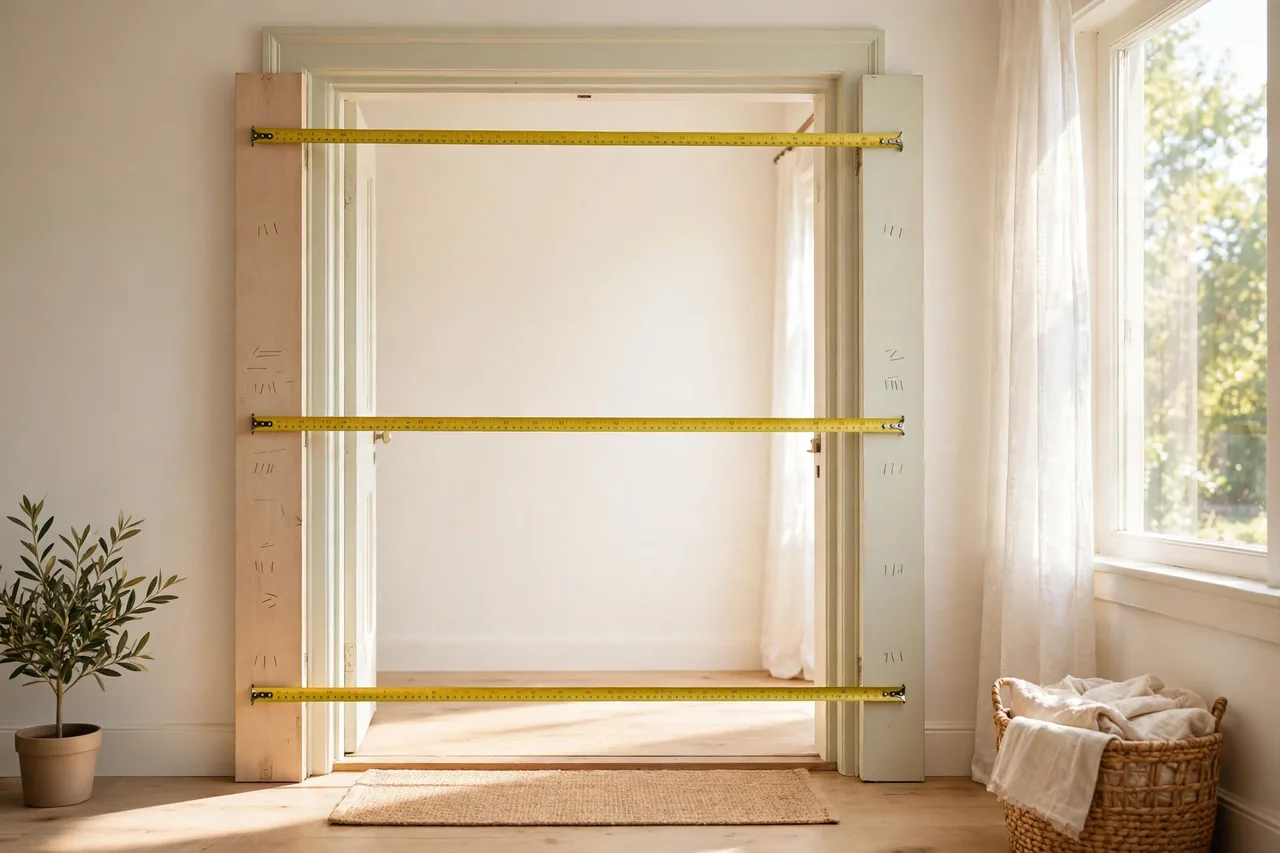
Install a security screen door yourself if your frame is square, you own a drill and a level, and you can spare an afternoon. A standard hinged door in a sound frame is a moderate DIY job, and doing it yourself saves roughly $100 to $150 in labor. Hire a pro if the frame is warped, rotted, or out of square, or if the door is a heavy custom steel unit. A pro also makes sense when the opening needs reframing, which can add $200 to $400 to the job. The table below makes the call fast.
Caption: DIY or hire a pro for a security screen door.
| Your situation | Best choice | Why |
|---|---|---|
| Square frame, standard 32 or 36 inch door | DIY | 2 to 4 hours, basic tools |
| Warped, rotted, or out-of-square frame | Pro | Needs reframing or a build-out |
| Heavy custom steel door | Pro | Weight and precise fit matter |
| No drill, level, or helper | Pro | Two hands are not enough for a steel door |
Guess which part of the job eats the most time? It is not the drilling. It is the measuring and shimming, because a door that is 1/8 inch out of square at the top will bind at the bottom for the life of the door. Get the fit right and the rest is straightforward.
What Makes a Screen Door a Security Screen Door?
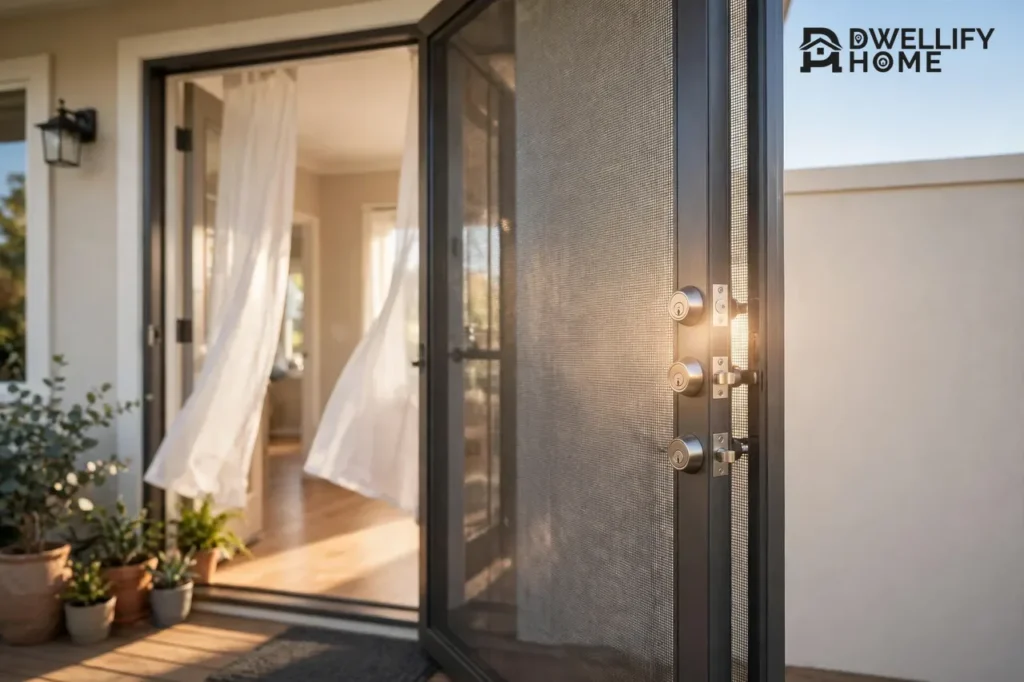
A security screen door is a steel or heavy aluminum door with a metal mesh panel, a reinforced frame, and a lock that bolts the door to the frame at more than one point. A plain screen door has a thin aluminum frame and fiberglass mesh you can push through with a finger. The security version looks similar from the street, but the mesh, the frame, and the lock are built to resist a kick, a pry bar, and a knife. Mesh is the difference that matters most: look for woven stainless-steel mesh, not fiberglass screen.
Crimsafe, the best-known maker of steel-mesh security screens, builds its doors around 0.9 mm high-tensile 304-grade stainless-steel mesh, screw-clamped into the frame every 25 mm. Its Regular profile is tested to withstand a single impact of up to 550 Joules, while the Australian Standard it exceeds calls for five impacts of 100 Joules. Read the Crimsafe Regular security screen specification to see how mesh thickness, clamping, and impact testing fit together before you shop. In the US, look for the same ideas on any brand you buy: stainless mesh, a clamped or welded mesh edge (never mesh held in by a rubber spline), and a frame that does not flex when you push it.
Three parts decide the door’s strength. First, the mesh: stainless steel, tightly woven, clamped into the frame so it cannot be pushed out of its channel. Second, the frame: steel or thick aluminum, with corners that are welded or screwed, not just pressed together. Third, the lock: a three-point lock that bolts into the frame at the top, middle, and bottom beats a single latch every time. A door with strong mesh and a weak lock is still a weak door, because the lock is where a kick lands.
Measure Your Opening Right the First Time
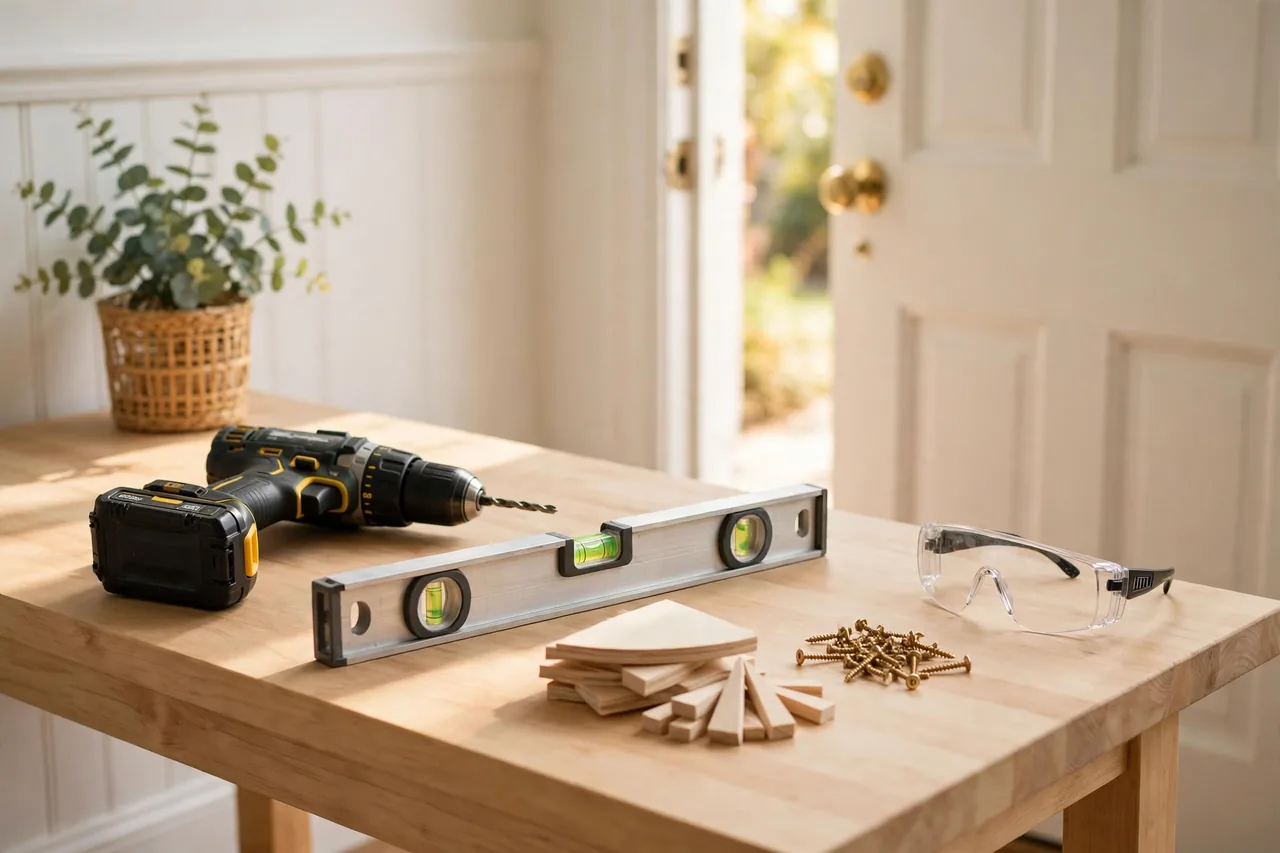
Measure your opening right the first time by measuring the width at the top, middle, and bottom, and the height on the left and the right, then ordering the door 1/4 inch smaller than the smallest width and height you recorded. That 1/4 inch leaves a 1/8 inch gap all the way around, which is the clearance a screen door needs to swing without binding. Measure the existing door casing, not the old door, because the old door may itself be the wrong size.
Work through these steps with a tape measure, a pencil, and paper. Write every number down. Do not trust your memory on five measurements. Sensible Digs’ screen door install guide uses the same three-point measuring method and the same 1/4-inch rule — see their step-by-step screen door installation guide for the full walkthrough.
- Measure the width of the opening at the top, the middle, and the bottom, inside the casing.
- Measure the height from the threshold to the header on the left side and on the right side.
- Circle the smallest width and the smallest height. Those two numbers are your opening size.
- Subtract 1/4 inch from each. That is the door size to order.
- Check the frame for square: measure both diagonals. If they differ by more than 1/4 inch, the frame is out of square and the door will need shimming or a pro.
- Note which side the hinges go on. A screen door usually swings opposite the main door, so the two doors never bump into each other.
If the opening is a standard 32 or 36 inches wide and 80 inches high, a stock door will fit. Odd sizes need a custom order, which costs more and takes longer, so measure twice before you order anything. A door that arrives 1/2 inch too wide cannot be trimmed the way a wood door can — steel does not forgive a bad measurement.
Tools and Materials You Need
Security screen door installation needs only basic tools, and most of them are already in a home toolbox. Gather everything before you start, because a half-hung steel door is a bad time to discover you are missing a drill bit.
- Tape measure, pencil, and a 2-foot or 4-foot level
- Drill with drill bits and a screwdriver bit
- Wood shims, a utility knife, and a step ladder
- Safety glasses and work gloves (steel edges are sharp)
- The door, its hinge kit, handle and lock set, closer, and all screws that came with it
- Three-inch hardened screws for the hinges and strike plate (see the hinge section — this is the warranty item)
- Exterior caulk and a caulk gun for sealing the frame
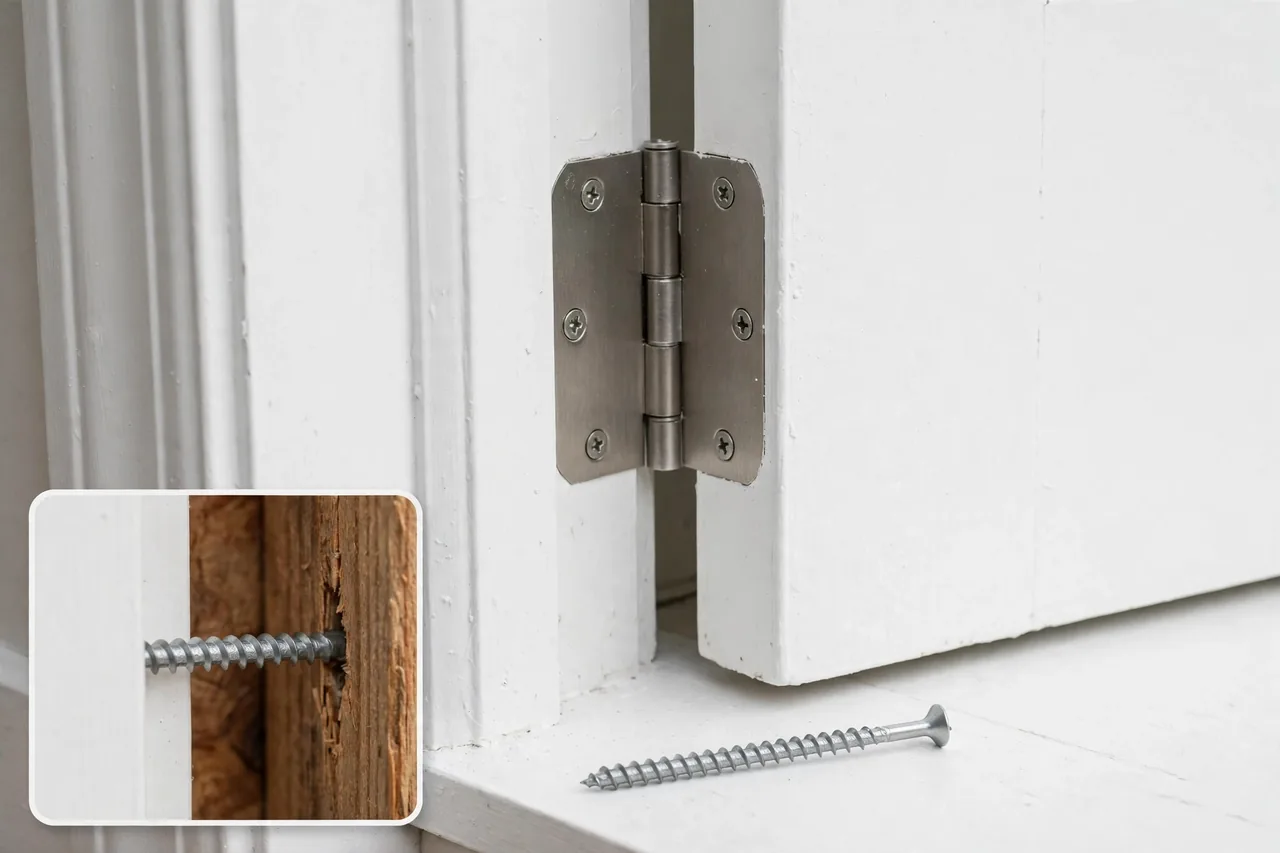
Do not use the short screws that come in some hinge kits for the final install. Short screws bite only into the thin door jamb, and a kick rips them straight out. The three-inch screws reach the wall stud behind the jamb, and that is what holds the door when someone kicks it.
How to Install a Security Screen Door, Step by Step
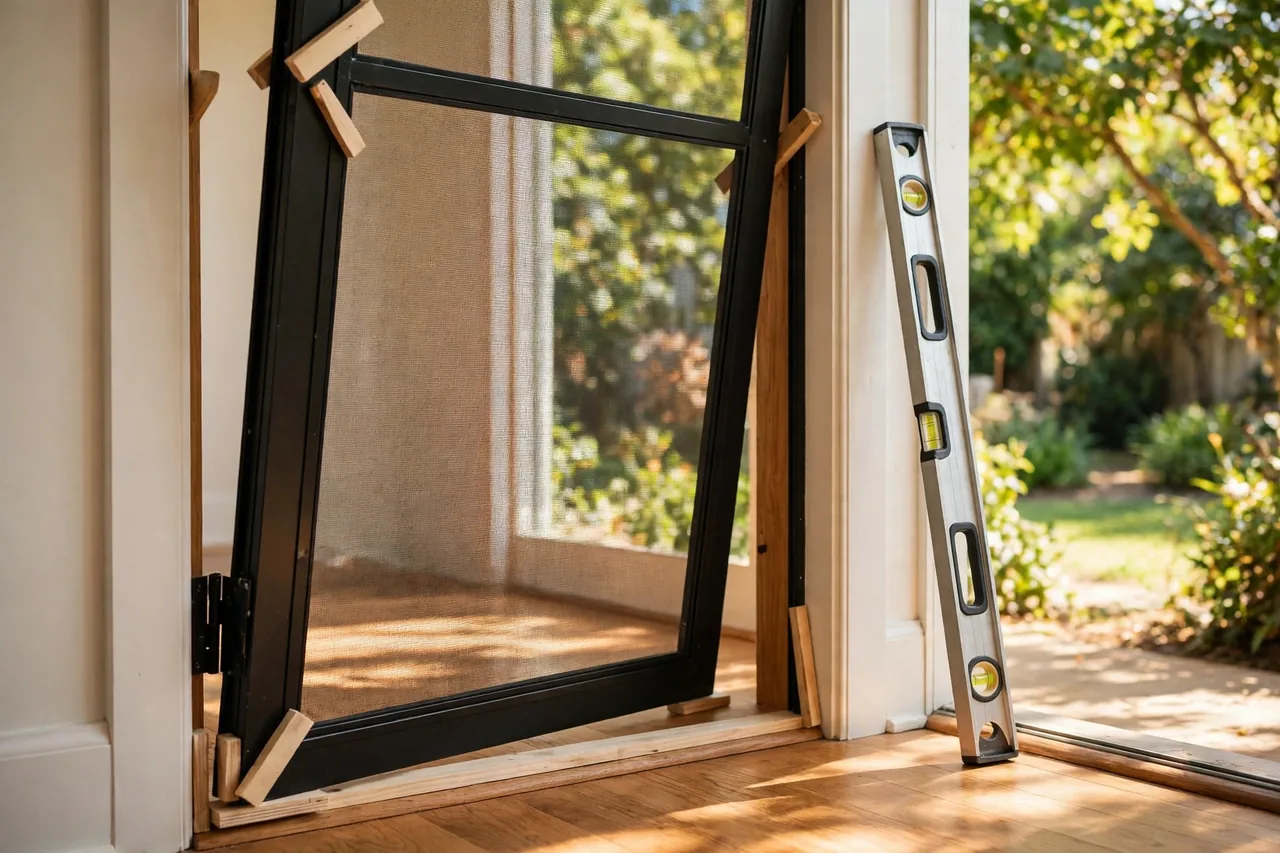
Installing a security screen door takes eight steps: fit the door dry, mark and drill the hinges, hang the door, shim it square, fit the handle and lock, add the closer, seal the edges, and test everything. Work slowly through the first four steps. A door that is hung square stays square, and a door hung crooked fights you at every step after.
- Set the door in the opening without screws and check the gap. You want an even 1/8 inch all the way around. Trim shims, not the door, to fix small differences.
- Mark the hinge spots on the door edge and the jamb. Put the top hinge 5 inches from the top of the door, the bottom hinge 5 inches from the bottom, and a third hinge centered between them.
- Drill pilot holes for every hinge screw. Pilot holes stop the jamb from splitting and keep the screws straight.
- Screw the hinges to the door first, then lift the door into the opening and screw the hinges to the jamb, starting with the top hinge.
- Wedge shims at all four corners to hold the door centered and level, then check the gap again with your level on the hinge side.
- Fit the handle and latch using the maker’s template. Drill the holes exactly where the template says, or the latch will miss the strike plate.
- Fit the lock and strike plate, then install the pneumatic closer at the top of the door. Adjust the closer screw until the door shuts gently instead of slamming.
- Run a bead of exterior caulk around the outside of the frame, wipe the joint smooth, and test the door ten times: open, close, lock, unlock.
Here’s the problem with rushing step five. If you skip the shims and screw the hinges in while the door sags, the latch will drag on the strike plate within a week, and you will blame the lock for what the hinges did. Shim first, screw second, and the door will swing true for years.
Hinge and Strike-Plate Details That Decide Real Security
Hinge and strike-plate details decide whether a security screen door resists a kick, because a kick attacks the screws, not the mesh. Replace every short hinge screw with a three-inch hardened screw that reaches the wall stud, and do the same for the strike plate. Three-inch screws into the stud are the single cheapest security upgrade on the whole door.
Use hinges with a non-removable pin or a hinge bolt, so nobody can tap the pin out from outside and lift the door off. On an outward-opening door the hinge pins face the street, which makes this detail matter even more. If your hinges have plain removable pins, swap them for security hinges before you call the job done. Check the gap at the latch side after you tighten everything: a gap wider than 1/8 inch lets a pry bar in, and a gap that pinches means the door is racked and needs re-shimming.
That fixes the symptom. The part that actually fails is in the next section: the lock.
Locks That Earn the Name “Security”
A lock earns the name security when it bolts the door to the frame at three points — top, middle, and bottom — instead of one. A single latch holds the middle of the door and leaves the top and bottom corners free to flex, so a kick bends the door away from the frame at the corners. A three-point lock spreads the force across the whole frame, and the door stays put. If your door came with a single-point latch, ask the maker whether a three-point lock fits the same cutout before you buy a replacement.
Pick a lock with a deadbolt, not just a spring latch, and keep a key on the inside only if everyone in the house can reach it fast in an emergency. A double-cylinder deadbolt (key on both sides) stops someone from breaking the mesh and turning a thumb latch, but it can trap you inside during a fire if the key is not in the lock. For most homes, a single-cylinder deadbolt with the key hanging beside the door is the safer balance. Test the lock with the door closed and with the door open: the bolt should slide home smoothly with no lifting or pushing on the door.
What Most People Get Wrong
Most people get security screen doors wrong in the same four ways, and each one is cheap to avoid. First, they buy on looks: a decorative iron door with thin mesh and a single latch is a screen door with a costume, not a security door. Second, they measure once, at the middle only, and order a door that binds at the top. Third, they use the short screws from the box and never upgrade them. Fourth, they hang the door to swing the same way as the main door, so the two doors collide every time someone comes in with groceries.
The fifth mistake is subtler: they never test the door after install. Open it, close it, lock it, and unlock it ten times, then push hard on the locked door from outside. If it flexes more than a hair, the shims or screws need work. A door you never test is a door you trust blindly, and that is the opposite of security.
How Much Does Security Screen Door Installation Cost?
Security screen door installation costs $100 to $1,500 in total, with a 2026 national average of $300, according to Angi’s cost data updated in October 2026. The spread is wide because the door itself is most of the cost: a basic screen door starts near $50, a steel security door runs $350 to $600, and a premium custom door can pass $1,200 before labor. Angi’s guide lists a standard 36 by 80 inch door at $175 to $330 installed, and a security screen at about $350 for the door alone. Read Angi’s 2026 screen door installation cost guide for the full size and type breakdown.
Caption: Security screen door costs in 2026.
| Item | Typical cost |
|---|---|
| Basic screen door (door only) | $50 to $100 |
| Steel security screen door (door only) | $350 to $600 |
| Premium or custom security door (door only) | $400 to $1,200+ |
| Pro labor, standard install | $100 to $150 flat, or $50 to $75 per hour |
| Frame repair or reframing | $150 to $400 |
| Old door removal and disposal | $25 to $50 |
DIY saves the labor line, which is roughly $100 to $150 on a standard job. It does not save the door, the lock, or the three-inch screws, and those are the parts that do the protecting. Spend the savings on a better lock, not a cheaper door.
When to Call a Pro Instead
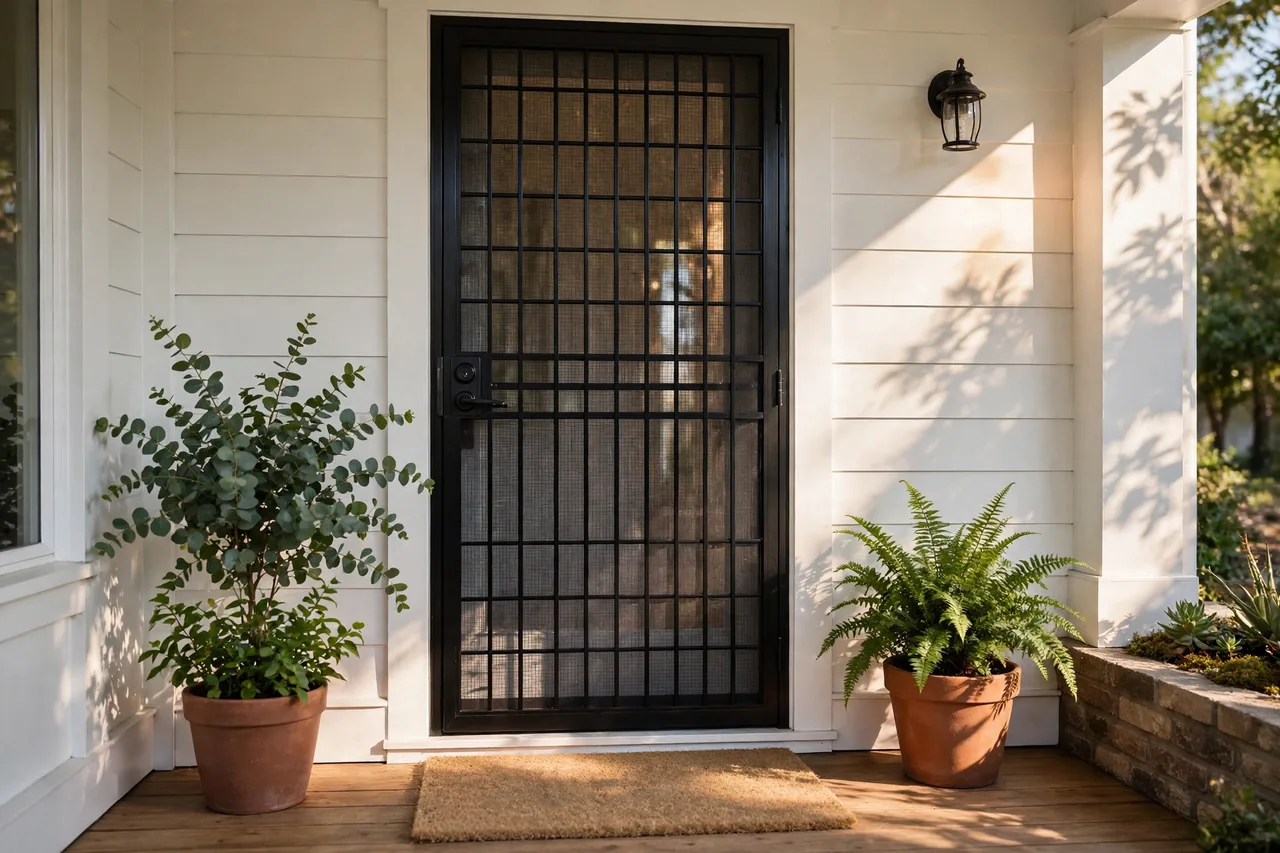
Call a pro when the frame is out of square by more than 1/4 inch on the diagonal, when the wood around the opening is rotted or soft, or when the opening needs reframing to hold a heavy steel door. A pro also earns the fee when the door is custom-sized, when the house is old and nothing is plumb, or when the install needs a new threshold or a build-out. Get two quotes and ask each installer whether the price includes the three-inch hinge screws and a three-point lock check — if they look blank, find another installer.
A short safety note before you start: steel doors are heavy and their cut edges are sharp, so wear gloves and safety glasses, get a helper for the lift, and never drill into a wall without knowing what is behind it. This guide is general information, not professional advice, and a door that guards a main entry deserves a pro’s eye if anything about the frame looks wrong.
Related Guides
A screen door guards the front entry, so pair it with eyes on that entry: our front porch camera guide shows where to mount a camera that watches the same door, and our best home security camera system guide plans the rest of the setup. French door security (plain-text sibling — link to be added at draft time when the companion article goes live) covers the glass double doors at the back of the house, which need a different fix than a screen door. For windows beside the door, window security film installation (plain-text sibling — link to be added at draft time) adds a shatter-resistant layer to the glass an intruder would otherwise break.
Frequently Asked Questions
How much does it cost to install a security screen door?
Between $100 and $1,500 in total, with a 2026 national average of $300, according to Angi. A steel security door alone runs about $350 to $600, pro labor adds roughly $100 to $150, and frame repairs add $150 to $400 when the opening needs work.
How long does it take to install a security screen door?
Most DIY installs take 2 to 4 hours, including measuring, drilling, hanging the door, and adjusting the closer. A pre-hung door in a ready frame can take as little as 45 minutes, while a door that needs shimming or frame repair takes most of an afternoon.
Can I install a security screen door myself?
Yes, if the frame is square and you have a drill, a level, and a helper for the lift. The job is moderate, not hard: measure at three points, drill pilot holes, shim the door square, and upgrade the hinge screws. Call a pro if the frame is warped, rotted, or out of square.
Do security screen doors really stop burglars?
They slow and deter them, which is the honest answer. A steel frame, stainless mesh clamped into the frame, and a three-point lock resist kicks and prying far better than a plain screen door. No door is unbreakable, so pair it with a good lock and a camera for real protection.
Should a screen door open the same way as the main door?
No. A screen door should usually open the opposite way from the main entry door, so the two doors never bump into each other. Check the swing before you drill the hinges, because flipping it later means filling holes and starting over.
What size security screen door do I need?
Measure the opening width at the top, middle, and bottom and the height on both sides, take the smallest numbers, and subtract 1/4 inch. Standard doors come in 32 or 36 inches wide and 80 inches high; anything else needs a custom order.
Measure three times, buy once, and spend the labor savings on three-inch screws and a three-point lock. Then read our front porch camera guide and put eyes on the door you just hardened.