
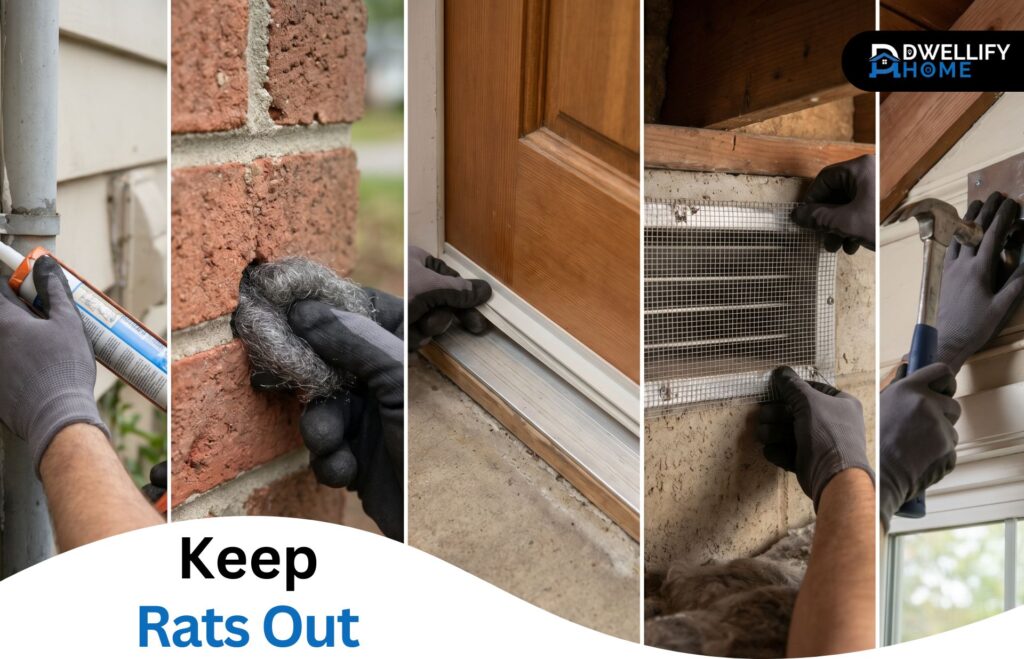
Rats don’t break in — they walk through gaps you never noticed. A hole the size of a quarter is all it takes, and by the time you spot the signs, they’ve usually been using that same route for weeks. Sealing those entry points costs far less in time and money than dealing with an established infestation.
| Entry Point | Risk Level | Best Sealing Material |
| Foundation Cracks | High | Mortar, steel mesh, concrete sealant |
| Pipe & Utility Gaps | High | Steel wool, caulk, metal mesh |
| Roof, Eaves & Soffits | High | Metal flashing, hardware cloth |
| Doors & Windows | Medium | Door sweeps, weather stripping |
| Vents & Drains | Medium | Fine metal mesh, drain covers |
Why Rats Keep Getting In Even After You’ve Tried to Stop Them
The entry point problem most homeowners get wrong
Traps and pest control visits handle the immediate problem. But when the same issue comes back two or three months later, the real cause is almost always the same — no one sealed the gap they used to get in.
Rats don’t randomly explore homes. They find a specific opening, commit it to memory, and return to it consistently. Trapping reduces the population for a while, but the next rat along the same wall finds the same gap within weeks. The cycle doesn’t stop until the physical opening is gone.
These gaps are rarely somewhere obvious. They tend to sit behind appliances, along rooflines, and around plumbing that most people haven’t looked at closely in years.
What rats are looking for and why your home qualifies
Rats move indoors for three things: food, warmth, and a quiet place to nest. A typical home offers all three, and the pressure to find them increases significantly from October through March when outdoor temperatures drop.
Once inside, they head for undisturbed areas — wall cavities, attic insulation, the space beneath kitchen units and appliances. A single breeding pair can produce up to 60 offspring in a year. A small gap found in autumn can mean a well-established colony by the time spring arrives.
Spot 1: Foundation Cracks and Ground-Level Gaps
Why the foundation is the first place rats look
The foundation is where your home meets the ground, and it’s where some of the most consistently overlooked entry points sit. A hairline crack that has widened slightly over years of soil movement and temperature change doesn’t look alarming to a homeowner — but it’s more than enough space for a rat to work through.
Older homes carry more risk here. Shifting ground, seasonal expansion and contraction, and decades of weathering gradually open up seams along the foundation line. There’s rarely one dramatic crack. There are usually several slow-developing gaps that no one has checked in years.
Rats are also drawn toward warmth, and foundation gaps sit right at the edge between outdoor cold and indoor heat. That’s exactly where they probe first.
How to seal foundation gaps the right way
Walk the complete perimeter of your home at ground level, torch in hand, and look at every point where the foundation meets siding, framing, or soil. Small cracks respond well to mortar or concrete sealant. Anything larger needs steel mesh combined with expandable foam — foam on its own isn’t enough, because rats chew through it within days if there’s nothing reinforcing it.
For open holes, cut 16-gauge wire mesh to size with a 1cm x 1cm grid and secure it over the gap before applying sealant over the edges. Do this inspection twice a year — spring and autumn are when gaps tend to open up after winter contraction and summer heat.
Spot 2: Pipe and Utility Entry Points
Why gaps around pipes are one of the most common ways rats enter
Every pipe, cable, and utility line that runs into your home from outside was installed through a hole someone cut in the wall. The pipe fills that hole, but the surrounding space almost never gets sealed to a standard that keeps rodents out.
That gap was created during installation and left open, because closing it wasn’t part of the job. Multiply that across gas lines, water pipes, electrical conduit, and cable runs, and a typical home has dozens of these points that have never been addressed.
Rats actively follow utility lines because those routes lead straight toward indoor warmth. They’re not guessing — they’re following physical signals.
The right way to seal pipe gaps without causing damage
Pull appliances away from walls and check behind them. The gap around the pipe where it enters through a cabinet floor or wall is one of the most commonly missed spots in the house, and it’s often accessible without any tools at all.
Pack steel wool tightly into the gap around any pipe, then cover it with caulk. The steel wool is what actually stops rats — they can’t chew through it, which is exactly why it works where foam fails. For wider openings at external utility entry points, use metal mesh fixed with screws rather than adhesive. Check dryer vents, AC lines, and any outdoor plumbing access panels at the same time.
Spot 3: Roof Lines, Eaves, and Soffits
Why rats use the roof more than most homeowners expect
Most people assume rats come in from ground level. Rats are capable climbers — drain pipes, rough brickwork, and overhanging tree branches all give them easy access to roof height without much effort.
Loose soffits, softening wood along eaves, and gaps where the roofline meets the gutter all lead directly into the attic. Once a rat is in the attic, it has access to beams and insulation that connect to the rest of the house.
Attic infestations tend to go undetected the longest. Scratching sounds at night or droppings found in the loft are often the first signs, and by that point the nest is usually well established.
How to close off roof and soffit entry points
Start from the ground with binoculars to spot anything obviously wrong, then use a ladder to check closely anything that looks like it could be a gap. Look for missing or cracked soffit panels, separating wood along eaves, and any point where the roofline meets the fascia or gutter with an open space behind it.
Use 1/4-inch hardware cloth to cover gaps larger than 1/4 inch. For smaller gaps where mesh won’t sit flat, pack with stainless steel wool exclusion fabric. Metal flashing handles the gaps along gutter and fascia lines cleanly and holds up well in wet conditions.
Check the roofline at least once a year. The north-facing side of a home retains moisture longest and develops wood rot fastest — that’s where gaps appear first, and where rats find their way in before anyone’s noticed a problem.
Spot 4: Doors, Windows, and Garage Entries
The gaps at ground level that get ignored until it’s too late
A door that latches and closes properly still has gaps. The base, corners, and frame edges all develop small openings over time that go unnoticed because the door functions fine in every other respect.
Weather stripping compresses and cracks. Door sweeps wear fastest at the corners and edges. Garage door seals split during cold spells and get replaced only when the draught becomes hard to ignore.
Two of the most underestimated entry points on any property are sliding doors and pet doors. Pet doors, in particular, are exactly what a rat is looking for — a ground-level opening with no obstruction.
What to install and where to check
Fit door sweeps with a metal-reinforced edge on all exterior doors. Rubber-only sweeps lose their shape gradually and develop gaps that are hard to see until something has already come through. Metal-backed versions hold up considerably longer.
Replace worn weather stripping around door frames and window edges. Pay particular attention to the bottom corners of exterior doors — that’s where sweeps wear first and where rats test most persistently.
For pet doors, fit a locking panel for overnight use. Rats are most active between dusk and dawn, so securing that opening at night removes a significant risk. For garage doors, check both the rubber seal along the bottom edge and the corners where the door meets the frame when closed.
Spot 5: Vents and Drains
Why vents and drains are a direct route into your home
Vents are open by design, which makes them straightforward targets. A dryer vent pushing warm air outward is a clear signal that something worth investigating is on the other side, and rats pay attention to that.
Roof vents, attic vents, and dryer vents all sit in spots that receive minimal inspection over the years. Plastic vent covers crack in cold weather and loosen with repeated temperature cycling — often without anyone noticing until something has already found its way through.
Drains are a separate concern altogether. Rats are capable swimmers and can move through drain systems from street level to your property if there’s no physical barrier in the way.
How to cover vents and drains without blocking airflow
Replace any plastic vent cover with a metal equivalent. Plastic deteriorates; metal holds. Fit a fine metal mesh behind the cover so that even if the cover loosens, there’s still a second layer in place.
Use 1/4-inch hardware cloth for attic and roof vents. That mesh size blocks a rat while keeping airflow unrestricted — it’s the right balance for most residential vent types. For external drains, install metal drain covers or screens and check them every couple of months for debris buildup. A blocked screen stops working and creates drainage problems. Keep it clear, and it does its job reliably for years.
What to Do If Rats Are Already Inside
How to confirm activity before sealing anything
Sealing entry points while rats are still active inside traps them in the walls, which creates a more difficult situation than the one you started with. Before you seal anything, take time to confirm whether there’s current activity.
Look for droppings along walls and behind appliances — rat droppings are roughly almond-sized. Check for gnaw marks on wood, wiring, and food packaging. Grease rub marks along skirting boards, left by the oils in a rat’s coat, are one of the clearest signs of a regularly used route.
Undisturbed spider webs in or around a gap suggest that opening hasn’t been used recently. A clean, clear gap with no web or debris is more likely active.
Clearing the problem before locking them out
Deal with any existing infestation before you seal. For a non-toxic, monitoring-based approach, catch rodents with Rat Vac motion sensor — a motion-activated catching system that works without poison and helps you identify exactly where activity is concentrated inside your home.
Clear the infestation first, then work through each of the five spots above. Foundation first, roofline last. Done properly and thoroughly, it’s a one-time job that holds for years without the need for repeat pest control visits.
Frequently Asked Questions
How small a gap do rats need to get inside a home?
Rats can squeeze through a gap roughly the size of a quarter — approximately half an inch wide. Mice need even less space. A practical rule: if you can fit a finger into a gap, a rat can work its way through given enough time and motivation.
What is the best material for sealing rat entry points?
Steel wool packed firmly into the gap, with caulk applied over the top, is the most reliable approach for pipe and utility openings. Rats cannot chew through steel wool, which makes it effective where foam alone fails. For structural gaps in foundations and rooflines, use hardware cloth or metal mesh secured with mortar or concrete sealant.
How do I know if rats are currently active in my home?
Fresh droppings, gnaw marks on wood or wiring, grease rub marks along baseboards, and scratching sounds at night are the most consistent indicators. A motion-sensing system removes the guesswork by detecting movement and pinpointing exactly where activity is occurring.
We appreciate you taking the time to read this article! Don’t forget to explore the rest of Dwellifyhome.com for more great reads. A note on transparency: some of the links you’ll find in this post may be affiliate or sponsored links. We may earn a modest commission on purchases made through these links, which directly supports Dwellifyhome.com. Every opinion shared here is authentic and belongs to the author.