Metal outdoor furniture is only a good buy when you pick the right metal for your climate, because aluminum cannot rust at all and a good powder-coated cast aluminum set lasts 15 to 25 years outside, while a cheap painted steel set can start rusting at the first paint chip within weeks. The metal decides the lifespan, not the brand name on the tag. This guide compares aluminum, steel, stainless steel, wrought iron, and cast iron, shows real prices checked on November 16, 2026, and walks you through care, so you buy once instead of replacing a rusty set every few summers.
One mistake on the list below voids most warranties and cuts a steel set’s life in half, and it has nothing to do with the metal you buy. It sits in the care section, and most owners make it in the first month without knowing. Before that, you need the metal decision right, because no cover or coat of paint can save the wrong metal in the wrong spot.
What Is Metal Outdoor Furniture?
Metal outdoor furniture is any patio, garden, or deck furniture built on a metal frame, from dining sets and lounge chairs to bistro tables, benches, and bar carts. The frame is the part that matters most. A metal outdoor table, a metal outdoor chair, and a metal patio couch can all look the same in a store photo, yet one frame is aluminum and will never rust, while another is plain steel and will rust the moment its coating chips.
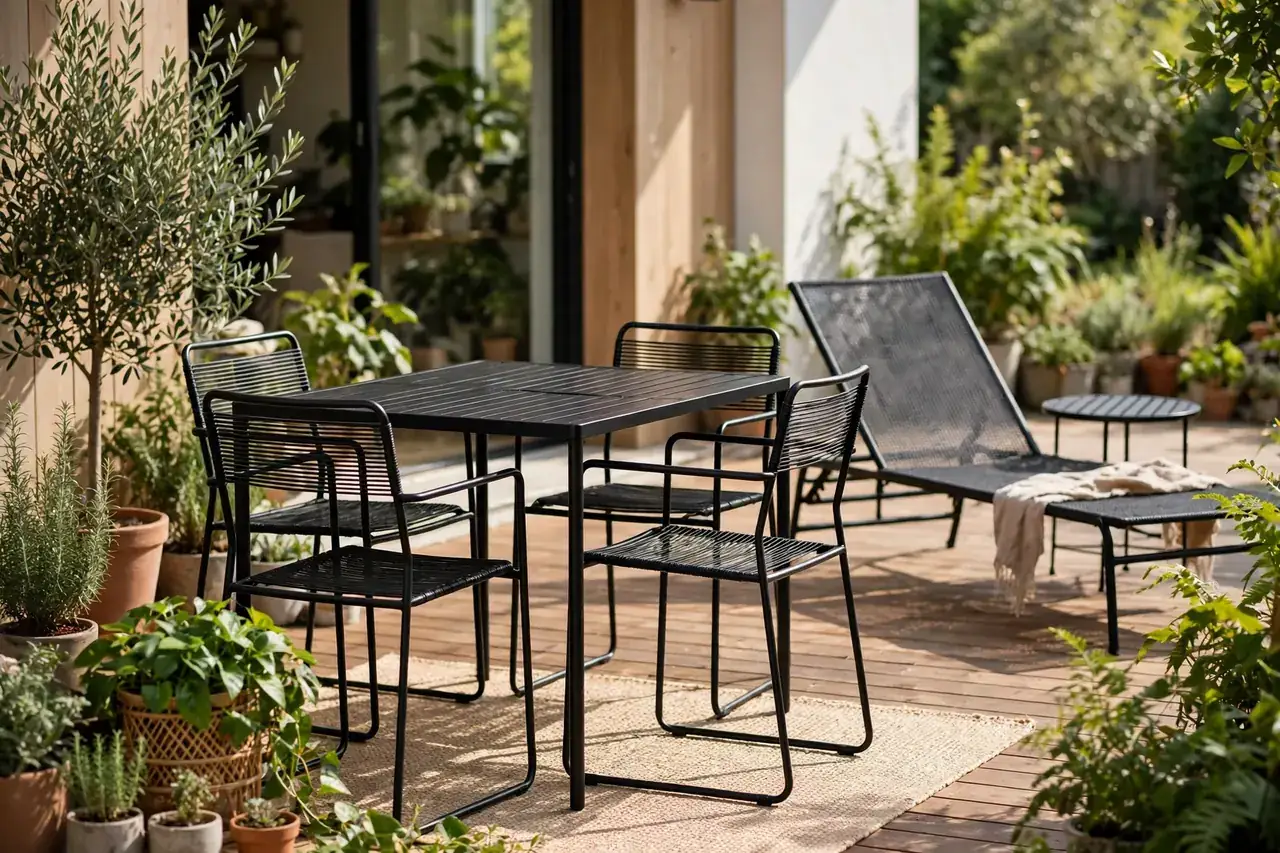
Shoppers meet five frame metals. Aluminum is light and rust-proof. Cast aluminum is heavier, sturdier, and often shaped into ornate designs. Steel is strong and cheap but rusts fast once its coating fails. Stainless steel resists rust far better and costs more. Wrought iron and cast iron are the heavy classics, beautiful and steady in wind, but they demand regular paint care.
Most sets mix metals and materials. A steel frame often carries a glass top, sling fabric, or wood-look slats. A cast aluminum set often pairs with cushions that need their own care. When you shop, read the frame material first and the style second, because the frame decides how long the set lives. If the listing only says “metal” with no type named, treat that as a warning sign and ask the seller before you buy.
Metal suits almost any outdoor room. It works on a small balcony, a wide deck, a poolside patio, and a garden path. It holds up to daily use, wipes clean fast, and comes in every style from modern black steel to classic scrollwork iron. That is why metal outdoor furniture sets outsell most other materials, and why the wrong metal choice stings so much when rust shows up in year two.
The 5 Metals Used in Outdoor Furniture
Every metal outdoor furniture set uses one of five frame metals, and each one trades weight, rust resistance, price, and upkeep against the others. There is no single best metal. There is only the best metal for your yard, your weather, and how much care you will honestly do.
Aluminum: Light, Rust-Proof, and Easy to Move
Aluminum is the most popular metal for outdoor furniture, and the reason is simple: aluminum cannot rust. Rust is iron oxide, and aluminum contains no iron. When air touches aluminum, it forms a thin oxide layer that protects the surface, and that layer rebuilds itself if scratched. The complete aluminum buying guide from LiveOuter puts it plainly: aluminum cannot rust, and a powder-coated finish adds a UV-stable color layer on top.
Aluminum comes in two forms. Tubular aluminum is hollow, very light, and the cheapest way into a metal set. Cast aluminum is poured into molds, so it is heavier, sturdier, and shaped into detailed designs that tube metal cannot copy. Both forms share the same rust-proof frame. The trade-off is wind: a light tubular aluminum chair can slide or tip in a strong gust, so weigh the set down with cushions or pick cast aluminum on an exposed deck.
Cast Aluminum: The Heavy, Ornate Cousin
Cast aluminum gives you the rust-proof frame of aluminum with the weight and detail of iron. It is the metal behind most ornate patio dining sets, the ones with rose or scroll patterns cast into the chairs and table edge. It costs more than tubular aluminum, usually $170 to $420 for a 3-piece bistro set on Wayfair, checked November 16, 2026, but it stays put in wind that would push a light tube set across the patio.
Cast aluminum needs almost no care beyond a soap-and-water wipe. Its powder coat can chip if you drag it across concrete, so lift it instead of dragging it, and touch up any bare spot with outdoor paint. That one habit keeps a cast aluminum set looking new for 15 to 20 years.
Steel: Strong, Cheap, and Rust-Prone
Steel is the strongest metal per dollar in outdoor furniture, and it is also the most rust-prone. A powder-coated steel frame is fine while the coating is perfect, but rust starts at the first chip, often within weeks of bare metal meeting rain. The coating on budget steel pieces typically lasts only about 2 to 5 years under normal outdoor use, according to the rust-proof comparison from Peak Home Furnishings.
Steel still earns its place. It is the cheapest way to get a sturdy dining set, with 3-piece metal sets on Wayfair starting near $120 to $200, checked November 16, 2026. It is heavy enough to stay put in wind, and it holds high weight limits, often 300 to 350 pounds per seat. Buy steel only if you will inspect it every spring and touch up chips at once, and store it or cover it through wet winters.
Stainless Steel: The Low-Care Heavyweight
Stainless steel is steel with chromium mixed in, and that chromium forms its own protective layer, so stainless steel resists rust far better than plain steel. Marine-grade 316 stainless steel resists salt air best, while common 304 grade can show small rust spots near the coast. Stainless steel costs roughly four times as much as plain steel for the same frame, so it shows up in premium sets and commercial patios, not budget bistro sets.
Stainless steel is heavy, strong, and modern looking, with clean lines that suit a contemporary patio. It can feel hot in direct sun, so cushions help on summer afternoons. If you live near the sea and want a set that stays out all year with almost no rust patrol, stainless steel is the metal to buy.
Wrought Iron and Cast Iron: Heavy Classics That Demand Paint
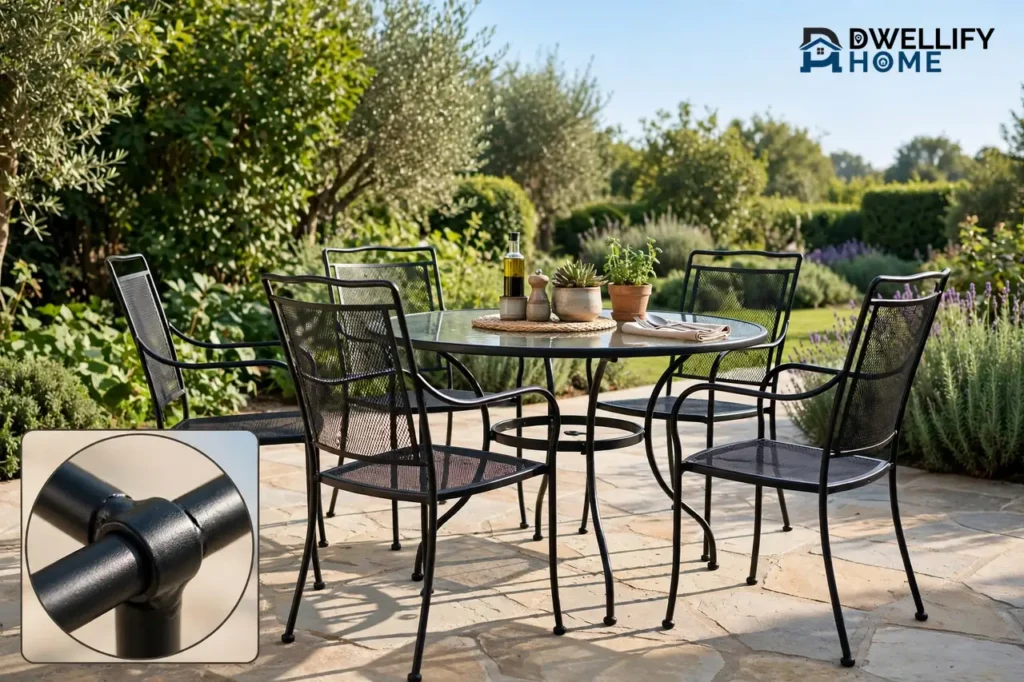
Wrought iron and cast iron are the oldest patio metals, and they still win on looks and weight. Both are remarkably solid, hold intricate scrollwork, and stay planted in the worst wind. A wrought iron dining set can last 25 years or more, but only if you keep its paint or powder coat intact, especially around the welded joints, where rust starts first.
The two irons differ in how they are made. Wrought iron is bent and hammered into shape, so it suits slim, graceful designs. Cast iron is poured into molds, so it suits heavy, detailed pieces. Both rust wherever paint breaks, and both need repainting every year or two in humid or coastal air. If you love the classic look, budget that paint time before you buy, and read our deeper guide when it is ready, because wrought iron gets its own full article in this series. That fixes the symptom of a rusty set, but the part that actually fails first is the coating, and the next section shows you how long each metal really lasts.
Which Metal Lasts Longest Outdoors?
Powder-coated cast aluminum lasts longest for most homeowners, at 15 to 25 years with basic care, because it cannot rust and its coating holds color for 10 to 15 years. Stainless steel matches it at 20 to 30 years in the right grade. Wrought iron can reach 25 years or more, but only with strict repainting. Painted mild steel lasts 5 to 10 years, and budget steel can fail in 3 to 5 years if chips go untouched.
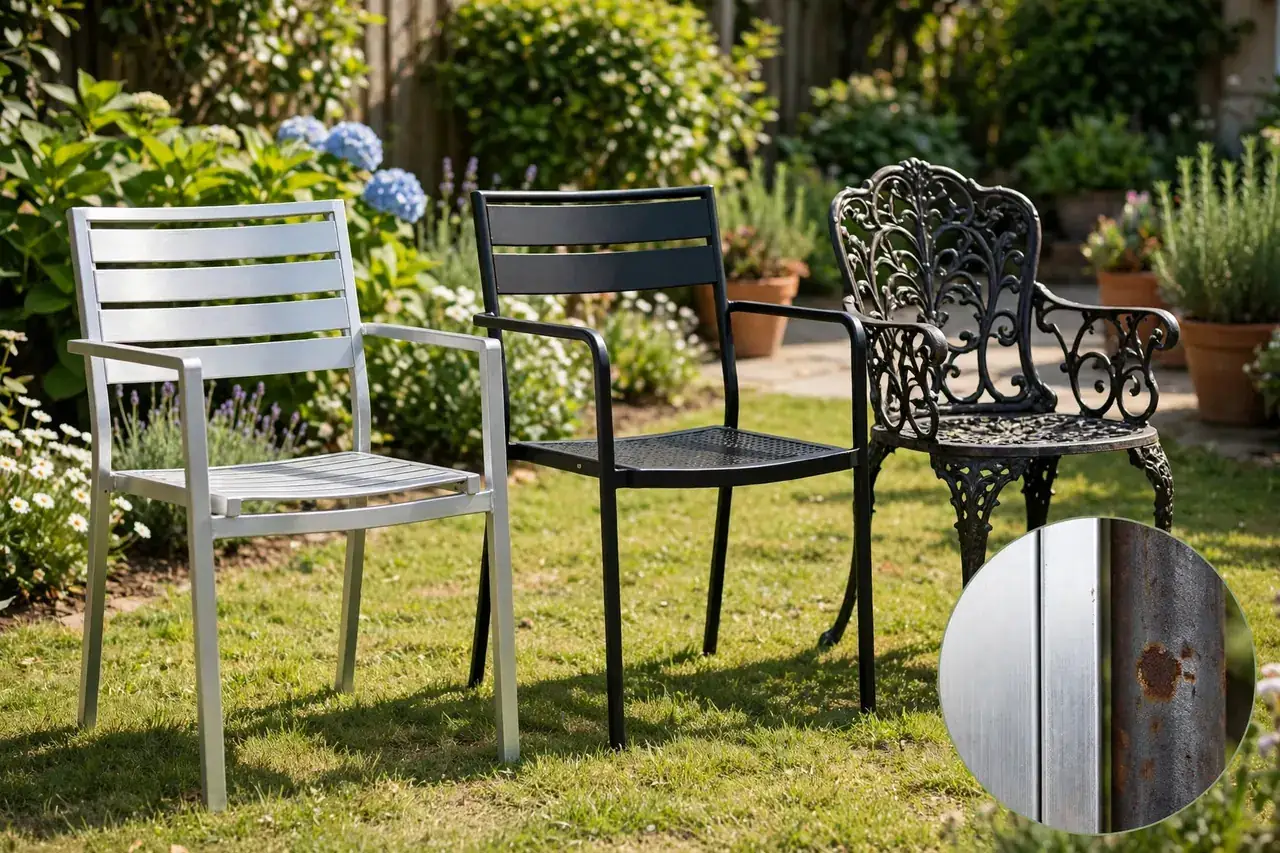
The table below puts the five metals side by side, using lifespan ranges from the EngineerFix patio lifespan guide and the LiveOuter aluminum guide, both checked November 16, 2026. Guess which metal costs the least per year of life before you read the last column, because the cheapest set on the shelf is rarely the cheapest set over a decade.
| Metal | Lasts outside | Rust risk | Yearly care | Typical set price |
|---|---|---|---|---|
| Cast aluminum | 15–25 years | None | Soap wipe | $170–$1,690 |
| Tubular aluminum | 15–25 years | None | Soap wipe | $120–$600 |
| Stainless steel | 20–30 years | Very low | Wipe, polish spots | $600–$2,300 |
| Wrought / cast iron | 15–25 years | High if paint breaks | Repaint 1–2 years | $340–$980 |
| Painted steel | 5–10 years | High at any chip | Touch up chips often | $120–$750 |
Two facts in that table surprise most buyers. First, aluminum beats iron on lifespan for the average owner, because iron’s long life depends on repainting that most owners skip. Second, steel’s low price hides a short life: a $150 steel bistro set replaced every 4 years costs more over 12 years than a $420 cast aluminum set that is still going strong. The EngineerFix guide states the same rule plainly: powder-coated cast aluminum furniture can easily last between 15 and 25 years, while wrought iron reaches 25 years or more only when its coating is rigorously maintained.
Climate moves these numbers. Salt air near the coast cuts steel and iron life in half, while aluminum barely notices it. Freeze-and-thaw winters crack trapped water in hollow steel tubes, so drain holes matter. Strong sun fades cheap paint in 2 to 3 years but leaves a quality powder coat alone for 15 to 20 years. Match the metal to your weather first, and the table above will hold true for your yard.
How Much Does Metal Outdoor Furniture Cost?
A metal outdoor furniture set costs $120 to $2,300 on Wayfair, checked November 16, 2026, and the price follows the metal, the size, and the seat count. A 3-piece metal bistro set runs $120 to $420. A 5-piece dining set runs $155 to $610. A 7-piece dining set for six runs $385 to $980. A 10-piece cast aluminum set runs $1,690 to $2,300.
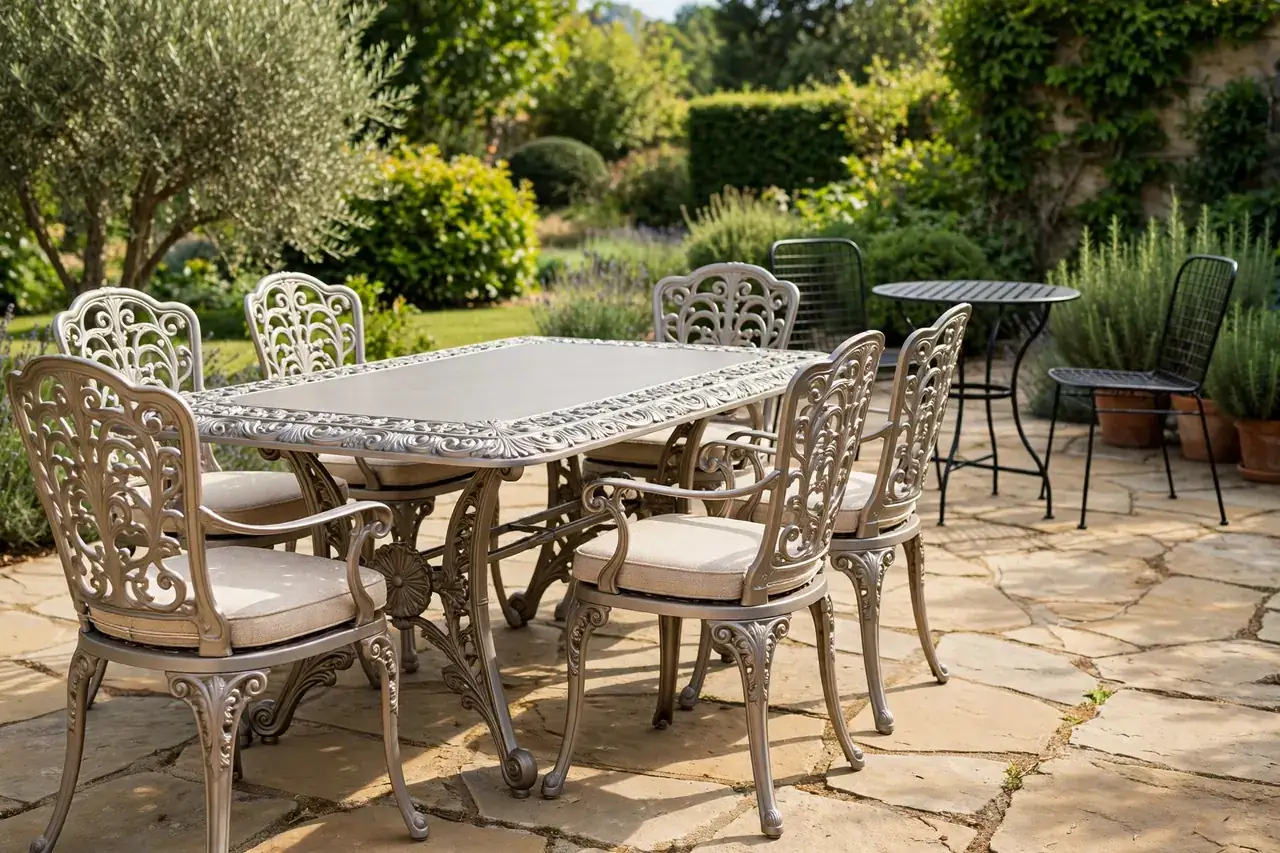
Real listings from Wayfair on November 16, 2026 show the range clearly. A 2-person metal patio dining set by Lark Manor lists at $294. A 3-piece cast aluminum rose bistro set by Fleur De Lis Living lists at $167.99, down from $204.99. A 3-piece cast aluminum tulip bistro set lists at $173.99. A 7-piece rectangular metal dining set by Latitude Run lists at $530, down from $620. A 10-piece cast aluminum dining set with eight cushioned chairs lists at $1,689.99, down from $1,929.99. Prices change with sales, so treat these as the checked snapshot, not a promise.
Three things push the price up. First, the metal itself: stainless steel costs about four times as much as plain steel, and aluminum costs about twice as much as steel, before a single cushion is added. Second, the build: cast aluminum and welded joints cost more than hollow tube and bolted joints, and they last longer. Third, the extras: cushions, swivel chairs, glass tops, and umbrella holes each add cost, and cushions are the part you will replace first.
Here is the problem with shopping by price alone. A $120 steel set looks like a deal until you add touch-up paint, a cover, and a replacement in year four. A $420 cast aluminum set looks dear until you divide it by 20 years of summers. Work out the cost per year before you buy, and the “expensive” set often wins by a wide margin.
How to Pick the Right Metal for Your Patio
Pick your metal by answering three questions in this order: how close is salt air, how strong is your wind, and how much care will you honestly do. The answers point at one metal, and they save you from buying on looks alone.
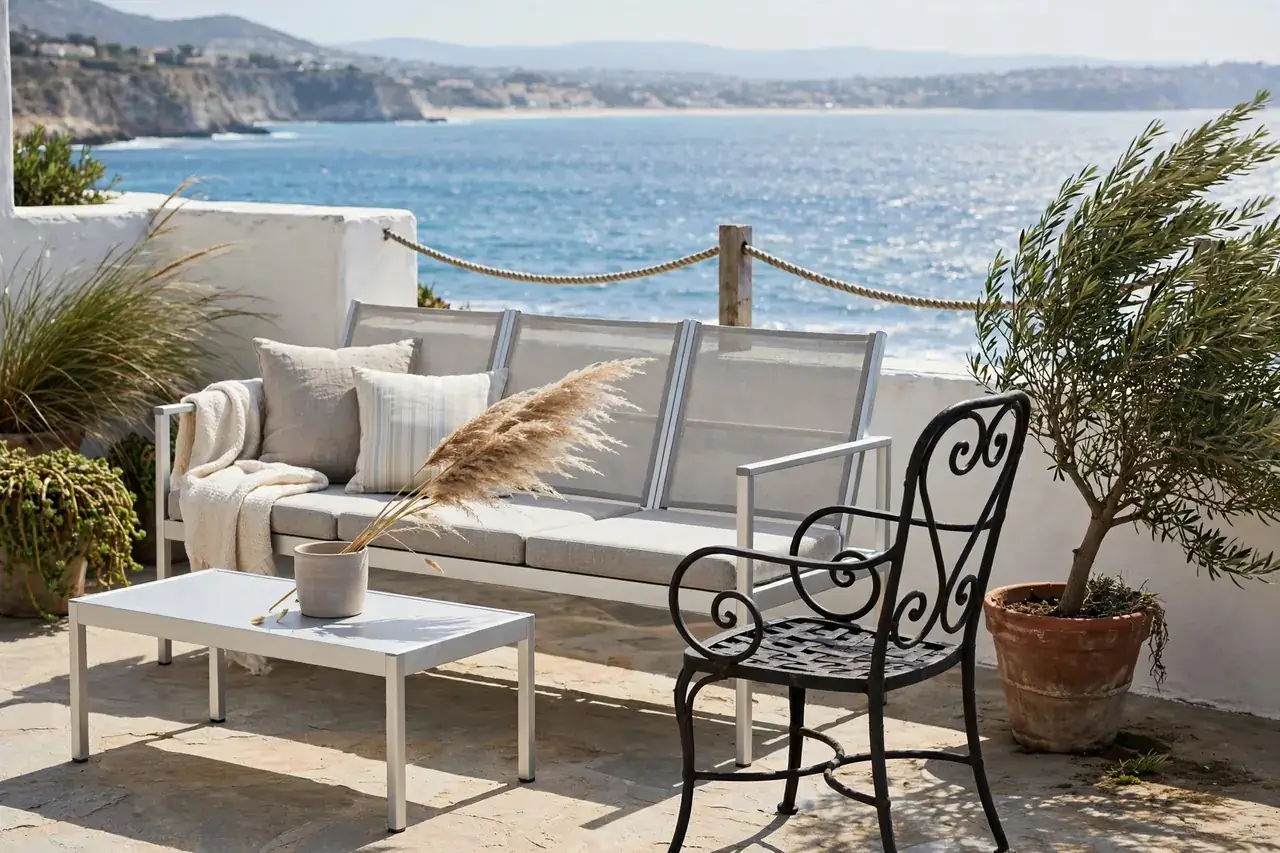
Live near the coast or in a humid climate? Buy aluminum or marine-grade 316 stainless steel. Salt air destroys iron and plain steel faster than most owners believe, and aluminum simply does not rust. The PatioLiving buying guide quoted by Cotswold Fine Furniture says the same thing: aluminum is the no-question pick for coastal or humid areas, while wrought iron does not fare well in humid or rainy places.
Live somewhere windy or on an exposed deck? Buy cast aluminum, stainless steel, or wrought iron. Weight is your friend here. A heavy set stays planted in a storm, while a light tubular aluminum chair can slide or tip. If you already own a light set, add weight with thick cushions and keep chairs tucked under the table when a storm is coming.
Working with a tight budget? Buy tubular aluminum, not cheap steel. Aluminum costs a little more up front, usually $120 to $200 for a small set, but you skip the rust patrol and the early replacement. Steel only wins if you truly enjoy maintenance and you will touch up every chip the week you spot it.
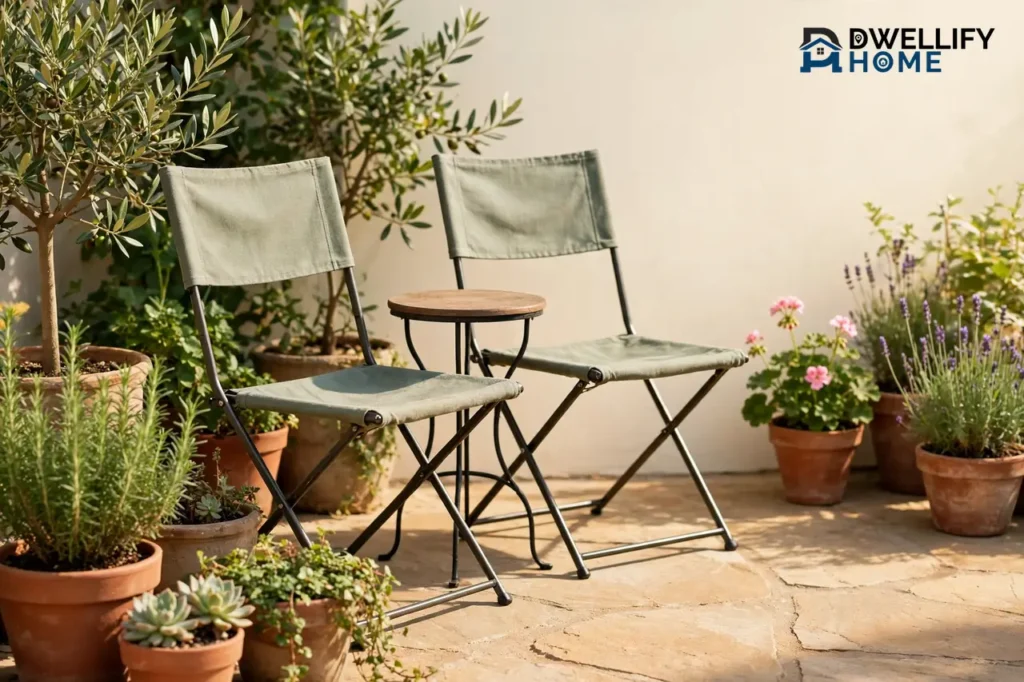
Short on space? Metal is the best small-space material, because slim steel and aluminum frames take up less room than thick wood or wicker. A folding steel bistro set tucks into a corner, and stackable aluminum chairs hang on a wall hook. Our guide to outdoor furniture for small spaces shows layouts that fit a bistro set on a balcony barely wider than the chairs. For dining, a round outdoor dining table in metal seats four in the footprint of a square table for two, and our outdoor dining sets for 6 guide covers metal sets big enough for family dinners.
One last check before you pay: lift a chair with one hand, push the table sideways, and look at the joints. Welded joints beat bolted joints outdoors, because bolts loosen and let water in. Feet should sit flat, glides should be fitted, and the frame should not wobble. A set that wobbles in the store will wobble worse after a year of rain.
What Most People Get Wrong About Metal Furniture
Most people get one thing wrong about metal outdoor furniture: they believe all metal rusts, or that no metal rusts. Both beliefs cost money. Aluminum truly cannot rust, because rust needs iron. Steel and iron truly do rust, and the only thing standing between them and rust is a thin coat of paint or powder coat.
The second wrong belief is that “rust-proof” on a listing means “care-free.” It does not. Even aluminum needs care: its powder coat can chip, its joints can loosen, and salt film can dull its finish. A “rust-proof” steel set is rust-proof only until the first scratch, and that scratch often comes from dragging the chair across concrete on delivery day. Lift furniture, never drag it.
The third wrong belief is that heavy always means better. Heavy iron is better in wind, but it is worse on a soft lawn, worse on a balcony with a weight limit, and worse for anyone who moves furniture alone. A 90-pound iron chair that never moves is a statue, not a seat. Match the weight to your space, not to a feeling of quality. Here is the thing most guides skip: the coating matters more than the metal, and the next section shows you how to keep that coating alive.
How to Care for Metal Outdoor Furniture
Metal outdoor furniture needs less care than wood, but it still needs a routine, and the routine is short. Wash it, check the coating, fix chips fast, and store cushions dry. Fifteen minutes a month covers most sets.
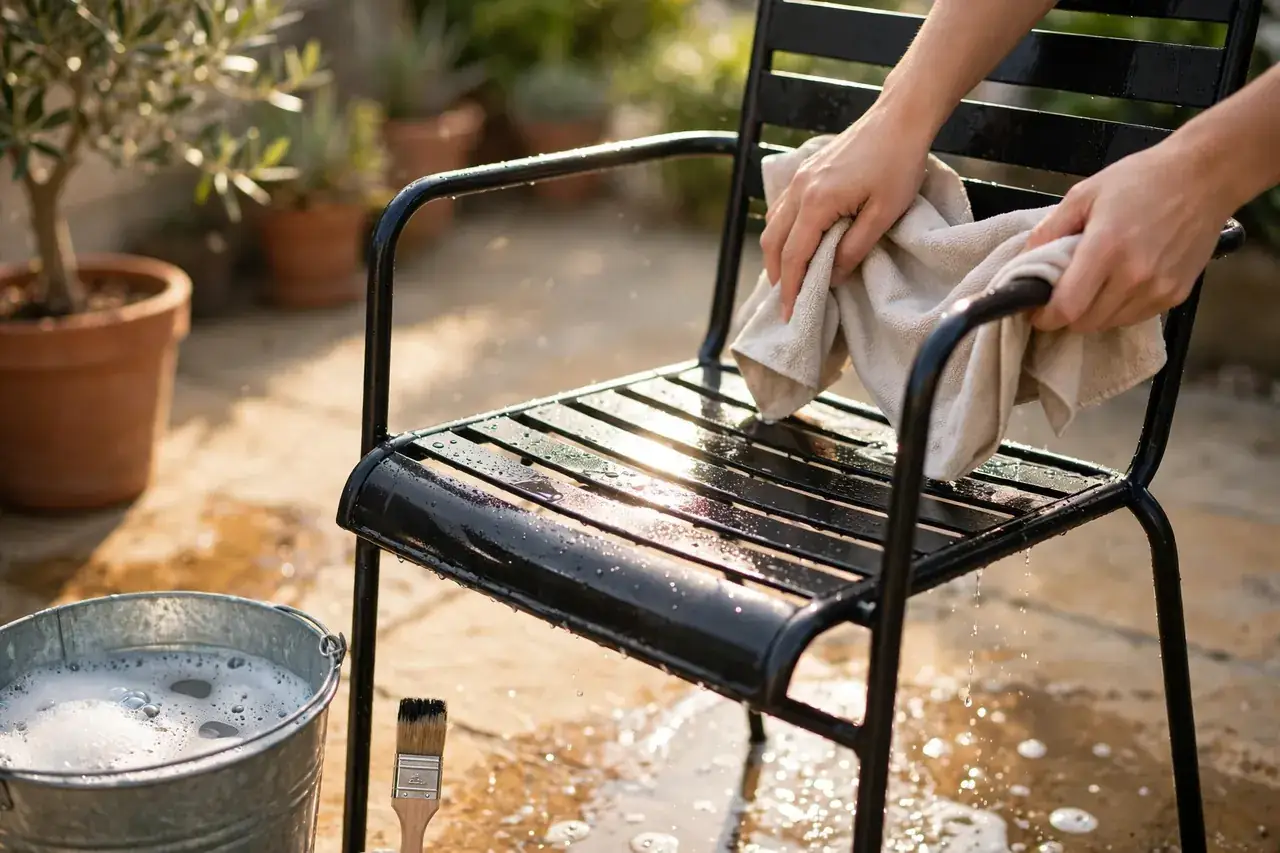
Start with a monthly wash. Mix mild dish soap with warm water, wipe the frame with a soft cloth, rinse with a garden hose on gentle spray, and dry it with a towel or let it dry in the sun. Never use a pressure washer on a powder-coated frame, because it can blast the coating off at the joints. Never use steel wool or a wire brush, because scratches invite rust on steel and iron and dull the finish on aluminum.
Next, inspect the coating every spring and every fall. Run your hand along the frame, the feet, and the welded joints, and look for chips, bubbles, or orange spots. On aluminum, a chip is cosmetic: clean it and touch it up with outdoor paint. On steel and iron, a chip is urgent: sand the rust spot, treat it with a rust converter, and repaint it the same day, because rust spreads under the coating from that one spot. The EngineerFix lifespan guide gives the same order: sand small rust spots down, treat them with a rust converter, and repaint to stop the oxidation from spreading beneath the finish.
Cushions need their own care. Take them inside when rain is coming, and store them dry over winter, because damp cushions grow mildew and stain the frame beneath them. Our guide to replacement cushions for patio furniture shows how to measure and pick new ones when the old set wears out. Covers help too, but only if they breathe: a tight plastic cover traps moisture and rusts steel faster than no cover at all, so pick a vented cover and lift it on dry days to air the set out.
For winter, the full routine lives in our guide on how to store outdoor furniture, and our outdoor covers for furniture guide covers which covers actually protect a metal frame. The short version: clean the set, fix every chip, dry it fully, and either store it under cover or cover it with a vented cover that lets air move.
Can You Leave Metal Outdoor Furniture Outside All Winter?
Yes, you can leave aluminum and stainless steel outdoor furniture outside all winter with almost no risk, because neither metal rusts from rain or snow alone. Cast aluminum sets are routinely left out all year, and they come through spring with a wash. That is the honest answer for most owners, and it is the main reason aluminum outsells every other metal.
Steel and iron are a different story. You can leave them out, but only if the coating is perfect and you check it before the first frost. A chip left through winter becomes a rust patch by spring, and a rust patch at a welded joint becomes a weak joint by next summer. If you own steel or iron and you cannot promise a pre-winter chip check, bring the set into a shed or garage, or cover it with a vented cover and check it monthly.
Snow and ice add two more risks. Water that pools inside a hollow steel tube can freeze, expand, and split the tube, so check that drain holes at the feet are open before winter. Heavy snow loads can bend a light tubular aluminum chair, so brush snow off the seats after a storm instead of letting it pile up. A little winter care costs minutes and saves a set.
Related Guides
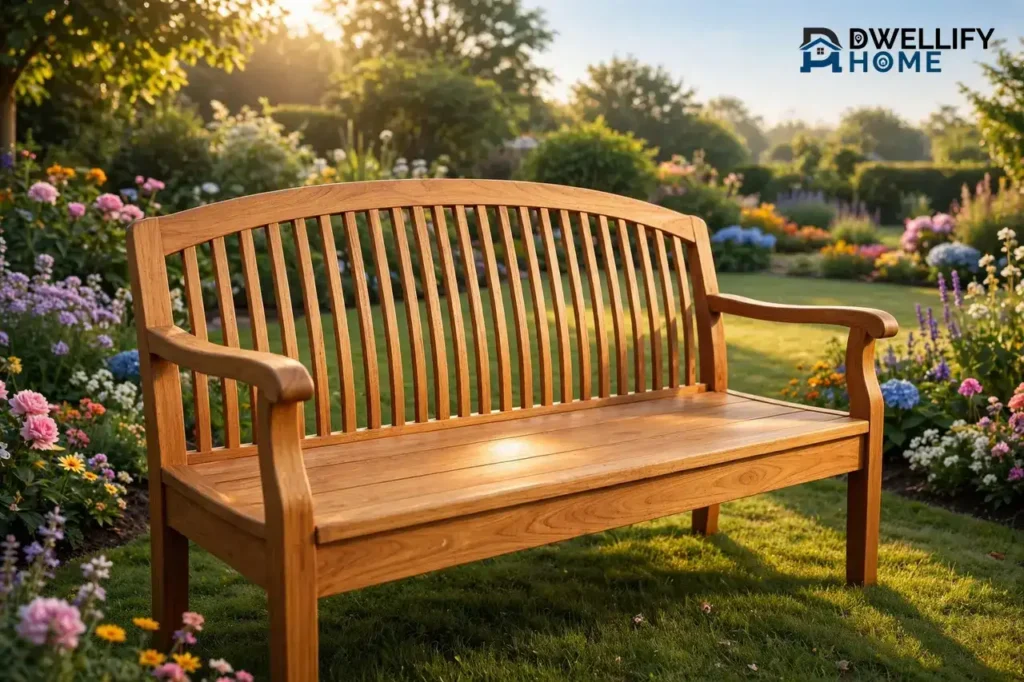
If metal is your material, these guides answer the next questions most owners ask. Start with our weather-resistant outdoor furniture guide to compare metal against wood, wicker, and rattan, then read our wicker outdoor furniture guide if you want a softer look on a metal frame. Our acacia wood furniture guide covers the warmest wood alternative to metal, and our outdoor wooden bench guide shows how a metal-frame bench compares with a solid wood one. For the table itself, see our patio dining set guide, and for the space around it, our patio garden ideas and outdoor bench with storage guide.
Frequently Asked Questions
Which Types of Metal Are Used in Outdoor Furniture?
Aluminum, stainless steel, wrought iron, cast iron, and cast aluminum are the common metals in outdoor furniture. Aluminum is light, rust-proof, and easy to care for. Stainless steel is strong and resists rust well. Wrought iron and cast iron are heavy, classic, and need paint care. Cast aluminum is sturdier and more ornate than tubular aluminum.
What is the Best Metal Patio Furniture for Areas Facing Extreme Weather?
Stainless steel is the best all-round pick for extreme weather, because it handles heat, cold, and humidity without rusting fast or turning brittle. Aluminum suits coastal and humid areas but can blow around in high wind. Heavy wrought iron resists wind well but rusts in humid or rainy places, so pick by your worst weather, not your average day.
Is Steel or Aluminum Better for Patio Furniture?
Aluminum is better for most homeowners, because it cannot rust, weighs less, and needs almost no care. Steel is better only when you need maximum strength at the lowest price and you will touch up chips promptly. If budget rules and you will maintain the set, steel works. If you want a set you can forget about, aluminum wins.
What Type of Patio Furniture is Most Durable?
Cast aluminum and stainless steel are the most durable metal choices, lasting 15 to 30 years with basic care. Wrought iron can match them, but only with regular repainting. The most durable set of any metal is also the one you can fold or store easily, because furniture stored through harsh seasons outlasts furniture left out in every storm.
Does Wrought or Cast Iron Outdoor Furniture Rust?
Yes, wrought iron and cast iron can both rust when moisture reaches bare metal, even though their higher carbon content resists rust better than pure iron. Rain, dew, and humidity all count. Protect iron with paint, galvanizing, or a powder coat, and touch up any chip at once, because rust spreads under the coating from the smallest break.
Does aluminum outdoor furniture rust?
No, aluminum outdoor furniture cannot rust. Rust is iron oxide, and aluminum contains no iron. Aluminum forms a thin oxide layer when it meets air, and that layer protects the surface and rebuilds itself if scratched. A powder-coated finish adds UV-stable color on top, but the frame underneath stays rust-free even if the coat chips.
Metal outdoor furniture rewards one decision above all others: pick the metal for your weather, not for the photo. Aluminum if you want to forget about rust, cast aluminum if you want weight with that same rust-proof frame, stainless steel if you live by the sea, and iron only if you will paint it like you mean it. Check your coating this weekend, fix the first chip you find, and your set will still be the one neighbors ask about in ten years.
Note: This guide gives general advice for choosing and caring for outdoor furniture. Check weight limits before you buy, keep rust-treatment products away from children and pets, and hire a qualified pro for structural repair or custom builds.