A kids outdoor table should fit children ages 3 to 8, with a table height of 18 to 22 inches and bench seats 10 to 12 inches high, because those are the measurements that let a small child sit with feet flat and elbows at the tabletop instead of hunching over it. Most good sets seat four children, weigh 15 to 30 pounds, and cost $80 to $300 in plastic or $150 to $600 in wood, and the material you pick decides whether the table survives three summers or ten. This guide covers sizes by age, the three materials that actually last outside, the safety checks that matter, and how to keep the table clean through a season of paint, snacks, and mud.
One detail in the safety section below catches most parents out, and it has nothing to do with the table itself. It is the spot you put it in. Before that, get the size right, because a table that is two inches too tall turns every meal into a wobble and every craft session into a complaint.
What Is a Kids Outdoor Table?
A kids outdoor table is a child-sized table built to live outside, usually a picnic table with attached benches, a small patio table with chairs, or a low activity table for crafts and water play, sized for children roughly ages 3 to 8. Unlike an adult table, every dimension shrinks: the tabletop sits low, the seats sit lower, and the whole set weighs little enough for one adult to move.
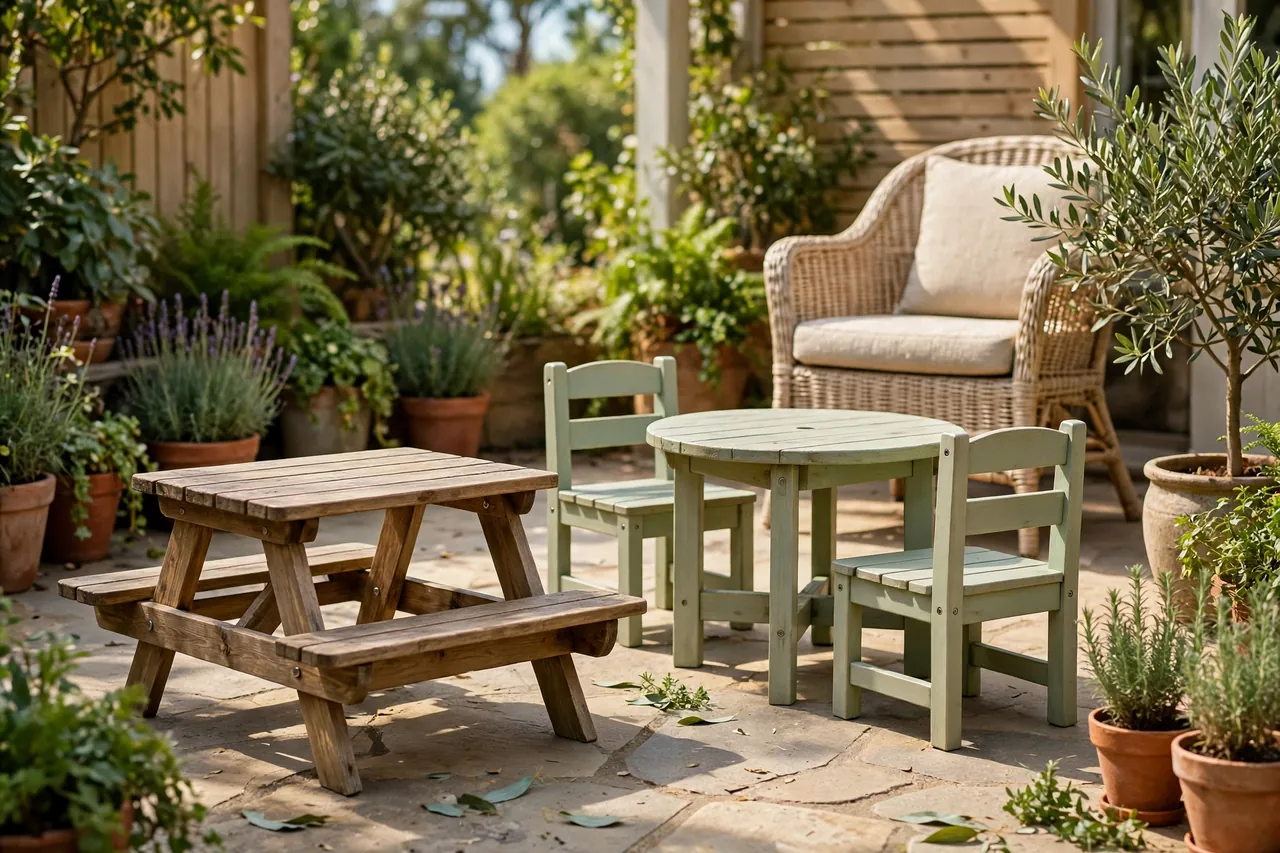
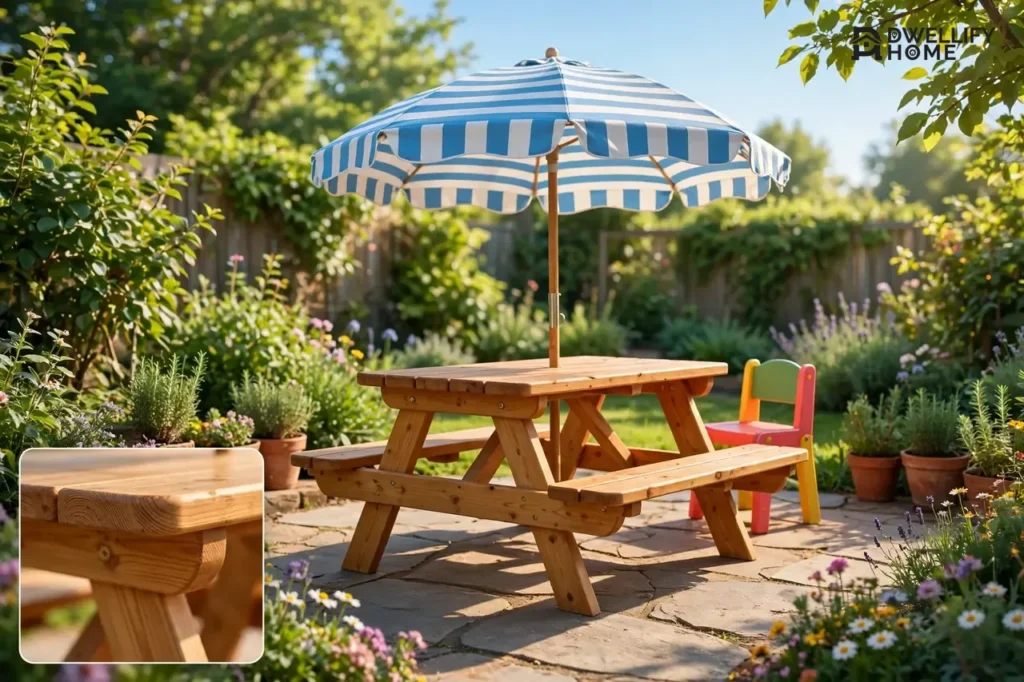
Shoppers meet three main types. A kids picnic table has attached benches on both sides, seats four to six children, and suits eating and group play; the Lifetime 280094 picnic table, for example, seats up to four children, weighs 21 pounds, and folds flat for transport. A kids patio set pairs a small round or square table with two to four separate chairs, and it suits a balcony or a small patio where a picnic table would crowd the space. An activity or water table is lower still, often with a lid that doubles as a play surface, and it suits toddlers and messy crafts more than meals.
The age range matters more than the style. Most kids outdoor tables are built for ages 3 to 8, and the manufacturers say so plainly: the Merry Garden wooden picnic bench, the Step2 Naturally Playful table, and the KidKraft wooden table set all list ages 3 to 8. A table made for that range fits a 3-year-old and an 8-year-old at the same time, which is exactly what a family with two children needs. Buy for the youngest child who will use it most, because a table that fits a 5-year-old today still fits a 7-year-old tomorrow.
Buy for the youngest regular user. A table that fits a 3-year-old still fits a 7-year-old; the reverse is never true.
What Size Kids Outdoor Table Do You Need?
A kids outdoor table for ages 2 to 5 should stand 18 to 22 inches high with bench seats 10 to 12 inches high, and a table for four preschoolers should measure about 36 by 24 inches on top, because those numbers put a small child’s feet flat on the ground and elbows at or just above the tabletop. For older children up to age 8, a table 19 to 21 inches high still works, since the same sets carry both ages.
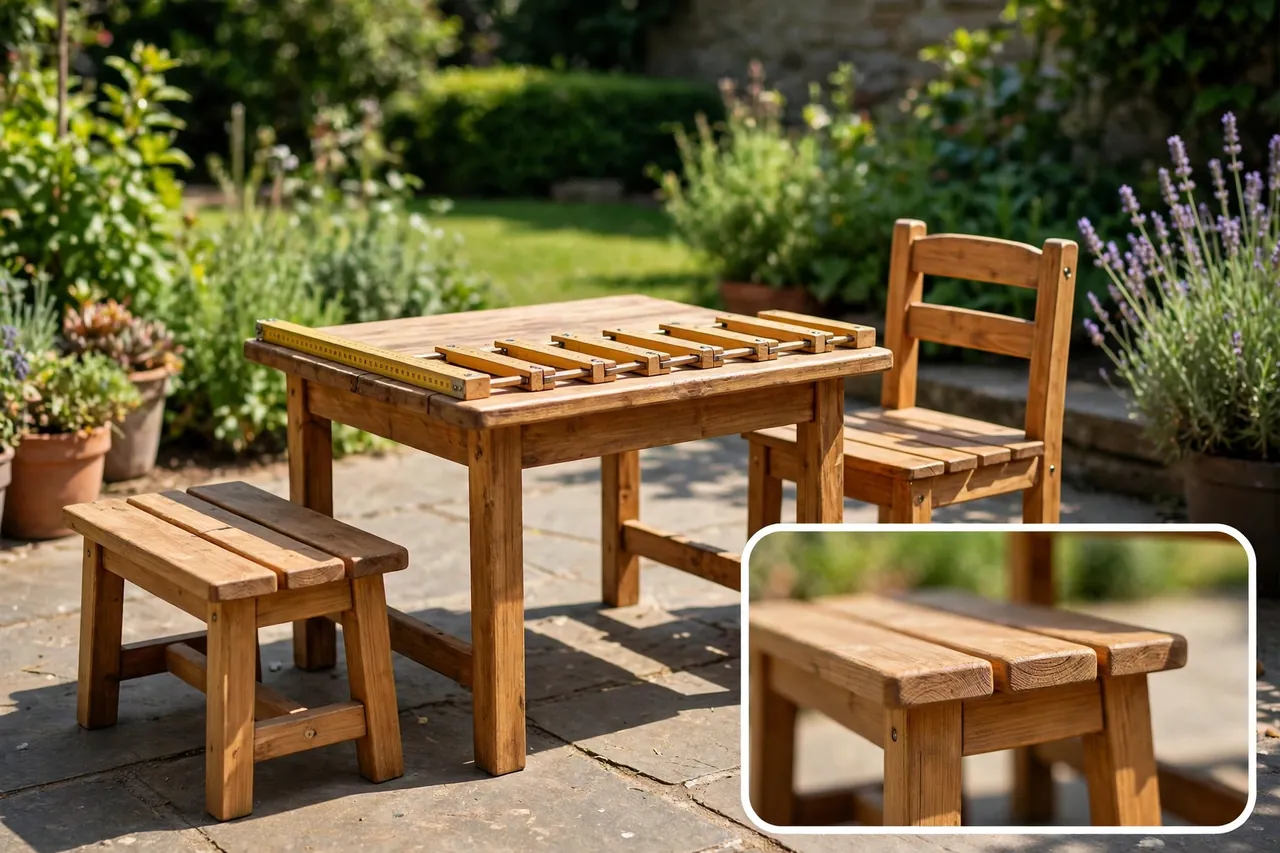
Measure your child, not the listing photo. Sit your child on a chair at home and measure from the floor to the bend behind the knee: that is the seat height you need, usually 10 to 12 inches for ages 2 to 5. Then check the gap between the seat and the tabletop: about 7 to 9 inches of clearance lets a child slide in, eat, and draw without hunching. The Merry Garden bench seats four children ages 3 to 8 at 35 by 31 by 19.6 inches overall, with each bench holding up to 100 pounds, while the Step2 Naturally Playful table seats four to six children with a 300-pound maximum weight.
Count seats honestly. A table that “seats four” seats four small children, not four children plus two adults squeezing in for a photo. Leave at least 24 inches of clear space around the table so children can get in and out without tipping it, and keep it off the main walkway: a table in the traffic path gets bumped, and a bumped table spills paint water on everyone. If the patio is tight, a folding table earns its keep, and our outdoor furniture for small spaces guide shows seven layouts where a compact set fits without crowding the space.
Measure the child, not the photo. Seat height 10 to 12 inches and table height 18 to 22 inches are the numbers that matter.
Which Material Lasts Longest Outdoors?
High-density polyethylene (HDPE) plastic lasts longest outdoors for a kids table, because it cannot splinter, will not rot, resists stains and UV, and needs nothing but a hose-down, while wood looks better but needs sealing and resin wicker fades fastest. Plastic sets run $80 to $300, wood sets $150 to $600 and more, and recycled composite sets $200 to $700 and up, all checked November 16, 2026.
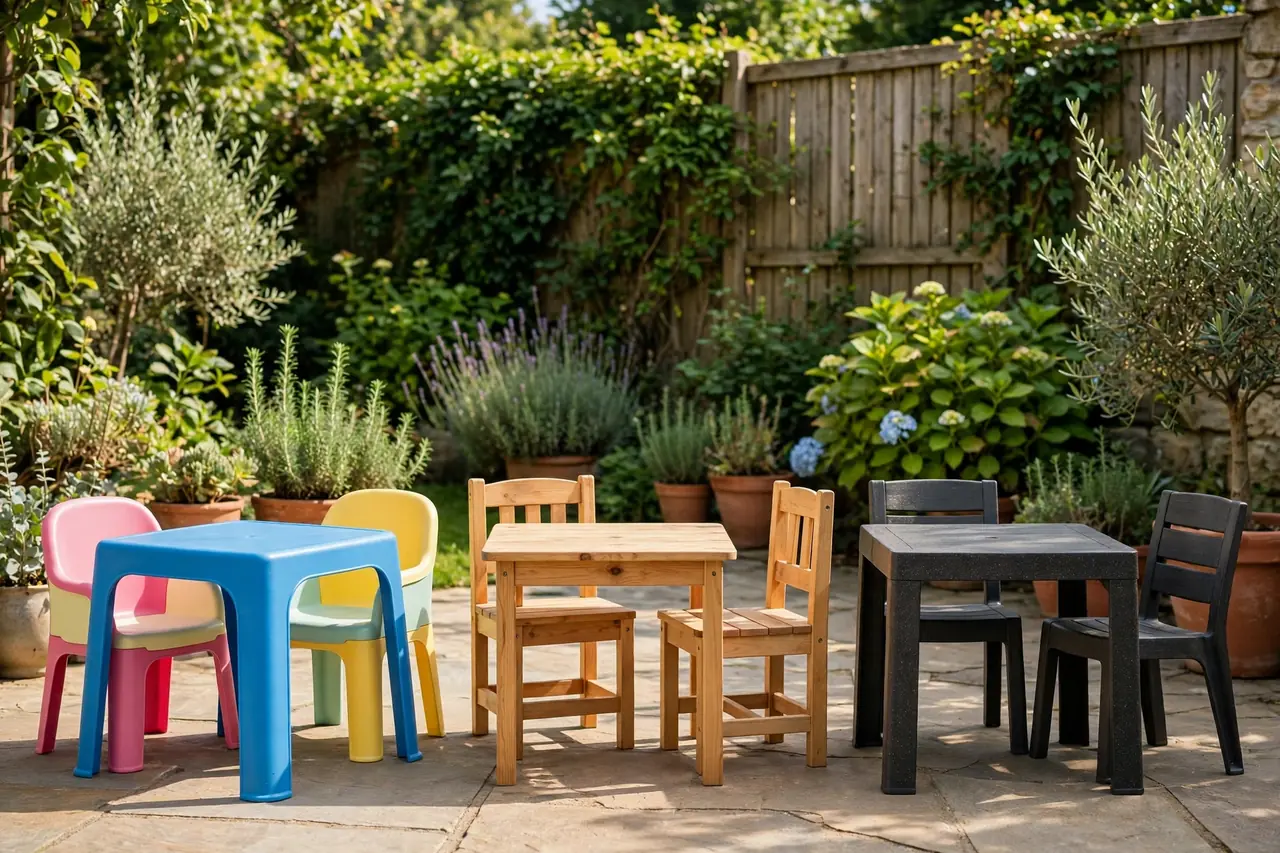
Plastic is the practical winner for most families. The Lifetime 280094 is made from high-density polyethylene that is waterproof, stain-resistant, and UV-resistant, with powder-coated steel legs, and it folds flat at 21 pounds. It looks plain next to a wooden set, and bright colors can fade after a year or two in full sun, but nothing about it splinters, rots, or needs sanding. For a table that lives outside all summer and takes crayons, markers, and mud, plastic is the low-drama choice.
Wood is the beautiful choice with a maintenance bill attached. Cedar, pine, and hemlock look like real furniture, and a wooden set suits a garden that already has wooden pieces. The catch is honest: wood needs sealing or staining to stop weathering, splintering, and rot, and an unfinished set like the Merry Garden bench, made of Canadian hemlock, must be sealed by the buyer before it lives outside. Read how the materials compare on price, lifespan, and upkeep at ListMixer’s preschool picnic table guide, which puts plastic at $80 to $300, wood at $150 to $600 and up, and recycled composites at $200 to $700 and up.
Metal frames show up as the skeleton under both. Tubular steel legs add stability to plastic tops, and powder-coated metal bistro-style sets suit older children who have outgrown a picnic bench. Watch for rust where the coating chips, and check that every bolt sits flush: a proud bolt head is a scraped knee waiting to happen. Recycled composite, a mix of HDPE and wood fiber, is the premium option: extremely durable, weather and insect resistant, and no splintering, but heavier and pricier than plain plastic.
Plastic wins on durability, wood wins on looks. Pick the one that matches how much maintenance you will actually do.
What Most Parents Get Wrong About Kids Outdoor Tables
Most parents get kids outdoor tables wrong in three ways: they buy an adult-sized table and add a booster, they pick the prettiest wood and skip the sealing, and they put the table in full sun with no shade. The first mistake is the most common, and it is the one that makes children stop using the table altogether.
An adult table with a booster seat is not a kids table. The child sits too high, the table edge hits mid-chest, and every reach for a cup is a stretch. Worse, a booster on a bench tips easily. A real kids table puts the child’s elbows at the tabletop and feet on the ground, which is why the 18-to-22-inch table height and 10-to-12-inch seat height from the sizing section matter more than any brand name.
The sealing mistake shows up in the second summer. An unfinished wooden set left outside through one rainy season grays, checks, and starts to splinter, and splinters on a child’s table are not a cosmetic problem. Seal or paint the wood before the first rain, not after the first splinter. And the shade mistake is the one from the intro: children’s skin burns fast, and a table in full sun at noon is a table nobody uses at noon. A built-in umbrella, a UPF 40+ canopy like the one on the Step2 table, or a spot under a tree or pergola turns the table from a decoration into the most-used seat in the yard.
A booster on an adult table is not a kids table. Height, shade, and sealed wood decide whether the table gets used.
Picnic Table, Patio Set, or Activity Table?
A picnic table suits eating and group play for ages 3 to 8, a patio set suits small spaces and older children who want real chairs, and an activity table suits toddlers and messy crafts, so pick by what your children actually do outside, not by what looks best in the store. Most families with two or more children get the most use from a picnic table.
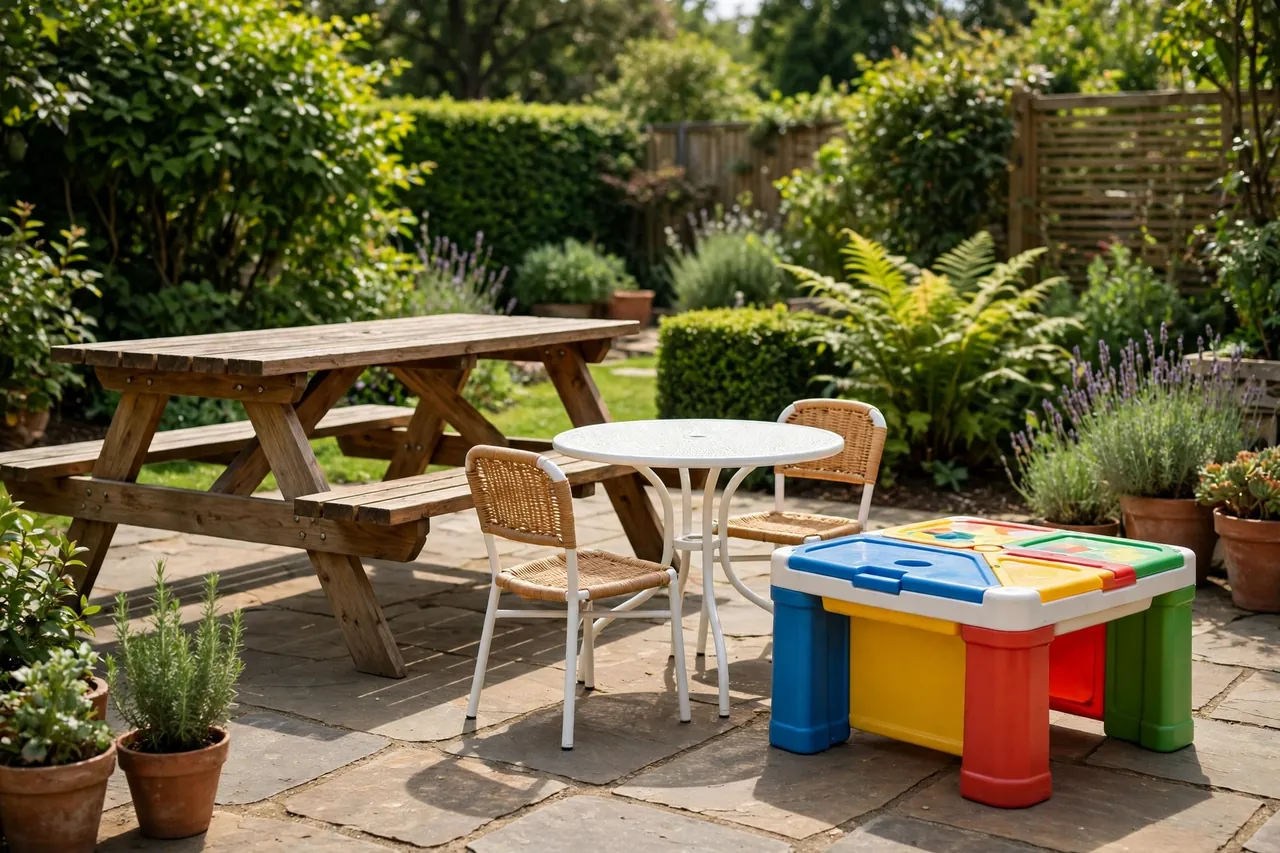
The picnic table is the workhorse. Attached benches mean nothing to lose, nothing to tip over separately, and four to six seats always ready. The KidKraft wooden picnic table with benches and umbrella is Outside Modern’s top pick, because it is well made and looks better than many adult sets, while the Lifetime 280094 is the runner-up for families who want a fold-flat table that travels. See the full comparison of six children’s picnic tables at Outside Modern’s best kids picnic table guide.
A patio set earns its place on a balcony or a small patio. Two chairs and a table about 24 inches across fit a corner a picnic table never could, and separate chairs let one child sit while another stands to paint. The trade-off is pieces: chairs wander, tip, and need a storage spot. If your outdoor space is small, read our patio dining set guide for sizing a table to its chairs so knees and elbows fit, and our small patio decorating ideas guide for making a tight space feel generous.
An activity table is the third option, and it is really a different product: low, often with a lid, built for sand, water, and crafts rather than meals. If your youngest is under 3, start here, and move to a picnic table when they turn 3. If your children are 5 and up, skip it: they will outgrow it in a season.
Match the table to the activity. Meals and groups mean a picnic table; tight spaces mean a patio set; toddlers mean an activity table.
How to Keep a Kids Outdoor Table Safe and Clean
Keep a kids outdoor table safe with four checks: rounded corners and smooth sanded edges, a non-toxic lead-free finish, stable legs that do not wobble, and a weight limit you respect, because children climb on tables and the table must hold them. Clean it with mild soap and water after messy play, and hose it down weekly in summer.
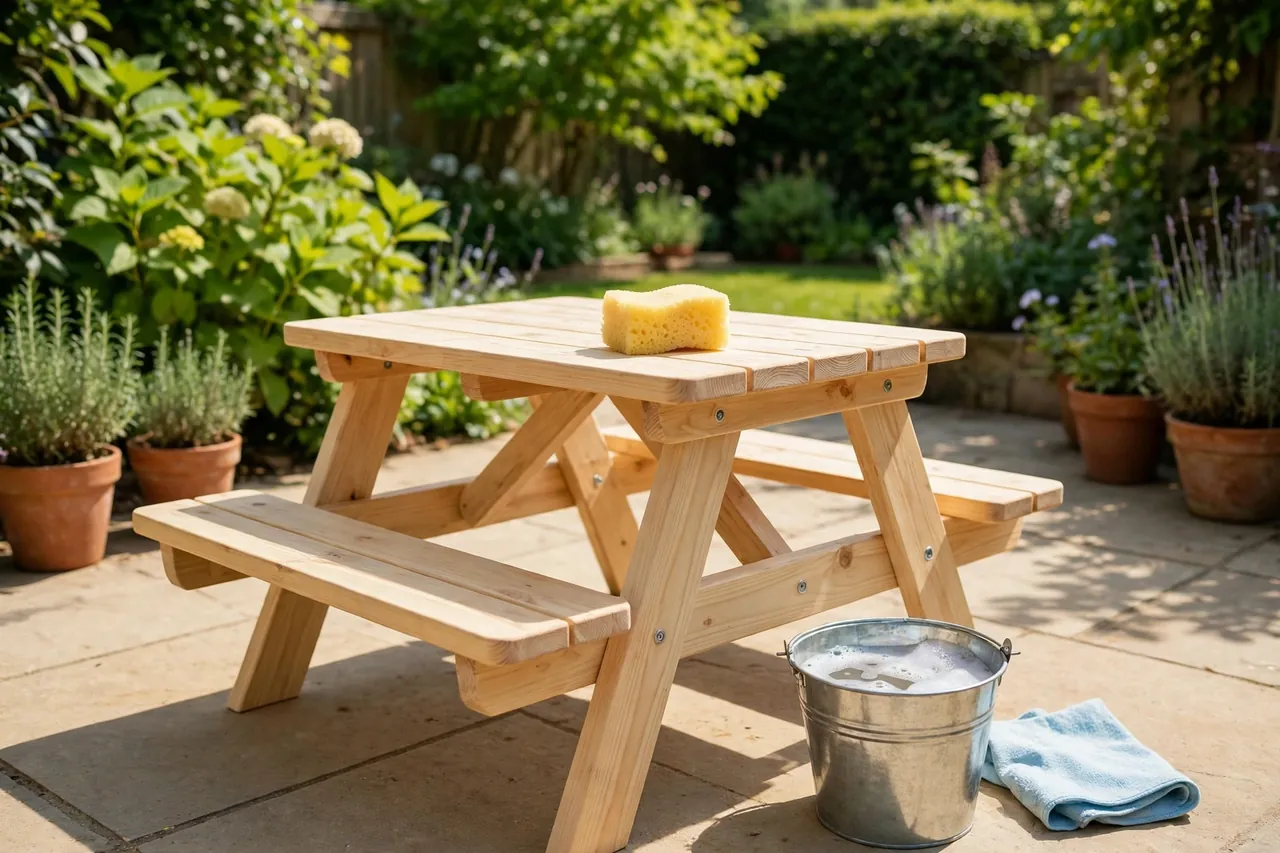
Start with the safety checks before the first use. Run your hand along every edge: rounded corners and smooth surfaces cut the bumps and scrapes that sharp corners cause, and any rough patch gets sanded before a child touches it. Check the finish: paint and sealant must be non-toxic and lead-free, and children’s products sold in the US must meet Consumer Product Safety Improvement Act (CPSIA) limits on lead and phthalates, so look for ASTM F963 certification on the listing. Then push the table sideways and try to tip it: a stable table barely moves, and a wobbly one gets its bolts tightened or goes back to the store.
Cleaning is simple if you do it often. Plastic wipes clean with a damp cloth and mild soap, and a hose handles the rest; wood needs a soft brush and soapy water, then a rinse, and never a pressure washer up close, which shreds the grain. Crayon and marker come off plastic with baking soda paste, and off sealed wood with a magic eraser used gently. Store the umbrella closed when the wind picks up: an open umbrella turns a light table into a sail.
Teach one rule and the table stays safe: the table is for sitting at, not standing on. Benches hold up to 100 pounds each on the Merry Garden set, and the Step2 table holds 300 pounds in total, which sounds generous until two children and a parent climb on together. Check the bolts once a month in summer, because children shake furniture loose faster than adults do.
Rounded edges, non-toxic finish, no wobble. Those three checks take five minutes and prevent most injuries.
Where to Put a Kids Outdoor Table
Put a kids outdoor table where you can see it from the house, in partial shade, on a flat hard surface with 24 inches of clear space around it, because a table you can watch is a table children actually use safely. A patio edge near the back door beats the far corner of the yard every time.
Shade decides the spot more than anything else. Under a tree, under a pergola, or beside the house where the afternoon sun misses it: any of these beats a sunny lawn at noon. If the yard has no natural shade, pick a set with an included umbrella and a hole for it, or plan a shade sail above the table. Our pergola shade ideas guide shows how to shade a play corner without building a roof.
The surface matters too. Pavers, decking, or a patio slab keep the table level and the legs out of mud; bare soil lets legs sink after rain and makes the table wobble. Keep the table near the garden, not in it: a table beside the planting beds invites children to pick herbs and flowers at it, and our patio garden guide shows how to pair seating with plants that do not drop sap and debris onto the seat all summer. In winter, fold the table flat or cover it, and store cushions and the umbrella indoors; our how to store outdoor furniture guide covers the full winter routine, and our outdoor storage bin guide shows where the small pieces live between seasons.
Visible from the house, shaded, and level. Those three decide whether the table becomes the favorite spot or the forgotten one.
Related Guides
If you are setting up the whole outdoor space for children, these guides pick up where this one leaves off:
- Patio Dining Set — size the grown-up table so the whole family eats together.
- Outdoor Furniture for Small Spaces — seven layouts that make a tiny patio feel big.
- Outdoor Bench With Storage — sit down and stash the toys in one piece.
- Patio Garden — pair the table with plants children can pick and touch.
- How to Store Outdoor Furniture — keep it clean, dry, and ready for spring.
- Outdoor Storage Bin — a home for cushions, toys, and the umbrella.
- Small Patio Decorating Ideas — make a tight patio feel generous.
Frequently Asked Questions
What is the best kids picnic table?
Outside Modern’s top pick is the KidKraft wooden picnic table with included benches and umbrella, because it is very well made and looks better than many adult sets. The runner-up is the Lifetime 280094, a durable HDPE table that folds flat, and the budget pick is the Merry Garden wooden bench, which needs sealing by the buyer.
What size picnic table is best for kids?
For ages 2 to 5, look for a table 18 to 22 inches high with seats 10 to 12 inches high, so your child sits with feet flat and elbows at the tabletop. A top around 36 by 24 inches seats four preschoolers comfortably. Measure your child first: the right size is the one that fits their knee height today.
Are plastic or wooden kids picnic tables better?
HDPE plastic is the most durable and lowest-maintenance choice: it cannot splinter or rot, resists stains and UV, and costs $80 to $300. Wood looks better and costs $150 to $600 and up, but needs sealing and annual care. Recycled composite is the premium option at $200 to $700 and up.
How do you clean a kids picnic table?
Wipe plastic with a damp cloth and mild soap, and hose it down weekly in summer; crayon and marker come off with baking soda paste. Wood needs a soft brush and soapy water, then a rinse — never a pressure washer up close, which shreds the grain. Reseal wood once a year to keep the surface smooth.
Can kids picnic tables be left outside?
Yes, if it is plastic or sealed wood and you cover it in bad weather. Bring the umbrella in when it is windy, store cushions indoors, and fold or cover the table in winter. Unfinished wood must be sealed before its first winter outside, or it will gray, check, and splinter.
Disclaimer: This guide gives general advice for choosing children’s outdoor furniture, not professional safety or medical guidance. Check weight limits, confirm non-toxic and lead-free finishes and CPSIA compliance on the listing, supervise young children at the table, and keep the table in shade during strong sun.
Measure your child, pick the material you will actually maintain, and put the table where you can see it in partial shade. Do that, and the table you buy this year is still the spot where snacks, crafts, and summer afternoons happen three years from now.