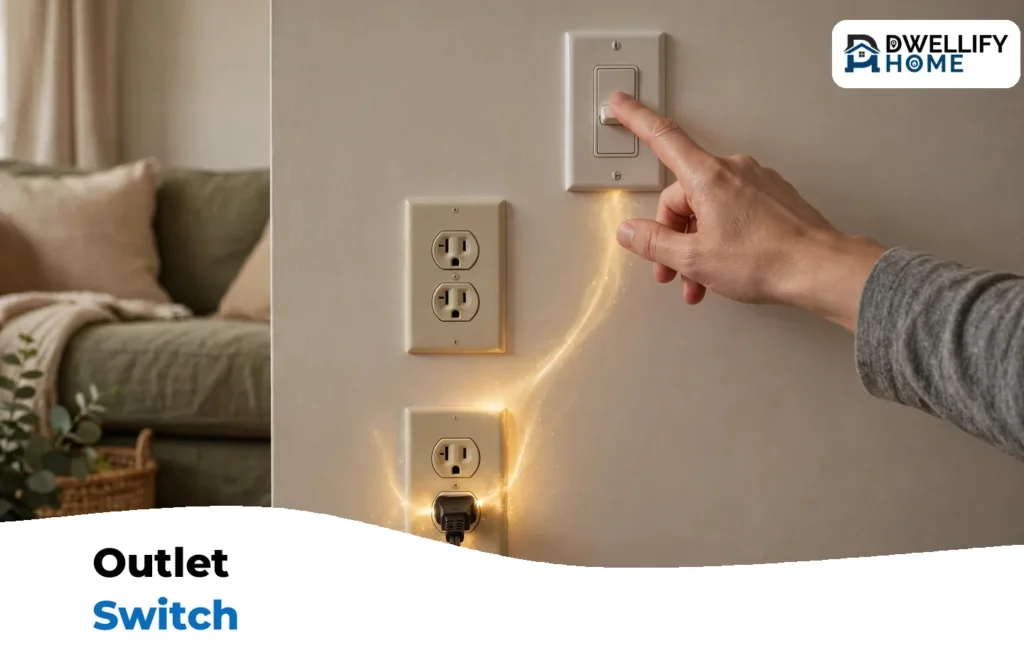
An outlet switch is not one single product. People use the words for three different things: an outlet that a wall switch controls, a small plug-in adapter that adds an on/off switch to any outlet, and a smart outlet you run from an app or with your voice. Each one solves a different problem.
The confusion usually starts with a socket that seems dead. One half of an outlet works and the other half does not, yet nothing looks broken. In most homes that is not a fault at all. It is the first kind on this list, working exactly as the electrician wired it. At DwellifyHome, this guide separates the three kinds, gives you a one-minute lamp test, and explains the safe ways to change the setup.
How to Test Which Kind of Outlet Switch You Have
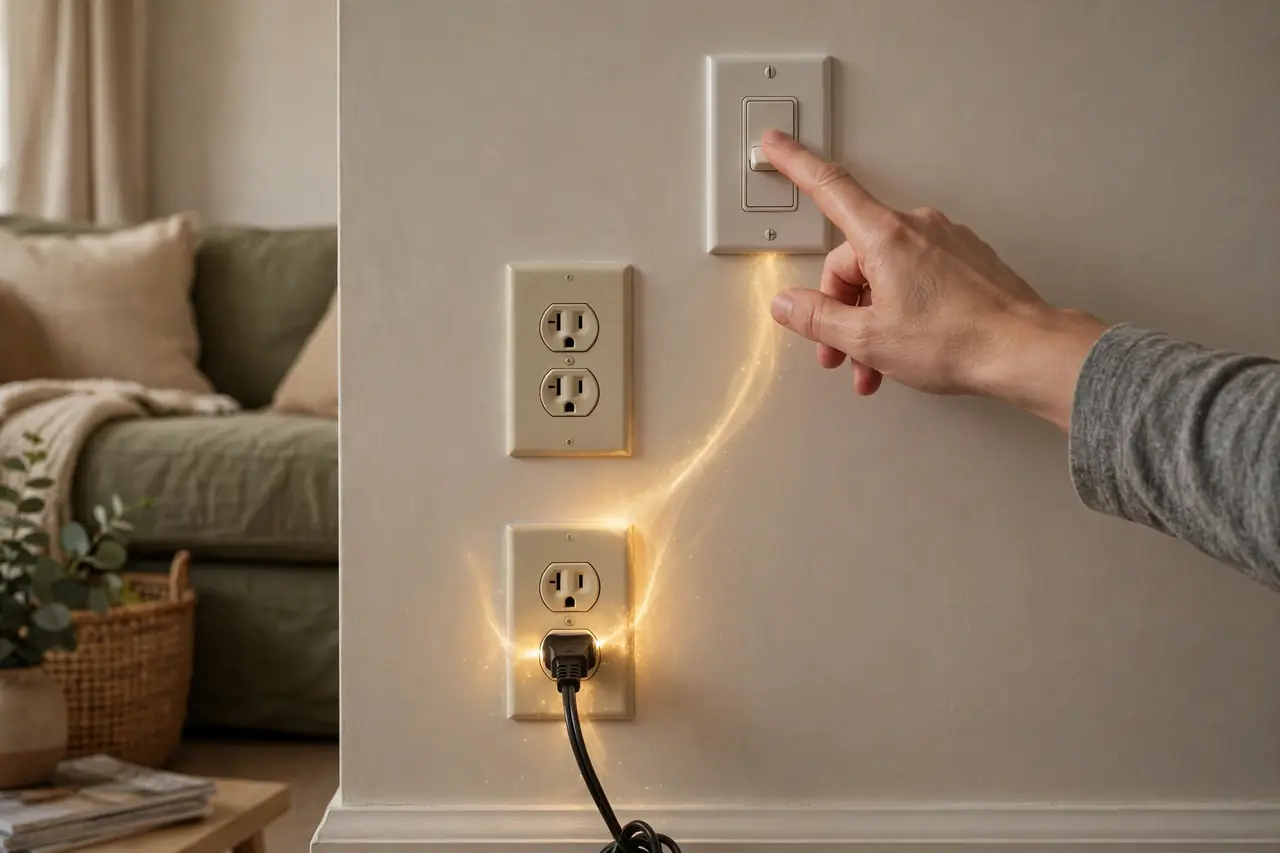
You need no tools for the basic test. You need one lamp that you know works, with its own switch turned on.
- Plug the lamp into the top socket of the outlet and note whether it lights.
- Flip every wall switch near the room’s door, one at a time. Watch whether the lamp follows any of them.
- Move the lamp to the bottom socket and repeat the same switch flips.
- Look at what is plugged into the outlet. A small box, tap, or short cord with its own switch points to a plug-in device, not wall wiring.
Use a lamp, not a phone charger. Electricians who troubleshoot these outlets recommend a lamp because chargers, power strips, and glow lights can look “on” from stored power and muddy the result.
Read your results like this:
- One socket follows the wall switch and the other stays on: you have a switched outlet, the half-hot kind.
- Both sockets follow the wall switch: you have a fully switched outlet.
- Both sockets stay on, and control sits in a little switch on a plug or cord: you have a plug-in outlet switch.
- A socket answers to an app, a voice assistant, or a remote: you have a smart outlet, a smart plug, or a remote-controlled plug.
If neither socket works at all, stop here. Check the breaker panel and look for a tripped GFCI outlet in the room or a nearby bathroom first. A fully dead outlet is a different problem from a switched one.
Kind 1: The Switched Outlet (Half-Hot Receptacle)
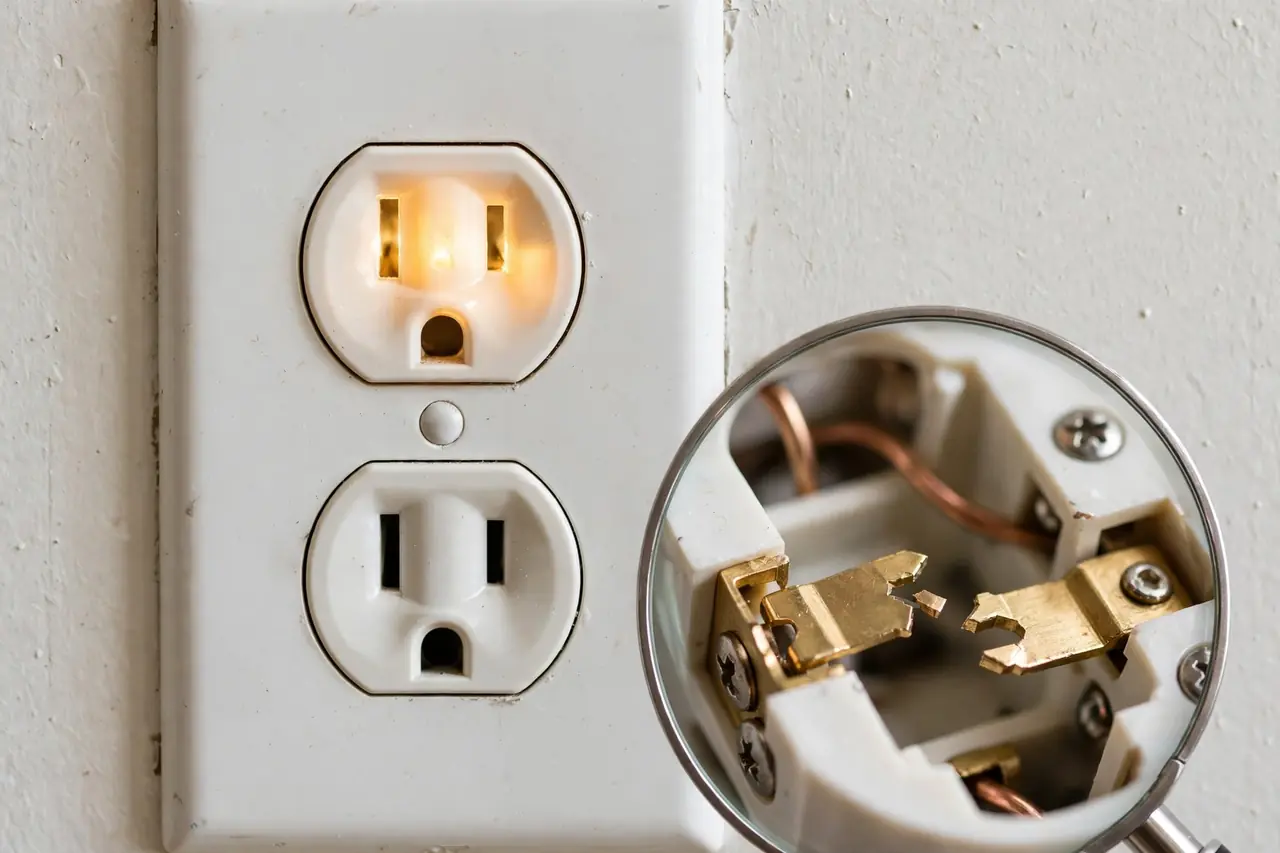
A switched outlet is a normal two-socket receptacle wired so that a wall switch controls one of its sockets. The most common version is called a half-hot or split receptacle: one socket has power all the time, and the other socket only has power while the wall switch is on.
Builders install these on purpose, usually in living rooms and bedrooms with no ceiling light. Building codes require a wall switch near the door to control a light, and as EngineerFix’s switched receptacle guide explains, wiring one receptacle to the switch meets that rule for less money than fitting a ceiling fixture. You plug in a floor or table lamp, and the room gets its “light switch” at the door.
Why Only Half of the Outlet Switches
Inside a two-socket receptacle, a small metal tab joins the two brass (hot) screw terminals, so one wire feeds both sockets. For a half-hot setup, the electrician breaks that tab on the hot side only. The neutral side stays joined. One socket is then fed by the always-on wire, and the other by the switched wire, which is often red. That broken tab is the whole trick — nothing inside the outlet is smart or electronic.
One clue before you test: some electricians install a switched receptacle upside down, with the round ground hole on top. It is a private signal, not a code rule, so treat it as a hint and still run the lamp test.
What a Switched Outlet Is Good For
- A lamp you want to control from the door, like a ceiling light.
- Seasonal or decorative lights you turn on and off as a group.
- A media corner. One flip cuts standby power to the TV and its boxes completely.
Its limit is just as clear. Never rely on the switched half for anything that must never lose power, such as a router, a clock you depend on, or a medical device. Someone will flip that switch by habit, sooner or later.
Fully Switched Outlets and the Replacement Trap
Some outlets are fully switched: the wall switch controls both sockets, and the tab stays intact. These show up where the whole outlet exists for one lamp and nothing else. Your lamp test tells them apart easily — both halves follow the switch.
The replacement trap catches many homeowners. If a half-hot receptacle wears out and gets replaced with a standard one, tab intact, the new outlet behaves differently from the old one: either the switch now controls both halves, or the outlet stays on and the switch seems to do nothing. Nothing is haunted — the tab is the difference. Matching the old setup means the replacement receptacle needs its hot-side tab broken the same way, which is one more reason receptacle swaps belong to people who know what they are looking at.
Kind 2: The Plug-In Outlet Switch
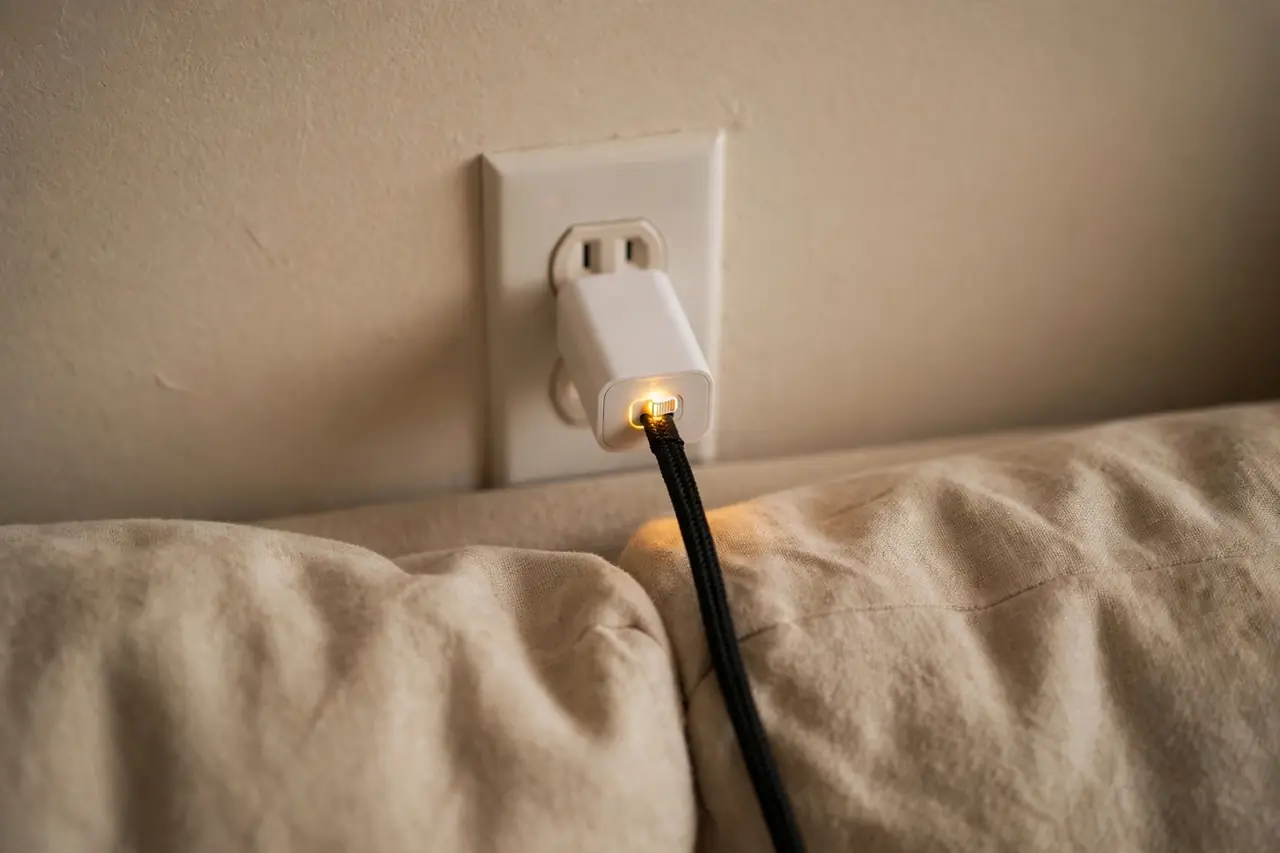
A plug-in outlet switch is a small adapter that sits between the wall outlet and your device’s plug, and adds the switch the setup was missing. Nothing is wired. You plug it in, plug your lamp or appliance into it, and control power at the adapter instead of pulling plugs in and out.
They come in three common shapes:
- A tap that plugs flat into the outlet, with a small on/off switch on its face or side.
- A short cord with a switch built into the cord itself, handy when the outlet hides behind furniture.
- A receiver plug worked by a small remote or a stick-on wall switch, which is really a remote control outlet — the no-wiring way to switch a lamp from across the room or from the bed.
This is the renter-friendly kind, and the fastest fix in this whole guide. It suits lamps with no switch of their own, devices tucked in hard-to-reach corners, and anything you switch off daily to kill standby draw.
A close cousin is the inline cord switch: a small switch fitted into a lamp’s own cord, so the lamp gains an on/off control partway down its cable. It solves the same reach problem for one specific lamp. Just know its limit — it controls only that cord, and it adds no control at the outlet itself.
One buying check matters more than the rest: the rating. Look for a safety listing mark (UL or ETL) and a rating that covers your device. For example, one ETL-listed remote receiver by Fosmon is rated 125 volts, 15 amps, 1,875 watts — the same ceiling as a standard household outlet. A heater or large appliance can eat most of that budget by itself, so match the numbers before you buy, not after.
Kind 3: The Smart Outlet
The third meaning is the smart outlet, and it comes in two forms. A smart plug is a plug-in adapter like Kind 2, but the switch lives in an app: you get phone control, voice control, and schedules over Wi-Fi. An in-wall smart receptacle replaces the outlet itself with one whose sockets are smart. That version is electrical-box work, so it carries the same hire-an-electrician boundary as any receptacle swap.
One trap links this kind back to Kind 1: a smart plug is only smart while it has power. Plug it into the switched half of a half-hot outlet, flip the wall switch off out of habit, and your app control, schedules, and voice commands all die with it. Smart plugs belong on the always-on half, or on a normal always-hot outlet.
Most people should start with the plug. Our guide to the plugs that work with Google Home smart plug setups covers picking one that pairs cleanly with your assistant. And if all you really want is lights that keep a daily schedule — no apps, no Wi-Fi — a simple timer outlet does that job for less.
Which Outlet Switch Fits Your Problem?
The three kinds side by side:
| Your situation | Best match | Why |
|---|---|---|
| One socket dies when the wall switch is off | You already have a switched outlet | Nothing is broken. Put the lamp on the switched half and always-on devices on the other half. |
| A lamp or device has no switch and is hard to reach | Plug-in outlet switch | Adds a switch in seconds, with no wiring and no landlord issues. |
| You want control from the couch, bed, or another room | Remote control outlet | A handheld remote or stick-on switch runs the plug for you. |
| You want voice or phone control | Smart plug or smart outlet | App and assistant control; the plug form needs no wiring. |
| You want lights to follow a daily schedule | Timer outlet, or a timer at the wall switch | Set the hours once and the switching happens by itself. |
If the wall switch itself is what you want to automate, look at a timer switch instead of anything that plugs in. Prefer simple dials and pins over screens and menus? That is exactly what a mechanical timer switch is for.
Can a Switched Outlet Be Made Always-Hot?
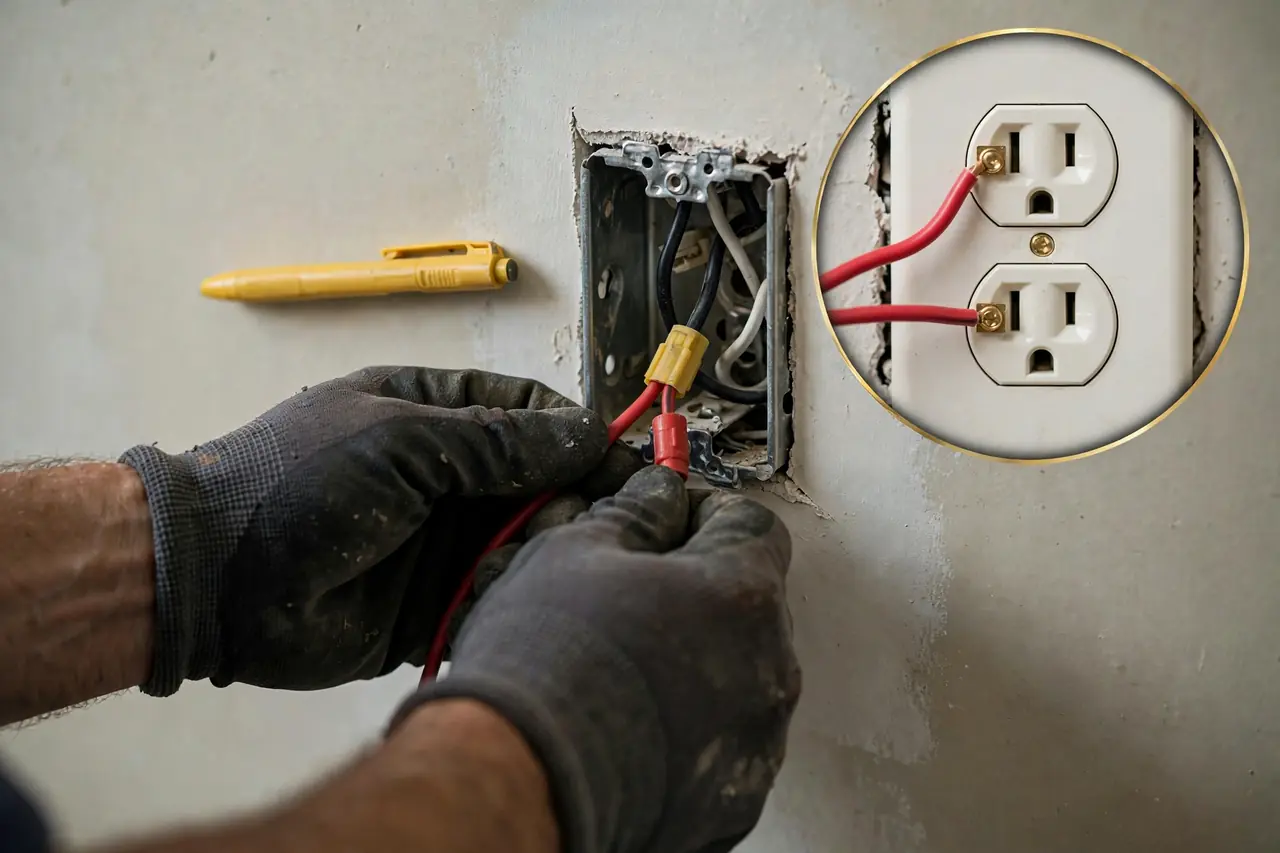
Yes — but first, the caution this job deserves. Making a switched outlet always-hot means opening the electrical box and changing wires. The breaker must be off, and the wires must be tested dead with a voltage tester before anything is touched. If you are not experienced with receptacle wiring, hire a licensed electrician for this one. The change is small, but a wrong connection can leave a socket live when it looks safely off.
People usually ask for this conversion for one of two reasons: the switched half feeds something that should never lose power, like the router or the alarm clock, or the room now has a ceiling light and the switched outlet has lost its job. Both are fair reasons.
Here is what the electrician actually does, so you know what you are paying for. As licensed electrician John Grabowski describes in his guide to converting a switched outlet to always-hot, the job is a few wiring changes at the outlet box. The switched wire (often the red one) is disconnected and capped off safely with a wire connector. The socket it fed is reconnected to the constant-hot wire — commonly by fitting a fresh receptacle with its joining tab intact, so both sockets are always on. The wall switch is then bypassed, removed and covered with a blank plate, or simply left in place controlling nothing.
What can you do yourself, with no box work at all? Three honest options:
- Leave the wall switch on, and put a small note or a switch guard on it so nobody flips it by habit.
- Move always-on devices to the always-hot half, and let the lamp keep the switched half.
- Wait — a plug-in adapter does not fix this problem. Anything plugged into the switched half still dies when the switch is off, whatever adapter it wears.
One more expectation to set: if your room has no ceiling light, the switched outlet may be the room’s code-required switched lighting. Converting it can leave the room with no switch-controlled light at all. An electrician will flag this before changing anything.
Safety Rules for Every Kind of Outlet Switch
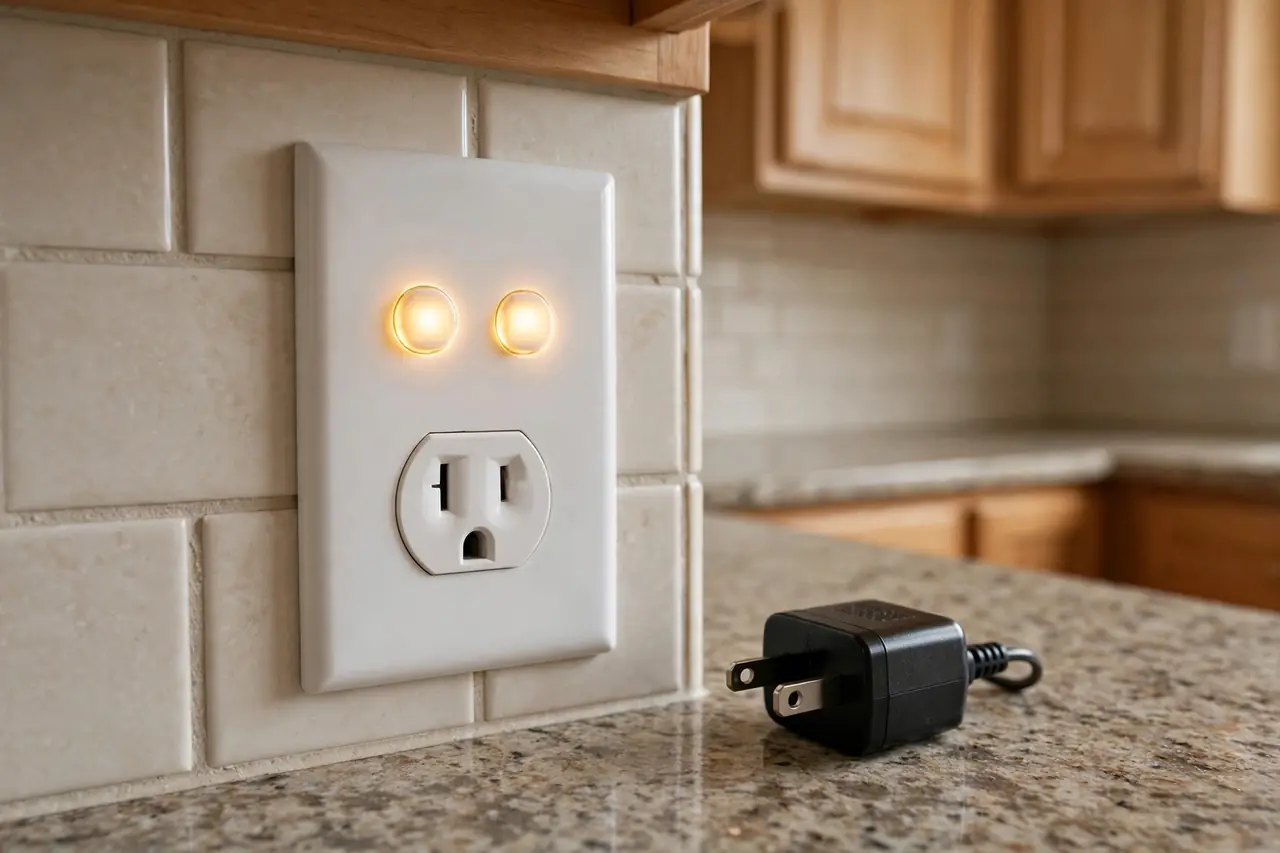
- Never overload the chain. Your total load must stay under the lowest rating in line — the adapter, the timer, or the outlet. Most household circuits give you 15 amps (1,875 watts), and one space heater can use nearly all of it.
- Wet areas need GFCI protection. The National Electrical Code requires GFCI protection in kitchens, bathrooms, garages, and outdoors, per the Electrical Safety Foundation International’s GFCI guidance. A plug-in switch or smart plug adds convenience, not GFCI protection.
- Buy listed devices only. Look for a UL or ETL mark on any adapter, timer, or smart plug. Skip no-name devices with no listing, however cheap they are.
- Do not stack adapters. Never plug one plug-in switch or tap into another, and never run a heater through a light-duty adapter or a long thin cord.
- Treat warning signs as stop signs. Heat, buzzing, a burning smell, or scorch marks at an outlet mean stop using it and call an electrician. These are not quirks to live with.
- Breaker off, then test, before any box work. A wall switch in the off position does not make an outlet safe to open. Only the breaker does that, and a tester proves it.
Disclaimer
This guide explains how outlet switches work and how to test them safely from outside the box. It is not wiring instruction. Electrical codes and existing wiring vary by home and area, and work inside an outlet or switch box — including converting a switched outlet — belongs with a licensed electrician unless you are experienced and your local rules allow it.
Related Guides
- GFCI outlet not working: safe fixes — If an outlet stops working entirely, start here.
- how to choose a smart home electrician — For wired installs that go beyond a simple swap.
Frequently Asked Questions
Why does only one half of my outlet work?
Usually because it is a half-hot outlet: one socket is wired to constant power and the other to a wall switch. With the switch off, the switched half has no power, so it looks broken. Plug a lamp into each half and flip the wall switches near the door to confirm it.
Can you change a switch-controlled outlet to always remain on?
Yes. An electrician caps the switched wire inside the box and feeds that socket from the constant-hot wire, so both halves stay on. It is a small job, but it is inside-the-box wiring: the breaker stays off, the wires get tested, and a licensed electrician is the safe choice for most homeowners.
Can a bad light switch cause outlets not to work?
Yes, if the outlet is switch-controlled. A failed switch cuts power to the switched socket just as surely as flipping it off, and sometimes to the whole outlet. Before blaming the switch, check for a tripped breaker and a tripped GFCI outlet, because those two are more common and cost nothing to reset.
Is a dead outlet dangerous or can it cause a fire?
Most dead outlets are harmless: the wall switch is off, a breaker tripped, or a GFCI needs a reset. It becomes urgent when you see the warning signs — a burning smell, discoloration, sparks, or a warm cover plate. Those can point to damaged wiring, so stop using the outlet and have an electrician inspect it.
Your next step is the one-minute lamp test. Run it on any outlet that has ever confused you, then put a tiny label on the switched half and on its wall switch. Ten minutes of testing today ends years of guessing which switch kills the TV.