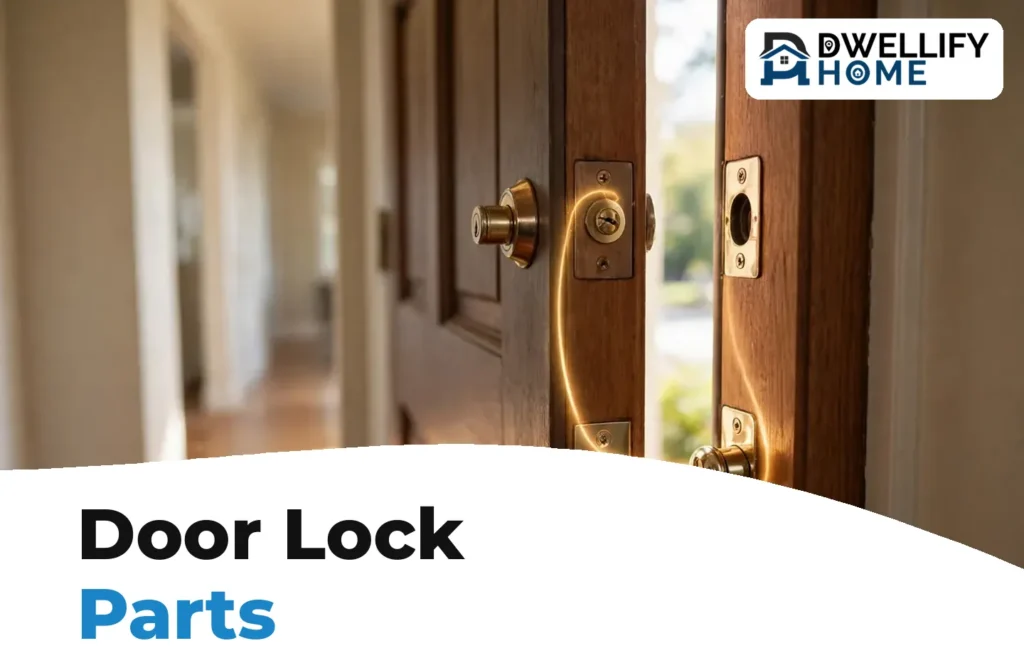
Door lock parts are the named pieces that work together to latch, lock, and open a door. The main ones are the cylinder, the latch bolt, the dead bolt, the faceplate, the strike plate, the spindle, and the thumb turn. Every other part supports one of those seven.
Learning the names matters most when something breaks. Hardware stores and locksmiths sell and search by part name, so asking for “the metal bit that sticks out of the door edge” gets you nowhere, while asking for a “latch bolt with a 2-3/8 inch backset” gets you the right part the first time.
This guide names every part, shows where it sits, and gives you the three measurements that decide whether a replacement part actually fits your door.
Door Lock Parts at a Glance
A standard home door usually has two locks working side by side: a knob or lever lock that latches the door shut, and a deadbolt that locks it. Their parts overlap a lot, so one map covers both.
Table: The main door lock parts, where they sit, and what each one does
| Part | Where it sits | What it does |
|---|---|---|
| Cylinder | Through the door face, outside | Reads your key and turns to drive the lock |
| Plug | Inside the cylinder | The round core that rotates when the right key is inserted |
| Keyway | Front face of the plug | The shaped slot the key slides into |
| Tailpiece | Back of the cylinder | Flat bar that carries the cylinder’s turn to the bolt |
| Latch bolt | Door edge, in the knob or lever lock | Spring-loaded angled bolt that holds the door shut |
| Dead bolt | Door edge, in the deadbolt lock | Solid bolt that locks the door when thrown |
| Faceplate | Flat on the door edge | The visible plate the bolt slides through |
| Spindle | Through the door, joining both knobs or levers | Square rod that turns the latch when you turn a handle |
| Thumb turn | Inside face of a deadbolt | The small lever you turn by hand to throw or retract the dead bolt |
| Rose / escutcheon | On the door face, around the knob or cylinder | Trim plate that covers the hole and mounting screws |
| Strike plate | On the door frame, opposite the bolt | Receives the bolt and reinforces the frame at that spot |
| Strike box | Behind the strike plate, inside the frame | A cup that gives a dead bolt room and adds strength |
With that map in mind, here is each part in plain detail, grouped by where it lives.
The Cylinder: Where Your Key Does Its Work
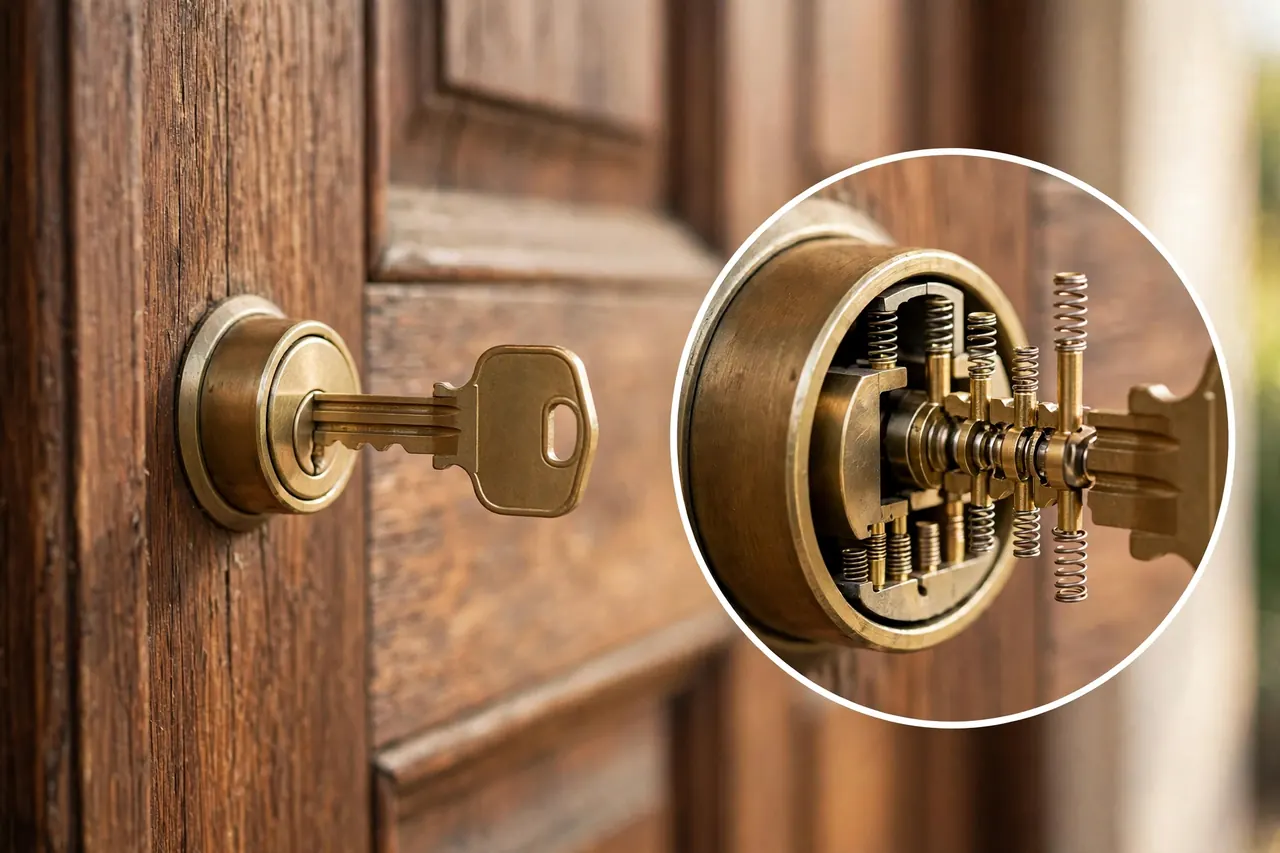
The cylinder is the round metal part on the outside of the door that your key slides into. It is the lock’s decision-maker: it checks the key, and only the right key lets it turn.
Inside the cylinder sits the plug, the smaller round core that actually rotates. The slot in the front of the plug is the keyway, and its shape is why a key from one brand usually will not even slide into another brand’s lock.
Inside the plug are tiny pins and springs. Your key’s cuts lift the pins to the correct heights, which frees the plug to rotate. Most home locks use five pins; many commercial cylinders use six, a detail worth knowing if you ever order a replacement cylinder.
At the back of the cylinder is the tailpiece, a flat metal bar. When the plug turns, the tailpiece turns with it and drives the bolt. If a key turns but the bolt does not move, the tailpiece is a prime suspect: it may be bent, broken, or the wrong length for the door’s thickness.
A cylinder is also the part involved when locks are rekeyed. Some cylinders are built to be rekeyed with a special tool so a new key works and the old one stops working; others must be replaced outright. When you shop, “cylinder” plus your lock’s brand and keyway is the search that finds the right one.
On the most common home setup, the outside has a cylinder and the inside has a thumb turn instead of a second key. That arrangement has its own name, explained in our guide to the single cylinder deadbolt.
Latch Bolt vs Dead Bolt: The Two Bolts People Mix Up
The latch bolt and the dead bolt both stick out of the door edge into the frame, and that is where the similarity ends. Mixing them up is the most common reason people buy the wrong part, so it pays to know the difference cold.
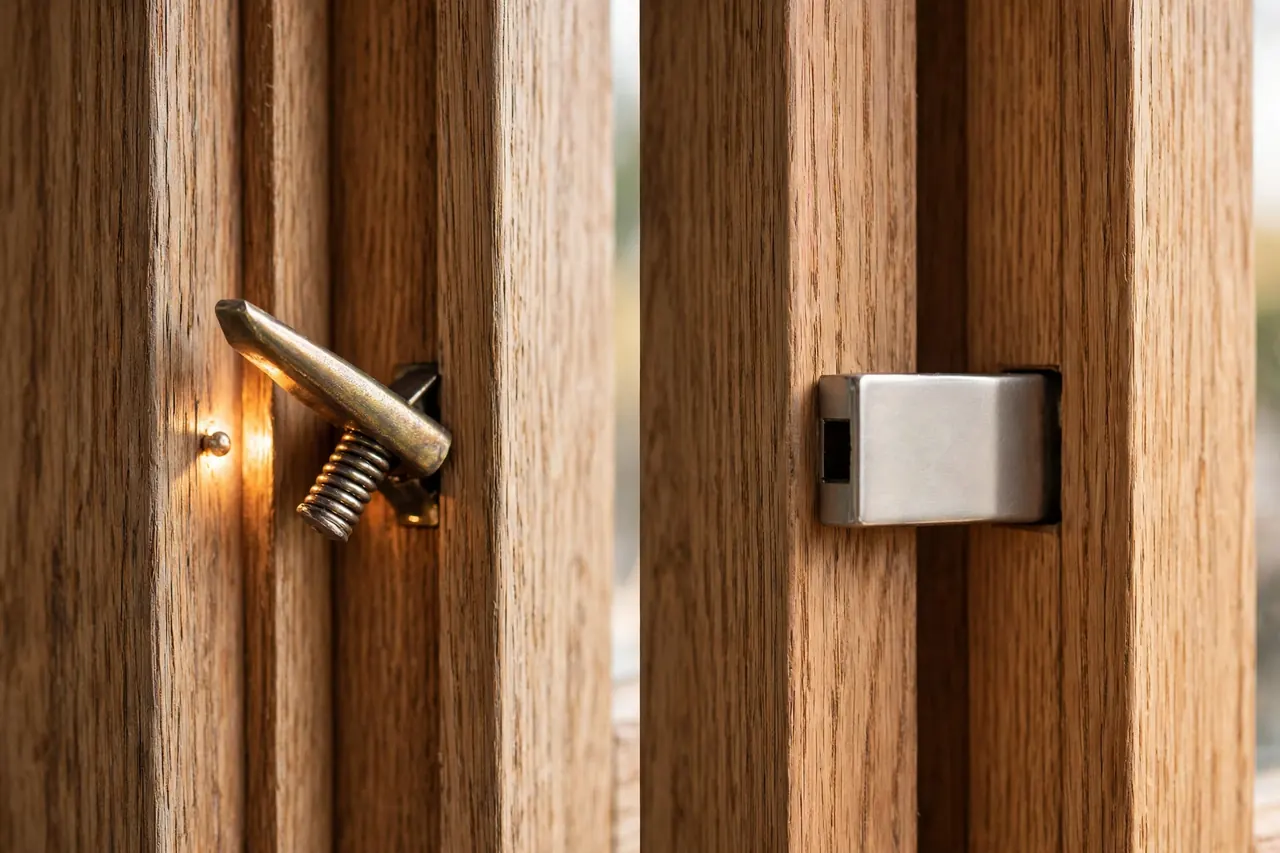
The latch bolt belongs to the knob or lever lock. It is spring-loaded and has an angled, beveled face. That angle is why it slides back on its own as the door closes, then springs into the frame to hold the door shut. It keeps the door closed, but it is not a real lock on its own.
The dead bolt belongs to the deadbolt lock. It is a solid bar with a flat end, and nothing springs it in or out. Only a key or the thumb turn moves it, which is exactly what makes it secure: pushing on the door cannot force it back.
Table: Latch bolt vs dead bolt, side by side
| Feature | Latch bolt | Dead bolt |
|---|---|---|
| Shape of the end | Angled (beveled) on one side | Flat and square |
| How it moves | Spring-loaded; pushes in when the door closes | Only moves when you turn a key or thumb turn |
| Typical throw (how far it reaches into the frame) | About 1/2 inch | A full 1 inch on standard home deadbolts |
| Its real job | Holds the door shut | Locks the door against force |
| Driven by | The spindle, when a knob or lever turns | The tailpiece, when the cylinder or thumb turn rotates |
One more detail separates good latch bolts from cheap ones. A deadlocking latch bolt (often just called a deadlatch) has a small extra pin beside the main bolt. When the door closes, the strike plate holds that small pin in, and the main bolt can no longer be pushed back with a card or a thin tool. If your latch bolt has no small side pin, it is a plain spring latch, and naming that difference matters when you replace it.
For a closer look at how the dead bolt itself works as a lock, see our deadbolt door lock guide.
The Parts Hidden in the Door Edge
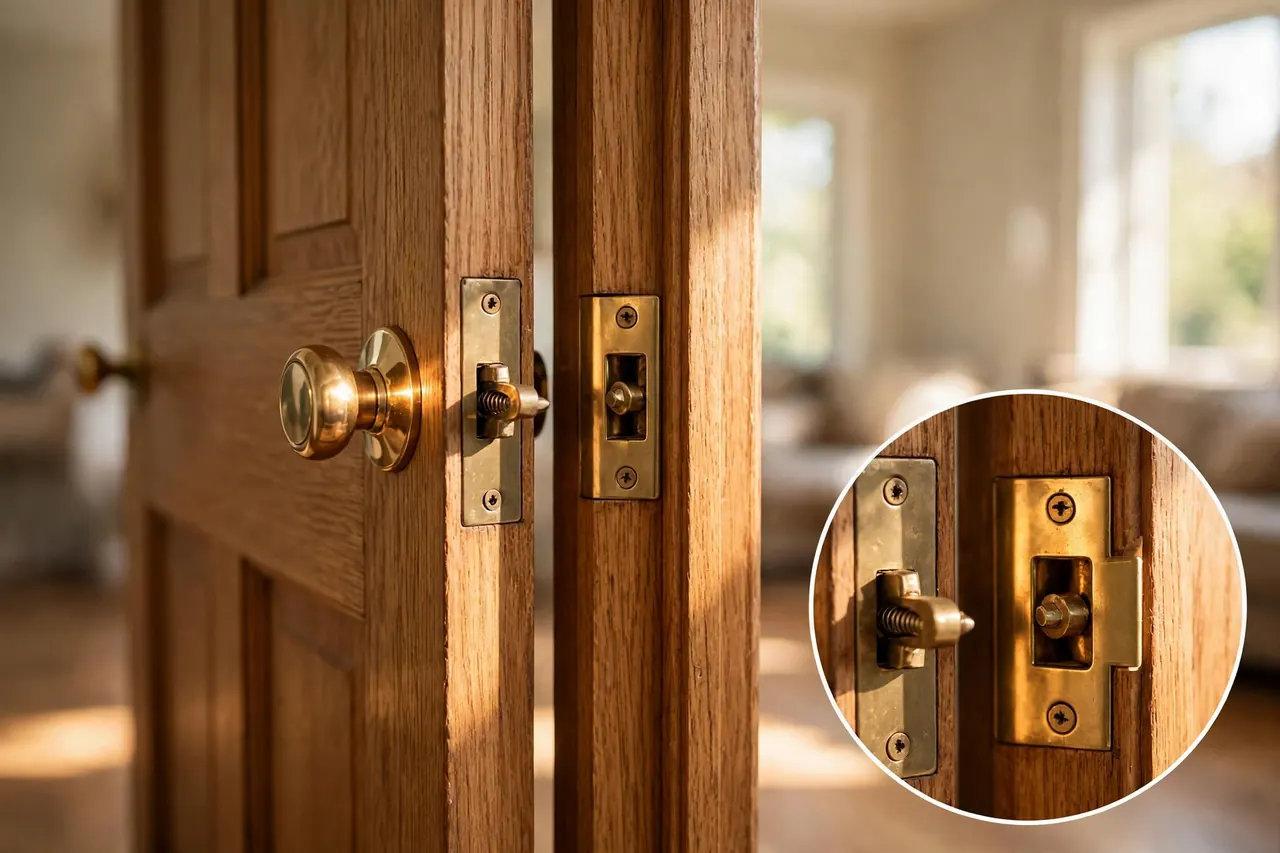
Open a door and look at its edge. Two parts live there, and both are easy to name once you see them.
The faceplate is the flat metal plate sitting flush on the door edge. The bolt slides through it, and two small screws hold the whole latch or bolt unit in place. Faceplates are about 2-1/4 inches tall and 1 to 1-1/8 inches wide on most home locks, and they come in three corner styles:
- Square corner — sharp 90-degree corners, needs a matching square pocket cut in the edge.
- Radius corner — rounded corners, the most common style on newer doors.
- Drive-in — no plate at all; the round latch body is simply pressed into a round hole.
These styles are not interchangeable without changing the door edge, so “faceplate style” is one of the first things to name when you order a latch.
Behind the faceplate sits the latch or bolt unit itself: a metal case inside the edge hole that holds the bolt, its spring, and the hub the spindle passes through. When a knob lock feels loose or a latch stops springing back, this hidden unit — not the knob — is usually the worn part.
The Parts on the Frame: Strike Plate and Strike Box
Every bolt needs something to land in, and that hardware sits on the door frame, not the door. Forget to check it, and a brand-new bolt still will not line up.
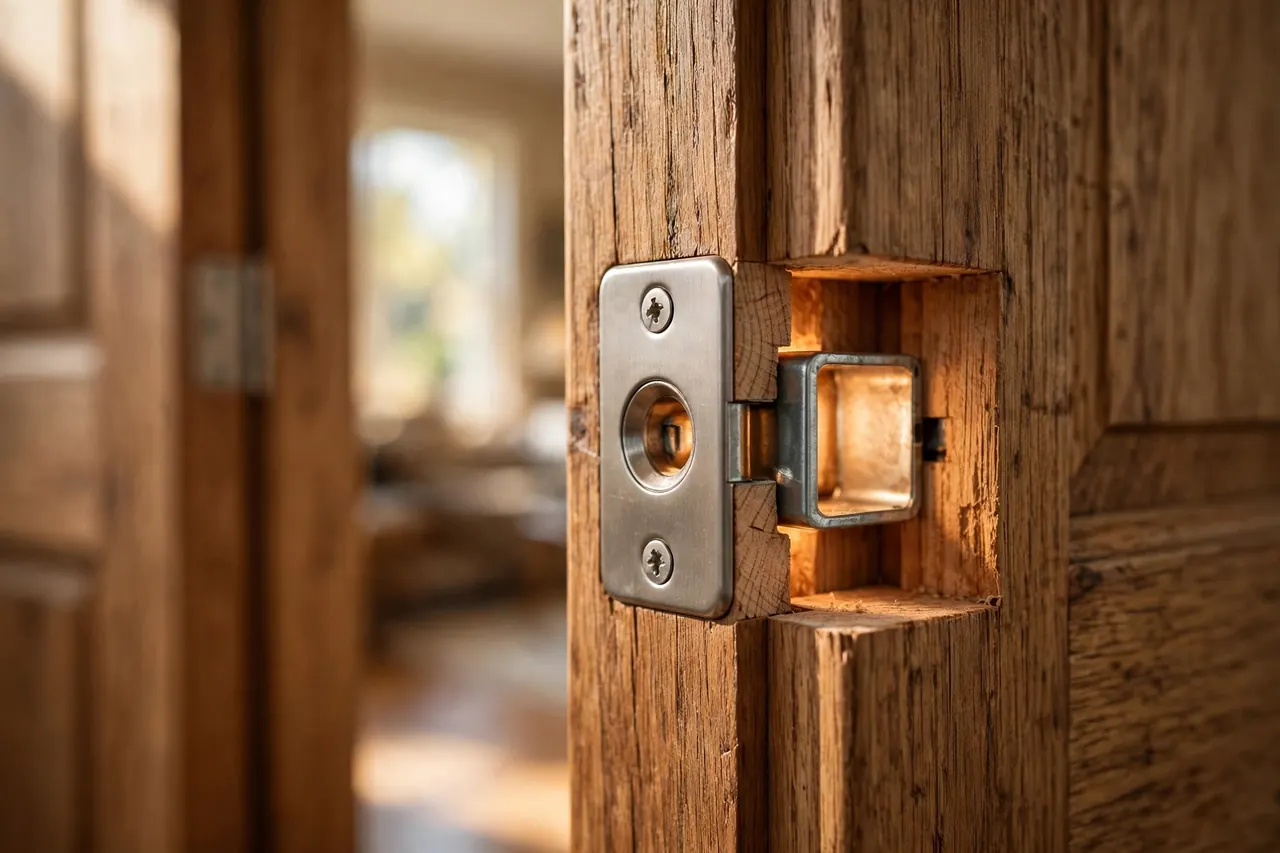
The strike plate is the metal plate screwed to the frame, with an opening the bolt enters. A latch strike is small, while a deadbolt strike is longer and heavier. The curved tab on a latch strike, called the lip, guides the angled latch bolt in as the door swings shut.
Behind many deadbolt strikes sits a strike box: a metal or plastic cup set into the frame that gives the 1-inch bolt room to fully extend and spreads out force. If the bolt opening in your frame is just a shallow hole in bare wood, you are looking at a missing or never-fitted strike box.
One identification detail matters for strength: the strike plate is only as strong as its screws. Short screws that grip only the frame trim are a weak point, while long screws that reach the wall stud behind the frame hold far better — a point This Old House’s guide to locks stresses for strike plates too. If your strike wiggles when you press it, name that when you shop — you want a strike plate, and screws sold with it, not just a plate.
Trim and Turning Parts: Thumb Turn, Spindle, Rose, and Key
The last group is the parts your hand actually touches, plus the trim that covers the holes. They rarely break, but their names come up in every parts listing.
Thumb turn
The thumb turn is the small lever on the inside of a deadbolt. It connects through the door to the same tailpiece slot the cylinder uses, so turning it throws or retracts the dead bolt without a key. A thumb turn that spins freely without moving the bolt points to a broken or misaligned tailpiece.
Spindle
The spindle is the long square metal rod that passes through the latch unit and joins the knobs or levers on both sides of the door. Turn either handle and the spindle rotates the latch hub, pulling the latch bolt in. Spindles wear at the corners over the years, and a rounded spindle is a classic cause of a knob that turns but barely catches. Note that a deadbolt has no spindle — the tailpiece does that job instead.
Rose and escutcheon
The rose is the round or square trim plate around a knob or lever base. An escutcheon is the taller plate that surrounds a cylinder, common on handlesets and older locks. Both are mostly trim: they cover the hole in the door and hide the mounting screws. They are sold by finish and shape, not by function, so match them by eye and measurement rather than by lock model.
The key
The key is a part of the system too. Its blade carries the cuts that match the pins, and the head shape and groove pattern define the keyway it fits. If you ever need copies, the keyway code stamped on the key or cylinder face (for example, the brand’s blank name) is what the copy machine needs.
The 3 Measurements That Decide Whether a Part Fits
Two locks can look identical in a photo and still not fit the same door. Three measurements decide compatibility for almost every latch, bolt, and cylinder you will ever buy. Measure all three before you order anything.
1. Backset: 2-3/8 or 2-3/4 inches
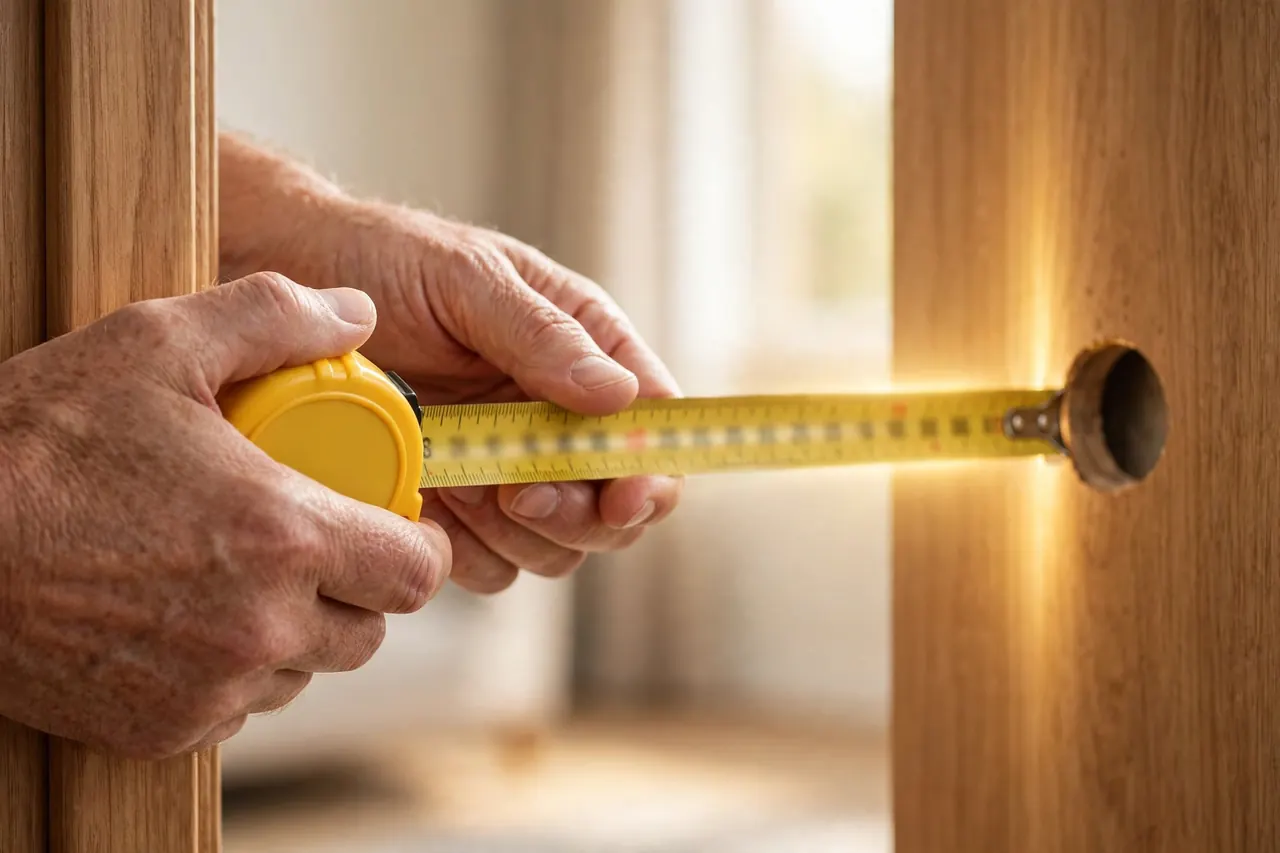
The backset is the distance from the edge of the door to the center of the big hole in the door face. Schlage’s support guide defines it exactly that way: measure from the center of the cross bore to the edge of the door. US home doors use two standard backsets:
- 2-3/8 inches (60 mm) — the most common on interior and newer exterior doors.
- 2-3/4 inches (70 mm) — common on older and heavier exterior doors.
Many replacement latches are adjustable and can be set to either size, but the bolt unit you buy must still cover your backset. To measure, put your tape at the door edge and read to the center of the face hole, or measure an old latch from its faceplate to the center of its spindle hole.
2. Bore holes: 2-1/8 inches across the face, 1 inch through the edge
The big hole through the door face is the cross bore. On modern doors it is 2-1/8 inches wide, and lock bodies are built to fill it. Some older doors were drilled at 1-1/2 inches instead; a modern lock dropped into a 1-1/2 inch bore will not sit right, and that smaller hole must be enlarged by someone with the right jig, or matched with a lock made for it.
The smaller hole through the door edge, where the latch or bolt unit slides in, is the edge bore. Standard edge bores are 1 inch across, matching the round body of most latch and bolt units.
3. Door thickness: 1-3/8 to 1-3/4 inches
Standard home doors are 1-3/8 inches thick (most interior doors) or 1-3/4 inches thick (most exterior doors). Standard locks, including Schlage’s deadbolts, are built to fit that 1-3/8 to 1-3/4 inch range out of the box.
Thickness matters because the tailpiece and the screws that join the two sides of the lock must span the door exactly. A thicker custom door needs a thick-door kit with longer screws and a longer tailpiece — Schlage’s kits extend fit up to 2-1/2 inches on some models. Measure thickness at the lock edge, where there is no weatherstripping in the way.
One bonus measurement: if your door carries both a knob lock and a deadbolt, their holes should sit at least 5-1/2 inches apart, center to center, so the two locks do not crowd each other. That spacing comes straight from manufacturer door-prep templates.
Mortise Locks: The All-in-One Case
One lock family breaks the pattern above. A mortise lock packs the latch bolt, the dead bolt, and the mechanism into a single large metal case that slides into a deep pocket cut into the door edge.
On a mortise lock, you will still see a cylinder, a thumb turn or key on the inside, knobs or levers on a spindle, and escutcheon plates on the face. What changes is the shopping: mortise parts are sold for the case, by brand and case size, and pieces rarely swap between brands. If your door has one big case instead of two round bores, take the case measurements and the brand name from the faceplate before ordering anything.
Mortise locks are common in older homes and in many city apartments. Naming the lock type correctly — mortise versus the standard bored setup described above — saves you from ordering parts that could never fit.
Before You Buy a Replacement Part
Run through this short checklist with your old part in hand. It turns “door lock parts” from a vague search into an exact order:
- Name the part using the terms above: cylinder, latch bolt, dead bolt, faceplate, strike plate, spindle, thumb turn.
- Say which lock it belongs to: the knob or lever lock, the deadbolt, or a mortise case.
- Record the backset: 2-3/8 or 2-3/4 inches.
- Record the cross bore: 2-1/8 inches, or 1-1/2 inches on some older doors.
- Record the door thickness: 1-3/8 or 1-3/4 inches, or thicker with a kit.
- Note the faceplate style: square corner, radius corner, or drive-in.
- For a cylinder, note the brand and keyway so the new one takes the same key.
- Take the old part and your measurements to the store, or photograph both sides of it before ordering online.
One boundary worth knowing: parts swap freely inside the standard bored-lock system only when the measurements match. A cylinder, latch, or bolt from a mortise case, or from a different prep size, is a different part even when the name is the same.
Frequently Asked Questions
What is a backset?
The backset is the distance from the edge of the door to the center of the hole in the door face where the lock sits. US home doors use two standard backsets: 2-3/8 inches and 2-3/4 inches. Measure before you buy, because a latch or bolt unit must be set to your door’s backset to line up with the strike plate.
Are deadbolts universal?
Mostly, but not blindly. Modern deadbolts are built for standard door prep: a 2-1/8 inch cross bore, a 2-3/8 or 2-3/4 inch backset, and doors 1-3/8 to 1-3/4 inches thick, and many have adjustable latches that cover both backsets. A deadbolt will not fit an older 1-1/2 inch bore or an extra-thick door without extra parts, so measure first.
What size hole does a deadbolt need?
A standard deadbolt needs a 2-1/8 inch hole through the door face and a 1 inch hole through the door edge for the bolt unit. Those are the sizes in manufacturer door-prep specs from brands such as Schlage. Some older doors have a smaller 1-1/2 inch face hole, which must be enlarged or matched with hardware made for it.
What should I do if my key gets stuck in the lock?
Do not force it, because a snapped key is a much bigger problem. Wiggle the key gently while pulling straight out, and make sure the plug is turned back to the upright position, since a key only comes out when the plug is at its home position. If it will not budge, or the key has already broken off inside, call a locksmith rather than digging at the pins.
How do I choose the right door lock for my home?
Start with fit, not features: match the backset, bore size, and door thickness in this guide, and almost any standard lock will mount correctly. Then choose by function — a deadbolt with a 1-inch throw for exterior doors, a knob or lever lock for latching, and a deadlocking latch bolt where you want basic card resistance. Finish and style come last, after the parts fit.
The Short Version
Every door lock is the same small team of parts: a cylinder that reads the key, a tailpiece that carries the turn, a latch bolt or dead bolt that meets the frame, a faceplate and strike plate that guide and receive it, and a spindle or thumb turn that lets your hand do the work. Name the part, take the three measurements — backset, bore, and door thickness — and replacement shopping becomes simple. Keep the old part until the new one is fitted and working, so you always have a reference if a size surprises you.
Note: this guide covers standard US residential locks. If your lock is part of a fire-rated door, a commercial system, or hardware damaged in a break-in attempt, have a licensed locksmith supply and fit the parts — a wrong or poorly fitted part can leave a door that looks locked but is not secure.