Meet the “Ice Cream Fruit”
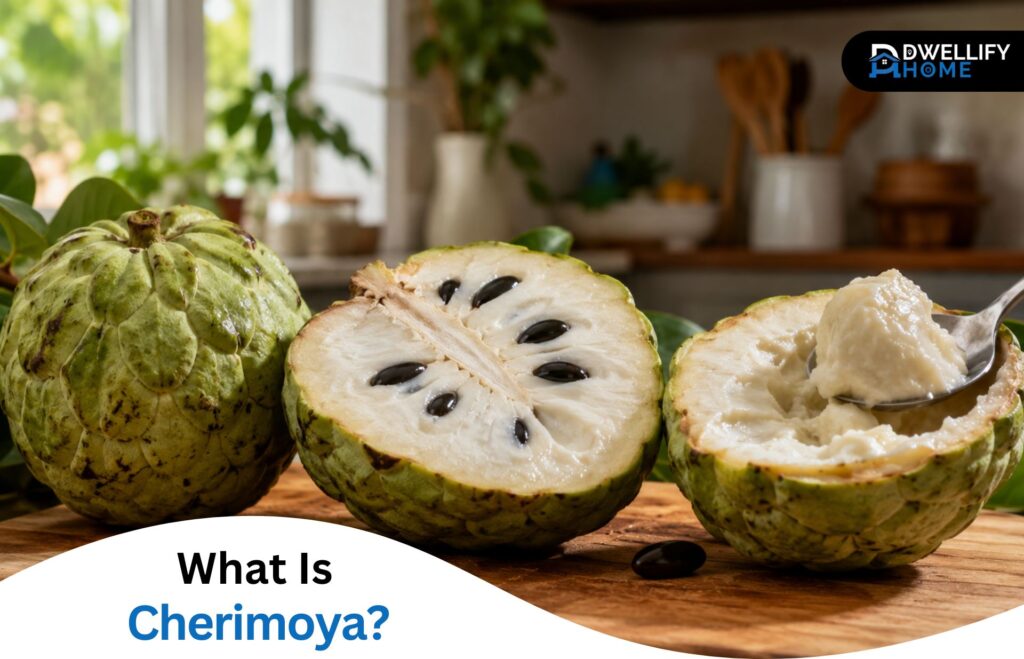
A cherimoya looks like something a dragon might have laid in a nest. It’s heart-shaped, sometimes a little lumpy, with green skin patterned in soft overlapping scales like a pinecone that decided to relax. Cut one open at the right moment and you get something else entirely: pearly white flesh with the texture of thick custard, sweet and perfumed, easy to eat with nothing but a spoon. That spoonable quality is why people have called it the “ice cream fruit” for well over a century. Mark Twain tried it in the 1860s and called the chirimoya “deliciousness itself,” which is about as good a review as a fruit can get.
If you’ve only ever seen one sitting quietly in a specialty produce bin, this guide covers everything worth knowing: how to say it (cheh-ree-MOY-uh), what it tastes like, how to pick and ripen it, how to eat it without hitting the parts you shouldn’t, what’s in it nutritionally, where to buy it, and whether you could grow your own.
Snippet-Ready Definition
Cherimoya (Annona cherimola) is a heart-shaped subtropical fruit with creamy, custard-like white flesh and a sweet pineapple-banana-strawberry flavor. People eat it chilled and scooped with a spoon as a naturally sweet, nutrient-dense fruit that needs no cooking or preparation beyond removing the seeds and skin.
Mission Statement
Dwellify Home helps homeowners, renters, and property enthusiasts make practical, informed choices — from the food on the counter to the trees in the yard. This guide reflects that goal, giving you clear, trustworthy guidance on choosing, enjoying, and growing cherimoya with confidence.
What Is Cherimoya?
Cherimoya (Annona cherimola) is a subtropical fruit that grows on a small evergreen tree in the Annonaceae family. The fruit is heart-shaped with scaly green skin and soft, creamy white flesh studded with hard black seeds. It’s prized for a sweet, custard-like interior and is eaten fresh, usually chilled and scooped straight from the rind.
The tree comes from the high valleys of the South American Andes, and for a long time that was the whole origin story. More recent genetic work has complicated it a little, with some evidence pointing toward the highlands of Honduras and Guatemala as the center of the fruit’s diversity. Both views are worth knowing, and the honest answer is that its earliest history is still being sorted out. The name itself traces back to the Quechua word chirimuya, often translated as “cold seeds,” a nod to the cool mountain climate where the tree thrives.
Quick comparison: cherimoya vs. its close relatives
| Fruit | Skin | Flavor & texture |
| Cherimoya | Smooth, scaly green | Creamy, mild, pineapple-banana-strawberry |
| Soursop | Spiny green | Tangier, fibrous, citrus-pineapple |
| Sugar apple | Bumpy, segmented | Very sweet, grainy, custard-like |
| Atemoya | Lightly bumpy green | Sweet-tart, smooth |
Why people enjoy cherimoya
- Creamy, dessert-like sweetness you can eat with just a spoon
- Nutrient-dense: fiber, potassium, vitamin C, and B6
- No cooking needed — chill, halve, and scoop
- Freezes into a natural sorbet when ripe
What Does Cherimoya Taste Like?
Cherimoya tastes like a blend of tropical fruits rolled into one. The flavor most people land on is pineapple and banana, with bright notes of strawberry, and depending on the fruit you might also catch papaya, pear, or a soft vanilla sweetness. The texture is the real surprise: smooth, melting, and custard-like, with very little acidity and only a faint fibrousness near the seeds.
That low acidity is part of what makes it so easy to like. There’s no sharp tang to push through, just sweetness and aroma. A good ripe one eats almost like dessert that happens to be a fruit, which is exactly why a chilled cherimoya and a spoon is the way most longtime fans prefer it. The flavor does fade if the fruit goes past its peak, so catching it at the right moment matters more than with most fruit.
Cherimoya vs. Custard Apple, Soursop, and Sugar Apple
This is where a lot of confusion creeps in, because these names get swapped around constantly. “Custard apple” technically refers to a different fruit, Annona reticulata, but in everyday American and British usage people often call cherimoya a custard apple too. If you’re following a recipe from another country, that overlap is worth keeping in mind so you don’t buy the wrong thing.
They’re all cousins in the same family, and they really do differ in skin, size, and taste. Here’s how the most common ones compare.
| Fruit | Skin | Size | Flavor & texture |
| Cherimoya (A. cherimola) | Smooth, scaly green | Medium, heart-shaped | Creamy, mild, pineapple-banana-strawberry |
| Soursop (A. muricata) | Spiny green | Large, oblong | Tangier, fibrous, citrus-pineapple |
| Sugar apple / sweetsop (A. squamosa) | Bumpy, segmented | Small, round | Very sweet, grainy, custard-like |
| Atemoya (cherimola × squamosa) | Lightly bumpy green | Medium | Sweet-tart, smoother than sugar apple |
If someone hands you a spiny one, that’s a soursop, and it’ll taste sharper. The smooth-scaled, heart-shaped one with the mellow flavor is your cherimoya.
How to Tell When a Cherimoya Is Ripe
A cherimoya is ripe when it gives to gentle pressure, the way a ripe avocado or a peach does. The skin shifts from bright green toward a paler green with brown undertones, and the fruit feels soft but not hollow or mushy. Buy them firm and let them ripen at home. A rock-hard cherimoya at the store is normal and nothing to worry about.
The squeeze test is the thing to learn, and it changes day by day. On day one, a freshly bought fruit usually feels firm with no give at all. By around day three it starts to yield slightly at the stem end. By day five it presses in like a ripe avocado across the whole fruit, and that’s your eating window. Push much past day seven and you’ll often find it has gone soft-soft, with darkening skin and a flavor that’s started to ferment.
The mistake I see most often is people waiting for the skin to turn fully brown, assuming brown means ready. It doesn’t. A little browning is fine, but a cherimoya that’s gone dark and bruised all over is usually overripe inside. You want soft-firm, not soft-soft, and a skin that’s matte green easing into tan rather than blackened.
How to Ripen and Store Cherimoya
Ripen a cherimoya at room temperature on the counter, never in the fridge while it’s still firm. It needs about three to seven days depending on how green it started. The single most important rule is this: do not refrigerate an unripe cherimoya. Cold below roughly 55°F damages the fruit before it can ripen, and you’ll end up with one that turns dark and never softens properly.
If you want to speed things along, put it in a paper bag, and toss in a banana or an apple if you have one. Cherimoya is a climacteric fruit, meaning it keeps ripening after picking and responds to the natural ethylene gas those fruits give off. The bag traps that gas and nudges the cherimoya along a day or two faster.
Once it’s ripe, the clock flips. Now the fridge is your friend, and a ripe cherimoya will hold for about three days chilled. If you can’t eat it in time, scoop out the seeded flesh, freeze it, and eat it later like a natural sorbet. Frozen ripe cherimoya is genuinely one of the best ways to enjoy it, and it rescues fruit that would otherwise go too far.
How to Eat a Cherimoya
Eating a ripe cherimoya is simple once you know the rhythm. Here’s the method that works every time:
- Chill the ripe fruit in the fridge for an hour or two. Cold flesh tastes better and firmer.
- Cut it in half lengthwise with a knife.
- Scoop the soft white flesh out of each half with a spoon, leaving the skin behind.
- As you eat, work around the hard black seeds and set them aside. Don’t bite into them.
- Discard the skin and the seeds. Neither one is for eating.
That spoon-straight-from-the-rind approach is how most people enjoy it, and honestly it’s hard to beat. But the flesh is versatile once you’ve separated it from the seeds. It blends beautifully into smoothies, layers into a yogurt parfait, drops into a fruit salad, or churns into sorbet and ice cream. The flavor pairs naturally with citrus, vanilla, dark chocolate, a little cardamom, and even a splash of rum if you’re making something for the grown-ups. Just remember to pick out every seed before anything goes in a blender.
Cherimoya Nutrition and Health Benefits
Cherimoya is nutrient-dense for a sweet fruit. Raw, it has roughly 75 calories per 100 grams, so a typical medium fruit (around 235 grams of edible flesh) runs near 175 calories. That same fruit delivers a meaningful dose of fiber, a good amount of potassium, plus vitamin C, vitamin B6, magnesium, and a range of antioxidants, all wrapped in that custard-sweet flesh.
What does that translate to? The fiber supports healthy digestion, which is part of why the fruit feels satisfying. Potassium and magnesium are the minerals tied to healthy blood pressure and heart function. Vitamin C and the antioxidant compounds play a role in immune support, and cherimoya also contains lutein, a carotenoid associated with eye health. None of this makes it a cure for anything, and it’s worth keeping expectations realistic, but as a whole food it earns its place. It’s naturally fairly high in sugar, so it eats more like fruit-as-dessert than an everyday snack for some people, which is fine in normal portions.
Is Cherimoya Safe to Eat? Seeds, Skin, and Moderation
The flesh of a ripe cherimoya is safe to eat. The seeds and skin are not. The hard black seeds contain compounds called annonaceous acetogenins, and they’re toxic if the seeds are crushed or chewed. Swallowing a whole seed by accident isn’t the same emergency, because the hard coat passes through intact, but the rule is simple: remove the seeds, never blend them, and don’t chew them. The skin is inedible and bitter, so discard it too.
There’s a bigger-picture caution worth understanding without overstating it. Those same acetogenin compounds, found across the Annona family, have been studied in connection with a form of atypical Parkinsonism, but that research centers on heavy consumption of soursop and on seeds and leaves, not on cherimoya flesh. There’s no direct human evidence tying normal cherimoya pulp eating to harm. The sensible takeaway is moderation rather than fear: enjoy the flesh, skip the seeds entirely, and don’t make seed-containing teas or extracts.
A quick note for pet owners, since people ask: don’t share the seeds or skin with dogs, as the same toxic compounds apply to them. A small bit of the plain flesh is generally low-risk, but it isn’t something a dog needs, and the seeds are the real hazard to keep well out of reach.
Where to Buy Cherimoya and When It’s in Season
In the United States, fresh cherimoya season runs roughly November through May for California-grown fruit, with the peak in winter and early spring. Chilean imports fill in part of the gap from around May to November, so you can often find it outside the domestic window if you look. The best places to check are specialty grocers like Whole Foods or Bristol Farms, Latin American and Asian markets, Southern California farmers markets, and online growers and shippers such as Melissa’s Produce or Miami Fruit.
If you’re searching for cherimoya near you and coming up empty, a Latin or Asian market is usually a better bet than a standard supermarket, since the fruit has deep roots in those cuisines. Globally, Spain is actually the largest producer, with a protected-origin growing region around Granada and Málaga, and Chile is the other major source. In the US, California is essentially the only commercial-scale producer.
That limited supply is the main reason cherimoya is expensive. The trees don’t pollinate well on their own and are often pollinated by hand, which is slow, labor-intensive work. The ripe fruit also bruises easily and has a short shelf life, so shipping it is tricky and some loss is built into the price. When you understand what goes into getting one to a store in good shape, the cost makes a lot more sense.
Can You Grow a Cherimoya Tree at Home?
You can, if your climate cooperates. Cherimoya is reliably hardy in USDA zones 10 and 11, and only workable in zone 9b if you have a protected, frost-free microclimate. It’s a subtropical tree, not a lowland tropical one, which is an important distinction. It loves the cool nights and mild days of coastal-inland Southern California, and it struggles in humid heat, so Florida is generally a poor fit despite being warm.
Give it full sun and well-drained soil, ideally on the slightly acidic to neutral side, around pH 6.5 to 7.6. A mature tree reaches roughly 15 to 30 feet, though it responds well to pruning if you want to keep it manageable. From a grafted nursery tree you can expect fruit in about two to four years; from seed it takes longer and the results are less predictable.
For renters or anyone short on yard space, container growing is possible in a warm zone with a large pot, full sun, and regular feeding, but be realistic. This isn’t a houseplant. It needs real outdoor light and warmth, so a sunny balcony in zone 10b might work while a dim apartment corner won’t. If you’re on the edge of its climate range, a pot you can move to shelter during a cold snap is the safer way to go.
Why Cherimoya Trees Need Hand-Pollination
Cherimoya flowers don’t pollinate themselves easily, and that’s the number one reason home trees fail to set fruit. The flowers are what’s called protogynous, meaning each one opens first in a female phase and only later switches to a male phase, so the timing rarely lines up for a flower to pollinate itself. In the fruit’s native range, specific small beetles handle the transfer. Outside that range, those pollinators simply aren’t around.
The fix is to do the bees’ job yourself, and it’s not hard once you get the rhythm. In the evening, collect pollen from flowers in their male phase, when the pollen is loose and powdery, into a small container with a soft artist’s brush. The next morning, brush that pollen onto the stigmas of flowers in their receptive female phase. Do it across several evenings and mornings during bloom and your fruit set will jump dramatically. Skip it, and even a healthy tree may give you almost nothing. This single chore is the difference between a tree that’s decorative and one that actually feeds you.
Frequently Asked Questions About Cherimoya
How do you pronounce cherimoya? It’s said cheh-ree-MOY-uh, with the emphasis on the “moy.” You’ll also see it spelled chirimoya, especially in Spanish-speaking countries, and that version is pronounced the same way.
Can you eat the skin? No. The green scaly skin is inedible, bitter, and tough. Cut the fruit open and scoop the soft flesh from inside with a spoon, leaving the skin behind to discard.
Are the seeds poisonous? The hard black seeds are toxic if crushed or chewed, so always remove them and never blend them into smoothies. Accidentally swallowing a whole seed isn’t a crisis since the coat stays intact, but don’t take the risk on purpose.
Is cherimoya the same as custard apple? Not exactly. “Custard apple” technically names a related fruit, Annona reticulata, but the term is often used loosely for cherimoya in the US and UK. They’re close cousins with a similar creamy texture.
Can you freeze cherimoya? Yes, and it’s excellent frozen. Scoop out the seeded flesh from a ripe fruit, freeze it, and eat it like sorbet. Freezing also saves ripe fruit you can’t finish in time.
Why is cherimoya so expensive? It’s labor-intensive to grow, often hand-pollinated, bruises easily, and has a short shelf life. Limited commercial production, especially in the US, keeps supply low and prices higher than common fruit.
What USDA zone does cherimoya grow in? It’s reliably hardy in zones 10 and 11, and only in zone 9b with a protected, frost-free microclimate. Young growth is damaged by light frost, so it needs a warm, sheltered spot.
How long until a cherimoya tree fruits? A grafted tree usually starts bearing in two to four years. Trees grown from seed take longer and won’t reliably match the parent fruit’s quality.
Can you grow it in a pot? Yes, in a warm climate with a large container, full sun, and regular feeding. It won’t thrive as an indoor plant, so a sunny patio or balcony in a mild zone is the realistic setup.
Can dogs eat cherimoya? Keep the seeds and skin away from dogs, since they contain the same toxic compounds. A small amount of plain flesh is generally low-risk, but it isn’t necessary, and the seeds are the real danger.
Is it safe during pregnancy? The ripe flesh is a normal fruit and is generally fine in moderation, but as with any food question during pregnancy, it’s best to confirm with your own doctor, and always avoid the seeds.
Is Cherimoya Worth Trying?
If you’ve never had a cherimoya, it’s well worth tracking one down in season. Few fruits give you that much creamy sweetness with so little effort: chill it, halve it, scoop it with a spoon, and skip the seeds and skin. It’s nutrient-dense, genuinely satisfying, and unlike anything else in the produce aisle.
The only learning curve is timing the ripeness and knowing which parts to leave behind, and now you have both. Pick one up firm, give it a few days on the counter, and wait for that gentle avocado-like give. That first cold spoonful tends to win people over on the spot, and it’s easy to see why this fruit has been quietly adored for centuries.
Disclaimer: This article is for general informational purposes only. Individual results, tastes, growing conditions, and dietary needs vary, and nothing here replaces advice from a qualified professional. For personal health or medical questions, consult your doctor.