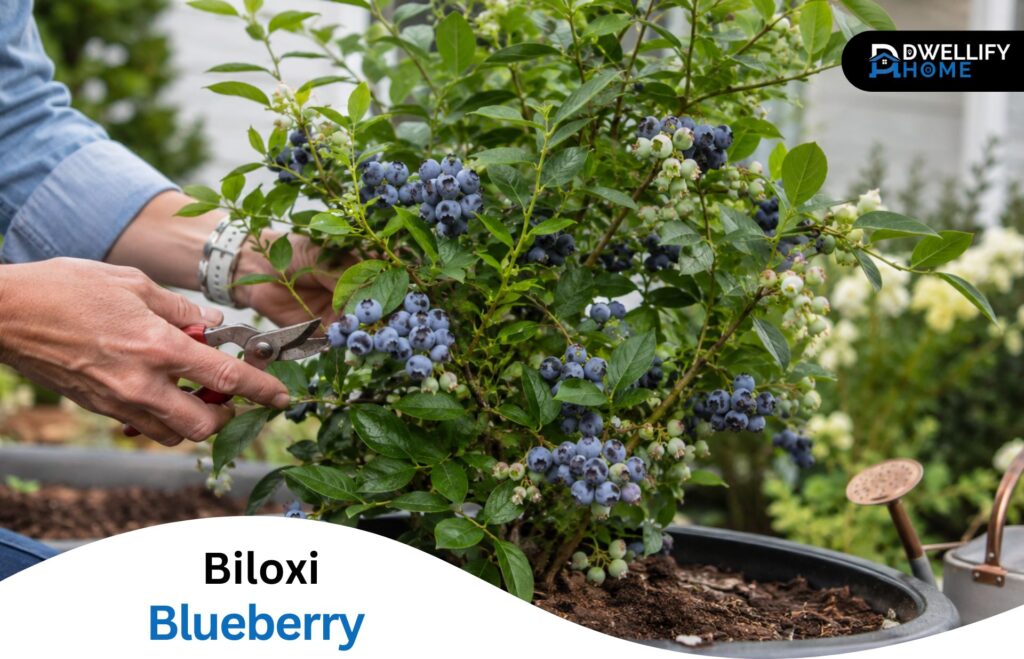
The Biloxi blueberry is a low-chill southern highbush variety that USDA breeders released in 1998 so people in hot, mild-winter regions could finally grow good blueberries at home. It needs very little winter cold to set fruit, shrugs off Gulf Coast heat and humidity, and ripens early, usually well before the northern bushes most folks picture. It’s also a good-looking shrub, with soft blue-green leaves in spring and warm color in fall. Most homeowners plant a Biloxi blueberry for the fruit and end up keeping it for the way it looks too. Over the next few sections I’ll walk you through choosing a spot, planting, feeding, pruning, and fixing the handful of problems that trip people up.
Snippet-Ready Definition
The Biloxi blueberry is a low-chill southern highbush variety released by USDA breeders in 1998. Warm-climate gardeners choose it because it fruits reliably in mild winters where standard blueberries fail, solving the region’s biggest blueberry-growing problem.
Mission statement
Dwellify Home helps homeowners, renters, and property enthusiasts make practical, informed decisions about their homes and gardens. With this guide, our goal is to give warm-climate gardeners clear, honest, experience-based guidance on growing the Biloxi blueberry successfully, from planting through harvest.
What the Biloxi blueberry actually is
Biloxi is a southern highbush blueberry, a tetraploid hybrid in the Vaccinium corymbosum group, developed at the USDA-ARS Thad Cochran Southern Horticultural Laboratory in Poplarville, Mississippi, and released in 1998. It was bred to fruit reliably in warm climates where the older northern highbush types simply won’t, and it became one of the standard low-chill varieties across the southern United States.
What makes that history matter to you is the intent behind the plant. Biloxi wasn’t bred for cold tolerance or flavor records. It was bred so a grower in a place with short, mild winters could still get a real crop. That single design goal explains almost everything about how it behaves in your yard.
Parentage and breeder lineage
You’ll see Biloxi described online as a simple cross of “Fla 4-B and Sharpblue.” The truth is a little messier. Its background includes Sharpblue and other southern highbush selections, with several wild Vaccinium species woven in through earlier breeding. The formal release was documented by Spiers, Stringer, Draper, and Gupton. If you’ve grown Sharpblue, you’ll recognize some family traits in Biloxi: early ripening, heat tolerance, and a willingness to fruit on very little chill.
Why “southern highbush” matters for warm-climate gardens
Northern highbush blueberries need a long, genuinely cold winter, often 800 to 1,000 hours below 45°F, to break dormancy and flower. Rabbiteye types need less but still want a real chill period. Southern highbush varieties like Biloxi were bred to drop that requirement dramatically. That’s the whole reason the category exists, and it’s why Biloxi works in zones where a northern bush would leaf out poorly, flower erratically, and disappoint you every spring.
Key reasons gardeners choose Biloxi
- Fruits on very low winter chill, suited to USDA zones 8–10
- Tolerates Gulf Coast heat and humidity
- Ripens early, often before northern varieties begin
- Partially self-fertile, with bigger yields when cross-pollinated
- Doubles as a three-season ornamental shrub
How Biloxi compares to other low-chill blueberries
| Variety | Chill needs | Stands out for | Best for |
| Biloxi | Very low | Heat tolerance, early crop, evergreen in mild zones | Warm-climate all-rounder |
| Sharpblue | Very low | Long, near-continuous fruiting | Frost-free zones, extended harvest |
| Misty | Low | Heavy yields, sweet fruit, good Biloxi partner | Pairing for pollination |
| Emerald | Low | Large berries, reliable set | Bigger fruit alongside Biloxi |
| Sunshine Blue | Low | Compact, tolerates higher pH | Containers and small spaces |
How low-chill is Biloxi, really?
Honestly, the published numbers don’t agree, and you should know that going in. Specialty nurseries often list Biloxi at 100 to 150 chill hours, some commercial sources call it near zero for evergreen production, and University of Georgia material has cited figures closer to 200 to 300. A safe working assumption for a home grower is roughly 150 to 250 hours.
The spread comes from how chill is measured and what each source is optimizing for. A commercial grower in frost-free south Florida cares whether the plant will crop while staying evergreen, so they quote a very low figure. A university trial in a region with real winters measures the chill that produces the best, most uniform bloom, which lands higher. Neither is wrong. For planning, treat Biloxi as a genuinely low-chill plant that’s happiest where winters are short and mild, not as a true zero-chill tropical.
Where Biloxi grows best — zones, climate, and cold limits
Biloxi performs best in USDA hardiness zones 8 through 10, which is the range most reputable nurseries and extension sources agree on. A few sellers stretch that to 8b through 11 for frost-free coastal and subtropical areas. You’ll occasionally see a claim that Biloxi is hardy to minus 10°F. I’d treat that with caution, because no extension source I trust backs it up, and a plant bred for mild winters is not where I’d gamble on extreme cold.
Evergreen in the Deep South, deciduous farther north
Climate decides whether your Biloxi blueberry keeps its leaves. In frost-free or nearly frost-free areas, it tends to stay evergreen and may flower in flushes nearly year-round. In the cooler end of its range, where you get a normal winter, it behaves like a deciduous shrub, dropping its leaves and going dormant. Both are normal. A Biloxi that drops its leaves in a zone 8 winter is not sick, it’s just responding to the cold the way it should.
Late-frost risk from Biloxi’s early bloom
Mississippi State Extension specifically warns that early-blooming southern highbush varieties are at risk in years with late spring freezes, and Biloxi blooms early. That’s the real cold-weather concern with this plant, not midwinter hardiness. An open flower or a tiny green fruit can be killed by a single late frost, even when the bush itself is perfectly fine. In borderline areas, that risk shapes where you plant it, which I’ll come back to.
How big a Biloxi bush gets and what it looks like year-round
A mature Biloxi blueberry reaches about 5 to 6 feet tall and nearly as wide, with an upright, slightly spreading habit. You’ll see one nursery listing claiming 8 to 12 feet, but that’s an outlier I wouldn’t plan around. Plan your spacing for a 6-foot shrub and you’ll be right.
It earns its keep visually across the seasons. Spring brings clusters of small white-to-pink urn-shaped flowers and fresh blue-green foliage. Summer is the fruit. In cooler zones where it goes dormant, the leaves can turn a glossy reddish-orange in fall before dropping. That three-season interest is why I tell people Biloxi works just as well in a mixed ornamental bed as in a dedicated berry patch.
Planting a Biloxi blueberry in the ground
Getting Biloxi in the ground correctly is most of the battle, and it comes down to three things: the right spot, truly acidic soil, and sensible spacing. Do these well and the plant mostly takes care of itself.
Choosing the right spot
Give Biloxi full sun, ideally six or more hours a day. It will tolerate light afternoon shade in the hottest climates, and a bit of shade can take the edge off extreme heat, but heavy shade costs you fruit. Good drainage is non-negotiable; blueberries hate wet feet. In humid regions, a spot with decent airflow helps keep leaf diseases down. In a late-frost area, avoid low pockets where cold air settles.
Building the acidic soil it needs
This is where most failures start. Biloxi needs acidic, well-drained soil with a pH between 4.5 and 5.5, which is more acidic than the average yard. Test your soil before you plant, not after. To build the right bed, work in plenty of pine bark fines and peat moss, and add elemental sulfur ahead of time if your pH runs high. Sulfur takes months to move the needle, so the earlier you start, the better.
Spacing, depth, and the best planting season
Space plants about 5 to 6 feet apart so each bush has room and air can move between them. Set the plant at the same depth it grew in the pot, no deeper, and loosen circling roots before backfilling. The best planting window in warm climates is the cool season, fall through late winter, so roots establish before summer heat arrives. Water it in well and mulch right away.
Growing Biloxi blueberry in pots and containers
Biloxi can grow in a pot, and plenty of people do it successfully, but I’ll be straight with you: in-ground plants perform better long term. Biloxi has a shallow, fibrous, spreading root system that’s happiest with room to run. A container works as a deliberate trade-off, not as the easier option, and it asks more of you in watering and pH management.
Pot size, material, and drainage
Go bigger than you think. A 15- to 20-gallon container gives the roots enough room and buffers the soil against drying out and overheating. Fabric pots or other breathable containers help keep roots cool in summer. Whatever you use, make sure it drains freely and never let the pot sit in a saucer of standing water, which suffocates those shallow roots fast.
Container mix and stopping pH drift
Fill with an acidic, free-draining mix heavy in pine bark, not standard garden soil. The hidden problem with containers is pH drift: over months, especially if your tap water is alkaline, the mix creeps upward out of the range Biloxi likes. Test the pot’s pH a couple of times a year and correct it before the plant starts showing stress, rather than waiting for yellow leaves to tell you it’s already too late.
Watering, mulching, and feeding through the year
Consistent care, not heavy care, is what keeps a Biloxi blueberry productive. The plant rewards a steady routine far more than occasional bursts of attention.
A simple watering rhythm and method
Keep the soil consistently moist but never waterlogged. Those shallow roots dry out quickly, so during fruiting and summer heat you may need to water every day or two, especially in pots. Drip irrigation or a soaker hose beats overhead watering, because keeping the leaves dry reduces foliar disease pressure in humid climates. Deep, regular watering is the goal; soggy soil is the thing to avoid.
Which fertilizer and when
Feed Biloxi with a fertilizer formulated for acid-loving plants, the same type sold for azaleas and camellias, and favor ammonium-based nitrogen rather than nitrate forms, which blueberries handle poorly. Apply lightly in early spring as growth begins, and again after harvest if the plant needs it. Less is safer than more here; blueberries are easy to over-fertilize, and a light, regular hand beats one heavy feeding.
Pine bark and pine straw mulch for shallow roots
Mulch is not optional with blueberries. A 2- to 4-inch layer of pine bark or pine straw protects the shallow roots, holds moisture, moderates soil temperature, suppresses weeds, and gently supports acidity as it breaks down. Keep it pulled back an inch or so from the crown, top it up as it decomposes, and you’ve solved several problems at once.
Does Biloxi need a pollinator? The honest answer
Biloxi is partially self-fertile, so a single bush will give you some fruit on its own. But planting a second compatible southern highbush variety within about 50 feet noticeably increases both your yield and your berry size. If you have the space, I always recommend two varieties. One Biloxi alone will fruit; two well-matched bushes will fruit far better.
The best cross-pollination partners for Biloxi
The key is matching low chill and overlapping bloom time, so both plants flower together and bees can move pollen between them. Mississippi State specifically names Misty as a good pollenizer for Biloxi. Other strong low-chill partners include Emerald, Jewel, Sharpblue, and O’Neal. Avoid pairing Biloxi with a high-chill northern variety that blooms on a completely different schedule, because mismatched bloom times defeat the whole purpose.
When Biloxi flowers, ripens, and double-crops
Biloxi blooms early, generally February through April depending on your latitude, and ripens early too, with harvest running from late April into early summer in most of its range. That early timing is a big part of its appeal; you’re picking blueberries while many gardens are just getting started.
In frost-free zones 9 and 10, Biloxi can do something unusual: produce a second, lighter crop in fall, and in the mildest areas it may flower and fruit in cycles nearly year-round. It’s not a guaranteed double harvest everywhere, but in the right climate it’s a real bonus.
Pruning Biloxi — less is more in the first three years
For the first three years, restraint is the rule. In year one, pinch off the flower buds so the plant puts its energy into roots and branches instead of fruit; it’s hard to do, but it pays off. Through years one to three, only thin out weak, dead, or crossing wood. Let the bush build a strong framework before you ask it to carry a heavy load.
From year four onward, prune in the dormant season to renew the plant. Remove a few of the oldest canes at the base each year to make room for vigorous new growth, take out anything dead or twiggy, and open the center slightly for light and air. That steady, light annual touch keeps berry size up and disease pressure down far better than occasional hard cutting.
Troubleshooting the most common Biloxi problems
Most Biloxi trouble traces back to a few predictable causes, and once you know the pattern, the fixes are straightforward.
Yellow leaves and iron chlorosis
Yellowing leaves with green veins almost always means the soil pH has crept above 5.5, locking up iron the plant can’t take up. The real fix is correcting the pH with elemental sulfur, not just spraying iron, which only masks the symptom. Retest, adjust, and be patient; sulfur works slowly. This is the single most common issue I see.
No fruit or undersized berries
When a Biloxi won’t fruit or the berries stay small, look at three things in order: pollination, chill, and pruning. No compatible partner nearby means weaker set and smaller fruit. An unusually warm winter can leave the plant short on chill. And over-pruning, or pruning at the wrong time, can remove the very buds you wanted. Work through those before assuming the plant is faulty.
Late-spring freeze damage on early blooms
Because Biloxi blooms so early, a late frost can kill open flowers and young fruit even though the bush is healthy. In borderline areas, plant it where cold air doesn’t pool, and be ready to cover it with frost cloth on the worst nights. Lost blooms are lost fruit for that flush, so protecting them during a snap is worth the effort.
Container pH drifting upward
Potted Biloxi quietly loses acidity over time, especially with alkaline tap water, and the first sign is usually the same yellowing you’d see in the ground. Stay ahead of it. Test the container a couple of times a year and correct early rather than waiting for stress to show. This is the main reason container plants underperform their in-ground siblings.
Bird protection that actually works
Birds will find ripe blueberries before you do. The only thing that reliably works is physical exclusion: drape proper bird netting over the bush as the fruit starts to color, secured so birds can’t slip underneath. Scare tape and decoys help for a few days at most before the birds learn to ignore them. Net early, net well.
Pests and diseases worth knowing about
I’ll be honest here: there’s no authoritative, Biloxi-specific resistance table I can point you to, so I won’t pretend one exists. What I can tell you is what southern highbush blueberries face in warm, humid regions, so you know what to watch for.
The main concerns are Phytophthora root rot, which thrives in poorly drained soil and is best prevented by good drainage; stem and twig blights; mummy berry, which mummifies developing fruit; anthracnose, which causes fruit rot; and leaf rusts in humid weather. Good airflow, clean pruning, drip irrigation, and prompt removal of affected wood and fallen fruit prevent far more trouble than any spray. Healthy, well-sited plants simply get sick less often.
How Biloxi compares to other low-chill blueberries
Biloxi isn’t your only low-chill option, and the right choice depends on your climate and what you want from the plant. Here’s how it stacks up against the varieties people most often weigh against it.
| Variety | Chill needs | Stands out for | Best for |
| Biloxi | Very low | Heat tolerance, early crop, evergreen in mild zones | Gulf Coast and warm-climate all-rounder |
| Sharpblue | Very low | Long, almost continuous fruiting in warm areas | Frost-free zones, extended harvest |
| Misty | Low | Heavy yields, sweet fruit, common Biloxi partner | Pairing with Biloxi for pollination |
| Emerald | Low | Large berries, vigorous, reliable set | Bigger fruit alongside Biloxi |
| Sunshine Blue | Low | Compact, semi-dwarf, tolerates higher pH | Containers and small spaces |
Biloxi vs. Sharpblue
These two share a family resemblance, which makes sense given the lineage. Both are very low-chill and heat-tolerant. Sharpblue tends to fruit over a longer, more continuous window in warm areas, while Biloxi gives firmer berries with a slightly better shelf life and a tidier harvest. They also make decent partners for each other.
Biloxi vs. Misty, Emerald, and Sunshine Blue
Misty and Emerald are most useful as companions to Biloxi rather than replacements; both pollinate it well, Misty leans sweet and productive, and Emerald brings larger berries. Sunshine Blue is the odd one out in a good way: it’s compact, more forgiving of slightly higher pH, and the one I steer people toward for patio pots when a full-size Biloxi is too much plant.
Which one fits your climate and goals
For a single, dependable bush in a hot, mild-winter climate, Biloxi is hard to beat. For the longest possible harvest in a frost-free zone, add Sharpblue. For the best overall yield, plant Biloxi with Misty or Emerald. For a container on a small patio, Sunshine Blue is the easier fit.
Buying a Biloxi blueberry plant — what to look for
When you’re buying, a few details separate a plant that fruits next year from one that struggles. Size matters: a 2-gallon plant costs more but fruits sooner, while a 1-gallon is cheaper and asks for more patience. Beyond that, prioritize healthy roots and clean, vigorous growth.
Quick checklist before you buy:
- Firm, well-branched top growth with no obvious dieback
- Healthy, white-tipped roots that aren’t tightly circling the pot
- Certified disease-free stock from a reputable nursery
- Shipping timed for your planting season, ideally cool weather
Biloxi has a sweet, mild flavor with a firm texture and a small, dry stem scar, which is part of why it ships and stores well. One useful note: Biloxi was released without a patent, so it’s legal to propagate from cuttings, which is handy once you have a plant you like and want more.
Biloxi blueberry FAQs
How many chill hours does Biloxi blueberry need?
Estimates vary by source. Specialty nurseries often list around 100 to 150 chill hours, while some university material cites closer to 200 to 300. A practical working range for a home grower is roughly 150 to 250 hours. Either way, Biloxi is a genuinely low-chill variety suited to short, mild winters.
How tall does a Biloxi blueberry get?
A mature Biloxi blueberry grows about 5 to 6 feet tall and nearly as wide, with an upright, slightly spreading shape. Space plants around 5 to 6 feet apart to give each room. You may see an occasional claim of 8 to 12 feet, but that’s an outlier and not what to plan around.
Is Biloxi blueberry self-pollinating?
Biloxi is partially self-fertile, so one bush will set some fruit alone. However, planting a second compatible southern highbush variety within about 50 feet meaningfully increases both yield and berry size. For the best harvest, grow Biloxi alongside a low-chill partner that blooms at the same time.
Can Biloxi blueberry grow in a pot?
Yes. Biloxi grows in containers, though in-ground plants perform better long term because of its shallow, spreading roots. Use a large pot of 15 to 20 gallons, an acidic and free-draining mix, and watch the pH closely, since container soil tends to drift out of range over time.
What does Biloxi blueberry taste like?
Biloxi berries are sweet and mild with a firm texture and a small, dry stem scar. They’re medium-sized, light powder-blue, and hold up well after picking. The flavor is pleasant and clean rather than intensely tart, which makes them good for fresh eating straight off the bush.
How long until a Biloxi blueberry produces fruit?
Expect a real crop by the second or third year after planting. In the first year, it’s best to remove the flowers so the plant builds roots and structure instead of fruit. A 2-gallon plant will generally reach a worthwhile harvest sooner than a 1-gallon starter.
Is the Biloxi blueberry evergreen?
It depends on climate. In frost-free or nearly frost-free areas, Biloxi tends to stay evergreen and may flower in flushes much of the year. In the cooler part of its range, where winters bring real cold, it behaves as a deciduous shrub and drops its leaves. Both are normal.
What zone is Biloxi blueberry hardy in?
Biloxi is best suited to USDA hardiness zones 8 through 10, the range most reliable sources agree on, with some sellers extending it to 8b through 11 for frost-free areas. Be skeptical of claims that it survives extreme cold; it was bred for mild winters, not hard freezes.
Final thoughts on growing the Biloxi blueberry
Strip away the spec sheets and it comes down to three things. Give a Biloxi blueberry genuinely acidic soil, keep its shallow roots consistently moist, and plant a compatible partner nearby, and it will reward you with early fruit and a handsome shrub for years. A couple of things still aren’t well documented, including its exact cold limit and any cultivar-specific disease ratings, so stay a little cautious on those points. For warm-climate gardeners who’ve struggled to grow blueberries, though, Biloxi remains one of the most dependable places to start.
Disclaimer: This content is for general informational purposes only. Growing conditions, climate, and individual results vary, so treat these recommendations as guidance rather than guarantees, and adjust to your own site and local conditions.