A contemporary outdoor bench is a backless or low-backed outdoor seat with clean lines, geometric shapes, and weather-proof materials — no scrolls, no ornate arms, just a slim slab or slatted seat on a simple frame. Prices run $695 to $2,203 for premium concrete benches and $855 to $1,149 for marine-grade aluminum, and the standard size is 48 to 72 inches long, seating two to four people. This guide covers the styles, the materials that last, the six numbers that decide comfort, and where a modern bench belongs on the patio.
One number decides whether a contemporary bench feels like design or like a shelf, and it is not the length. It sits in the sizing section below, and most buyers get it wrong by two inches. First, what “contemporary” actually means on a bench, because the word gets stuck on everything from concrete slabs to plastic park seats.
What Is a Contemporary Outdoor Bench?
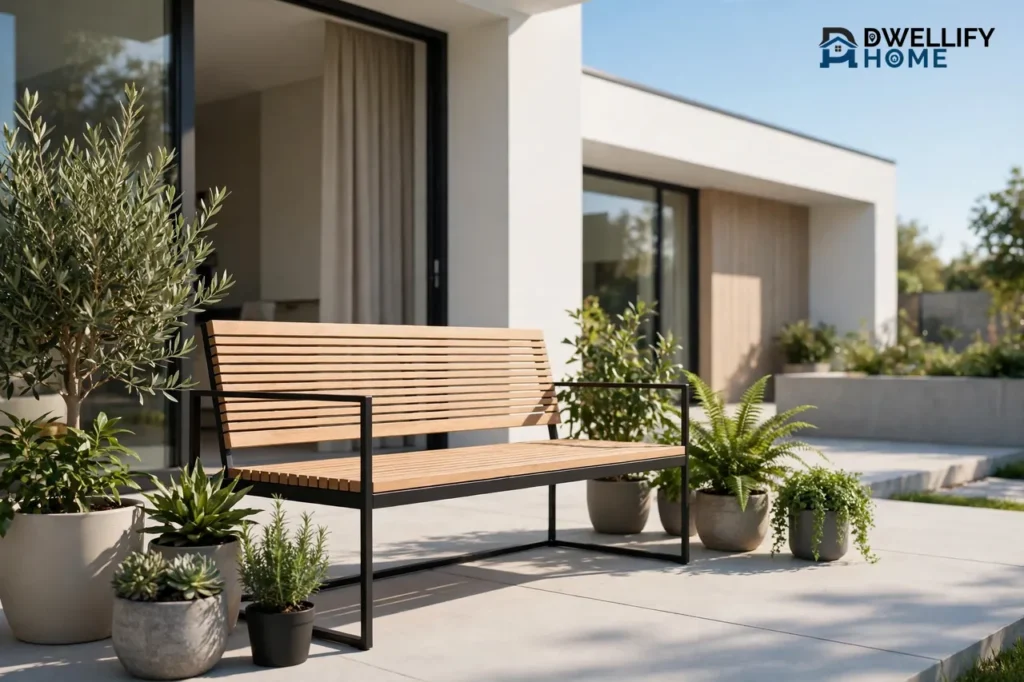
A contemporary outdoor bench is a modern outdoor seat built around minimalist forms, geometric shapes, and materials engineered for weather resistance. Unlike a traditional park bench with ornate details, a contemporary bench uses streamlined profiles — slat construction, monolithic concrete forms, or sculptural metal frames — and lets the material and the line do the talking. The look is calm, architectural, and deliberately plain.
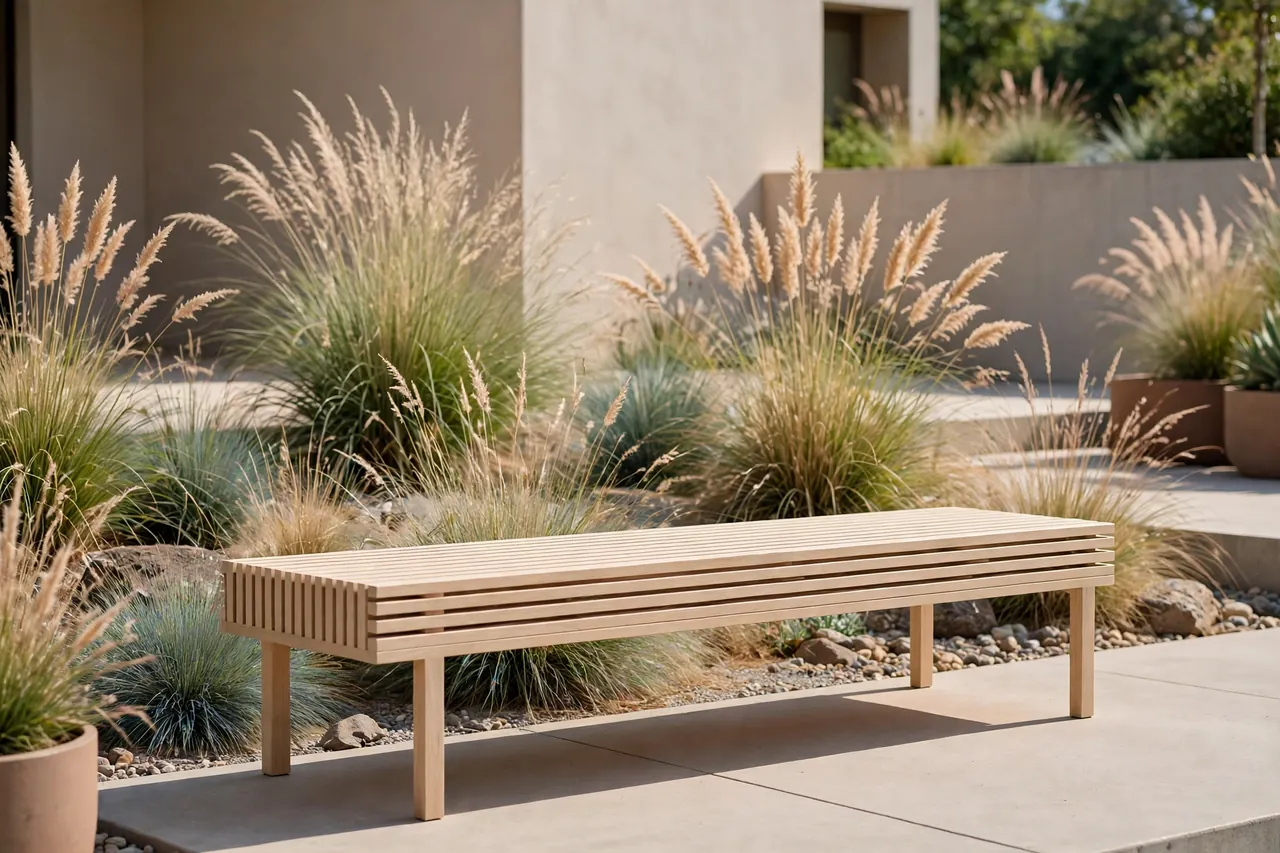
The style splits into four families. Minimalist slat benches use clean horizontal lines in wood or recycled plastic; the Loll Designs Cubby bench comes in 44-, 60-, and 72-inch lengths in twelve colors. Sculptural statement pieces use bold, artistic forms, like the Frank Gehry bench in eight powder-coated finishes, built to anchor a seating vignette. Industrial metal benches pair powder-coated aluminum or steel frames with mesh or perforated seats, like the Blu Dot Hot Mesh bench. Organic material benches use teak, oak, or reclaimed wood with natural grain, like the Fritz Hansen Cutter bench in teak, black oak, or oak slats on a stainless steel base. Read the full style breakdown at Lumens’ modern outdoor benches collection.
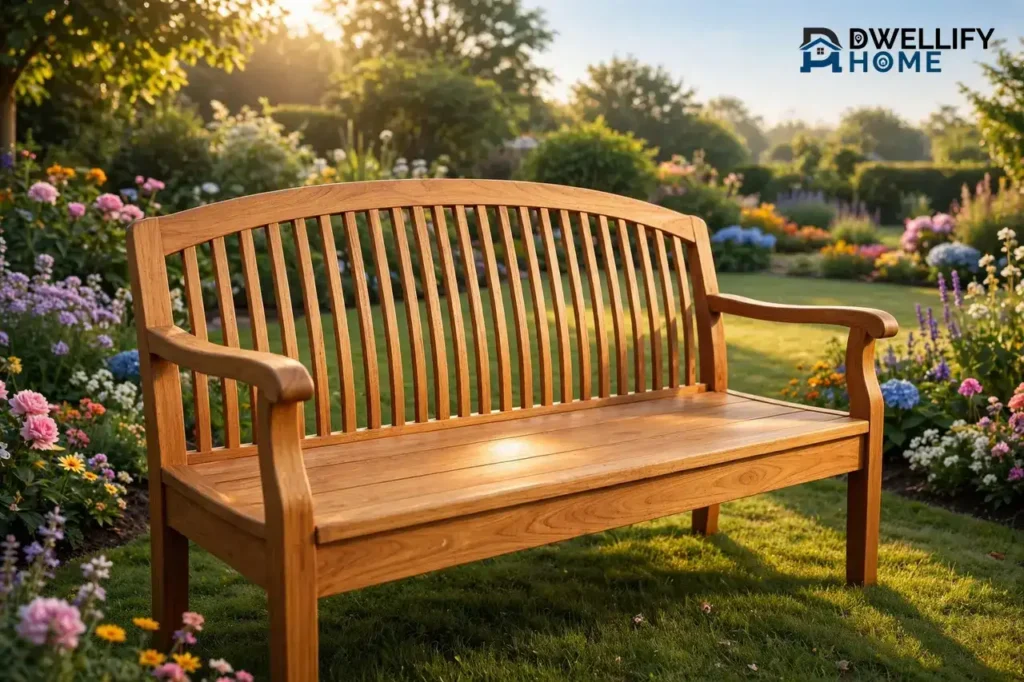
A contemporary bench is not a traditional bench with the arms removed. The proportions are different — lower, longer, wider slats — and the materials are different too: recycled HDPE plastic, powder-coated aluminum, and high-density concrete replace the cast iron and softwood of the old park bench. Our outdoor wooden bench guide covers the classic wood bench when the modern look is too stark for the garden.
Clean lines, honest materials, no ornament. If it has scrolls, it is not contemporary.
Contemporary Outdoor Bench Materials That Last
Premium concrete, marine-grade aluminum, and natural teak offer the best outdoor durability for a contemporary bench. Concrete lasts 25 years or more with periodic sealing, marine aluminum lasts 20 years or more with basic cleaning, and teak lasts decades while weathering to a silver-grey. Recycled HDPE plastic is the low-maintenance fourth option: fade-resistant, splinter-free, and made from post-consumer milk jugs.
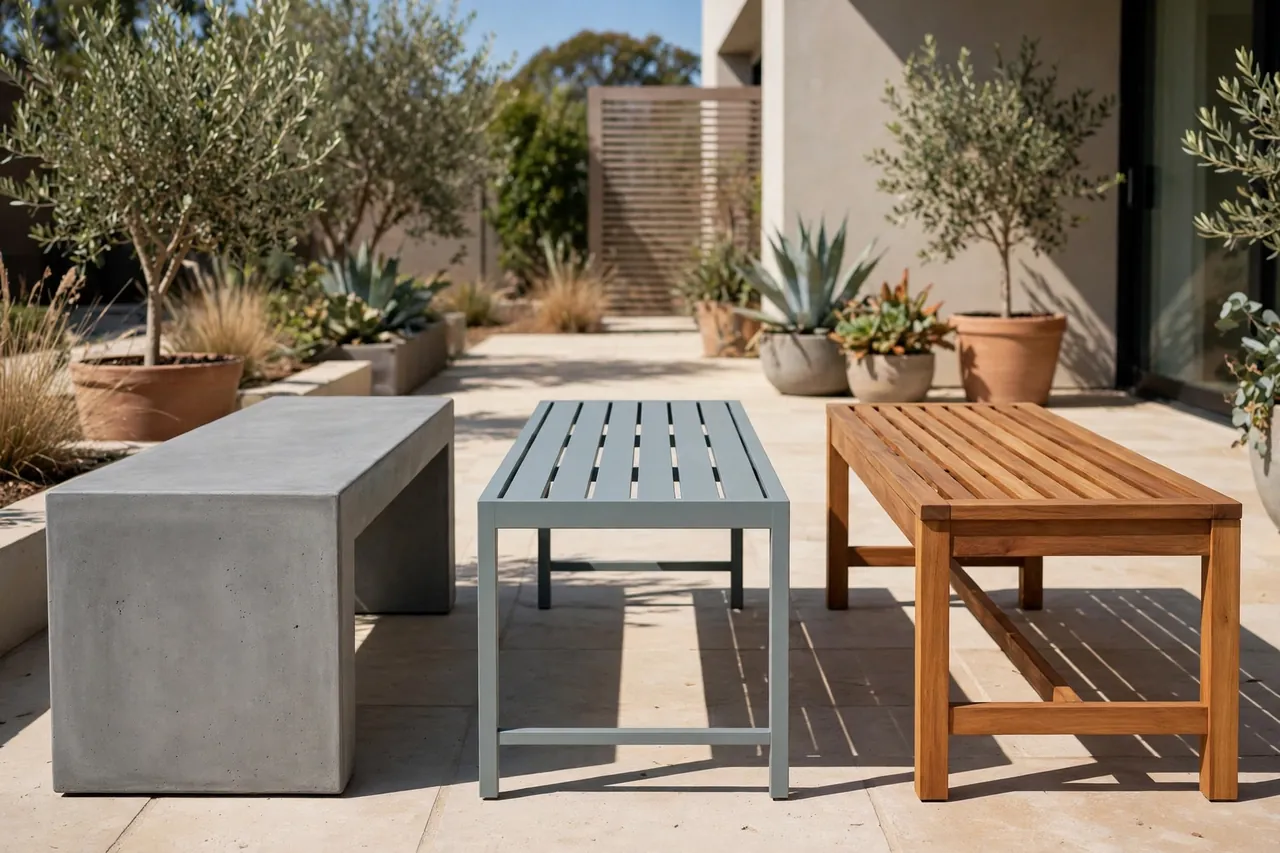
Contemporary bench materials at a glance
| Material | Weather resistance | Maintenance | Price range |
|---|---|---|---|
| Premium concrete | Excellent (25+ years) | Low — periodic sealing | $695–$2,203 |
| Marine aluminum | Excellent (20+ years) | Low — basic cleaning | $855–$1,149 |
| Teak (Grade A) | Excellent (15–25 years) | Oil annually (optional) | $650–$1,200 |
| Recycled HDPE | Excellent (20+ years) | Almost none | Varies by brand |
| Sunbrella upholstery | Very good (10+ years) | Medium — fabric care | $1,059–$1,249 |
The material figures come from Loomlan’s complete outdoor benches buying guide for 2026–2027, which prices concrete at $695 to $2,203, marine aluminum at $855 to $1,149, and Sunbrella-upholstered benches at $1,059 to $1,249. Read the full material comparison at Loomlan’s outdoor benches guide 2026–2027. Teak is the gold standard for weather resistance: its natural oils repel moisture, it develops a silvery patina over time, and FSC-certified wood guarantees sustainable sourcing. The Fermob Luxembourg compact bench offers 26 color options in UV-resistant powder coating that stays cool in direct sun, and Loll Designs benches use post-consumer milk jugs for eco-friendly durability with minimal upkeep.
Concrete for permanence, aluminum for lightness, teak for warmth. The material is the design decision.
What Size Contemporary Outdoor Bench Fits Your Patio?
A contemporary outdoor bench fits a patio when it is 48 to 72 inches long, 16 to 18 inches high, and 16 to 20 inches deep, with 36 to 48 inches of clearance behind it. Allow 24 inches of bench length per adult: a 4-foot bench seats two snugly, a 5-foot bench seats two comfortably, a 6-foot bench seats three properly, and an 8-foot bench seats four. The seat height is the number that matters most — 18 inches is the standard, and 17 to 19 inches is the workable band.
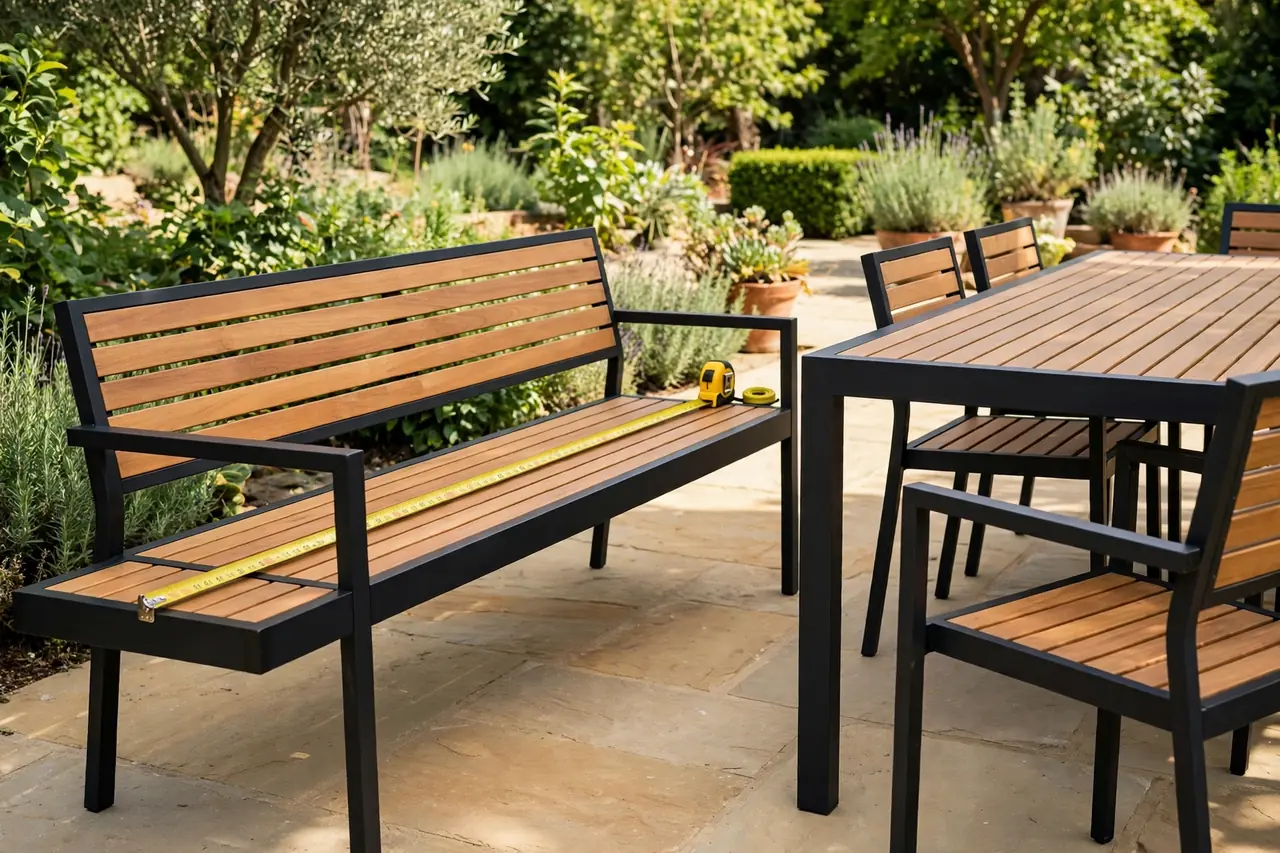
Contemporary bench sizing at a glance
| Dimension | Standard range | Capacity |
|---|---|---|
| Length | 48–72 inches | 2–4 people |
| Seat height | 16–18 inches | 17 in casual, 18 in dining |
| Seat depth | 16–20 inches | Deeper for relaxation |
| Back height | 30–36 inches (if backed) | Optional |
| Clearance behind | 36–48 inches | Comfortable access |
Below 16 inches of seat height, knees sit above hips; above 20 inches, most guests’ feet dangle. Under 16 inches of seat depth, you are perching on a shelf; over 22 inches, people slouch at a strange angle or build a cushion nest behind themselves. Match the bench length to the table, not the reverse: a bench should run a few inches shorter than the tabletop so it tucks fully underneath and leaves room for an end chair. A 2-inch-thick slab spanning 6 feet needs a center leg or apron support so it does not flex under three adults.
Weight capacity is the number listings hide most often. Look for a minimum 400-pound rating for two adults, and verify load-testing data rather than trusting “supports 2 people” — bench failure is rarely structural, it is leg weld fatigue or slat sag. Our outdoor dining table and chairs guide covers the table pairings that match a 6-foot bench.
18 inches high, 24 inches per adult. Get the height wrong by two inches and the bench feels like a stool.
Backless or Backed: Which Contemporary Bench Is Right?
A backless contemporary bench is right when the seat must work from both sides, tuck under a table, or keep a small patio visually open, while a backed bench is right when people sit for an hour or more. Backs enhance comfort for extended relaxation but are not essential for every use — a backless bench offers versatility and space efficiency, while a backed bench provides support for longer seating periods.
The backless bench is the contemporary default. It slides under a dining table, doubles as a side table or plant stand when guests leave, and never blocks the view across the patio. It also seats people from either side, which matters at a dining table where the bench serves both the table and the garden behind it. The cost is comfort: without a back, nobody leans back for an hour, so backless benches suit meals and short sits, not reading afternoons.
The backed bench is the comfort pick. A back height of 30 to 36 inches with a backrest angle between 100 and 105 degrees supports the upper body without forcing an upright posture, and it turns the bench into the patio’s best reading seat. The cost is space: a backed bench needs its full depth plus clearance behind it, and it cannot tuck under a table. Our outdoor bench with storage guide covers the backed bench that hides cushions and garden tools inside.
Backless for dining and flexibility, backed for lingering. The way you sit decides, not the catalog photo.
Where Does a Contemporary Bench Belong on the Patio?
A contemporary outdoor bench belongs against a wall, beside a dining table, along a garden path, or facing the view — anywhere a chair would feel fussy and a sofa would feel too big. It anchors a wall, frames a view, and fills the gap between the dining set and the lounge corner. The bench is the piece that makes a patio feel furnished without making it feel crowded.
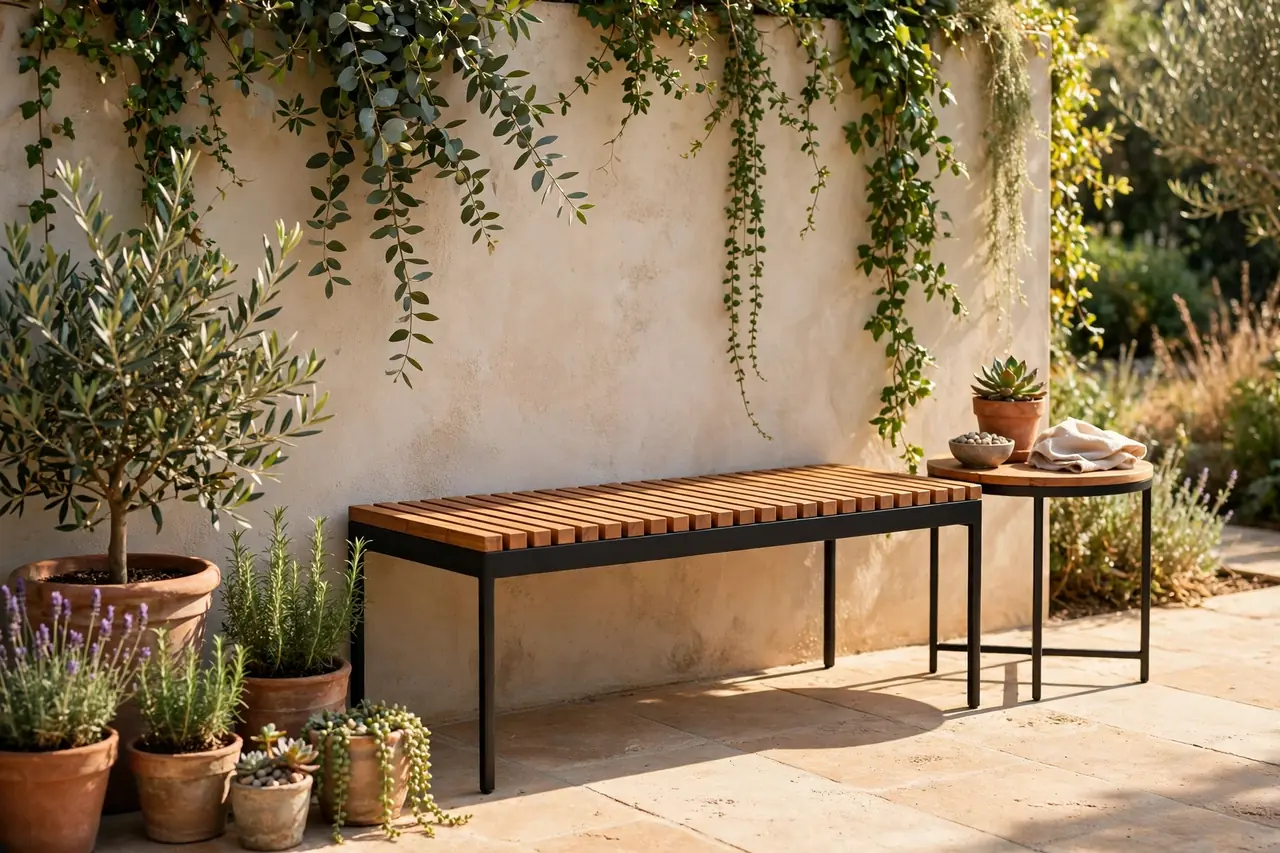
At the dining table, the bench replaces two chairs and seats three people in the space of two, which is why a 6-foot bench pairs with a 60-inch table. Against a wall, a backed bench becomes the patio’s reading corner with a side table and a cushion. Along a path, a backless bench becomes a pause point — a place to set down a watering can, tie a shoe, or watch the garden for a minute. By the fire pit, a low bench rings the circle without blocking the flames the way a tall chair would.
Keep 36 inches of clear walking path on all accessible sides, and 36 to 48 inches behind the bench for comfortable access. Position the bench to enhance traffic flow rather than obstruct it, and face it toward the view or the focal point, not toward the house wall. Our how to arrange outdoor furniture guide covers the full layout routine, including the clearance numbers that keep a bench from blocking the grill path.
A bench fills the gap between dining and lounging. If a chair feels fussy and a sofa feels too big, the bench is the answer.
What Most People Get Wrong About Contemporary Benches
Most people get contemporary benches wrong in three ways: they buy a bench that is too short for the table, they buy untreated softwood because it looks modern in the photo, and they ignore the weight capacity. All three mistakes show up the first time the bench is actually used.
The length mistake is the big one. A bench should run a few inches shorter than the tabletop so it tucks fully underneath, and a 4-foot bench seats two adults snugly — not three, no matter what the listing implies. Sit three adults on a four-foot bench and ask again whether 24 inches per person sounds generous. Six feet seats three properly, and it is also the length where a bench starts to look intentional, not apologetic.
The softwood mistake runs the other way: untreated softwood and pallet wood split, gray, and wobble within a season, while teak, powder-coated aluminum, and sealed concrete last decades. A uniform gray bench against black steel and green foliage is the most modern thing on any patio — but only if the gray is powder coating or weathered teak, not rotted pine. Here’s the problem with that advice: it sounds like a materials lecture, but it is really a money rule — the cheap softwood bench is the one you replace next spring.
Match the bench to the table, skip the softwood, check the 400-pound rating. Three checks, one good bench.
How Much Does a Contemporary Outdoor Bench Cost?
A contemporary outdoor bench costs $695 to $2,203 for premium concrete, $855 to $1,149 for marine-grade aluminum, $650 to $1,200 for Grade A teak, and $1,059 to $1,249 for a Sunbrella-upholstered bench. Entry-level concrete starts at $695 to $895, and the cost per year over a 15-year lifespan runs $46 to $60 annually — cheaper per year than most budget furniture that needs replacing.
Contemporary bench prices at a glance
| Bench | Price | Cost per year |
|---|---|---|
| SUNPAN Colohan concrete | $2,203 | ~$88 over 25 years |
| SUNPAN Soma concrete | $1,910 | ~$76 over 25 years |
| SUNPAN Nomad concrete | $2,023 | ~$81 over 25 years |
| Telescope Bazza aluminum | $855 | ~$43 over 20 years |
| Telescope 56-inch Bazza MGP | $1,149 | ~$57 over 20 years |
| Sunset West Provence Sunbrella | $1,249 | ~$83 over 15 years |
| Sunset West Newport / Redondo | $1,059 | ~$71 over 15 years |
The prices and cost-per-year figures come from Loomlan’s 2026–2027 outdoor benches guide, which prices the entry-level concrete range at $695 to $895, premium aluminum at $855 to $1,149, and luxury upholstered benches at $1,059 to $2,203 and up. The per-year math is the guide’s own: divide the price by the expected lifespan, and the premium bench costs less per year than the budget set that dies in three summers.
Guess which bench costs less over fifteen years: the $855 aluminum bench or the $300 softwood bench? The aluminum bench lasts twenty years at about $43 a year, while the softwood bench lasts one season and needs replacing fourteen times. The expensive bench is the one you buy once, so compare the cost per year, not the price on the tag.
Compare the cost per year, not the tag. A $2,000 concrete bench at $80 a year beats a $300 bench you replace every spring.
How to Care for a Contemporary Outdoor Bench
Care for a contemporary outdoor bench by material: wash concrete and aluminum with mild soap and water, seal concrete once a year, and hose teak off monthly with an optional annual oiling. Sunbrella upholstery needs regular fabric cleaning and stain treatment, plus covers during harsh weather. The bench that gets a ten-minute wash each season is the bench that still looks new in ten years.
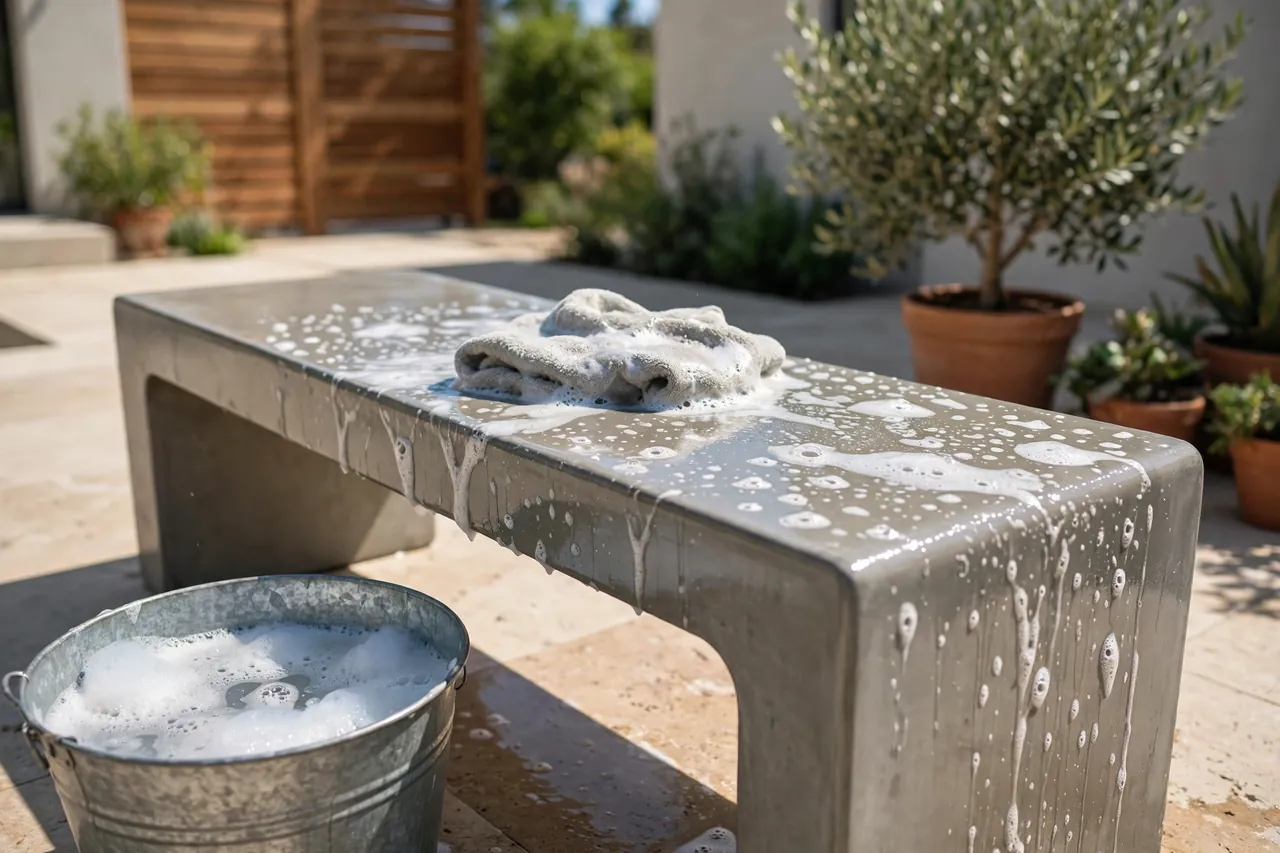
Concrete benches need spills cleaned promptly, basic washing, and a protective sealer applied annually. Aluminum benches need a wipe after use, mild soap cleaning, and a seasonal deep clean with a hardware inspection. Sunbrella upholstery benefits from regular cleaning, stain treatment, and seasonal protection. In winter, cover upholstered benches and store cushions indoors; in spring, deep-clean every surface and inspect for winter damage.
Teak weathers to a silver-grey without treatment, and that patina does not affect its strength — oiling is optional, for looks only. Recycled HDPE benches need almost nothing: leave them year-round without covers, and wash them when they look dusty. Our how to care for outdoor furniture guide covers the season-by-season routine for every material, our outdoor covers for furniture guide shows which covers breathe, and our how to store outdoor furniture guide covers the full winter routine.
Wash it, seal the concrete, cover the cushions. Ten minutes a season beats a replacement bench.
Related Guides
If you are planning the whole outdoor space, these guides pick up where this one leaves off:
- Outdoor Wooden Bench — the classic wood bench when the modern look is too stark.
- Outdoor Bench With Storage — the backed bench that hides cushions and tools inside.
- Outdoor Dining Table and Chairs — the table pairings that match a 6-foot bench.
- Outdoor Coffee Tables — the low table that pairs with a backless bench.
- Outdoor Side Tables — the small table for the reading corner beside a backed bench.
- How to Arrange Outdoor Furniture — traffic flow, rug sizing, and clearance numbers for the whole patio.
- How to Care for Outdoor Furniture — the season-by-season routine for every material.
- Outdoor Covers for Furniture — which covers breathe and which ones trap damp.
- How to Store Outdoor Furniture — keep it clean, dry, and ready for spring.
- Acacia Wood Furniture — the hardwood look on a softwood budget.
- Teak Outdoor Dining Table — the teak table that matches a teak bench.
- Outdoor Picnic Table — the bench-and-table set for family meals outside.
- How to Choose Outdoor Patio Furniture: 5 Decisions That Save You From a $1,000 Regret — five decisions that keep a patio set from becoming a $1,000 regret.
Frequently Asked Questions
What materials work best for outdoor benches?
Premium concrete, marine-grade aluminum, and natural teak offer the best outdoor durability. Telescope’s American-made aluminum provides corrosion resistance, while concrete designs from SUNPAN offer contemporary styling with excellent weather resistance.
How do I choose the right size outdoor bench?
Standard outdoor benches range from 48 to 72 inches in length. Consider your space size, intended capacity of 2 to 4 people, and coordination with existing furniture. Dining benches should be 18 inches high, while garden benches can be 16 to 17 inches for casual seating.
Are stackable outdoor benches as stable as regular benches?
Yes, quality stackable benches from Telescope maintain full stability while adding space-saving functionality. Premium stackable designs incorporate wide bases and precision engineering without compromising safety or comfort for outdoor seating.
Do outdoor benches need backs for comfort?
Backs enhance comfort for extended outdoor relaxation but are not essential for all applications. Consider your intended use — backless benches offer versatility and space efficiency, while backed benches provide enhanced comfort for longer seating periods.
How do I maintain outdoor benches for longevity?
Maintenance varies by material. Concrete benches need periodic cleaning and sealing. Aluminum benches require basic cleaning and hardware inspection. Sunbrella upholstery benefits from regular cleaning and seasonal protection for extended lifespan.
Measure the table, pick the material that matches the care you will actually do, and buy the bench at 18 inches high with 24 inches per adult. A concrete or aluminum bench at $43 to $88 a year outlasts every budget replacement, and its clean line is still the calmest seat on the patio a decade from now. Start with the 5-foot bench — it seats two comfortably, tucks under most tables, and leaves room for the garden to breathe.