
Some homes stay free of pests for decades, while others invite them in despite regular cleaning. The difference often traces back to decisions made long before anyone moved in. Where a door sits, how a pipe passes through a wall, and what lies behind a vent cover all affect how easily insects and rodents find a way inside. Good design lowers the odds, but no building stays tight forever. Wood shrinks, caulk cracks, and rubber seals flatten with use. The sections below cover the design features that matter most, explain why upkeep has to follow, and outline the habits that keep a well-planned house from slowly becoming a porous one.
How Layout and Door Placement Influence Pest Access
Doors take more traffic than any other opening, so their placement matters. An entry that faces a wooded lot or a dense garden bed puts a gap right beside the places where ants, spiders, and rodents already live. A door leading straight from a cluttered garage into the kitchen creates a short path between a partly outdoor space and a room full of food. Thresholds set slightly above grade, with a drip edge and a tight sweep, tend to stay drier and harder to breach.
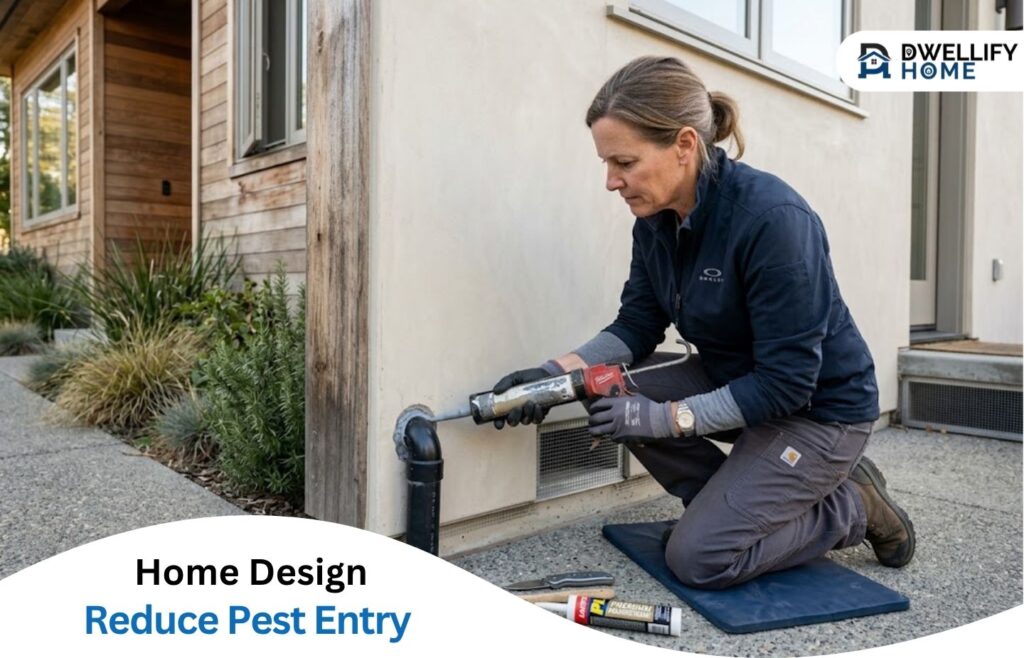
Utility penetrations are the quieter weakness. Every gas line, refrigerant line, cable, and water pipe that crosses an exterior wall needs a hole, and that hole is rarely filled perfectly. A mouse can pass through a gap about the width of a pencil, and many penetrations leave more room than that. Grouping these openings in locations that are easy to see and reach, instead of behind shrubs or under decks, makes sealing and later checks far simpler. Fewer scattered openings also means fewer places to monitor.
Trim, Ventilation, and the Voids Where Pests Settle
Exterior trim looks decorative, yet it forms a series of seams. Fascia boards, corner boards, window casings, and soffits meet at joints that open slightly as materials expand and contract with temperature and humidity. Ants and wasps exploit those seams, and rodents widen them. Trim that sits tight against siding, with sealant at every joint, leaves fewer pockets to colonize. Gaps behind trim also trap moisture, which attracts termites and carpenter ants.
Ventilation is a required feature, since attics, crawl spaces, and foundations need airflow to stay dry. Unscreened or poorly screened vents turn that airflow into an entrance. Hardware cloth with small openings keeps out rodents and larger insects while still letting air pass, and fine mesh stops smaller ones. Homeowners who notice repeated activity near a vent, a trim joint, or a pipe collar often discover that the cause is structural instead of behavioral. In those cases, the pest control experts at Smart Solutions Pest Control can inspect how a building’s features contribute to the problem, which helps separate design limits from simple housekeeping issues.
Why Good Design Still Needs Maintenance
Even a carefully detailed house begins aging the day it is finished. Rubber weatherstripping hardens and cracks after years of sun and compression. Sealants lose elasticity and pull away from surfaces. Wood swells in humid months and shrinks in dry ones, and each cycle widens joints a little more. A foundation can settle by a fraction of an inch, enough to open a gap where siding once met concrete cleanly.
The trouble is that these changes arrive slowly. Nobody notices a door sweep wearing down over three years, and nobody sees a caulk line separating until a trail of ants shows up on the counter. Humid climates add moisture stress, which speeds decay and favors pests that thrive in damp materials. Maintenance acts as the counterweight, restoring what time takes away. A design that looked airtight at the final inspection is only as good as its current condition. The real question is never whether to maintain a home, but how often to check it.
Maintenance Tasks That Keep Barriers Intact
A short, repeatable list covers most of what matters, and it fits easily into a seasonal routine:
- Replace weatherstripping and door sweeps when daylight shows along the bottom or sides of a closed door
- Check screens on vents, attic openings, and crawl space access points for rust, tears, or bent edges
- Inspect transitions between materials, such as siding to foundation, brick to trim, and deck to wall, and reseal open joints
- Recaulk around windows, pipe collars, and cable entries when sealant cracks or peels
- Keep meters, crawl space doors, and utility panels clear so they can be inspected
Transitions deserve extra attention because two materials rarely expand at the same rate. Where vinyl meets masonry, or wood meets concrete, the joint absorbs that difference and eventually splits. Resealing is inexpensive, but it only works if the gap is clean and dry first. If activity returns within weeks of a repair, the pest control experts at Smart Solutions Pest Control can help determine whether a hidden gap, a wall void, or a poorly detailed junction is still feeding the problem.
Keeping Storage and Service Areas Accessible
Storage design affects pests as much as exterior seals do. Closets tucked under stairs, crawl spaces with tiny hatches, and mechanical rooms packed with boxes all become places nobody checks, and pests prefer exactly that. A rodent nest behind a water heater or a wasp colony behind stacked lumber can grow for months in a space no one can easily see.
Accessible service areas change the equation. A crawl space door that opens fully, a clear path to the electrical panel, and shelving that lifts belongings off the floor let a person scan the area with a flashlight in under a minute. Lidded plastic bins beat cardboard, since they remove both food and nesting material. Leaving a few inches between stored items and walls allows airflow and a clear view. Designers can plan generous access panels, and owners can treat that access as something worth protecting.
Key Takeaways
Design decides how many openings a home has, and maintenance decides whether those openings stay closed. Door placement, utility penetrations, trim joints, vents, and storage access all shape pest pressure, but each one weakens as materials age. Replace worn seals, screen vents, reseal transitions, and keep service areas reachable. When the same entry point keeps failing after repairs, the cause is likely structural, and a professional inspection can settle it. A building maintained with its design in mind keeps pests out far longer than either effort alone.
Some links in this article may be associated with affiliate or sponsored partnerships. Dwellifyhome.com may receive compensation when readers make qualifying purchases through these links. This comes at no additional cost to you and helps support our publishing activities.



