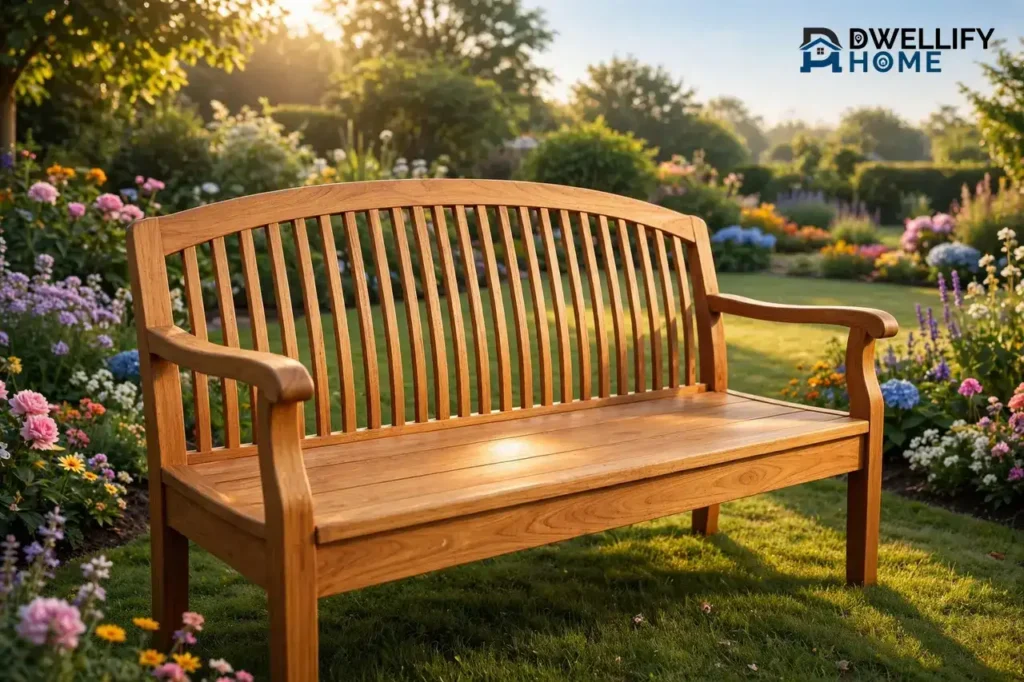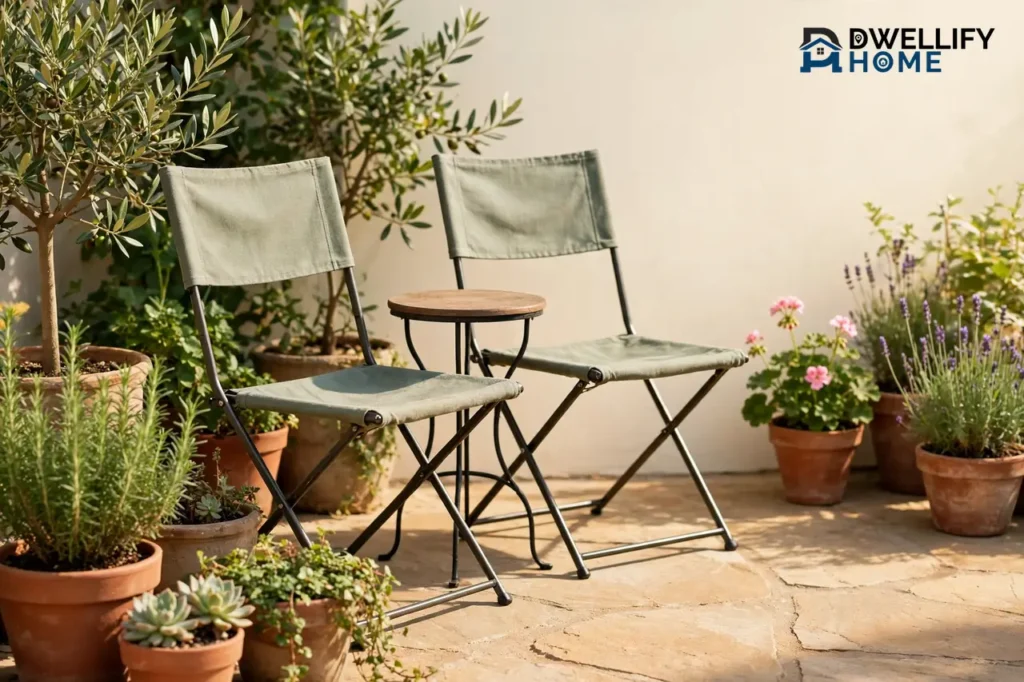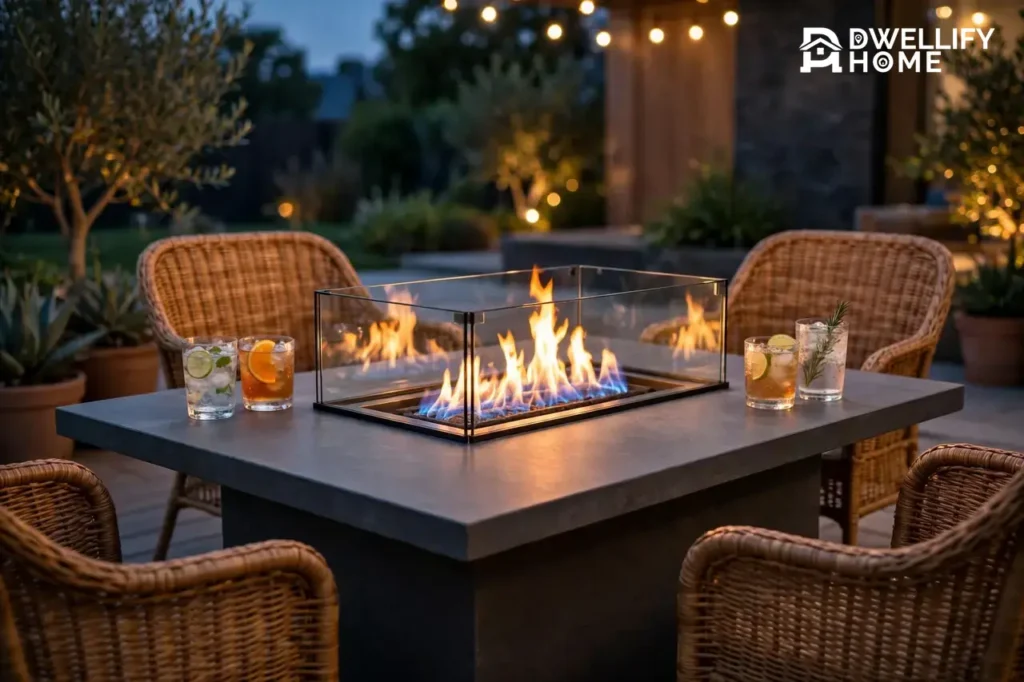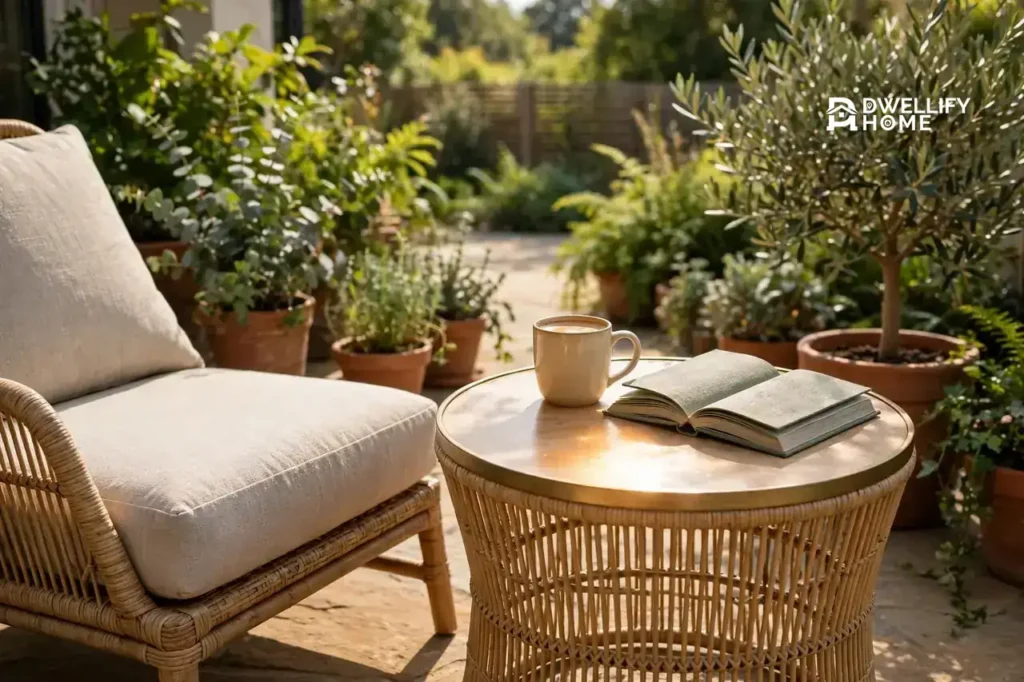
An outdoor side table is a small table that sits beside a patio chair, a lounge chair, or a sofa, and the right one measures 16 to 20 inches wide and 18 to 24 inches tall, with its top sitting within 1 to 3 inches of your chair’s armrest height. Get that height right and you set a drink down without thinking; get it wrong by 4 inches and you lean, reach, and spill for the whole summer. The table’s job is simple — hold a mug, a book, and a phone within arm’s reach — and the size, not the style, decides whether it does it.
One sizing mistake ruins more side tables than bad weather ever will, and it is the reason a beautiful table ends up holding a plant instead of a drink. It sits in the sizing section below, next to the 4-inch test that tells you whether a tabletop is actually big enough. First, you need the height rule straight, because it is the whole game.
What Height Should Outdoor Side Tables Be?
Outdoor side tables should be 16 to 20 inches high beside a low lounge chair, 18 to 22 inches high beside a patio sofa or loveseat, and 20 to 24 inches high beside a taller outdoor armchair. The rule behind every number is the same: the table’s top should sit within 1 to 3 inches of your chair’s armrest height.
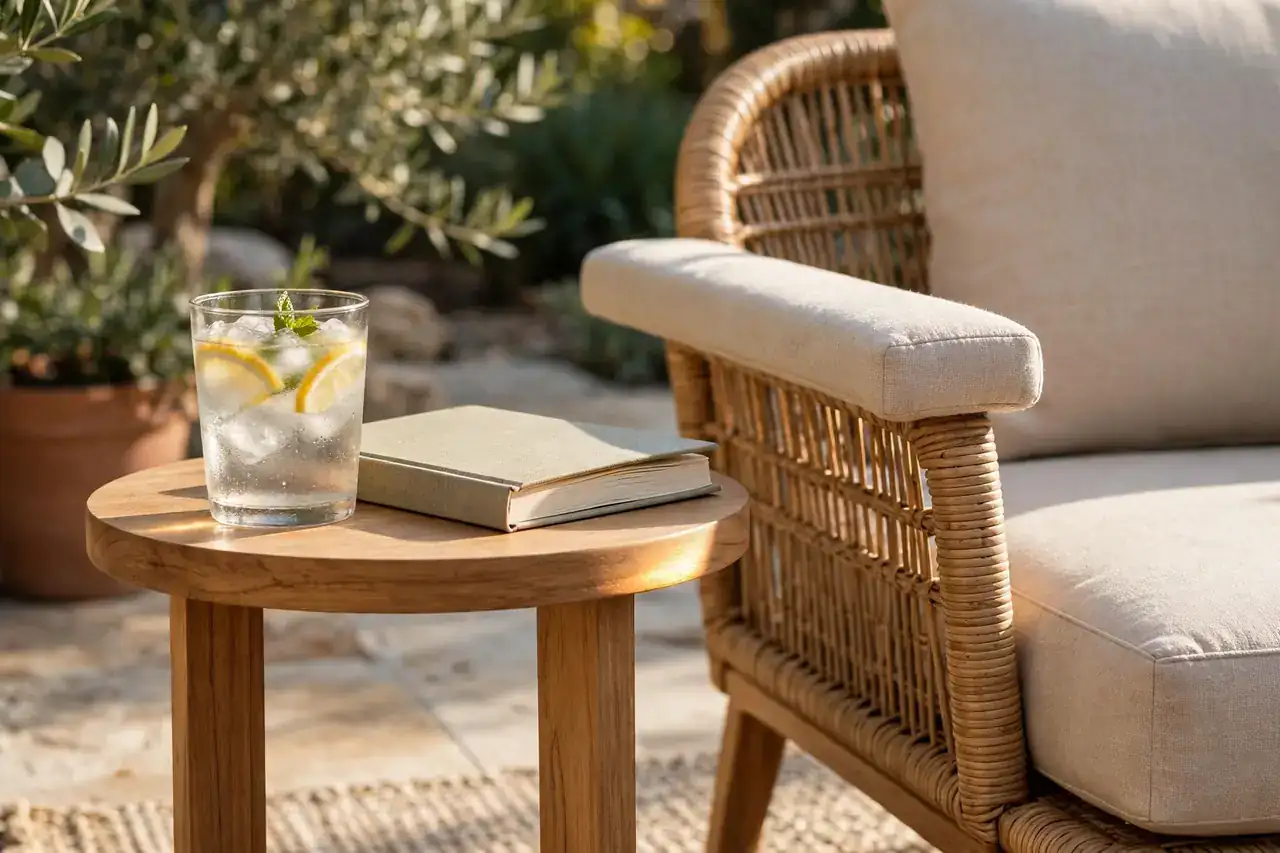
Measure the armrest first, then shop. If your armrest is 22 inches off the ground, aim for a table between 19 and 23 inches tall. A table that is too tall looks awkward next to a low lounge chair, while one that is too short forces you to lean down every time you reach for a drink. Outdoor Furniture Atlas, whose buying guide covers sizes, materials, and placement in one place, gives the same rule: a side table measuring 16 to 20 inches wide and 18 to 24 inches tall works best next to a standard lounge chair or sofa. Read the full guide at Outdoor Furniture Atlas’s outdoor side table buying guide.
The numbers shift with the seat. Beside a poolside lounger, a low table of 14 to 18 inches suits a reclining body. Beside a dining chair between meals, a table of 24 to 26 inches matches the higher seat. And beside a deep sectional, a table of 18 to 20 inches coordinates with the seat height rather than the arm height, because sectional arms run high and a table matched to them would tower over the seat.
Leave clearance around the table too. You need at least 18 to 24 inches of walkway between a side table and any wall or railing, and ideally 12 to 15 inches between the table and the chair it serves. A table jammed against the chair is a shin-bruiser; a table a foot away is a stretch.
Within 1 to 3 inches of the armrest. That one measurement decides the whole buy.
What Size Outdoor Side Table Do You Need?
The right outdoor side table top is 14 to 20 inches across for one chair and 20 to 24 inches across for two chairs sharing a surface. A top under 12 inches across holds a mug and a phone, but not a mug, a phone, and a book at the same time — and a 10-inch table looks nice in photos but cannot hold all three at once.
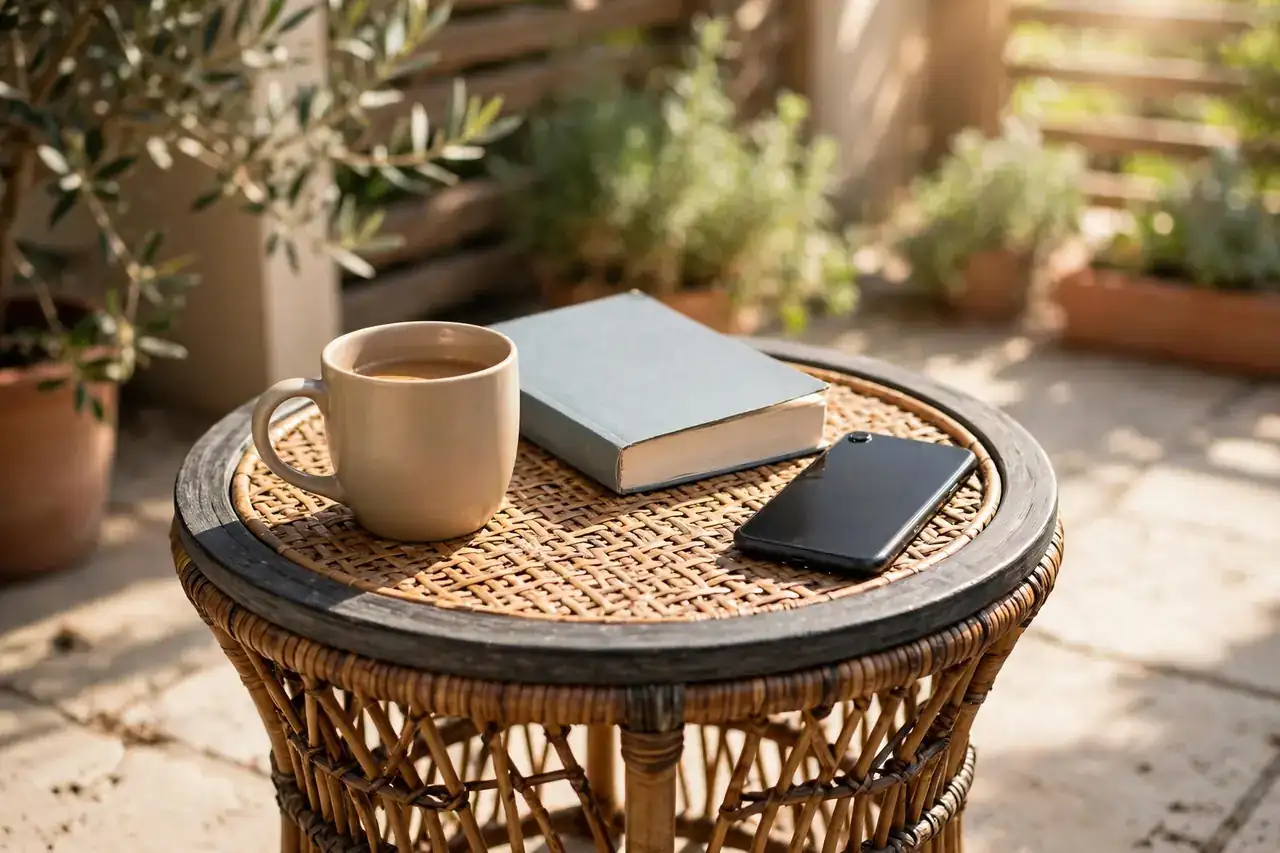
Run the 4-inch test before you buy. A coffee mug needs about 4 inches of diameter, a paperback needs about 6 by 9 inches, and a phone needs about 3 by 6 inches. Add them up and a top under 12 inches across fails the test before it leaves the box. A 14-to-16-inch round top passes for one person; an 18-to-20-inch top passes for one person plus a candle or a pair of sunglasses; a 20-to-24-inch top serves two chairs.
Shape matters as much as size. A round top is easy to reach from any angle and has no corners to catch a knee, which suits a lounge chair you approach from different sides. A square or rectangular top sits flush against a sofa arm and holds a book flat, which suits a sectional. A drum or garden-stool shape doubles as an extra seat in a pinch, and a two-tier table gives you a lower shelf for a book or sunscreen while the drink stays up top.
Before you buy, measure the gap beside your chair. A table that is 16 inches wide needs about 18 inches of clear floor once you allow for the chair arm and a walkway. On a small balcony, that gap is the whole decision: a 14-inch table fits where a 20-inch table blocks the door. Our outdoor furniture for small spaces guide shows seven layouts where a slim side table earns its footprint on a tiny patio.
A mug is 4 inches; a book is 6 by 9. If the top cannot hold both, it is decoration, not furniture.
What Is the Best Material for an Outdoor Side Table?
The best materials for an outdoor side table are powder-coated aluminum, teak, resin wicker, and glazed ceramic, because they resist moisture, sun, and repeated cleaning better than indoor wood, raw steel, or veneer. Aluminum is the lightest and the longest-lived; teak is the warmest; ceramic is the heaviest and the most wind-proof; resin wicker is the cheapest that still survives a winter.
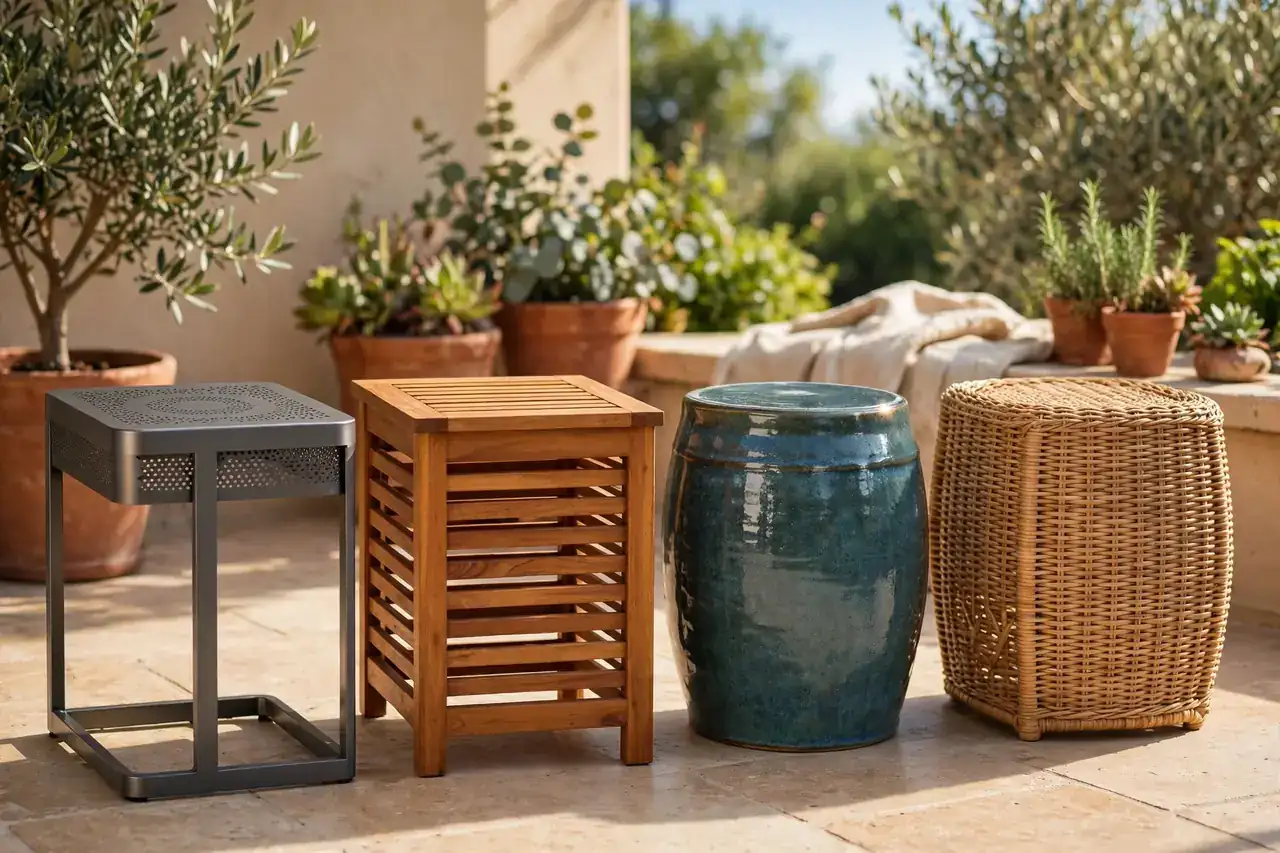
Aluminum wins on lifespan and weight. A powder-coated aluminum table lasts 25 years or more with almost no care, weighs little enough to move with one hand, and never rusts. Its weakness is wind: a light aluminum table blows over on an exposed deck, so pick one with a wide base or a heavier top if your patio catches gusts. Loomlan’s side table guide lists premium aluminum tables at $1,078 to $2,070 and rates the material excellent for 25-plus years; read it at Loomlan’s outdoor side table buying guide.
Teak wins on looks and warmth. A teak side table ages into a silver-gray patina that most owners love, and it feels solid under a full mug. It needs one oiling a year to hold its honey color, and it costs more than aluminum for the same size. If your patio already has teak chairs or a teak dining set, a teak side table is the piece that ties the set together; our patio dining set guide covers matching wood across a set.
Ceramic and stone win on stability. A glazed ceramic garden stool or a fiber-reinforced concrete table will not blow over, will not rust, and will not fade. The trade-off is weight and fragility: ceramic chips if you drag it across stone, and a 40-pound concrete table is not the one you carry inside before a storm. Resin wicker and HDPE plastic win on price and weather: a 16-inch HDPE side table costs little, never splinters, cracks, peels, rots, or rusts, and weighs little enough to move with one hand.
Avoid raw steel, indoor wood, and veneer outdoors. Raw steel rusts at the first rain, indoor wood swells and rots, and veneer peels within a season. A table made from any of those is an indoor table with an outdoor photo.
Aluminum for life, teak for warmth, ceramic for wind. Pick the material for your weather, not the photo.
How Much Do Outdoor Side Tables Cost?
Outdoor side tables cost $40 to $1,200 or more, with quality entry-level tables at $40 to $150, mid-range designer pieces at $150 to $400, and luxury materials like solid teak, cast aluminum, or weatherproof stone at $400 to $1,200 and up, all checked November 16, 2026.
The price ladder follows the material and the maker. A 14-inch round metal side table costs about $40 to $60 at major retailers. A 16-inch HDPE or resin wicker table costs $60 to $120, often sold as a set of two for the price of one order, which covers both sides of a two-chair setup. A teak or cast aluminum side table costs $150 to $400, and a large stone or designer aluminum table costs $400 to $1,200 or more. Outdoor Furniture Atlas gives the same three bands — $40 to $150 entry, $150 to $400 mid-range, $400 to $1,200-plus luxury — in its buying guide.
Sets of two are the best value in the category. A set of two 16-inch HDPE tables costs little more than one teak table and covers both sides of a loveseat or two chairs, so nobody reaches across anyone. A single statement table is the better buy only when it anchors a corner or holds a lamp: one beautiful ceramic stool beside one reading chair beats two cheap tables that wobble.
Check the weight limit before you buy, because many listings never state one. A side table that holds a mug is fine at any rating, but a table that holds a potted plant, a stack of books, and a lamp needs a stated capacity. One two-tier table in a recent roundup lists a 200-pound capacity, far above anything else in its group — and that is the table to buy if the top will carry anything heavier than a drink.
Buy the set of two, not the single. Two chairs need two tables, and the pair costs little more than one.
What Most People Get Wrong About Side Tables
Most people get side tables wrong in the same three ways: they buy by looks and ignore the armrest height, they buy a top too small to hold anything, and they put the table where nobody can reach it. All three mistakes are free to avoid and expensive to fix after delivery.
The height mistake is the big one. A 26-inch table beside a 16-inch lounge chair is not a side table; it is a barrier. A 14-inch table beside a 24-inch armchair is not a side table; it is a footstool. Measure the armrest, then buy the table within 1 to 3 inches of it, and the table disappears into the seating instead of fighting it.
The size mistake is the quiet one. A 10-inch table looks charming in a product photo and useless in real life, because a mug, a phone, and a book do not fit on it at the same time. Run the 4-inch test: if the top cannot hold a mug and a paperback side by side, it is decoration. Coffee Tables Selection’s sizing guide makes the same point with numbers: a side table should sit at or slightly above seat height, usually 18 to 24 inches, within arm’s reach of every seat. Read it at Coffee Table Selection’s outdoor coffee and side table buying guide.
The placement mistake is the annoying one. A side table belongs 6 to 12 inches from the chair arm, not across the patio and not jammed against the chair. Put it where your hand falls naturally when you sit down, and keep the main walkway at least 30 to 36 inches wide. If the table forces you to stand up to reach your drink, it is in the wrong place, no matter how good it looks.
Height first, size second, looks third. In that order, every time.
Where to Put Outdoor Side Tables
Put outdoor side tables within arm’s reach of every seat: one beside each lounge chair, one between two chairs, and one at each end of a sofa or sectional. A seat without a table beside it is a seat where drinks end up on the ground.
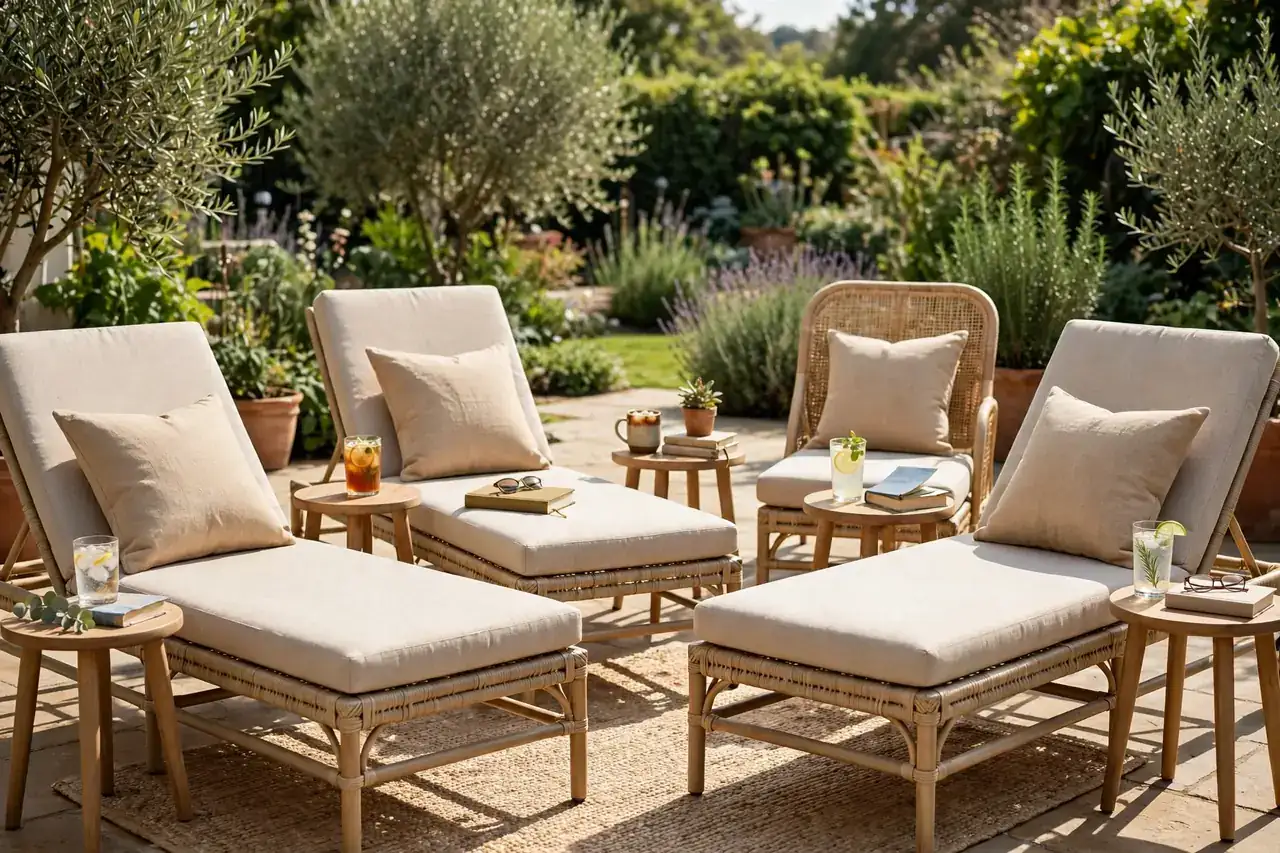
Beside a lounge chair, the table goes on the side your dominant hand falls — usually the outside edge, away from the traffic path. Beside a loveseat or a two-seat sofa, one table at each end serves both sitters, and a table between two chairs serves both at once. Beside a sectional, a square table at the corner anchors the whole arrangement, and our outdoor sectional couch guide shows how to size tables to a deep seat.
Poolside, a low round table between two loungers holds drinks, sunscreen, and a phone without forcing anyone to sit up. Keep it 14 to 18 inches tall here, because a tall table beside a reclining body is a reach, not a rest. And keep the table off the splash zone: chlorinated water spots a teak top and streaks a ceramic one, so a foot of distance saves an afternoon of cleaning.
On a balcony, one slim table does the work of two. A 14-inch round metal table beside a single chair holds everything one person needs, weighs 3 pounds, and moves inside in seconds when a storm rolls in. Our apartment patio ideas guide shows how a single slim table can anchor a whole balcony layout, and our patio shade ideas guide shows how to keep that table in the shade instead of the sun.
Winter care is simple: wipe the table down, bring light tables inside, and cover heavy ones with a breathable cover. A plastic tarp traps condensation underneath and grows mold exactly where you cannot see it, and our how to store outdoor furniture guide covers the full winter routine.
Every seat gets a table. A seat without one is a drink on the ground.
Related Guides
If you are planning the whole outdoor space, these guides pick up where this one leaves off:
- Outdoor Sectional Couch — deep seating for the lounge corner.
- Outdoor Furniture for Small Spaces — seven layouts that make a tiny patio feel big.
- Patio Dining Set — size a table to your chairs so knees and elbows fit.
- Apartment Patio Ideas — make a small balcony feel like a room.
- Patio Shade Ideas — keep the whole patio cool, not just one chair.
- How to Store Outdoor Furniture — keep it clean, dry, and ready for spring.
- Replacement Cushions for Patio Furniture — get the fit, fabric, and price right the first time.
- Balcony Cover Ideas — stay dry and cool on a small balcony.
Frequently Asked Questions
What height should outdoor side tables be?
Outdoor side tables should be 16 to 20 inches high to coordinate with most outdoor seating. Match the height to your chair arms or slightly below for comfortable reach, and consider the specific seating height when selecting tables for optimal functionality.
What size outdoor end table fits a small balcony?
A small balcony suits a table with an 11-to-14-inch round top and a height of 15 to 16 inches. The smallest tops in recent roundups measure 11 inches across and weigh about 3.3 pounds, so they move inside in seconds when the balcony needs sweeping or a storm rolls in.
How tall should an outdoor side table be?
A side table should be 22 to 26 inches tall beside a chair with a 24-inch arm, so you can set a glass down without leaning. Ottoman-height tables at 16 to 18 inches work only for lounging, not for regular seating, where the arm sits higher.
What is a good outdoor side table material?
Teak, powder-coated aluminum, glazed ceramic, and fiber-reinforced concrete hold up outdoors because they resist moisture, sun, and repeated cleaning better than indoor wood, raw steel, or veneer. Aluminum lasts longest with the least care, while teak gives the warmest look.
What’s the right side table footprint?
A 14-to-20-inch round top, or a 16-by-16-inch square, suits most patios. Bigger tables crowd seat clearance, while smaller tables only hold a single glass, so measure the gap beside your chair and the walkway before you buy.
Disclaimer: This guide gives general advice for choosing and placing outdoor side tables, not professional furniture or structural instructions. Check weight limits before loading a table with heavy planters or equipment, and hire a qualified pro for any structural patio work.
Measure the armrest, run the 4-inch test, and buy the material for your weather. A table within 1 to 3 inches of the arm, wide enough for a mug and a book, placed 6 to 12 inches from the chair, turns every seat on the patio into a place you actually sit. Do that, and the table you buy this year is still the one you reach for ten summers from now.