Metal balcony furniture is the best choice for a small apartment balcony, because powder-coated steel and aluminum are slim, strong, and weatherproof: a 24-inch round bistro table with two armless chairs fits a 4-by-6-foot balcony, folds flat for storage, and survives rain, sun, and coastal air without the upkeep wood demands. The metal matters more than the style, though, since thin unprimed iron rusts and stains the floor within a season, while powder-coated steel and aluminum last for years. This guide covers the metals, the sizes that fit, the space-saving pieces, and the renter rules.
One check below decides whether a metal set ruins your balcony floor, and it has nothing to do with the table. It is the feet, and a set with the wrong feet leaves rust rings on the tiles in the first rainy month. That check sits in the buying section, and it takes ten seconds.
What Is Metal Balcony Furniture?
Metal balcony furniture is outdoor furniture made from steel, aluminum, or wrought iron, sized for a small balcony, usually a folding bistro set, a railing bar counter with stools, nesting chairs, or a slim storage bench, built to handle wind, rain, and sun on an elevated slab where every inch and every pound counts. It is not a shrunken patio set: the pieces are designed around balcony constraints from the start.
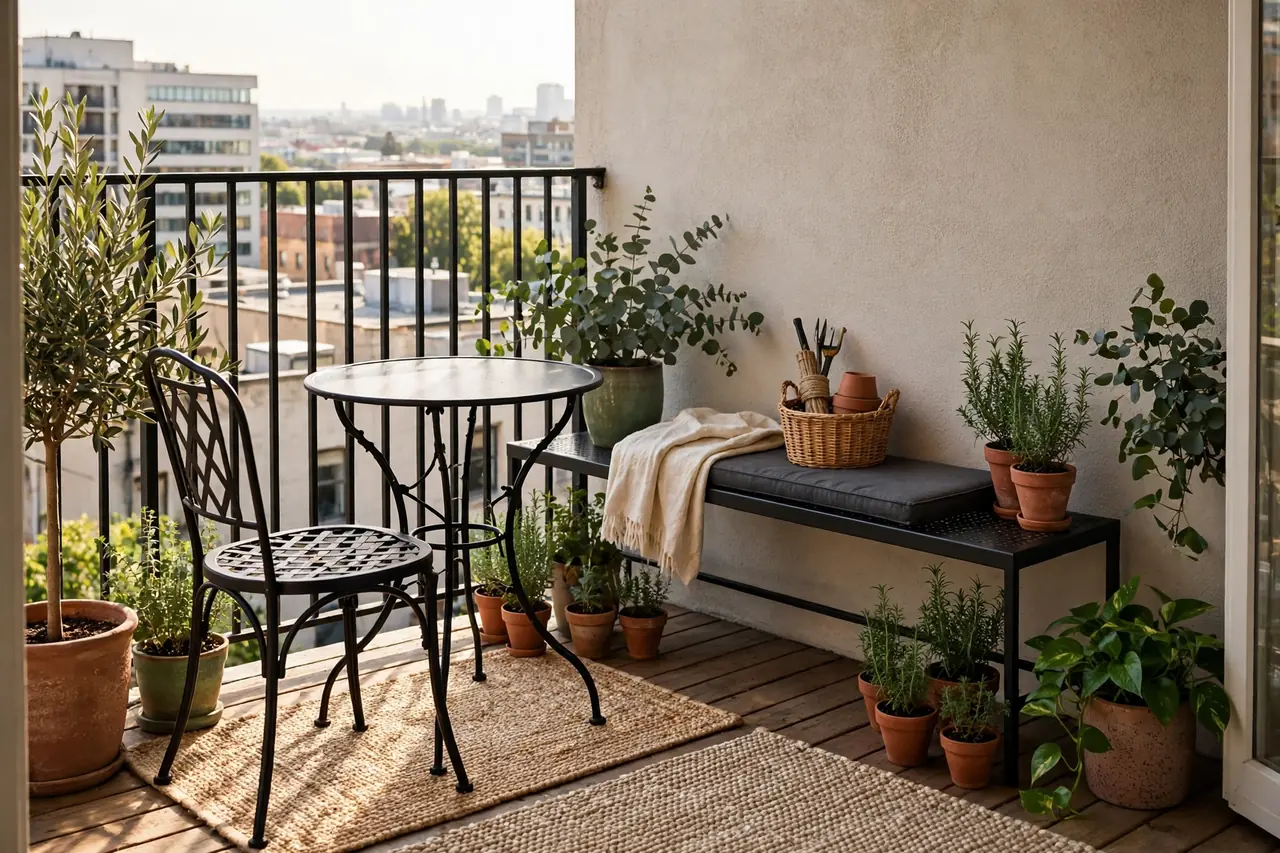
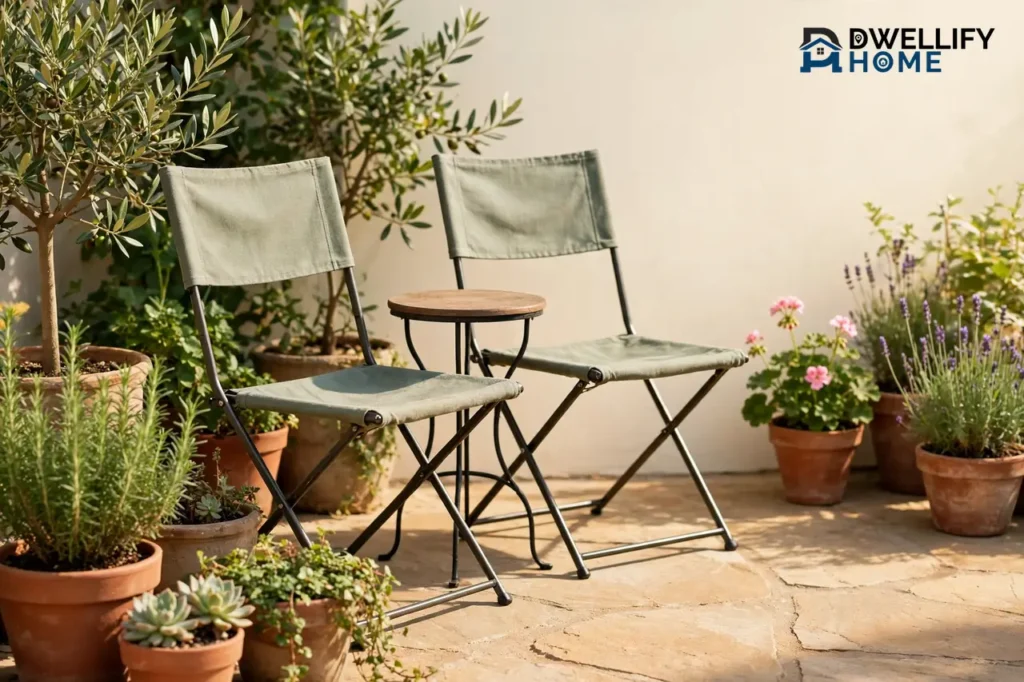
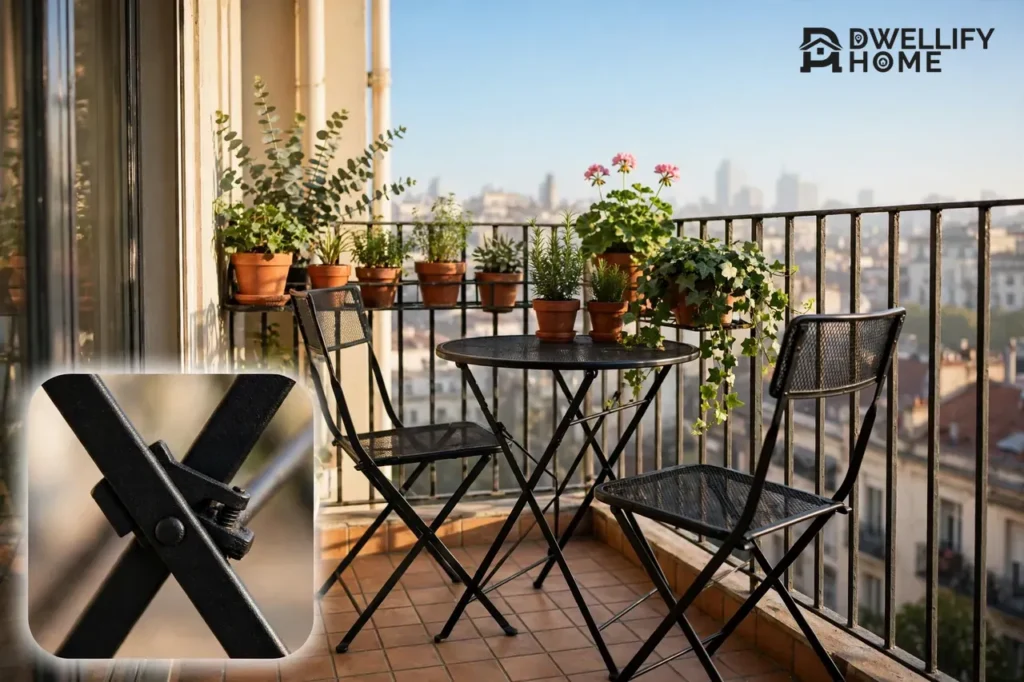
Shoppers meet four types. A folding bistro set, two chairs and a table about 24 inches across, is the classic small-balcony move: it fits a corner a full dining set never could, folds flat for storage, and leaves room to walk past. A railing bar counter clamps to the railing and turns dead edge space into a coffee ledge, with stools that slide underneath when not in use. Nesting and stacking chairs disappear into a corner when guests leave. A slim storage bench, 36 to 48 inches long and 16 to 18 inches deep, solves two balcony problems at once: nowhere to sit and nowhere to put things.
Metal earns its place on a balcony for three reasons. Its slim profiles do not overwhelm a small space the way bulky wicker does. Its weight holds it steady in the wind that hits an elevated balcony harder than a ground patio. And it folds, stacks, and nests, which matters when the whole balcony is 36 to 48 square feet and the furniture must cover less than 40 percent of it to keep the space usable. If your balcony needs a full design plan, our small balcony design ideas guide covers layouts, and our ideas for balcony design guide covers the bigger picture.
Slim, heavy enough for wind, and foldable. Those three decide whether metal earns its footprint on your balcony.
Which Metal Should You Buy for a Balcony?
Powder-coated aluminum is the best metal for most balconies, because it cannot rust, it is light enough to carry up in a lift and fold away, and it handles rain and sun with a wash, while powder-coated steel is heavier and steadier in wind but needs its coating intact, and 316 stainless steel is the only right choice for a coastal high-rise where salt mist reaches the balcony daily. The metal decision is a climate decision first and a style decision second.
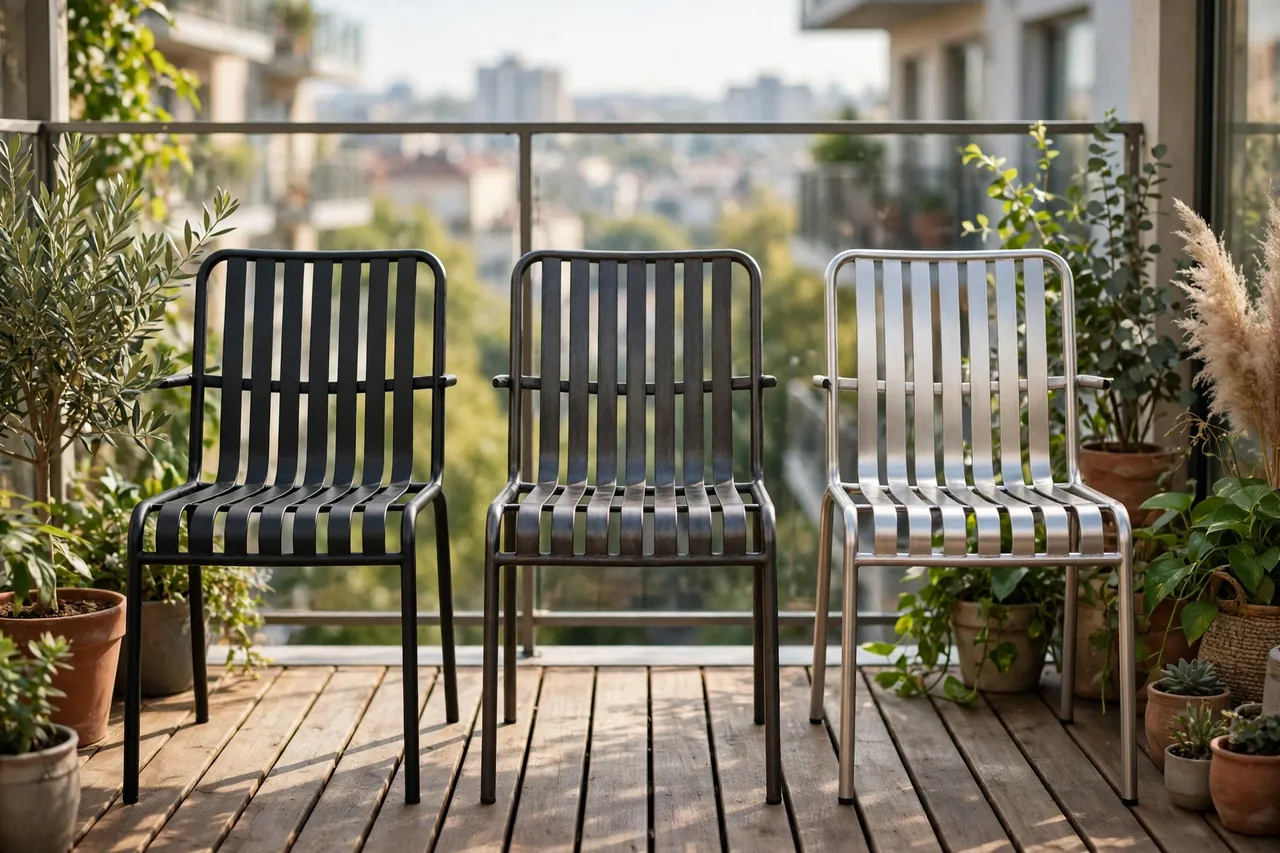
Here is how the metals compare on a balcony. Powder-coated aluminum is the default: lightweight, rustproof, easy to move, and available in bistro sets that fold flat. It can blow around on a very windy high floor, so look for cast aluminum rather than thin tubular frames when wind is a factor. Powder-coated steel is heavier and steadier, and a steel bistro set with a 330-pound capacity per chair, like the Grand Patio 3-piece folding set tested by Ditmas Park Corner, handles rain, sun, and coastal air without rusting while it stays folded flat and needs zero assembly. Its weakness is the coating: a chip at a weld lets rust start, so check the welds before you buy.
Wrought iron is the classic balcony metal, and its slim profiles and structural efficiency suit small spaces beautifully: a round bistro table 24 to 28 inches across with two chairs, seat heights 17 to 18 inches, and table height 28 to 30 inches is the standard compact iron set. Its weight is its gift on a windy balcony and its tax every time you move it. Stainless steel, grades 304 and 316, is the premium choice: 316 marine stainless is mandatory on coastal high-rises where salt mist causes tea-staining on lesser metals, and it is heavy and solid against high-floor gusts. Read the full alloy and corrosion guide at SRE Metal Furniture’s outdoor and balcony metal furniture guide, and the compact iron sizing guide at Homestyler’s compact wrought iron furniture guide.
Aluminum for most balconies, steel for wind, 316 stainless for the coast. Match the metal to your floor, your wind, and your salt air.
What Size Fits Your Balcony?
A two-person balcony set needs a 24-to-26-inch round table with two armless chairs and about 30 to 32 inches of clearance radius around it, because that is the footprint that fits a 4-by-6-foot balcony with room to walk past, and anything bigger turns the balcony into a furniture warehouse. Measure the balcony before you shop, and keep furniture under 40 percent of the floor area.
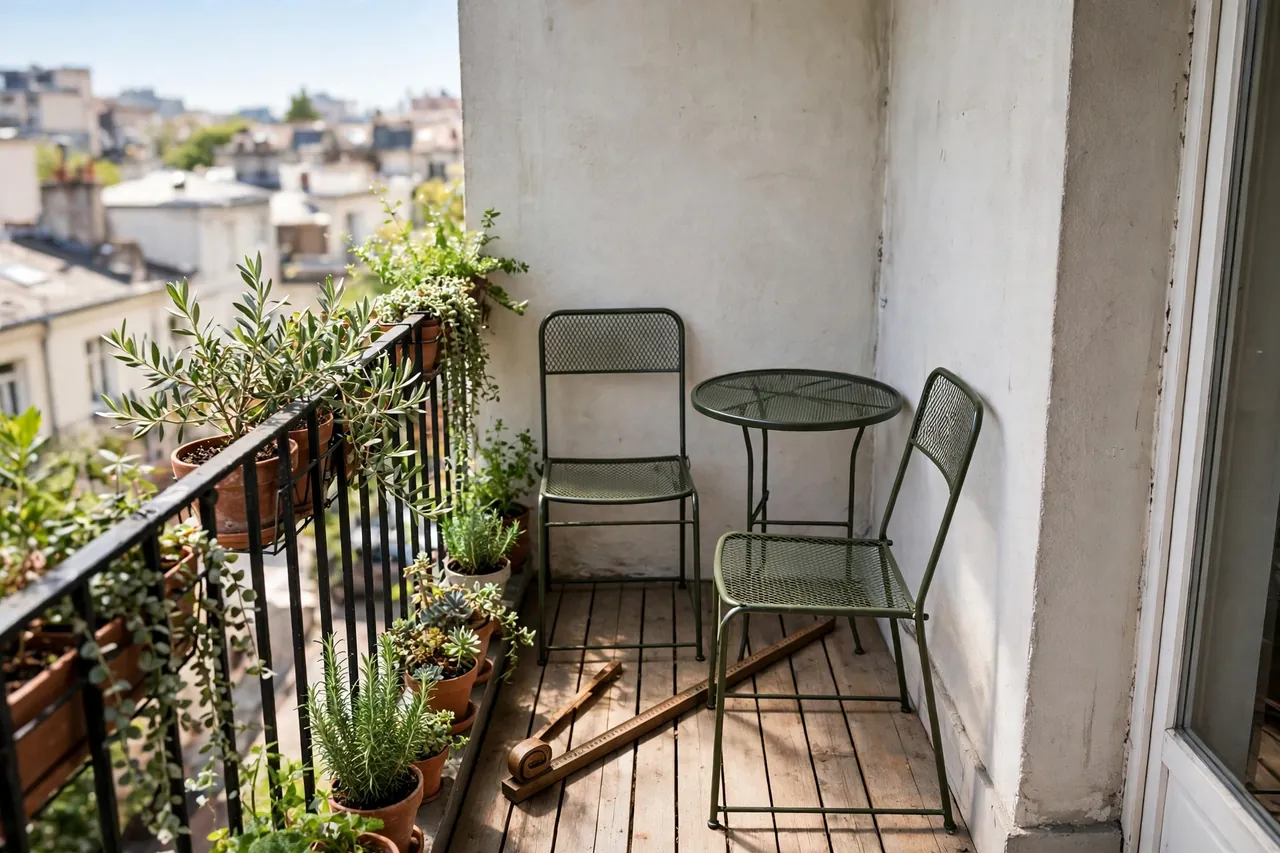
Measure twice, in two directions. Most apartment balconies are 4 to 6 feet deep and 6 to 10 feet wide, and the depth is the number that decides everything: a table 24 inches across plus a chair pulled out needs about 48 inches of depth, and a balcony 4 feet deep has exactly that, with nothing to spare. A 28-inch round table or a 24-by-28-inch oval table gives better thigh clearance against a wall, and a half-round wall-mounted bistro table saves even more room, since it folds flat when you are done. Armless chairs slide in and out in limited space where armchairs jam against the table.
Place the set against the wall rather than the railing, with at least 18 inches of clearance behind each chair so you can pull out without bumping the door, and point the table toward the view instead of the wall. Rotate the set 15 to 20 degrees off square if the balcony is awkward: the angle breaks the shoebox feeling and makes the space feel designed rather than filled. Keep the center open, push furniture toward the edges, and use the vertical space: tall planters, a trellis, and wall shelves add greenery without taking a single inch of floor. Our outdoor furniture for small spaces guide shows seven layouts for tight spaces, and our balcony decor ideas guide shows how to make a small balcony feel finished.
24-inch table, armless chairs, under 40 percent of the floor. Measure the depth first, because depth decides everything.
Space-Saving Pieces That Earn Their Footprint
The space-saving metal pieces that earn their footprint on a balcony are a folding bistro set, a clamp-on railing bar counter, nesting stools that slide under it, and a fold-down wall bench, because each one disappears when you are done with it, and a balcony that can be emptied in a minute is a balcony you use for more than one thing. Bulky furniture that cannot fold is furniture that owns your balcony.
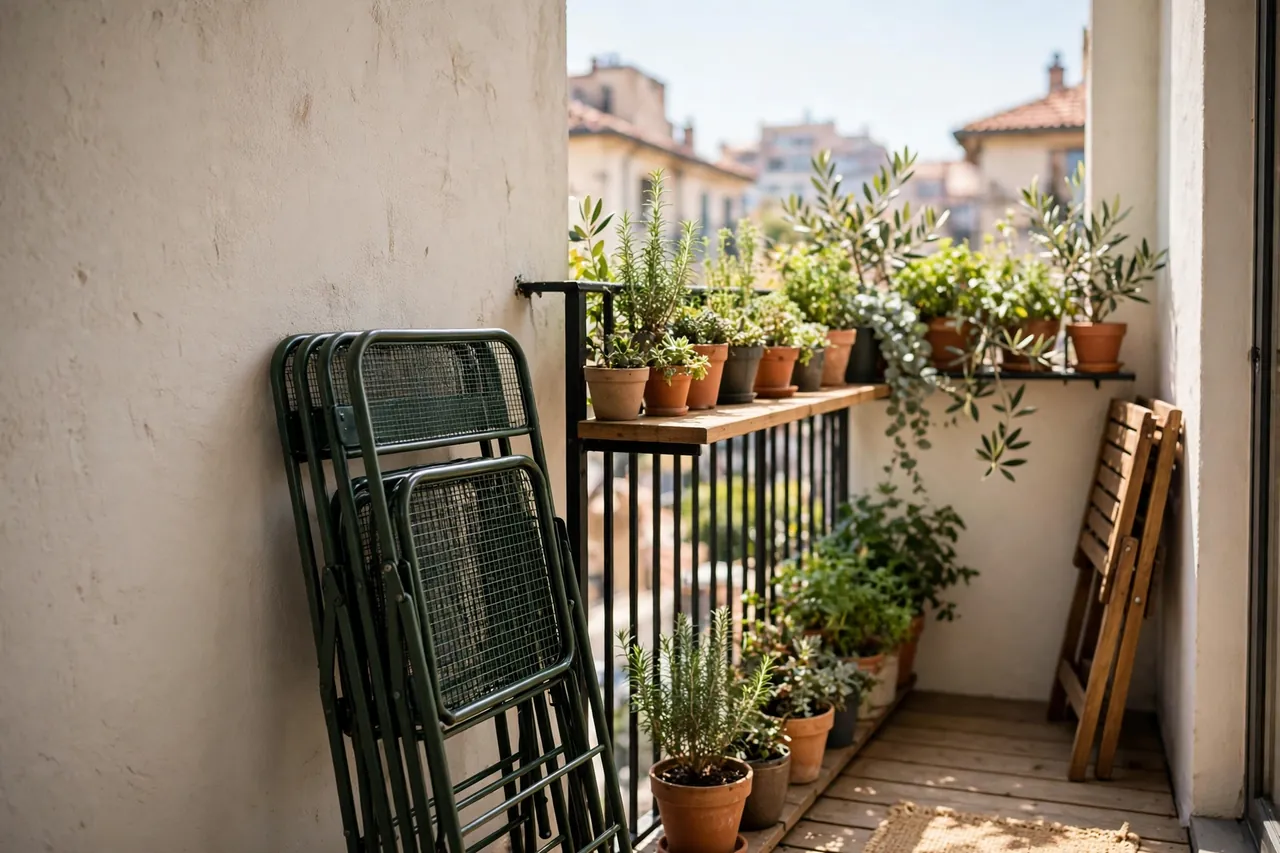
The folding bistro set is the starting point, and the best ones need no assembly at all: unfold the chairs, unfold the table, and you are done, with no screws, no Allen keys, and no missing bolts. The Grand Patio 3-piece folding bistro set, tested on a 4-by-6-foot balcony by Ditmas Park Corner, sets up in under a minute and folds flat for storage, with a powder-coated steel frame and a 330-pound capacity per chair. Read their full small-balcony set test at Ditmas Park Corner’s best patio furniture sets for small balconies.
The railing bar counter is the cleverest piece for a narrow balcony. An ultra-slim top, 280 to 350 millimeters deep, clamps to the railing on powder-coated steel brackets, and turns the edge of the balcony into a coffee ledge with a view. Stackable steel stools slide completely underneath it when not in use. A fold-down wall bench does the same job on the wall: heavy-duty hinges fold it flush against the facade when you need the floor for laundry or plants. A slim storage bench, 36 to 48 inches long, hides cushions, watering cans, and games under a lift-up lid, and resin and powder-coated metal versions resist weather with little care.
If it cannot fold, stack, or slide away, it does not belong on a small balcony. Every piece must earn its footprint twice: when you use it and when you store it.
What Most People Get Wrong About Metal Balcony Furniture
Most people get metal balcony furniture wrong in three ways: they buy thin unprimed iron that rusts and stains the floor, they buy a set that is too big for the balcony, and they ignore the building’s rules until a neighbor complains. The rust mistake is the most expensive, because it damages a floor you do not own.
Thin unprimed iron, untreated wicker, and softwood are the materials that fail fastest on a balcony: they rust, flake, and grow mildew within a season, and the rust stains they leave on tiles and concrete are hard to remove and easy for a landlord to notice. Buy powder-coated metal with the coating intact, check the feet for plastic or rubber caps, and put felt pads under every leg: bare metal feet on tiles leave rust rings in the first rainy month, and that is the check from the intro. If a set has no foot caps, add them before the first rain, not after the first stain.
The size mistake is the one you live with every day: a set that fills the balcony leaves no room to walk, water plants, or open the door fully. Measure first, keep furniture under 40 percent of the floor, and choose the smaller set when you are torn. And the rules mistake is the one that costs a deposit: many buildings restrict drilling into exterior walls, limit balcony weight, and ban hanging anything over the railing. Check the lease and ask the landlord before you drill a bracket or clamp a bar counter, and check the balcony’s weight limit before you add a heavy iron set and a storage bench full of soil.
Foot caps first, measure second, lease third. Rust rings, a blocked door, and a landlord’s letter are all preventable.
Care, Covers, and Winter on a Balcony
Care for metal balcony furniture with a wash in mild soapy water a few times a season, a check of the coating and the bolts once a year, and cushions brought in for long rain and winter, because the metal handles the weather but the coating, the hardware, and the cushions do not. A balcony set that is washed and tightened once a year lasts for years; a set that is ignored rusts at the welds first.
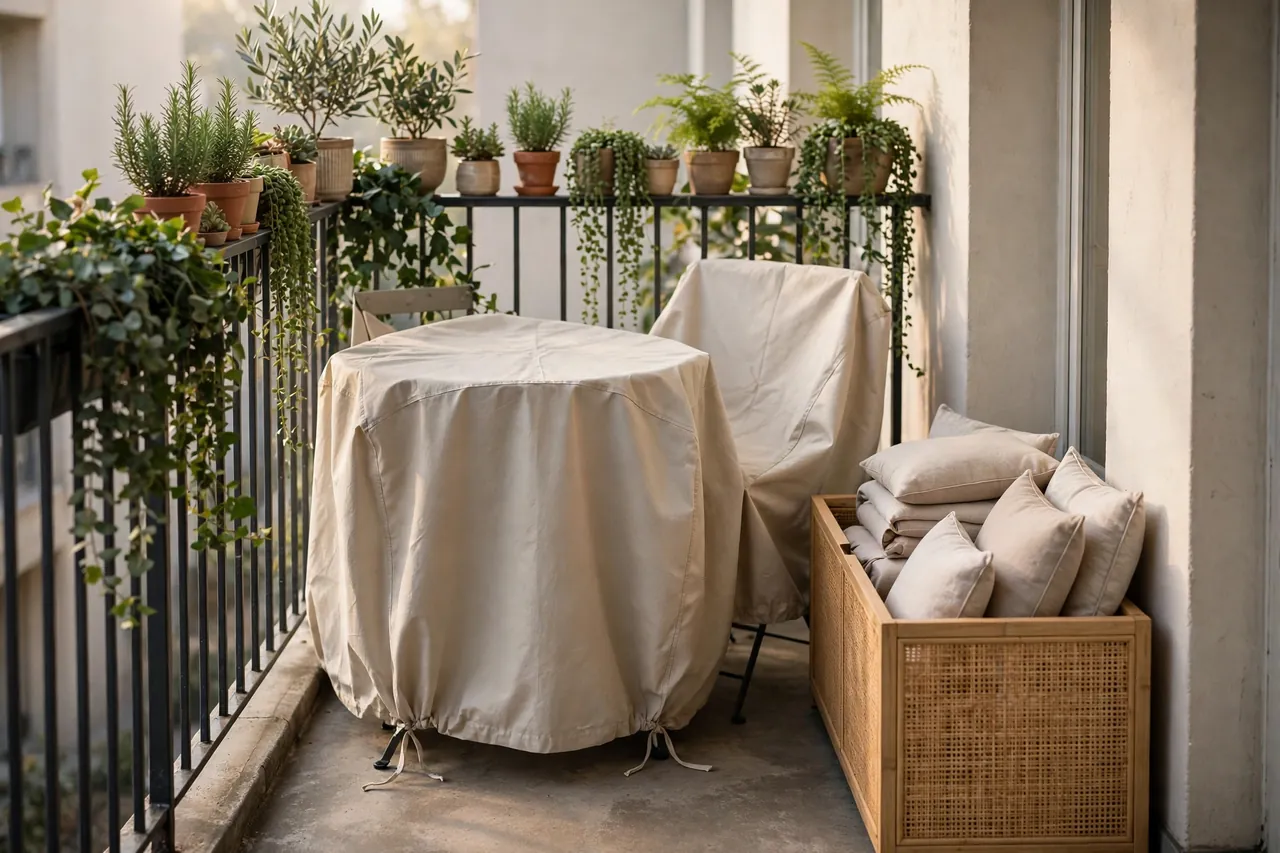
Wash the frames with mild soap and water and a soft cloth, rinse, and let them dry. Touch up any chip in the powder coat promptly, since a chip is where rust starts on steel, and check the welds and joints for cracks once a season. Tighten the bolts, since balcony furniture gets shaken by wind more than ground furniture does, and replace any rusted fastener with stainless steel. Bring cushions in for long rain and winter, and store them dry with airflow: a 1.5-to-2-inch quick-dry cushion dries fast, but a cushion stored damp grows mildew from the inside.
Cover the set in winter or fold it flat and lean it against the wall: a breathable cover keeps rain off without trapping damp underneath, while a plastic tarp traps condensation and grows mold exactly where you cannot see it. If the balcony is exposed, a cover also keeps the set from becoming a wind sail in a storm. Our balcony cover ideas guide covers breathable covers for small balconies, our how to store outdoor furniture guide covers the full winter routine, and our apartment balcony privacy ideas guide shows how to screen the space once the furniture is sorted.
Wash, touch up chips, bring the cushions in. Three habits keep a metal balcony set looking new for years.
Related Guides
If you are planning the whole balcony, these guides pick up where this one leaves off:
- Small Balcony Design Ideas — arrange a balcony that actually works.
- Outdoor Furniture for Small Spaces — seven layouts that make a tiny patio feel big.
- Ideas for Balcony Design — the bigger balcony picture.
- Balcony Decor Ideas — make a small balcony feel finished.
- Balcony Cover Ideas — stay dry and cool on a small balcony.
- Balcony Plants — greenery that earns its place.
- Handrail Planters — plants on the railing, not the floor.
- Apartment Patio Ideas — renter-friendly outdoor living.
- Apartment Balcony Privacy Ideas — screen the space from neighbors.
- How to Store Outdoor Furniture — keep it clean, dry, and ready for spring.
Frequently Asked Questions
What are some good furniture ideas for a small balcony?
Compact bistro seating is the classic move: two chairs and a table about 24 inches across fit a corner a full dining set never could. Add a folding table, a slim storage bench, wall-mounted shelves, and plants that work the vertical space, and choose pieces that fold away so the balcony can be emptied in a minute.
What is the best furniture for a small balcony?
A compact 3-piece metal bistro set is the best pick: two armless chairs and a table about 24 inches across. Choose powder-coated aluminum for most balconies — it cannot rust and folds away — or powder-coated steel for windy high floors. Keep the footprint small so you keep 18 inches of walking clearance to the door.
What are some good patio sets for a small balcony?
The Grand Patio 3-piece folding bistro set is the standout: zero assembly, folds flat, and each chair holds 330 pounds on a 4-by-6-foot balcony. The NUU GARDEN cast aluminum bistro set is the versatile upgrade at 300 pounds per chair. Measure your balcony first, then pick the set that fits it.
What kind of outdoor furniture is suitable for a small balcony?
Bistro sets with two armless chairs and a small round table suit most balconies, and folding or nesting chairs store away when you need the floor clear. A slim railing bar counter, 280 to 350 millimetres deep, adds a perch without eating floor space. Avoid bulky sectionals — anything deeper than 24 inches blocks door swings.
What is the best outdoor furniture for a small balcony?
The best set is the one that fits your door swing, leaves 18 to 24 inches of walking clearance, and uses metal rated for your climate. For most balconies, a powder-coated aluminum bistro set wins: it cannot rust, folds flat for storage, and carries easily. On a windy high floor, choose heavier powder-coated steel or cast aluminum instead.
Measure the depth, pick the metal for your climate, and put felt pads under every leg before the first rain. Do that, and a small metal set turns the narrowest balcony into the spot you reach for first every morning.