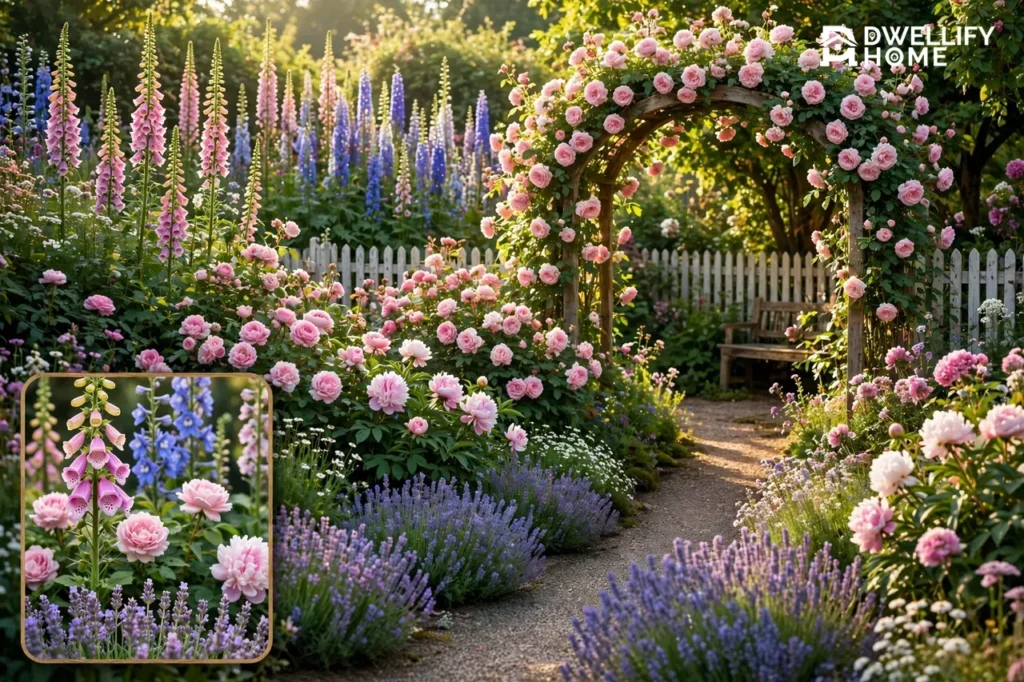
A cottage garden is an informal, densely planted garden where flowers, herbs, and food plants grow together with almost no bare soil showing. The Royal Horticultural Society names foxgloves, lavender, delphiniums, scented mock orange, and roses as the five key plants for the look, and those five alone tell you most of what you need to know: tall spires, scent, soft color, and plants that fill every gap.
This guide walks you through the whole style in plain steps. You will learn what makes a garden read as cottage instead of just messy, how to lay it out, which plants to pick for each layer, how to handle paths, fences, and color, and how to keep it all under control once it starts growing. You do not need a cottage, a big yard, or a big budget. You need a sunny spot, a simple plan, and a willingness to let plants touch each other.
What Makes a Garden a Cottage Garden?
A cottage garden looks full, soft, and a little wild, but it is not an accident. It follows a few clear ideas. Plants grow close together in mixed layers. Flowers share space with herbs and vegetables. Paths curve instead of running straight. Old materials like brick, wood, and stone beat shiny new ones. And the garden changes through the seasons because something is always coming into bloom.
The style started in England centuries ago, when families with small homes grew food, medicine, and flowers in the same tiny plot. They could not afford separate beds for pretty and useful, so everything grew together. That history is why a cottage garden still mixes roses with rosemary and lettuce with lavender. It is a working garden that happens to look romantic.
Three traits separate a cottage garden from a formal garden. First, the planting is dense, so you see flowers and leaves, not bare dirt or mulch. Second, the shapes are loose, with curved edges, mixed heights, and plants that spill over path edges. Third, the garden invites you in, with scent at nose height, flowers to cut, and a bench or chair tucked somewhere shady. Homes & Gardens puts it well in its cottage garden ideas guide: the style is guided by nature, working with the surrounding area rather than against it. If your garden has those three traits, it reads as cottage, whatever the size of your house.
Start With a Simple Layout
Keep the layout simple, because the planting will be busy. Draw your yard on paper first and mark three things: where the sun falls, where you walk, and where water sits after rain. Most cottage plants want at least six hours of sun and soil that drains, so pick your sunniest, driest spot for the main beds. A spot that stays soggy after rain will rot lavender and roses, so save wet corners for ferns and other moisture lovers or fix the drainage first.
Plan one clear path through the garden, even in a small yard. A single winding path gives you access for weeding and watering, and it gives the eye a route to follow. Make it at least two feet wide so you can walk without crushing plants, and a little wider where two people might pass. Everything else can grow as full as it likes around that path.
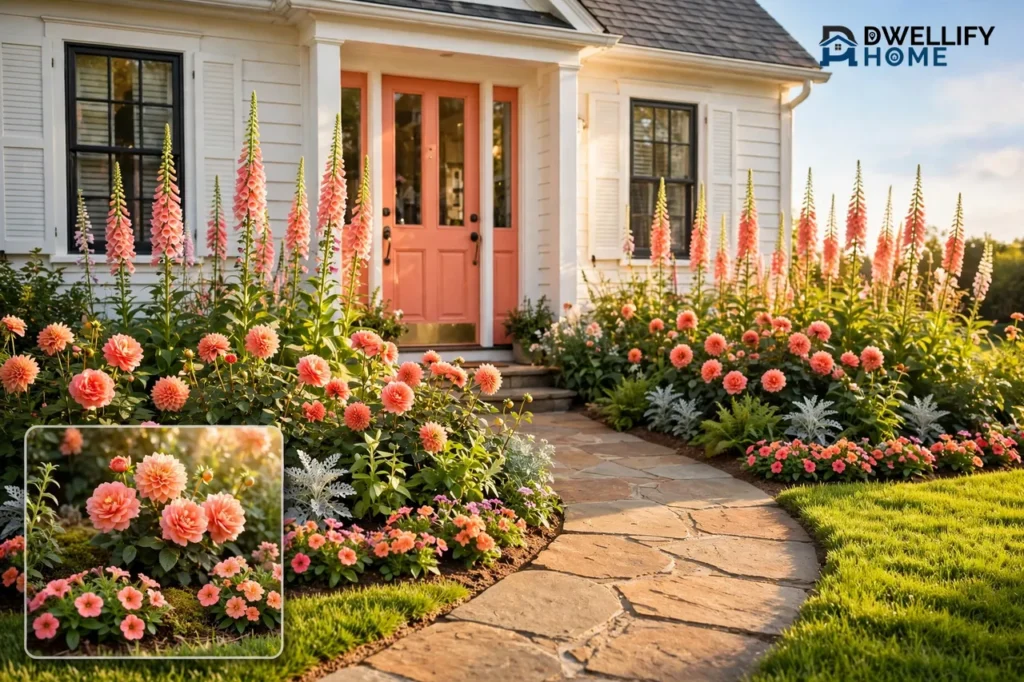
Start with one border instead of the whole yard. Pick the bed you see most, often the one by the front door or the patio, and make that your first cottage border. Plant it full, learn what thrives, and then copy what works into the next bed. A small cottage garden done well beats a big one that gets away from you, and it keeps the work fun instead of overwhelming. If that first border sits at the front of the house, our front-of-house landscaping guide shows how to frame the entry so the planting reads as welcoming, not messy.
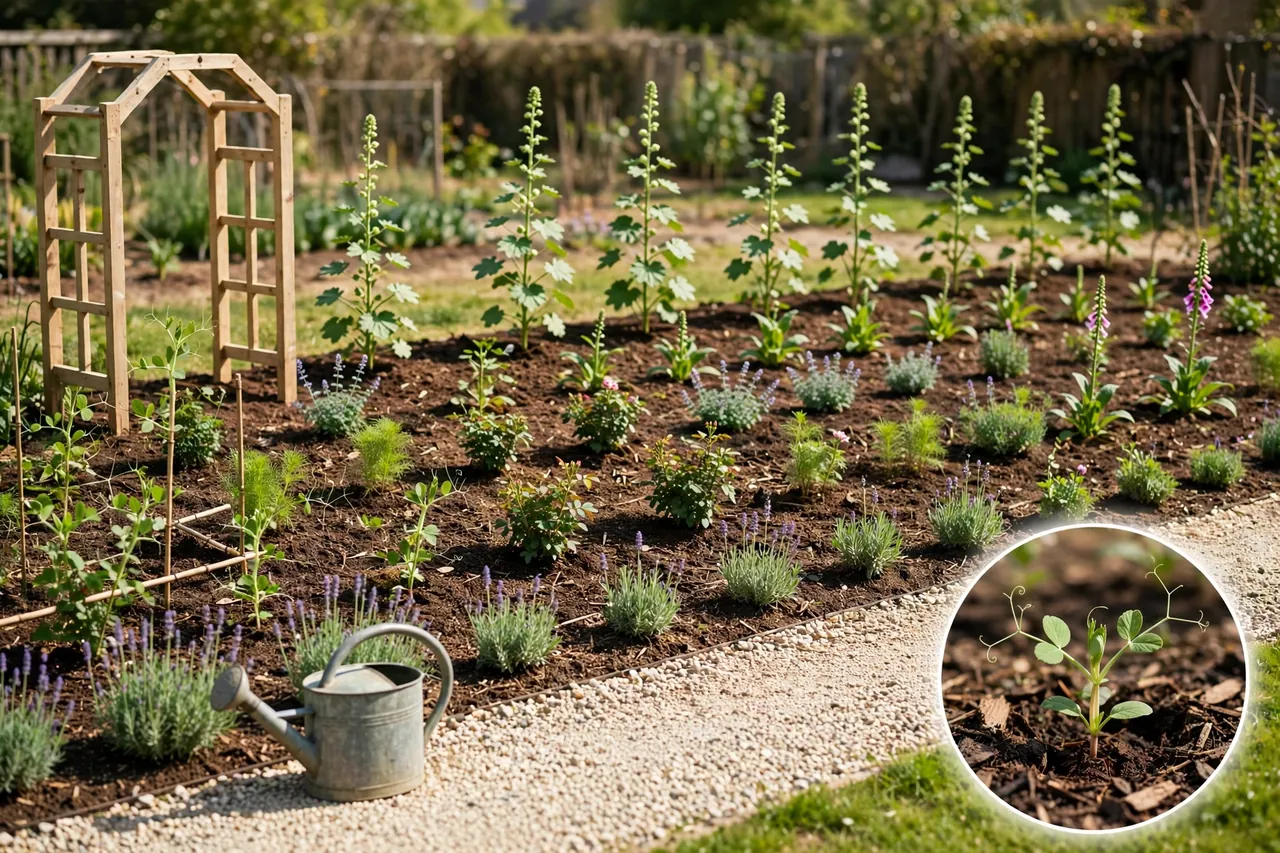
Give the garden one structure to lean on. A simple arch over the path, a low fence, a trellis on a wall, or even a single obelisk in a bed gives tall plants something to climb and gives the eye a place to rest. Without any structure, a full cottage garden can look like a jumble. With one or two strong pieces, it looks planned.
The Best Cottage Garden Plants
Cottage garden plants share a few habits: they flower generously, they mix well with neighbors, and many of them self-seed or spread a little on their own. Build your planting in three layers. Tall plants go at the back of a border or in the middle of an island bed. Medium plants fill the center. Low plants edge the front and spill onto the path. When each layer is full, the bed looks lush from every angle.
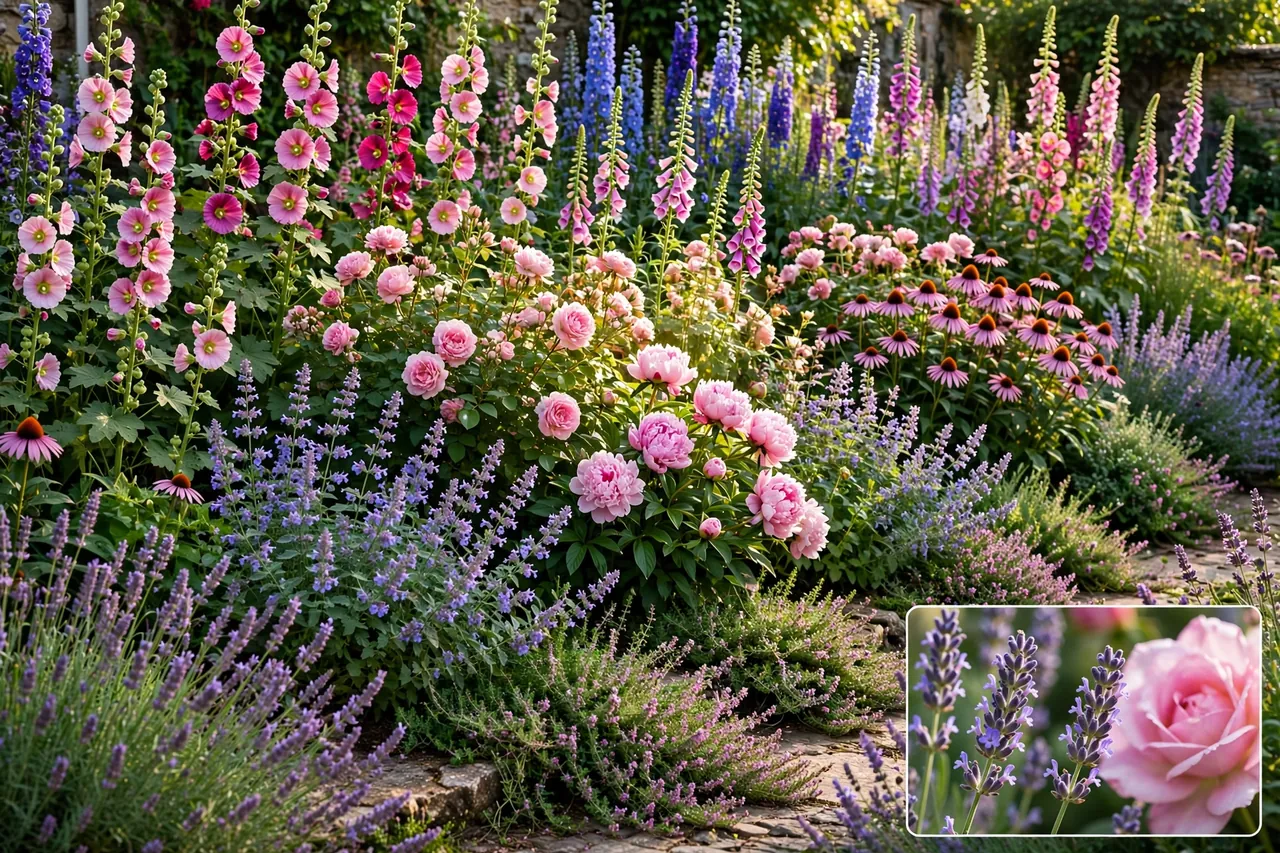
For the tall layer, lean on the classics. Hollyhocks grow six to eight feet tall and flower all summer in pink, white, yellow, and deep red. Foxgloves send up spires of bell-shaped blooms in late spring, and bees love them. Delphiniums bring blue, purple, pink, and white spikes in early summer, and some repeat later in the season. Climbing roses and clematis cover arches and fences with color and scent. A quick note before you plant foxgloves or delphiniums: all parts of foxgloves are toxic if eaten, and delphiniums are toxic too, so keep them away from spots where small children or pets chew on plants.
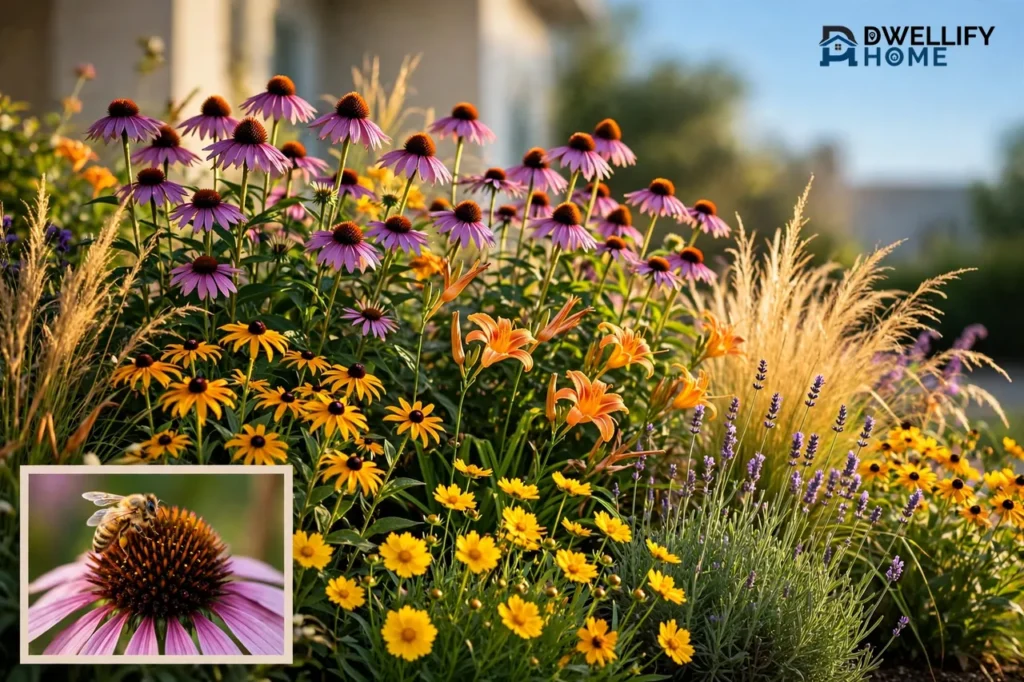
The middle layer does most of the work. Roses are the heart of it, especially shrub roses and old-fashioned varieties with scent, which flower from early summer into fall. Peonies bring big, soft blooms in late spring. Catmint makes waves of lavender-blue flowers that bees crowd around, and it keeps blooming if you shear it back after the first flush. Coneflowers stand up to heat and drought and feed birds with their seed heads in fall. Bee balm, also called monarda, adds bright red, pink, or purple flowers and draws hummingbirds. Lemon bee balm is one easy variety to try if you want that hummingbird pull in a sunny spot.
The low layer ties it all together. Lavender edges paths with purple spikes and scent, and it loves sun and sharp drainage. Hardy geraniums, also called cranesbills, make mounds of flowers that weave between taller plants. Sweet alyssum and lobelia fill gaps fast in the first year. Creeping thyme spreads between stepping stones and smells wonderful when you brush past it. Elfin thyme is a tiny, tight variety that works well tucked between stones. For shady edges, try creeping myrtle or periwinkle, but read our comparison of creeping myrtle vs periwinkle first, since one of them can spread fast enough to take over a bed.
Let a few plants self-seed on purpose. Foxgloves, hollyhocks, love-in-a-mist, and verbena drop seed and pop up in new spots each year. That is how a cottage garden gets its happy accidents, a seedling in a crack that turns out to be the prettiest plant in the bed. When a self-seeder lands in the wrong place, pull it while it is small or move it. When it lands in the right place, let it stay.
A Starter Plant List by Layer
Use this table as a shopping shortlist. Heights and bloom times are for typical varieties in average garden soil, so check the plant tag before you buy, since named varieties can run taller or shorter.
| Layer | Plant | Height | Bloom time |
|---|---|---|---|
| Tall | Hollyhock | 6 to 8 feet | Summer |
| Tall | Foxglove | 3 to 5 feet | Late spring to early summer |
| Tall | Delphinium | 4 to 6 feet | Early summer |
| Middle | Shrub rose | 3 to 5 feet | Early summer to fall |
| Middle | Peony | 2 to 3 feet | Late spring |
| Middle | Catmint | 1 to 2 feet | Late spring to fall |
| Middle | Coneflower | 2 to 3 feet | Summer to fall |
| Low | Lavender | 1 to 2 feet | Summer |
| Low | Hardy geranium | 1 to 2 feet | Late spring to summer |
| Low | Creeping thyme | Under 6 inches | Summer |
Buy plants in odd-numbered groups of three, five, or seven when you can. A drift of five lavender plants reads as a soft purple river, while one lonely plant reads as a dot. Repeat the same plant in two or three spots along a border, and the whole garden starts to feel connected instead of random. When you shop, compare the best places to buy plants online so you can find the exact varieties on your list without driving to five nurseries.
Match every plant to your USDA hardiness zone before you buy. The USDA Plant Hardiness Zone Map from the U.S. Department of Agriculture tells you your zone from your zip code, and the plant tag tells you which zones that variety survives. A plant that loves your zone will come back year after year with almost no fuss, while a plant two zones off will struggle no matter how well you water it.
Paths, Fences, and Arches That Set the Look
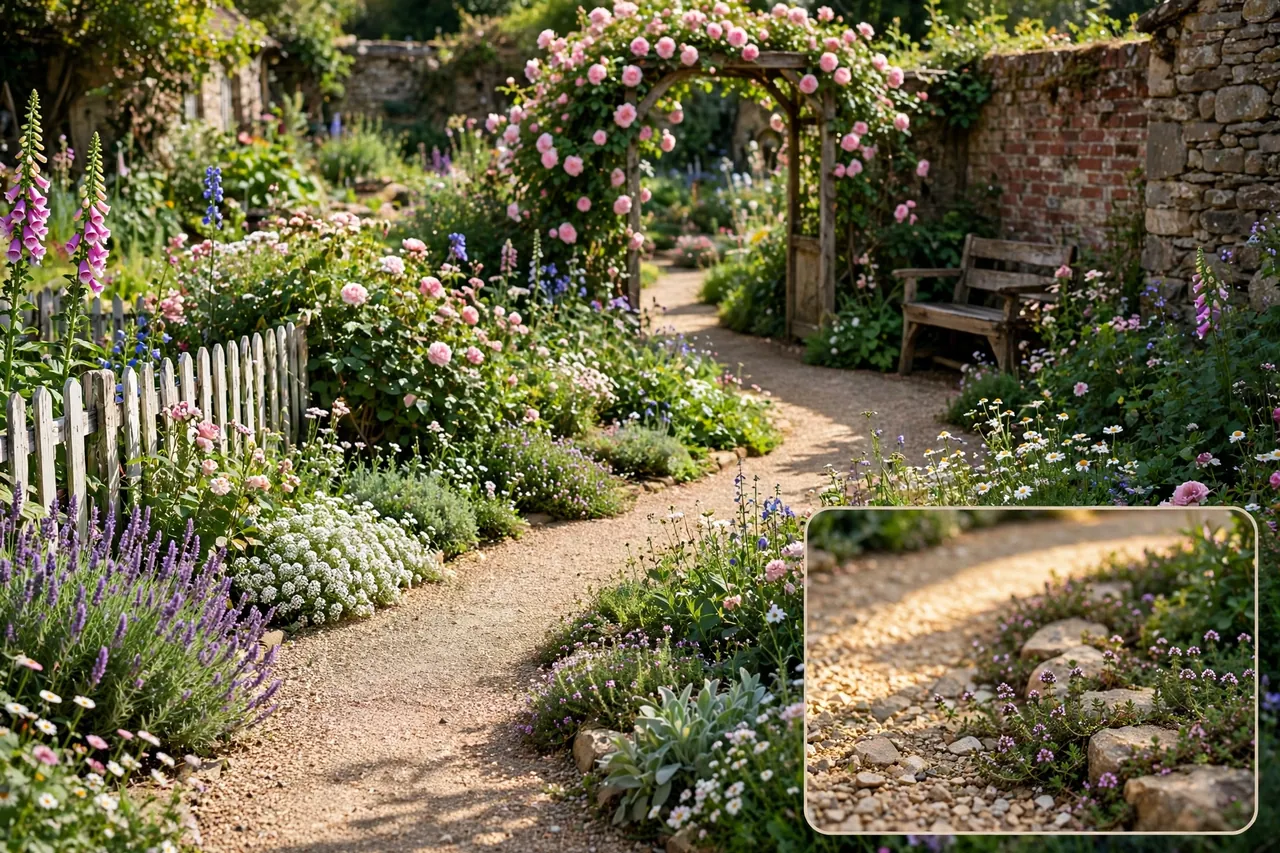
Paths do more than carry your feet. In a cottage garden, the path is the structure that keeps all that loose planting from looking messy. A winding path works better than a straight one, because a curve hides what is around the bend and makes even a small garden feel bigger. Gravel, brick, flagstone, and wood chips all fit the style, and a path that is a little uneven looks more at home here than perfect pavers.
Keep path materials natural and weathered. Old brick, reclaimed stone, and bark chips age well and blend with the planting. Avoid bright concrete, glossy tile, and plastic edging, which fight the soft cottage feel. Let low plants spill over the path edge a little. That overlap is the cottage look, as long as you can still walk through without ducking. If you want cheap ways to build one, our guide to cheap DIY garden path ideas covers gravel, stepping stones, and mulch paths you can lay in a weekend.
Fences and walls should feel like they grew there. A low picket fence, a woven hazel hurdle, a dry stone wall, or a simple wooden gate all fit. Paint them a soft color, white, sage green, or a pale blue, or leave the wood to weather gray. Avoid tall solid fences that shut the garden in and block the sun. A cottage garden wants to be seen from the street and to borrow the view beyond it.
Arches and arbors give you height and a moment of drama. Put one where the path enters the garden or where it turns a corner, and grow a climbing rose or clematis over it. In a year or two the arch disappears under flowers, and walking through it feels like stepping into a different room. Add a bench just past the arch, and you have the classic cottage garden moment: a seat, a view back through the flowers, and a reason to linger.
Color the Cottage Way
Cottage garden color is soft, mixed, and generous. The classic palette is pink, mauve, lavender, and soft blue, with white to cool it down and a touch of deep purple or magenta for drama. That palette works because it echoes the flowers themselves: roses, lavender, catmint, delphiniums, and foxgloves all live in that range. You do not need to plan every combination. If you stick mostly to pinks, purples, and blues, the garden will harmonize on its own.
Repeat one color along the whole border to hold it together. Three clumps of lavender spaced down a bed, or the same pink rose at each end, act like a thread that ties the planting together. Then let the other colors wander. A cottage garden can hold a lot of different flowers at once, as long as one or two colors repeat and keep it from turning into noise.
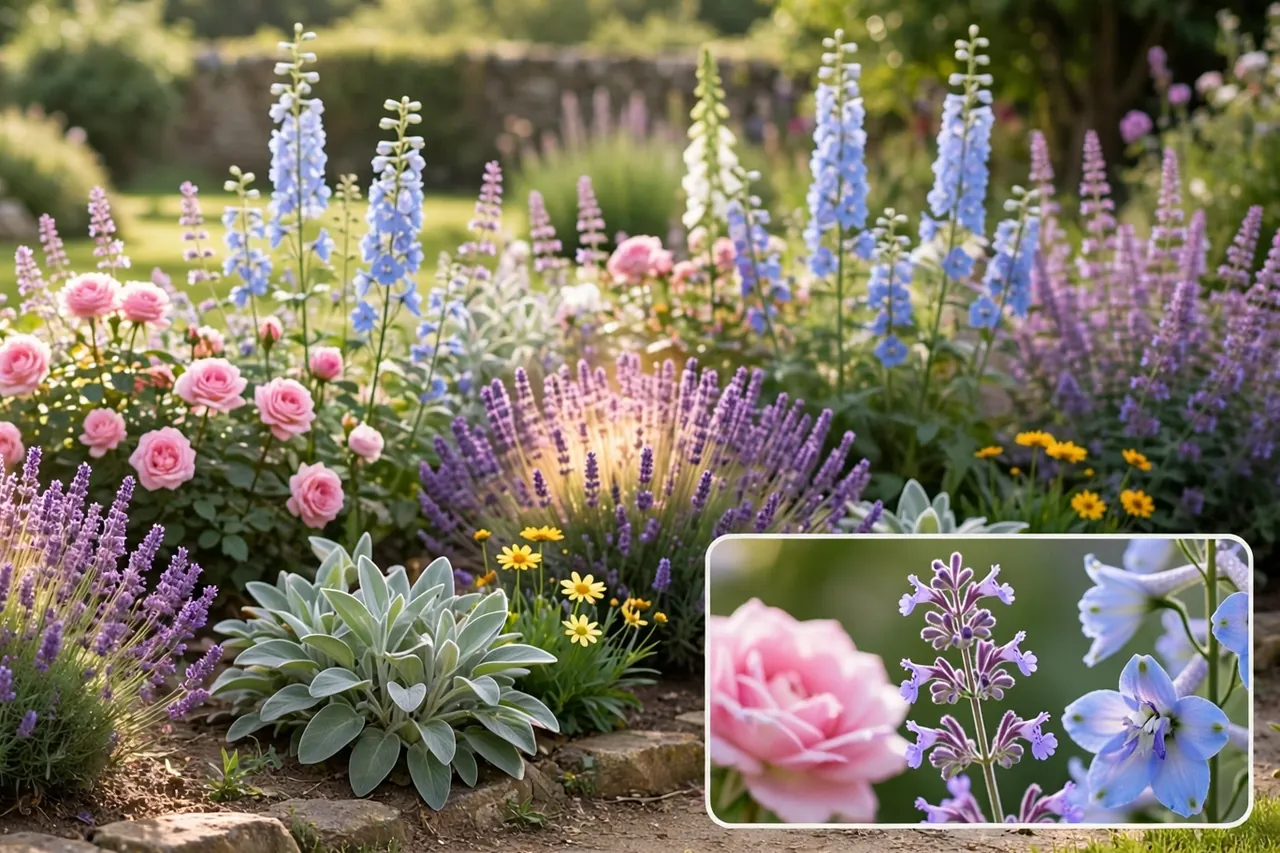
Use white and silver foliage as a resting place for the eye. White foxgloves, white roses, and white sweet peas cool down a hot pink stretch, and silvery plants like lambs ears, artemisia, and dusty miller make the pinks and purples look brighter beside them. A little yellow goes a long way too. A few yellow coreopsis or marigolds warm up a cool palette, but a whole bed of yellow can overpower the soft cottage feel.
Plan for color in every season, not just June. Spring bulbs like tulips, daffodils, and grape hyacinths open the show. Summer belongs to roses, lavender, and delphiniums. Fall brings asters, sedum, and the seed heads of coneflowers and grasses. Winter interest comes from evergreen shrubs, rose hips, and frosted stems. When you pick plants, check the bloom time on the tag and make sure each month from April to October has at least two or three things in flower.
Mix In Herbs and Edibles
A true cottage garden feeds the kitchen as well as the eye. That is the oldest part of the style, and it is the easiest way to make your garden feel authentic. Tuck herbs along the path where you can brush them as you pass. Rosemary, thyme, sage, chives, and parsley all look at home between flowers, and they earn their place by flavoring dinner. Lavender counts twice, since you can dry it for drawers and bake with it too.
Mix vegetables in among the flowers instead of hiding them in a separate patch. Rainbow chard has bright stems that look like flowers. Scarlet runner beans climb a wigwam and flower in red all summer before they feed you. Cherry tomatoes can ramble up an obelisk beside the roses. Lettuce and salad leaves grow fast in the shade of taller plants, and a few nasturtiums add orange flowers you can eat in salads. The rule is simple: if it looks good and tastes good, it belongs.
Grow fruit the cottage way, on walls and in corners. A trained apple or pear against a sunny wall takes almost no ground space and gives you blossom in spring and fruit in fall. Raspberries and currants fit along a fence, and strawberries make a sweet groundcover at the front of a bed. Pick varieties that suit your zone and your sun, and prune them once a year so they stay productive instead of tangled.
Keep edibles easy to reach and easy to water. Put the herbs and salad plants near the kitchen door or at the front of the border, where you will actually pick them. A small raised bed near the path works well for vegetables, since it keeps the soil loose and the plants at a comfortable height for picking. Water edibles more often than flowers, and mulch them well, since a dry tomato plant drops its fruit and a dry lettuce turns bitter.
Cottage Gardens in Small Spaces
You do not need a big yard. A cottage garden works in a front yard strip, a side yard, a small backyard, or even a terrace full of pots. The trick is to think in layers and go up as well as out. A small space with a climbing rose, a tall foxglove, and a low lavender hedge feels full and generous, because every inch holds a plant.
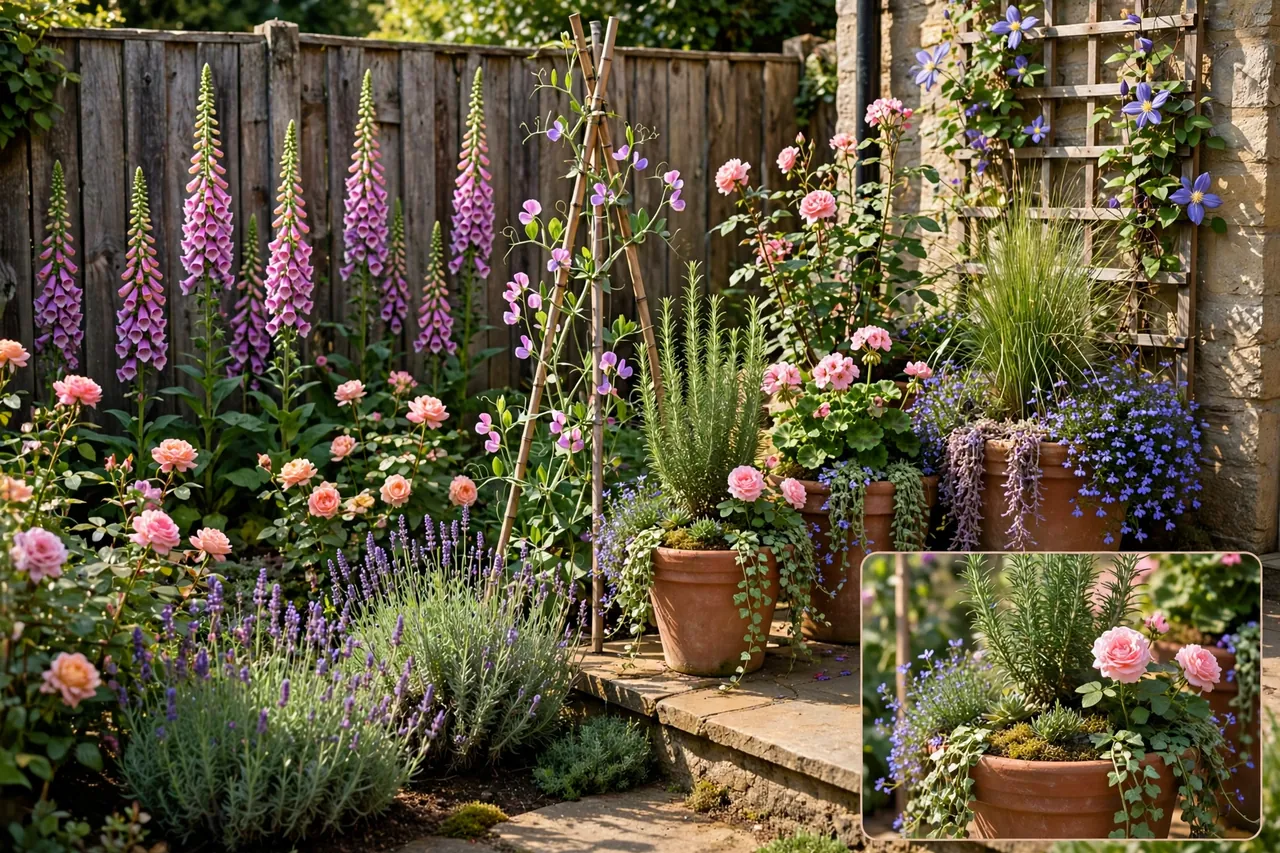
On a terrace or balcony, go big with pots. Fill large containers with flowering perennials and fragrant herbs, such as verbena, lavender, and coneflowers, and add annuals like sweet peas and cosmos for color that changes each year. One large pot planted thickly looks far better than five small pots with one plant each. Mix a tall plant, a filler, and something that tumbles over the edge in each container, and group the pots close together so the planting reads as one garden instead of scattered pots.
Use walls and fences as planting space. A trellis with clematis or jasmine, a wall-mounted planter with herbs, or a hanging basket of trailing lobelia all add flowers without taking ground space. In a narrow side yard, a single deep border along one fence, with tall plants at the back and low ones at the front, can hold a full cottage planting in a strip only three feet wide.
Choose compact varieties when space is tight. Dwarf hollyhocks, compact lavender like Hidcote, and smaller shrub roses give you the cottage look without swallowing the garden. Check the mature size on the tag, not the size of the plant in the pot, and leave enough room for it to grow. A plant that needs three feet at maturity will crowd out its neighbors in a year if you plant it in a one-foot gap.
Keep It Lush Without Losing Control
A cottage garden needs regular care, but not fussy care. The work is mostly editing: pulling what does not belong, cutting back what finished flowering, and letting the good plants fill in. Set aside a short session each week in the growing season, and the garden will stay lush without ever turning into a chore.
Water deeply and less often, so roots grow down instead of staying near the surface. New plants need water every few days for the first season until they settle in. After that, most cottage perennials manage on rain plus a deep soak in dry spells. Water in the morning so leaves dry before night, which cuts down on mildew, and water the soil, not the flowers. Mulch with two to three inches of compost or bark in spring to hold moisture and smother weeds.
Deadhead spent flowers to keep the blooms coming. Snip off faded roses, delphiniums, and catmint, and many of them will flower again. Leave some seed heads standing in fall, though, since coneflowers and grasses feed birds and look lovely with frost on them. Cut the whole border back in late winter or early spring, before new growth starts, and the garden will come back fresh and full.
Edit the self-seeders once a month. Pull seedlings that landed in paths, in the middle of another plant, or too close to the house. Thin out crowded clumps so air can move between plants, which keeps mildew down. And stake the tall plants early, before they flop. A few bamboo canes and soft twine in spring, put in while the plants are still short, will hold up delphiniums and hollyhocks through summer storms.
Common Cottage Garden Mistakes to Avoid
The biggest mistake is planting too far apart. Beginners space plants like a formal garden, with bare soil between them, and then wonder why the bed looks thin. Cottage planting wants plants close enough to touch. Space by the mature width on the tag, not by how the plant looks in its pot, and accept that the bed will look crowded in year one and perfect in year two.
The second mistake is skipping the structure. A garden with no path, no arch, and no fence is just a crowd of plants. You need at least one piece of structure so the eye has somewhere to rest and your feet have somewhere to go. Even a simple gravel path and a low fence change the whole feel.
The third mistake is planting for one month only. A bed full of June flowers looks wonderful for three weeks and bare for the rest of the year. Mix in spring bulbs, summer perennials, fall asters, and a few evergreens, so the garden earns its keep from April to October and still looks good in winter.
The fourth mistake is ignoring the zone and the sun. A lavender planted in shade will stretch, flop, and rot. A delphinium planted in a hot, humid spot will melt by July. Check the sun hours and the hardiness zone before you buy, and pick plants that match your yard, not just the ones in the prettiest photo. Your local nursery can confirm which varieties handle your winters, since a plant that thrives two states away may not survive yours.
A Simple First-Year Plan
Follow these steps in order, and you will have a real cottage garden by the end of your first growing season. The plan assumes one border about ten feet long and three feet deep, in a sunny spot. Scale it up or down to fit your yard.
- Watch the sun for a week. Note which hours the bed gets direct sun, and confirm it gets at least six hours before you buy sun lovers.
- Clear the bed and improve the soil. Pull weeds, fork in two to three inches of compost, and rake the surface level.
- Lay the path first. Put down gravel, stepping stones, or bark along the front edge so you can reach the bed without stepping in it.
- Set the structure. Add an arch, a trellis, or an obelisk where a climber will grow, and fix it firmly before you plant around it.
- Plant the tall layer at the back. Put in hollyhocks, foxgloves, and delphiniums first, spaced by their mature width.
- Plant the middle layer next. Add roses, peonies, catmint, and coneflowers in groups of three or five.
- Fill the front with low plants. Edge the bed with lavender, hardy geraniums, and creeping thyme.
- Water everything deeply, then mulch. Soak the bed, spread two inches of mulch, and keep the mulch off the plant stems.
- Fill the gaps with annuals. Sow cosmos, sweet peas, and nasturtiums in the bare spots for color in year one while the perennials settle in.
- Edit monthly. Pull weeds and stray seedlings, deadhead faded flowers, and stake tall plants before they flop.
By fall, your perennials will have settled in and your annuals will have filled every gap. Cut back the spent annuals, leave the seed heads for the birds, and plan next spring’s additions. Year two is when a cottage garden truly arrives, because the plants you put in this year will come back bigger, fuller, and ready to self-seed into the gaps you left for them.
Related Guides
Best Plants for Small Gardens · Small Backyard Garden · Side Yard Ideas
- Cheap DIY Garden Path Ideas — gravel, stepping stone, and mulch paths you can lay in a weekend.
- Best Places to Buy Plants Online — where to find the exact cottage varieties on your list.
- Elfin Thyme Seeds — a tiny thyme that fills the gaps between stepping stones.
- Monarda Citriodora Lemon Beebalm — a bee balm that draws hummingbirds to a sunny border.
- Creeping Myrtle vs Periwinkle — which groundcover suits a cottage border, and which one spreads too fast.
Frequently Asked Questions
What is cottage style gardening?
Cottage style gardening is a personal, informal style built on a happy riot of color and a wonderful sense of abandon. It blends color, texture, and form in dense, mixed planting, with flowers, herbs, and edibles growing together, and it balances that lush fullness so it feels generous instead of chaotic.
What are the key elements of new cottage style gardens?
The key elements are easy curves in the pathways, more flowering shrubs for rotating seasonal color, informal and low-maintenance planting, evergreens chosen wisely for year-round structure, and decorative touches like urns and arbors paired with dramatic plants. Together they give the garden its relaxed, layered look.
How can you make a cottage garden low-maintenance?
Use color from shrubs and perennials instead of relying on annuals you must replant each year. Plant closely to minimize weeding, let plants lap over pathways a little, and choose evergreen shrubs of different heights and leaf colors to hold interest through winter. Pick plants that match your sun and zone, and most of the work takes care of itself.
What climbing plants are recommended for cottage gardens?
Climbing roses, clematis, honeysuckle, jasmine, and wisteria are the classic choices. A rambling rose covers an arch fast and fills the air with scent, clematis pairs well with roses on the same support, and American wisteria gives you the same draped flowers as Chinese wisteria but grows more slowly, which suits a smaller garden better.
I love cottage garden plants, but only have a small terrace – what should I grow?
Go big with pots. Fill large containers with flowering perennials and fragrant herbs, such as verbena, lavender, and coneflowers, and add annuals like sweet peas for color that changes each year. Train the sweet peas over a small bamboo cane tripod, and mix a tall plant, a filler, and a tumbler in each pot so it reads as a tiny cottage garden.
A cottage garden rewards you for starting, not for waiting until it is perfect. Pick one border, lay one winding path, plant it full with the classics, and let it grow a little wild. Next year it will be fuller, the year after that it will start surprising you with seedlings in all the right places, and the garden will feel more like yours with every season. Start this weekend, and by next summer you will be sitting on a bench in the middle of it, wondering why you waited so long.