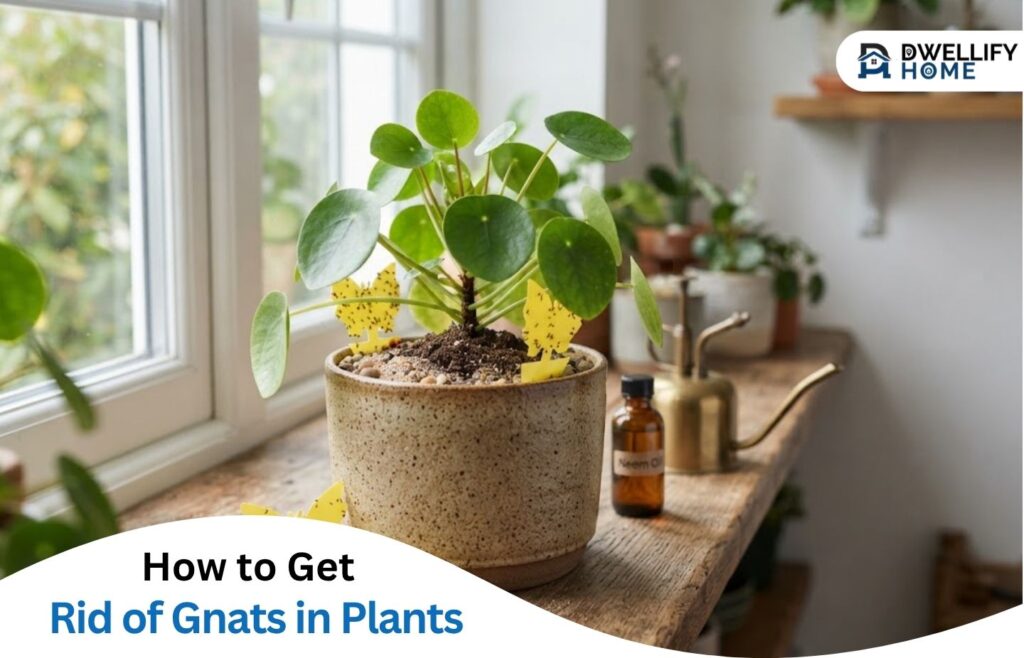
A few tiny flies rise from the soil when you water a houseplant. Soon, one is hovering near your coffee, and another is circling your screen. Swatting the flies gives little relief when more keep appearing.
To get rid of gnats in plants, first confirm they’re coming from the potting soil. Adjust watering to reduce excess moisture, catch flying adults with yellow sticky traps, and use a suitable larval treatment when needed. Keep following the treatment directions as numbers fall.
The useful distinction is simple: catching the flies you see and controlling the young insects in the soil are different jobs.
Short Definition / Direct Answer
To get rid of gnats in plants, confirm the source, reduce excess soil moisture without stressing the plant, catch adults with yellow sticky traps, and use a suitable larval treatment when needed, following its label.
Practical Home Tip
A crowded sticky trap records past activity, so it can make progress hard to judge. Date each fresh trap and compare catches over similar periods in the same spot. Fewer flies suggest improvement, but they don’t prove all the larvae are gone.
DwellifyHome Mission Statement
DwellifyHome helps homeowners and renters make informed, practical choices for comfortable, stylish living spaces, with clear guidance that fits everyday needs.
Plant-gnat action checklist
- Confirm which pots are affected.
- Remove dead leaves and check drainage and saucers.
- Adjust watering to suit each plant.
- Place yellow sticky traps near the soil.
- Use a labeled larval treatment when needed.
- Follow repeat-treatment directions and compare fresh trap catches.
- Inspect incoming plants and review watering as conditions change.
Are the Gnats Coming From Your Plant Soil?
Fungus gnats are small, dark flies with slender legs and antennae. They look a little like tiny mosquitoes, but they don’t bite. Look for weak, fluttering flights near pots and insects walking across the soil.
Their larvae—the young, wormlike stage—live in the growing mix. These have pale, almost clear bodies and dark heads. Adults are mainly a nuisance, while heavy larval populations can damage roots, particularly in seedlings and young plants.
Check which pots have flies around them before treating your whole collection. A sticky trap beside each suspect plant can help you narrow the search.
Flies gathering near a window don’t necessarily breed there. Likewise, insects around a sink don’t prove your plants are responsible. When the source remains unclear, identify it before adding more products to the soil. Plant soil and damp debris elsewhere can both need investigation.
How to Get Rid of Gnats in Plants, Step by Step
Start with the conditions in the pot, then choose controls that fit the problem. You don’t need a cupboard full of remedies or a different treatment every day.
1. Check Your Pots and Remove Dead Plant Material
Inspect the plants near the worst-affected pot, including small nursery pots tucked behind larger ones. Note where you see flies, wet soil, or fallen leaves.
Remove dead leaves and spent flowers from the soil surface. Check beneath the pot and inside any decorative outer container. Empty water left after ordinary watering, and clear away loose, decaying plant material.
These checks cost nothing and give you a clearer starting point. They also help prevent a common mistake: concentrating on the plant nearest your chair while overlooking another affected pot.
For a larger collection, jot down each suspect plant’s name and the date you began treatment. A short note is enough; you don’t need a detailed plant-care spreadsheet.
2. Adjust Watering and Check Drainage
Give the soil surface a chance to dry between waterings, as far as your plant’s needs allow. Constantly moist growing mix favors fungus gnats, so correcting unnecessary watering is part of control.
Avoid treating “let the top two inches dry” as a rule for every plant. A small propagation pot and a large established houseplant need different judgments. Don’t deliberately wilt a plant or dry its entire root ball to fight insects.
Before watering, check the mix instead of relying only on the day of the week. Make sure the inner pot has drainage holes and that excess water can escape.
Bottom watering may suit your usual care routine, but it isn’t a guaranteed gnat treatment. Check the resulting moisture rather than assuming the upper soil stays dry. A pot should not remain soaking indefinitely simply because the water entered from below.
If a treatment requires particular soil moisture, follow those instructions too. The aim is suitable plant care, not the driest possible pot.
3. Place Yellow Sticky Traps Near the Soil
Position yellow sticky traps close to the growing mix, following the trap instructions. Keep the sticky surface clear of leaves and somewhere children and pets won’t brush against it.
Traps catch flying adults and help you see where activity continues. They don’t reach larvae inside the pot, so a full trap doesn’t mean the source has been removed.
Write the installation date on the trap’s holder or keep a phone note. Replace traps when they become crowded, dusty, or no longer useful.
You can begin trapping while you review watering and select any needed soil treatment. There’s no benefit in waiting for one approach to “fail” before addressing another part of the problem.
4. Choose a Suitable Treatment for the Larvae
For persistent activity, consider a treatment intended for fungus-gnat larvae in houseplant soil. Check the pest, application site, and directions on the package before buying.
Bti is short for Bacillus thuringiensis subspecies israelensis. It is a naturally occurring bacterium used in products that target certain fly larvae, including fungus gnats.
A soil drench means applying treatment in water to the growing mix. It does not mean spraying the room or coating every leaf.
Mosquito Bits is one labeled example. Its published specimen label describes soaking four tablespoons in one US gallon of water for 30 minutes, removing the granules, stirring the water, and applying it to the soil surface. It specifies repeating weekly for three weeks. Follow your own package if its directions differ.
That example is not a mixing rule for other Bti products. Nor does the gallon amount mean you should pour a gallon into one pot.
Steinernema feltiae is another option: beneficial microscopic worms that attack fungus-gnat larvae. These are living organisms, so storage, application timing, temperature, and moisture instructions matter. Don’t combine their use with an aggressive drying routine.
| Option | Target | Useful role | Main limitation |
| Yellow sticky traps | Flying adults | Catch flies and show activity | Do not directly treat soil larvae |
| Bti product labeled for the use | Larvae | Treat the source in the growing mix | Requires correct application and label-directed repetition |
| Steinernema feltiae | Larvae | Provide biological control | Living product with specific handling and moisture needs |
Start with one suitable larval treatment rather than mixing several remedies. Check directions before combining any products.
For herbs or other edible plants, confirm that the intended use is allowed. Also follow handling precautions: a naturally derived ingredient does not remove the need to read the package. The Mosquito Bits specimen label, for example, includes dust and skin-contact precautions.
Choose a treatment schedule compatible with your plant’s care. If following a drench schedule would keep the pot excessively wet, ask the supplier or an extension service about an appropriate alternative.
Do Home Remedies for Plant Gnats Work?
Home remedies are appealing because the ingredients are already nearby. The difficulty is knowing whether a recipe controls the pest reliably and suits the plant.
Begin with practical measures such as cleaning up plant debris, correcting excess watering, and using traps. Treat kitchen-ingredient claims more cautiously.
Cinnamon and Hydrogen Peroxide
Don’t rely on a dusting of kitchen cinnamon as your main fungus-gnat treatment. The evidence reviewed for this guide does not establish a dependable household application that clears an infestation.
Hydrogen peroxide deserves similar care. Online recipes can leave readers unsure about the starting strength, dilution, amount, and repeat schedule. A ratio shared without those details is not useful plant-care guidance.
A general peroxide recipe could not be verified well enough to recommend here. Choose an appropriately labeled larval treatment rather than guessing a stronger mix when the first attempt seems unsuccessful.
This does not mean every reported success is invented. It means a personal account cannot tell you which part of a combined routine worked or whether it will suit your plants.
Neem Oil, Sand, and Other Soil Toppings
“Neem oil” is not a complete set of treatment instructions. Check the exact formulation and whether its label permits the proposed soil application. Don’t assume a leaf-spray recipe can also be poured through the roots.
Sand and powders are often suggested as barriers. However, Kansas State reports that studied sand layers and diatomaceous-earth applications did not provide the expected fungus-gnat control. Those findings do not test every possible product, but they weaken blanket claims that a topping solves the problem.
Avoid adding layer after layer simply because flies remain visible. Recheck the source and treatment plan first.
How Long Does It Take, and Why Do Gnats Keep Coming Back?
Expect control to require follow-through over several weeks, rather than judging success after one watering. Timing depends on conditions, the chosen method, and whether every source has been addressed.
At typical room temperatures of 65–75°F, a fungus gnat’s egg-to-adult life cycle may take about three to four weeks. That biological timing is not a promise that your home will be clear by a particular date.
Check Progress With Fresh Traps
An old trap records past activity. It cannot tell you how many flies are arriving today.
Try comparing fresh traps over similar periods—for example, one week against the next—with roughly the same placement and number of traps. You’re looking for a trend, not a perfect count.
Imagine one trap caught many flies during the first week and only a few during the next. That suggests improvement. It does not prove the pot contains no larvae, so complete the treatment’s stated schedule.
Keep a simple record of treatment dates alongside trap changes. This helps you avoid both missed applications and unnecessary extra doses.
Look for Missed Pots and Ongoing Moisture
When activity stays high, check these points before changing products:
- Was the pest correctly identified?
- Are flies coming from another pot or damp source?
- Is water collecting inside an outer planter?
- Was the product applied to the intended place?
- Were preparation and repeat instructions followed?
- Has plant care left the mix continually wet?
A new fly after treatment does not, by itself, answer any of those questions. Work through the checks instead of assuming you need a stronger dose.
Also avoid blaming yourself for every recurrence. New plants and growing mix deserve inspection too.
Decide Whether Repotting or Extra Help Is Needed
Repotting can make sense when the growing mix has broken down and holds too much moisture. It should be a response to the pot’s condition, not an automatic step for every plant with a fly nearby.
Assess plant health separately. Wilting and poor growth can have several causes; seeing gnats does not prove they explain every symptom.
For a declining plant or uncertain insect identification, contact your local university extension service. A clear close-up photo, plant name, watering history, and treatment record can make that conversation more useful.
Persistent flies with no confirmed plant source may warrant a pest professional’s inspection, especially when hidden moisture is suspected.
How to Keep Gnats From Coming Back
Prevention works best as part of ordinary plant care. Use a short routine you can maintain:
- Inspect incoming plants. Check new purchases and plants returning indoors before placing them among the collection.
- Store potting mix carefully. Keep unused mix closed and off the ground.
- Keep containers tidy. Remove fallen leaves and check saucers during watering.
- Review moisture regularly. Adjust watering when the mix stays damp longer than usual.
Inspecting incoming plants is especially useful when moving outdoor pots inside. Plant-inspection advice
Avoid assuming your summer watering routine will suit the same plant all winter. Slower growth and lower water use can leave the mix wet for longer.
Once the problem settles, keep the helpful habits rather than adding preventive doses of an unverified home remedy. Deal with fresh activity early, while still checking what the plant actually needs.
Frequently Asked Questions
Can I Put Vinegar in My Plants to Kill Gnats?
Don’t use household vinegar as an improvised soil drench. A vinegar trap beside a plant and vinegar poured into its pot are different treatments; a trap recipe does not establish a suitable soil dose. Choose yellow traps for flying adults and a labeled treatment when larvae need control.
Will Coffee Grounds Get Rid of Fungus Gnats?
Don’t rely on coffee grounds to clear an infestation. They are not an established fungus-gnat treatment in the university guidance reviewed here. Keep the pest-control plan focused on the source, plant care, adult traps, and any needed larval treatment rather than adding grounds to the pot.
Do I Need to Throw Away a Plant With Gnats?
Usually, finding gnats is a reason to inspect and treat the plant, not immediately discard it. Consider its overall condition and whether you can manage the infestation. A severely declining plant may need a different decision, but a few visible flies alone don’t justify throwing away a healthy houseplant.
Can Fungus Gnats Spread to Other Houseplants?
Yes. Adults can move between pots, so inspect nearby plants as well as the one with the most visible flies. Avoid moving an infested pot into an unaffected plant group. Finding another affected pot changes where you focus control; it doesn’t mean you must automatically repot the entire collection.
Keep Following the Plan as Gnats Decline
Start by finding the source, then give each part of the plan a clear job: suitable watering, adult traps, and larval treatment when needed. Watch fresh activity and follow the product’s directions.
As numbers fall, keep checking plant health too. The goal is a manageable care routine that leaves you with healthier conditions and fewer returning gnats.
Disclaimer
This guide provides general information. Homes, plant needs, budgets, and conditions vary. Follow product labels, and seek advice from a local extension service or qualified pest professional when identification or treatment is unclear.