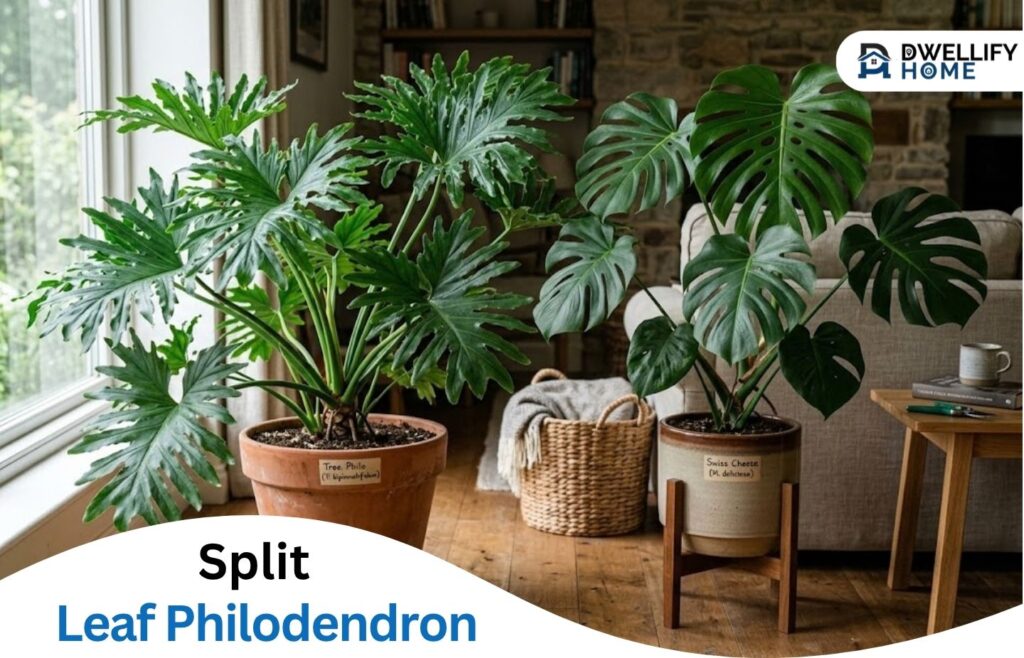
A split leaf philodendron label doesn’t always tell you which plant you’ve brought home. It can refer to a broad, deeply lobed tree philodendron or a climbing Monstera with holes in its leaves.
Both can become substantial houseplants, but they don’t need identical treatment. Identifying yours first makes decisions about watering, support, pruning, and propagation much clearer.
Short Definition
“Split leaf philodendron” is a common name used for tree philodendron and Monstera deliciosa, two large-leaved houseplants. Identifying the plant behind the label helps owners choose appropriate care, support, and propagation methods.
DwellifyHome Mission Statement
DwellifyHome helps homeowners, renters, and home lovers make informed, practical choices that bring comfort, style, and everyday usefulness to their living spaces.
Which plant do you have: tree philodendron or Monstera?
Tree philodendron usually has deeply divided leaves on long stalks attached to a thickening central stem. Monstera deliciosa climbs, producing aerial roots and, as it matures, leaves with both edge splits and enclosed holes. Look at the whole plant: young leaves alone can be misleading.
Tree philodendron appears under several botanical names. NParks lists it as Thaumatophyllum bipinnatifidum, with Philodendron bipinnatifidum and Philodendron selloum as synonyms. Monstera deliciosa belongs to a different genus, although both plants belong to the arum family, Araceae. Compare the reference photographs from NParks and NC State Extension.
| What to examine | Tree philodendron | Monstera deliciosa |
| Mature leaves | Deep, often wavy lobes extending inward from the edges | Edge splits plus enclosed holes within the blade |
| Growth pattern | Spreading crown; thick stem develops conspicuous old leaf scars | Climbing stem with leaves attached along its length |
| Young foliage | Shallower divisions than mature leaves | May have no splits or holes |
| Support needs | Often stands independently when young; large specimens may need stabilizing | Benefits from a sturdy climbing support |
The leaf stalk, called a petiole, connects one leaf to the main stem. Follow it back before deciding where to prune or take a cutting.
Split leaf philodendron care at a glance
| Care factor | Tree philodendron | Monstera deliciosa |
| Indoor light | Bright, indirect light | Bright, filtered light |
| Watering cue | Surface mix has dried; avoid prolonged saturation | Upper portion of the mix has dried |
| Pot and soil | Drainage holes and an airy mix that retains some moisture | Drainage holes and an airy mix that retains some moisture |
| Space | Allow for a spreading crown | Allow height and room for support |
| Propagation approach | Suitable offshoots; stem cuttings require care | Stem cutting that includes a node |
| Household safety | Keep away from chewing pets and children | Keep away from chewing pets and children |
Treat these as starting points. Light, pot size, roots, and room conditions determine how quickly each plant uses water.
Build a care routine that fits your home
Choose the right light, temperature, and humidity
Start near a bright window with protection from harsh midday sun. Across the room, an attractive empty corner may receive too little light for strong growth. A sheer curtain can soften intense exposure without moving the plant into deep shade.
Ordinary warm household conditions suit both plants. Keep foliage away from cold glass, drafts, and heating vents. Typical indoor humidity can be adequate; don’t assume brown tips automatically mean the room needs a humidifier. The RHS philodendron guide emphasizes indirect light, warmth, and suitable watering alongside humidity.
Change light exposure gradually, especially when moving a plant outdoors. A leaf grown inside isn’t prepared for hours of direct summer sun.
Check moisture before you water
Water when the potting mix has dried sufficiently, rather than on a particular weekday. Check below the surface with a finger and compare the pot’s weight after watering with its weight as it dries.
For tree philodendron, aim for moisture below a drying surface without leaving the roots persistently wet. For Monstera, NC State recommends allowing roughly the upper quarter to third of the mix to dry between waterings.
Water thoroughly until excess escapes through the drainage holes, then empty the saucer or decorative outer pot. A draining nursery pot inside a cover pot works well only when trapped water is removed.
Both overly wet and overly dry roots can cause wilting, so check moisture before responding to drooping. University of Maryland Extension explains why temperature, humidity, containers, and growing media change watering needs.
Match the pot and soil to the roots
Choose a pot with drainage holes and a loose houseplant mix that holds moisture while allowing excess water to escape. Bark and perlite can improve the structure of a dense mix; there’s no need to chase one supposedly essential recipe.
Repot when the root ball has become crowded and normal watering is difficult to manage. Move up only a modest pot size. A much larger container holds extra wet mix around a relatively small root system.
Terracotta usually dries faster than plastic or glazed containers. Don’t add gravel beneath the mix as a substitute for drainage holes. These container and growing-medium principles are covered by Maryland Extension’s repotting guidance.
Feed during growth and keep the leaves clean
Use a houseplant fertilizer according to its label while the plant is actively growing. Reduce feeding when growth slows, and check whether fresh potting mix already contains fertilizer.
Wipe dusty leaves gently with a damp cloth, supporting each leaf underneath. Cleaning also gives you a chance to inspect leaf undersides and the places where stalks meet stems. Avoid treating fertilizer as a remedy for unexplained yellowing; check growing conditions first.
Can your split leaf philodendron stay outside?
Both plants can spend warm weather outdoors, provided they’re gradually introduced to brighter conditions and protected from cold. Keeping either outside year-round requires a suitable local climate. A sheltered patio in summer is a different situation from a permanent planting exposed to winter weather.
Begin in a sheltered, shaded position. Move into brighter exposure gradually, watching for pale or scorched patches. Wisconsin Extension recommends gradual outdoor acclimation for Monstera deliciosa.
For container plants, bringing them indoors before nights settle below about 60°F is a cautious household approach, rather than a claim about their survival limit. NC State specifically recommends this threshold for tree philodendron.
Check drainage after heavy rain and inspect for pests before bringing plants inside. For permanent outdoor planting, confirm the species and ask local extension staff about winter exposure; a USDA hardiness zone alone doesn’t describe every growing condition.
How to propagate the plant you actually have
Propagating Monstera deliciosa
Use a stem cutting containing a node—the point on the main stem where a leaf and potential new growth originate. A detached leaf stalk without the necessary stem tissue won’t produce a complete new Monstera.
- Find a healthy section of stem with a node and preferably a leaf.
- Cut below the node with a clean, sharp tool.
- For water propagation, keep the node submerged and the leaf above water. Replace water when it becomes cloudy.
- Keep the cutting in bright, indirect light. Transfer it to potting mix once it has developed a useful root system.
The RHS Monstera guide supports rooting stem cuttings in water. Rooting speed varies; a fixed deadline isn’t a reliable measure of success.
Propagating tree philodendron
Look for a distinct offshoot with its own roots and growing point. Separating a suitable offshoot during repotting is a more manageable starting point than cutting through the main trunk. UF/IFAS identifies offshoot division as a propagation method for this plant.
Gently expose the connection, preserve the offshoot’s roots, and separate it with a clean tool if necessary. Pot it in a container suited to its root system.
Don’t pull apart a single crown or assume that a leaf stalk will behave like a Monstera stem cutting. Stem propagation is possible, but without an obvious offshoot, seek advice from an experienced nursery before making a major cut.
What yellow leaves, brown tips, and drooping can tell you
These symptoms are clues, not diagnoses. Check moisture, drainage, recent changes, and pests before choosing a treatment.
| Symptom | What to check | Sensible next action |
| Several yellowing leaves | Persistently wet mix, trapped water, reduced light | Empty standing water and reassess watering and placement |
| Drooping with dry, light-weight pot | Whether the root ball has dried excessively | Water thoroughly and let excess drain |
| Drooping with wet mix | Drainage and root condition | Don’t add more water; investigate persistent saturation |
| Brown tips or margins | Drying cycles, fertilizer use, mineral crust | Correct the identified watering or feeding issue |
| Pale, dry patches after a move | Sudden direct-sun exposure | Move to gentler light and acclimate gradually |
| Fine webbing, cottony deposits, or sticky leaves | Leaf undersides and stalk junctions | Isolate the plant and identify the pest before treatment |
Drooping after repotting doesn’t automatically call for another watering. Check moisture and keep conditions steady. If decline continues while the mix remains wet, inspect the roots; soft, decaying roots are more concerning than color alone.
Young Monstera leaves naturally lack mature holes. Poor light can also limit leaf development. Tree philodendron leaves develop deeper lobes with maturity, so enclosed Monstera-style holes aren’t the goal.
For suspected pests, avoid improvised sprays. Choose any treatment for the identified pest and follow its indoor-use label. Clemson Extension provides identification and control guidance.
What to do when your plant outgrows its space
Plan around the mature shape. Tree philodendron can occupy substantial floor space, while a supported Monstera grows upward but still extends leaves into the room. Measure the available area before buying a large specimen or accepting an inherited plant.
Give Monstera a sturdy support and secure the main stem without tightly binding the leaf stalks. Aerial roots are normal; guide manageable roots toward the support or pot instead of cutting them automatically.
Pruning can reduce bulk, but removing healthy leaves repeatedly won’t turn a large-growing plant into a naturally compact one. Cut unwanted leaves at their stalk bases without damaging the main stem.
Major trunk cutting deserves more planning than routine leaf removal. For a heavy, leaning tree philodendron, ask an experienced nursery about stabilization or propagation before cutting. Arrange help moving a specimen that’s awkward to lift safely.
Keep pets and children safe around your plant
Both plants can cause irritation when chewed because they contain insoluble calcium oxalates. Monstera is toxic to cats and dogs, according to the ASPCA; NC State also identifies poisoning and skin-irritation risks for tree philodendron.
Keep leaves, fallen pieces, and propagation cuttings out of reach. Wear gloves when cutting or handling sap, and wash your hands afterward. A large floor plant may need a pet-free room if it can’t be placed securely beyond reach.
Contact a veterinarian or animal poison service if a pet chews the plant. For a child’s exposure in the United States, contact Poison Control at 1-800-222-1222. Keep a photograph or botanical identification available; the common name alone may be ambiguous.
Frequently asked questions
How long can a split leaf philodendron live?
Both tree philodendron and Monstera are perennial plants that can remain houseplants for many years. There isn’t one dependable indoor lifespan. Long-term condition depends on suitable light, healthy roots, space, and care that changes as the plant grows. Losing an older leaf doesn’t by itself mean the whole plant is dying.
Will a split leaf philodendron flower indoors?
Indoor flowering is uncommon for both plants. They’re usually grown for foliage, and a healthy plant may never bloom in a home. Don’t increase fertilizer simply to force flowers; steady leaf and root growth are more useful signs that ordinary care is working.
Your next step: match care to the plant and its conditions
Start by tracing a leaf stalk back to the stem and comparing the plant’s growth pattern. Then check light, moisture, drainage, and available space. Identify the clearest problem and adjust that first. A suitable support or an emptied outer pot may be more useful than a complicated new care routine.
Disclaimer
This content is for general informational purposes only. Individual homes, needs, preferences, budgets, and situations vary. Seek qualified professional advice for safety concerns, installation or repairs, legal matters, structural, electrical, plumbing or HVAC work, and major property decisions.