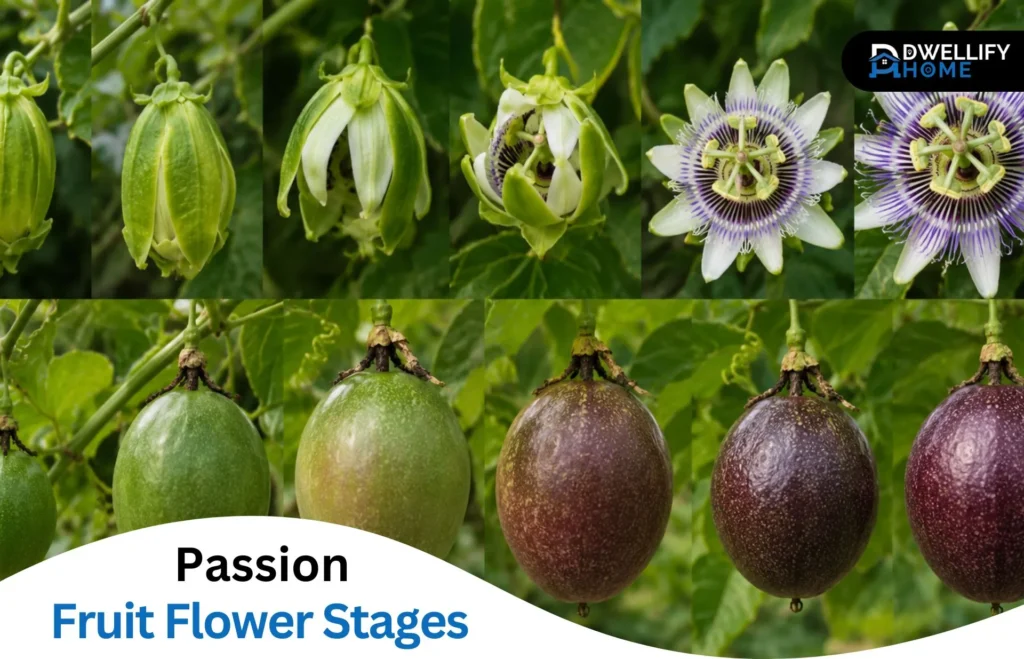
Watch a passion fruit vine long enough and you start reading its flowers like a calendar. Each bloom is a small, intricate machine, and every part of it has a job to do in a sequence that decides whether you get fruit or just a pretty show. Most vines flower generously. Far fewer set the fruit their owners are hoping for, and the gap between the two almost always comes down to what happens across a single day in the life of one flower.
This is a stage-by-stage guide to the passion fruit flower stages of Passiflora edulis, from the first tiny bud to a young fruit forming on the vine. Knowing where your flowers sit in that sequence tells you what’s normal, what to watch for, and exactly when to step in if nature needs a hand.
SHORT DEFINITION
Passion fruit flower stages are the six steps a Passiflora edulis bloom passes through, from bud formation and development, through opening and the brief pollination window, to wilting and fruit set. Reading them tells growers when to pollinate and why fruit does or doesn’t form.Our Mission:
Dwellify Home helps people make practical, stylish, and well-informed decisions about their homes, gardens, and properties — turning everyday questions into confident choices.
Passion Flower or Passion Fruit? Make Sure You Have the Right Plant
A passion flower only turns into edible passion fruit if it belongs to a fruiting species — most commonly Passiflora edulis — and the bloom is successfully pollinated. Ornamental relatives like the blue passion flower (Passiflora caerulea) and the maypop (Passiflora incarnata) flower freely but produce fruit that’s small, bland, or barely worth picking.
This matters before you worry about a single stage. The blue passion flower is grown for its looks; its orange fruit is largely tasteless and mildly toxic when unripe. The maypop is a hardy North American native with modest edible fruit. The passion fruit you actually want to eat comes from Passiflora edulis, which grows in two forms: the purple type and the larger yellow type. Check your plant’s label or species first. A caerulea won’t hand you a bowl of passion fruit no matter how beautifully it blooms.
Quick view — the 6 passion fruit flower stages:
| Stage | What you’ll see |
| 1. Bud formation | Tiny green bud at a leaf joint |
| 2. Bud development | Bud swells and shows a hint of color |
| 3. Open bloom (anthesis) | Flower fully open, anthers shedding pollen |
| 4. Pollination window | Three styles curve downward (the decisive moment) |
| 5. Wilting | Flower closes and fades |
| 6. Fruit set | Ovary swells into a small green fruit |
Why growers track these stages:
- Know exactly when a flower is receptive and ready to pollinate.
- Tell purple from yellow types by when the flower opens.
- Diagnose a vine that flowers heavily but sets no fruit.
- Confirm success early by spotting a swelling ovary vs an “empty cage.”
- Decide whether one vine is enough or a second is needed for cross-pollination.
A Quick Look at Passion Fruit Flower Anatomy
The passion fruit flower looks complicated, and that complication is the whole point. It’s built to make cross-pollination almost unavoidable when the right insect visits. A short tour of the parts makes every stage that follows easy to read.
The showy outer parts: sepals, petals, corona, and operculum
The flower opens into what looks like ten rays: five sepals (green on the back) and five white petals, so alike they’re hard to tell apart. Inside them sits the corona, a dense ring of thread-like filaments banded deep purple near the center and fading to white at the tips. That corona is the flower’s landing pad and its main visual lure for pollinators. At the base, tucked over the nectar chamber, is a small membrane called the operculum, which helps reserve the nectar for insects strong enough to work for it.
The reproductive column: androgynophore, anthers, and three stigmas
Rise up from the center and you hit the part most guides skip. Passion fruit lifts its reproductive organs on a central stalk called the androgynophore, holding them up above the corona instead of tucking them down inside. On that column sit five stamens, each ending in a flat anther loaded with pollen and angled to dust the back of a large bee. Above the anthers, the pistil divides into three styles, each tipped with a knob-like stigma, the receptive surface pollen must reach. The way those three styles move, up when the flower opens and then down, is the single most important thing to watch on the whole plant. It’s the heart of Stage 4.
The 6 Passion Fruit Flower Stages, from Bud to Fruit
Here’s the full sequence at a glance, then each stage in turn. Timings shift with variety, temperature, and season, so treat them as a guide rather than a stopwatch.
| Stage | What you’ll see | Rough timing |
| 1. Bud formation | Tiny green bud at a leaf joint | Weeks before bloom |
| 2. Bud development | Bud swells, softens, shows a hint of color | Days before bloom |
| 3. Open bloom (anthesis) | Flower fully open, anthers shedding pollen | A single day |
| 4. Pollination window | Three styles curve downward | Roughly 1–2 hours mid-bloom |
| 5. Wilting | Flower closes and fades | Same day into the next |
| 6. Fruit set | Ovary swells into a small green fruit | Within a few days |
Stage 1 — Bud formation
Buds appear at the leaf axils on new growth, the current season’s green stems, not old wood. That’s why a wave of fresh growth or a well-timed prune often comes right before a flush of buds, and why a neglected, tangled vine can flower poorly. Each bud starts as a small round green ball, easy to mistake at first for a new tendril or leaf shoot. On a healthy vine in season, you’ll see them forming continuously rather than all at once.
Stage 2 — Bud development and swelling
Over the next several days the bud fattens and rounds out, and as it nears opening you can often catch a hint of color and the folded sepals through the skin. A plump bud that has lost its tight, hard green look is usually a day or so from opening. This is also where the vine quietly makes decisions. Under heat stress, drought, or heavy nitrogen feeding, buds can yellow and drop at this point before they ever open — a problem worth catching early, and one I’ll come back to.
Stage 3 — The open bloom (anthesis)
Anthesis is simply the day the flower opens, and the timing is a useful clue to your variety. Purple passion fruit tends to open in the morning, while yellow passion fruit usually opens around midday and into the afternoon. When the flower opens, the five anthers are already shedding pollen beneath the central column, while the three styles still point upward or outward. The bloom is wide, faintly fragrant, and at its most attractive to pollinators. It’s a one-day event, though. This exact flower won’t reopen tomorrow, which is why the next stage carries so much weight and why any hand-pollination has to happen the same day.
Stage 4 — The pollination window
This is the make-or-break moment. Over the first hour or two after opening, the three styles slowly bend downward until the knob-tipped stigmas drop to sit level with, or just below, the pollen-laden anthers, right where a big bee’s back will brush against them. Fully down-curved styles are the flower signalling that it’s receptive. That window is short, often cited as roughly 90 minutes to a couple of hours [VERIFY], and pollen has to move onto all three stigmas within it.
Notice the clever trap in the design. When the flower first opens, the stigmas point away from the pollen, so a bloom generally can’t fertilize itself by accident. It’s built to need a visitor. Miss this window, with no bee and no helping hand, and even the healthiest flower on the vine will fade without setting fruit.
Stage 5 — Wilting and fertilization
By late in the day the show winds down. Petals and corona fold inward, the colors dull, and the whole flower begins to wilt and close. What happens next depends entirely on Stage 4. If pollen reached the stigmas, pollen tubes grow down the styles and fertilize the ovary over the following hours, all of it out of sight. If nothing landed, the closed flower simply dries out. For the first day the two outcomes look almost identical from the outside, which is exactly why the final stage is your real answer.
Stage 6 — Fruit set
Fruit set is the payoff, the point where a fertilized ovary starts swelling into a young green fruit instead of dropping off. Within a few days of a successful bloom, you’ll see the small round ovary at the base of the spent flower begin to enlarge and firm up while the dried petals fall away. From there the green fruit grows and then ripens to purple or yellow over roughly 70 to 80 days, depending on variety and warmth. A visibly swelling ovary is your first solid proof the flower took.
How to Support Pollination and Fruit Set
Understanding the stages is half the job. The other half is making sure Stage 4 actually succeeds, because a vine smothered in flowers means nothing without pollination.
Who pollinates passion fruit flowers?
Carpenter bees (Xylocopa species) are the main and most effective pollinators of passion fruit. They’re big enough to touch both the low-hanging anthers and the down-curved stigmas in a single visit. Honey bees are usually too small to bridge that gap and tend to rob nectar without moving much pollen.
Passion fruit pollen is heavy and sticky, so wind does almost nothing. The plant leans on a large-bodied insect, or on you. You can encourage carpenter bees by leaving some undisturbed old wood or logs nearby for nesting, and by avoiding broad insecticide sprays while the vine is in flower. Where carpenter bees are scarce, hand-pollination steps in.
Self-incompatibility: why some vines won’t fruit without a partner
Here’s a distinction that catches a lot of growers off guard. Yellow passion fruit (f. flavicarpa) is largely self-incompatible, meaning a flower usually can’t be fertilized by pollen from the same plant, or even another plant of the same clone. To fruit reliably, it needs pollen from a genetically different yellow vine nearby. Purple passion fruit (f. edulis) is generally self-compatible, so a single vine can set fruit on its own, though some purple hybrids are partly self-incompatible too. The practical takeaway: one lonely yellow vine can flower endlessly and never fruit, and hand-pollinating it with its own pollen won’t fix that.
Choosing a variety that fruits reliably
For a single-vine garden, this choice matters more than almost anything else you’ll decide. A self-compatible purple type like ‘Purple Possum’ (also sold as ‘Possum Purple’) will set fruit on its own and tends to fruit sooner, which makes it the low-stress pick for one plant. A yellow type such as ‘Sweet Sunrise’ can give larger fruit but generally needs a second, different vine for cross-pollination, so plan for two if you go that way. When you only have room for one plant and want a dependable harvest, a self-fertile purple cultivar is the safer bet.
How to hand-pollinate passion fruit, and exactly when
Hand-pollinating passion fruit is simple once you time it to Stage 4. Do it on the day a flower is open, during its receptive window, late morning for purple types and around midday to afternoon for yellow, once the three styles have curved downward.
- Confirm the flower is fully open and the styles have bent down toward the anthers.
- Touch a clean fingertip or a small dry brush to the anthers to pick up the sticky yellow pollen.
- Gently dab that pollen onto all three stigmas, the knobbed tips of the down-curved styles.
- For yellow varieties, use pollen taken from a different vine, not the same plant.
- Work one bloom at a time; a light touch is all it takes.
Late morning to early afternoon is the sweet spot, while the pollen is fresh and the stigmas are receptive. Two minutes of this across a handful of flowers can be the difference between a bare vine and a productive one.
Troubleshooting: Lots of Flowers but No Fruit
A passion fruit vine with lots of flowers but no fruit almost always has a pollination problem, not a flowering problem. The usual culprits are missing pollinators, a self-incompatible yellow vine growing alone, or too much nitrogen, with heat, rain, drought, and vine immaturity close behind.
Why your vine flowers but won’t set fruit
Work through these roughly in order. Most cases turn out to be one of the first three.
- No pollinators: no carpenter bees around, so nothing carries the pollen. Hand-pollinating a few flowers is the fastest way to test this.
- Self-incompatibility: a single yellow (flavicarpa) vine with no cross-pollination partner nearby.
- Too much nitrogen: high-nitrogen feed drives lush leaves and few, weak flowers. Ease off and favor a lower-nitrogen, higher-potassium approach.
- Heat: very hot spells, roughly above 30–35°C, can impair pollen and receptivity [VERIFY exact threshold].
- Rain during bloom: wet weather washes pollen off and keeps bees grounded on the one day that counts.
- Water stress or immaturity: a thirsty vine, or a first-year vine still too young, will often flower before it’s truly ready to fruit.
Flower drop and bud drop
Buds or flowers dropping before they set is usually stress, not disease. The common triggers are the soil drying out enough for the vine to wilt, sudden heat, and cold snaps, all of which push the plant to cut its losses and shed buds. Steady moisture, some shelter from extreme heat, and avoiding big swings in watering keep more buds on the vine. A flower that opens, goes unpollinated, and then drops is a different matter entirely; that’s a pollination miss, covered just above.
Did the flower take? Swelling ovary vs the “empty cage”
The cleanest test is one you run on your own vine, 24 to 48 hours after a flower closes. Look at the base of the spent bloom, where the ovary sits at the top of the central column.
- Success: the small round ovary is visibly swelling and firming, and the dried petals are dropping away. That’s fruit set underway.
- Failure: no swelling at all. The whole spent flower dries and drops, often leaving just the persistent bracts behind, an “empty cage” with nothing forming inside.
Check a few flowers over the course of a week and you’ll quickly learn your vine’s real fruit-set rate, which tells you whether pollination is genuinely your bottleneck or not.
Frequently Asked Questions
Does passion flower turn into passion fruit?
Only sometimes. A passion flower becomes passion fruit when the plant is a fruiting species like Passiflora edulis and the bloom is pollinated. Ornamental passionflowers such as Passiflora caerulea flower well but set little or no edible fruit, so a flower on its own doesn’t guarantee fruit.
How long do passion flowers take to bloom?
A passion fruit vine usually starts flowering about 12 to 18 months after planting, though some seedlings take longer. Once a vine is mature and in its warm-season flowering period, it can produce new blooms continuously, with each individual flower opening for just a single day.
How long after flowering do passion fruits appear?
A pollinated flower begins forming fruit within a few days; the ovary starts swelling almost immediately after fertilization. That young green fruit then takes roughly 70 to 80 days to ripen fully to purple or yellow, depending on variety and temperature.
Why does my passion fruit have lots of flowers but no fruit?
Most often it’s a pollination gap: no carpenter bees to move the heavy pollen, a self-incompatible yellow vine growing on its own, or excess nitrogen pushing leaves at the expense of fruit. Hand-pollinating a few flowers is the quickest way to pin down which one it is.
Do I need more than one passion fruit plant to get fruit?
It depends on the type. Yellow passion fruit (flavicarpa) is largely self-incompatible and usually needs a second, genetically different vine to set fruit. Purple types like ‘Purple Possum’ are generally self-fertile and can fruit as a single plant.
What time of day do passion fruit flowers open?
Purple passion fruit generally opens its flowers in the morning, while yellow passion fruit tends to open around midday and into the afternoon. Each flower stays open for one day, with a short receptive window of a couple of hours for pollination.
Why won’t my passion fruit vine flower at all?
A vine that refuses to flower is often too young in its first year, getting too much nitrogen, sitting in too much shade, or growing too vigorously without pruning. Give it full sun, cut back on high-nitrogen feed, and be patient through its first season.
The Bottom Line on Passion Fruit Flower Stages
A passion fruit flower runs its entire course in about a day, moving from open bloom to a brief, decisive pollination window before it wilts. The passion fruit flower stages only end in fruit when pollen reaches those three down-curved stigmas in time. Learn to read the buds forming on new growth, the styles bending downward at midday, and the ovary swelling a day or two later, and you’ll know at a glance whether your vine is on track. When the bees are scarce, a two-minute dab of pollen at the right moment is often all that stands between a flower and a fruit.
Disclaimer: This article is for general informational purposes only. Growing conditions, plant varieties, and local climates vary, so your results may differ. For advice specific to your garden or region, consider consulting a local horticulturist or extension service.