
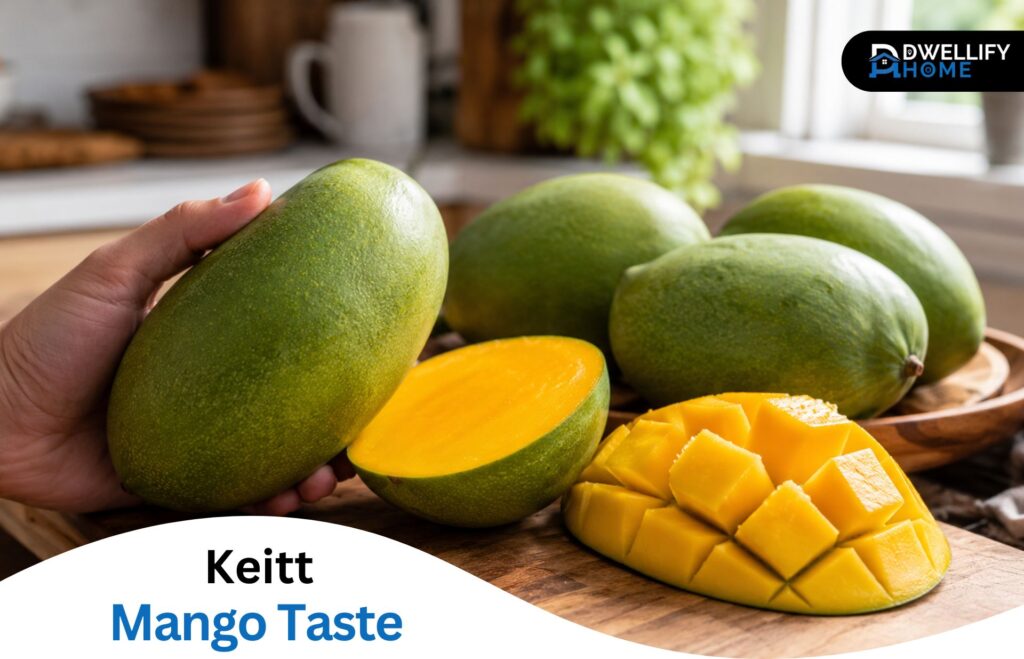
A ripe Keitt tastes like a mango with the drama turned down in the best possible way: clean and sweet, low in acid, with a faint lemon-and-honey note and flesh so smooth it sits closer to a ripe peach than the stringy fruit most people picture. That gentle, dessert-like Keitt mango taste is exactly its appeal — but its flavor hinges almost entirely on ripeness, and a Keitt hides its ripeness better than any mango I handle.
Here’s the part that trips everyone up. A perfectly ripe Keitt is usually still deep green on the outside. People see that green skin, assume the fruit is unripe, and either skip it or cut into it three days too early. Get the timing right and it’s one of the most reliable, low-fuss mangoes you can buy. Get it wrong and you’ll swear the variety is bland. Both experiences come from the same fruit.
SHORT DEFINITION
The Keitt mango taste is mild, sweet, and low in acid, with a smooth, nearly fiber-free flesh and a light lemon-honey finish. People choose it for its clean, balanced sweetness — ideal when other mangoes taste too sharp, too fibrous, or too perfumed.
Mission: Dwellify Home helps people make practical, stylish, and informed decisions about their homes, gardens, and properties — turning everyday choices into confident ones.
SERP ENHANCEMENT ELEMENTS
Keitt vs. common mangoes at a glance:
| Variety | Skin when ripe | Texture | Flavor |
| Keitt | Stays green | Smooth, low fiber | Mild, sweet, low-acid, light lemon |
| Tommy Atkins | Red over green | Firmer, fibrous | Mild, sometimes bland |
| Kent | Green with red blush | Firm, rich | Sweet, fuller, richer |
| Ataulfo (Honey) | Golden yellow | Soft, buttery | Intensely sweet, tropical |
Why shoppers choose a Keitt:
- Mild, low-acid sweetness that isn’t cloying
- Smooth, nearly fiber-free flesh with a light lemon finish
- Large fruit with a small, thin seed, so more usable flesh
- Good across stages — tart and firm for savory dishes, soft and honeyed for blending
- Freezes exceptionally well and is often a bargain in season
The full flavor and texture profile
Sweetness is the headline, but balance is the real story. A Keitt isn’t trying to overwhelm you with tropical intensity. It’s mellow, rounded, and easy to eat by the bowlful, which is part of why it’s a favorite for people who find other mangoes too sharp or too perfumed.
Sweetness, tang, and the light citrus finish
A ripe Keitt is solidly sweet with just enough tartness to keep it from tasting flat, finished by a light citrus note people often describe as lemon. It’s not a sugar bomb and it’s not sour — it lands in a comfortable middle, with a clean sweetness that lingers rather than spikes.
That citrus edge is the Keitt’s signature. When the fruit is fully ripe, the tang softens and a mild honeyed quality comes forward. Eaten a little firmer, the tartness leads and the whole thing tastes brighter and more refreshing.
What “buttery” and “fiber-free” actually feel like
The texture is where Keitts win converts. Ripe flesh is dense, smooth, and creamy, and it slices into clean cubes without collapsing into mush. “Buttery” is the word that gets used, and it’s fair — the fruit yields softly and coats the tongue instead of stringing between your teeth.
On fiber, let me settle the contradiction you’ll see online. Keitts are among the low-fiber mangoes, and through most of the fruit you won’t notice any at all. There’s usually a little fine fiber right up against the flat seed, which is normal and easy to cut around. So the honest answer sits between the marketing claim of “fiberless” and the “it has fibers” you’ll read elsewhere: nearly fiber-free flesh, with a touch near the pit.
What a ripe Keitt smells like — and why the aroma is subtler
A ripe Keitt has a soft, sweet, faintly citrusy smell rather than the loud floral perfume of an Ataulfo or an Alphonso. Bring it to your nose at the stem end and you’ll catch a mild honeyed sweetness — present, but restrained.
Don’t read that quiet aroma as a flaw or a sign it isn’t ready. Keitts simply aren’t heavy-scented mangoes. If you’re chasing that intense tropical fragrance, this isn’t the variety that delivers it, and that’s a matter of character, not quality.
Why the same variety tastes different from California, Mexico, or South America
The name on the sign is the same, but the eating experience shifts with where the fruit was grown and how long it stayed on the tree. Fruit that ripens longer on the branch before picking tends to taste sweeter and rounder, which is why domestic late-summer Keitts often eat better than fruit shipped a long distance and ripened in transit.
Growing region and sun exposure also nudge the balance between bright tartness and mellow sweetness. It’s the same reason two tomatoes of one variety can taste noticeably different — the genetics set the range, and the growing conditions decide where in that range the fruit lands.
How a Keitt compares to the mangoes you already know
Most people meet the Keitt after a lifetime of one or two other mangoes, so the fastest way to understand its taste is by comparison. Here’s the quick version, then the detail.
| Variety | Skin when ripe | Flesh & texture | Flavor |
| Keitt | Stays green | Smooth, low fiber, juicy | Mild, sweet, low-acid, light lemon |
| Tommy Atkins | Red over green/yellow | Firmer, more fibrous | Mild, sometimes bland |
| Kent | Green with red blush | Firm, rich, deep-orange | Sweet, fuller, richer |
| Ataulfo (Honey) | Turns golden yellow | Soft, buttery, no fiber | Intensely sweet, tropical |
Keitt vs Tommy Atkins — texture is the difference
The Tommy Atkins is the red-skinned mango stacked high in nearly every supermarket, bred for shipping and shelf life rather than flavor. Set it beside a Keitt and the gap is mostly texture: the Tommy is firmer and noticeably more fibrous, while the Keitt is smoother and cleaner on the palate.
Flavor-wise they’re both on the mild side, but a ripe Keitt reads sweeter and less stringy. If your only mango memory is a fibrous grocery Tommy Atkins, a good Keitt will feel like an upgrade.
Keitt vs Kent — two green siblings, and how to tell them apart
Keitt and Kent are the two big green-skinned mangoes people mix up in the bin, and they’re closely related. Quick tells: the Keitt is usually longer, larger, and a duller flat green; the Kent is rounder and rutier, with more red or orange blush. Cut them open and the Kent’s flesh runs a deeper orange, while the Keitt’s is a lighter gold.
On taste, the Kent is a touch richer and fuller; the Keitt is milder, brighter, and often juicier. Neither is “better” — Kent leans indulgent, Keitt leans refreshing.
Keitt vs Ataulfo (Honey / Champagne) — mild balance vs concentrated sweetness
The Ataulfo, sold as Honey or Champagne mango, is the small yellow kidney-shaped fruit, and it’s the opposite of a Keitt in flavor strategy. It’s intensely sweet and floral with a soft, almost custardy flesh. The Keitt is larger, milder, and more balanced, with that lemony lift the Ataulfo doesn’t have.
Reach for an Ataulfo when you want concentrated tropical sweetness in a small package. Reach for a Keitt when you want a big, clean, easy-eating mango that isn’t cloying.
If you liked a certain mango, here’s what to expect from a Keitt
- Liked a red grocery mango (Tommy Atkins)? Expect the same mildness but smoother, sweeter, and far less stringy.
- Loved a Honey/Ataulfo? A Keitt will taste less sweet and less perfumed, but juicier and more refreshing.
- Enjoyed a Kent? You’re close to home — just a lighter, brighter, slightly less rich version.
- Only ever had a fibrous, turpentine-ish mango? A ripe Keitt should change your mind about the whole fruit.
Ripeness is the whole game — how to tell when a Keitt is ready
I’ll say it plainly: with a Keitt, ripeness matters more than which farm or country it came from. This is the section that decides whether you love the variety or dismiss it, so it’s worth slowing down.
Why a ripe Keitt stays green (the green-skin problem)
A ripe Keitt stays green because the variety simply doesn’t turn the yellow, orange, or red that people use as a ripeness shortcut on other mangoes. The skin holds its deep green even when the flesh inside is soft and sweet, so color tells you almost nothing about whether it’s ready.
Fruit grown with more direct sun may pick up a light red or yellow blush on one cheek, but plenty of Keitts — especially from humid growing areas — stay fully green start to finish. Judging one by color is the single most common mistake I see, and it’s usually why perfectly good fruit gets left behind.
The squeeze test — what “yields to gentle pressure” really feels like
The reliable test is touch. Cradle the whole mango in your palm and press gently with your fingers spread, not with one fingertip. A ripe Keitt gives slightly and evenly, the way a ripe avocado or a ripe peach does — soft but not hollow, yielding but not squishy.
Rock-hard means wait. A little give at the shoulders means it’s ready or nearly there. Mushy, wet, or dented spots mean it’s gone past its best. One fingertip poke just bruises the fruit, so use your whole hand.
Five cues shoppers overlook — stem, shoulders, lenticels, weight, and yellow patches
For anyone who’d rather not go around squeezing every fruit in the display, these cues read ripeness without much pressure:
- The stem end. A sweet, faintly fruity smell at the stem is a good sign; no smell means it likely needs more time.
- Full shoulders. Ripe fruit plumps out and rounds at the top near the stem rather than staying angular.
- Prominent lenticels. The tiny dots on the skin often become more visible as the fruit matures.
- Weight. A ripe Keitt feels heavy and full for its size — a sign of juicy, dense flesh.
- Subtle yellowing. Any faint patches of yellow creeping under the green usually point toward ripeness, though many Keitts never show it.
The four ripeness stages — and which one you actually want
Keitts are genuinely useful across several stages, which is rare. Match the stage to your plan:
- Green and hard. Crisp, tart, barely sweet. Great shredded into green-mango salads or pickled.
- Firm and semi-ripe. Bright, tangy, lightly sweet, holds its shape. Ideal for salsas, slaws, and slicing.
- Ripe. Soft-yielding, sweet with a gentle tang, smooth. The all-purpose eating stage.
- Fully ripe. Very soft, honeyed, rich. Best for purées, smoothies, sorbet, and baking.
Firm and tart or soft and honeyed? Choose by what you’re making
Decide by what you’re doing with it. For fresh eating, slicing into a fruit bowl, or anything you want to keep tidy cubes, catch a Keitt when it’s just ripe and still slightly firm — the flavor is brighter and the flesh behaves. For smoothies, purées, sorbet, or spooning straight from the skin, let it go fully soft, when the sweetness peaks and the tartness fades.
There’s no single “correct” ripeness here, and that flexibility is one of the Keitt’s quiet strengths.
How to ripen, cut, store, and use a Keitt at home
Buying a green Keitt and finishing it at home is genuinely easy once you stop waiting for a color change that never comes.
Ripening a green Keitt on the counter (and when to move it to the fridge)
Ripen a Keitt at room temperature, out of direct sun, and check it once a day by feel. To speed things up, put it in a paper bag — the trapped natural gases push ripening along, and adding an apple or banana to the bag works faster still. Depending on how firm it started, it can take anywhere from a couple of days to over a week.
Keep it out of the fridge until it’s ripe; chilling a hard Keitt can stall ripening and cause cold damage. Once it yields to gentle pressure, refrigerate it and use it within several days.
Cutting a large mango with less waste — and how much fruit you’ll get
Stand the mango on end and slice down either side of the flat central seed to get two “cheeks,” then score each cheek in a grid and either scoop the cubes or turn it inside out. Trim the two thin strips around the seed last — that’s where the little bit of fiber lives.
Keitts are big, so one fruit goes a long way — expect roughly a generous cup or two of chopped flesh from a good-sized one [VERIFY exact yield]. For a single mango that’s plenty for a fruit salad or a couple of smoothies.
Best uses at each ripeness stage, from green salads to sorbet
Firm, green-leaning fruit shines in savory territory: shredded salads, quick pickles, crunchy salsas, and slaws alongside fish, chicken, or pork. Just-ripe fruit is your slicing-and-snacking stage and pairs beautifully with citrus, berries, stone fruit, and herbs like mint, basil, and cilantro. Fully ripe fruit belongs in anything blended or baked — smoothies, purées, sorbet, and mango-forward desserts.
Freezing Keitts — one of the best mangoes for it
The Keitt’s dense, low-fiber flesh freezes exceptionally well, which makes it a smart pick when it’s cheap and in season. Peel and cube ripe fruit, spread the pieces on a tray so they freeze loose, then transfer them to a bag. Frozen this way they blend straight into smoothies and sorbets and keep for months without turning to slush.
When Keitt mangoes are in season and where they grow
Timing is half the battle, because Keitt is a late-season variety that shows up after the summer mango rush most shoppers already know.
The main US window — late summer into early fall
In the US market, Keitts run mainly from around July into early October, with the strongest supply in August and September. They arrive as the earlier summer mangoes are winding down, which is exactly why they’re easy to miss — you have to be looking once the main mango wave has passed.
California Coachella Keitts vs imported fruit
Late in the season, domestically grown Keitts come out of California’s Coachella Valley, and they’re worth seeking out. Because they’re grown at home, they can ripen longer on the tree and travel a short distance, which usually shows up as sweeter, better-eating fruit. California-grown mangoes are also exempt from the hot-water treatment required on imported fruit [VERIFY treatment specifics], and a good share of the Coachella crop is certified organic [VERIFY].
The second, off-season window to watch for
Because Keitts are also grown in the Southern Hemisphere and other regions, a smaller off-season window can appear in roughly the spring months, depending on your market and importer [VERIFY]. It’s less predictable than the late-summer window, but it’s why you’ll occasionally spot Keitts well outside their main US season.
Where the Keitt comes from — and how to say its name
A little background pays off here, both because it explains the fruit’s quirks and because it settles a name that confuses almost everyone.
A chance seedling from Homestead, Florida
The Keitt began as a chance seedling in Homestead, Florida, on the property of a woman named Mrs. Keitt — discovered around 1939 and released commercially in the mid-1940s [VERIFY dates]. It went on to become one of the most widely grown mangoes in the Western Hemisphere, prized by growers for its heavy, late-season crops.
The Mulgoba vs Brooks parentage question
For years the Keitt was assumed to have grown from a Mulgoba seed, a common story you’ll still read. Later genetic analysis pointed instead to the Brooks variety as the more likely parent [VERIFY]. It’s a small detail, but it’s the kind of thing that separates a careful source from one just repeating old copy.
Kent, Cotton Candy, and Honey Kiss — the Keitt family tree
The Keitt doesn’t stand alone. It’s closely related to the Kent — the reason those two green mangoes taste and look so similar — and it’s been linked as a parent to newer specialty varieties sometimes sold as Cotton Candy and Honey Kiss [VERIFY lineage]. Knowing the family helps explain why a Keitt and a Kent are such easy cousins to confuse.
How do you pronounce “Keitt”?
Here’s where even produce folks disagree. The name comes from the Keitt family, and you’ll hear it said two ways: most commonly as “kit” (rhyming with “hit”), and also as “keet.” Either will get you understood at the market [VERIFY preferred pronunciation]. Don’t let the spelling talk you out of buying one.
Tasting a Keitt at each stage — what I noticed
Cut the same Keitt open across its ripening and it’s almost like tasting different fruit. Dead firm and green, it’s crisp and puckery, more tart than sweet, with the citrus note dominating and hardly any perfume — genuinely good shredded into something savory. A few days on, at that just-ripe stage where it gives slightly at the shoulders, the flesh turns silky, the sweetness catches up to the tang, and the lemony finish sits right in balance. That’s my favorite window for eating out of hand.
Left until it’s soft all over, it goes honeyed and rich, the tartness nearly gone, the flesh loose enough to spoon — right for blending, not slicing. The one constant across every stage is that smooth, low-fiber texture. The flavor moves; the clean mouthfeel stays put.
Keitt mango questions, answered
Are Keitt mangoes any good?
Yes — when ripe, they’re excellent, especially for anyone who finds other mangoes too sharp, too perfumed, or too stringy. They’re mild, sweet, low in acid, and unusually smooth. They suit fresh eating, savory cooking, and freezing. They’re a weaker pick only if you specifically want an intense, heavily fragrant tropical mango.
How do you know if a Keitt mango is ripe?
Ignore the color, which stays green, and go by feel: a ripe Keitt yields to gentle pressure when cradled in your palm, feels heavy for its size, and smells faintly sweet at the stem end. Firm and hard means it needs more days at room temperature.
Which mango is the sweetest — and where does a Keitt rank?
The Keitt is not the sweetest mango; that title usually goes to intensely sugary varieties like Alphonso or a Carabao-type [VERIFY]. The Keitt trades peak sweetness for balance, a clean low-acid profile, and a smooth, nearly fiber-free texture — which is exactly why many people prefer eating it in quantity.
Why are Keitt mangoes so cheap?
Mostly because they look unripe. The green skin reads as “not ready” to shoppers, so demand stays soft and stores price them to move — even though the fruit inside can be perfectly ripe and delicious. In practice, that green stubbornness makes Keitts one of the better values in the produce aisle during their season.
Are Keitt mangoes fibrous or fiber-free?
Both claims float around, and the truth sits in between. Keitts are a low-fiber variety, and most of the flesh is smooth and essentially fiber-free. There’s typically a little fine fiber right against the flat seed, which you simply cut around when you trim the fruit.
Can you eat a Keitt while it’s still green?
Yes. Firm, green Keitts are crisp and tart rather than sweet, and they’re genuinely good used that way — shredded into green-mango salads, sliced into salsas and slaws, or pickled. Eating one green is a real choice, not a mistake; you’re just choosing tart-and-crunchy over sweet-and-soft.
How big does a Keitt mango get?
Keitts are among the larger mangoes, commonly running a pound or two, and frequently bigger — some tip well past three pounds [VERIFY range]. They also carry a small, thin, flat seed, so a big fruit gives you a lot of usable flesh relative to its size.
Where are Keitt mangoes grown?
Keitts are grown in Florida and California in the US, across Mexico, and in parts of Central and South America and the Caribbean, plus regions such as Spain, Israel, and Australia [VERIFY current list]. The late-summer US supply leans on Florida and California’s Coachella Valley.
The bottom line on Keitt mango taste
The Keitt mango taste is best summed up as mild, sweet, low in acid, and remarkably smooth — a balanced, refreshing mango rather than a loud one, defined more by its clean texture and lemony lift than by raw sugar. Remember the one rule that separates a great Keitt from a disappointing one: judge it by feel, never by color, because a ripe Keitt stays green. Pick one that yields to gentle pressure and you’ve got a big, easy-eating, low-fiber fruit that’s ideal for anyone who wants their mango sweet without the sharpness — and a genuine bargain while it’s in season.
Disclaimer: This article is for general informational purposes only. Individual tastes, produce quality, and growing conditions vary, so your experience with any given fruit may differ.