Most of the dead saplings I get called out to inspect weren’t killed by the cold, the drought, or bad luck. They were killed by something wrapped around the trunk that nobody looked at again until spring. That’s the hard truth about a tree trunk protector: the right one quietly saves a tree for years, and the wrong one can strangle or cook it while you congratulate yourself for protecting it.
The term itself covers a lot of ground — spiral wraps, mesh cylinders, rigid tubes, hardware cloth, even a coat of white paint. These tools solve completely different problems. So the useful question isn’t which one is best. It’s which threat is actually going after your tree, because that answer decides everything else.
SHORT DEFINITION
A tree trunk protector is a barrier or coating placed around a young tree’s lower trunk to shield the bark from animals, mowers, and winter sun. People use it to prevent girdling and bark damage that can weaken or kill the tree.
Our Mission:
Dwellify Home helps you make practical, stylish, and well-informed decisions about your home, garden, and property — clear guidance you can actually act on.
What a tree trunk protector actually is — and when you need one
A tree trunk protector is any barrier or coating placed around the lower trunk of a young or thin-barked tree to shield the bark from animals, equipment, and sun. It puts a physical or reflective layer between the trunk and whatever would otherwise chew, rub, cut, or scald it.
Why damage to the trunk can kill a tree
Bark isn’t just skin. Just beneath it sits a thin living layer, the cambium, and the phloem — the tissue that carries sugars from the leaves down to the roots. Damage that runs all the way around the trunk severs that supply line. This is called girdling, and once it circles the trunk, the roots slowly starve even if the top leafs out one final spring. That’s why a strip of missing bark a few inches wide is more dangerous than a snapped branch — it can take the whole tree.
The five threats a trunk protector is meant to stop
Nearly every case I see comes down to one of five culprits: string trimmers and mowers at ground level, gnawing animals like rabbits and mice and voles, deer rubbing or browsing, winter sunscald, and wood-boring insects. Each attacks at a different height, in a different season, in a different way. Those five are the spine of this whole guide.
When you don’t need one
Not every tree needs a guard. Once bark thickens and roughens — usually after the first several years, depending on species — most trees shrug off what would kill a sapling. A mature oak doesn’t need a mesh cylinder. If your tree has thick, corky bark, no deer pressure, and nobody’s running a trimmer near it, you’re often better off skipping the guard and keeping a wide, mulched, grass-free ring around the base instead. That ring pulls double duty: it removes the tall grass rodents hide in and keeps mower blades away from the bark, no wrapping required.
A quick note on “tree trunk protector straps”
Search that phrase and you’ll get two very different products. One is a bark protector — a soft sleeve that keeps a rope, cable, or hammock strap from cutting into bark. The other is an off-road recovery strap that wraps a trunk to winch out a stuck vehicle. This guide is about protecting the tree. If it’s vehicle recovery you’re after, you want a rated tree-saver strap, which is another thing entirely.
SERP ENHANCEMENT ELEMENTS
Match the threat to the protector:
| Threat | Best protector |
| Rabbits & mice | ¼-inch hardware cloth or rigid mesh cylinder |
| Voles | Mesh or hardware cloth, buried 2–3 in below soil |
| Deer (rub/browse) | Tall mesh guard or cage, 4–6 ft, staked |
| String trimmers & mowers | Wide mulched, grass-free ring (rigid guard as backup) |
| Winter sunscald | Light-colored wrap or interior white latex paint |
| Borers | Prevent sunscald cracks; white paint or reflective wrap |
Quick things to get right:
- Cover the threat’s reach — 18–24 in above the snow line for rabbits, 4–6 ft for deer.
- Bury the base 2–3 in to stop mice and voles slipping underneath.
- Leave an air gap between guard and bark, and check the fit every spring.
- Take seasonal wraps and spirals off after the last frost so they don’t scar or trap moisture.
Match the protector to your threat: the decision framework
This is the part no product page bothers with. Before you buy anything, read the tree — because the culprit decides the tool.
First, diagnose the damage (or the risk you’re facing)
Damage leaves signatures, and each culprit has a tell. Here’s the field guide I use.
| What you see | Likely culprit | Typical location |
| Clean, angled 45° cuts; bark stripped in patches | Rabbits | Ground up to snow height |
| Narrow parallel gnaw marks; surface runways in the grass | Voles | At or just below the soil line |
| Bark shredded and torn, vertical scrapes | Deer (antler rub) | 1–3+ ft up, in fall |
| Round or D-shaped exit holes, sawdust-like frass | Wood-boring beetles | Anywhere on the trunk |
| Cracked, sunken, discolored bark on one side | Sunscald | South/southwest face, late winter |
| Gouges and torn bark at the base | Trimmer / mower | Ground level |
Rabbits and mice — hardware cloth or a rigid mesh cylinder
For rabbits and mice you want a barrier they can’t chew: quarter-inch galvanized hardware cloth or a rigid plastic mesh cylinder. Stand it a couple inches off the bark so they can’t gnaw through gaps, and bring it high enough to clear the snow, since rabbits feed from the top of the snowpack.
Voles — and why meadow voles and pine voles need different answers
This one fools people. “Voles” aren’t a single problem. Meadow voles feed above ground, chewing the trunk at the soil line and leaving those little surface runways. Pine voles (also called woodland voles) work underground, eating roots and the base of the trunk out of sight. A trunk guard stops the first and does nothing about the second [VERIFY: Penn State framing]. So if you’ve wrapped the trunk and the tree still declines, check the roots — the underground kind is a baiting and habitat problem, not a wrapping one.
Deer rub and browsing — taller mesh guards, cages, and heavy sleeves
Deer damage bark two ways: bucks rub antlers on trunks in fall, and hungry deer browse bark in winter. Both call for a tall, rigid barrier — a mesh guard or welded-wire cage roughly 4 to 6 feet tall, staked so a determined buck can’t flatten it.
Repellents can cut browsing, but they won’t stop antler rub. A buck rubbing a sapling isn’t hungry — he’s marking territory, and no spray talks him out of it. For rub, a physical guard set out from the trunk is the only thing I trust.
String trimmers and mowers — a guard, or a stake-and-mulch zone instead
Ground-level trimmer strikes are one of the most common ways landscape trees die, and the fix is often not a wrap at all. Here’s the honest version: thin plastic spiral wraps are sold as trimmer protection, but a string trimmer at full speed will chew through or fling a light spiral.
The reliable move is to remove the reason equipment comes near the bark — keep a wide mulched, grass-free circle so there’s nothing to cut close to the trunk. Extension horticulturists often push this further with an eight-foot weed-free zone [VERIFY: UF/IFAS Gilman], plus a couple of stakes set well away from the trunk so the mower hits the stake, not the tree.
Winter sunscald and frost crack — light wraps and the right white paint
Sunscald happens when winter sun warms one side of the trunk during the day, waking the bark tissue, and then a hard nightfall freeze kills it. It shows up as sunken, cracked bark on the south or southwest side. The fix is to reflect that sun with a light-colored wrap or a coat of white paint that keeps the trunk cool and evens the swing.
Thin-barked young trees are the usual victims — maple, linden, honeylocust, fruit trees, mountain ash — and Prunus species like cherry, plum, and peach can stay vulnerable well into maturity [VERIFY: species list]. A young tree in open winter sun faces a real risk here, not a theoretical one.
Borers — why stopping sunscald is half the battle
Here’s the link most people miss: sunscald cracks are open doors for wood-boring insects. Flatheaded appletree borers, peachtree borers, and dogwood borers are drawn to stressed and wounded bark. So the same white paint or reflective wrap that prevents sunscald also removes a main entry point borers hunt for. Prevention is the whole game — once larvae are tunneling under the bark, no wrap reaches them.
Squirrels — baffle placement and why isolation is the real fix
Squirrels are hard to stop with a trunk guard alone because they climb and jump. A smooth baffle mounted well up the trunk can block climbing, but only on an isolated tree — otherwise they simply jump in from a nearby branch, fence, or roof [VERIFY: jump distances]. For a lone tree away from launch points, a baffle works. For a tree inside a canopy, it usually doesn’t.
Sizing the guard — height above the snow line, burial depth, and trunk clearance
This is where good intentions go wrong. A guard that’s too short, too tight, or resting on top of the soil fails no matter how good the product is. My rule of thumb:
- Height: cover the threat’s reach. Rabbits, 18 to 24 inches above the expected snow line — not just above the ground [VERIFY]. Deer rub, 4 to 6 feet.
- Depth: for mice and voles, bury the base 2 to 3 inches into the soil so they can’t slip under [VERIFY].
- Clearance: leave a couple inches between guard and bark, and check yearly that the trunk hasn’t grown into it.
Tree trunk protector types compared
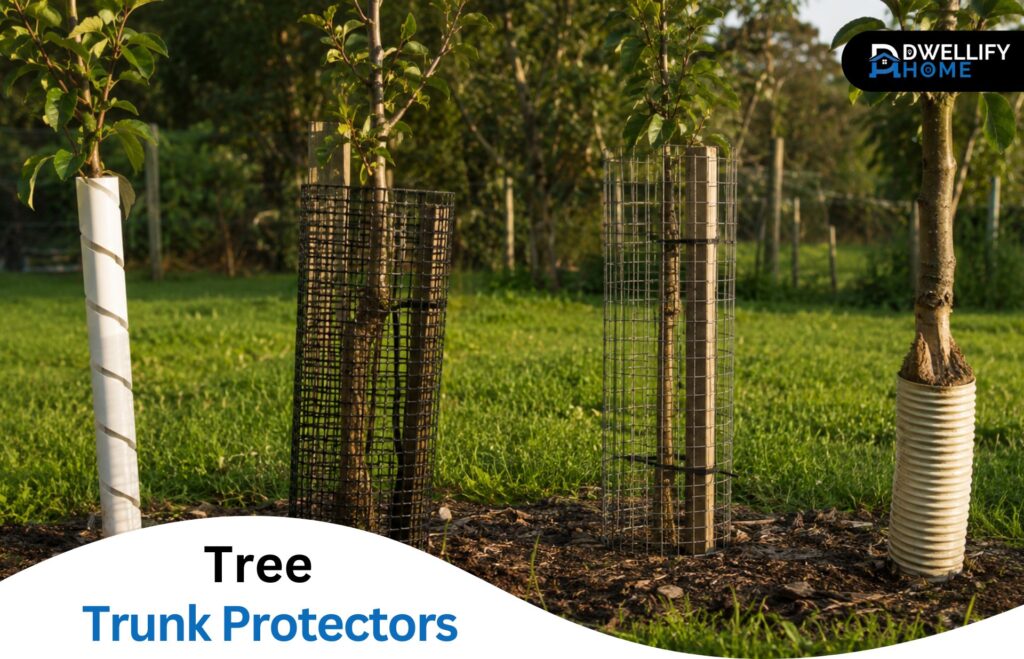
Plastic spiral wraps
Coil-style guards that expand as they wind around the trunk. Cheap, fast to fit, fine for sunscald and light rabbit protection on smaller trunks. They aren’t trimmer armor, and they must come off in summer or they trap moisture and leave scars.
Rigid and flexible mesh cylinders
Ventilated plastic mesh that stands off the trunk. Good airflow, good against rabbits and general gnawing, and they don’t overheat the way solid tubes can. A solid all-rounder for most young landscape trees.
Corrugated tubes and tree shelters (grow tubes)
Solid-walled tubes, usually for seedlings. They block animals and equipment and create a warm microclimate, but solid dark tubes trap heat and moisture — a trade-off you manage with venting and placement.
Metal hardware cloth — including DIY builds
Quarter-inch galvanized hardware cloth rolled into a cylinder is the most durable rodent barrier there is, and my go-to for heavy vole and rabbit pressure. It breathes, lasts years, and you can build it yourself. One field note: if you reach for window screen instead, use aluminum, never fiberglass — rodents chew straight through fiberglass.
Cloth, paper, and foam tree wraps
Flexible wraps, mostly for winter sunscald. I’ll be blunt about the downsides: they can stay damp against the bark and shelter borers and scale, and some research has found kraft paper wrap can swing trunk temperature faster than bare bark [VERIFY: Litzow & Pellett via UF/IFAS]. Treat any wrap as a seasonal tool that comes off in spring.
White paint and reflective washes
A coat of diluted white latex is one of the oldest sunscald defenses, and it works — it reflects winter sun and steadies the temperature. Use interior white latex, not exterior; exterior formulas can carry additives that harm bark [VERIFY: USU]. Standard practice is a 50/50 latex-and-water mix [VERIFY], and full-strength paint brushed on has been shown to deter some borers better than a thin sprayed coat [VERIFY: Cornell via Fruit Growers News].
| Type | Best against | Pros | Cons | Remove? |
| Plastic spiral wrap | Sunscald, light rabbit | Cheap, fast, expandable | Not trimmer-proof; traps moisture | Yes — each spring |
| Mesh cylinder | Rabbits, general gnawing | Breathable, reusable | Not deer-rated | Can stay if loose |
| Corrugated tube / shelter | Seedlings, equipment | Sturdy, microclimate | Solid types overheat | Vent; monitor |
| Hardware cloth | Voles, heavy rabbit pressure | Most durable, breathable, DIY | More effort to fit | Can stay years if loose |
| Paper / cloth wrap | Winter sunscald | Inexpensive, easy | Harbors pests; stays damp | Yes — spring |
| White latex paint | Sunscald, some borers | Cheap, no girdling risk | Cosmetic; reapply | Reapply as needed |
How to install a tree trunk protector without harming the tree
When to put a guard on
For animal and sunscald protection, late fall is the window — before hard freezes and before rodents get desperate, roughly late October into November in colder zones [VERIFY]. Equipment protection can go on any time. On a new planting, fit the guard at planting so you don’t forget.
Clearing the base and setting a vegetation-free zone
Clear grass and weeds back from the trunk first. Rodents nest in that cover and it invites the mower in. A mulched, grass-free ring a couple feet across — mulch pulled back off the bark, never mounded into a volcano — is the foundation the guard sits inside.
Fitting it right — air gap, clearance, and room to grow
Leave an air gap. The guard should stand off the bark, not press against it. That gap lets the trunk breathe, keeps moisture from sitting on the bark, and gives the trunk room to expand. A guard clamped tight to the bark is a wound waiting to happen.
Anchoring at the soil line — burying the base to stop mice and voles
Anything meant to stop mice and voles has to go into the ground at the bottom — 2 to 3 inches below the surface [VERIFY]. Rest it on top and rodents simply tunnel under in winter and work the trunk anyway. Buried, it’s a wall; sitting on the soil, it’s just a roof.
Securing it without girdling — ties, stakes, and what to avoid
If a guard needs securing, tie it to a separate stake set a few inches away — not cinched around the trunk. Never wrap wire, zip ties, or twine tightly around the bark; that’s girdling with your own hands. Loose is the rule. It should shift slightly, not bite in.
A worked example — fitting a hardware-cloth cylinder to a young fruit tree
Here’s how I do it on a young apple. Cut a strip of quarter-inch hardware cloth long enough to form a cylinder three or four inches wider than the trunk — you want the air gap, not a tight sleeve. Roll it, hook the cut wires together to close the seam, and fold the sharp edge over so it won’t slice you or the bark. Stand it around the trunk, push the base two to three inches into the soil, and tie it to a short side stake. Sized this way it clears the snow, defeats rabbits and meadow voles, breathes freely, and can stay for a few years — just confirm each spring that the trunk hasn’t grown out to meet it.
How to remove and maintain it — before it becomes the problem
The basic rhythm — on in late fall, off after the last frost
Simple version: guards for winter threats go on in late fall and come off after the last hard frost [VERIFY]. Paper and plastic wraps in particular should never ride through the growing season.
Which guards can safely stay on year-round
Breathable barriers that stand off the trunk — mesh cylinders and loosely fitted hardware cloth — can stay a few years, as long as they’re loose and you inspect them. Anything solid, snug, or moisture-trapping is seasonal. The test is easy: if it hugs the bark or holds dampness, it comes off.
Spotting early girdling before it turns fatal
Every spring, check the trunk where the guard sits. Warning signs: a groove or indentation, bark bulging above a tie, discoloration, or the guard pressing into the wood. Catch it here and you just loosen or resize. Miss it for a couple years and you get the candy-cane scar — a permanent spiral wound from a wrap left on too long.
Repairing bark damage the right way — and why you leave the wound uncovered
If bark is already damaged, resist the urge to paint or tar over it. The current guidance is to clean the wound — trim loose, dead bark back to living tissue with a sterilized blade, round off the edges — then leave it open to callus over on its own [VERIFY: UMN]. Dressings and tar seal in moisture and slow healing. And if the bark is gone all the way around, be realistic: a fully girdled trunk usually can’t be saved short of bridge grafting, which is a specialist job.
Common mistakes that turn a protector into a problem
Dark or solid tubes that cook the trunk in summer
A solid dark tube in full summer sun becomes an oven. Heat and trapped moisture build against the bark and you get scorched or rotting tissue — the opposite of protection. Vent it and watch it in summer, or switch to breathable mesh.
Wraps and paper guards that shelter borers and scale
A snug paper wrap is a perfect hideout. Bark borers and scale shelter underneath, and the bark stays soft instead of toughening up. This is the core argument for pulling wraps off in spring rather than leaving them.
Spiral wraps left on too long — the “candy-cane” scar
A spiral left in place for years scars the trunk as it grows against the coil. I see it constantly. The wrap did its job the first winter, then quietly became the problem. Spiral on in fall, spiral off in spring.
Paper wrap that can make temperature swings worse, not better
Counterintuitive but worth knowing: some research has found common kraft paper wrap doesn’t buffer trunk temperature the way people assume, and can let it change faster than bare bark [VERIFY: Litzow & Pellett via UF/IFAS]. For sunscald, reflective wraps and white paint are more dependable.
Guards set above the soil instead of buried below it
The most common rodent-guard failure I find is a cylinder sitting on the ground. Mice and voles go straight under it. If it’s meant to stop them, the base belongs in the soil, not on it.
The wrong white paint — which formulas help and which have injured trees
White paint helps with sunscald, but not every paint is tree-safe. Use interior white latex, diluted. Skip exterior latex and anything with mildewcides or heavy additives — some latex paints have been linked to bark injury on maples [VERIFY: USU / ISA]. Never put oil-based paint on bark.
Expecting a guard to save an already-girdled tree
A guard prevents damage; it doesn’t reverse it. Wrapping a trunk that’s already girdled all the way around won’t bring it back. If the damage is complete, the honest call is usually to replace the tree rather than nurse a trunk that’s lost its supply line.
Frequently asked questions
How long should a tree trunk protector stay on a tree?
Most trees need trunk protection for the first three to five years, until the bark thickens enough to resist damage on its own [VERIFY]. Fast-thickening species may need less; thin-barked and dwarf fruit trees may need it far longer. Seasonal wraps still come off every spring regardless.
How do I protect a tree trunk from string trimmers and mowers?
The most reliable protection is a wide, mulched, grass-free ring around the trunk, so there’s nothing to cut near the bark. A rigid guard adds a backstop, but thin spiral wraps won’t reliably stop a trimmer. Keeping equipment away from the trunk beats armoring it.
How high should a rabbit or vole guard be?
For rabbits, reach 18 to 24 inches above the expected snow line, since they feed from the top of the snow [VERIFY]. For voles and mice, height matters less than depth — bury the base 2 to 3 inches into the soil so they can’t get underneath.
Can I leave a plastic spiral guard on year-round?
No. Plastic spiral guards should come off in spring. Left on through the growing season, they trap moisture against the bark, shelter insects, and leave a spiral girdling scar as the trunk grows. Fit them in late fall and remove them after the last hard frost.
Does painting a trunk white really prevent sunscald, and which paint should I use?
Yes. A white trunk reflects winter sun and reduces the temperature swing that causes sunscald. Use interior white latex diluted roughly 50/50 with water [VERIFY]. Avoid exterior and oil-based paints, which can contain additives that harm bark. Reapply as the coat fades or the trunk grows.
Can a tree recover if it has been fully girdled?
Usually not. Once bark and the living tissue beneath it are gone all the way around, the tree can’t move sugars to its roots and declines even if it leafs out once more. Bridge grafting can sometimes save a valuable tree, but it’s a specialist repair.
What’s the difference between a tree wrap, a tree guard, and a tree tube?
A tree wrap is a flexible material wound around the trunk, mainly for winter sunscald. A tree guard is a cylinder or coil that stands around the trunk to block animals and equipment. A tree tube, or shelter, is a taller solid tube used mostly on seedlings for protection and a growth microclimate.
How do I make a DIY tree trunk protector that actually works?
Roll quarter-inch galvanized hardware cloth into a cylinder a few inches wider than the trunk, close the seam by hooking the cut wires, and fold the sharp edge over. Set it around the trunk, bury the base 2 to 3 inches, and tie it to a side stake. It’s cheap, breathable, and rodent-proof.
What’s the best thing to put around the base of a tree?
For most trees, a ring of mulch two to three inches deep, pulled back a few inches from the trunk and never piled against it. It smothers the weeds rodents hide in and keeps mowers away. Add a guard on top only when a specific threat calls for one.
The bottom line
The right tree trunk protector is simply the one that matches the threat your tree actually faces — and comes off before it becomes a threat itself. Read the damage first, then size the guard to the job: tall enough to clear the snow line and reach a browsing deer, buried deep enough to stop a vole, and loose enough to let the trunk grow. Get the match wrong and the guard can kill a tree faster than the thing you were guarding against. Get it right, check it every spring, and a few dollars of the correct barrier will carry a young tree all the way to the thick, tough bark that finally lets it protect itself.
Disclaimer: This article is for general informational purposes only. Individual trees, sites, and local conditions vary, so results will differ from one situation to the next. For a valuable, damaged, or at-risk tree, consider consulting a certified arborist for advice specific to your property.