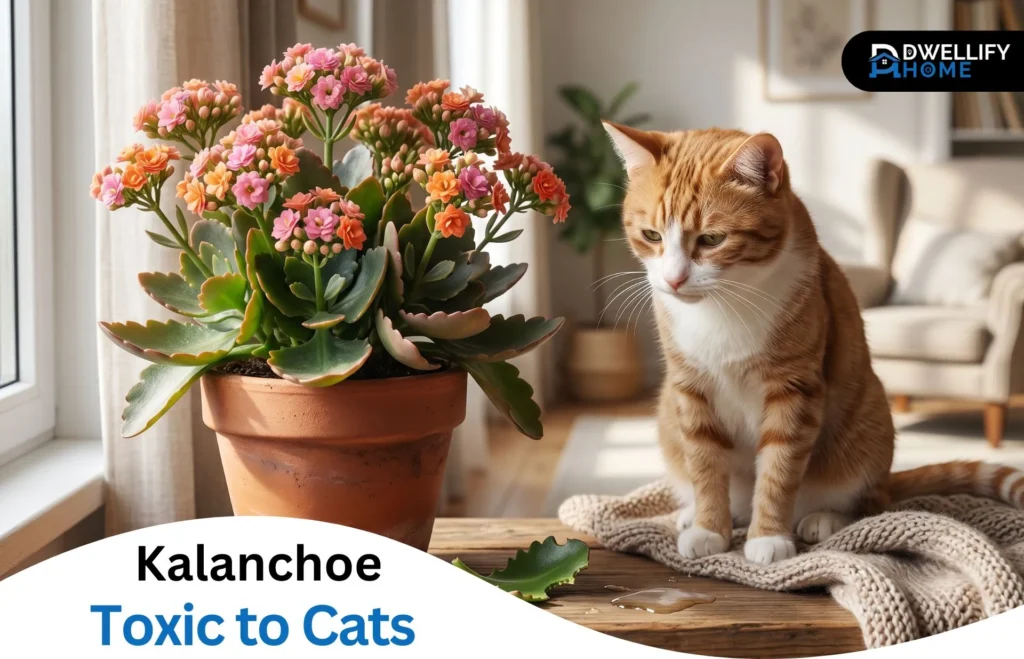
A worried call from a cat owner who just spotted chewed leaves on their kalanchoe is one of the most common conversations in pet poison work. The plant is everywhere — grocery stores, garden centres, holiday gift baskets — and most people have no idea it’s a problem until a curious cat shows interest. The short answer most owners want to hear right away: yes, kalanchoe is toxic to cats, but not every nibble is an emergency. The longer answer, and what to actually do about it, is what really matters.
The Short Answer
Kalanchoe is a flowering succulent that’s toxic to cats due to bufadienolides, a type of cardiac glycoside. Ingestion typically causes vomiting and diarrhoea, and in larger amounts, irregular heart rhythm.
About Dwellify Home
Dwellify Home is built to help homeowners create spaces that feel good to live in. From modern décor and garden ideas to property insights and everyday home solutions, the goal is simple — practical, well-researched guidance that helps you make confident decisions about the place you call home.
Is Kalanchoe Toxic to Cats? The Direct Answer
Yes. Every part of the plant — leaves, stems, flowers, and roots — contains compounds that can make a cat sick. The flowers carry the highest concentration, which is why blooming plants are the bigger concern.
Most cases I’ve come across involve mild stomach upset that resolves within a day. Severe poisoning is genuinely rare, but it does happen, especially when a cat eats a large amount or chews into a plant in full bloom. The plant is officially listed as toxic to cats by the ASPCA, and that classification is worth taking seriously without slipping into panic.
Key Things Cat Owners Should Know
- All parts of kalanchoe are toxic to cats, with flowers carrying the highest concentration
- Most cases involve mild stomach upset that clears within 24 hours
- Symptoms usually appear within 2 to 3 hours of ingestion
- Severe poisoning is rare but possible with large amounts, especially flowers
- The plant is also toxic to dogs, often more severely than to cats
- Florist kalanchoe is the variety most often involved in pet exposure cases
What Is Kalanchoe? Common Names and Quick Background
Kalanchoe is a genus of succulents with well over a hundred species. It’s loved as a houseplant because it tolerates low light, doesn’t need much watering, and produces small clusters of bright flowers in red, pink, orange, yellow, or white.
You may know it by a different name depending on where you bought it. The most common ones include:
- Florist kalanchoe (Kalanchoe blossfeldiana)
- Mother of millions (Kalanchoe delagoensis or tubiflora)
- Mother-in-law plant
- Devil’s backbone
- Chandelier plant
- Widow’s thrill
- Panda plant (Kalanchoe tomentosa)
- Paddle plant (Kalanchoe luciae)
If a plant matches that description and came home from a supermarket flower aisle around the holidays, there’s a strong chance it’s florist kalanchoe — the variety most often involved in cat exposure cases.
Why Kalanchoe Is Dangerous to Cats: The Science Behind the Toxicity
The active toxins in kalanchoe are called bufadienolides. They belong to a broader group called cardiac glycosides — the same family of compounds found in oleander, foxglove, and the heart medication digoxin.
In simple terms, these toxins interfere with the way heart muscle cells move sodium and potassium across their membranes. When that balance gets disrupted, the heart’s electrical rhythm can become irregular. The same compounds also irritate the gut lining, which is why vomiting and diarrhoea usually appear long before any cardiac signs.
Here’s the part most articles miss. The toxins aren’t spread evenly through the plant. Flowers carry the highest dose, leaves come next, and stems and roots have the least. A cat that bites into a bloom is taking on far more risk than one that nibbles a leaf tip.
Symptoms of Kalanchoe Poisoning in Cats
Symptoms generally follow a predictable pattern. Stomach signs come first, and only with larger ingestions do things progress toward the heart. Knowing the order matters because it tells you whether the situation is manageable at home with monitoring or whether it’s heading somewhere serious.
Early and Mild Symptoms to Watch For
These are the signs that show up most often and usually settle within 12 to 24 hours:
- Drooling or pawing at the mouth
- Vomiting (sometimes with bits of plant material)
- Diarrhoea, occasionally with a small amount of blood
- Loss of appetite
- Mild lethargy or hiding behaviour
- Reduced interest in food or play
In the majority of mild cases, the cat throws up once or twice, looks miserable for a few hours, and then bounces back. That’s not a reason to skip a vet call, but it’s helpful context.
Severe Signs That Need Emergency Care
If a cat eats a significant amount — particularly the flowers — you may see signs that go beyond the gut:
- Persistent or bloody diarrhoea
- Weakness or wobbliness when walking
- Cold paws and ears
- Slow, fast, or irregular heartbeat
- Laboured or shallow breathing
- Collapse or fainting
- Tremors or, very rarely, seizures
Any of these is an emergency. Don’t wait to see if it improves — these signs mean the cardiac glycosides are affecting the heart, and that needs hands-on veterinary care.
How Soon Do Symptoms Appear?
Most cats start showing signs within two to three hours of eating the plant. In some cases, symptoms can take up to 12 hours to surface, occasionally longer. That’s why I always tell owners to keep watching for a full 24 hours, even if their cat seems fine at the four-hour mark.
My Cat Ate Kalanchoe — What Should I Do?
This is where calm, practical thinking helps far more than panic. The actions you take in the first 30 minutes shape how the rest of the day goes.
Immediate Steps to Take at Home
Move through these in order:
- Get the cat away from the plant and put the plant somewhere it can’t be reached again — including any fallen leaves or petals.
- Check inside the mouth and gently remove any visible plant material. A quick rinse of the mouth with cool water can help if your cat tolerates it.
- Take a photo of the plant and try to identify the species and whether it was flowering.
- Estimate how much was eaten — a single chewed leaf is very different from half a flower stalk.
- Call your vet or a poison helpline right away. The ASPCA Animal Poison Control Center and the Pet Poison Helpline are both available around the clock.
- Watch closely for the next 24 hours, even if your cat seems fine. Note any vomiting, changes in breathing, gum colour, or behaviour.
What NOT to Do Before Calling the Vet
A few well-meaning moves can actually make things worse with this plant:
- Don’t try to make your cat vomit at home. Hydrogen peroxide, salt, or anything else used in dogs is not safe for cats and can cause severe internal damage.
- Don’t give milk, oil, or food in an attempt to “neutralise” the toxin. It does nothing useful and complicates treatment.
- Don’t wait it out because your cat “looks okay.” Cardiac signs can show up later than gut signs.
- Don’t assume a small bite is harmless without checking — particularly with a flowering plant.
When in doubt, call. A short phone consultation often saves an unnecessary emergency visit, and when it’s actually serious, those minutes count.
How Vets Treat Kalanchoe Poisoning
Treatment depends on how much was eaten and how the cat is presenting. There’s no specific antidote for bufadienolides, so care is supportive — meaning the goal is to limit toxin absorption, settle the gut, and keep the heart stable.
In a recent ingestion with no symptoms yet, vets usually focus on decontamination. That can mean inducing vomiting under medical control and giving activated charcoal to bind whatever is left in the stomach. Once symptoms have already started, the plan shifts toward intravenous fluids, anti-nausea medication, and continuous heart monitoring with an ECG.
If the heart rhythm is affected, antiarrhythmic medications come into the picture. Bloodwork to check electrolytes is standard because potassium levels matter a lot with this group of toxins. Most cats that are seen quickly recover well, often within 24 to 48 hours. Outcomes get worse the longer treatment is delayed, which is the strongest argument for not waiting at home.
Are All Kalanchoe Species Equally Toxic?
All species in the genus contain bufadienolides, but the concentration and the typical exposure risk vary.
- Florist kalanchoe (Kalanchoe blossfeldiana): The most common variety in homes and the one behind most pet exposure calls. Risk peaks during its long flowering period.
- Mother of millions (Kalanchoe delagoensis / tubiflora): Considered one of the more dangerous varieties. It produces tiny plantlets along its leaf edges that fall and scatter, which means cats can encounter the toxin even when the main plant is out of reach.
- Panda plant (Kalanchoe tomentosa): The fuzzy-leafed type. It rarely flowers indoors, so the cardiac risk is generally lower, but the leaves are still toxic if chewed.
- Paddle plant (Kalanchoe luciae or thyrsiflora): Toxic, but the thick, waxy leaves don’t tend to be chewed often. Most cases I’ve seen involve a single bite that’s quickly spit out.
No kalanchoe species is genuinely safe around cats. The differences are about likelihood of exposure, not whether the plant is toxic at all.
Why Kalanchoe Is Especially Risky During Flowering Season
Florist kalanchoe is heavily marketed in late autumn and through winter because it blooms when little else does. That’s exactly when cases spike. The flowers concentrate the toxins more than any other part of the plant, and a blooming kalanchoe sitting on a coffee table is far more interesting to a cat than the plain green version.
Holiday gifting plays a role here too. Many owners receive kalanchoe as a present without realising what it is or that it’s a concern for their cat. If someone hands you a bright-flowered succulent in a foil-wrapped pot during the colder months, it’s worth checking the tag before deciding where to put it.
Is Kalanchoe Poisonous to Touch?
For people, no. Kalanchoe doesn’t have the irritating latex sap that euphorbia species are known for. You can repot it, prune it, and handle it without gloves. A quick handwash afterwards is sensible, but skin contact alone isn’t a real concern.
For cats, the danger is in chewing or swallowing — not in brushing past the plant or sniffing it. A cat that walks by and rubs against a leaf is fine. The risk starts the moment the plant goes into the mouth.
Is Kalanchoe Toxic to Dogs Too? A Quick Comparison
Yes, and dogs are generally more susceptible than cats. Part of that comes down to body size and behaviour — a curious dog will often eat a much larger amount than a cat, who tends to nibble and stop. Cattle, sheep, birds, and rabbits have all been affected too, with severe cases documented in livestock exposed to kalanchoe in pasture.
Symptoms in dogs mirror what’s seen in cats: vomiting, diarrhoea, weakness, and in serious cases, heart rhythm changes. The treatment principles are the same. In a multi-pet household, kalanchoe is a problem for the whole family, not just the cat.
How to Keep Cats Safe Around Kalanchoe
The cleanest solution is also the simplest one — don’t keep kalanchoe in a home with cats. I know that’s not always what people want to hear, especially when the plant was a gift or has sentimental value. There are middle-ground options, but each comes with limits.
Practical steps that actually work:
- Move the plant to a room your cat genuinely doesn’t enter, with the door kept closed.
- Use hanging baskets only if your cat can’t reach them from a nearby surface — and remember cats jump higher than most people expect.
- Sweep up fallen petals and leaves daily during flowering, especially with mother-of-millions varieties.
- Provide cat grass or catnip nearby. Cats often chew houseplants out of boredom or a need for fibre, and giving them a safe target reduces interest in the toxic one.
- Skip the plant entirely if you have a kitten, an indoor-only cat that loves to chew, or an older cat with existing heart issues.
For outdoor gardens in warm climates where kalanchoe grows freely, supervise outdoor cats during the flowering months and remove any plants that are spreading near walkways or resting spots.
Cat-Safe Alternatives to Kalanchoe
The good news is that the cat-safe plant world is far bigger than people realise. If you’re after the same look — small, easy-care, flowering, succulent-style — there are several options that won’t put your cat at risk.
- Christmas cactus (Schlumbergera): Bright winter blooms in similar colours to kalanchoe. Listed as non-toxic by the ASPCA.
- Echeveria: Rosette-shaped succulents in soft greens, blues, and pinks. Easy to find and pet-safe.
- Haworthia (zebra plant): Compact striped succulents that look great on shelves and are non-toxic to cats.
- Burro’s tail (Sedum morganianum): A trailing succulent for hanging pots.
- Hens and chicks (Sempervivum): Hardy outdoor or sunroom succulents, fully pet-safe.
- African violet: A small flowering plant that brings colour without the cardiac glycosides.
- Spider plant, Boston fern, or Calathea: Reliable, non-toxic foliage choices that hold up well around curious cats.
Always cross-check any new plant against the ASPCA’s toxic plant database before bringing it home. Common names overlap, and the same name is sometimes used for very different species.
Frequently Asked Questions
Will my cat die if it eats kalanchoe?
Death from kalanchoe ingestion in cats is rare. The vast majority of cases involve mild stomach upset that resolves with basic care. Fatal outcomes are typically tied to large ingestions of flowers combined with delayed treatment. Acting quickly almost always changes the picture.
How much kalanchoe is dangerous to a cat?
There’s no exact toxic dose published for cats, partly because the plant tastes unpleasant and most cats stop after one bite. As a general guide, a single nibble of a leaf usually causes only mild signs, while eating multiple leaves or any quantity of flowers raises the risk meaningfully. When in doubt, treat it as worth a vet call.
Do cats avoid kalanchoe naturally because of its taste?
Most do, which is why severe cases aren’t as common as the plant’s toxicity might suggest. The leaves have a bitter, unpleasant taste, and cats tend to spit out the first bite. That said, kittens, bored cats, and cats with pica (a habit of chewing non-food items) are exceptions. Don’t rely on instinct to keep your cat safe.
How long does it take a cat to recover from kalanchoe poisoning?
Mild cases usually clear within 24 hours. Cases serious enough to need fluids and monitoring typically resolve in 24 to 48 hours of supportive care. Cats that develop cardiac signs may need a longer hospital stay, but full recovery is the norm when treatment starts early.
Final Thoughts: Keeping Your Cat Safe From Kalanchoe
Kalanchoe is toxic to cats — that’s the honest answer. But the realistic picture is more reassuring than the worst-case scenarios online suggest. Most cats that taste this plant end up with a bad afternoon and nothing more, especially when their owner notices, calls a vet, and watches them carefully.
The smart approach is prevention. Know what kalanchoe looks like, check the plants already in your home, be careful with winter flower gifts, and choose cat-safe alternatives when you can. If something does happen, don’t waste time second-guessing — pick up the phone, describe what you saw, and let a professional walk you through the next step. That single call is the difference between a story you tell at dinner and one you’d rather forget.
Disclaimer
This article is intended for general informational purposes only and is not a substitute for professional veterinary advice. Every cat reacts differently based on size, health, and the amount ingested. If you suspect your cat has eaten kalanchoe or any toxic plant, contact your veterinarian or a pet poison helpline straight away.