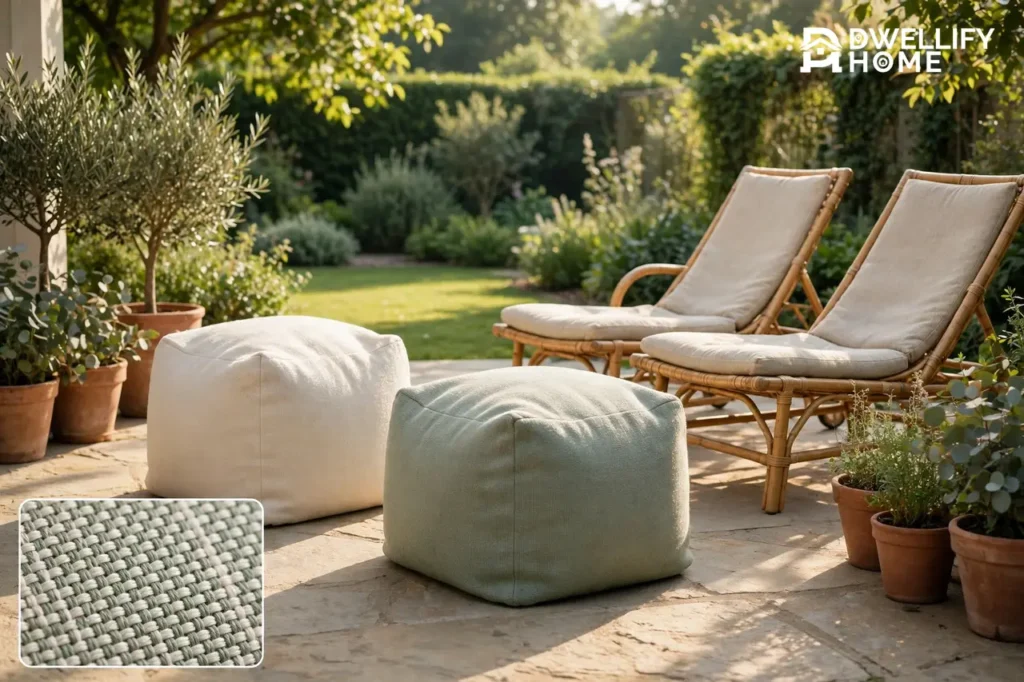
An outdoor pouf ottoman is a soft, backless cube or round seat that works as a footrest, an extra seat, and a low side table, and the best ones cost $50 to $130, weigh under 15 pounds, and use Sunbrella or olefin fabric over quick-drain foam that sheds rain instead of soaking it up. A pouf earns its place on a small patio because it does three jobs and stores anywhere. This guide compares the types, shows real checked prices, and helps you pick a pouf that stays outside without turning into a soggy sponge.
One detail on the list below decides whether your pouf survives its first rainy week, and it is not the fabric or the price. It is what is inside the pouf, and the foam section in the middle of this guide shows exactly why a pretty cover cannot save a bad core. Before that, you need to know what a pouf actually is, because poufs, ottomans, and footstools are not the same piece of furniture.
What Is an Outdoor Pouf Ottoman?
An outdoor pouf ottoman is a versatile, low upholstered piece designed for exterior spaces that serves as both a footrest and an auxiliary seating or table surface. Built with weather-resistant materials like UV-resistant fabrics and waterproof foam, an outdoor pouf withstands sun exposure, moisture, and temperature fluctuations.
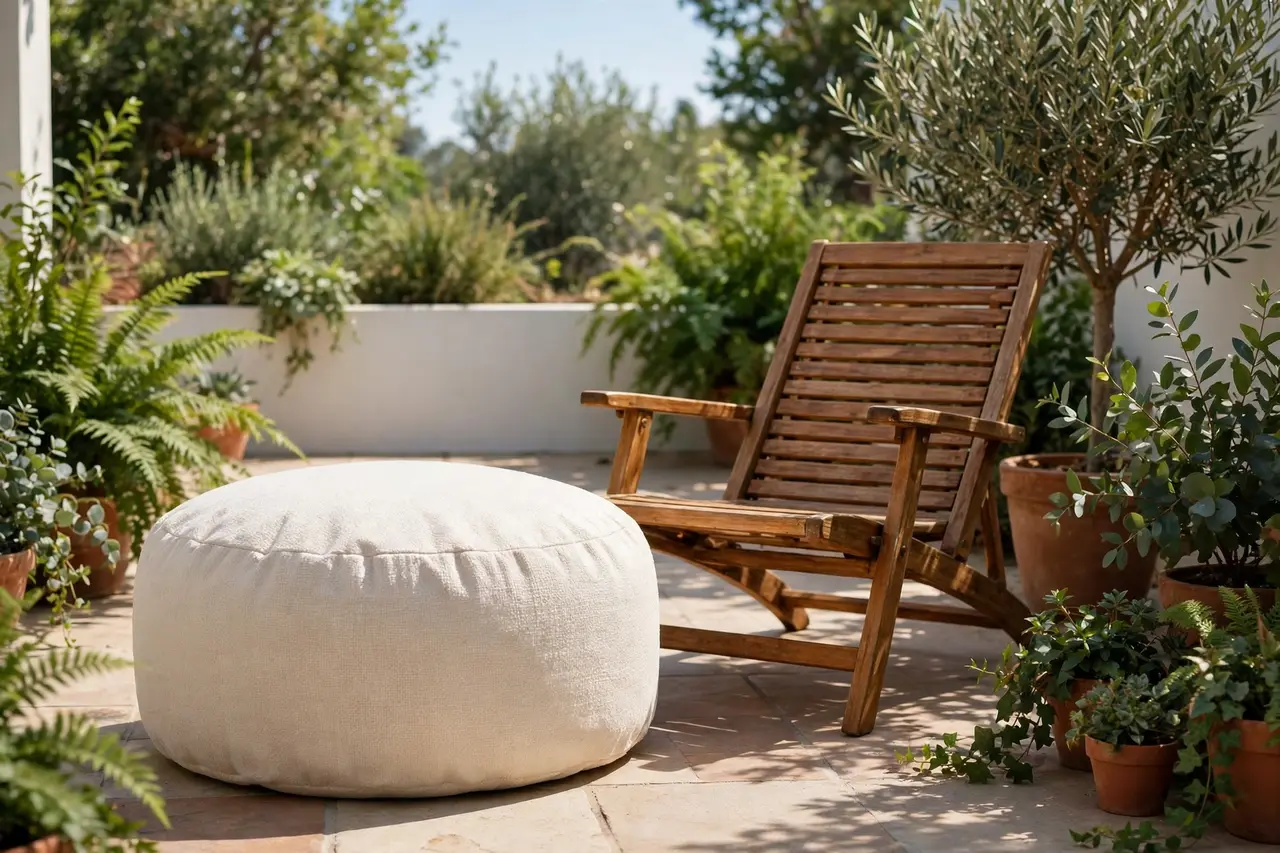
A pouf and an ottoman look alike and behave differently. A pouf is a backless, cushioned piece that functions as a footrest, extra seating, or low side table, and poufs typically feature soft construction with dense foam cores, which makes them lightweight and movable. An ottoman usually has a rigid wood or metal frame, which makes it heavier and sturdier but harder to move. A footstool is smaller and lower, built for feet only, while a pouf can hold a person, a tray, or a book. Loomlan’s pouf guides spell out the difference plainly: poufs have soft all-foam construction and lighter weight, while ottomans often include rigid frames, and both serve as footrests but poufs offer greater portability. Read the full comparison at Loomlan’s Sunbrella outdoor pouf cube guide.
A pouf earns its place in three jobs at once. It lifts your feet after a long day, so a deep lounge chair becomes a lounger. It seats a guest when the party grows by one, so nobody drags a dining chair across the lawn. And with a tray on top, it becomes a side table for drinks and books, so the patio needs one less piece of furniture. A pouf that cannot do all three is a cushion with a fancy name, not a pouf.
A pouf is a footrest, a seat, and a table in one soft cube. If it can only do one job, it is the wrong pouf.
What Is Inside an Outdoor Pouf?
What is inside an outdoor pouf decides whether it survives rain: the best poufs use a waterproof sheet over a high-density foam core with a reticulated foam base and mesh drainage, so water runs through instead of pooling inside. Cheap poufs use regular foam or loose fill that soaks up rain like a sponge and grows mold from the inside out.
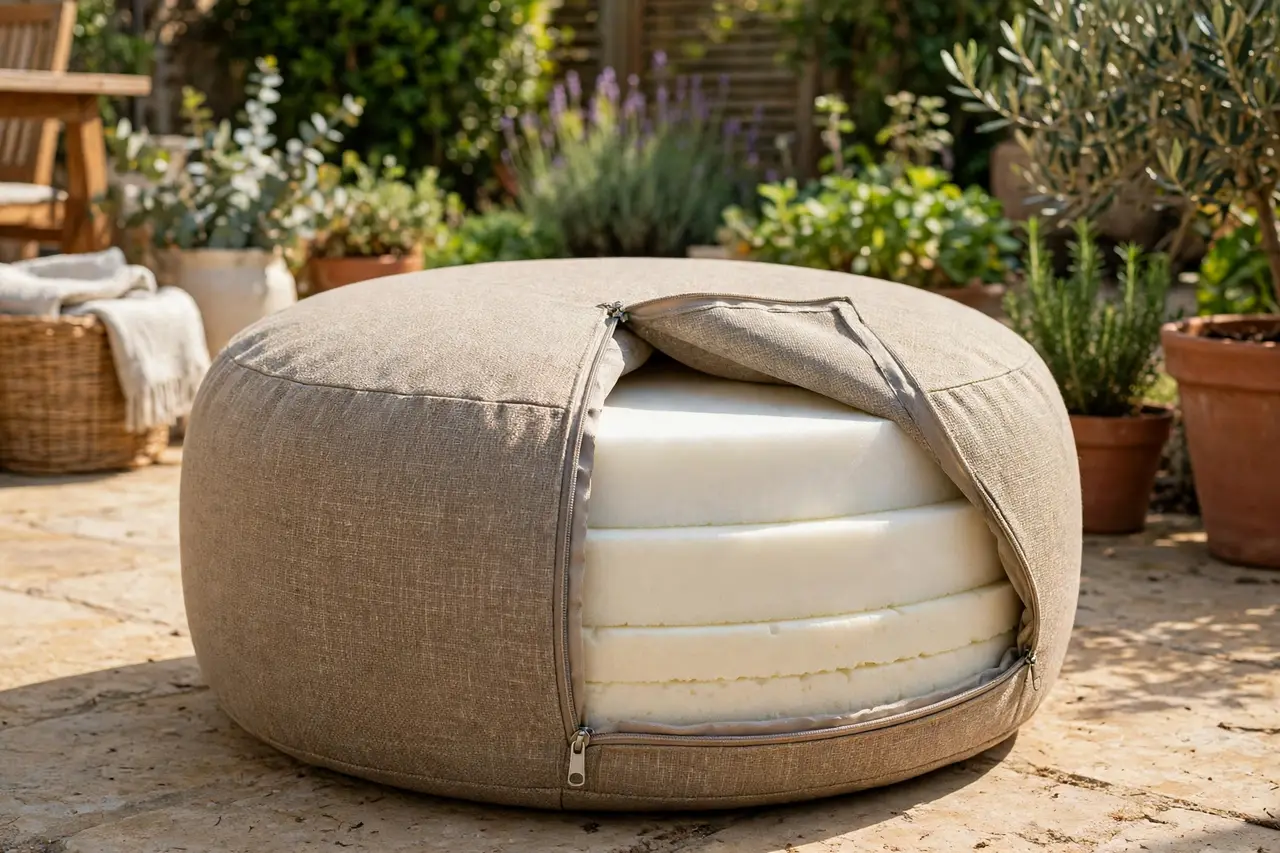
The good core has four layers, and the Sunset West Bazaar pouf shows how they work together. A waterproof sheet sits on top of the comfort foam and keeps rain and spills out of the interior. A high-density structural foam center holds the shape when you sit on it. A reticulated foam base with mesh lets any water that does get in drain rapidly instead of pooling. And a zip-on, zip-off Sunbrella cover wipes clean and comes off for washing. The whole cube weighs about 10 pounds, so anyone can carry it with one hand. See the full spec sheet at Loomlan’s weatherproof outdoor ottoman guide.
The bad core has one layer and one problem. Regular open-cell foam absorbs water, holds it for days, and starts smelling musty by the second wet week. Loose polystyrene beads do not absorb water, which is good, but they shift under weight, so the pouf flattens on one side and never holds a tray level. Shredded foam scrap is the worst of both: it absorbs water and clumps into lumps that never dry. Before you buy, ask what the fill is: if the listing does not say, assume the cheapest fill and walk away.
The fabric matters too, but it cannot save a bad core. Sunbrella solution-dyed acrylic resists fading, mildew, and water because the color runs through the whole fiber instead of sitting on the surface. Olefin knit fabric drains and dries fast and costs far less. Plain polyester fades and holds water unless it is UV-treated and coated. A waterproof cover over a sponge core is a wet sponge in a raincoat: dry outside, rotten inside.
The core decides the pouf. A waterproof sheet and a drainable base beat a pretty cover every time.
How Much Does an Outdoor Pouf Ottoman Cost?
Outdoor pouf ottomans cost $50 to $1,500 depending on the fabric and the build, with most good poufs landing between $50 and $130. Budget poufs run $50 to $75, mid-range Sunbrella and olefin poufs $90 to $220, and premium Sunbrella ottomans $370 to $1,500.
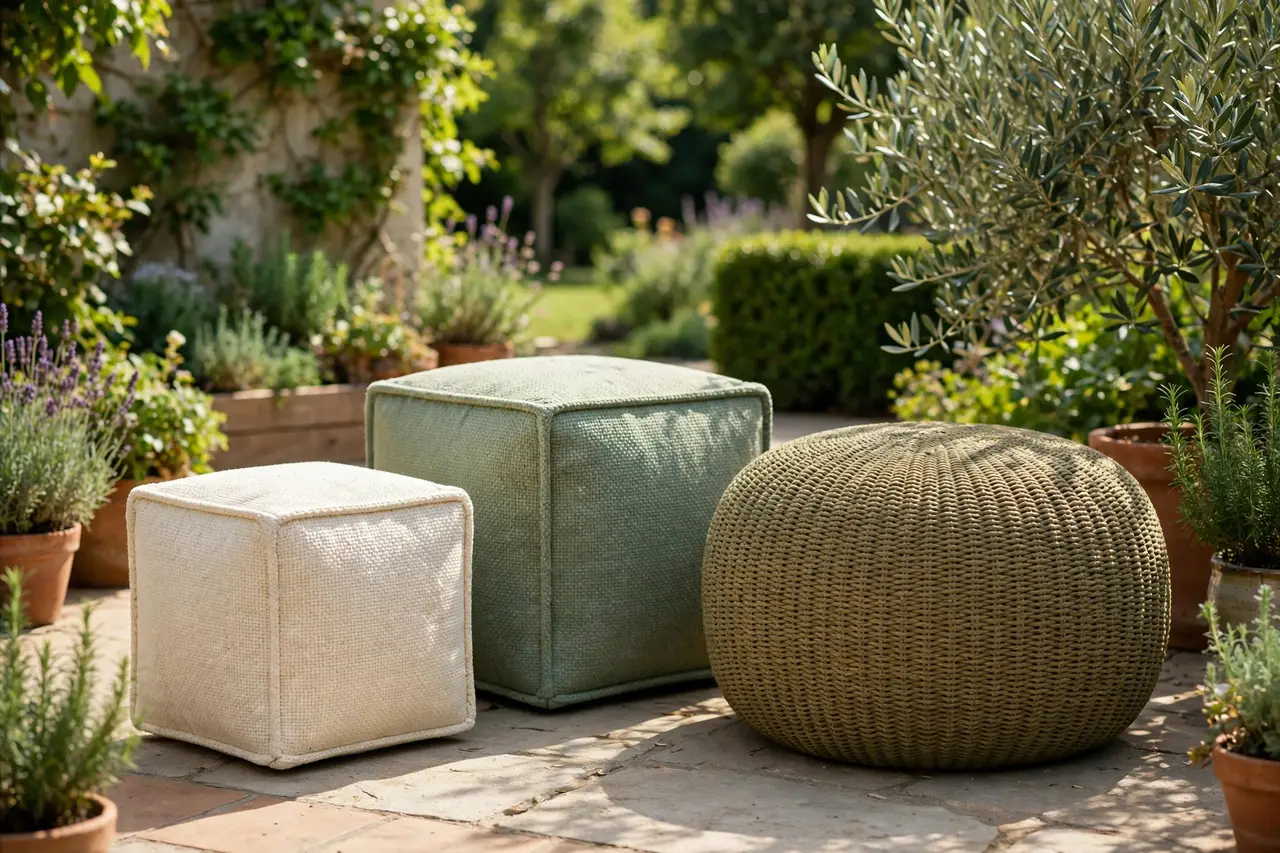
Real prices show the spread, all checked November 16, 2026. A Room Essentials 18-by-15-inch outdoor patio pouf lists at $50 to $60 at Target. A Threshold 20-by-15-inch knit olefin pouf lists at $56. A Big Joe Lux patio pouf with waterproof, UV-protected fabric lists at $74.99, and Target reviewers report it drains nicely after rain and works as a footrest, a seat, and a side table with a tray. A WyndenHall woven PET polyester pouf lists at $93.49 to $132.79. A Sunset West Bazaar Sunbrella pouf cube lists at $369, and the larger Bazaar weatherproof ottoman lists at $979 for the rectangle and $1,509 for the square. The gap between a $56 pouf and a $369 pouf is the fabric and the core: solution-dyed Sunbrella over a waterproof multi-layer core costs more to make and lasts far longer.
Three things push the price up beyond the fabric. Size adds cost fast: a 20-inch cube uses far more foam and fabric than an 18-inch cube, and a 36-inch round ottoman is a small sofa in disguise. A rigid frame adds cost too: a Marine Grade Polymer ottoman with Sunbrella cushions costs more than a soft pouf because the frame is impervious to fresh and salt water. And a removable, washable cover adds cost that pays for itself the first time a guest spills red wine on it.
Do not judge a pouf by its sticker price alone. A $56 pouf that flattens in year one and a $115 pouf that holds its shape for five years cost about the same over two years, and then the good pouf keeps going while you buy your third cheap one. Compare the three-year total, not the tag: purchase price plus the replacement poufs and the cushion cleaning you pay for when a cheap core soaks through.
Compare the three-year total, not the tag. A flat pouf and a moldy core both count.
What Most People Get Wrong About Outdoor Poufs
Most people get outdoor poufs wrong in the same three ways: they buy an indoor pouf for an outdoor patio, they pick the size by the photo instead of the chair, and they leave a wet pouf flat on the ground. All three mistakes show up fast, and the first one is the most common.
The indoor-pouf mistake is the big one. An indoor pouf uses cotton, untreated foam, and a cover that fades in a month of sun. It looks identical to an outdoor pouf in a product photo, and it turns into a soggy, faded lump after one rainy week. Check the listing for outdoor-rated fabric and a drainable core before you buy: if it says “indoor/outdoor” but names no fabric and no fill, it is an indoor pouf with an outdoor label. Some outdoor labels are misleading, so check for true water-repellency, sealed seams, and a mildew-resistant lining.
The size mistake runs the other way. A pouf that is too tall lifts your knees above your hips and ruins the lounge chair it is supposed to serve, while a pouf that is too short leaves your feet dangling. Measure your chair first: the pouf top should sit 1 to 2 inches below the seat of the chair it serves, and a standard lounge seat at 16 to 18 inches high wants a pouf 13 to 15 inches tall. A cube that is 18 inches tall suits a deep sofa, not a low lounge chair.
The wet-pouf mistake is the quiet killer. A pouf that soaks through needs to drain and dry, and a pouf left flat on the ground stays wet underneath for days. Stand a wet pouf on its side so water runs out, let it dry fully in the sun, and store it under cover during long wet spells. Our how to store outdoor furniture guide covers the full winter routine, and our outdoor storage bin guide shows bins that hold poufs and cushions through the cold months.
Outdoor fabric, chair-matched height, dry it on its side. A pouf that drains is a pouf that lasts.
Where Does an Outdoor Pouf Work Best?
An outdoor pouf works best beside a lounge chair on a patio, by a pool where quick-dry furniture matters, and in any small space where one piece must do three jobs. The 18-inch cube fits into covered patios, pool decks, and small balconies that cannot hold a full ottoman and a side table.
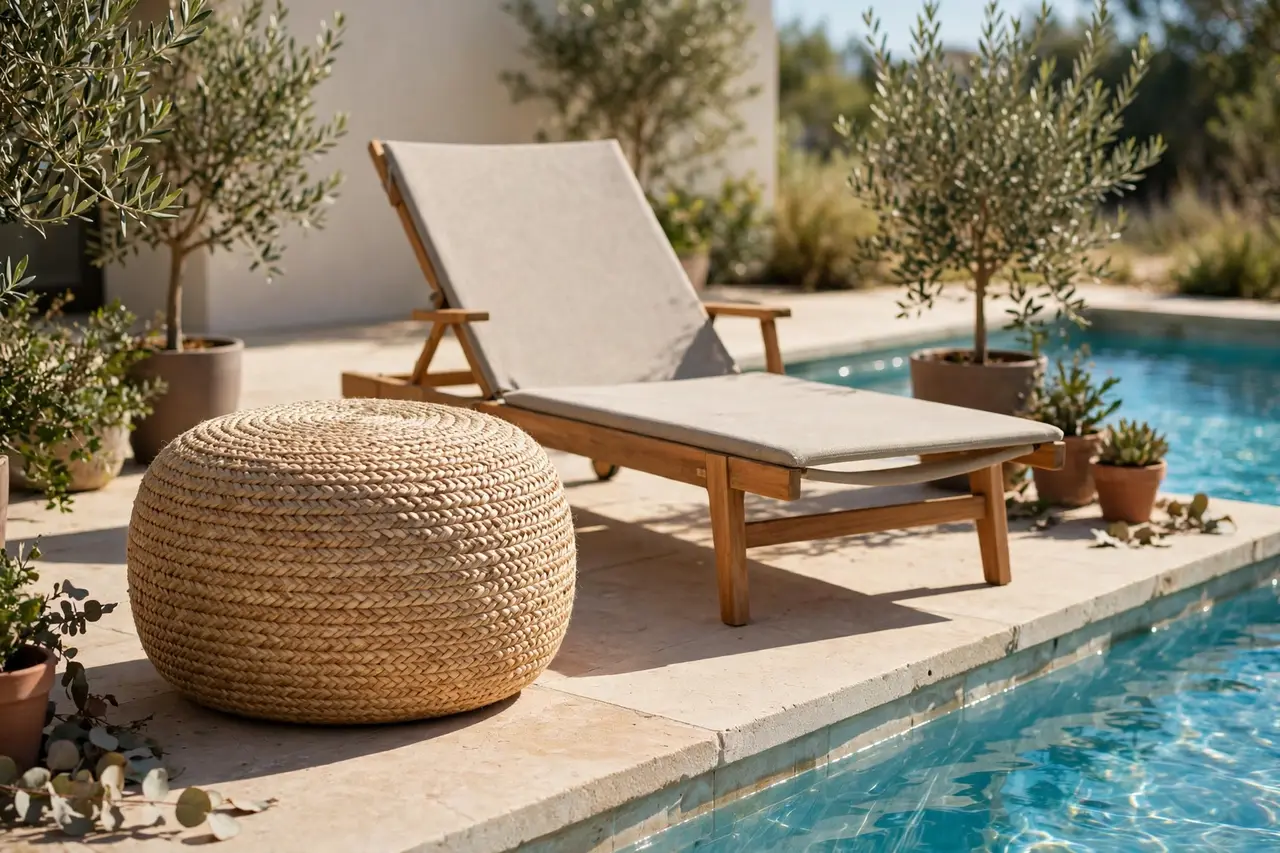
Beside a lounge chair is the classic spot. A pouf at the foot of a reclining patio chair turns it into a lounger without buying a new chair, and it slides away under the chair when dinner starts. Pair it with the right chair and the set reads as one piece of furniture: our outdoor sectional couch guide shows deep seating that pairs with a pouf for the lounge corner, and our replacement cushions for patio furniture guide shows how to match the pouf fabric to the cushions you already own.
By the pool is the practical spot. A pouf with a quick-drain base sheds splashes and dries fast, so it is ready to sit on again in minutes, while a foam-filled ottoman stays wet for hours. Keep the pouf a step back from the waterline so it does not get kicked in, and pick a dark or patterned fabric that hides chlorine spots and sunscreen smears.
On a small patio or balcony is the smartest spot of all. A pouf does the work of a footrest, an extra seat, and a side table in one 18-inch cube, and it tucks into a corner or under a table when the party ends. Our outdoor furniture for small spaces guide shows seven layouts where a pouf earns its footprint, and our small patio decorating ideas guide shows how one soft cube can anchor a whole corner. A pouf also earns its keep by the front door, where it holds bags while you find your keys, and beside a fire pit, where it seats the guest who arrives late.
One cube, three jobs, any corner. The pouf’s best spot is wherever the patio is short on space and long on guests.
How to Care for an Outdoor Pouf Ottoman
Care for an outdoor pouf ottoman with a five-minute routine after rain and a thirty-minute routine each season: stand it on its side to drain, wipe the cover with a dry cloth, and wash it with mild soap and warm water when it gets dirty. Sunbrella covers wipe clean and come off for washing, while olefin covers hose off and dry fast.
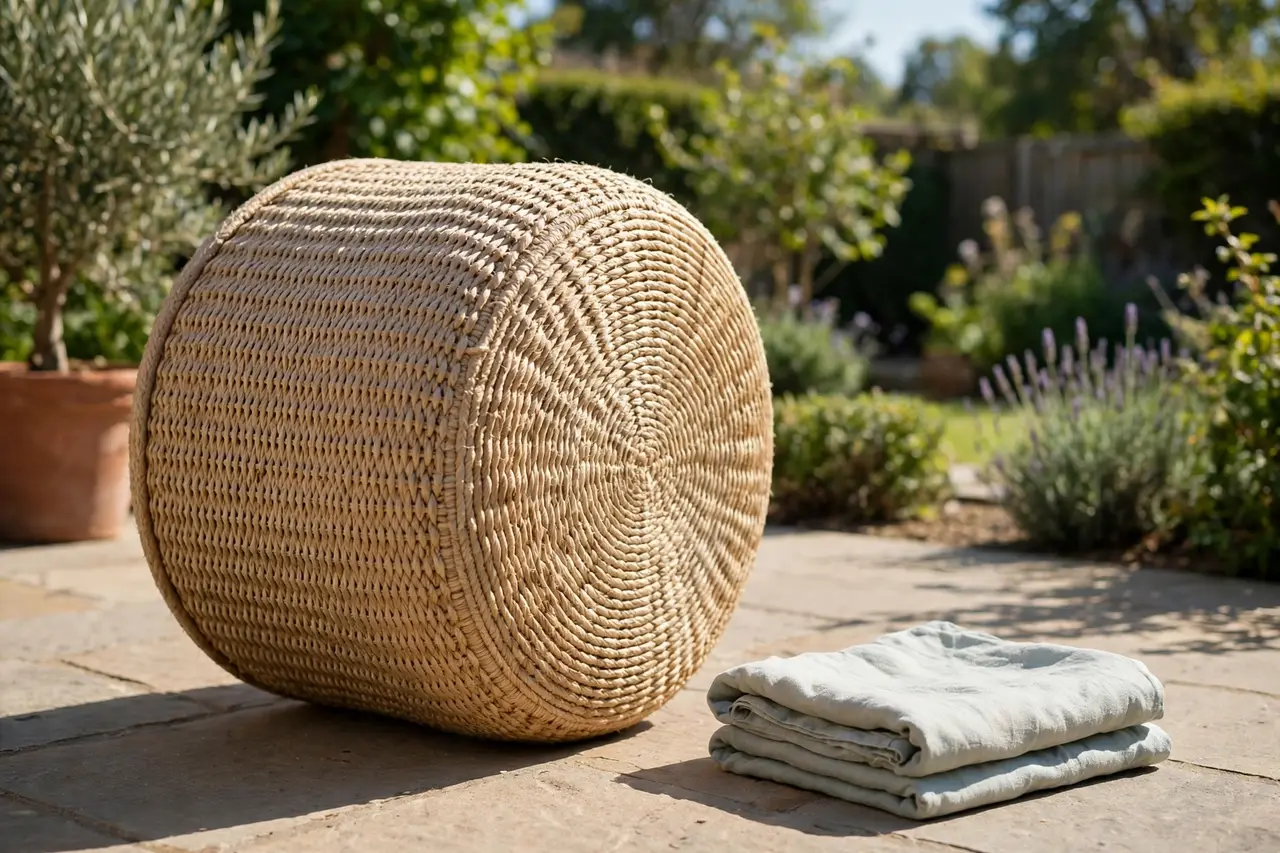
After rain, stand the pouf on its side so water runs out of the mesh base, then let it dry fully in the sun before you sit on it again. Wipe light spills with a clean, dry cloth right away, because a spill that dries becomes a stain that needs scrubbing. For stubborn stains, use a soft brush and a bucket of warm water with mild soap, rinse, and let the cover dry completely before you put it back on.
Each season, unzip the cover and check the core: the waterproof sheet should be intact, the foam should spring back when you press it, and the mesh base should be clear of leaves and grit. If the foam stays flat after you press it, the core is done and the pouf needs replacing, not cleaning. Cover the pouf during severe weather and store it indoors during prolonged winter freezes to make it last as long as possible.
Winter care decides whether the pouf survives to next summer. A Sunbrella pouf can remain outdoors year-round in moderate climates, but covering it during severe weather and storing it during winter extends its life. Never store a pouf while it is damp: fold it only after it is completely dry, because a damp pouf in a closed bin grows mold all winter. Our balcony cover ideas guide covers breathable covers that keep rain off without trapping damp underneath.
Drain it, dry it, then store it. A pouf that dries fully is a pouf that never smells.
Related Guides
If you are planning the whole outdoor space, these guides pick up where this one leaves off:
- Outdoor Sectional Couch — deep seating for the lounge corner beside your pouf.
- Outdoor Furniture for Small Spaces — seven layouts that make a tiny patio feel big.
- Replacement Cushions for Patio Furniture — get the fit, fabric, and price right the first time.
- How to Store Outdoor Furniture — keep it clean, dry, and ready for spring.
- Outdoor Storage Bin — a dry home for poufs and cushions.
- Small Patio Decorating Ideas — make a small patio feel generous.
- Balcony Cover Ideas — stay dry and cool on a small balcony.
- Outdoor Bench With Storage — sit down, stash the clutter, and reclaim your patio.
Frequently Asked Questions
What is an outdoor ottoman?
An outdoor ottoman is a versatile, low upholstered piece designed for exterior spaces that serves as both a footrest and an auxiliary seating or table surface. Built with weather-resistant materials like UV-resistant fabrics and waterproof foam, an outdoor pouf withstands sun exposure, moisture, and temperature fluctuations.
What is the difference between a pouf and an ottoman?
Poufs typically have soft all-foam construction and lighter weight, while ottomans often include rigid wood frames. Both serve as footrests, but poufs offer greater portability. The Bazaar pouf cube weighs about 10 pounds, so one person can carry it anywhere on the patio.
Are outdoor ottoman cushions weatherproof?
The best outdoor ottomans use a waterproof sheet over the foam core and a quick-drain reticulated base, making the entire piece weatherproof without removable cushions. Sunbrella fabric is solution-dyed, so the color runs through each fiber and resists fading even under intense sun.
Can outdoor ottomans be left outside?
A well-built outdoor ottoman can remain outdoors year-round in moderate climates. Cover it during severe weather and store it during prolonged winter freezes to maximize its lifespan. A cheap foam-filled pouf should come inside during long wet spells instead.
Can I leave my outdoor pouf ottoman outside all year?
Only if it is explicitly rated for all-season use with fully waterproof fabric and sealed seams. Otherwise, store it indoors during wet or freezing months to extend its lifespan. Always let a wet pouf drain and dry fully before you cover or store it.
Disclaimer: This guide gives general advice for choosing and caring for outdoor furniture, not professional structural or engineering instructions. Check weight limits before standing on a pouf, keep poufs away from open flames, and hire a qualified pro for any structural repair.
Buy the core first and the cover second. Waterproof sheet, high-density foam, and a drainable mesh base, wrapped in Sunbrella or olefin, sized 1 to 2 inches below your chair seat. Drain it on its side after rain, wipe it clean, and store it dry for winter. Do that, and the pouf you buy this year is still the most-used piece on the patio five summers from now.