Door locks security is decided less by the lock on the shelf than by how someone attacks your whole door. In the FBI’s 2019 Uniform Crime Reporting data, 55.7% of burglaries involved forcible entry — force used against a door, window, or frame — and 37.8% needed no force at all, because a door was unlocked or a key was within reach. Most break-ins, in other words, are won or lost at the frame, the strike plate, and your habits, not inside the cylinder.
So judge your door the way an attacker tests it. Can the door be kicked or pried open before the lock is even challenged? Can the cylinder be bumped, picked, drilled, or opened with a copied key? Lab ratings — ANSI/BHMA grades, BHMA letter grades, and UL 437 — answer exactly those questions. This guide explains each attack, decodes each rating, and ends with a checklist that fixes the weakest link first.
A Locked Door Is a System, Not a Single Lock
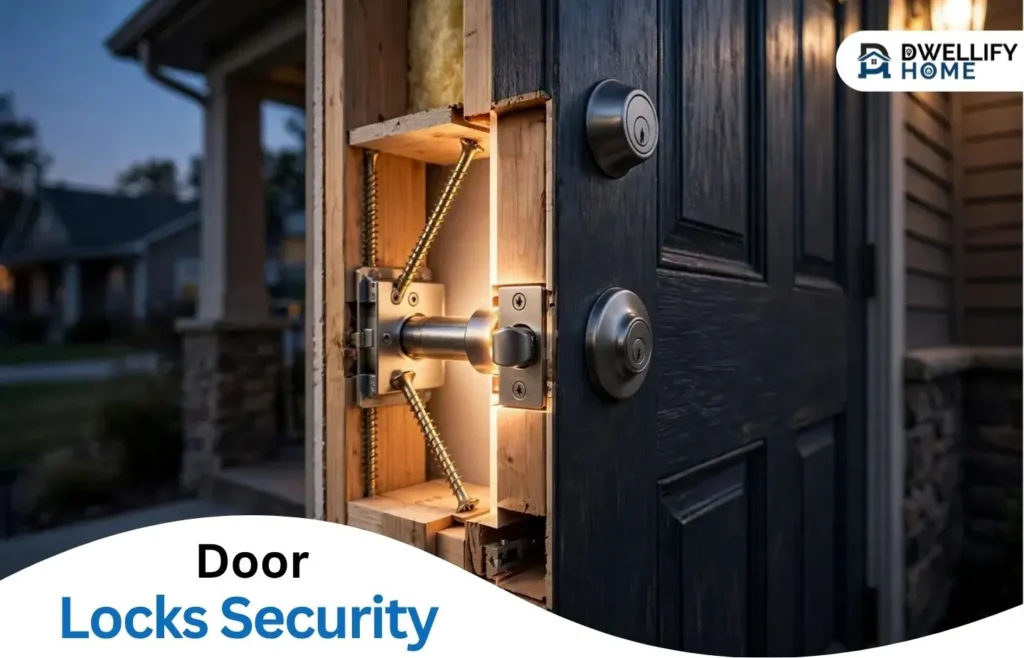
A locked entry door is a chain of parts: the key cylinder, the bolt, the door slab, the wooden frame (called the jamb), the metal strike plate the bolt slides into, the hinges, and the keys floating around your household. An attacker only needs the weakest link in that chain. A top-grade deadbolt screwed into a soft jamb with short screws behaves, under a hard kick, like a cheap lock.
This is why ratings need careful reading. A grade certifies that one product passed lab tests on a standard test door. It says nothing about your frame, your screws, or how worn your door is. New to the parts? Our deadbolt door lock guide names each piece and shows how the bolt works. This hub stays on the bigger question: how the whole system fails, and which labels prove a lock resists it.
How Door Locks Actually Fail: The Main Ways In
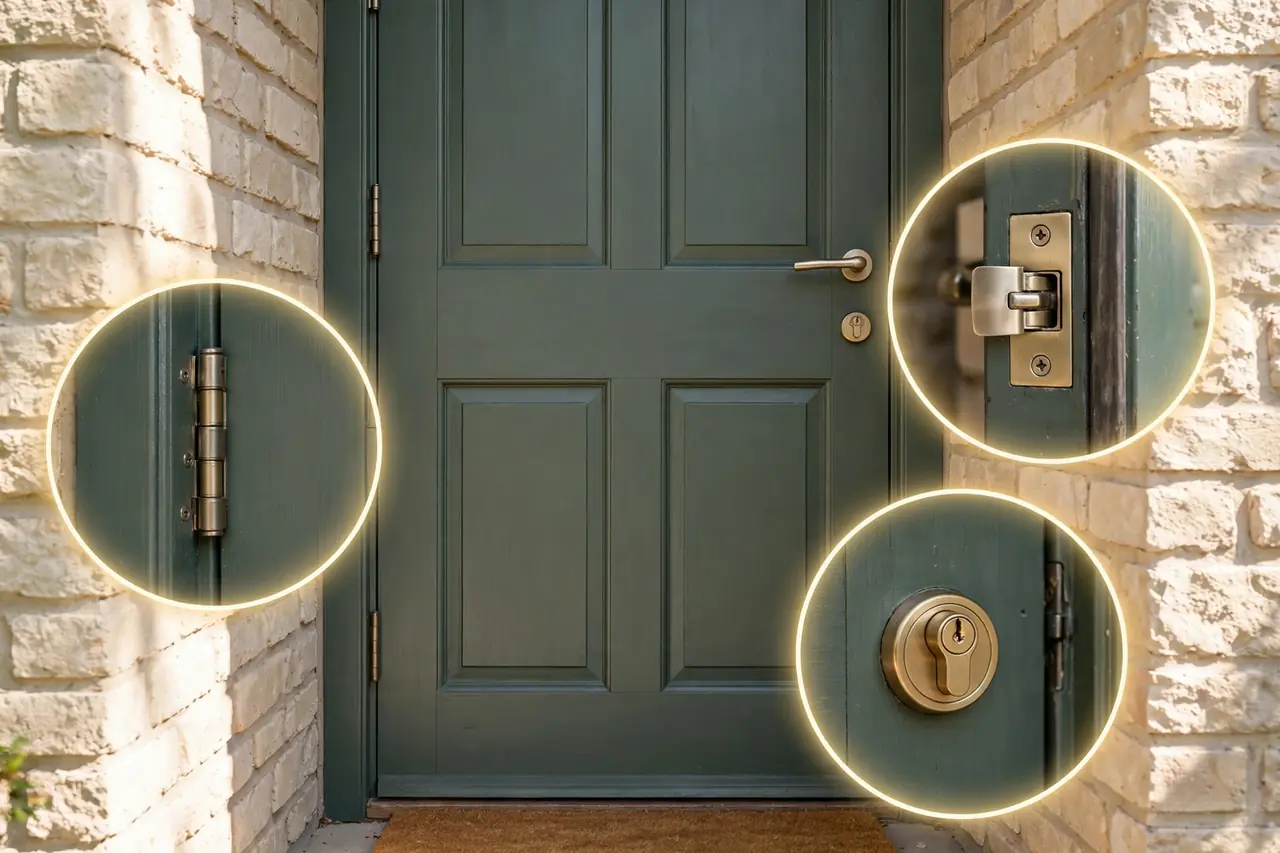
Attacks on a door fall into two families. Loud attacks use force: kicks, pry bars, drills. Quiet attacks use skill or a key: bumping, picking, or simply a copy of your key. The FBI numbers above show force and unlocked doors dominate real burglaries, but quiet attacks matter because they leave almost no evidence. Here is how each one works.
Kicks and Pry Bars: Brute Force Against the Frame
A kick does not test your lock’s brand name. It slams the extended bolt against the strike plate, and the strike plate against its screws, and the screws against the jamb. Something wooden usually gives first: the screws tear out, or the jamb splits along the grain beside the bolt hole. The lock itself is often found undamaged in the wreckage.
Prying works the same weak point more slowly. A bar slipped between door and frame spreads the frame or levers against the bolt until wood or hardware bends enough to release it. A deadbolt helps here because its solid bolt cannot be pushed back the way a spring latch can — the classic credit-card trick fails on a deadbolt — but the force still lands on the frame. If the frame is soft, the bolt’s strength is wasted.
Lock Bumping: In Without a Mark
Most home deadbolts use a pin tumbler cylinder: stacks of small pins that only let the plug turn when the right key lifts every stack to a clean split, called the shear line. A bump key is a key cut to the deepest setting on every cut. The attacker slides it in, taps it sharply, and the impact makes all the pins jump at once — the same physics as a Newton’s cradle desk toy. For a split second, every stack splits at the shear line, light turning pressure rotates the plug, and the door opens.
The whole attempt takes seconds and normally leaves no visible damage, which is why bumping worries insurers: a bumped home shows no sign of forced entry. Standard cylinders resist poorly. Cylinders built with shaped security pins — spool, mushroom, or serrated pins — jam and bind under this kind of attack, so bumping gets much harder, though not impossible. Cylinders with a sidebar or rotating pins, and cylinders listed to UL 437, are designed to defeat it outright.
Picking: Real, but Rarely the Burglar’s First Choice
Picking opens a pin tumbler lock one pin stack at a time, using a tension tool and a thin pick instead of a key. It is a genuine skill that takes practice, the right tools, and time standing exposed at a stranger’s door. That is why picking is a small part of real-world break-ins compared with force and unlocked doors — most burglars choose speed over finesse. Security pins fight picking the same way they fight bumping: they catch in the cylinder and feed the picker false signals, stretching a quick job into a long, risky one.
Drilling and Wrenching: Attacking the Cylinder Directly
Drilling skips the finesse and destroys the lock’s internals: a bit driven at the shear line chews through the pins so the plug can be turned with a screwdriver, or the drill attacks the screws holding the cylinder. Wrenching grips the exposed cylinder with locking pliers and twists until it snaps or tears free. Better cylinders answer with hardened steel inserts that blunt and deflect drill bits, anti-drill plates over the pins, and an outside guard — the ring around the keyhole — that is tapered or spins freely, so a wrench cannot get a grip. Police crime-prevention guides list that free-spinning or tapered guard as a basic feature to look for.
Cylinder Snapping: Mostly a Euro Cylinder Problem
You may see alarming videos of cylinders being “snapped” in seconds. That attack targets the Euro profile cylinder — the long, oval-ended cylinder common on doors in the UK and Europe — which can be gripped where it sticks out of the handle and broken at a weak point in its middle. Most US deadbolts use a different format: the cylinder sits inside the door hardware with very little exposed, so there is nothing practical to snap. If your home has an imported or multipoint door with a Euro cylinder, keep it flush with the handle and choose one built with an anti-snap sacrificial section. For a typical American deadbolt, drilling and wrenching are the realistic cylinder attacks to defend.
No Attack at All: Unlocked Doors and Copied Keys
The quietest way in needs no tools. The FBI’s 2019 figures say 37.8% of burglaries were unlawful entries with no force used — an unlocked door, a window left open, a spare key under the mat, or a key the intruder already had. Key control is the lock-side half of this problem. A standard house key can be copied at any kiosk in minutes, and a “Do Not Duplicate” stamp is only a request; nothing physically stops the copy. Restricted keyways — patented key designs sold only through locksmiths, who check authorization before cutting a copy — are the real control, and they are part of what high-security cylinder standards test.
The main attacks at a glance
| Attack | How it defeats the door | What actually resists it |
|---|---|---|
| Kick-in | Force tears the strike screws out of the jamb or splits the frame | 3-inch strike and hinge screws into the wall stud, heavy-duty or box strike, sound solid door |
| Prying | A bar spreads the frame or levers the bolt free | Full 1-inch bolt throw, tight door fit, reinforced strike and jamb |
| Bumping | A struck bump key makes all pins jump clear of the shear line for a split second | Security pins help; sidebar or rotating-pin cylinders and UL 437 listings defeat it |
| Picking | Tools lift pin stacks one at a time until the plug turns | Security pins, tight-tolerance cylinders, UL 437 / high-security cylinders |
| Drilling and wrenching | A drill destroys the pins, or pliers twist the exposed cylinder out | Hardened inserts, anti-drill plates, tapered or free-spinning cylinder guard |
| Copied key / unlocked door | No attack at all — entry looks authorized | Locking up every time, restricted keyway, rekeying after a move or a lost key |
Why the Frame and Strike Plate Fail Before the Lock Does
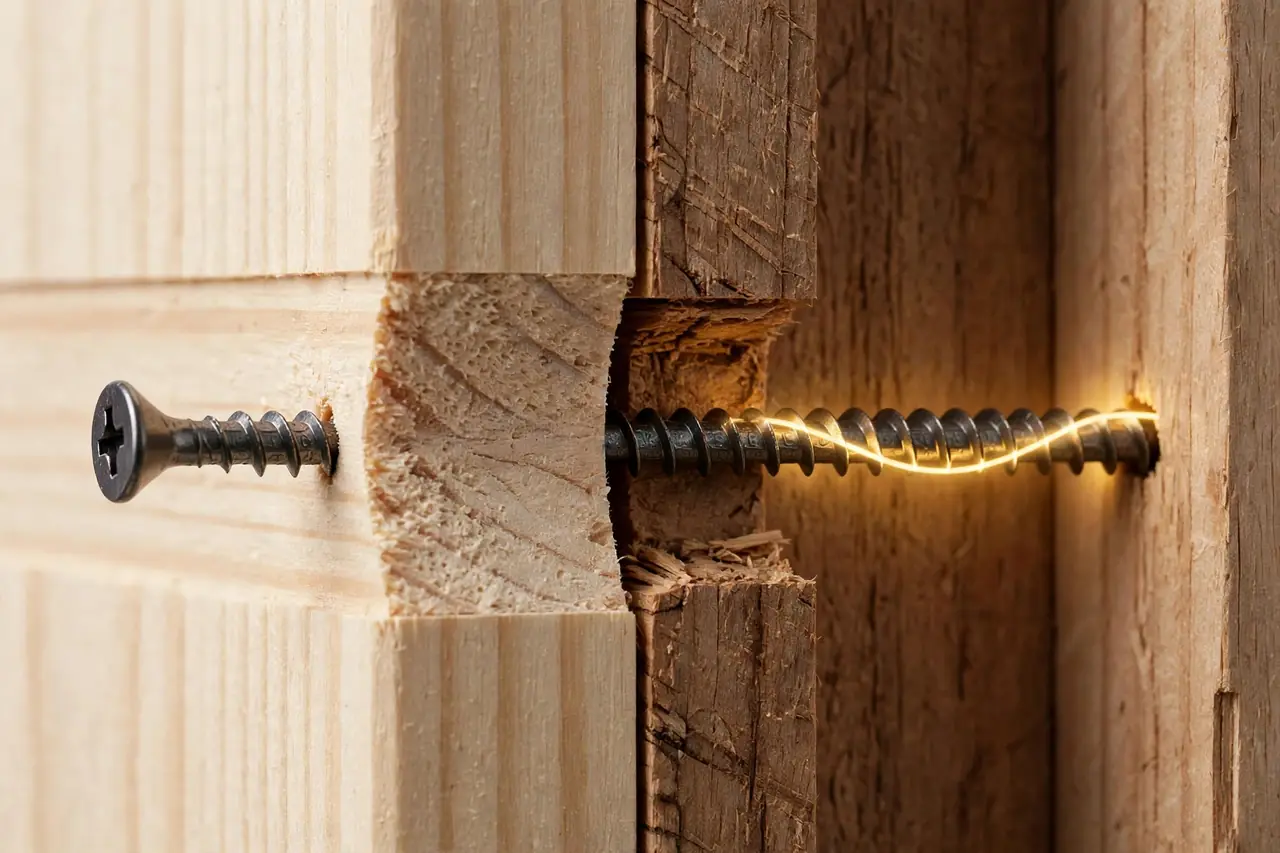
Follow the force. Your key turns, the bolt slides across the gap, and its end rests inside the strike plate screwed to the jamb. When a kick lands, all that energy travels bolt → strike → screws → jamb → wall stud. The chain breaks at its thinnest wood, and the thinnest wood is usually the jamb right beside the bolt hole, where much of the material has already been cut away to make room for the strike.
The screws decide how much of the house is holding your door shut. Builder-installed strike plates are commonly held by screws under an inch long, which bite only into the soft jamb — never reaching the stud behind it. Police guidance is blunt about the fix: the strike plate should be attached with screws at least 3 inches long, long enough to anchor through the jamb into the wall framing. The same advice covers the hinges: swap short hinge screws for 3-inch screws, because the hinge side of the frame takes kick force too.
Three more details decide whether the bolt can do its job:
- Bolt throw. A deadbolt should extend at least 1 inch out of the door edge, and that full inch should land inside a deep strike hole. A bolt that barely reaches the strike can be levered back as the frame flexes.
- Strike design. A heavy-duty strike with four screws spreads the load, and a box strike adds a metal cup that wraps the bolt’s end, so the jamb beside it is not the only thing resisting.
- The door itself. Exterior doors should be solid wood, fiberglass, or steel. A hollow-core door — the light, cardboard-filled kind made for closets — can fail before any lock does, and no grade of deadbolt fixes that.
None of this is expensive or glamorous, and that is the point: on most homes, the frame and strike are a weaker link than the lock, so they deserve money and attention first.
ANSI/BHMA Grades: What the Numbers Certify (and What They Do Not)
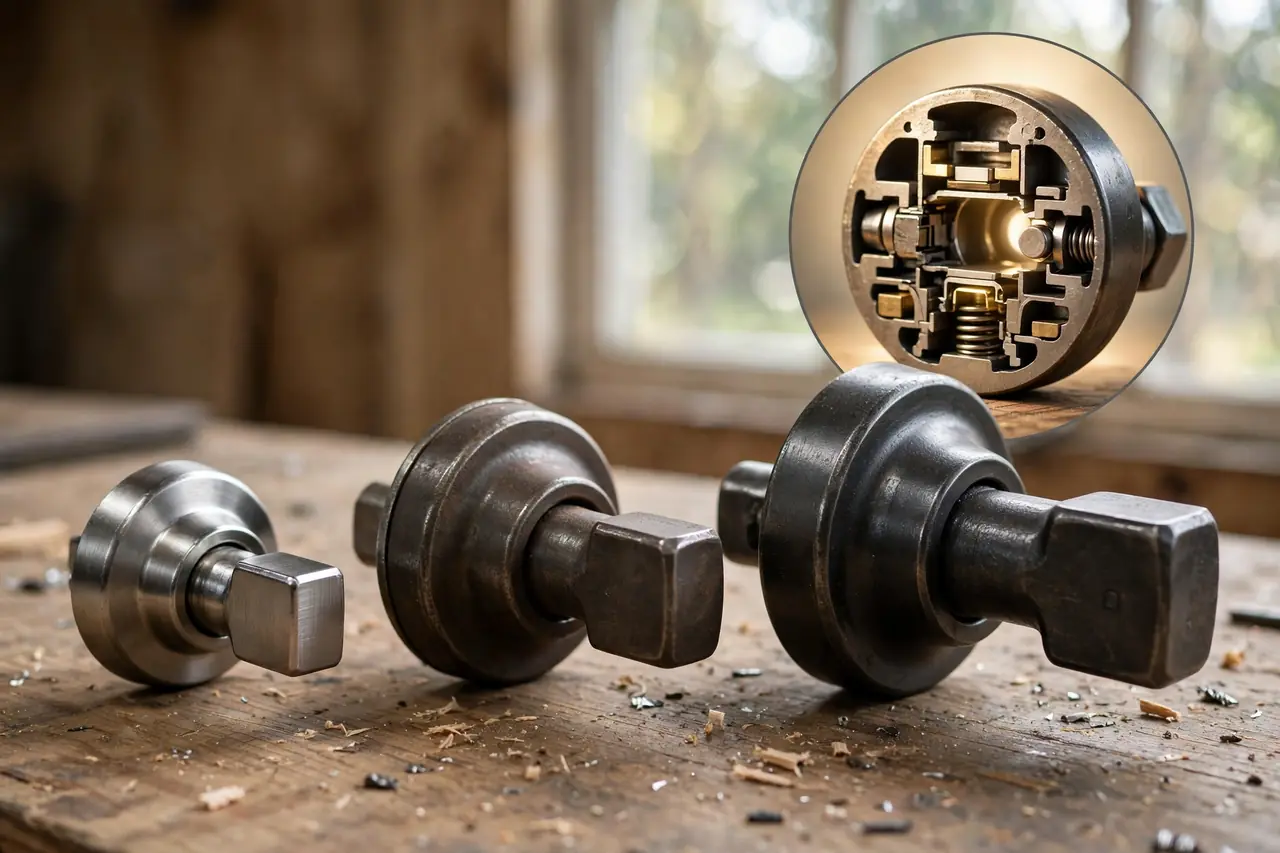
The numbered grades — Grade 1, Grade 2, Grade 3 — come from standards written by BHMA (Builders Hardware Manufacturers Association) and approved by ANSI (the American National Standards Institute). Manufacturers send products to independent labs, which cycle them open and closed, strike the bolt with hammer blows, and load them with weight. Deadbolts are graded under the standard ANSI/BHMA A156.36, and the headline numbers look like this:
ANSI/BHMA deadbolt grades under A156.36
| Grade | Open-close cycles | Hammer strikes on the bolt | Where it belongs |
|---|---|---|---|
| Grade 1 | 250,000 | 10 | The strongest tier — commercial duty, and the best choice for a home’s main entry doors |
| Grade 2 | 150,000 | 5 | Solid residential security — the sensible minimum for an exterior door |
| Grade 3 | 100,000 | 2 | Basic builder hardware — acceptable inside the home, weak for an entry door |
Read the table with three cautions. First, a grade belongs to the exact product and type tested: a deadbolt’s Grade 2 is earned on deadbolt tests, and says nothing about the knob or lever sold beside it. Second, the lab door is new, square, and perfectly fitted — the grade certifies the hardware, not your frame, which is why the strike section above matters as much as this one. Third, and most misunderstood: the numbered grades mainly measure wear and brute force. They are not a promise about picking or bumping. A Grade 1 deadbolt with a plain pin tumbler cylinder can still be bumped by a practiced hand — sneaky-attack resistance is certified by different labels, covered next.
When you shop, look for the actual claim “ANSI/BHMA A156.36 Grade 1” (or Grade 2) on the package or in BHMA’s Certified Products Directory, rather than vague words like “commercial grade” or “heavy duty,” which have no test behind them.
BHMA Letter Grades: The Residential Label Worth Looking For
Because numbered grades grew out of commercial hardware, BHMA also runs a residential certification program, under ANSI/BHMA A156.39 for locksets and A156.40 for deadbolts. Every certified product earns a letter in three categories — Security, Durability, and Finish — where A means Best, B means Better, and C means Good. A lock rated AAA earned the top mark in all three, and certified products carry the BHMA Certified Secure Home label on the packaging.
The letter system fixes a real shopping problem: it grades the complete product as sold, so one weak category cannot hide behind one strong number. The Security letter is the one this guide cares about most — it reflects how the lock handled impact and attack tests. If a package shows letters instead of a numbered grade, an A for Security is the residential signal to look for, and AAA is the strongest combination a home lock can carry.
UL 437: The Listing That Tests the Sneaky Attacks
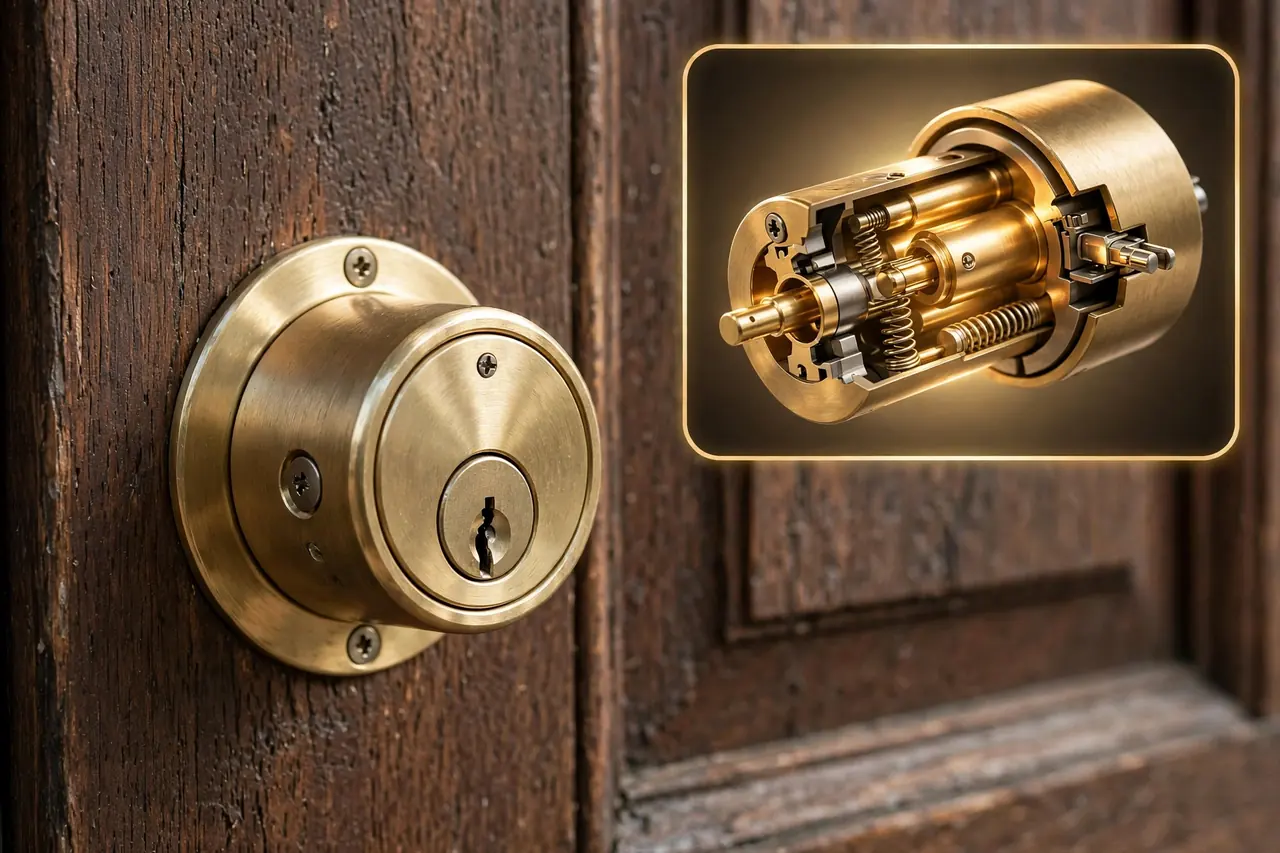
UL 437 is Underwriters Laboratories’ standard for key locks, and it is the label that speaks to the quiet attacks. To earn the listing, a cylinder must resist picking and impressioning for at least 10 minutes and resist forcing and drilling for at least 5 minutes under lab attack, on top of endurance and corrosion tests. Five minutes of drilling noise is an eternity at a front door, which is exactly the point: the listing certifies delay against a skilled attacker, not just strength against a kick.
BHMA’s companion standard, ANSI/BHMA A156.30, certifies high-security cylinders on the same ground — physical attack resistance, pick resistance, and key control. Cylinders built to this level usually add a second locking mechanism, such as a sidebar that must align before the plug can turn, plus patented, restricted keys that a hardware-store kiosk cannot copy. They cost more than hardware-store deadbolts and are usually sold and installed through locksmiths. Our guide to high security locks explains how these cylinders work and when the upgrade is worth it.
One honest limit applies to every label in this guide: lab tests use trained testers, standard tools, and a clock. They prove a lock resisted a defined attack for a defined time. They do not — and cannot — promise that a given door will never be beaten.
Your Door Security Checklist: Fix the Weakest Link First
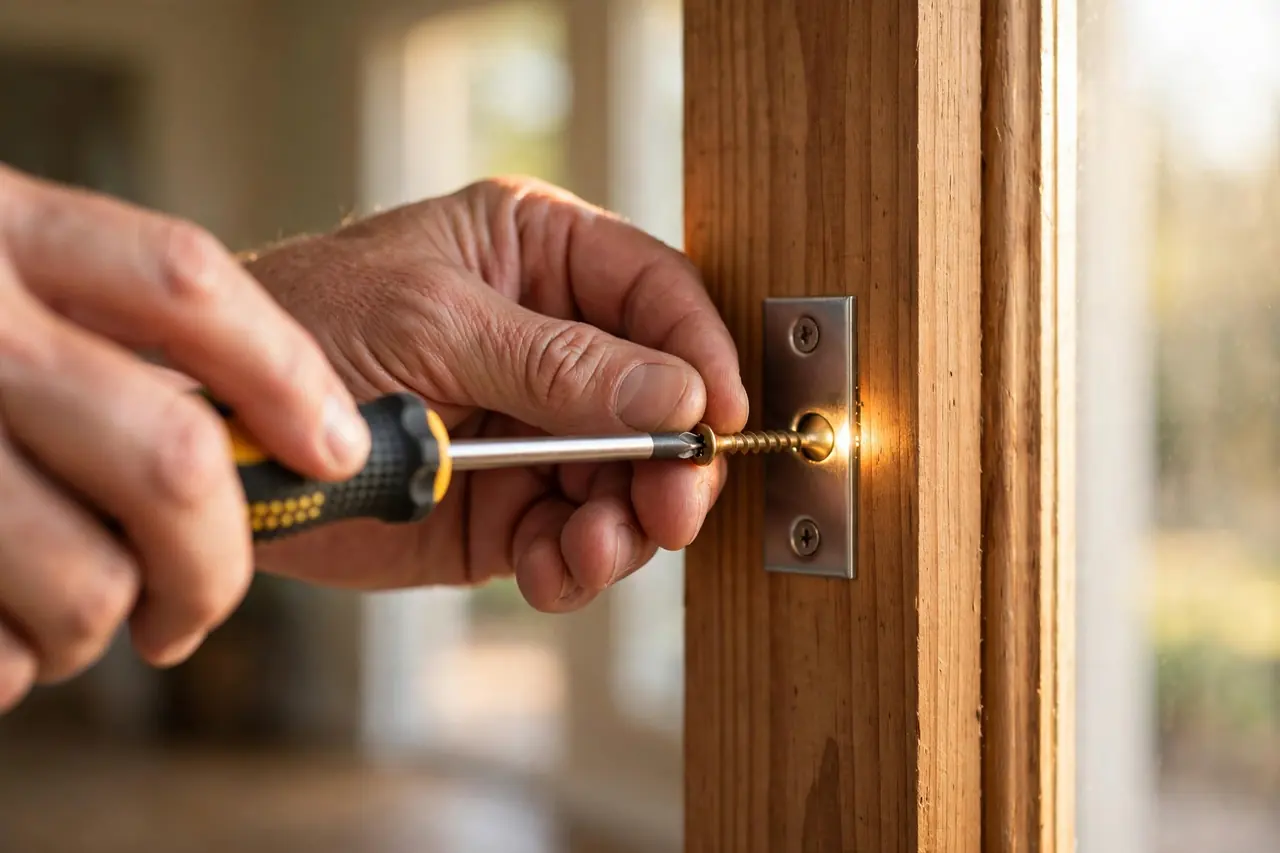
Work this list in order. Each step removes the cheapest, most common failure before you spend on the next one, and together they turn the ratings above into a plan. For the full step-by-step version with tools and walkthroughs, see our action plan on how to improve home security with better locks.
- Use the deadbolt, every time. Throw it even for short trips, and retire the spare key hidden under the mat or a fake rock — no-force entries are over a third of burglaries.
- Replace the strike screws. Swap the short screws in the deadbolt and latch strikes for 3-inch screws that reach the wall stud. Do the same for at least one screw in each hinge.
- Upgrade the strike itself. Fit a heavy-duty four-screw strike or a box strike, and check that the bolt throws its full 1 inch into the strike hole with the door closing smoothly — no lifting or pushing to make it latch.
- Replace builder-grade deadbolts. If an entry door still has a basic Grade 3 deadbolt, move to Grade 2 at minimum, Grade 1 for the main door — or a BHMA A rating for Security where letters are used.
- Match the cylinder to the quiet attacks. Security pins are the floor, not the ceiling. If bumping, picking, or drilling is a real concern, choose a cylinder listed to UL 437 or certified under ANSI/BHMA A156.30.
- Take control of your keys. Rekey when you move in, after a lost key, or after keys have circulated to cleaners and contractors. Choose a restricted keyway if unauthorized copies would be a serious problem.
- Inspect the whole opening once a year. Look for a cracked or soft jamb, a door that rattles in its frame, rusted hardware, and glass within reach of the inside thumbturn. If your door has glass near the lock, ask a locksmith about your options — some fixes affect fire-escape rules and local codes, so get that advice before changing lock types.
A quick note on limits: this guide explains how door locks resist common attacks, to help you choose and harden hardware. No lock can guarantee a break-in will never happen, and a determined attacker with enough time and noise cover can defeat almost any residential door. For high-risk homes, rental properties with code requirements, or frame and door replacement, a licensed locksmith or qualified door professional is the right next call.
Frequently Asked Questions
What grade lock should I buy?
For an exterior door, buy at least a Grade 2 deadbolt certified to ANSI/BHMA A156.36, or a lock with a BHMA A rating for Security. Choose Grade 1 for a main entry door or a busy household. Keep Grade 3 for interior doors. Remember that the grade measures wear and force — pair it with a reinforced strike, and check UL 437 if you also want tested pick and drill resistance.
What is lock bumping?
Lock bumping uses a specially cut “bump key” and a sharp tap. The impact makes every pin inside a standard cylinder jump at the same moment, clearing the shear line for a split second so the plug can turn. It can open a basic deadbolt in seconds and usually leaves no visible damage, which is why bump resistance comes from cylinder design — security pins, sidebars, or a UL 437 listing — not from the bolt.
Which locks are vulnerable to bumping?
Any standard pin tumbler cylinder can be bumped, including most basic hardware-store deadbolts. Cylinders with spool, mushroom, or serrated security pins are much harder to bump but not immune. Real resistance comes from cylinders that add a second mechanism a bump key cannot satisfy — a sidebar or rotating pins — especially those listed to UL 437 or certified as high-security cylinders under ANSI/BHMA A156.30.
Can you tell if your lock was bumped?
Usually, no. A bumped lock looks and works exactly like one opened with the correct key — no scratches, no bent metal, no splintered wood. Even locksmiths often cannot prove bumping after the fact. That lack of evidence can complicate an insurance claim, and it is the strongest argument for preventing the attack with a resistant cylinder instead of hoping to spot it later.
Does lock bumping work on smart locks?
Only where there are pins to bump. A keypad or fingerprint deadbolt with no key cylinder has no pin tumblers, so a bump key does nothing. Many smart locks, though, include a backup key cylinder — and that cylinder can be bumped or picked like any other of its quality level. If you choose a smart lock, its physical grade and its backup cylinder deserve the same scrutiny as a regular deadbolt.
Door locks security is a chain: cylinder, bolt, strike, frame, and the keys in circulation, tested by force on one side and patience on the other. You now know how each link fails and which labels prove it was tested. Pick the weakest link on your own front door — for most homes it is the strike screws — fix that first this weekend, and work the checklist upward; the DwellifyHome action plan linked above walks through each upgrade in order.