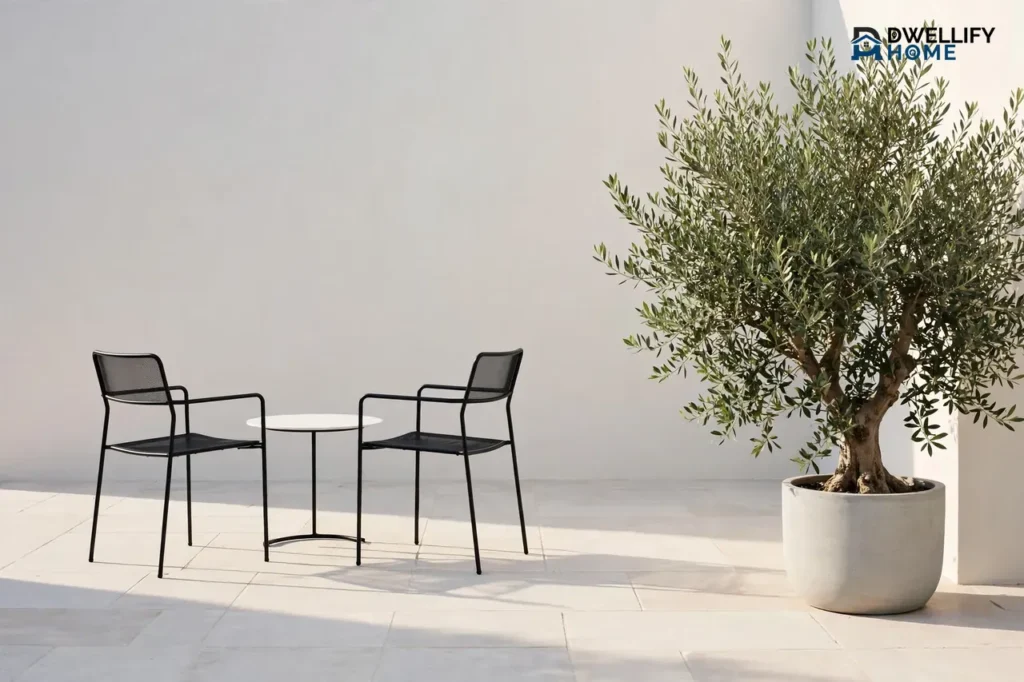
Minimalist patio furniture means fewer pieces, clean lines and one calm color palette, so a small patio feels open instead of crowded. Start with two slim chairs and one small table, keep to three colors and three materials at most, and leave about a third of the floor empty. This guide shows you how to pick each piece, fit it to a small patio, and style it so the space feels finished without filling it up.
Most patios go wrong in the same way: too many chairs, too many colors, and a table that eats the walking space. Minimalism fixes that by making every piece earn its place. A chair must be comfortable, light enough to move, and slim enough to leave room around it. If a piece does none of those jobs well, it does not belong on the patio.
What Is Minimalist Patio Furniture?
Minimalist patio furniture is outdoor furniture with simple shapes, slim profiles and no decoration for its own sake. Think straight lines, open frames, flat surfaces and neutral colors, with one accent at most. The style comes from the idea that a patio should feel calm, and calm comes from empty space as much as from the furniture itself.
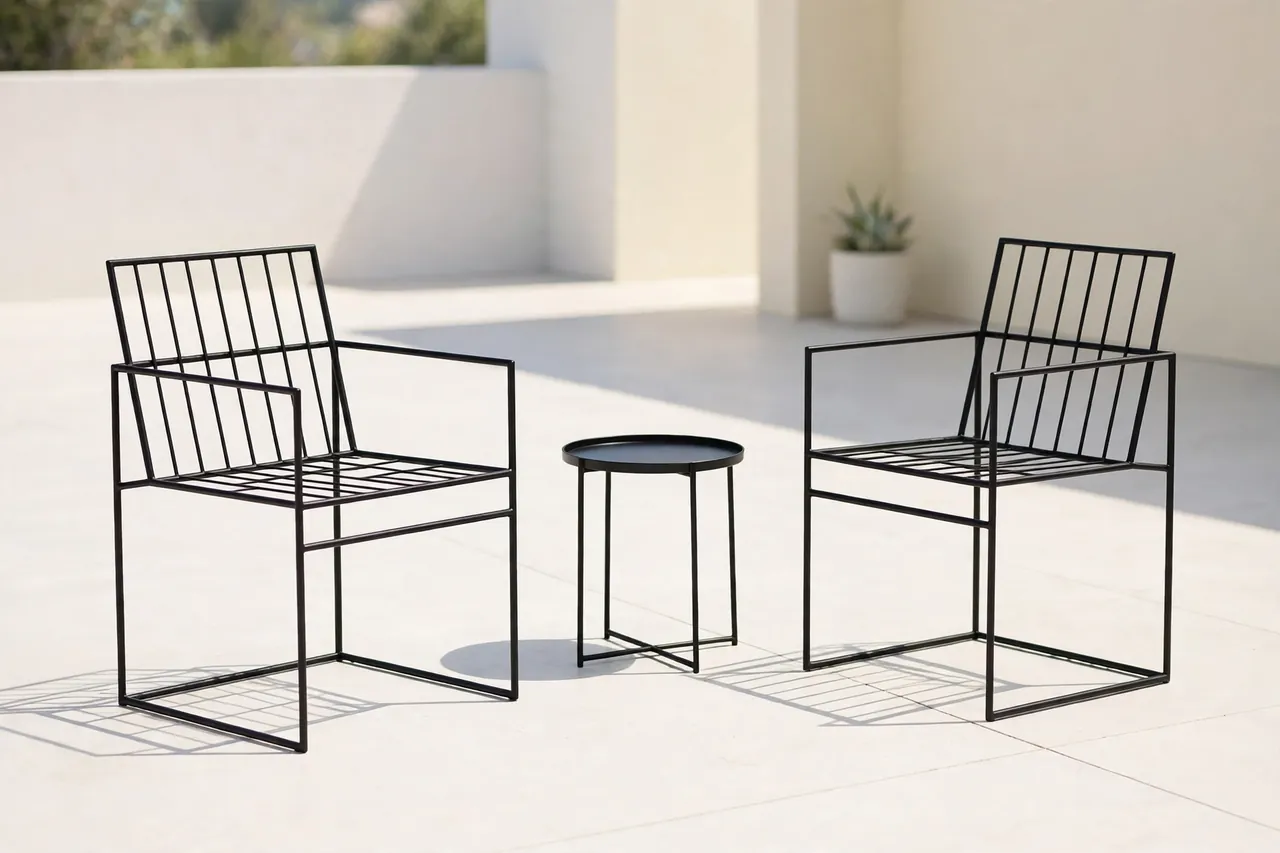
A minimalist set is not an empty patio. It is a patio where every piece has a job and nothing is there just to fill a corner. Two chairs and a small table can be a complete patio, and a bench that stores cushions can replace three separate pieces. The test is simple: remove a piece, and if the patio still works, that piece was clutter.
Minimalism also suits small patios better than any other style, because slim furniture and empty floor make a space look bigger than it is. On a small patio, fewer pieces always beat smaller pieces, because three tiny chairs still crowd a space while two good chairs leave room to breathe. Our guide to outdoor furniture for small spaces covers the same space-first thinking in full.
The look is close to modern and mid-century styles, but it is stricter about count and color. A modern patio can carry five colors and a bold rug. A minimalist patio keeps three colors, one focal point and a mostly empty floor, and the restraint is the whole point.
The 3-3-1 Rule: Colors, Materials, One Focal Point
The easiest way to keep a minimalist patio calm is the 3-3-1 rule: three colors, three materials, one focal point. It sounds strict, and that is why it works. Every time you add a fourth color or a fifth material, the patio gets a little busier, and a small space shows the mess faster than a big one.
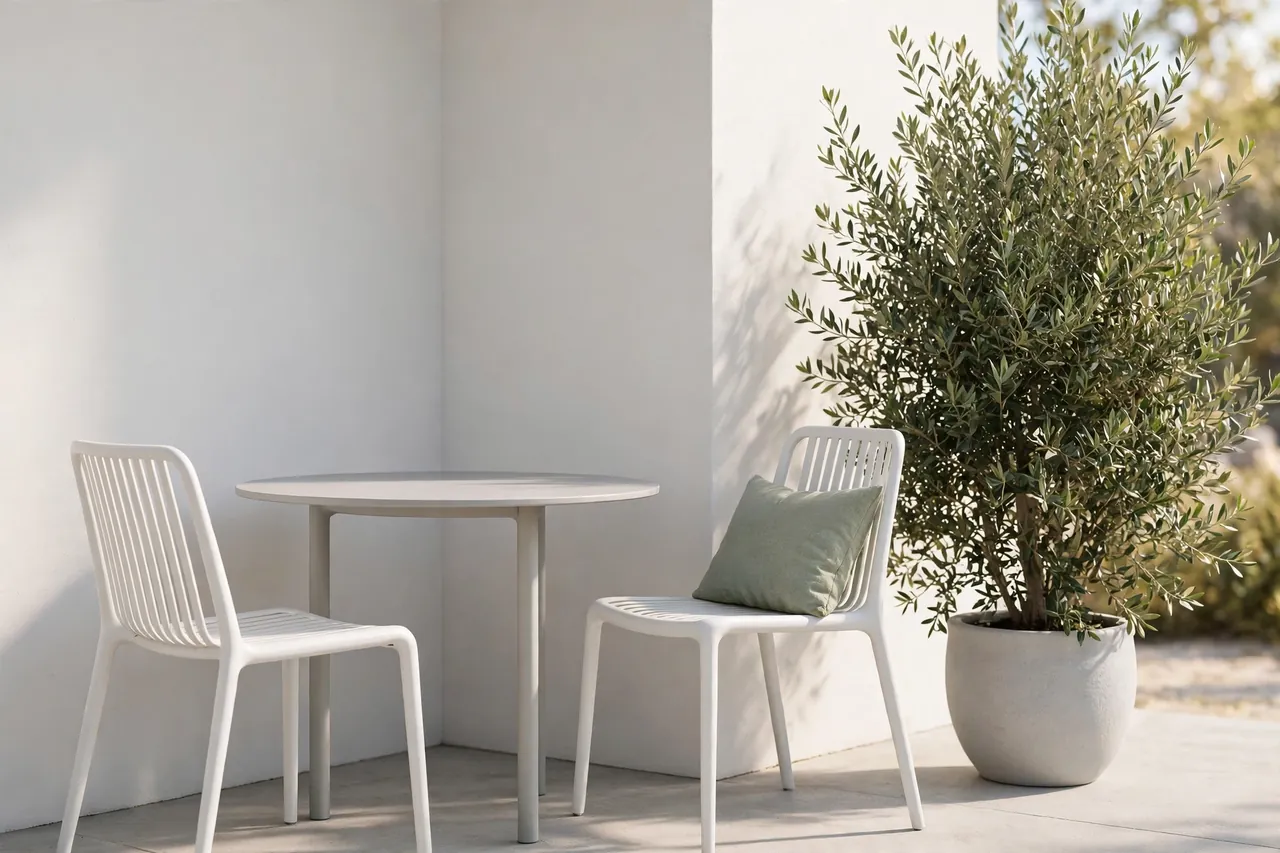
Pick three colors: a base, a second neutral and one accent. A safe set is warm white, light gray and sage green, or charcoal, natural wood and a single warm accent such as terracotta. Keep the big pieces in the two neutrals and save the accent for cushions or one planter, so you can change the mood by swapping two cushions instead of buying new furniture.
Pick three materials at most, and let one of them repeat across the pieces so the set looks planned. Good minimalist trios are powder-coated aluminum with teak and solution-dyed acrylic fabric, or black steel with concrete and natural rattan. Our guide to metal outdoor furniture and our aluminum outdoor furniture guide both cover the slim metal frames that suit this style best.
Then choose one focal point and let everything else stay quiet. The focal point can be a sculptural chair, a round concrete coffee table, or one large planter with a small tree. One strong focal point makes a patio feel designed; five make it feel like a shop display. If you need help choosing colors that hold up outside, our guide to outdoor furniture colors ranks the shades that fade least in the sun.
How Many Pieces Does a Minimalist Patio Need?
Count seats, not furniture. Most patios need two seats, one surface and one storage spot, and that is the whole list. Everything beyond that is optional, and on a small patio optional usually means in the way.
For one or two people, two slim chairs and a small side table are enough. A 24-inch round table seats two for coffee, and a 30-inch table seats two for a meal while staying compact, according to a small-space layout guide from Homary. Add a storage bench only if you have cushions to hide, because a bench that stores things replaces a deck box and a seat in one piece. Our guide to outside storage boxes shows the sizes that hide cushions without crowding a patio.
For a family of four, a compact loveseat with two armless chairs around a small coffee table works, as long as the chairs tuck under the table edge when nobody sits in them. Armless chairs save 4 to 6 inches each, which is a full foot of floor across a set. Our guide to patio conversation furniture sets covers the compact set sizes that fit a small patio.
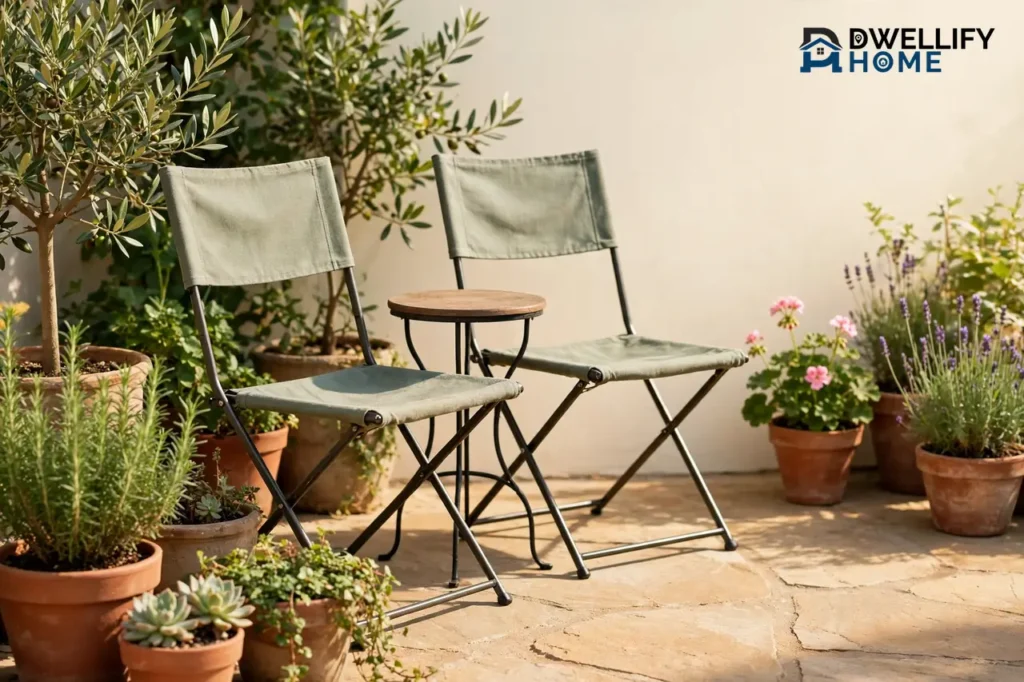
For dining, a bistro set for two is the minimalist answer. A folding bistro table and two chairs set up for a meal and fold away when you want the floor back. Our guide to the patio bistro set covers the 24 to 28 inch table sizes that seat two without wasting space.
| Patio size | Seats | Surfaces | Storage |
|---|---|---|---|
| Balcony, 4 by 6 feet | 1 to 2 slim chairs | 1 side table | Wall shelf or none |
| Small patio, 6 by 8 feet | 2 chairs | 1 small table | 1 storage bench |
| Medium patio, 10 by 12 feet | 2 chairs plus loveseat | 1 coffee table | 1 deck box |
| Large patio, 12 by 16 feet | 4 seats, two zones | 1 coffee plus 1 side table | 1 deck box |
Whatever the size, keep about a third of the floor empty. Empty floor is what makes a patio feel big, and no furniture can fake it. Measure first, tape the layout on the floor with painter’s tape, and walk the route before you buy anything, as our guide to how to arrange outdoor furniture recommends.
Materials That Suit the Minimalist Look
Minimalist furniture looks best in materials that are honest and quiet: metal, wood, concrete and woven rope in flat, even finishes. Glossy plastic, fake stone and busy patterns all fight the look, because they add visual noise to a style that depends on calm.
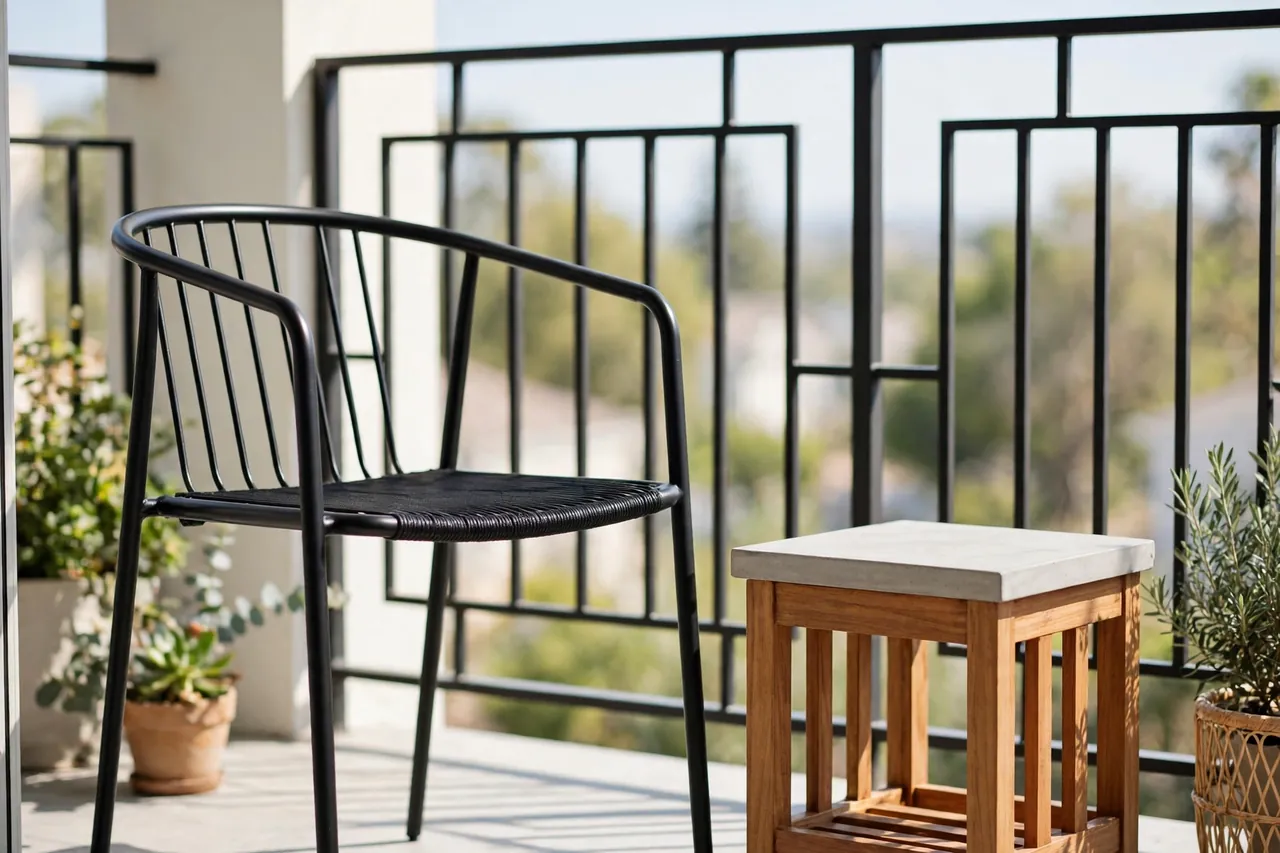
Powder-coated aluminum is the first choice for most minimalist patios. It is light enough to move with one hand, it never rusts, and its slim frames leave the eye free to travel past the furniture to the garden. Black and charcoal frames look sharp against pale paving, while white frames disappear against a light wall. The trade-off is heat: dark metal gets hot in full sun, so pair it with light cushions or a shaded spot.
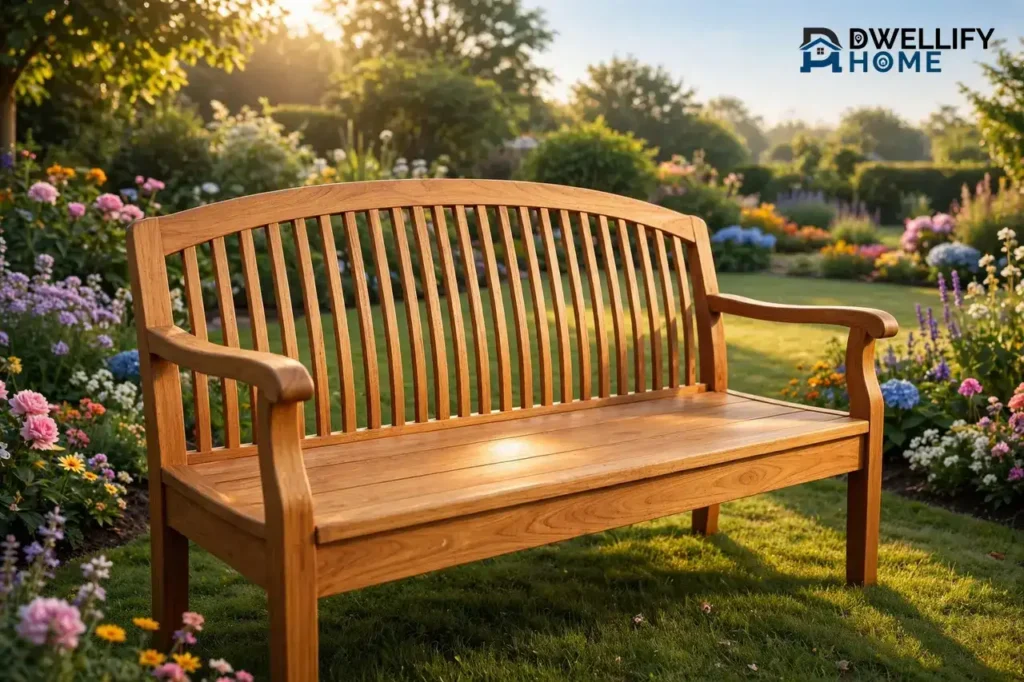
Teak and acacia bring warmth to a look that can feel cold in all metal and concrete. A single teak bench or a slatted wood table softens a black frame set without adding a color, because wood reads as a neutral. Our guide to acacia wood furniture covers the care and the color change to silver-gray if you leave it untreated, which suits the minimalist palette either way.
Concrete and stone-topped tables anchor the set with weight and a flat, quiet surface. A round concrete coffee table makes a strong focal point and never needs a cushion, a cover or a second thought. Keep the top light gray or natural, and avoid busy veining that turns the table into the loudest thing on the patio.
For seats, look for open frames with mesh, rope or sling seats that you can see through. See-through seats are the minimalist secret, because the eye passes through them and the patio reads as larger. A solid bulky seat blocks the view and shrinks the space, even when the measurements say it fits. Our guide to modern outdoor chairs shows the slim open-frame chairs that work best here, and our mid-century modern outdoor furniture guide covers the clean tapered-leg look that started this style.
Small-Space Layouts That Feel Bigger
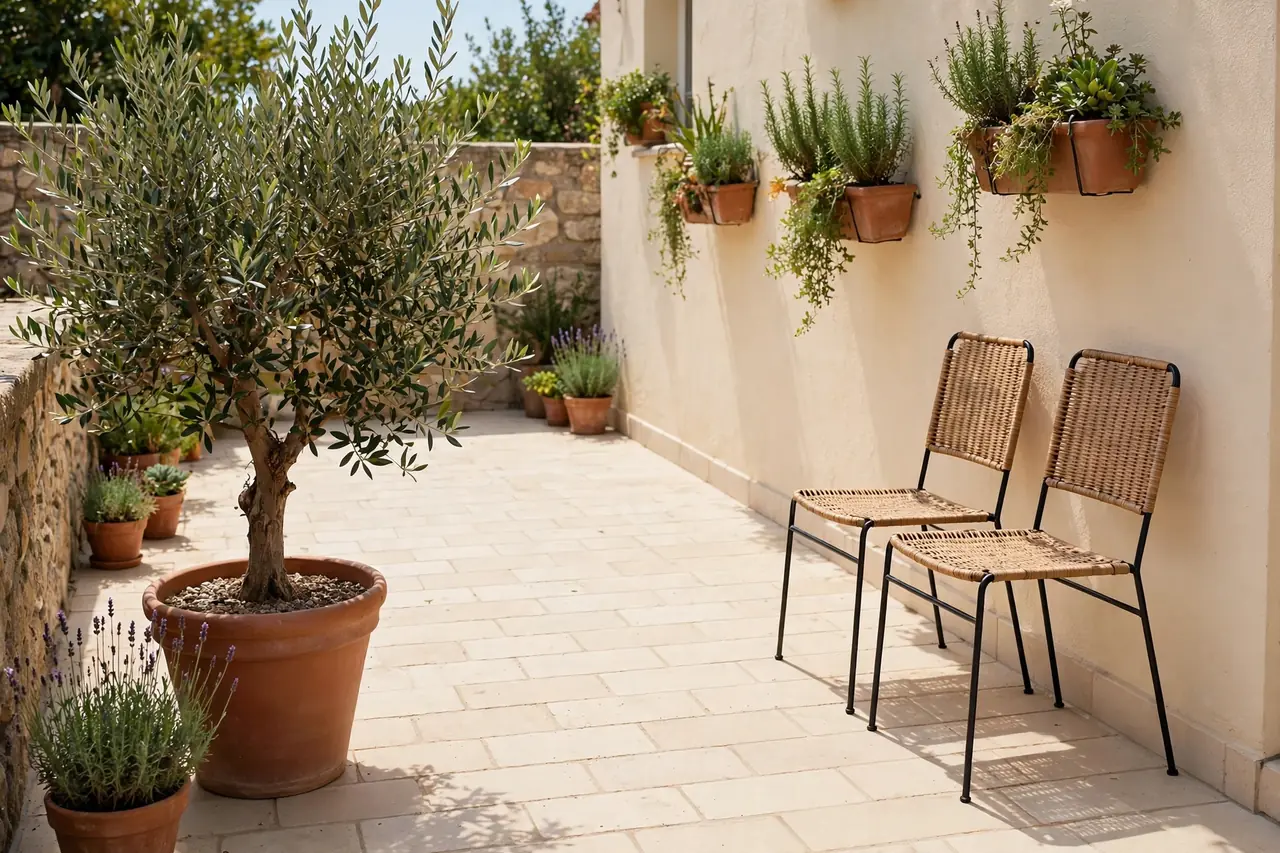
Layout is where minimalism wins or loses. The same three pieces can feel spacious or cramped depending on where they sit, and the difference is usually a foot of walking space and one clear focal point.
Start by measuring the patio and the walking route. A practical target for the main walking route is 24 to 30 inches wide, and a single-person passage can work at 20 to 22 inches in a very compact space, according to Homary’s small-space layout guide. Tape the furniture outlines on the floor and walk the route with a laundry basket in your hands, because that is how you will really use the space. A small-space guide from Patio Productions gives the same advice in short form: measure first, go light and airy, and choose fewer, better pieces.
Push the seating to one side instead of centering it. A chair against a wall or a bench along a railing leaves one big open area instead of two narrow strips, and the open area is what your eye reads as space. Keep taller pieces at the edges so they do not block the sun or the view, and keep the center low with a small table or nothing at all.
Use vertical space for everything that does not need a seat. Wall-mounted shelves, hanging planters and a slim vertical cabinet move storage and greenery off the floor, and one large plant in a 14 to 16 inch planter finishes a patio better than ten small pots, according to a budget minimalist patio guide from Organizables. Our guide to outdoor side tables covers the slim nesting tables that add a surface without adding a footprint.
Finally, keep the floor visible. A flat-weave rug in one neutral defines the seating zone, but a rug that covers the whole patio hides the floor and shrinks the space. Leave the edges of the patio bare so the eye can measure the full size of the floor. Our guide to outdoor coffee tables shows the round and nesting tables that keep the center light.
Styling Without Clutter: Cushions, Light and Plants
Styling a minimalist patio is an editing job. Add one thing, step back, and ask whether the patio looks better or just busier. If it looks busier, remove it.
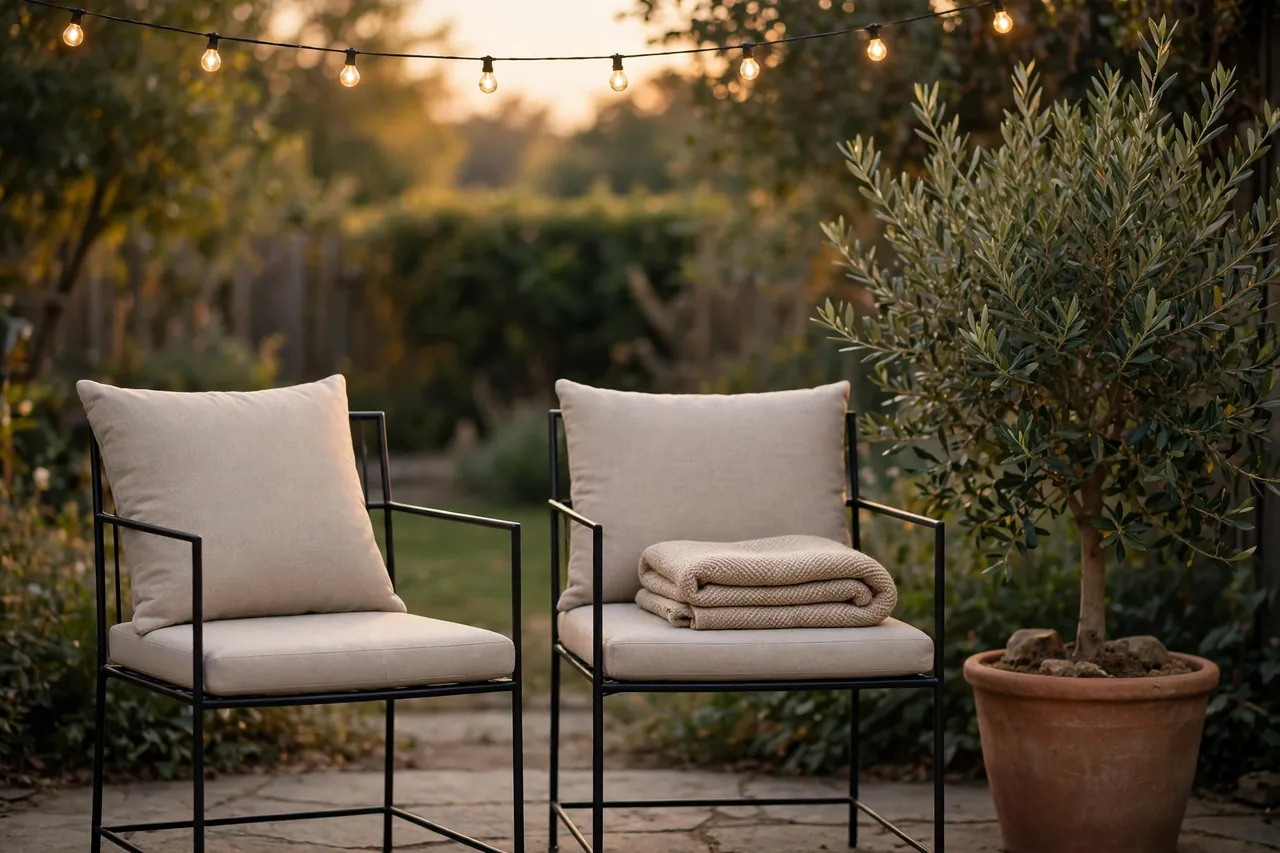
Cushions are the easiest place to add comfort without adding clutter. One throw blanket and two cushions in the same fabric and color are enough for a small patio, according to Organizables’ minimalist patio guide, and that restraint is what keeps the look calm. Choose solution-dyed acrylic fabric in a neutral, because it resists fading and wipes clean. Our guide to outdoor furniture fabric covers the fabrics that hold color, and our patio pillows guide shows how two pillows can change a set without overwhelming it.
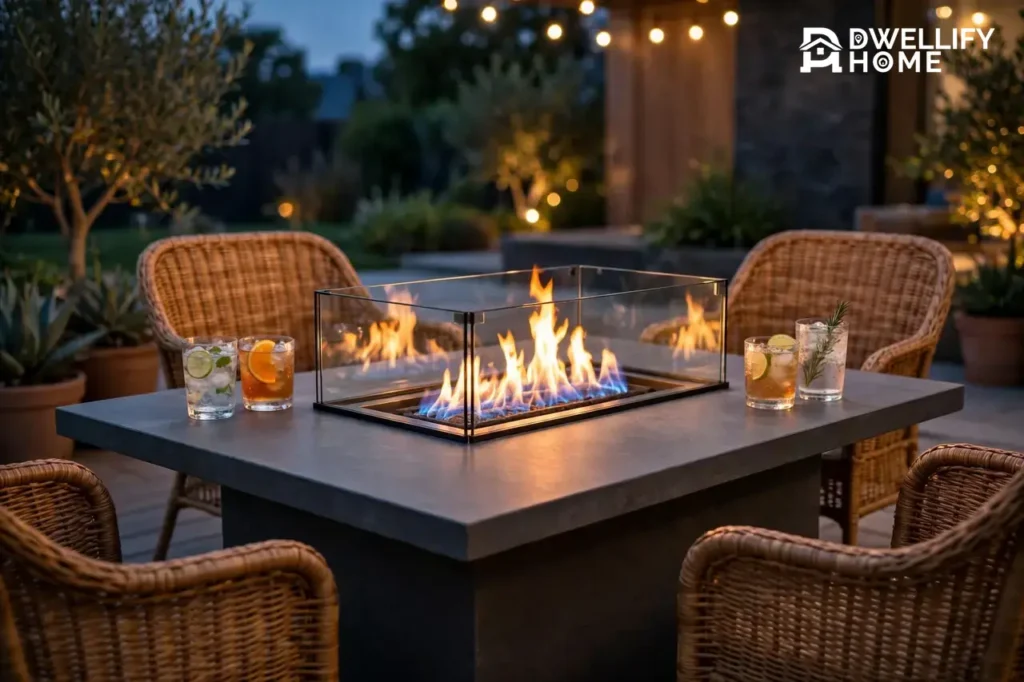
Light should come from one warm source, not five. A single 20 to 30 foot strand of warm white string lights at 2700K gives a small patio its evening glow, and one lantern on the table finishes it. Skip the fairy lights in the planters, the candles on every surface and the colored bulbs, because each extra light is another color in a palette that only has room for three.
Plants should be few and large. One olive tree, one ornamental grass or one tall snake plant in a plain pot adds life without adding clutter, while a row of small pots reads as mess. A vertical planter on the wall adds greenery without taking floor space, and it doubles as the patio’s second focal point if you keep the first one simple.
Storage is styling too. A lidded bench hides cushions, blankets and tools, and a tidy patio reads as a bigger patio. If you can see clutter, the patio is not minimalist yet, no matter how simple the furniture is. Our guide to the contemporary outdoor bench covers the storage benches that hide the mess and seat a guest.
What to Avoid: 6 Minimalist Mistakes
Most minimalist patios fail in the same six ways, and all six are easy to avoid once you know them. Check your plan against this list before you buy anything.
- Too many small pieces. Five small chairs crowd a patio worse than two good ones. Count seats, not furniture, and stop at the number you actually use.
- Too many colors. A fourth and fifth color turn a calm patio into a busy one. Stick to the 3-3-1 rule, and let the garden supply the extra color.
- Bulky rolled arms. Wide rolled arms eat a foot of width and block the view through the chair. Choose slim or armless chairs that tuck under the table.
- A table that is too big. A coffee table wider than 36 inches dominates a small patio. A 24 to 30 inch round table seats two and leaves the floor free.
- Matching everything. A full matching set in one color looks like a showroom. Mix two materials and let one piece stand out as the focal point.
- No storage plan. Cushions on the floor, tools on the table and toys in the corner undo the whole look. Hide it all in one lidded bench or deck box.
One more mistake is buying cheap furniture that looks minimalist in the photo and falls apart in the rain. Slim does not mean flimsy, and a thin frame still needs a welded joint and a powder-coated finish. Our guide to eco-friendly outdoor furniture covers the durable low-impact materials that last, and our guide to how to care for outdoor furniture keeps a simple set looking new with a wash a few times a season.
If your taste runs warmer and more rustic, the same fewer-better-pieces thinking applies, and our guides to boho outdoor furniture and coastal outdoor furniture show how to keep those styles calm too. Minimalism is a method, not a color, and it works on any style once the count and the palette are under control.
A short note on safety: check weight limits before you buy slim chairs, because a light frame is not always a strong one. Keep string lights and lanterns away from fabric cushions, and never leave a lit candle unattended on a patio table.
Frequently Asked Questions
What should I do before buying anything for a tiny patio or balcony?
Measure first, then sketch or tape the layout. Measure the space, leave walking clearance of 24 to 30 inches, and outline each piece with painter’s tape to test traffic flow. This prevents buying items that crowd the area. Think measure twice and buy once, because returns on furniture are slow and costly.
What design choices make small spaces feel bigger?
Choose slim profiles and a simple palette. Pick see-through elements such as open-frame chairs and glass tops, keep to a restrained color scheme with one accent, and feature a single statement piece. Let the supporting pieces stay visually light so the area feels open instead of crowded.
Which seating saves the most space on small patios?
Benches, stackables, bistro sets and compact sectionals save the most space. Benches tuck along walls and can double as storage, stackable chairs disappear when guests leave, and a bistro set for two folds away entirely. Armless chairs also help, because they tuck under the table edge and free a foot of floor.
How can light and color make my patio feel larger?
Maximize daylight and use light hues. Keep taller pieces to the sides so they do not block the sun, choose light colors that reflect light, and add string lights or small lanterns for the evening. A weather-resistant mirror or a glass-top table can also amplify brightness, but use mirrors sparingly on a small patio.
How do I accessorize without overwhelming a small space?
Limit accessories and go vertical with plants. Use two to three coordinated pillows and a throw for comfort, add vertical greenery with hanging or wall planters, and choose three to five decor pieces that truly earn their place. Rotate them seasonally instead of adding more, so the patio stays calm all year.