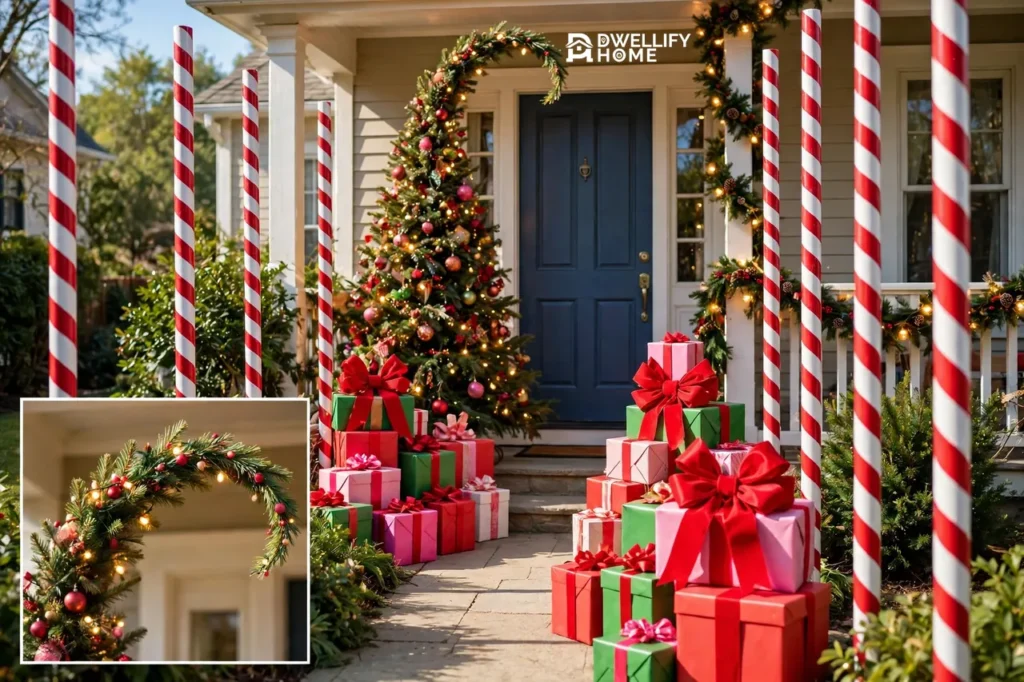
Whoville outdoor Christmas decorations turn a plain front yard into a playful, storybook street. You bend trees into gentle curves, line the walk with tall candy-striped poles, stack gifts at tipsy angles, and splash the whole scene with bright red, green, pink, and white. You build most of it yourself from poles, plywood, paint, ribbon, and lights, and you keep every piece sturdy enough to survive wind, rain, and snow.
Start with one crooked tree by the door, then add a candy cane path and a few oversized bows. That small trio tells the whole story at a glance, and you can grow the display year by year without redoing the yard from scratch.
What Makes Whoville Outdoor Christmas Decorations Look Whimsical?
The look works because it breaks the straight lines we expect. Real Christmas decor usually stands tall, straight, and even. This style leans, curves, tilts, and swirls, and that small surprise makes people smile before they even reach your door.
Think of a little town where every house, tree, and lamppost bends a little to one side, as if a friendly wind pushed it and it stayed that way. You do not need a big budget to copy that feeling. You need a few bold shapes, a clear color plan, and the courage to let things sit a little off-center.
The Shapes That Do the Work
Curves carry this style. A tree top that droops to one side, a candy cane pole that bends like a shepherd’s hook, a wreath that hangs at a jaunty tilt, and a gift stack that leans like a tower of blocks all read as playful in seconds.
Size helps too. One oversized bow beats ten small ones, and one tall striped pole beats a row of tiny ones. Pick two or three large shapes for the front yard, then fill the gaps with smaller ornaments, lights, and ribbon. The big shapes set the theme, and the small details keep eyes moving.
The Color Palette That Keeps It Joyful
Stick to a short palette so the yard looks joyful, not messy. Bright red, leaf green, crisp white, and one candy accent such as hot pink or sky blue give you plenty of pop without clashing.
Repeat those colors in every zone. If the candy canes are red and white, echo red and white on the porch rail, the mailbox, and the gift wrap. If you add pink ornaments to the tree, add pink ribbon to the door wreath too. Repetition ties a wild, curvy yard together.

Plan Your Yard Like a Little Storybook Street
Walk your yard in daylight before you buy or build anything. Stand at the curb and look at the house the way a guest sees it. Note the path to the door, the porch, the windows, the mailbox, and any tree or fence you can use as an anchor.
Now divide the yard into three zones: the curb and walk, the porch and door, and the house front itself. Give each zone one star piece and one supporting piece. For example, the walk gets candy cane poles plus small lights, the porch gets a crooked tree plus a tilted wreath, and the house front gets swirling lights plus oversized bows. This plan keeps the display balanced, and it stops you from crowding everything near the door.
Sketch the plan on paper, even roughly. Mark where each tall piece stands, where cords run, and where guests walk. Keep the walking path clear and wide, and keep every tall piece back from the path so nobody bumps into it at night. A clear path matters even more than a pretty path, because guests should enjoy the display without tripping over it.
For a full-yard layout, borrow ideas from our guide to outdoor Christmas displays, which covers lights, figures, and scenes in one balanced plan. Then come back here and bend that plan into curves.
Make a Crooked Outdoor Christmas Tree That Stays Standing
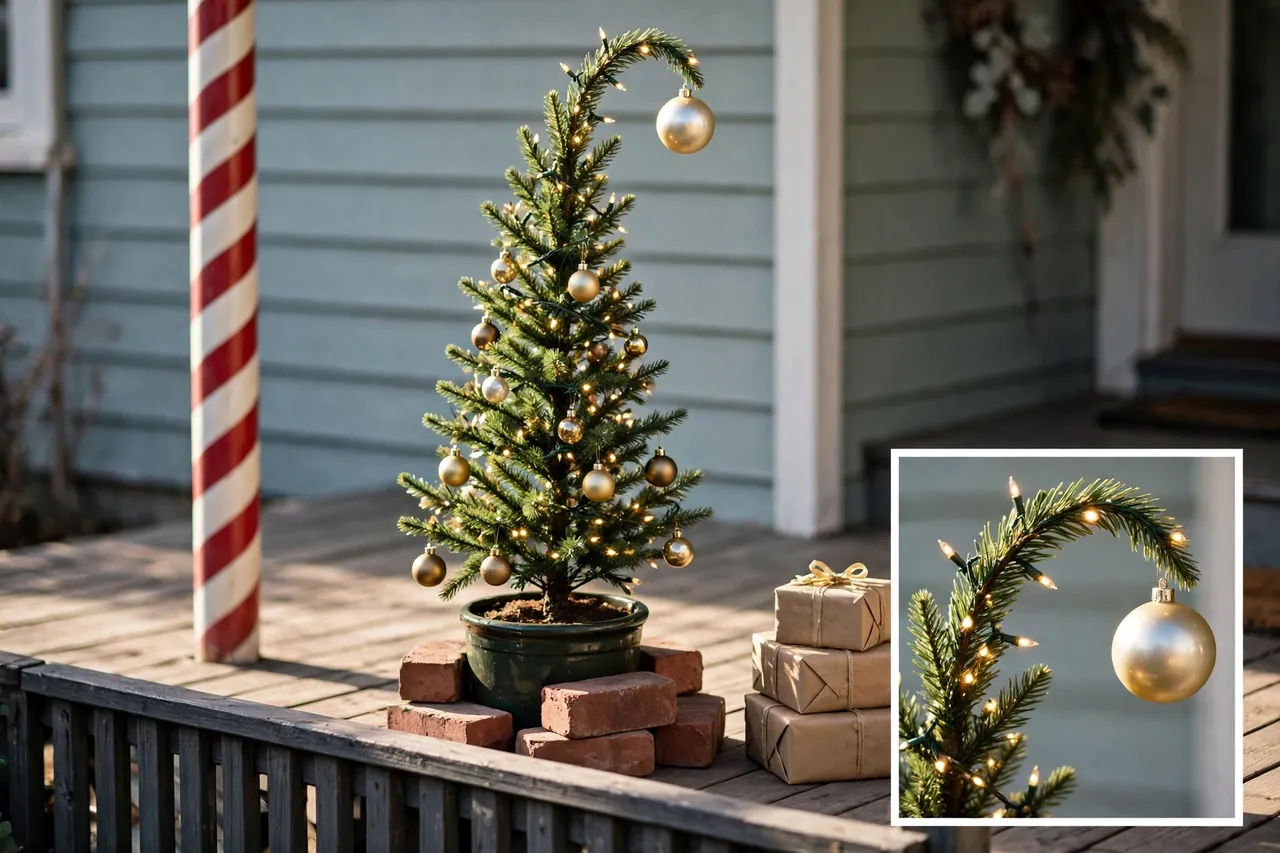
The crooked tree is the star of this style, and it is easier to build than it looks. You start with a normal artificial tree or a sturdy potted evergreen, then you bend only the top into a soft curve and lock that curve in place. The rest of the tree stays straight and stable, so the bend reads as playful rather than broken.
Use a slim artificial tree if you want full control, because you can bend its top section and wire it without fighting stiff branches. Use a live potted evergreen if you love a real-tree scent and you plan to plant it or keep it in a sheltered spot after the holidays. Either way, pick a tree that fits your porch or yard, not one that towers over the roofline and catches every gust of wind.
- Set the tree in a heavy pot or stand, and weigh the base down with bricks or sandbags so wind cannot tip it.
- Slide a long, flexible garden stake or a length of sturdy wire up the center of the tree, and fasten it to the trunk with zip ties or garden wire.
- Bend the top 12 to 18 inches of the stake into a gentle curve to one side, and wrap the tree branches around it so the curve looks full, not bare.
- Hang one large, lightweight ornament at the very tip, then add smaller ornaments lower down so the tree does not get top-heavy.
- Wrap lights from the bottom up, tuck them into the branches, and step back to check the curve from the street before you call it done.
Keep the curve soft. A gentle bend looks charming, while a sharp kink looks like damage. If the top flops instead of curving, shorten the bend or add a second wire for support. If the tree leans at the base, fix the base first, because no amount of pretty ribbon saves a tree that wobbles.
Flank the tree with two smaller curved pieces, such as a striped pole on one side and a small gift stack on the other. The trio frames the door and gives guests a clear focal point the moment they arrive.
Build a Candy Cane Path That Guides Guests to the Door
A candy cane path does two jobs at once. It welcomes guests with bright stripes, and it shows them exactly where to walk. Space the poles evenly on both sides of the walk, vary their heights a little, and lean each one at a slightly different angle so the row feels handmade, not factory-made.
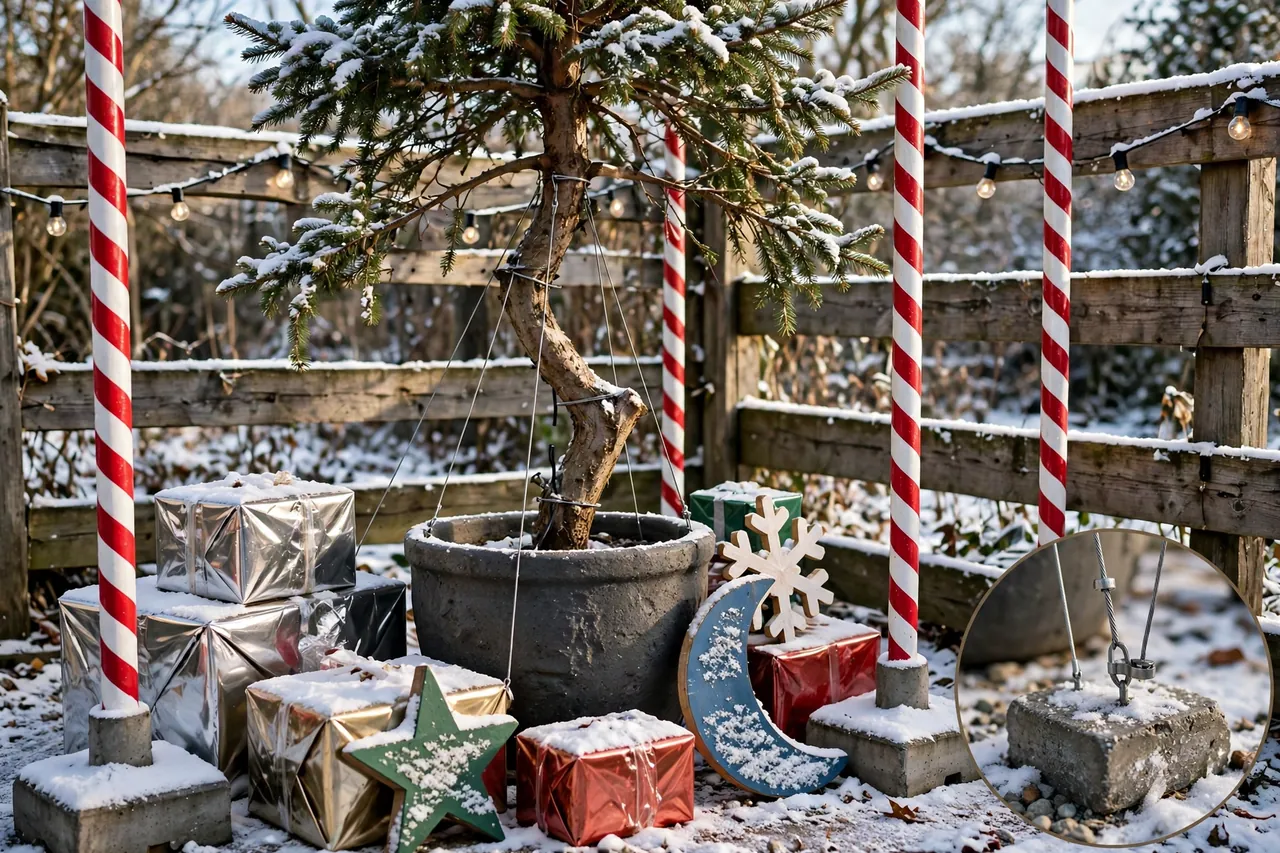
Make the poles from PVC pipe, pool noodles over garden stakes, or painted wooden dowels, and wrap them in red and white tape or weatherproof ribbon. Push each pole deep into the ground or into a weighted base, and check that none of them wobble when you nudge them. A candy cane that falls over in the first storm tells the wrong story.
For a softer glow, tuck small stake lights or lanterns between the poles so the path shines at night without harsh spotlights. Our guide to Christmas lantern decorations shows how lanterns warm up a porch, a path, and a table without stealing focus from the main display.
End the path with a clear payoff at the door: a wreath, a bow, or a small sign in a playful curved shape. Guests should feel the display build as they walk, then land on a bright, welcoming door. If the path ends at a dark porch, add one more light or one more bow at the door itself.
Dress the Porch, Door, and Windows in the Same Playful Style
The porch ties the yard and the house together, so carry the same curves and colors from the walk right up to the door. Wrap the porch rail with wide striped ribbon, hang a wreath at a slight tilt, and lean a tall striped pole beside the door frame. Add a doormat in a bold color, and swap plain porch lights for warm, glowing lanterns if you have them.
For the door itself, hang one oversized bow at the top and let its tails fall long. Add a garland that dips and swells instead of hanging in a straight line, and tuck a few large ornaments into the garland at uneven spots. The uneven spacing matters here. Perfect symmetry looks formal, while playful gaps look like a storybook.
Windows can join the fun without much work. Cut simple curved tree and swirl shapes from weatherproof foam board or plywood, paint them in your palette, and set them in the windows or on the porch wall. Back them with a string of warm lights at night so the shapes glow from behind. Keep the shapes simple and bold, because small fussy details vanish from the street.
If you want the whole entry to feel like one warm welcome, read our guide to Christmas decorating for the entrance way before you hang the first garland. It covers the walk to the door as one journey, which is exactly how guests experience it.
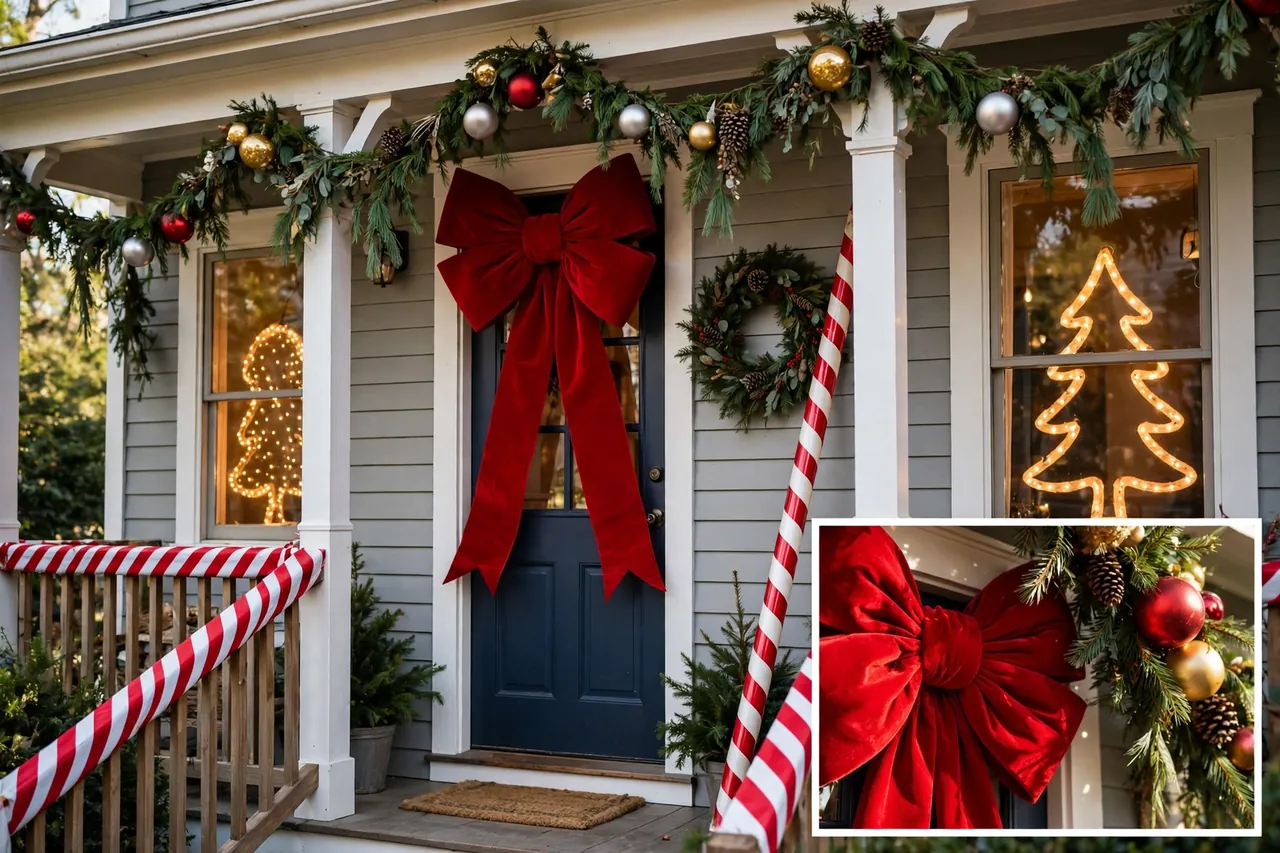
Add Oversized Bows, Gift Stacks, and Swirling Orbs
Once the tree and path stand, add the pieces that make neighbors stop and grin. Oversized bows, tilted gift stacks, and hanging orbs fill the middle layer of the display, between the tall trees and the low path lights, and they give the yard its full, finished feel.
Make bows from wide wired ribbon so they hold their shape outdoors. Form two large loops, pinch the center with wire, and fan the tails out. Fasten each bow to a rail, a lamppost, a mailbox, or a tree branch with wire, not tape, so rain and wind cannot peel it off. One bow per zone beats a bow on every single branch.
Build gift stacks from sturdy boxes, and wrap them in bright paper or weatherproof fabric in your palette. Stack them at tipsy angles, largest at the bottom, and run a garden stake or a dowel through the center of the stack into the ground so the whole tower cannot topple. Top the stack with a big bow, and keep the stack away from the walking path so nobody kicks it in the dark.
Hang swirling orbs from porch beams, tree branches, or shepherd’s hooks. Use lightweight plastic ornaments in mixed sizes, and hang them at different heights with fishing line or ribbon so they catch light and move gently in the breeze. Group orbs in threes, because a single orb looks lost while a cluster looks intentional.
Wooden pieces suit this style well, because paint grips wood and wood holds up outdoors. Our guide to wood Christmas decorations outside explains which finishes and shapes survive winter, and our guide to outdoor metal Christmas decorations helps if you prefer metal frames and stakes that last for years.
Light It Up Without Losing the Whimsy
Lights turn a daytime display into a nighttime story. Wrap trees in warm white lights first, then add one color accent, such as red or pink, on the candy canes or the gift stacks. The warm white base keeps the yard cozy, and the single color accent keeps it playful instead of chaotic.
Run lights in swirls and zigzags rather than straight lines. Spiral them up a striped pole, zigzag them across a porch rail, and drape them in loose curves between posts. The light itself should bend, just like the trees and poles do. Step back at night and check the whole yard, because a display that looks great in daylight can look patchy in the dark if one zone stays unlit.
Use LED strings made for outdoor use, and check every string before you hang it. The U.S. Consumer Product Safety Commission (CPSC) advises that you check labels to be sure lights have been certified for outdoor use, and that you throw out any set with broken sockets, frayed wires, or loose connections. That quick check protects both your display and your home.
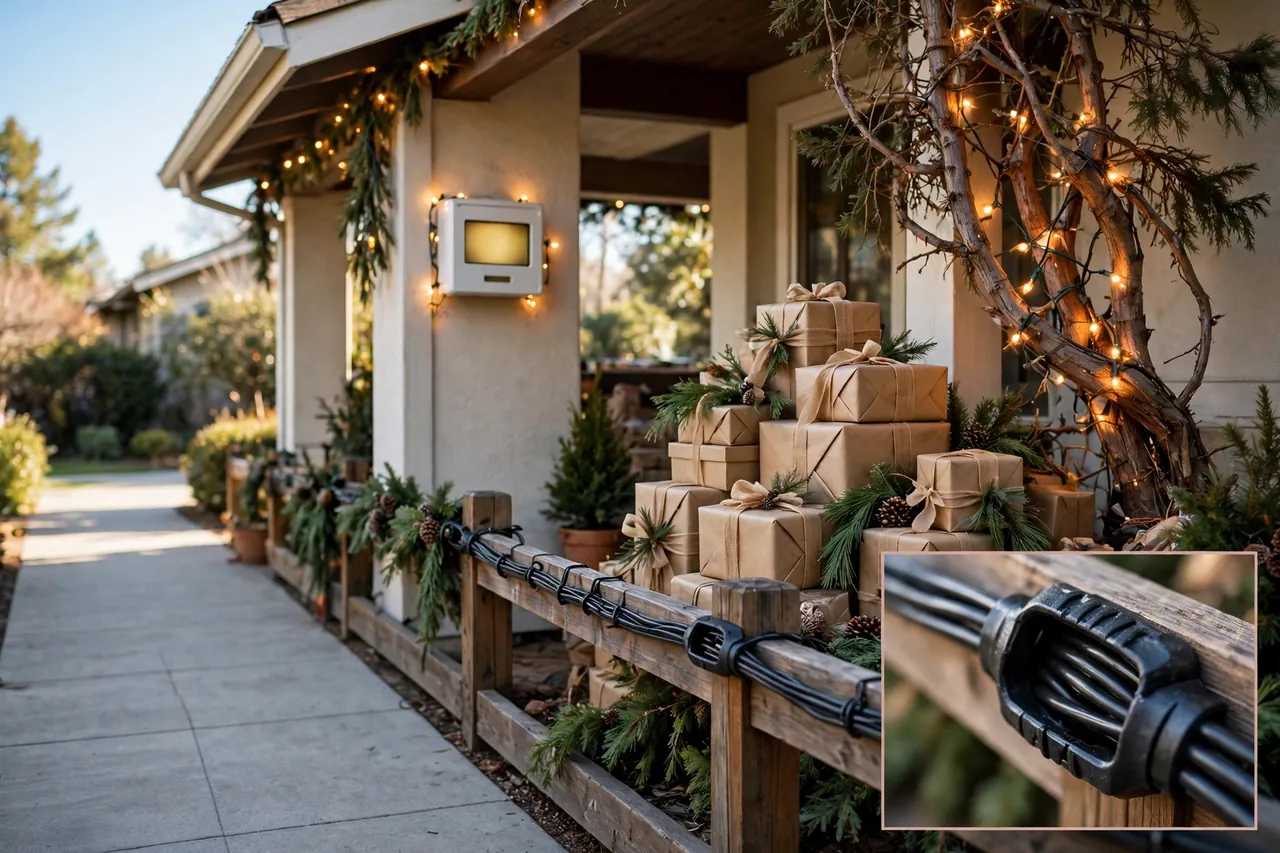
Keep cords tidy and out of the walking path. Run them along fences, under porch edges, or through cord covers, and plug outdoor lights into ground-fault protected outlets where you can. The U.S. Consumer Product Safety Commission (CPSC) also advises that you plug outdoor electric lights and decorations into circuits protected by ground fault circuit interrupters (GFCIs) for added shock protection. Turn the display off when you go to bed or leave the house, and put the lights on a timer so you never have to remember in the dark.
If you love a countdown moment, a lit number display or a light-up calendar adds a second reason for neighbors to visit each night. Our guide to an outdoor Christmas countdown shows how to build that nightly moment into a yard display without cluttering the main theme.
Weatherproof Your Display for Wind, Rain, and Snow
A whimsical yard still has to survive real weather. Wind hits tall, curved pieces hardest, because a bent top acts like a sail. Rain soaks paper, cardboard, and unsealed paint, and snow loads weight onto branches and gift stacks. Plan for all three before the first storm, not after it.
- Anchor every tall piece with a heavy base, a ground stake, or guy wires hidden behind the display.
- Seal painted wood and foam board with outdoor sealant, and let each coat dry fully before you set pieces outside.
- Wrap gifts in weatherproof fabric or plastic-backed paper, and keep real cardboard boxes indoors or under a covered porch.
- Use outdoor-rated tape, wire, and zip ties, because indoor tape peels off in the first rain.
- Brush snow off branches and gift stacks after a storm so the weight does not bend or snap them.
- Bring lightweight orbs and bows inside during a severe wind warning, then set them back out in minutes.
Check the display after every storm with a quick walk-around. Tighten a loose wire, straighten a leaning pole, and replace a soaked bow before the damage spreads. A ten-minute check after a storm saves a full rebuild later, and it keeps the yard looking fresh right through Christmas Day.
A Simple Weekend Plan and Budget-Friendly Shopping List
You can build the core display in one weekend if you plan the work in order. Day one covers the plan, the tree, and the path, because those pieces set the whole layout. Day two covers the porch, the lights, and the finishing touches, because those pieces need the big shapes in place first.
| Step | What you do | Time to allow |
|---|---|---|
| Plan and shop | Walk the yard, sketch the zones, and buy poles, ribbon, paint, and lights | Half a day |
| Build the tree | Set, weigh, bend, and light the crooked tree | Two to three hours |
| Build the path | Set, wrap, and anchor the candy cane poles | Two hours |
| Dress the porch | Hang the wreath, bow, garland, and window shapes | Two hours |
| Light and check | Run lights at night, fix dark spots, and tidy cords | One evening |
Shop from what you already own first. Old artificial trees, leftover ribbon, spare plywood, and last year’s lights all fit this style, because paint and ribbon hide their age. Buy new only for safety items, such as outdoor-rated lights and cords, and for the few large pieces that carry the theme, such as wide ribbon and large ornaments. That order keeps costs down and keeps the display safe where safety counts most.
For color confidence, look at our guide to colorful Christmas decor before you buy paint. It shows how bold palettes stay joyful instead of messy, and the same rule works outdoors, where bright colors read even stronger in daylight.
Common Mistakes That Flatten the Fun
Most disappointing displays fail in the same few ways, and every one of them is easy to fix. First, too many small pieces and no big star. If guests cannot name the first thing they saw, add one tall tree or one large bow and remove three small items.
Second, too many colors. A yard with red, green, pink, blue, purple, gold, and silver looks busy, not whimsical. Cut the palette back to four colors and watch the display calm down at once.
Third, perfect symmetry. Two identical trees, two identical wreaths, and two identical poles look formal, and formality kills this style. Shift one piece, tilt one wreath, and vary the pole heights so the yard feels handmade.
Fourth, a dark zone. If the porch glows but the path stays dark, or the tree shines but the house front stays flat, guests notice the gap more than the glow. Add one string of lights or one lantern to the dark zone before you add anything new to a bright zone.
Fifth, wobbly pieces. A leaning gift stack charms guests only until it falls. Anchor it, stake it, or move it to a sheltered spot, because a display that stays standing looks far more magical than one you rebuild every weekend.
Keep It Safe Outdoors
Outdoor displays mix electricity, wind, and foot traffic, so treat safety as part of the design, not an afterthought. Use only outdoor-rated lights and cords, keep cords out of walkways, anchor tall pieces, and turn lights off when you leave the house or go to bed. Check strings for damage before you hang them, and replace any damaged set instead of taping it and hoping for the best.
Disclaimer: this guide shares general decorating ideas for a home display. It does not replace the safety labels on your lights, cords, and decorations, and it does not cover electrical work. If you need a new outdoor outlet or a circuit change, hire a qualified electrician, and follow the maker’s instructions for every product you use.
Related Guides
Outdoor Cat Christmas Decorations · Christmas Porch Leaner · Commercial Outdoor Holiday Decorations
Frequently Asked Questions
What is a Whoville tree?
A Whoville tree is a Christmas tree with a soft, playful curve at the top instead of a straight point. You bend the top section to one side, cover the bend with branches, and hang one large, lightweight ornament at the tip. The rest of the tree stays straight and stable, so the curve looks charming rather than broken.
How do you make Whoville decorations?
You make them by bending familiar shapes into curves and painting them in bright, joyful colors. Bend a tree top, wrap poles in red and white stripes, hang wreaths at a slight tilt, and stack gifts at tipsy angles. Use plywood, foam board, PVC pipe, ribbon, and outdoor paint, and anchor every tall piece so wind cannot tip it over.
How do you make a Whoville Christmas tree?
Start with an artificial tree or a potted evergreen in a heavy base. Run a flexible stake or sturdy wire up the center, bend the top 12 to 18 inches into a gentle curve, and wrap branches around it. Hang one large ornament at the tip, add smaller ornaments below, wrap lights upward, and check the curve from the street.
Can I use real plants for Whoville decorations?
You can use a live potted evergreen as your crooked tree, and fresh garland on a covered porch works well too. Keep real plants away from hot lights and dry indoor heat, water potted trees as advised, and bring tender plants inside during hard frost. For poles, signs, and window shapes, painted wood or foam board lasts longer outdoors than cut greenery.
Start With One Crooked Tree
You do not need a whole storybook town on the first try. Build one crooked tree, line the walk with striped poles, and hang one oversized bow on the door. Stand at the curb at night, enjoy the glow, and add one new piece each year. That slow, steady build keeps the display fun to make, safe to enjoy, and easy to love for many Christmases to come.
When the holidays end, label each piece, pack the ornaments and bows in sturdy boxes, and store the poles and tree where they stay dry. Our guide to Christmas decor boxes shows how to pack decorations so next year’s setup starts fast and nothing arrives broken. Next December, you will unpack a display you already love, and you will know exactly which curve to add next.