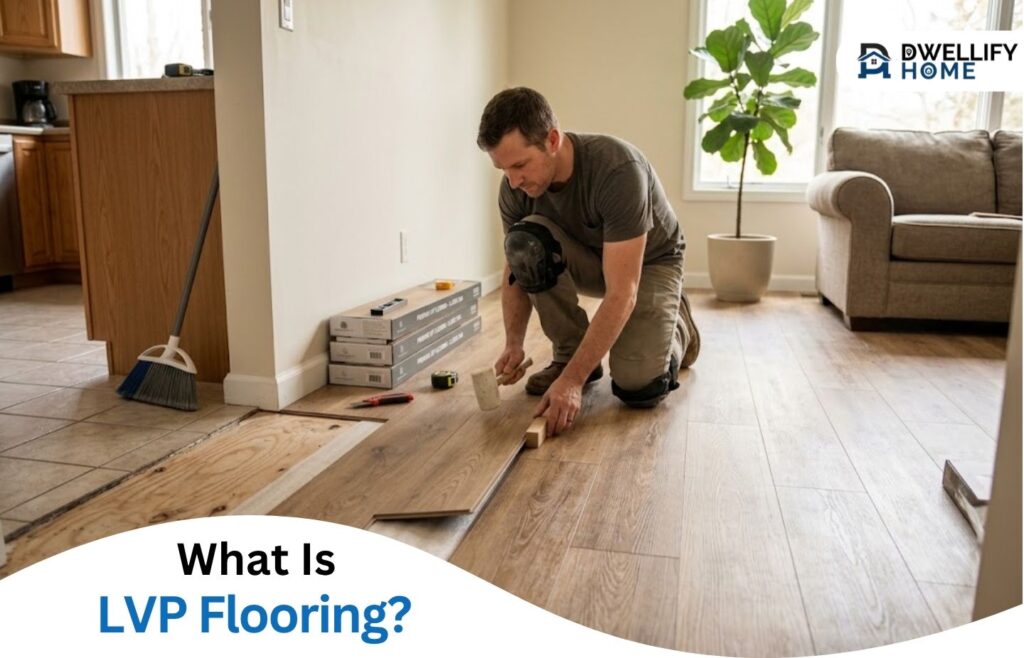
LVP stands for luxury vinyl plank. LVP flooring is a layered, vinyl-based floor covering made in long pieces, usually with a printed design that looks like wood. It offers a wood-style finish with a surface designed for everyday wear and cleaning.
Many LVP products are sold as waterproof. That describes the flooring material; it does not automatically protect the subfloor—the solid base beneath your flooring—from leaks or trapped moisture. Armstrong makes this distinction in its waterproof flooring guidance.
Whether LVP suits your home depends on the room, the product, and the installation. Understanding those differences also helps you compare the full project cost, beyond the price printed on the box.
Direct Answer
LVP stands for luxury vinyl plank, a layered vinyl flooring usually designed to look like wood. Many products are waterproof, but they do not automatically protect the subfloor from leaks or trapped moisture.
Practical Home Tip
Two LVP samples can look similar but have different wear layers and installation needs. Compare the product labels and ask for an itemized quote that includes any needed floor preparation. An attached pad does not replace those preparation checks.
Mission Statement
DwellifyHome helps homeowners and renters make informed, practical choices for stylish, comfortable homes.
LVP buying checklist
- Confirm the exact product name and model number.
- Compare wear-layer thickness separately from total plank thickness.
- Check approved rooms, water protection, and warranty conditions.
- Confirm subfloor preparation and approved installation materials.
- Compare quotes that separate flooring, labor, and additional work.=
What Is LVP Flooring Made Of?
LVP combines several materials rather than one solid piece of wood. Vinyl, or polyvinyl chloride (PVC), is a main ingredient. Products may also contain mineral fillers and other ingredients. For example, Karndean describes its luxury vinyl as primarily limestone, PVC, and pigments. Exact construction varies by product.
Most products have these main parts, though manufacturers may divide or name the layers differently:
- Protective surface: A clear wear layer protects the design underneath. Some products have an additional surface treatment.
- Design layer: A printed image creates the wood grain, color, and knots. Texture may add a more wood-like feel.
- Core or supporting layers: These give the plank its body and stability. Construction affects how firm or flexible it feels.
- Backing: The bottom layer supports the product. Some planks include an attached cushion, but backing and cushioning are not always the same thing.
Karndean’s LooseLay collection, for example, lists a surface coating, wear layer, photographic layer, stability layer, and grip backing. This is why an illustration showing exactly four layers will not describe every LVP product.
You will also see flexible vinyl and rigid-core vinyl. Flexible planks can bend more readily. Rigid-core products have a firmer center.
Two common rigid-core labels are SPC and WPC. SPC, often called stone polymer composite, generally has a dense, mineral-filled core. WPC, often called wood polymer composite, uses a foamed core that can provide more cushioning. Compare the actual products for comfort and performance.
Construction and installation method are separate details. Click-lock planks join at their edges to form a floating floor, which is not normally glued across the subfloor. Glue-down products use adhesive. Loose-lay products use a different backing and may still need adhesive in specified areas. Always check the installation method for the product you choose.
The Main Pros and Cons of LVP Flooring
Practical Benefits
Routine cleaning is straightforward. Removing loose dirt and using an approved cleaner can keep the surface in good condition. There is no need to build your cleaning routine around sanding or wood treatments.
There are many wood-look choices. You can compare light oak looks, darker tones, different plank widths, and surface textures. A physical sample helps you judge whether the appearance works beside your cabinets and furniture.
Suitable products handle ordinary household spills. That can make LVP worth considering in kitchens, entryways, and other busy rooms. The water-related limits still matter, especially below the surface.
Some systems suit capable DIY installers. Click-lock flooring can reduce the need for adhesive, although cutting, fitting, and preparing the base still take care. Shaw recommends professional installation when the area is complex or the homeowner is unsure of the work.
Limitations to Consider
LVP cannot be sanded and refinished like hardwood. If the surface suffers serious damage, replacing affected pieces may be the suitable repair. This matters if you want a floor you can renew by sanding years later.
Scratch-resistant does not mean scratch-proof. Grit, dragging furniture, and concentrated loads can still cause damage. Shaw recommends suitable furniture protectors to reduce scratches and indentations.
The base beneath it matters. An attractive plank cannot fix a damp or poorly prepared subfloor. Preparation may add work and cost before installation can begin.
Heat and sunlight need attention. Some products have restrictions for temperature extremes or prolonged direct sunlight. Check the instructions before choosing flooring for a sunroom or a space without regular heating and cooling.
Consider how these trade-offs match your priorities. For example, a household that wants simple cleaning may accept plank replacement as a future repair. Someone who values real wood and the possibility of refinishing may prefer a suitable wood floor instead.
What Does Waterproof LVP Actually Protect?
The key question is whether a claim covers the plank, the installed flooring system, or both. Read the product warranty alongside the installation instructions.
A waterproof plank may withstand water without swelling, while moisture still affects the materials underneath. Water from a leak or flood can reach the subfloor, and moisture already present below the flooring can become trapped. The plank’s water resistance does not remove that problem.
For a kitchen, check the product’s approved use and wipe up spills promptly. A leaking dishwasher still needs repair.
For a bathroom, look for the manufacturer’s wet-area installation requirements. These may include specific perimeter details. Approval for a bathroom floor does not automatically mean approval inside a shower.
For a basement, check moisture conditions before choosing flooring. COREtec calls for subfloors to be clean, flat, dry, and structurally sound, with moisture testing and any problems addressed before installation.
Ask the installer what was checked and which moisture-control materials the selected product requires. An attached cushion does not answer those questions. The right approach depends on the flooring, the base beneath it, and the site conditions.
LVP vs. Vinyl, LVT, Laminate, and Engineered Hardwood
LVP is one type of vinyl flooring. When someone compares “LVP vs. vinyl,” they may mean planks versus sheet vinyl, which comes in large rolls.
LVT means luxury vinyl tile. It often describes square or rectangular pieces with stone or tile designs, although some manufacturers use LVT as a wider label for luxury vinyl products. Check the actual format rather than relying on the abbreviation alone.
| Flooring | Basic construction or format | Main decision point |
| LVP | Vinyl-based planks, commonly with a wood-look design | Compare construction, installation requirements, and warranty |
| Sheet vinyl | Vinyl flooring supplied in rolls | Consider how the sheet will fit the room and how seams will be handled |
| LVT | Luxury vinyl commonly supplied in tile formats | Useful when you prefer a stone or tile appearance |
| Laminate | Usually a wood-fiber core with a printed design and protective surface | Compare the exact product’s water protection and care requirements |
| Engineered hardwood | A real-wood surface over a layered construction | Consider it when real wood is a priority; check moisture and refinishing limits |
Laminate and LVP can look similar because both can use printed wood designs. Their construction differs: Floor & Decor describes laminate as a high-density fiberboard core with decorative and protective layers. Mannington’s engineered hardwood uses layers of real wood.
Avoid the old blanket rule that laminate is never waterproof. Products such as Pergo Pro+ offer a waterproof system, subject to their installation and warranty conditions. Compare specific products rather than assuming the category name tells the whole story.
Start by ranking your priorities. For example, if real wood is your main goal, focus on suitable wood products. If easy spill cleanup leads the list, compare each shortlisted product’s water warranty and care instructions. If you plan to install it yourself, include preparation and tools in the comparison.
Bring home samples of the materials you are considering and request quotes covering the same work. A useful comparison matches the room, the product requirements, and your budget, rather than treating one flooring category as the winner everywhere.
How Much Does LVP Flooring Cost?
Materials, Labor, and Extra Costs
In its US cost guide checked on October 14, 2026, Home Depot lists vinyl plank materials at $2–$4 per square foot and labor at $3–$5 per square foot. Together, that gives a $5–$9 baseline before project-specific extras. These are retailer estimates, not a fixed nationwide price range.
Ask whether your quote includes old-floor removal, disposal, subfloor preparation, furniture moving, trim, transitions, and stairs. Tax and delivery may also affect the final bill. Confirm what is included rather than adding an allowance for work already covered.
Material quantities also need attention. You buy flooring to cover the room plus the cuts and waste created by the layout. Whole-carton packaging can increase the amount purchased. Ask your supplier or installer to confirm the allowance for your chosen pattern.
Keep purchase quantity and installation area separate. In the example below, the room covers 200 square feet, but you purchase 225 square feet because of cuts and carton sizes. Ask how labor is measured and what happens to unused material.
Example Budgets for 200 and 2,000 Square Feet
For a hypothetical 200-square-foot room, consider Lifeproof Sterling Oak, model I966106LPX. On October 14, 2026, its Home Depot listing showed a 22-mil wear layer, 25 square feet per case, and a price of $87.25 per case, or $3.49 per square foot. Local prices and availability may differ.
Using an illustrative 10% cutting allowance:
| Calculation | Result |
| Room area plus allowance | 220 sq. ft. |
| Whole cases needed | 9 |
| Flooring purchased | 225 sq. ft. |
| Material cost: 9 × $87.25 | $785.25 |
The 10% allowance is an example assumption, not a requirement for every layout. This amount covers flooring only; labor and other project costs remain separate.
For a DIY project, also list the tools and approved installation materials you will need. Decide which preparation tasks you can handle and which need a separate quote before treating avoided installation labor as your final saving.
For 2,000 square feet of actual flooring area, the guide’s $5–$9 baseline gives $10,000–$18,000 for materials and labor before extra material allowance and additional work. Use the area receiving new flooring, not automatically the home’s advertised size.
For example, bedrooms keeping their existing carpet would not belong in that flooring quantity. Several small rooms, stairs, or extensive preparation can also change the quote. A measured, itemized estimate is the next step before committing to a whole-house budget.
What to Check Before Buying and Installing LVP
Read the Product Label
Start with the exact collection and product number. Similar colors from the same brand may have different specifications.
Separate wear-layer thickness from total thickness. Wear layers are commonly listed in mils; total plank thickness is commonly listed in millimeters. They measure different parts of the floor. Karndean LooseLay, for example, lists a 20-mil wear layer and 4.5 mm total thickness.
Check the finish and warranty alongside thickness. A thicker wear layer alone does not tell you how the complete floor will perform. Look for the stated residential use, approved rooms, exclusions, and care requirements. Keep the product details and your purchase records together.
Ask what a valid claim would cover: replacement material, labor, or both. Find out who handles the claim and what records you must keep. A long warranty name is less useful than knowing how its terms apply to your project.
Examine a physical sample. Look at it beside your cabinets or furniture in daylight and with the room lights on. Check the texture and color from standing height. If possible, view several full planks to understand the pattern variation.
Published sample tests can add context. BHG reviewer Jamie Fischer reported that aligning a tested Lifeproof sample’s locking joints took trial and error. That is a useful reminder to understand the joint system, although a sample test does not establish years of installed performance.
If indoor emissions are a concern, check a relevant certification such as FloorScore. It assesses specified volatile organic compound emissions—gases released from materials. It is not a guarantee that a product contains no chemicals or has no environmental impact.
Check the Floor and Installation Plan
Before ordering, work through these checks with the installer or the product instructions:
- Identify the base. Concrete, wood, and existing flooring can have different requirements.
- Check condition and moisture. Resolve leaks or damaged areas before covering them.
- Check flatness. Follow the product’s permitted variation; an attached pad is not a substitute for preparation.
- Confirm the installation details. Check approved underlayment, moisture protection, expansion space, and transitions.
- Check finished height. Consider doors, adjoining floors, and access around appliances.
Use the manufacturer’s installation guidance for the selected floor. Do not transfer one product’s expansion gap or acclimation rule to every LVP product.
If old flooring or adhesive may contain asbestos, do not sand, scrape, or disturb it yourself. Follow EPA guidance and arrange an assessment by a trained professional.
After installation, check for visible gaps, lifting edges, or unusual movement and raise concerns with the installer. A neat-looking surface does not replace the moisture and preparation checks needed beforehand.
How to Clean and Protect LVP Flooring
Yes, LVP can generally be damp-mopped, following its care instructions. First remove loose dirt with a suitable broom, dust mop, or vacuum setting. Grit left on the surface can contribute to scratching.
Use the cleaner approved for your product and follow the dilution instructions. COREtec recommends a well-wrung damp mop and warns against steam mops unless approved for the specific product. Do not assume waterproof flooring can tolerate every cleaning method.
Wipe spills promptly, protect furniture feet, and lift heavy items rather than dragging them. Check that entry mats and rug backings are compatible with your floor; some backing materials can cause discoloration. Shaw includes these precautions in its care guidance.
If the floor develops a sticky or dull film, check the cleaning product and its instructions before adding a stronger chemical. Avoid improvised waxes, polishes, or abrasive treatments unless the flooring manufacturer specifically allows them. The correct care routine belongs to the exact floor you bought.
LVP Flooring FAQs
Can LVP Be Installed Over Existing Tile?
Sometimes. The existing tile must meet the new floor’s installation requirements, including condition, stability, and flatness. Grout joints may need preparation, and added height may affect doors or transitions. Have the surface assessed before assuming that covering it will save removal work.
Do I Need Extra Underlayment With LVP?
It depends on the product and subfloor. Some planks have an attached pad; others use a different system. Additional cushioning must be permitted by the manufacturer. Moisture protection is a separate question, so an attached pad does not automatically settle what is needed over concrete.
Can One Damaged LVP Plank Be Replaced?
Often, but the method and difficulty depend on the installation system and location of the damage. Karndean describes its LooseLay pieces as individually replaceable; that does not mean every click-lock floor is equally simple to repair. Keep suitable spare material and ask about the approved repair method.
Can Renters Install LVP Flooring?
Ask the landlord for written approval before buying materials or changing the floor. Explain the installation method, any changes to trim or doors, and the removal plan. A floating floor may still involve changes to the property. Agree on who pays and what must happen when the tenancy ends.
Is LVP Right for Your Home?
LVP is worth considering when you want a wood-look floor and a manageable cleaning routine. Its fit depends on the exact product, the room conditions, and the work needed underneath.
Choose a few samples, read their installation and care requirements, and compare itemized quotes. If refinishing, real wood, or a particular feel underfoot matters most, compare suitable alternatives before deciding. The goal is a floor that fits both your daily life and your complete project budget.
Disclaimer
Homes, budgets, and flooring requirements vary, so use this guide as general information. Follow your product’s instructions and consult a qualified flooring professional about moisture problems, subfloor damage, or complex installation. Have suspected asbestos assessed by a trained specialist before disturbing old flooring.