A small vine with plain, pointed leaves can look very different from the large, split-leaf plant pictured on its label. That difference often raises the first question about Epipremnum pinnatum: does it need different care, or simply more time?
This tropical climber grows best indoors with bright, indirect light, a potting mix that drains well, and watering guided by moisture checks. You can let it trail or train it upward. Your choice affects its display and can influence how its leaves develop.
Start with a suitable spot and a manageable setup. Learn how the mix dries and watch new growth before adding more equipment.
Short Definition
Epipremnum pinnatum is a tropical climbing houseplant grown for its foliage. Indoors, it needs bright, indirect light, potting mix that drains well, and watering guided by moisture checks rather than a fixed schedule.
Practical Home Tip
A dry surface can hide damp mix deeper in the pot. Check below the surface and lift the pot before watering. The right interval changes with pot size, light, and temperature.
Mission Statement
DwellifyHome helps homeowners and renters create comfortable, stylish spaces with clear, practical guidance. We make everyday home decisions easier to understand, so you can choose what suits your space, needs, and budget.
Quick Care Checklist
- Check the light where the leaves actually sit.
- Feel the potting mix before adding water.
- Empty collected water from saucers and outer pots.
- Choose a trailing or climbing setup you can maintain.
- Inspect leaf undersides and stem joints for pests.
- Keep plants and cuttings away from children and pets that may chew them.
What Is Epipremnum Pinnatum?
Epipremnum pinnatum is an evergreen climbing plant in the Araceae family, also called the arum family. Common names include dragon-tail plant and silver vine. Young leaves usually have smooth edges; mature growth can develop deep splits and openings called fenestrations.
It is often sold as a pothos. However, it and golden pothos, Epipremnum aureum, are separate species. Pinnatum commonly has longer, narrower young leaves, while familiar golden pothos has more heart-shaped foliage. Check the botanical label because leaf shapes change with maturity.
Keep it away from children and pets that may chew plants. Calcium oxalate crystals can irritate the mouth and throat when eaten. Remember that trailing stems may eventually hang within reach. After suspected ingestion, contact a veterinarian for pets or Poison Control for people.
Should You Let It Trail or Climb?
Both approaches can work. Trailing stems suit hanging baskets and shelves, while climbing growth creates a taller display. Choose according to your space and the care you can maintain.
Before buying a tall support, check whether you can reach the pot for watering. A plant that looks good in a corner still needs enough light and room for its growing stems.
Choosing a Support
A sturdy stake or trellis can hold stems upright without requiring a damp surface. You may need soft ties to keep the vine in place. Secure the main stem loosely, leaving the leaf stalks free.
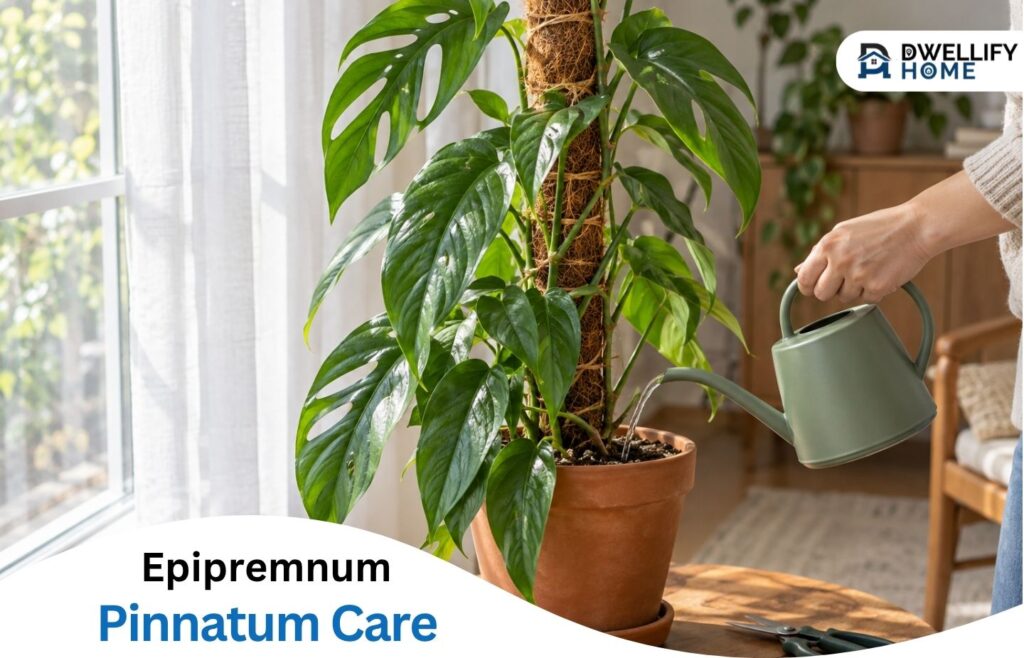
A moss pole offers a surface that aerial roots—roots growing from the stem above the soil—can grow into. Keeping that surface damp helps attachment, but adds another moisture check to your routine. A dry decorative pole should not be assumed to work like moist rooting material.
Pick a support you can extend or manage as the vine grows. Position it carefully without forcing it through established roots, and make sure the pot stays stable.
Why the Leaves May Not Split Yet
Small, smooth leaves are normal on young plants. Larger, deeply divided leaves develop as the plant matures under suitable growing conditions. Climbing height and attachment matter, so a recently installed pole does not guarantee immediate changes.
Variety matters too. Baltic Blue tends to develop splits earlier than some other selections. A trailing plant with split leaves therefore does not prove that every variety will behave the same way.
Watch successive new leaves rather than expecting an existing leaf to transform. Check light, healthy root growth, and support before adding more fertilizer in pursuit of bigger foliage.
How to Care for Epipremnum Pinnatum Indoors
Use this reference as a starting point, then adjust according to your plant and home.
| Care need | Practical starting point |
| Light | Bright, indirect light at leaf level |
| Water | Allow the upper mix to dry partly; check before watering |
| Pot | Drainage holes and room suited to the root ball |
| Mix | Moisture-retentive potting mix with good air space and drainage |
| Temperature | A warm room, protected from cold drafts and direct heat |
| Humidity | Ordinary household conditions are often suitable |
| Feeding | Modest feeding during active growth, following the product label |
Find Bright, Indirect Light
Choose a bright position near a window where harsh sun does not strike the leaves for long periods. An east-facing window can be a useful starting point. Strong afternoon light may need filtering through a sheer curtain.
Judge the actual plant position. A shelf behind a curtain or several feet into a shaded room can receive much less light than the nearby windowsill.
Move plants toward stronger light gradually, especially after winter. Sudden exposure can scorch foliage. Recheck the position as seasons change rather than assuming last month’s arrangement still works.
For a darker space, compare other low light indoor plants. Tolerating lower light and producing strong new growth are different goals.
Check the Mix Before Watering
Check the upper inch or two of mix with a finger. In an ordinary nursery pot, partial drying in this area is a useful signal to investigate further. Lift the pot too: a noticeably lighter pot usually holds less water.
Do not treat a dry surface as proof that a deep pot is dry below. Pot size, mix, warmth, and light all affect drying. A calendar reminder works best as a reminder to check.
When watering is needed, wet the mix thoroughly and let excess water drain. Empty the saucer or decorative outer pot before putting the plant back. Avoid repeated small splashes that leave parts of the root ball dry.
The aim is partial drying between waterings without prolonged saturation or repeatedly letting the whole pot become parched. Let how quickly the mix dries guide your next check, rather than watering simply because a week has passed.
Choose a Pot and Mix That Drain Well
Use a container with drainage holes. A nursery pot inside a decorative cover is convenient because you can remove it, water thoroughly, and drain it.
Choose a houseplant potting mix with good air space. Bark and perlite can help create a looser blend, but there is no single recipe that suits every home. A very coarse mix may need frequent checking; a dense mix can stay wet too long.
Match the container to the roots. A small plant does not need a large pot merely because you want it to grow tall. Keep the root ball at its previous planting depth when repotting.
Keep Temperature and Humidity Comfortable
A warm room suits this plant. Around 65–85°F is a practical indoor range, but steady conditions matter more than hitting an exact number. Avoid cold window glass, drafty doors, and air blowing directly from heating or cooling vents.
Average household humidity is often adequate for commonly sold selections such as Baltic Blue and Albo. You do not automatically need a humidifier. Check watering, roots, and light before deciding dry air explains every brown edge.
Feed, Prune, and Repot as Needed
Use a fertilizer labeled for houseplants during active growth, following its directions. Check whether the potting mix already contains fertilizer before adding more. Reduce feeding when growth slows; extra fertilizer cannot replace suitable light.
Trim overly long stems just above a node, the point where a leaf joins the stem. This can encourage branching and keep the plant manageable. Wear gloves when pruning, and save suitable healthy pieces for propagation.
Repot when roots crowd the container or the mix dries unusually quickly because roots occupy most of the space. Move up one pot size rather than making a large jump. Routine repotting is usually easiest during active growth, but a serious root problem may need attention sooner.
Popular Types and What to Check Before Buying
The names can be confusing, especially when shops shorten botanical labels. Variegated means the leaves have areas of different colors; it does not identify one particular variety.
| Type | Main identifying feature | Useful consideration |
| Green form | Plain green foliage | A choice when leaf shape matters more than color patterns |
| Cebu Blue | Silvery blue-green, narrow young leaves | Its mature appearance differs from its young foliage |
| Baltic Blue | Dark green leaves with a bluish cast | Often develops splits earlier than other selections |
| Albo | Green leaves with white patches or streaks | The amount and pattern of white can vary |
| Marble | Fine white marbling across green leaves | Different from Marble Queen golden pothos |
| Skeleton Key | Mature leaves develop a broad base and long, narrow tip | Small plants may not yet show the characteristic shape |
Young plants can look unlike mature specimens. Check whether listing photographs show the actual plant or a mature example.
When comparing plants for sale, check what you are actually buying. An unrooted cutting and an established pot are different starting points.
Look for firm stems, healthy growth, and no obvious pests. Ask for the exact variety name and, when buying online, a clear description of size and rooted status. Consider cold-weather shipping arrangements if relevant to your location.
Include the pot and support in your budget. A smaller, healthy plant with a manageable setup may suit you better than a large vine you cannot easily place or maintain.
How to Propagate a Stem Cutting
Epipremnum pinnatum propagation starts with a stem section containing a node. A leaf and its stalk alone are not a reliable way to grow a new vine; the cutting needs the stem’s growing point.
Water rooting lets you watch progress. Start with a healthy plant and clean, sharp scissors.
- Find a node. Look for the point where a leaf attaches to the main vine. There may also be a small aerial root nearby.
- Cut below it. Keep at least one healthy leaf and a node on the cutting.
- Remove submerged leaves. Place the node in clean water while keeping remaining foliage above the surface.
- Choose a warm, bright spot. Avoid harsh direct sun. Refresh the water every few days and keep the developing roots covered.
- Pot the rooted cutting. Once several roots are roughly 1–2 inches long, move it into a small pot of premoistened, airy mix.
Keep the new mix lightly moist while the cutting adjusts, without leaving it soaked. Water-grown roots need to adapt after potting, so monitor the plant rather than immediately treating it like an established vine.
Judge readiness by root development, not a promised number of days. Warmth, light, and the condition of the cutting affect progress.
Common Problems and What to Check First
A yellow or drooping leaf does not identify the cause by itself. Check the mix, drainage, growing position, and recent changes before choosing a fix.
| Symptom | Check first | Sensible next action |
| Yellow leaves | Is the mix persistently wet, very dry, or draining poorly? | Correct the moisture problem; do not automatically add water |
| Brown patches or edges | Strong sun, cold exposure, drying, and root condition | Address the clearest cause; damaged areas will not turn green again |
| Drooping with wet mix | Collected water, blocked drainage, soft stems, or deteriorating roots | Stop routine watering and inspect the root area |
| Small leaves or slow growth | Available light, season, crowded roots, and support | Improve the limiting condition before increasing fertilizer |
| Less white or yellow coloring | Recent light changes and whether whole shoots are turning green | Improve unsuitable conditions without promising restored variegation |
| Webbing, cottony patches, or attached bumps | Leaf undersides and stem joints for mites, mealybugs, or scale | Separate the plant and identify the pest before treatment |
Moisture problems can produce overlapping symptoms. Guidance for related pothos also identifies both excessive wetness and dryness as possible reasons for yellowing.
For a plant declining in wet mix, gently inspect the roots. Firm roots should be preserved; soft, decaying tissue calls for attention. Remove clearly rotten roots with clean tools and repot into suitable fresh mix in a draining container. If damage is extensive, healthy stem cuttings may offer another way to save part of the plant.
For pests, avoid guessing with household mixtures. Follow a product label that covers the identified pest and indoor ornamental plants. Your local extension service can help when identification is unclear.
Loss of variegation can involve genetic change as well as growing conditions. More light is not a guaranteed way to restore a fully green shoot.
After a change, look for stable foliage and healthier new growth. Repeatedly changing the pot, feeding, light, and watering together makes it harder to learn what helped.
Frequently Asked Questions
Is Epipremnum Pinnatum Easy to Care For?
Generally, yes. It can suit beginners who provide useful light, a draining pot, and regular moisture checks. A trailing plant requires less support maintenance than one grown on a damp moss pole. Choose the setup you can care for consistently.
Is Epipremnum Pinnatum a Money Plant?
“Money plant” is a common name often applied to golden pothos, Epipremnum aureum. Common names vary, so the phrase alone does not reliably identify pinnatum. Check the scientific name on the label, particularly when comparing plants online.
What Are the Benefits of Growing It Indoors?
Its main benefits are decorative: trailing greenery, a vertical display, and a choice of leaf colors and shapes. Propagation also lets you grow additional plants. However, ordinary potted plants do not meaningfully clean room air, so enjoy the foliage without treating it as an air purifier.
Does Epipremnum Pinnatum Produce Fruit?
Yes. The species can flower and produce clustered berries that turn red when ripe. For an indoor plant, focus on leaf and root health rather than trying to encourage a crop. Do not eat the plant or its fruit, or use it as a home remedy.
Start With a Care Routine That Fits Your Plant
Choose a bright position, check the mix before watering, and decide whether you want trailing stems or a climbing display. Then watch how new growth responds.
A healthy plant does not need every adjustment at once. Begin with the clearest need, make a sensible change, and let regular checks guide the next decision.
Disclaimer
This guide provides general plant-care information. Growing conditions, plant varieties, household needs, and budgets vary. After suspected ingestion, contact a veterinarian for pets or Poison Control for people.