LED Christmas decor gives you bright, colorful holiday lighting that uses far less energy than old-style incandescent lights and stays cool to the touch. You can use it on the tree, along the mantel, across the roofline, and around the yard, and you can control it with simple timers or smart plugs. This guide walks you through the types, colors, indoor and outdoor uses, energy savings, controls, and care, so you can plan a display that looks great and stays safe all season.
LED stands for light-emitting diode. Unlike an incandescent bulb, which makes light by heating a thin wire until it glows, an LED makes light through a small semiconductor. That difference explains almost everything you will love about LED Christmas decor: it wastes less energy as heat, it lasts longer, and its bulbs resist breakage far better than glass incandescent bulbs.
What Is LED Christmas Decor?
LED Christmas decor covers every holiday decoration that uses LED lights as its light source. That includes string lights for the tree, net lights for bushes, icicle lights for the eaves, rope lights for railings, pre-lit wreaths and garlands, glowing yard figures, and lighted gifts for the porch. Some pieces glow on their own, and others simply carry LED strings woven through greenery or wrapped around a frame.
The big win is efficiency. The U.S. Department of Energy explains that LED holiday light strands consume 70 percent less energy than conventional incandescent strands, and it notes that LEDs are sturdier and far less likely to burn out or break (U.S. Department of Energy). ENERGY STAR certified LED holiday lights go further still: according to Hydro-Québec’s summary of ENERGY STAR guidance, multicolor strings typically use 75 percent less energy than incandescents, single-color strings use 90 percent less, and the bulbs last 10 times longer than standard minibulbs (Hydro-Québec, ENERGY STAR certified holiday lights). In plain terms, you can light more of your home for less electricity, and you can reuse the same sets for many seasons.
LEDs also run cool. You can wrap them close to branches, ribbons, and fabric without the heat worry that comes with incandescent bulbs. That cool running makes them a smart pick for indoor displays near the tree and for homes with curious kids or pets, though you still need to follow the safety checks later in this guide.
LED Christmas Light Types
Walk down any holiday aisle and you will see a wall of LED options. They all glow, but each shape suits a different job. Pick the shape for the spot first, and the color second, and your display will look planned instead of patched together.
Mini and String Lights
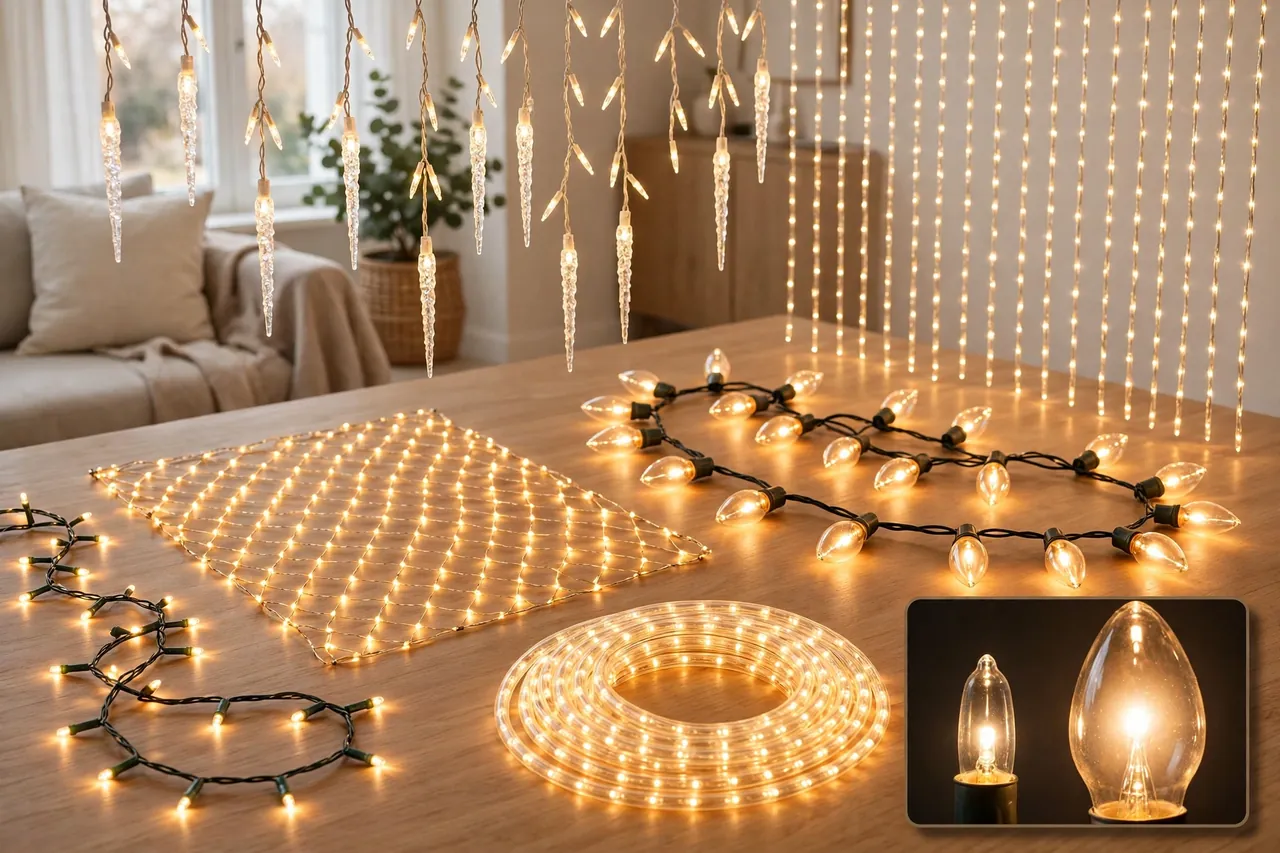
Mini lights are the workhorses of LED Christmas decor. Their small bulbs sit close together on a wire, so they wrap trees, garlands, wreaths, and railings with an even glow. Use tight spacing for a rich, full look on the tree, and wider spacing when you want a soft sparkle along a shelf or window frame. Mini lights also weave neatly through outdoor Christmas greenery, where they light the branches from inside instead of sitting on top of them.
C6, C7, and C9 Bulbs
C-series bulbs are the bigger, bolder cousins of mini lights. C6 bulbs are small and strawberry-shaped, C7 bulbs are a classic mid-size glow, and C9 bulbs are the large, bright bulbs you see outlining rooflines and fences. Bigger bulbs read well from the street, so they suit outdoor outlines and large trees. Smaller C6 bulbs suit porches, shrubs, and entryways where viewers stand close.
Net, Icicle, and Curtain Lights
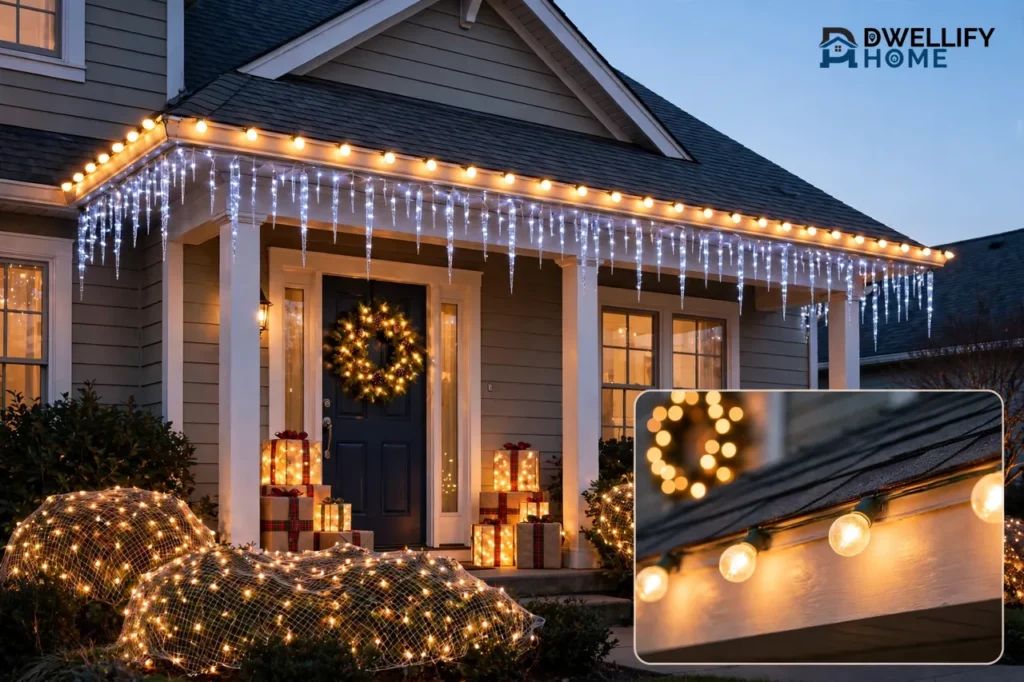
Net lights drape over bushes and shrubs in one quick step, and their grid keeps the spacing even without careful wrapping. Icicle lights hang from eaves and gutters in staggered drops, which gives your roofline a classic winter look. Curtain lights hang in long vertical strands from a top wire, and they work beautifully across a wide window, a porch opening, or a bare indoor wall behind the tree.
Rope, Strip, and Tape Lights
Rope lights place LEDs inside a flexible clear tube, so they draw clean lines along walkways, stair edges, and rooflines. Strip and tape lights stick to flat surfaces and tuck under shelves, mantels, and cabinets for a soft wash of color. Both types suit spots where a string of separate bulbs would look messy or snag. Check that any strip you place outdoors carries an outdoor rating before you hang it outside.
Pre-Lit Decor and Novelty Pieces
Pre-lit wreaths, garlands, trees, and yard figures build the LEDs right into the decoration, so you skip the wrapping step entirely. Lighted gift boxes, stars, snowflakes, and animal figures add focal points to porches and lawns, and they pair well with string lights rather than replacing them. For ideas on glowing porch pieces, see these outdoor lit Christmas gifts, which show how lighted accents can anchor a whole display.
Choosing Colors and Brightness
Color sets the mood of your whole display, so choose it before you buy a single strand. Warm white LEDs glow with the soft golden tone most people picture when they think of a classic Christmas. Cool white LEDs give a crisp, icy sparkle that suits modern displays, snow themes, and blue-and-silver palettes. Multicolor strands bring a playful, old-fashioned feel, while single-color strands in red, green, blue, or gold create a bold, coordinated look.
Brightness matters just as much as color. A strand packed with many bulbs per foot looks rich and full, while a sparse strand looks delicate and airy. For a tree that guests admire up close, pick dense mini lights. For a roofline seen from the street, pick larger C9 bulbs, which read clearly from far away. When you mix bulb sizes in one display, keep the color family consistent, or the display can look scattered.
Many LED sets now offer color-changing and dimming modes. A remote or app lets you switch from warm white for a quiet evening to multicolor for a party, and a dimmer lets you soften bright strands in a small room. Test every mode before you hang the lights, because a flashing mode that looks fun in the store can feel frantic in your living room.
LED Christmas Decor Indoors
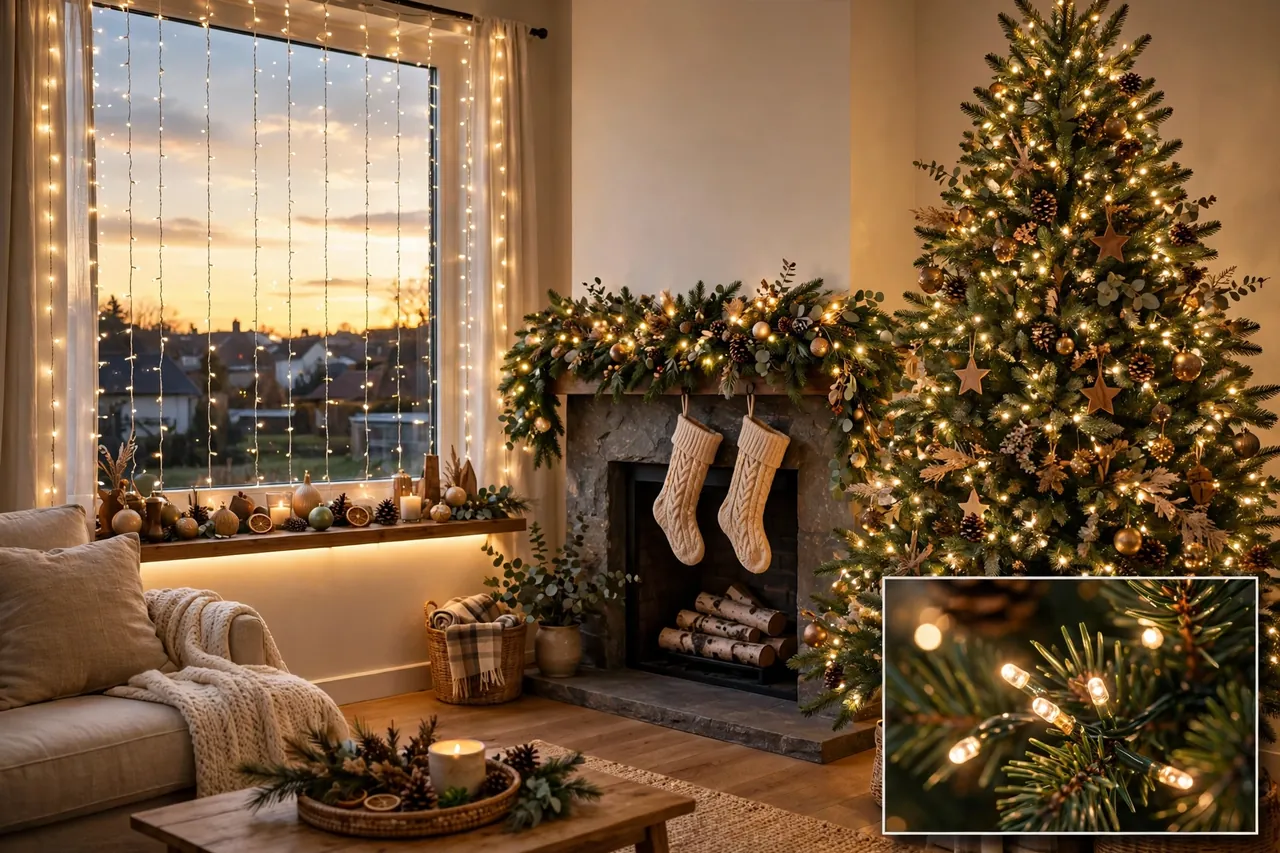
Indoors, LED Christmas decor shines because it runs cool and sips power, so you can leave a beautiful display glowing for hours without heating up the room. Start with the tree, since it anchors the whole room. Wrap mini lights from the trunk outward, working from the bottom up, and step back often to check for dark patches. A well-lit tree needs no other explanation, and it sets the tone for everything else in the room.
Next, carry the light to the spots your eyes land on naturally. Drape a pre-lit garland along the mantel, wind mini lights through the stair railing, and frame a window with curtain lights. Add a lighted wreath to an interior wall or above the fireplace, and tuck strip lights under a shelf to wash ornaments and stockings in a soft glow. Keep cords flat against walls and out of walkways, and plug indoor sets into outlets you can reach without moving furniture.
Indoor displays also reward restraint. Two or three lit features in a room feel festive, while lights on every surface can feel noisy. Pick one star, usually the tree, and let the mantel and windows support it. That balance keeps the room calm and lets each piece earn its place.
LED Christmas Decor Outdoors
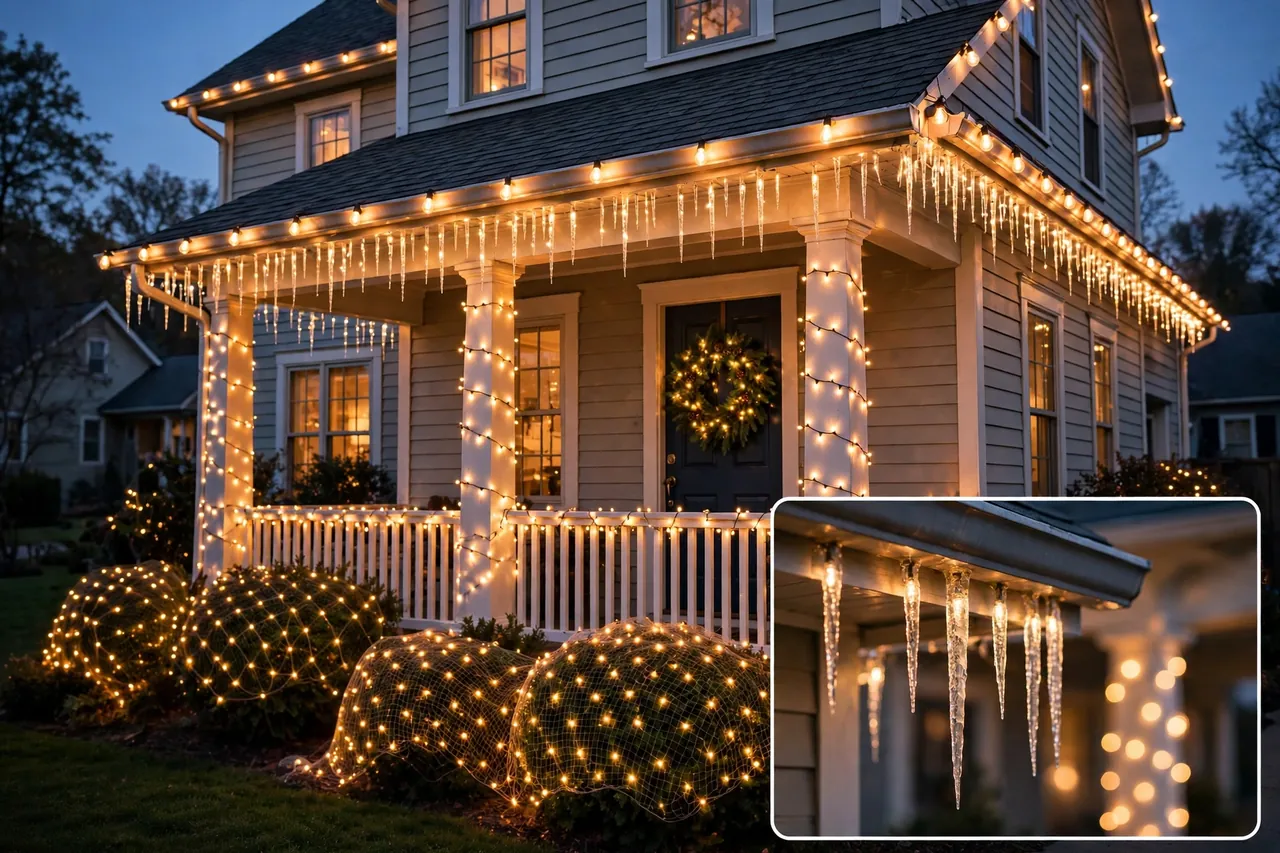
Outdoors, LED Christmas decor earns its keep with bright bulbs that stand up to cold nights and long evenings. Start with the roofline, since it frames the whole house, then move to the porch, the yard, and the walkway. Outline the eaves with C9 bulbs or icicle lights, wrap porch columns and railings with mini lights, and drape net lights over shrubs for instant coverage. A lighted wreath on the door and glowing figures near the entry welcome guests before they reach the door.
Outdoor displays need outdoor-rated products, full stop. Check the tag on every strand, cord, and timer before it goes outside, and never send an indoor-only set outdoors, even onto a covered porch. Rain, snow, and cold can damage indoor wiring and turn a pretty display into a hazard. When you plan a driveway display, this guide to decorating a driveway for Christmas pairs well with your lighting plan, since lights and layout work best when you plan them together.
Wind deserves a thought, too. Fasten outdoor strands to firm supports with clips or hooks made for lights, and never use nails or tacks, which can pierce the wire. Heavy or tall yard pieces need proper anchoring, and our notes on weights for outdoor Christmas decorations explain how to keep them steady through winter storms. Finally, aim lights at your own home and yard, not into a neighbor’s windows or the street, so your display delights instead of distracts.
Energy Use and Running Costs
LED Christmas decor saves energy in a way you can measure on your electric bill. The table below sums up the verified comparison between LED and incandescent holiday lights, so you can see the difference at a glance.
LED vs. Incandescent Holiday Lights: Verified Comparison
| Feature | LED Holiday Lights | Incandescent Holiday Lights |
|---|---|---|
| Energy use | 70 percent less than incandescent strands (U.S. Department of Energy); ENERGY STAR certified strings use 75 to 90 percent less | Baseline for comparison |
| Heat | Run cool to the touch | Run hot, since light comes from a heated filament |
| Lifespan | Last 10 times longer than standard minibulbs (ENERGY STAR guidance) | Shorter life, with bulbs that burn out more often |
| Durability | Sturdy bulbs that resist breakage | Glass bulbs that break more easily |
Because LED strands draw so little power, you can usually run more of them on one circuit than you could with incandescents, and a timer becomes even more useful. Set your display to switch off late at night, and you save energy without lifting a finger. Note that this article states no product prices, because prices vary by store, set size, and season, and no single price would stay true for every reader.
Timers, Controls, and Smart Features
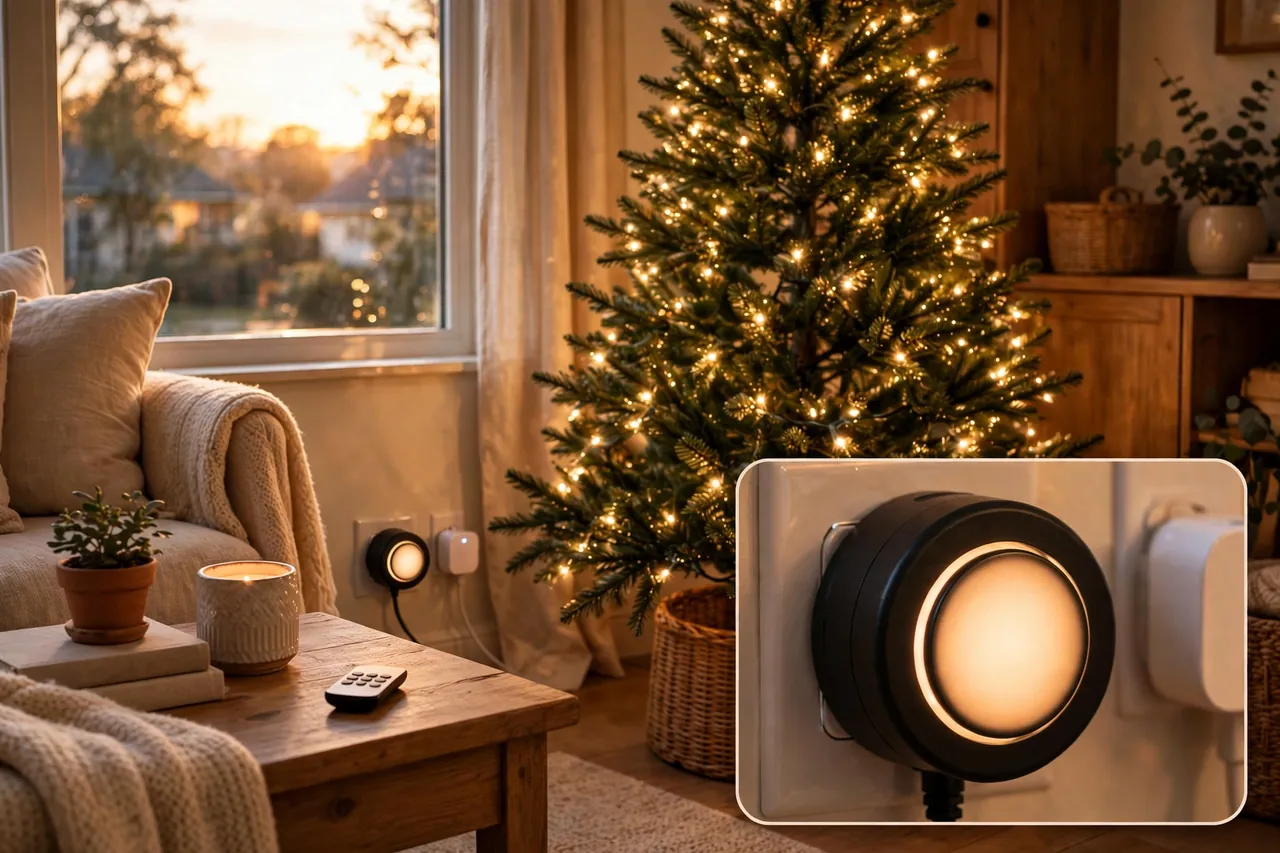
Timers turn a good display into an easy one. A basic plug-in timer switches your lights on at dusk and off at bedtime, so you never walk outside in the cold to unplug a strand. A digital timer adds multiple on-and-off times, and a smart plug or smart timer lets you control lights from your phone, set schedules, and dim compatible sets. Outdoor timers must carry an outdoor rating, just like outdoor lights, and indoor timers should stay indoors.
Before you buy a timer, match it to your display. Check the timer’s load rating on its housing, add up the wattage printed on your light tags, and keep the total comfortably below the timer’s limit. LED strands draw little power each, so most displays fit easily, but a large yard display still deserves this quick math. If you use a smart plug, test it from the spot where you will actually stand, since a weak Wi-Fi signal near an outdoor outlet can make a smart control feel anything but smart.
Color and effect controls deserve a test run, too. Many LED sets cycle through steady, fading, twinkling, and chasing modes. Pick one steady mode as your default, and save flashing modes for short party moments. A calm, steady glow looks classy from the street and feels restful indoors, while constant flashing can tire the eyes fast.
How to Plan and Hang LED Decor
A little planning saves a lot of ladder time. Follow these steps in order, and your display will go up faster and look better than a display you improvise on the spot.
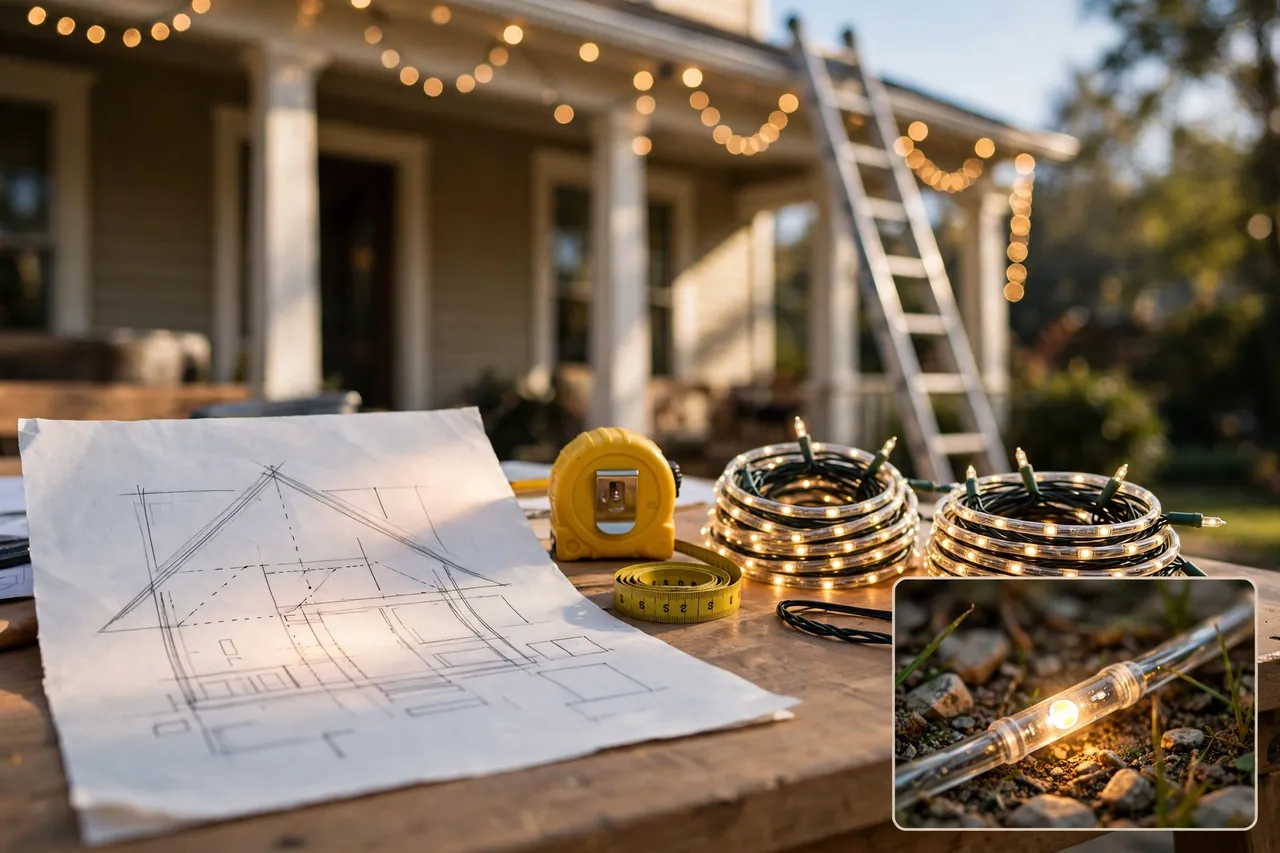
- Sketch your display on paper first. Mark the tree, the roofline, the porch, and the yard features you want to light, and note where each strand will start and end.
- Measure every run with a tape measure, and add a little slack for curves and corners. Buy strands that fit the measurement instead of stretching a short strand to reach.
- Test every strand on the ground before you hang it. Plug it in, check every bulb, and set aside any strand with cracked sockets, frayed wire, or loose connections.
- Read the tag on each strand for its end-to-end connection limit, and never join more strands than the tag allows. That number protects the wire from overload, and it varies by product.
- Hang the highest strands first, then work downward, so you finish near the outlets instead of climbing past finished work.
- Step back to the street and into each room to check the result, then adjust spacing and straighten lines before you call the job done.
Caution: work with electricity only when the power is off at the outlet, and never hang lights near overhead power lines. The U.S. Consumer Product Safety Commission urges decorators to stay away from power or feeder lines leading into the home, to fasten outdoor lights securely, and to use only insulated staples or hooks, never nails or tacks (U.S. Consumer Product Safety Commission). If a strand or outlet feels hot, smells scorched, or trips a breaker, unplug it at once and do not reuse it until you find the fault. When any electrical work goes beyond swapping a strand or resetting a breaker, call a qualified electrician.
Troubleshooting Common LED Problems
Most LED problems have simple causes. Work through this list from the easiest fix to the hardest before you replace a whole strand.
- Check the outlet first. Plug a lamp or phone charger into the same outlet to confirm it has power, and reset the breaker or GFCI if it tripped.
- Check the timer and remote. Confirm the timer sits on the right schedule, the remote has fresh batteries, and the set is on steady mode rather than a dim or off setting.
- Check the plug fuse. Many light plugs carry a small fuse, and a blown fuse kills the whole strand. Replace it only with the same type and rating printed on the plug.
- Check the connections. Unplug the strand, reseat every plug firmly, and look for bent prongs, corrosion, or water inside outdoor connectors.
- Check for one loose bulb. On some sets, a single loose bulb can dim or darken a section, so press each bulb gently into its socket and replace any cracked bulb with the same type from the same set.
- Check the end-to-end count. If a long run dims at the far end or trips a fuse, you may have joined more strands than the tag allows. Split the run across two outlets instead.
- Retire damaged sets. Throw out any strand with cracked sockets, frayed or bare wires, or loose connections, exactly as the CPSC advises, instead of taping over the damage.
Caring for and Storing LED Decor
Good storage decides whether next year’s setup takes an hour or a whole weekend. When the season ends, unplug every strand before you take it down, and wipe outdoor strands clean of dirt and moisture. Wind each strand loosely around a spool, a piece of cardboard, or your hand and elbow, and never yank a strand free from a gutter or branch, since rough handling cracks sockets and frays wire.
Store lights in a cool, dry place in labeled boxes or bags, with spare bulbs and fuses tucked into the same box as their set. Keep indoor and outdoor sets in separate, labeled boxes, so you never grab an indoor strand for the porch next December. Test every strand again before you hang it next year, and replace worn sets instead of nursing them through another season.
LED Christmas Decor Safety Checklist
LEDs lower the risk of a holiday lighting accident, but they do not remove it. Run through this checklist every year before the first switch-on.
- Buy only lights that carry the mark of a recognized testing laboratory, such as UL or ETL.
- Use outdoor-rated lights, cords, and timers outdoors, and plug outdoor displays into GFCI-protected outlets.
- Inspect every set, new or old, for broken sockets, frayed wires, and loose connections, and throw out damaged sets.
- Follow the end-to-end connection limit printed on each strand’s tag.
- Use no more than three standard-size sets of lights per single extension cord, as the CPSC advises, unless the product tag states a different limit for that product.
- Never put electric lights on a metal tree, since a faulty strand can charge the whole tree.
- Turn lights off when you leave the house or go to bed, or let a timer do it for you.
- Keep lights away from candles, heaters, and open flames, even though LEDs run cool.
Disclaimer: this guide gives general decorating advice, not electrical advice. If you feel unsure about a circuit, an outlet, or a damaged set, unplug it and ask a qualified electrician before you use it again. Your safety matters more than any display.
LED Christmas decor lets you celebrate bigger, brighter, and smarter than ever before. Start with one well-lit tree, add color that matches your home, use outdoor-rated gear outside, and let a timer handle the nightly routine. For tree-specific safety steps that pair with your lighting plan, read our guide to Christmas tree safety, and for the story behind the tradition itself, see why we decorate a tree at Christmas. Then step back, switch the lights on, and enjoy the glow.
Related Guides
Outdoor Lit Christmas Gifts: Light-Up Gift Boxes That Glow All Season · Christmas Tree Safety: How to Keep Your Tree Beautiful and Safe All Season · Weights for Outdoor Christmas Decorations
Frequently Asked Questions
How long do LED Christmas lights last?
LED Christmas lights last far longer than incandescent lights. ENERGY STAR guidance summarized by Hydro-Québec states that certified LED bulbs last 10 times longer than standard minibulbs, and many households reuse the same sets for many seasons. Your actual life depends on the product, the weather it faces, and how you store it.
Can LED Christmas lights get wet?
Outdoor-rated LED Christmas lights can handle rain and snow, but indoor-only sets cannot. Check the tag before any set goes outside, and use outdoor-rated cords, timers, and GFCI-protected outlets. Never submerge any light set in water, and bring damaged or waterlogged sets out of service at once.
Are LED Christmas lights safer?
Yes, LED Christmas lights are safer than incandescent lights in the ways that matter most. They run cool to the touch, which lowers burn and fire risk near trees and fabric, and their sturdy bulbs resist breakage. You still need lab-tested, correctly rated sets and sound wiring, since no bulb type forgives damaged cords.
Can I leave LED Christmas lights on all night?
You can, since LEDs run cool and draw little power, but a timer serves you better. Set the display to switch off at bedtime, and you save energy, extend the life of your sets, and remove the small risk of an overnight fault going unnoticed. The CPSC also advises turning tree lights off when you leave the house or go to bed.
Can you connect LED Christmas lights together?
Yes, when the product tag says the set is connectable. Read the end-to-end limit printed on the tag or packaging, and never join more strands than it allows, since that limit varies by product. If you cannot find a limit on the tag, do not chain that set to others, and split large displays across separate outlets instead.
Ready to glow? Pick your color family, measure one display area, and hang a single test strand tonight. Once you see how bright and easy LED Christmas decor looks in your own home, planning the rest of the display feels like the fun part, not a chore.