Walk into enough living rooms in July and you start to recognize the same white box wheeled into the corner, hose taped to a half-open window, doing its honest best to keep a bedroom livable. The Ocean Breeze portable air conditioner shows up a lot in budget-minded homes, and most of the confusion around it comes down to a few specs nobody explains clearly. Here’s the short version.
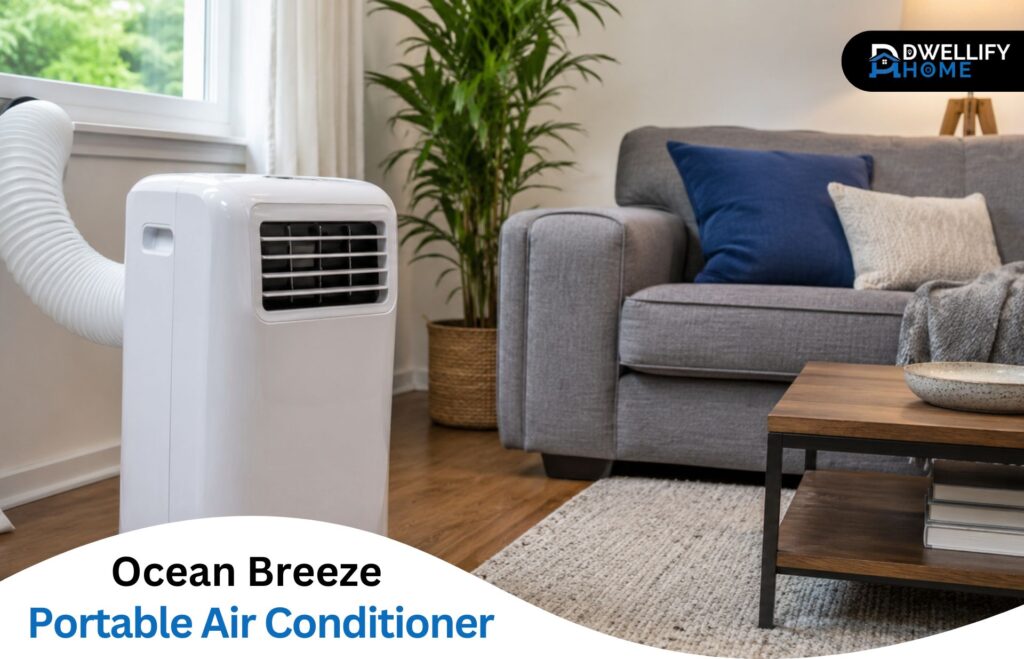
An Ocean Breeze portable air conditioner is a value-priced, single-hose, 3-in-1 unit (cooling, dehumidifying, and fan) sold under the Ocean Breeze Comfort brand by JC Global Inc. Models range from roughly 8,000 to 14,000 BTU. They’re simple, affordable, and easy to move room to room, with predictable trade-offs once you understand how they actually work.
This guide gives you the real model lineup, honest sizing advice, the setup and troubleshooting details owners actually run into, and a straight answer on whether it’s worth your money.
Snippet-Ready Definition
An Ocean Breeze portable air conditioner is a value-priced, single-hose 3-in-1 unit (cooling, dehumidifying, fan) sold by Ocean Breeze Comfort in 8,000–14,000 BTU sizes. People choose it for affordable, movable spot cooling in a single room.
Mission Statement
Dwellify Home helps homeowners, renters, and property enthusiasts make practical, well-informed decisions about their living spaces. With this guide, our aim is to cut through the marketing around portable air conditioners so you can choose, set up, and maintain the right unit for your home with confidence.
What Is an Ocean Breeze Portable Air Conditioner?
Ocean Breeze is a consumer air-conditioning brand sold by JC Global Inc., a distributor based in Fort Lee, New Jersey, that also markets units under names like Magnavox-licensed AC, Nantucket Breeze, and Sarasota Breeze. The portable line is built overseas and aimed squarely at the budget end of the market. It cools, dehumidifies, and runs as a plain fan.
Think of it as the practical, no-frills option. You won’t find inverter compressors or Energy Star badges on these portables, and you won’t pay premium-brand prices either. They’re sold mostly through Ocean State Job Lot, with resellers filling in the gaps on Amazon, Walmart, eBay, and local marketplace listings.
What you get is a rolling box on caster wheels with a touch panel, a remote, a window kit in the carton, and enough cooling to take the edge off a room that your central system can’t reach or that you’d rather not pay to cool whole-house. For a lot of people, that’s exactly the job they need done.
Key things to know at a glance
- Single-hose, 3-in-1 design (cool, dehumidify, fan); budget tier
- Real models: OBZ-09NPH, OBZ-12NPF, OBZ-14NPF, plus legacy NPE/PE units
- Advertised BTU runs well above the realistic DOE rating — size by the DOE number
- Auto-evaporative, but expect to drain it more often in humid climates
- Best for small-to-midsize rooms in mild-to-moderate climates
Quick model comparison
| Model | Advertised BTU | Realistic (DOE) BTU | Best for |
| OBZ-09NPH | 9,000 | ~5,300 | Small bedroom or office |
| OBZ-12NPF | 12,000 | ~6,500 | Average bedroom or living room |
| OBZ-14NPF | 14,000 | ~8,200 | Larger or open-plan space |
Ocean Breeze Comfort vs. Ocean Breeze Marine A/C — Don’t Confuse the Two
This trips people up constantly, so it’s worth clearing first. The Ocean Breeze that makes home portable units is Ocean Breeze Comfort (JC Global Inc.). It has nothing to do with Ocean Breeze Marine A/C, a separate company made by Quorum Marine & Electronics in Stuart, Florida, that builds self-contained air conditioning for boats.
If you go searching for reviews and land on boating forums like The Hull Truth or Trawler Forum, the praise and complaints you read there are about the marine systems, not the portable you saw at the store. They’re built by different companies for completely different uses. There’s also a loosely similar “Sea Breeze” name floating around that isn’t a portable AC brand at all.
So when you’re judging the home unit, stick to feedback that clearly references model numbers like OBZ-09NPH or a retailer like Ocean State Job Lot. Marine reviews, however glowing, tell you nothing about how the portable in your bedroom will perform.
Ocean Breeze Portable AC Models and BTU Sizes
The lineup is smaller than the scattered listings make it look, and some review sites invent model codes that don’t exist. Here are the real ones. Every model is single-hose and follows the same basic 3-in-1 design, so the meaningful differences are capacity, weight, and noise.
Current Models (OBZ-09NPH, OBZ-12NPF, OBZ-14NPF)
These three are what you’ll generally find sold new. The figures below pair the advertised BTU with the more realistic DOE rating (more on that distinction in the next section).
| Model | Advertised BTU | Realistic (DOE/SACC) BTU | Approx. weight | Notes |
| OBZ-09NPH | 9,000 | ~5,300 | ~49 lb | Lightest; manual louver |
| OBZ-12NPF | 12,000 | ~6,500 | ~57 lb | Auto-swing louver |
| OBZ-14NPF | 14,000 | ~8,200 | ~69 lb | Largest of the current line |
The OBZ-09NPH is the easy one to move between rooms. The OBZ-14NPF is the one to reach for in a larger space, with the OBZ-12NPF sitting in between.
Previous and Legacy Models (NPE-series, PE-series)
Plenty of these are still in service and turn up used or open-box. The NPE-series (OBZ-08NPE, 10NPE, 12NPE, 14NPE) directly preceded the current units and shares the same controls and layout. Older still is the PE-series (OBZ-08PE, 10PE, 12PE, 14PE). If you see a listing for an “OB2-08PE,” that’s almost certainly a typo for OBZ-08PE.
One spec correction worth knowing: the OBZ-08CR3W is a window air conditioner, not a portable, so don’t lump it into your portable comparisons.
Retailer-Exclusive 13,500 BTU “PX Series” (OBZ-135PXW)
Ocean State Job Lot carries a 13,500 BTU “PX Series” portable (model OBZ-135PXW) with a remote, multi-speed operation, a 24-hour timer, auto swing, and a washable filter. The product page lists coverage at up to 350 square feet, which reads low for a unit of that size. Treat that figure cautiously and check it against the current in-store listing before buying on square footage alone.
ASHRAE vs. SACC BTU Ratings: Why the Number on the Box Is Misleading
The big number on the box is an ASHRAE rating, and the smaller, more honest one is the DOE figure (often called SACC). On Ocean Breeze portables, the gap between the two runs roughly 40 to 50 percent. A “14,000 BTU” OBZ-14NPF rates closer to 8,200 BTU under DOE testing. An 8,000 BTU OBZ-08NPE comes in around 4,000.
This isn’t an Ocean Breeze defect; it’s how single-hose portables behave once you account for the warm air the unit pulls back into the room. But it explains the most common complaint I hear, which is that a unit that “should” cool a big room only really handles a small one. The marketing number describes lab conditions. The DOE number is closer to what you’ll feel.
The practical takeaway: judge these by the DOE rating, not the headline BTU. Once you do that, your size expectations line up with reality and you stop blaming the unit for doing exactly what its real capacity allows.
How to Choose the Right BTU Size for Your Room
Size by the realistic rating and round up rather than down, because single-hose units lose ground in real rooms. As a rough starting point:
- Small bedroom or office (up to about 200 sq ft): 8,000 to 9,000 BTU
- Average bedroom or living room (200 to 350 sq ft): 10,000 to 12,000 BTU
- Larger or open-plan space (350 sq ft and up): 14,000 BTU, and temper your expectations
Then adjust. A room with strong afternoon sun, high ceilings, lots of electronics, or a hot upstairs location needs more capacity than the square footage suggests. A humid climate also makes the unit work harder, since it spends energy wringing water out of the air. When you’re on the fence between two sizes, take the bigger one. An oversized portable cycling comfortably beats an undersized one running flat out and never quite catching up.
Key Features and How They Work
The feature list looks similar across the range, but a few details shape day-to-day living with the unit more than the spec sheet lets on.
Single-Hose, Auto-Evaporative Design (and What It Means for You)
Every Ocean Breeze portable is single-hose, and in cooling mode it’s auto-evaporative, meaning it recycles most condensation out through the exhaust as vapor instead of into a tank you empty. In dry weather this works well and you rarely touch a drain.
In humid weather it’s a different story. When the internal tray fills faster than the unit can evaporate it, you’ll get a “P1” code, the cooling stops, and the fan keeps running until you drain the tray from the lower port. Owners in muggy climates sometimes find themselves draining more often than the marketing implies. That single fact is the biggest hidden factor in whether you’ll be happy with one of these, so weigh it honestly against your local summers.
Controls, Remote, and Modes
You get a touch-style control panel and an included remote, with COOL, DRY, FAN, and AUTO modes, a sleep setting, and a 24-hour timer. Many remotes support a “follow me” function that reads temperature at the remote rather than the unit. After a power cut, the unit restarts on its own. There’s also a built-in three-minute delay before the compressor restarts, which protects it from short-cycling. People often mistake that pause for a failure when it’s the unit doing its job.
Filters and Maintenance
There are washable filters (typically an upper and lower) that slide out for rinsing. Clean them about every two weeks during heavy use, and expect a filter reminder around the 250-hour mark. A clogged filter is the number-one cause of weak cooling I see, and it’s a five-minute fix. Keep the filters clean and the back of the unit clear, and you’ve handled most of the maintenance these need.
How to Install the Window Kit and Exhaust Hose
Setup takes about fifteen minutes and the kit comes in the box. Work through it in this order:
- Place the unit a few inches from the window with clearance behind it for airflow.
- Fit the window slider bracket to the opening. The slider adjusts across a range of common window widths; trim or shim as needed for a snug seal.
- Attach the exhaust hose to the back of the unit, then to the window adapter.
- Close the window onto the bracket and seal gaps with the included foam so warm air can’t sneak back in.
- Keep the hose as short and straight as it’ll go.
That last step matters more than people think. A kinked or stretched-out hose traps heat and kills cooling performance, and it’s a frequent culprit behind “it’s not getting cold.” Double-hung windows are the easy case. For sliding or casement windows you may need a third-party trim kit or a custom panel, and several universal portable-AC window kits on the market fit Ocean Breeze hoses with minor adjustment.
Common Problems and How to Fix Them
Most issues come down to a handful of repeat offenders, and you can clear the majority yourself.
Weak or no cooling usually traces to a dirty filter, a blocked or kinked exhaust hose, or a unit that’s simply undersized for the room. Start with the filter, then the hose, then your size expectations. Water pooling or a P1 code points to a full tray in humid conditions; drain it and, in dry mode, run a continuous drain line from the top port.
On some units, especially the OBZ-09NPH, a worn start capacitor can cause a rumbling noise on startup and even dim the lights briefly. That’s a compressor straining to start and a sign the unit needs service rather than a DIY fix. And again, that three-minute pause before the compressor kicks back in is normal protection, not a breakdown.
Ocean Breeze Error Codes (P1, E1–E7)
The codes look cryptic but map to specific parts. Here’s the plain-English version:
| Code | Meaning | What to do |
| P1 | Bottom tray full | Drain the tray; common in humidity |
| E1 | Room temperature sensor | Service if it persists |
| E2 | Evaporator sensor | Service if it persists |
| E3 | Condenser sensor | Service; check airflow and filters |
| E4 | Display panel communication | Power-cycle; service if repeated |
| E7 | Zero-crossing / electrical fault | Try a different outlet; service if repeated |
P1 is the one you’ll actually see and can fix in a minute. The E-codes are sensor or board faults; power-cycle once, and if a code returns, it’s a service call.
Where to Find the Manual and Replacement Parts
Manuals for the portable line live on the manufacturer’s support site at jcwarranty.com/manuals.html, organized by model number, so match the code on your unit’s nameplate. For parts like filters, hoses, adapters, and remotes, the official portal is warrantysupply.com, and the support line is 1-866-277-7878 if you need to source a vent hose or window adapter that’s hard to find elsewhere.
On the remote, one detail saves people money: the correct replacement is in the RG57 family (for example, RG57H4/BGEFU1), which runs about $10 to $15 and is cross-compatible with several other brands’ portables. You don’t need a brand-stamped remote at a markup. Match the RG57-series and it’ll work.
Ocean Breeze Portable AC Price and Where to Buy
Pricing depends heavily on condition, and the brand’s bargain reputation rests on the lower end of these ranges. As a snapshot, expect roughly $249 to $499 new, $200 to $350 open-box or refurbished, and $80 to $300 used. Prices move with the season and stock, so treat these as guideposts, not quotes.
Buying New
Ocean State Job Lot is the primary new-retail channel, including the exclusive 13,500 BTU PX unit, and it runs seasonal promotions worth waiting for. Amazon and Walmart list models on and off through resellers, so availability varies by year.
Open-Box and Refurbished
Walmart’s pre-owned listings and refurb outlets like Woot regularly carry Ocean Breeze portables at a discount. For a budget brand, a clean open-box unit with the kit intact is often the smartest value, since you’re already buying on price.
Used (eBay, Facebook Marketplace) — What to Check First
Secondhand is where the deals and the headaches both live. Before you hand over cash, confirm the exhaust hose, window kit, and remote are all included, since replacing them eats the savings. Run it in cooling mode and feel the output. Listen at startup for any rattling or rumbling that hints at a tired compressor, and pass on anything that dims the lights when it kicks on.
How Ocean Breeze Compares to Midea, Frigidaire, LG, and Whynter
Ocean Breeze sits firmly in the value tier, and that’s the honest frame for any comparison. It’s single-hose, non-inverter, and typically carries a one-year warranty.
Step up to a Midea Duo and you’re looking at a dual-hose inverter unit that reviewers have ranked at the top of the category, holding a far higher share of its advertised BTU under real testing, running quieter, and costing more. LG’s inverter portables and Whynter’s dual-hose models land in similar mid-premium territory. Frigidaire sits in the middle, and Black+Decker is the closest direct rival in the budget single-hose segment.
The trade-off is straightforward. Ocean Breeze generally costs a hundred to a few hundred dollars less than those names at a given BTU class, and in exchange you accept less real-world cooling per advertised BTU, lower efficiency, and a shorter warranty. Whether that’s a good deal depends entirely on how hard you’re going to push the unit.
Is the Ocean Breeze Portable Air Conditioner Worth It? Pros, Cons, and Who It’s For
For a small-to-midsize room, a mild-to-moderate climate, and a tight budget, an Ocean Breeze portable air conditioner is a reasonable buy. It’s cheap, genuinely portable, simple to run, and does three jobs in one box. The cost is real-world cooling power, efficiency, and humid-weather convenience.
The honest scorecard:
- Strengths: low price, easy to move, straightforward controls, 3-in-1 function, widely available used and open-box.
- Weaknesses: single-hose efficiency, more frequent draining in humidity, no Energy Star on the portables, and warranty repairs that can mean weeks without your unit.
Buy it if you want affordable spot cooling for a bedroom, office, or guest room and you live somewhere that isn’t relentlessly humid. Skip it if you’re cooling a large open space, you’re in a swampy climate, or you care most about running cost and quiet operation. In those cases, paying up for a dual-hose inverter unit will serve you better over the years.
Frequently Asked Questions
Who makes Ocean Breeze air conditioners?
Ocean Breeze home air conditioners are sold under the Ocean Breeze Comfort brand by JC Global Inc., a distributor based in Fort Lee, New Jersey. The units are manufactured overseas. JC Global also markets other house brands, but Ocean Breeze Comfort is the name on the portable and window units you’ll find at retail.
Is it the same as Ocean Breeze marine air conditioners?
No. The home portable brand (Ocean Breeze Comfort, JC Global) is unrelated to Ocean Breeze Marine A/C, which is made by Quorum Marine & Electronics in Florida for boats. Online reviews on boating forums refer to the marine systems and don’t reflect how the home portable units perform.
How often should I clean the filter?
Rinse the washable filters about every two weeks during regular use, and sooner if you notice weaker airflow. The unit will usually flash a filter reminder around 250 hours of run time. A dirty filter is the most common reason these units stop cooling well, and cleaning it takes only a few minutes.
How do I fix a P1 error?
A P1 code means the internal water tray is full, which happens in humid weather. Power off, locate the lower drain plug, and let the collected water drain into a shallow pan. The unit resumes cooling once the tray is empty. In dry mode, attach a continuous drain hose to avoid repeat stoppages.
What size do I need for my room?
Go by the realistic DOE rating, not the box number. As a guide, choose 8,000 to 9,000 BTU for a small room, 10,000 to 12,000 for an average bedroom or living room, and 14,000 for larger spaces. Size up for sunny rooms, high ceilings, or humid climates.
Where do I find the manual and the right remote?
Manuals are organized by model at the manufacturer support site (jcwarranty.com/manuals.html); match the code on your nameplate. For a replacement remote, the correct one is in the RG57 family, around $10 to $15, available from general retailers and cross-compatible with several other portable AC brands.
Is Ocean Breeze a good air conditioner?
It’s a reasonable budget choice for the right job. For a small-to-midsize room in a mild-to-moderate climate, it cools affordably and moves easily. The trade-offs are lower efficiency, single-hose performance, and more frequent draining in humidity. For large or very humid spaces, a higher-tier unit serves better.
Do those portable air conditioners really work?
Yes, within their real capacity. The catch is the advertised BTU sits well above the actual DOE rating, so a “14,000 BTU” unit cools more like a mid-size one. Sized correctly by the DOE number, with a clean filter and a short, kink-free hose, it cools a single room effectively.
Is it worth buying a portable AC?
A portable AC is worth it when you can’t install a window or central unit, need to cool one room rather than the whole home, or want something you can wheel away off-season. For permanent whole-home cooling, central or mini-split systems are more efficient and cost less to run.
How do I clean an Ocean Breeze air conditioner?
Power it off, slide out the upper and lower filters, and rinse them under cool water about every two weeks during heavy use; let them dry fully before reinserting. Wipe the exterior and keep the rear intake clear. A clean filter is the most common fix for weak cooling.
The Bottom Line
The Ocean Breeze portable air conditioner earns its place as a budget pick: affordable, easy to move, and perfectly capable of cooling the right-sized room in a reasonable climate. Just buy it for what it actually is. Size it by the DOE rating rather than the headline BTU, expect to drain it more often if your summers are humid, and keep the filter clean. Get those few things right, and a value-tier unit will do its job without surprising you.
Disclaimer
This content is for general informational purposes only. Specifications, pricing, and availability can change, and individual results, preferences, and situations vary. Always check the current product listing and your unit’s manual before making a purchase or service decision.