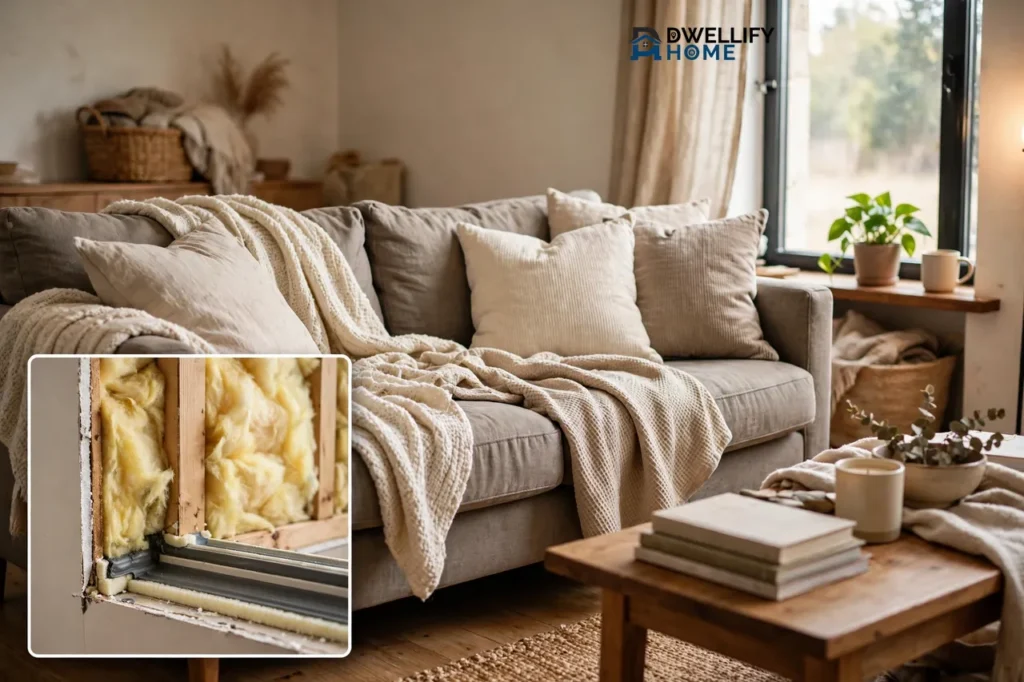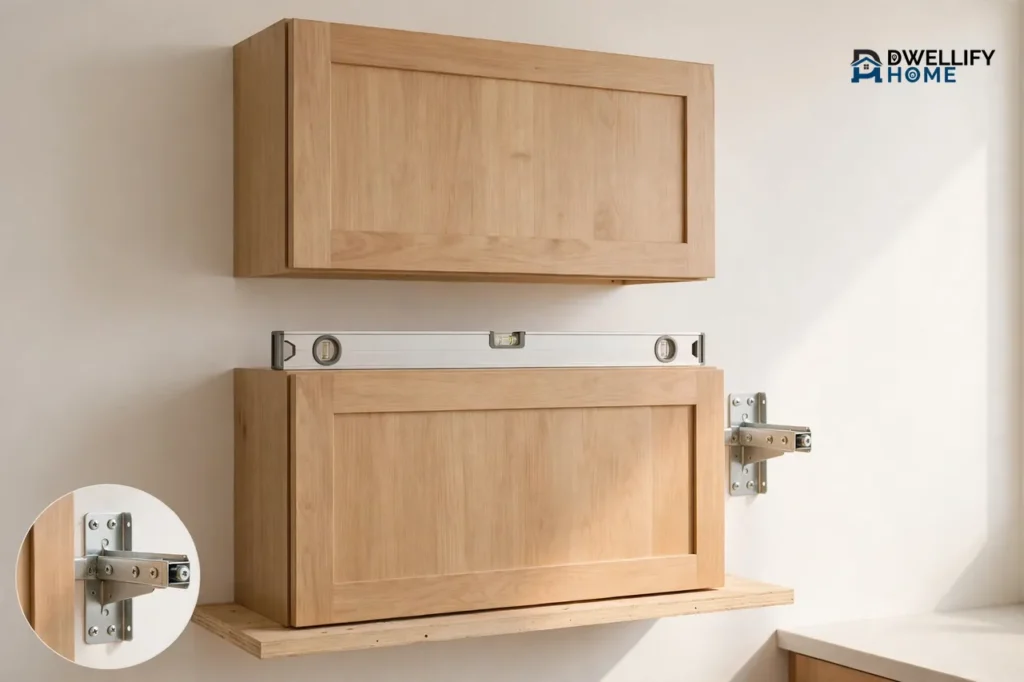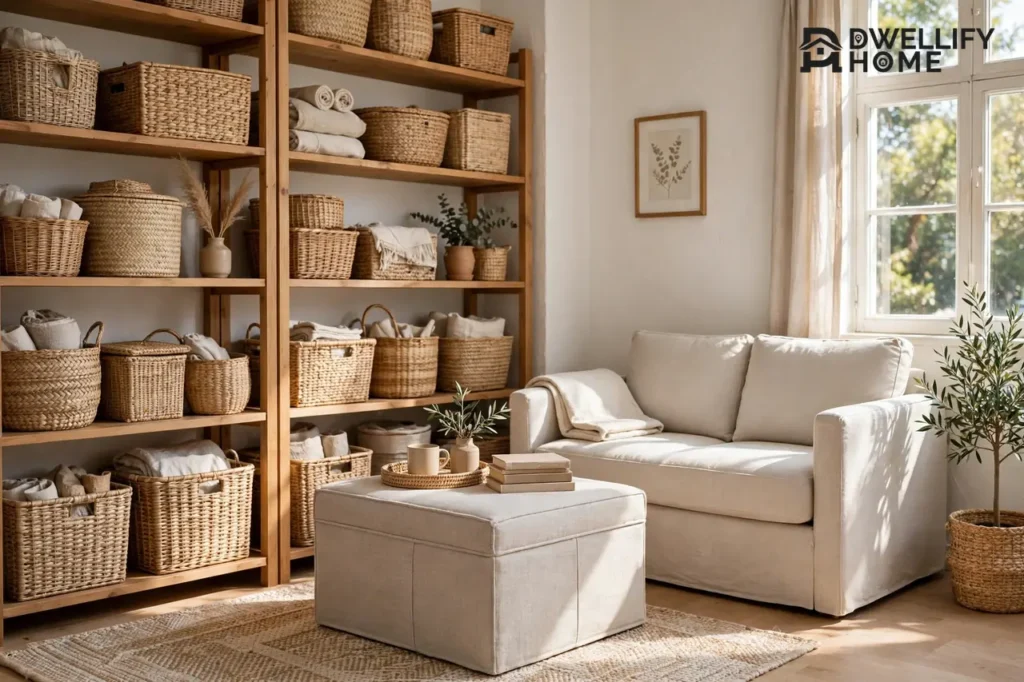
Small space storage ideas work when they follow one rule: sort first, then store only what you use, in the space you already have. The best ideas cost little or nothing — go vertical with tall shelves, use the back of every door, pick furniture that stores things too, and give every zone one basket. A small home can hold your whole life. It just needs storage that works with the room you have, not against it.
This guide covers every room — kitchen, bathroom, bedroom, laundry, garage, and the stairs — with ideas that fit rentals, small apartments, and tight houses alike. One buying mistake wastes more money than any other in small homes, and it is in the section on what most people get wrong, so keep reading.
The First Rule: Sort Before You Store
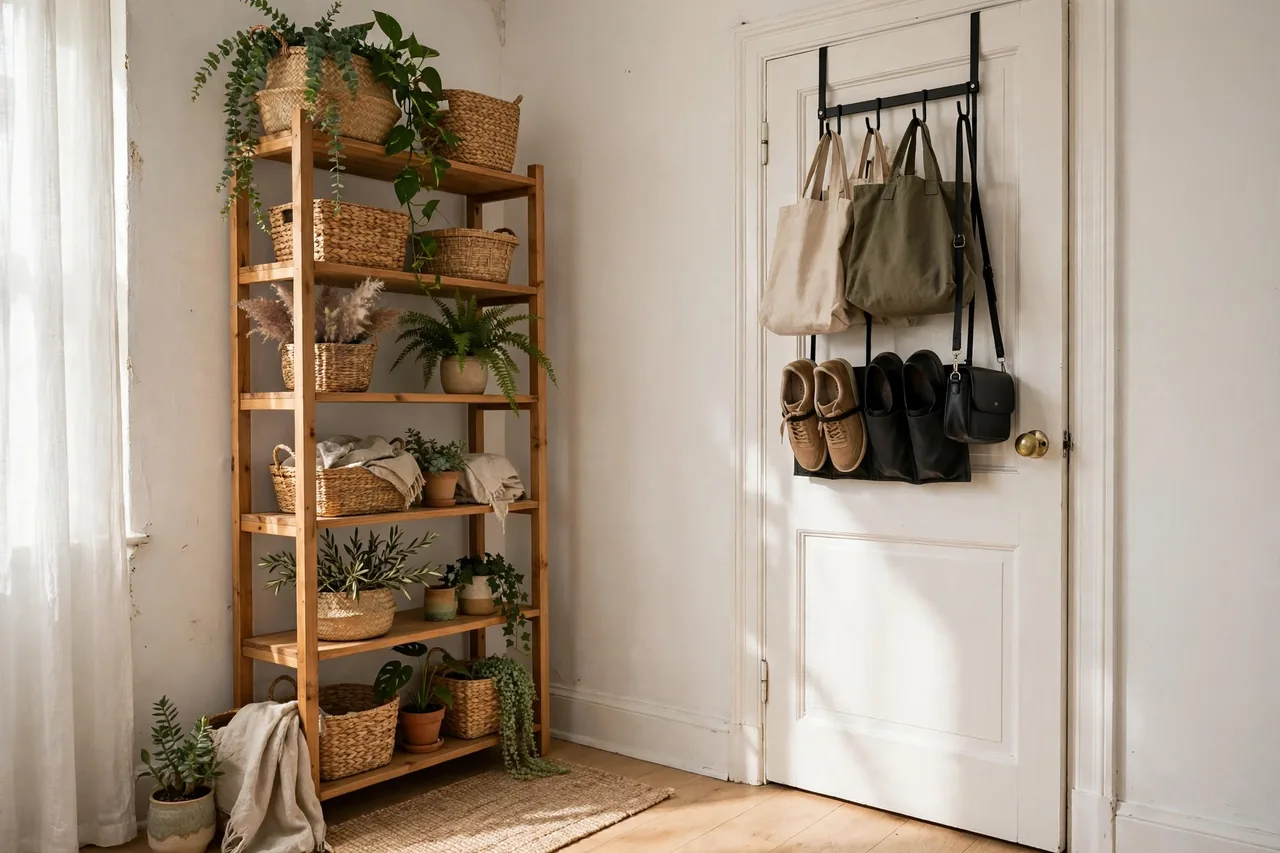
No storage idea can fix a home that holds too much. Before you buy a single shelf or basket, sort each room with the keep, donate, and toss method. If you do not have enough space for the items you own, the question probably is not about your storage — it is about your stuff. Our pillar guide on decluttering with a checklist walks through the sort, and it is the fastest storage upgrade you will ever make, because it costs nothing and creates space instantly.
Once you know what is staying, measure before you buy. Measure the shelf, the wall, and the items that must fit there. A basket that is two inches too wide for the shelf is not storage — it is clutter you paid for. Write the measurements on your phone before you shop, and buy only the piece that fits the numbers. Sort first, measure second, buy last.
Sort by how often you use things, not by what they are. Daily items live between waist and shoulder height, where you can reach them without a step stool. Weekly items go on higher or lower shelves. Seasonal and rarely used items go to the hardest-to-reach spots — the top of the closet, under the bed, or the back of the garage. When the most-used things are the easiest to reach, the house feels bigger overnight.
Go Vertical: Walls, Doors, and the Space Above Everything
When the floor is full, the walls take over. A tall shelf or a row of hooks turns empty wall space into storage for books, plants, and baskets, and it costs nothing in floor space. In a small home, the wall above a door, above a window, and above the toilet is all free real estate — use it before you buy anything that stands on the floor.
The back of a door is the most ignored storage in any home. An over-door rack holds shoes, cleaning supplies, or pantry jars, and it needs no screws at all. Hang one on the bedroom door for accessories and one on the kitchen door for wraps and bags. If you rent, over-door hooks lift off when you move and leave no mark behind. Every door in your home is a free shelf you have not used yet.
Stagger shelves instead of stacking identical boxes. Uniform, boxy shelving makes a small room feel cramped, while ladder-style pieces with narrower shelves toward the top feel airy and hold just as much. In narrow spots, a short shelf in a nook or a slim unit beside the fridge turns a dead gap into a home for spices, cans, or cleaning supplies.
Do not forget the ceiling zone in the garage and the laundry room. Overhead racks hold seasonal bins, suitcases, and camping gear that you touch twice a year, freeing the floor and the wall shelves for daily life. Keep a small step stool nearby so the high spots stay usable instead of becoming a place where things go to be forgotten.
Look above doors and windows too. A single shelf above a bedroom door holds books and spare bedding, and a shelf above a bathroom door holds towels and backstock. These spots are invisible from the floor, so they add storage without changing how the room looks — the best kind of storage in a small home, because it asks nothing of the space you live in.
Double-Duty Furniture: Every Piece Earns Its Floor Space
In a small home, every piece of furniture should do two jobs. An ottoman with storage inside holds throws and board games. A bench by the door holds shoes and bags. A bed with drawers underneath stores out-of-season clothes and spare bedding. A coffee table with a lift top becomes a desk. If a piece of furniture holds nothing, it costs floor space for nothing.
Start with the biggest pieces, because they hold the most. A storage bed is the single best storage purchase for a small bedroom: the space under the bed is the biggest hidden shelf in the apartment, and flat boxes or zip bags slide out of sight in seconds. Label each box on the short end, so you can find what you need without pulling them all out.
In the living room, choose a sofa with storage underneath or beside it, and a side table with a drawer instead of a bare top. In a studio apartment, a dresser can serve three purposes at once — clothes storage, TV stand, and room divider. And in the entryway, a bench with shoe storage underneath catches coats, shoes, and bags the moment you walk in, so they never reach the living room floor.
Put storage on wheels where you need it to move. A rolling cart fits between the fridge and the wall for pantry overflow, rolls beside the sofa for crafts or remotes, and tucks into a closet when guests come. A wheeled island in a small kitchen adds counter space and cabinet space in one piece — and it moves out of the way when you need the floor.
Use storage as a room divider in open plans. A tall open shelf between the living area and the sleeping area in a studio gives both sides privacy and storage at once, and it costs far less than a wall. Fill the lower shelves with baskets and the upper shelves with books and plants, and the divider looks like furniture instead of a barrier.
The Kitchen: Storage in Every Nook
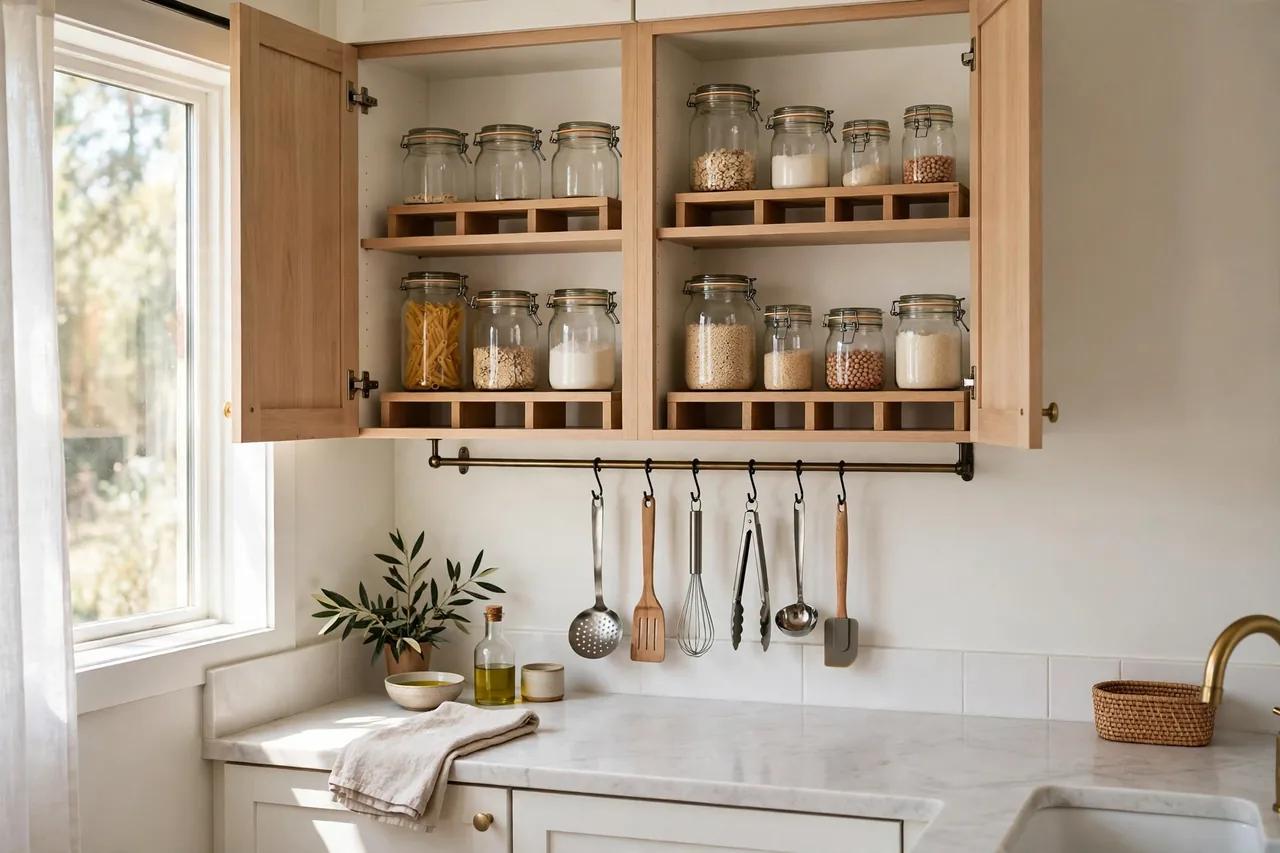
Small kitchens punish clutter more than any other room, because every inch of counter is a workspace. Clear the counters first: keep out only what you use daily — the coffee maker, the knife block, the cutting board — and move everything else into cabinets. A clear counter makes a small kitchen feel twice as big.
Use the inside of cabinet doors. Mount a narrow rack on the inside of a cabinet door for spices, measuring cups, or cleaning supplies, and the door becomes a shelf that hides itself when closed. Add shelf risers inside deep cabinets so plates and bowls stack in two layers instead of one tall, wobbly pile. Pull-out drawers in lower cabinets turn the dark back corners into space you can actually reach.
Hang what you use most. A peg rail above the worktop holds aprons, tea towels, and wire baskets for onions and garlic. A magnetic strip holds knives and metal utensils off the counter and out of a drawer. Hooks under the upper cabinets hold mugs, freeing a whole shelf for plates. Hang the daily tools, and the counters stay clear for cooking.
Small appliances need a parking rule. Keep out only the one or two you use daily — the coffee maker, the toaster — and store the rest in a deep cabinet or on a high shelf. An appliance garage, a cabinet with a roll-up or lift-up door, hides the blender and the food processor while keeping them one motion away. If an appliance has not been used in six months, it belongs in a donation box, not on your counter.
When the kitchen still feels tight, look at the walls with fresh eyes. Our guide to laundry room shelving shows shelf layouts that work just as well in a kitchen pantry, and the same thinking applies: narrow shelves, grouped items, and labels you can read from the doorway. If the room itself needs to feel larger, these paint color ideas for a small bathroom show how light colors open tight rooms — a trick that works in small kitchens too.
The Bathroom: Narrow Rooms, Smart Storage
Narrow bathrooms punish oversized furniture, so scale everything down. A slim open shelf unit, an over-toilet cabinet, and a narrow rolling cart between the toilet and the wall hold towels, toiletries, and cleaning supplies without crowding the room. Small spaces need small furniture — an oversized vanity in a tiny bathroom wastes the very space you need most.
Use the space above the toilet first. It is the most wasted spot in most bathrooms, and a cabinet or two shelves there hold spare toilet paper, towels, and medicines within reach. Keep daily items at eye level and backstock higher, and use baskets or bins so small items do not slide off open shelves.
Roll towels instead of folding them. Rolled towels take less shelf space, look tidy, and let you see at a glance how many clean towels are left. Keep one towel per person in use plus one spare, and store the rest where they dry fully between uses. Our full guide to narrow bathroom storage maps shelf, hook, and cabinet ideas for the tightest bathrooms, including rentals where you cannot drill.
Behind the door, an over-door rack with clear pockets holds hair tools, cleaning supplies, and first aid without a single screw. Inside the vanity, stackable bins separate hair care, skin care, and medicines so nothing gets lost at the back. And under the sink, a small tension rod creates a hanging spot for spray bottles, freeing the cabinet floor for bins. Our guide to organizing bathroom cupboards shows these layouts shelf by shelf.
Give medicines and first aid one clearly marked home, up high and out of reach of small children. A small lidded box on the top shelf holds bandages, pain relief, and prescriptions together, so nobody hunts through three drawers at midnight. Check expiry dates twice a year and take old medicines to a pharmacy take-back program instead of the trash or the sink.
The Bedroom and Closet: Hidden Storage That Works
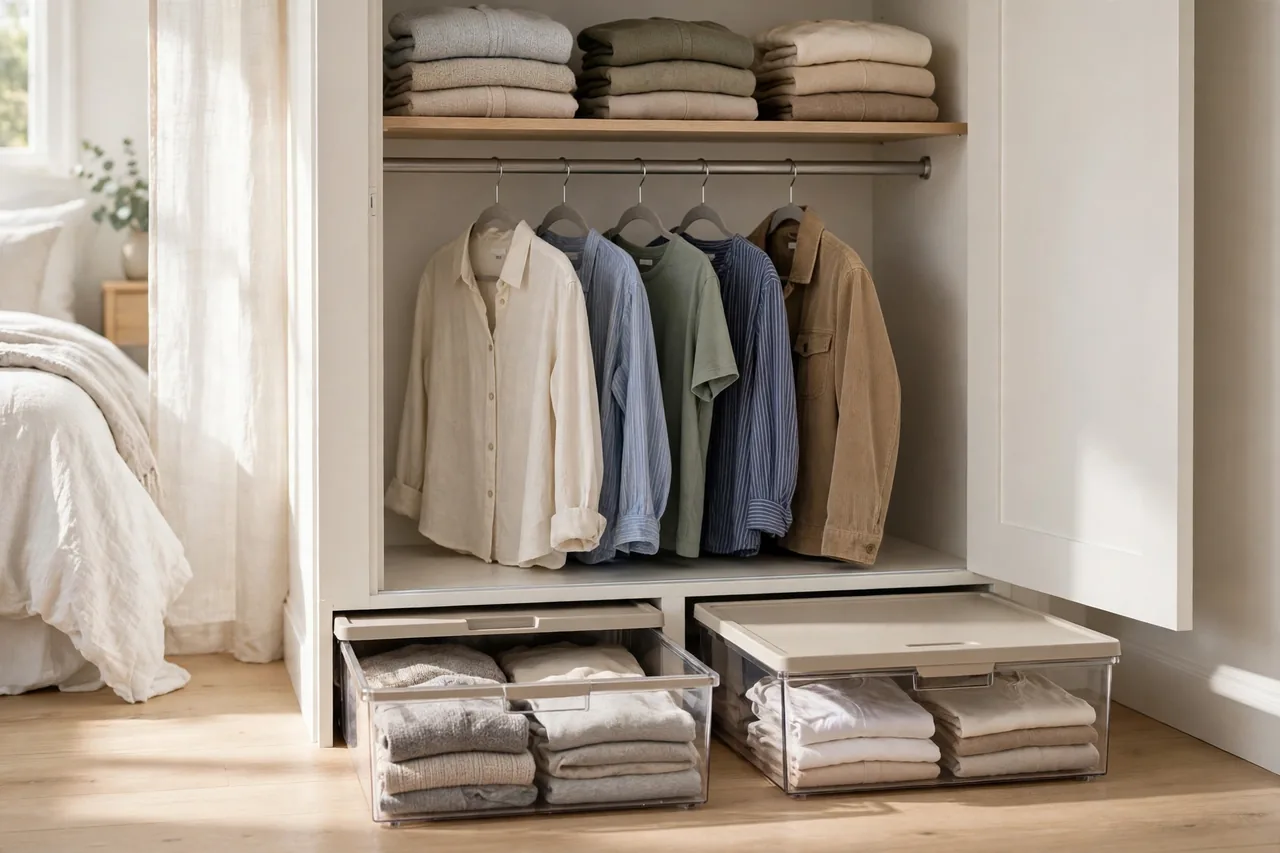
The bedroom hides more storage than any other room, because the bed and the closet are both bigger than they look. Under the bed, flat boxes hold out-of-season clothes, spare bedding, and shoes. In the closet, slim hangers save inches on the rod — enough for several extra garments — and a second hanging rod below the first doubles the hanging space for shirts and folded pants.
Use the closet door. Over-door hooks or a narrow rack on the inside of the closet door hold scarves, belts, bags, and jewelry without taking shelf space. On the closet floor, one low shelf or a pair of stackable bins holds shoes in pairs, so you stop losing one shoe to the dark corner behind the dresses.
Keep the nightstand minimal. A drawer holds charging cables and the book you are reading; the top holds a lamp and water only. A nightstand that holds everything becomes a junk drawer with a lamp on top, and the bedroom feels cluttered no matter how tidy the closet is.
When the closet still overflows, the answer is usually fewer clothes, not more storage. A capsule of 30 to 40 pieces per season fits most closets with room to spare, and our guide on decluttering clothes shows how to reach it without regret. If the floors show the effort, learn how to deep clean hardwood floors the right way — a damp microfiber mop and a hardwood-safe cleaner bring back the shine without harming the finish.
The Garage, Laundry Room, and Under the Stairs
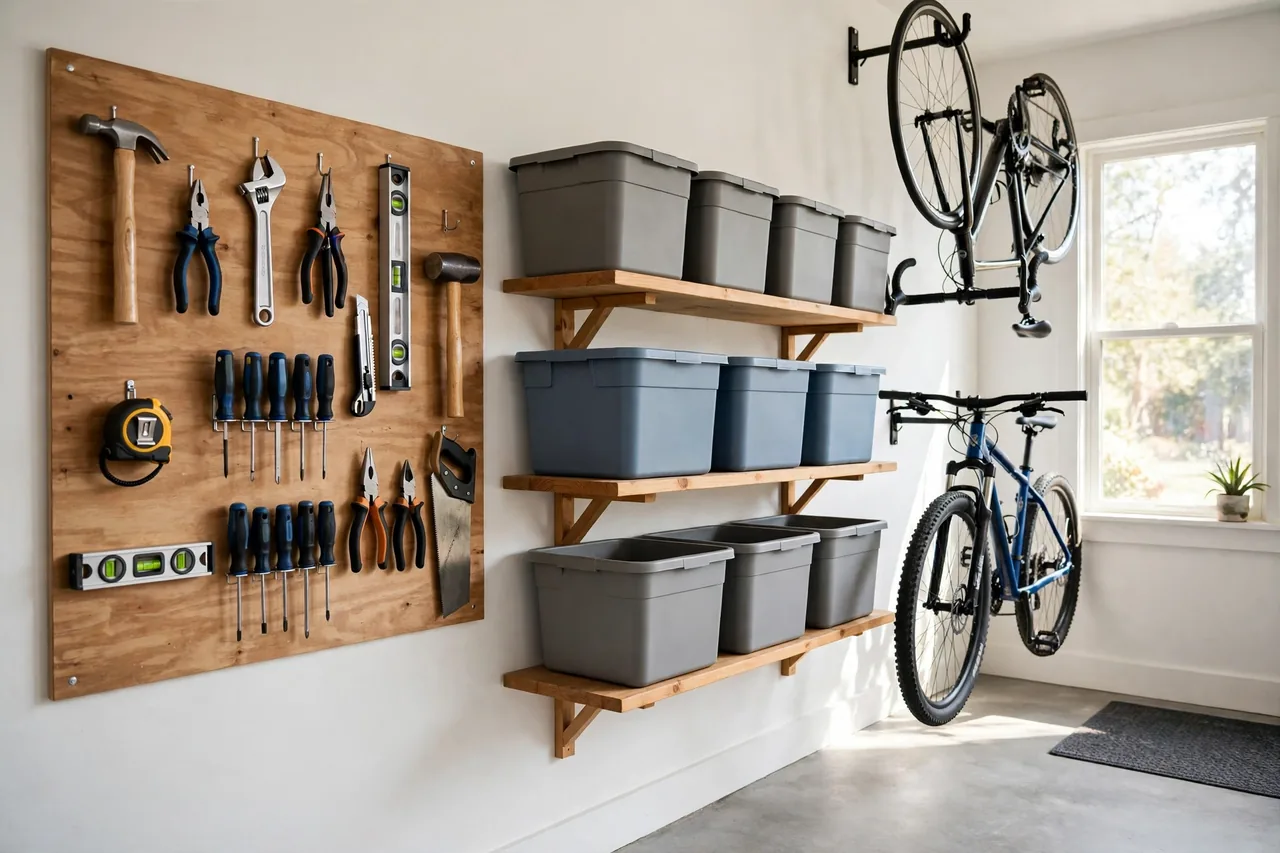
The garage is where small-space storage pays off biggest, because it is the room most homes waste. Start with the walls: pegboard holds tools where you can see them, and a row of hooks holds bikes, ladders, and garden tools off the floor. Our guide to cheap garage organization ideas shows how to do this on a small budget with secondhand shelves and dollar-store bins.
In the laundry room, shelves above the washer and dryer hold detergent, stain remover, and cleaning supplies at arm’s reach, and a folding shelf over the machines turns a dead surface into a workspace. A drying rack that folds flat against the wall saves floor space on the days you do not need it. Our guide to laundry organization ideas covers sorting, folding, and supply storage for tight laundry corners and closets alike.
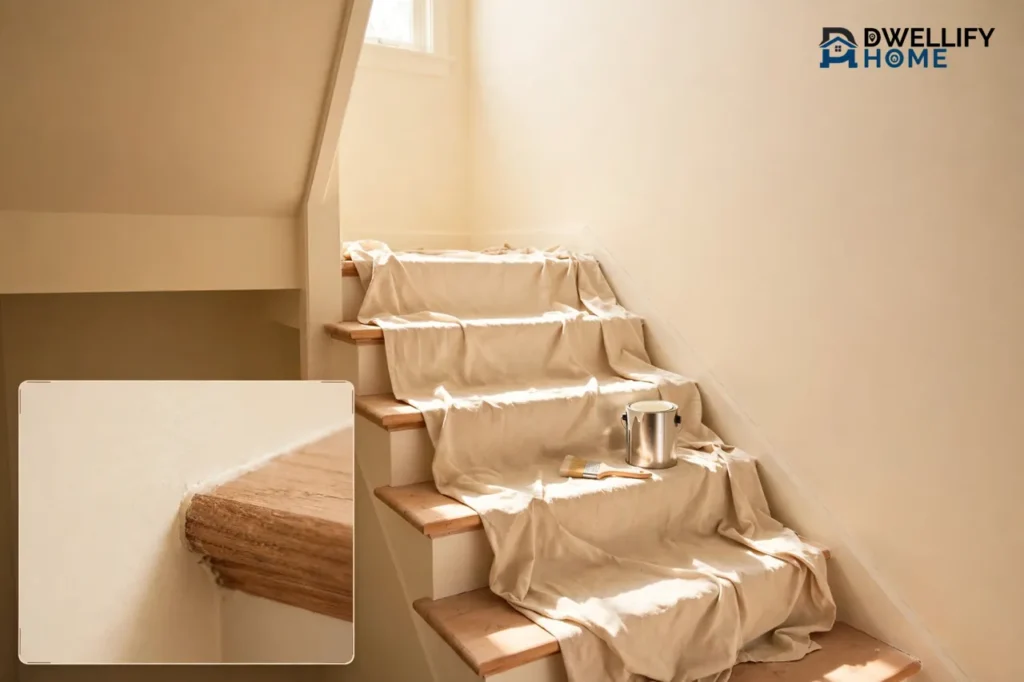
Under the stairs is the most underused storage in a two-story home. Pull-out drawers under the lowest steps hold shoes and cleaning supplies. The taller end fits a bookshelf, a coat closet, or a small desk. Our guide to under stairs storage ideas shows drawer, shelf, and closet builds for every stair shape, including rentals that need no construction at all.
Keep seasonal and rarely used items in labeled bins on high shelves or overhead racks, and keep daily items low and visible. When every bin has a label you can read from the floor, you stop opening five boxes to find the holiday lights. Label every box, and the garage stops being a mystery.
Storage for Kids’ Rooms and Shared Spaces
Kids’ rooms need storage a child can actually use, or the room will never stay tidy no matter how many bins you buy. Keep everything low, open, and labeled with pictures for younger kids who cannot read yet. One bin per toy type — blocks, dolls, cars, art supplies — and a simple rule: one toy out, one toy back. A room a child can tidy alone stays tidy far longer than a room only adults can fix.
Rotate toys instead of displaying them all. Keep half the toys in a labeled bin in a closet and swap them every month. The “new” toys feel exciting again, the room holds half as much, and cleanup takes minutes instead of an hour. Our guide on playroom organization shows bin systems, toy rotation, and a cleanup routine kids will follow, while our guide on how to help kids stay organized covers age-by-age routines from toy bins to homework stations.
Shared spaces need shared rules. In the living room, one basket per person holds their things — a book, a charger, a craft project — and the basket empties every night. In a shared bedroom, each person gets one shelf and one drawer that is theirs alone, and the rest of the room follows the same system for everyone. One basket per person keeps shared rooms from becoming nobody’s job. When everyone has a place for their own things, the shared spaces take care of themselves.
Books and Collections: Storage That Looks Good
Books need storage that shows them off without swallowing the room. A bookshelf organized by size or color looks tidy and holds more than a shelf of randomly stacked books. Leave breathing room on each shelf — a shelf packed edge to edge looks cluttered, while one with a small plant or a framed photo between book groups looks designed. Our guide on how to organize a bookshelf shows grouping, spacing, and styling that work in small rooms.
When the bookshelf is full, books move to the second tier: a basket by the sofa for current reads, a stack on the nightstand, and a box under the bed for the ones you keep but rarely open. Our guide to book storage ideas goes beyond the bookshelf with window seats, stair shelves, and hidden storage for big collections in small homes.
Collections of any kind — vinyl, craft supplies, kids’ art — follow the same rule: one home per collection, with a hard limit. A collection with no limit is clutter with a hobby attached. Pick the shelf, the bin, or the wall, and when it fills up, something leaves before anything new arrives. The smartest storage idea in our whole family, smart storage ideas for making the most of every room in your home, shows how to give every room its own storage job so collections never spill into the living space.
What Most People Get Wrong About Small Space Storage
The biggest mistake is buying storage before sorting. New boxes cannot fix a room full of things you never use. Sort first, keep only what you use, then buy the box that fits what is left. Buying storage before sorting wastes more money than any other mistake in a small home.
The second mistake is buying matching sets. A matching set of bins looks perfect in the store and wrong in your home, because your shelves are not all the same size. Buy one bin, test it on the shelf, and only then buy the rest. Mixed bins that fit beat matching bins that do not.
The third mistake is filling every inch. A shelf packed to the edge looks cluttered and makes it hard to take anything out or put anything back. Leave breathing room on each shelf — about a hand’s width of empty space — and the room feels calmer and the storage works better. Empty space is not wasted space. It is the space that lets you use the rest.
The fourth mistake is hiding storage behind closed doors when open storage would work better. Daily items belong where you can see and reach them. If you must open two doors and move three things to reach the coffee, the system is wrong. Put daily items in open baskets and easy hooks, and reserve closed cabinets for backstock and rarely used things.
A 7-Day Plan to Add Storage Without Buying Everything at Once
Add storage one day at a time, so the cost stays small and each idea gets tested before the next one arrives. Start with the free ideas — sorting, door racks you already own, and moving things to better spots — and buy only what the week proves you need.
| Day | Job | Cost |
|---|---|---|
| 1 | Sort one room: keep, donate, toss | Free |
| 2 | Go vertical: hang hooks and use door backs | Under $20 |
| 3 | Kitchen: door racks, shelf risers, hang daily tools | Under $30 |
| 4 | Bathroom: over-toilet shelf, roll towels, bin the vanity | Under $30 |
| 5 | Bedroom: under-bed boxes, slim hangers, closet door rack | Under $40 |
| 6 | Laundry and stairs: shelves, labels, pull-out bins | Under $40 |
| 7 | Walk-through: label everything, remove what did not work | Free |
On day seven, walk the house with fresh eyes and remove anything that did not earn its place. A storage idea that nobody uses is not storage — it is decoration. Keep what works, return what does not, and enjoy the space you just found. If something still has nowhere to go, it may not belong in the house at all — and that is a sorting decision, not a storage problem. Our home organization hub ties these room systems together when you are ready to organize what you kept.
Related Guides
Go deeper with the guides in this family: laundry room shelving, cheap garage organization ideas, how to organize a bookshelf, under stairs storage ideas, book storage ideas, laundry organization ideas, smart storage ideas for making the most of every room in your home, and narrow bathroom storage. Start the whole job with our home organization hub.
Frequently Asked Questions
How do you add storage to a small apartment without drilling?
Use a tall freestanding shelf, over-door racks, and baskets. Freestanding shelves lean on the wall, over-door hooks lift off when you move, and baskets need no hardware at all. Tension rods and adhesive hooks add more spots without a single hole.
What is the best storage for a studio apartment?
Start with the space under the bed and one tall shelf, then add a basket for each zone. Under-bed boxes hold out-of-season clothes, and a tall shelf holds books, plants, and baskets without eating floor space.
How do you keep storage from looking cluttered?
Keep the baskets in one material, label every box, and leave breathing room on each shelf. Matching materials calm the eye, labels stop the hunting, and empty space lets each shelf breathe instead of shouting.
Where should you start when an apartment feels full?
Start by sorting one room and removing what you do not use, then add storage only for what is left. A small apartment feels full because of excess things more often than a lack of shelves, so the sort comes before the shopping.
A small home is not a problem to solve. It is a space to use well — one wall, one door, one basket at a time. Start with the sort today, add one idea tomorrow, and by next week your home will hold everything you own without feeling full. The best storage is not the most expensive — it is the piece that fits your space, holds what you use, and stays out of your way. Your small home is ready.