
We decorate a tree at Christmas because an evergreen, brought indoors and dressed with light, carries a hope people have felt for centuries: life does not end in winter. The tree stays green when almost everything else outside looks bare, so it became a natural symbol of enduring life, of light in darkness, and, for Christians, of the birth of Jesus and the promise of eternal life. That is the heart of the answer, and the rest of the story explains how a German household custom grew into a tradition shared around the world.
If you ask why do we decorate a tree for christmas, you are really asking two questions at once. Why a tree at all, and why do we decorate christmas trees for christmas with lights, ornaments, and a star or angel on top? The first answer is older than Christmas itself. The second took shape in Germany in the 1500s and 1600s, then spread through royal fashion, migration, and, later, mass-produced ornaments and electric lights.
Why an Evergreen? Life in the Darkest Weeks
Winter is the hardest season to love. Days shrink, gardens die back, and cold settles in for months. An evergreen refuses to join in. Fir, spruce, and pine trees keep their color while other trees stand bare, so people long treated them as proof that life holds on through the dark.
That simple observation explains most of the tradition. A cut branch or a whole tree, carried into a warm room, turned an abstract hope into something a family could see and touch. It said, in green, that spring would return and that the darkest days would pass. Later meanings layered on top of that feeling, but they never replaced it.
The shape of the tree mattered too. Some Christians read the fir’s triangular outline as a reminder of the Holy Trinity: Father, Son, and Holy Spirit. Others simply saw a tree that points upward, toward heaven. You do not need to accept either reading to understand the custom, but both help explain why this particular tree, and not another plant, became the centerpiece.

Before Christmas Trees: Winter Greenery in the Ancient World
Long before anyone put a whole tree in a parlor, people decorated their homes with evergreen branches in winter. The practice was widespread across Europe, and it served different purposes in different places: protection, celebration, and a stubborn refusal to let winter win.
Romans and Saturnalia
In ancient Rome, the mid-December festival of Saturnalia honored Saturn, the god of agriculture. Romans decorated their homes and temples with evergreen boughs during the festival, which fell close to the winter solstice, the shortest day of the year. The greenery marked a turning point: the days would soon grow longer again, and the return of spring could be trusted even when it could not yet be seen.
Northern Peoples and the Winter Solstice
Farther north, Germanic and Celtic peoples also valued evergreens in winter. Some believed the plants carried protective power and could ward off evil spirits during the long, dark nights. Others treated them as signs of fertility and renewal. Historians disagree about the details of these early customs, and the evidence is thin, so beware of any account that tells you exactly what one ancient tribe believed. What the sources do support is the broader point: evergreen plants already carried winter meaning long before Christmas trees existed.
That older layer matters because it corrects a common mistake. The Christmas tree did not appear out of nowhere, and it did not come from a single inventor. It grew out of a much older habit of bringing green life indoors at the darkest time of the year, then took on a new, specifically Christmas meaning in Christian Europe.
The Paradise Tree: How a Church Play Became a Household Custom
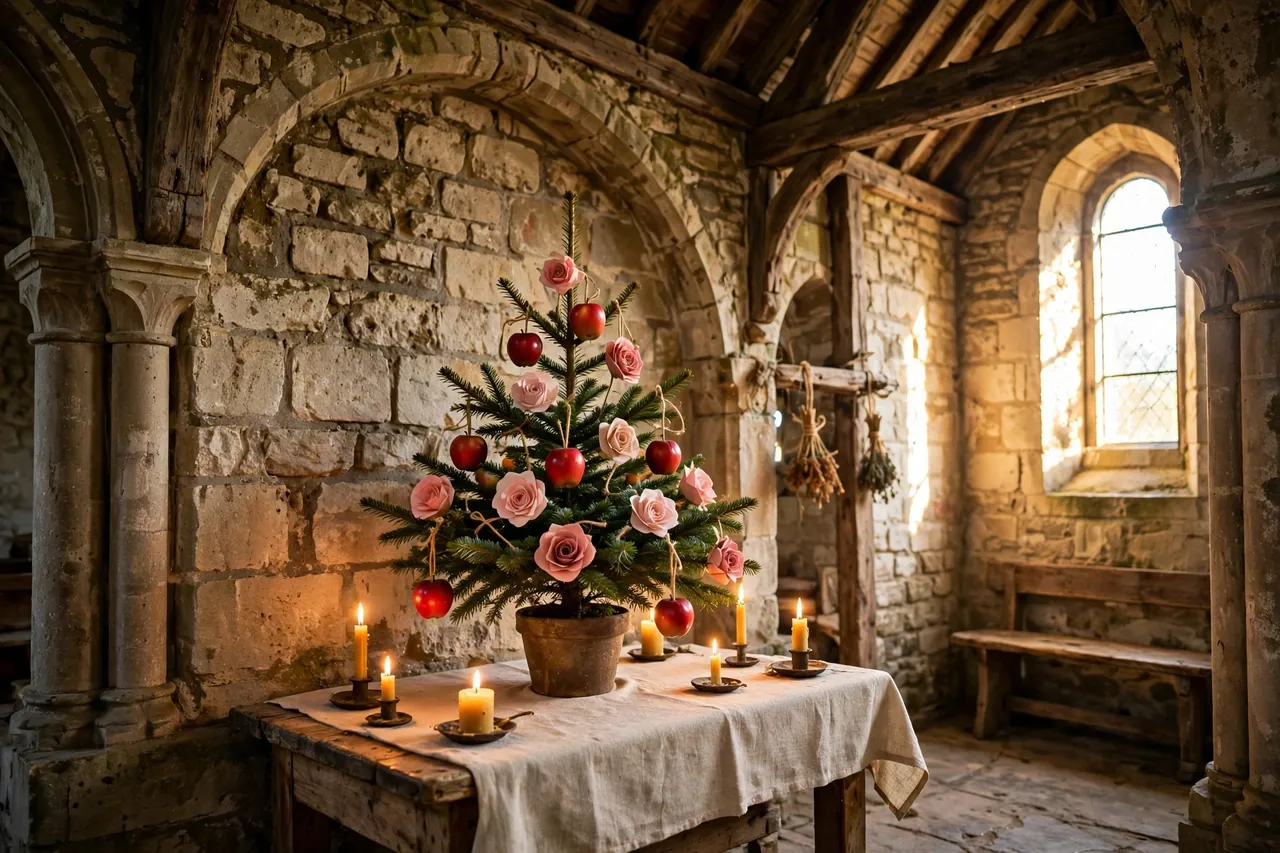
The most direct ancestor of the Christmas tree was the “paradise tree” of medieval Christian plays. Churches staged plays about the Garden of Eden, and because the plays needed a tree that stayed green in December, they used a fir. The tree carried apples, which stood for the forbidden fruit and the story of Adam and Eve.
These plays were performed around December 24, the feast day of Adam and Eve in some local customs. The plays helped teach Bible stories to audiences, many of whom could not read, and the apple-hung fir gave them a vivid image to remember. Over time, the paradise tree moved out of the church and into the home. Families in German-speaking lands began setting up small firs of their own, decorated with apples, wafers, and paper roses.
This step is easy to miss, and it is the key to the whole story. The Christmas tree did not start as a decoration looking for a meaning. It started as a teaching aid with a meaning already built in: the tree of Eden, and the promise, in Christian belief, that the fall of humanity would be answered by a savior. The apples on the earliest trees were not random ornaments. They told a story.
Germany in the 1500s and 1600s: The First Decorated Christmas Trees
By the 1500s, decorated evergreen trees had become a recognizable custom in German towns. Guilds set up trees in their halls, and households brought small firs indoors at Christmas. The decorations were simple and often edible: apples, nuts, wafers, paper flowers, and sweets. A tree like this was a feast for the eyes and, sometimes, quite literally for the children.
The best-known early description comes from Strasbourg in 1605. A visitor recorded that people there set up fir trees in their parlors at Christmas and hung them with paper roses, apples, wafers, gold foil, and sweets. Britannica notes that fir trees decorated with apples were first known in Strasbourg in 1605, and that the first recorded use of candles on such trees came from a Silesian duchess in 1611. Those two dates anchor the tradition in real records rather than legend.
Candles changed the tree completely. A candlelit fir in a dark winter room glowed in a way no unlit tree could, and Christians soon read the flames as a symbol of Christ as the light of the world. The beauty came with a real danger, though. Open flames on dry branches started fires that burned homes, schools, and even hospitals, and around 1900 some insurance companies began refusing to pay for Christmas tree fires. That frightening history is one reason the modern tree, and the separate question of Christmas tree safety, still belong together in any honest account of the tradition.
The Martin Luther Story: Beautiful Legend, Shaky Evidence
Ask many people who started the Christmas tree, and they will name Martin Luther. The story is lovely: walking home on a winter night, Luther saw stars shining through the branches of fir trees, cut one down, brought it inside, and fixed candles to its branches so his family could see the starlight the way he had. It is one of the most retold tales in Christmas history.
Historians, however, treat it as legend rather than proven fact. No contemporary document shows Luther decorating a tree, and the first clear evidence of lighted trees appears more than a century after his death in 1546. Luther may well have loved evergreens, and the story captures something true about why candles on a tree moved people. But the honest answer is that no single person invented the Christmas tree, and crediting Luther alone hides the slower, shared work of German families, guilds, and churches over generations.
The same caution applies to an even older tale, the story of Saint Boniface cutting down a sacred oak in eighth-century Germany and pointing to a fir as a Christian symbol. It is a powerful story, and it may preserve a real memory of missionaries challenging older tree worship. Yet historians cannot confirm its details, and it should be told as tradition, not as a dated fact. The Christmas tree’s real history is interesting enough without dressing legends up as records.
How the Custom Spread Across Europe and to America
For a long time, the Christmas tree stayed a mainly German custom, and even within Germany it spread slowly. Catholic regions in the south adopted it later than Protestant regions in the north, where some people viewed it as a Protestant habit. Then, in the 1800s, royal families, migration, and print carried it across the world.
Britain: Victoria, Albert, and One Famous Picture
Prince Albert, Queen Victoria’s German-born husband, grew up with the Christmas tree tradition, and Victoria herself remembered trees from her own childhood. But the moment that made the tree fashionable in Britain was a picture, not a palace decree. In 1848, the Illustrated London News published an engraving of Victoria, Albert, and their children gathered around a candlelit tree at Windsor. The University of Queensland’s history of the tradition records that Albert set up a tree at Windsor in 1840 and that the 1848 engraving made the custom popular among the British people.
Within a decade, the decorated tree had moved from a royal novelty into middle-class British parlors. One correction matters here: Albert popularized the tree in Britain, but he did not introduce it. Queen Charlotte, the German wife of George III, had put up a tree at Windsor as early as 1800. Royal fashion amplified the custom; it did not invent it.
America: German Immigrants First, Then Everyone
German immigrants carried the tradition to America, especially to Pennsylvania, where Moravian settlers had a decorated tree as early as 1747. For decades it remained a German-American custom, and some other Americans even distrusted it as foreign or old-fashioned. The turning point came when the 1848 royal picture crossed the Atlantic: Godey’s Lady’s Book, America’s most popular women’s magazine, published its own version in 1850, with the royal crowns and Albert’s mustache edited out to make the scene look like an ordinary American family.
By the 1870s, Christmas trees had become widespread in the United States. German glass ornaments arrived in larger numbers, department stores embraced the season, and the tree became the place where family gifts gathered. American enthusiasm then fed back into the tradition worldwide, through trade, films, and popular culture.
The Rest of the World
From Britain and America, the tree spread through trade routes, missionary work, colonial ties, and migration. German princesses marrying into royal houses across Europe carried the custom with them, and each country adapted it. Some places kept the German habit of setting the tree up on Christmas Eve itself. Others made the decorating a weeks-long family event. In many countries today, the tree stands beside older local customs rather than replacing them, which is why Christmas looks both familiar and different from one country to the next.
What Each Part of the Tree Came to Mean
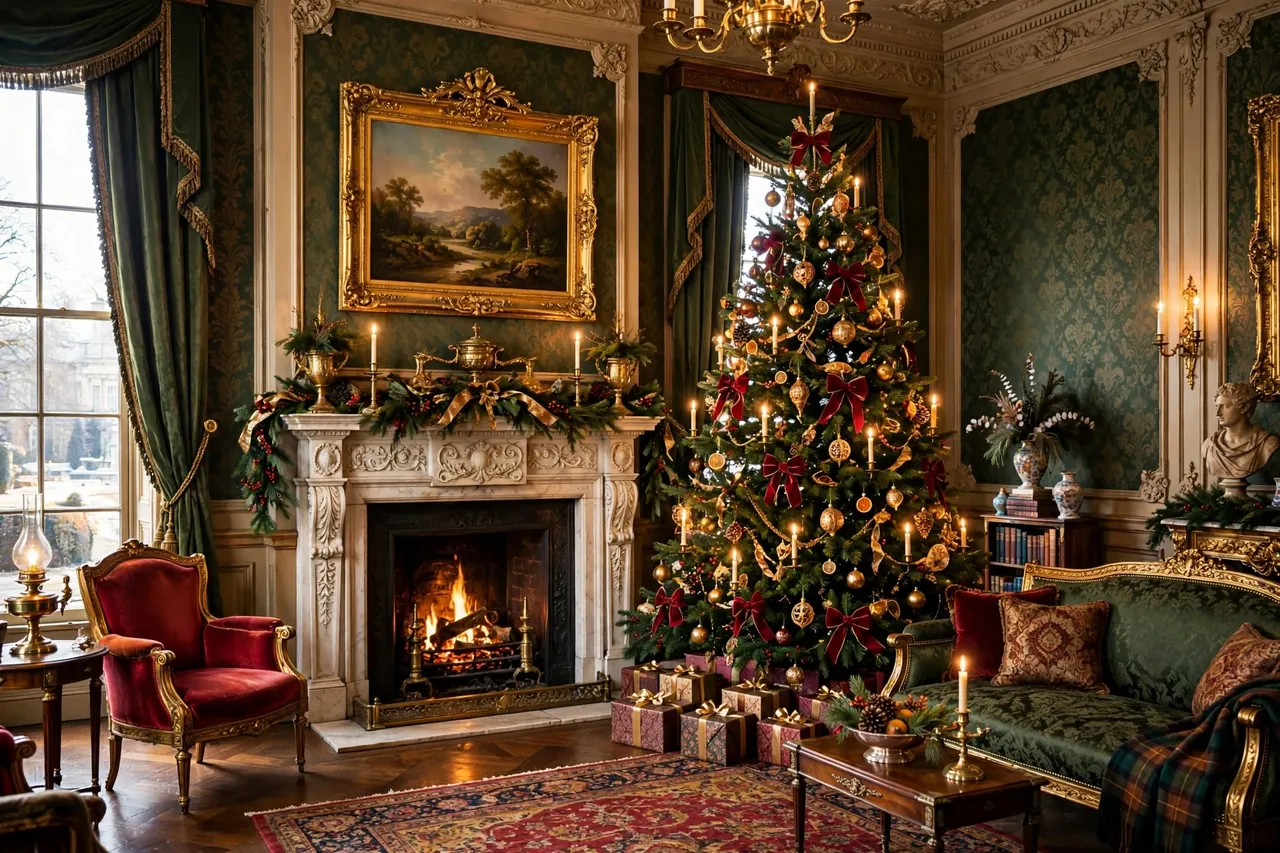
Every familiar part of a decorated tree carries a meaning, and most of those meanings grew up gradually rather than arriving all at once. Knowing them turns a pretty object into a story you can read from bottom to top.
- The evergreen itself: life that endures through winter, and, in Christian belief, eternal life. This is the oldest meaning of all, older than the Christmas tree itself.
- Lights: first candles, then electric bulbs. They stand for light in darkness and, for Christians, Christ as the light of the world. They also recall the older winter-solstice hope that longer days would return.
- Apples and round ornaments: the earliest ornaments were apples from the paradise tree, standing for Eden. Glass balls, which reached Britain and America in the 1880s, kept the round shape long after the Eden story faded from most living rooms.
- The star on top: the Star of Bethlehem, which, in the nativity story, guided the wise men to the birthplace of Jesus. It crowns the tree because it points beyond the tree, toward the event Christians celebrate.
- The angel on top: the angels of the nativity story, especially Gabriel’s announcement to Mary. Families who choose an angel often do so for this reason, while others choose a star. Neither choice is more “correct” than the other.
- Gifts underneath: generosity and the giving at the heart of the Christmas story. The tree became a gathering place for gifts because children once found sweets and small treats on its branches, and the custom grew from there.
Not every family reads these meanings the same way, and that is part of the tradition’s strength. For some households the tree is a religious symbol. For others it is a family ritual, a marker of the season, or simply a beautiful centerpiece. The tree holds all of those meanings at once, which is one reason it survived when other customs faded.
Candles, Glass, and Electric Light: The Tree Changes With Its Times
The decorations on the tree tell the story of the centuries that produced them. Early trees carried things a household could make or eat: apples, nuts, cookies, paper roses, and wafers. Silver tinsel, first made from real silver in Germany, showed wealth as plainly as jewelry did. Then glass ornaments, made in Germany and exported in the late 1800s, turned the tree into something a shop could sell, and the tree became a product as well as a ritual.
Electric light was the biggest change of all. In 1882, Edward Johnson, an associate of Thomas Edison, lit a tree with hand-wired electric bulbs in his home. Findmypast’s history of the royal Christmas tree notes the same 1882 milestone. At first, electric lights were a luxury far beyond most families, and candles remained common for decades. Over time, safer and cheaper lights won, and the glow that once depended on open flame became something any household could enjoy. Modern LED Christmas decor is the latest chapter in that same long story: the light stays, while the fire risk falls away.
Artificial trees belong to the same story. Feather trees made in Germany in the late 1800s answered a practical problem: real firs were scarce in some places and messy in warm rooms. Later plastics and, eventually, pre-lit trees made the custom easier to keep in apartments, offices, and climates where a fresh fir was hard to find. Each change kept the symbol while changing its materials, which is why the tradition still feels both old and current.

Why We Still Decorate a Tree Today
So why does the custom survive in an age of electric light, central heating, and online shopping? Part of the answer is memory. For many adults, the tree is the smell of pine, the box of ornaments collected over years, and the evening when the family gathers to bring it to life. Traditions that carry personal memories are hard to give up, and the tree is unusually good at holding them: each ornament can mark a year, a trip, a child, or a person who is no longer there.
Another part is togetherness. The tree gives a household a shared project and a shared center. People gather around it to open gifts, sing, talk, or simply sit in its glow. In a season that can feel rushed and commercial, the tree slows one corner of the home down and makes it beautiful on purpose.
The tree also works because it is flexible. A family can keep it deeply religious, entirely secular, or somewhere in between, and the tree still does its job. It can be a fir cut from a farm, a potted tree that returns to the garden, or an artificial tree reused for decades. Its meaning bends without breaking, which is exactly what a tradition needs to last for centuries.
Finally, the tree connects the present to the past. When you stand before a decorated tree, you stand in a line that runs back through Victorian parlors, German guild halls, medieval church plays, and winter firesides far older than Christmas itself. That sense of belonging to something larger than one household is, for many people, the real reason the tree still matters.
The Spread of the Christmas Tree: A Quick Timeline
The table below gathers the tradition’s key turning points in one place. Dates before the 1600s describe customs and plays that fed into the Christmas tree, while later dates mark the decorated tree itself.
| Period | What Happened | Why It Matters |
|---|---|---|
| Ancient winter festivals | Romans, Celts, and Germanic peoples used evergreen boughs in winter celebrations | Evergreens already meant life and renewal in the darkest weeks |
| Middle Ages | Church plays featured a fir “paradise tree” hung with apples for the Garden of Eden | The tree gained a story: Eden, and the promise of redemption |
| 1500s Germany | Households and guilds brought decorated firs indoors at Christmas | The household Christmas tree took shape |
| 1605, Strasbourg | A visitor recorded firs decorated with paper roses, apples, wafers, and sweets | The earliest detailed description of the decorated tree |
| 1611 | A Silesian duchess recorded the first use of candles on such trees | Light joined the tree, with beauty and fire risk together |
| 1800, Windsor | Queen Charlotte set up a tree for a children’s party | The first known whole Christmas tree in England |
| 1848, London | The Illustrated London News pictured Victoria and Albert around a tree | The image made the tree fashionable across Britain |
| 1850, America | Godey’s Lady’s Book republished the royal picture for US readers | The tree spread from German-American homes to the wider US |
| 1880s | Glass ornaments reached Britain and America; electric lights appeared in 1882 | The tree became a mass-market, safer-lit centerpiece |
| Today | Trees stand in homes, squares, and public places worldwide | An old symbol now carries family, faith, and seasonal meanings at once |
Common Myths About the Christmas Tree, Cleared Up
The Christmas tree attracts confident claims, and several of the most popular ones are wrong. Clearing them up makes the real story stronger, not weaker.
- Myth: Martin Luther invented the Christmas tree. The candle story is a beloved legend, but no record from Luther’s lifetime proves it. The custom grew from German households and church plays over generations.
- Myth: Prince Albert introduced the tree to England. He popularized it, especially through the 1848 picture, but Queen Charlotte had already set up a tree in 1800, and Victoria remembered trees from her childhood.
- Myth: The Christmas tree is purely pagan, or purely Christian. Neither claim fits. Its roots include pre-Christian winter greenery, but the decorated indoor tree itself took shape in Christian Germany, and it has carried both religious and secular meanings ever since.
- Myth: The tradition is ancient and unchanged. The decorated Christmas tree is surprisingly recent. Before about 1830, it was still a mainly German custom, and most of what we now picture, glass ornaments, electric lights, and trees in public squares, arrived in the last 150 years.
- Myth: Every decoration has one fixed meaning. Meanings shifted over time. Apples began as Eden’s fruit and became glass balls; candles became electric lights. A symbol can keep its shape while its story changes.
Related Guides
If this history has you looking at your own tree with fresh eyes, these Dwellify Home guides continue the story in the present day: types of Christmas decorations for the wider world of festive decor, homes decorated for Christmas for seasonal inspiration, and Christmas tree with bows only for one simple, elegant styling idea.
Two more Day 7 companions sit close to this article’s themes. Outdoor Christmas greenery continues the evergreen story outside the front door, while Christmas tree safety carries forward the candle-fire lesson that shaped how we light trees today.
Frequently Asked Questions
Why do we decorate a tree at Christmas?
We decorate a tree at Christmas because the evergreen symbolizes life that endures through winter, and Christians also read it as a sign of eternal life and the birth of Jesus. The custom grew from older winter greenery, took shape as a decorated household tree in Germany, and spread worldwide in the 1800s.
Where did the Christmas tree tradition come from?
The decorated Christmas tree came from Germany, growing out of medieval paradise trees used in church plays about the Garden of Eden. The earliest detailed description dates to Strasbourg in 1605, when firs were hung with paper roses, apples, wafers, and sweets.
Why do we put a star on top of the Christmas tree?
The star represents the Star of Bethlehem, which, in the nativity story, guided the wise men to the birthplace of Jesus. An angel topper carries a related meaning, recalling the angels who announced Jesus’ birth. Families choose either symbol, and both point beyond the tree itself.
Did Martin Luther really invent the Christmas tree?
Probably not. The story of Luther adding candles to a fir after seeing starlight through branches is a cherished legend, but historians have found no record from his lifetime to prove it. The tradition grew gradually from German households, guilds, and church plays instead of from one inventor.
When did Christmas trees become popular in America?
German immigrants brought trees to America, especially Pennsylvania, in the 1700s, but the custom spread widely only in the mid-1800s. The 1850 republication of the British royal family’s tree picture in Godey’s Lady’s Book helped, and by the 1870s trees were common across the United States.
Why do we use an evergreen instead of another tree?
Evergreens stay green through winter while other trees lose their leaves, so they naturally stood for life, hope, and renewal in the darkest weeks. That simple, visible fact made fir, spruce, and pine the obvious choice long before any deeper symbolism was added.
A Tradition Worth Keeping on Purpose
The next time you see a decorated tree, look past the lights for a moment. You are looking at a very old human habit, bringing green life indoors when the world outside looks dead, joined to a German household custom, a royal photograph, and two centuries of migration and invention. We decorate a tree at Christmas because it still says, better than almost anything else in the house, that light returns, life endures, and the darkest season does not get the last word.