You turn on the shower, wait, and the water stays cold. A hot water heater that is not working usually comes down to a short list of simple causes: a tripped breaker, a pilot light that went out, a thermostat set too low, a tripped reset button, sediment in the tank, or a part that has worn out. Most of the time, you can find the problem with a few safe, free checks that take less than 30 minutes. This guide walks you through them in order, from the easiest fix to the ones that need a licensed plumber.
Before you touch anything, know this one rule. If you smell gas, see a growing pool of water around the tank, or hear sparking or buzzing from the unit, stop and call a professional. Gas and 240-volt electricity can hurt you fast, and a leaking tank will not fix itself. Everything else in this guide starts with the safest, cheapest check first.
💡 Practical Home Tip: Before you start, run the hot tap at two different sinks and note what happens at each one. If every tap is cold, the problem is almost certainly the water heater itself. If only one tap is cold, the problem is usually that faucet or its pipes, not the heater — and that one test can save you an hour of checking the wrong thing.
First, Figure Out Exactly What Is Happening
A water heater that does not work can fail in several different ways, and each one points to a different cause. Spend one minute pinning down your symptom before you open a single panel.
| What you notice | What it usually means | Start with |
|---|---|---|
| No hot water at all | No power or gas reaching the unit, or a safety switch has tripped | Breaker, gas valve, pilot light, reset button |
| Water is lukewarm, never hot | Thermostat set too low, or one heating element has failed | Thermostat setting, then a plumber |
| Hot water runs out fast | Sediment in the tank, a failed lower element, or more demand than the tank can meet | Thermostat setting, sediment check, household demand |
| Water is too hot or scalding | Thermostat set too high or stuck | Turn the setting down to 120°F |
| Rumbling or popping noises | Sediment boiling at the bottom of the tank | Flush the tank |
| Water pooling around the base | Leaking fitting, valve, or tank | Call a licensed plumber |
Notice the pattern. “No hot water at all” is usually a power, gas, or safety-switch problem, and those are the checks you can do yourself. Lukewarm water and water that runs out fast usually point to a part inside the tank, and those are mostly plumber jobs.
Safety First: Stop and Check These Before You Touch Anything
Water heaters mix three things that demand respect: gas or high-voltage electricity, water under pressure, and water hot enough to scald. Take two minutes on these checks before you do anything else.
- Smell gas? Stop right now. Do not flip any switches, do not use your phone inside, and do not try to relight anything. Leave the house and call your gas company from outside. A gas leak is never a do-it-yourself job.
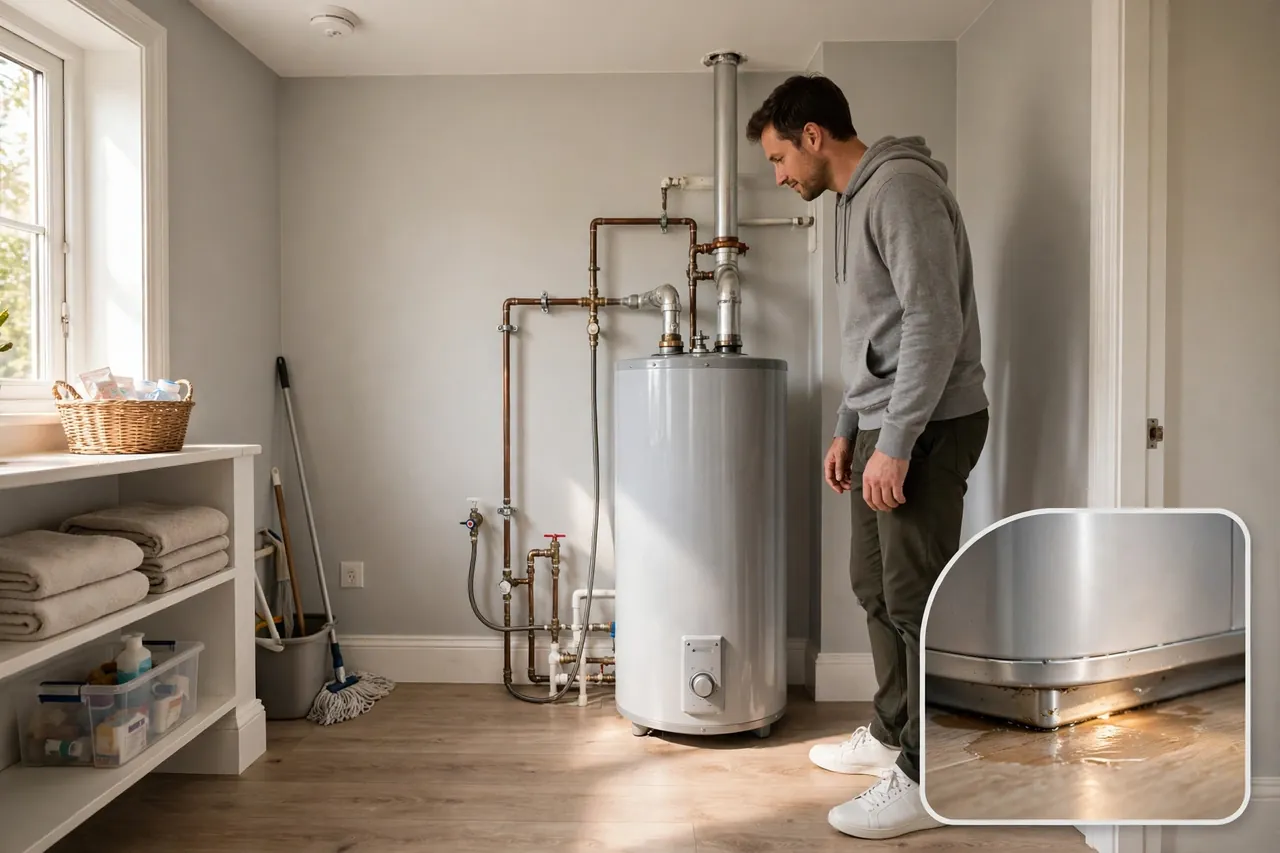
- See water pooling around the base? If the pool is growing, turn off the water supply to the heater and the power or gas to the unit, then call a licensed plumber. A leaking tank usually means the tank itself has corroded, and that cannot be patched.
- Hear buzzing or sparking, or smell burning? Turn off power at the breaker and call an electrician or plumber. Do not open any access panels.
- Feel the tank is very hot to the touch, or hear hissing from the pressure relief valve? Do not cap or block the valve, and do not stand close to it. Call a licensed plumber the same day.
For electric units, always switch off the breaker labeled “water heater” before you open any access panel. For gas units, turn the gas control knob to “pilot” or “off” before you inspect anything. Lennox gives the same advice in its troubleshooting guide: turn off the power or gas first, and if you smell gas at any point, leave the house and call your gas company before doing anything else.
Is Your Water Heater Gas or Electric?
Half of the checks in this guide depend on which type you have, so figure this out first if you are not sure. It takes ten seconds.
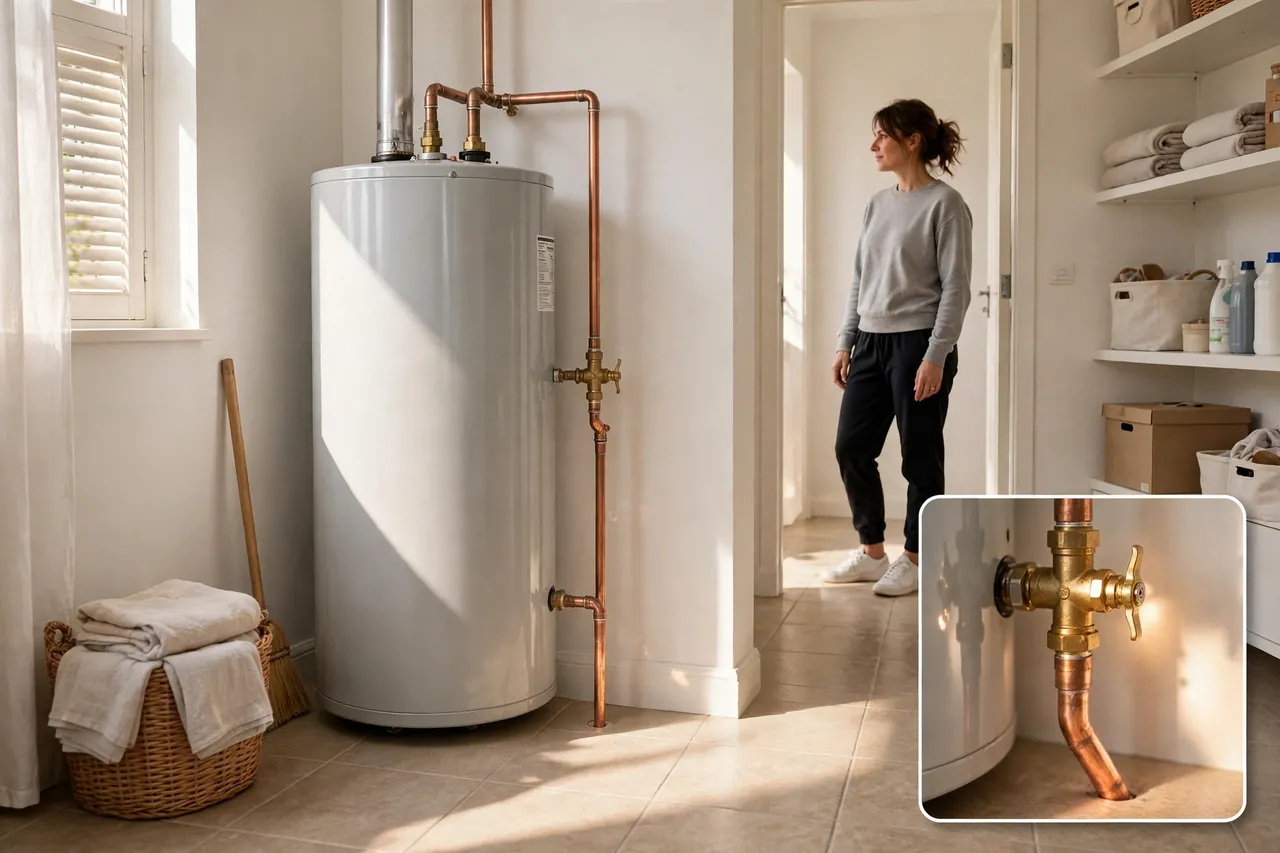
- Gas: Look at the bottom of the tank. You will see a gas pipe running into a control valve, a small viewing window near the base, and a vent pipe going up from the top. A small blue flame through the window is the pilot light.
- Electric: There is no gas pipe and no vent. Instead, a thick electrical cable runs into the top or side of the tank, and two rectangular access panels sit on the side, one near the top and one near the bottom. The thermostats and heating elements sit behind those panels.
- Tankless: There is no big tank at all — just a box on the wall. Tankless units heat water only when a tap opens, and most failures show up as error codes on a small display. This guide focuses on tank heaters, which are what most American homes have.
Heat-pump or hybrid electric heaters have a fan grille on top and a digital display. Many failures show up as error codes, so check your owner’s manual for the code list and call a technician for anything past the basic power and setting checks.
Step-by-Step: Check These in Order
Work through these steps in order. Each one is cheaper and safer than the next. Stop at the step that fixes the problem, and stop the whole process and call a pro if any step tells you to.
Step 1: Check the Power or Gas Supply
Start here, because this is the most common reason a water heater stops working, and it costs nothing to check.
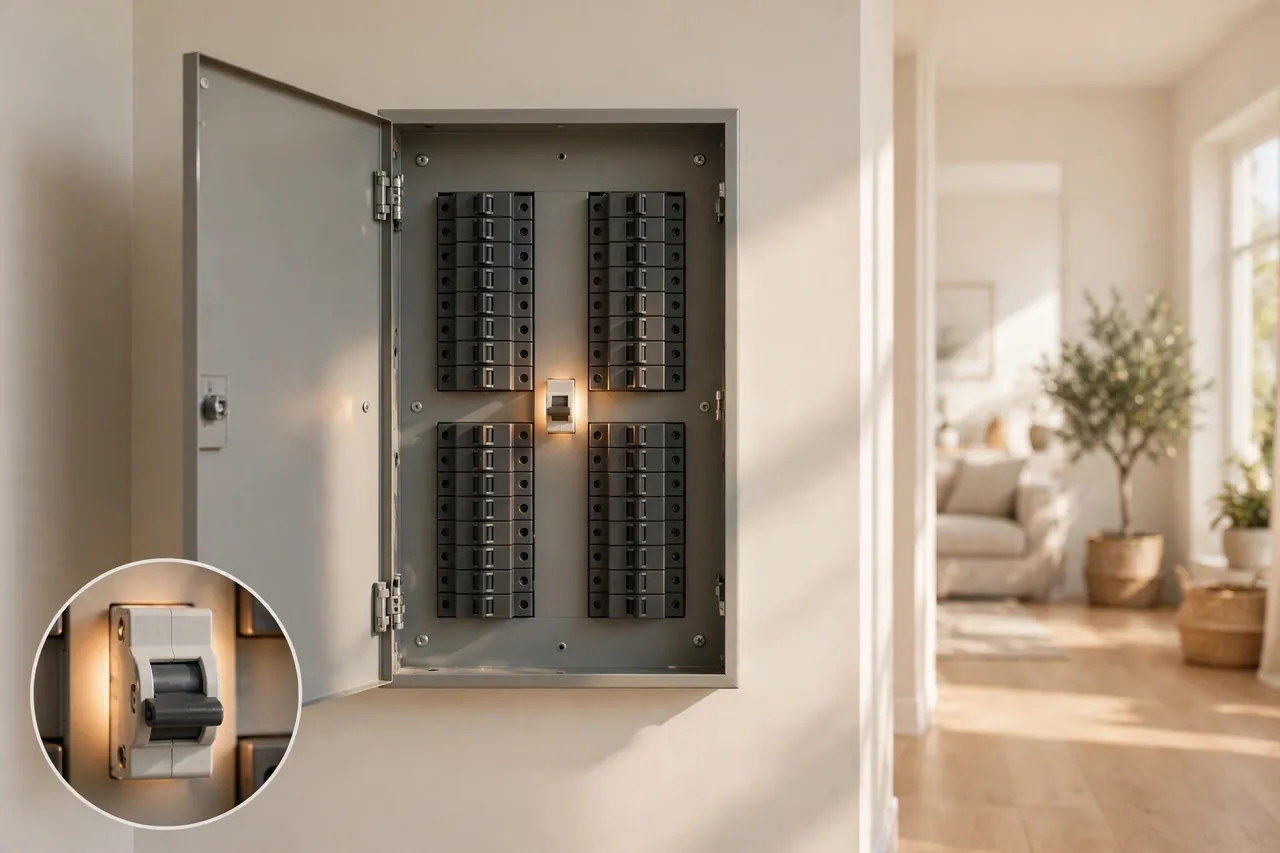
For electric heaters, go to your electrical panel and find the breaker labeled “water heater.” If it sits in the middle — not fully on, not fully off — it has tripped. Flip it completely off, then firmly back on. Wait 30 to 60 minutes, then test a hot tap. If the breaker trips again right away, stop. A breaker that will not stay on usually means a shorted heating element or a wiring fault, and that is a job for a licensed electrician or plumber.
For gas heaters, find the gas shutoff valve on the pipe leading into the heater. The handle should run parallel to the pipe, which means open. If it sits across the pipe, it is closed — turn it so it lines up with the pipe. Also check that the gas control knob on the heater is set to “on,” not to “pilot” or “off.” If other gas appliances in the house are also dead, call your gas company. After a power outage, an electric heater may need the breaker reset, and a gas heater may need the pilot relit.
Step 2: Check the Thermostat Setting
A thermostat that was bumped or turned down by mistake is a surprisingly common cause of lukewarm water. On a gas heater, the temperature dial sits on the gas control valve at the bottom front of the tank. On an electric heater, the thermostats sit behind the upper and lower access panels.
The U.S. Department of Energy recommends setting your water heater to 120°F for most households. That is hot enough for showers, laundry, and dishes, and it keeps scalding risk low. Many tanks ship from the factory set to 140°F, which wastes energy and can cause a serious burn in seconds. If your dial reads below 120°F, turn it up to 120°F and wait a few hours — a full tank takes time to heat. If the dial uses words instead of numbers, the “warm” or “A” mark usually means about 120°F.
On an electric heater, set both the upper and lower thermostats to the same temperature. When the two dials disagree, you can end up with a tank that is hot on top and cold on the bottom. Never set either dial above 140°F.
Step 3: Gas Only — Check the Pilot Light
Caution first: if you smell gas at any point during this step, stop immediately, leave the house, and call your gas company from outside. Do not try to relight the pilot if you smell gas.
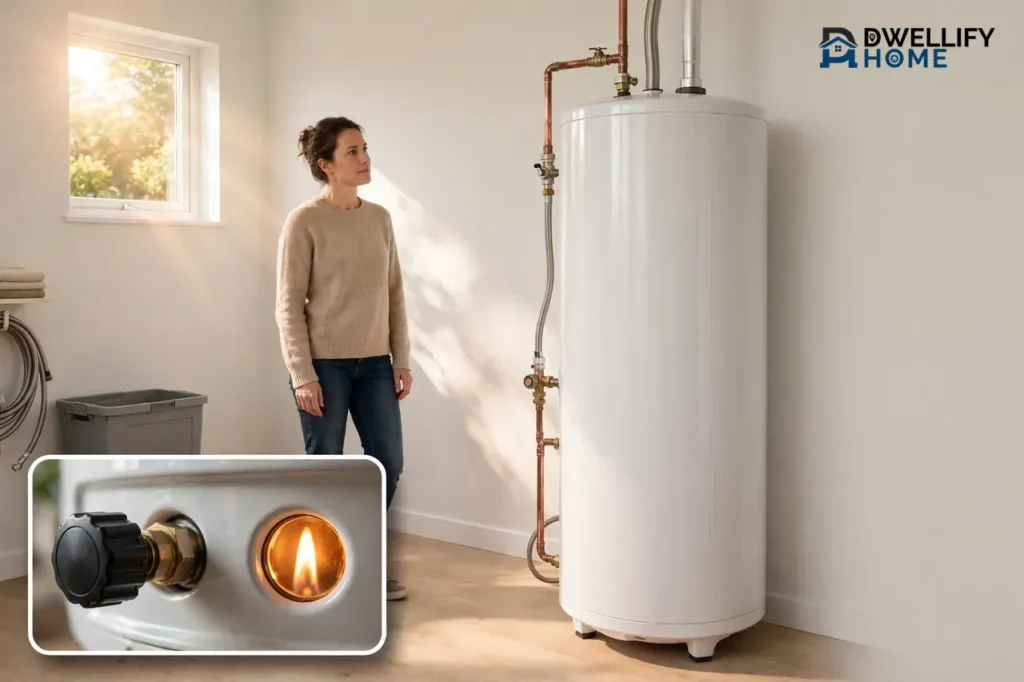
The pilot light is a small, steady blue flame that stays lit all the time on a gas water heater. It lights the main burner whenever the tank needs heat. If it goes out — from a draft, a gas interruption, or a worn part — the burner never fires, and the water stays cold. Look through the small viewing window near the base of the tank. If the window is dark, the pilot is out.
If the pilot is out and you do not smell gas, follow the relighting instructions printed on the label stuck to your water heater. Every model is a little different, and the label on your unit is the right guide for it. A.O. Smith’s use-and-care manuals add one check: the status light on the gas control valve should flash once every three seconds when the pilot is lit and nothing is wrong. If the pilot will not light, call a qualified person.
Try relighting it two or three times at most. If the pilot lights and then goes out again, or it will not stay lit at all, the thermocouple is the usual suspect. That small sensor sits next to the pilot flame and tells the gas valve the pilot is lit. When it wears out, the valve shuts the gas off for safety. Replacing a thermocouple is a gas job, so call a licensed plumber. Do not keep relighting a pilot that will not stay lit.
Step 4: Electric Only — Press the Reset Button
Caution first: turn off the power at the breaker before you open any access panel on an electric water heater. These units run on 240-volt power, which can deliver a fatal shock. Do not skip this step.
Electric water heaters have a red reset button, also called the high-limit switch, on the upper thermostat behind the upper access panel. It trips when the water gets too hot or after a power surge, and once it trips, the heater stops running until you reset it by hand. With the power off at the breaker, remove the upper access panel with a screwdriver, pull back the insulation, and press the red button firmly until you feel or hear a click. Put the insulation and panel back, restore power at the breaker, and wait 30 to 60 minutes before testing a hot tap.
If the button clicks and the water heats up again, the problem is solved — but keep an eye on it. If it trips again within a few days, something is making the water overheat, often a failing thermostat or a grounded heating element. That needs a professional diagnosis.
Step 5: Check Whether the Problem Is One Tap or Every Tap
Run the hot water at two or three different faucets. If some taps give you hot water and others do not, the water heater is fine. The problem is at the cold tap’s faucet or shower valve. Many modern shower controls have a built-in mixing valve that blends hot and cold water, and when that valve fails, one shower can run cold while the rest of the house is fine. A plumber can replace a faulty mixing valve, and it is a much smaller job than a water heater repair.
If every tap is cold, the problem is the heater or the pipes feeding it. In winter, that can also mean a frozen pipe, which can block hot water from reaching your taps entirely. If your area is below freezing, check our guide on how to unfreeze frozen pipes before you assume the heater is broken.
Step 6: Listen, Look, and Smell Around the Tank
Your senses will tell you a lot about what is happening inside a tank you cannot see into.
- Rumbling or popping sounds: That is sediment — mineral deposits that settle at the bottom of the tank and trap heat underneath. The water under the sediment boils and pops. Flushing the tank once a year clears it out, and in hard-water areas, twice a year is better.
- Rusty or brown water from hot taps: Rust usually means corrosion inside the tank or a worn anode rod, the metal rod that protects the tank from rusting. If the water is rusty only from the hot side, call a plumber — the tank may be near the end of its life.
- A rotten-egg smell: That smell usually comes from bacteria reacting with the anode rod. It is unpleasant but rarely dangerous. A plumber can fix it by flushing the tank and, if needed, changing the anode rod.
- Water dripping from the pressure relief valve: The temperature and pressure relief valve, or T&P valve, sits on the side of the tank with a small lever and a discharge pipe running toward the floor. It releases water when pressure gets too high. Never cap or plug it. If it drips or hisses, call a licensed plumber the same day — a faulty T&P valve is a serious safety risk.
A leak at a pipe fitting on top of the tank can often be tightened or replaced. But if water is coming from the tank body itself, or pooling steadily at the base, the tank has corroded through. No repair fixes a corroded tank — it needs replacing. A flood sensor near the heater can warn you about a leak early, before it soaks a floor.
How Much Does a Water Heater Repair Cost?
Knowing the likely cost helps you decide whether to repair or replace, and it keeps a repair quote from surprising you. The figures below are HomeAdvisor’s published U.S. ranges, checked on November 6, 2026. They are estimates for typical jobs, including parts and labor, and your town and your plumber will move the price.
| Repair | Typical cost range |
|---|---|
| Average water heater repair (all types) | $616, with most jobs between $228 and $1,018 |
| Gas water heater repair | $150 to $500 |
| Electric water heater repair | $20 to $300 |
| Heating element replacement | $200 to $300 |
| Thermostat replacement | $150 to $200 |
| Thermocouple replacement | About $150 |
| Gas control valve replacement | About $350 |
| Tank flushing or cleaning | About $200 |
| Full replacement (tank, installed) | $875 to $1,800 |
HomeAdvisor also notes that a conventional tank water heater lasts about 10 to 15 years. If your unit is under 8 years old and the repair is a single part, repairing almost always makes sense. If the unit is over 10 years old and the repair costs close to half of a new unit, replacement is usually the better spend. Get two quotes before you approve a big repair.
When to Call a Licensed Plumber
Some water heater problems are not do-it-yourself jobs, no matter how handy you are. Call a licensed plumber when any of these apply:
- You smell gas anywhere near the unit, or the pilot will not stay lit after two or three tries.
- Water is pooling around the base of the tank, or the tank itself is leaking.
- The breaker trips again right after you reset it, or the reset button keeps tripping.
- You have checked the power, gas, pilot, thermostat, and reset button, and you still have no hot water.
- The pressure relief valve is dripping, hissing, or stuck.
- Any repair means opening the gas line, replacing a heating element, or working on live 240-volt wiring.
- Your unit is 8 to 12 years old or older and problems keep coming back.
When you call, tell the plumber three things: whether the unit is gas or electric, what symptom you have, and what you already checked. That short summary lets them bring the right parts and often saves a second visit. If water has already leaked onto the floor, shut off the water supply to the heater first — our guide to underground water leak detection explains how to tell a pipe leak from a tank leak.
How to Keep Your Water Heater Working
The best water heater problem is the one that never happens. A little routine care goes a long way, and most of it is simple.
- Flush the tank once a year. Connect a garden hose to the drain valve at the base, run the water into a floor drain or bucket until it flows clear, then close the valve and restore power or gas. In hard-water areas, do it twice a year.
- Check the anode rod every 2 to 3 years. This metal rod inside the tank stops the tank from rusting, and replacing it when worn can add years to a tank’s life.
- Keep the area around the unit clear. Do not store paint, gasoline, or cleaning chemicals near a gas heater, and keep vents clear so the burner gets air.
- Test the pressure relief valve once a year. Lift the lever briefly and let it snap back. Water should flow out of the discharge pipe and then stop. If it keeps dripping, call a plumber.
- Winterize before the cold arrives. If you live where pipes freeze, read our guide on how to winterize a house before the first freeze, and know what temperature water pipes freeze at so you can act before a pipe bursts.
- Have it serviced once a year. One visit covers the flush, the relief valve, the anode rod, and the heating elements. HomeAdvisor’s own FAQ gives the same advice: annual service keeps a water heater running up to 15 years.
If your power goes out often in storms, read our guide on how to stay warm without power, including what not to do with gas appliances during an outage.
A Quick Safety Note
This guide covers only the checks a homeowner can safely do: power, gas supply, thermostat setting, pilot light, reset button, and what you can see, hear, and smell around the tank. Gas lines, electrical wiring, heating elements, and pressure relief valves are licensed-professional work. Water heaters also store water hot enough to scald, so test tap water with care after any change, especially if children or older adults use the shower. Homes and water conditions vary, so get a licensed plumber’s advice for your specific unit.
Related Guides
Thermostat Not Working? Fix It Fast With These Symptom-First Checks · Wireless Thermostat: What It Is, How It Works, and When to Choose One
Frequently Asked Questions
Why is my water heater not producing hot water?
It usually stops producing hot water because it is not getting power or gas, the breaker has tripped, a heating element has failed, the pilot light is out, or a safety switch has tripped. Work through the checks in order — breaker, gas valve, pilot light, thermostat, reset button — and call a plumber if you still have no hot water after an hour.
Why is my electric water heater not heating water?
The four most common causes are a tripped circuit breaker, a tripped high-limit reset button, a failed heating element, or a failed thermostat. Check the breaker first, then press the red reset button on the upper thermostat with the power off at the breaker. If both are fine and the water is still cold, a professional needs to test the elements or thermostats.
How often should I service my water heater?
Have it serviced by a professional at least once a year. Regular maintenance includes flushing the tank to remove sediment, checking the pressure relief valve, and inspecting the heating elements. When properly maintained, a water heater should last up to 15 years.
What is the most common problem with water heaters?
Faulty heating elements, malfunctioning thermostats, and sediment buildup in the tank are the most common problems. They cause insufficient hot water, fluctuating temperatures, or unusual noises. Regular maintenance helps prevent them, and a repair professional should look at any of these issues before they get worse.
A hot water heater that is not working feels like an emergency, but most of the time the fix is a breaker, a pilot light, a setting, or a reset button. Work through the steps in order, respect the stop signs, and call a licensed plumber the moment gas, leaks, or live wiring are involved. Your hot water is usually one safe check away.