Most water heaters fail not because of a mechanical breakdown, but because of one small, overlooked part that quietly wore out years earlier. That part is the anode rod — and in over a decade of working on residential water heaters, it’s the single most neglected component I come across. Homeowners spend thousands replacing a water heater they could have kept running for another five or six years, simply because nobody told them this $30–$50 rod needed attention.
This guide covers everything you need to know: what the rod actually does, how to tell when it’s failing, how to replace it yourself, and how to choose the right one for your home’s water type.
The Short Answer
An anode rod is a sacrificial metal rod — made of magnesium, aluminum, or zinc — installed inside a tank water heater to prevent internal corrosion. It deteriorates over time so the steel tank doesn’t, extending the water heater’s usable life by several years.
Dwellify Home
At Dwellify Home, our goal is simple: help homeowners make practical, well-informed decisions about their living spaces — from everyday maintenance to long-term home improvements. We focus on clear, honest guidance that respects your time, your budget, and your home.
What Is an Anode Rod?
An anode rod is a long metal rod — typically 3 to 5 feet — that threads into the top of a tank-style water heater. It’s made from magnesium, aluminum, or a zinc-aluminum alloy, and it has one job: to corrode so your tank doesn’t have to.
The rod is often called a “sacrificial anode” because it literally sacrifices itself to protect the steel interior of your water heater. Once it’s fully consumed, there’s nothing left standing between the corrosive water and your tank walls.
How Does It Actually Protect Your Water Heater?
Water sitting in a steel tank, constantly heated and cooled, creates the conditions for galvanic corrosion — an electrochemical process where one metal breaks down in the presence of water and another metal. Without protection, your tank would be the target.
The anode rod works because it carries a lower electrochemical potential than the steel of your tank. In plain terms, corrosive particles in the water are drawn to the rod first. They attack it, not the tank. The rod slowly erodes over months and years, and as long as there’s enough rod material left, your tank stays protected. Once the rod is gone — down to a bare wire — corrosion shifts directly to the tank. That’s when leaks start, and replacement becomes unavoidable.
Where Is the Anode Rod Located?
On most residential water heaters, the anode rod sits at the top of the unit. You’ll usually see a hexagonal bolt head, sometimes covered by a plastic cap labeled “ANODE.” On some models — Bradford White being the most common example — the rod is integrated into the hot water outlet nipple rather than having its own port.
If you can’t find it by looking, check your owner’s manual or search your model number online. The location matters because it affects how easy the replacement will be.
Quick Comparison Table — Anode Rod Types at a Glance
| Rod Type | Best For | Lifespan | Avg. Cost |
| Magnesium | Soft water homes | 3–4 years | $20–$40 |
| Aluminum | Hard water homes | 4–5 years | $20–$40 |
| Zinc-Aluminum | Sulfur odor / well water | 3–5 years | $25–$50 |
| Flexible | Low-ceiling installations | 3–5 years | $30–$70 |
| Powered (Electric) | Harsh water / long-term use | 20+ years | $150–$300 |
Key Facts Worth Knowing
- A depleted anode rod is the leading cause of premature water heater failure
- Most rods need inspection every 2–3 years; every 6 months if you have a water softener
- The standard removal tool is a 1-1/16-inch socket wrench — impact wrench recommended for seized rods
- Replacing a rod costs $20–$50; replacing the entire water heater costs $800–$1,500
- Tankless water heaters do not use anode rods — only tank-style units do
Do All Water Heaters Have an Anode Rod?
Any traditional tank-style water heater — gas, electric, heat pump, or solar — has at least one anode rod. Tankless water heaters do not, because they don’t store water in a tank.
There’s one exception worth knowing: certain direct vent water heaters designed for mobile homes or manufactured housing have anode rods that are physically inaccessible. They’re buried under insulation foam with no serviceable port. On these models, you simply can’t replace the rod, so the only options are proactive water treatment or eventually replacing the unit itself.
Commercial water heaters often have two or more rods. Some Bradford White EF-series commercial units carry four — one powered rod and three magnesium rods — because larger tanks need more sacrificial surface area to stay protected.
Types of Anode Rods — What’s the Difference?
Not all anode rods are built the same, and choosing the wrong one for your water type can cause real problems — including the rotten egg smell that sends homeowners into a panic thinking their water heater is dying.
Magnesium Anode Rods
Magnesium rods offer the strongest corrosion protection and are the standard choice for homes with soft water. They’re reactive, which is exactly what you want — they corrode quickly and aggressively, pulling corrosive elements away from the tank.
The downside is that magnesium reacts with sulfur-reducing bacteria in certain water supplies, which can produce a hydrogen sulfide gas — the rotten egg smell. If your home has well water or naturally occurring sulfur in the supply, a magnesium rod may make that smell worse, not better.
Aluminum Anode Rods
Aluminum rods are the factory standard in most water heaters because they’re durable, affordable, and handle hard water well. They corrode more slowly than magnesium, which gives them a longer functional life in households with moderately hard water.
One thing to watch for: as aluminum rods corrode, they can produce a white or milky gel — aluminum oxide — that occasionally makes its way into faucet aerators. It’s not harmful, but if you’re cleaning that gel out of your aerators regularly, check the rod.
Zinc-Aluminum Anode Rods
These are the go-to solution for homes dealing with sulfur odors in hot water. The zinc content inhibits the growth of sulfur-reducing bacteria, which reduces or eliminates the rotten egg smell. They’re not meaningfully more expensive than standard aluminum rods, so if odor is your issue, this is the straightforward fix — though severe water quality problems may require additional water treatment.
Powered (Electric) Anode Rods
A powered anode rod — sometimes called an electric or electronic anode rod — works differently from all the others. Instead of corroding, it uses a small electrical current to repel corrosive ions from the tank wall. It doesn’t dissolve, doesn’t need to be replaced on a regular schedule, and typically comes with a warranty measured in decades rather than years.
The trade-off is upfront cost. A quality powered rod runs $150–$200 for residential use, compared to $20–$50 for a traditional rod. They also require a nearby electrical outlet. For homes in areas with aggressive water chemistry — high mineral content, well water, water with naturally elevated chloride levels — the math often works in favor of the powered option over a 10-year period.
Flexible Anode Rods
A flexible rod is the same magnesium, aluminum, or zinc-aluminum material as a standard rod, but it’s constructed in linked segments rather than one solid piece. This lets you bend it slightly during installation — crucial when you have less than 44 inches of clearance above your water heater.
If your heater sits in a tight closet or a low-ceiling utility room, a flexible rod is not optional — it’s the only practical choice short of moving the heater.
How Long Does an Anode Rod Last?
Under normal conditions with average municipal water, a sacrificial anode rod lasts roughly 3 to 5 years. That’s the range most manufacturers reference, and it holds true in homes with moderate water quality and average usage.
The problem is that “average” covers a wide range of real-world conditions. In practice, several factors can dramatically shorten that lifespan.
How a Water Softener Affects Your Anode Rod
This is something a lot of homeowners don’t expect: water softeners accelerate anode rod corrosion. Softened water has elevated sodium content, and sodium is corrosive. In homes with aggressively softened water, an anode rod can be fully consumed in six months to a year.
If you have a water softener, don’t wait five years to check the rod. Check it every six months. And consider whether a powered anode rod — which isn’t affected by water chemistry the same way — makes more sense for your setup.
Well Water and Anode Rods — What Homeowners Should Know
Well water tends to contain higher concentrations of minerals, iron, bacteria, and dissolved gases than municipal water. All of these accelerate rod depletion. Homes on well water should inspect their anode rod every six months rather than annually, and many well water homeowners find that a powered rod pays for itself quickly by eliminating the constant replacement cycle.
Signs Your Anode Rod Needs to Be Replaced
The rod doesn’t announce when it’s failing. It just quietly stops doing its job, and the first signals usually show up as water quality issues or strange noises.
What a Failing Anode Rod Looks Like
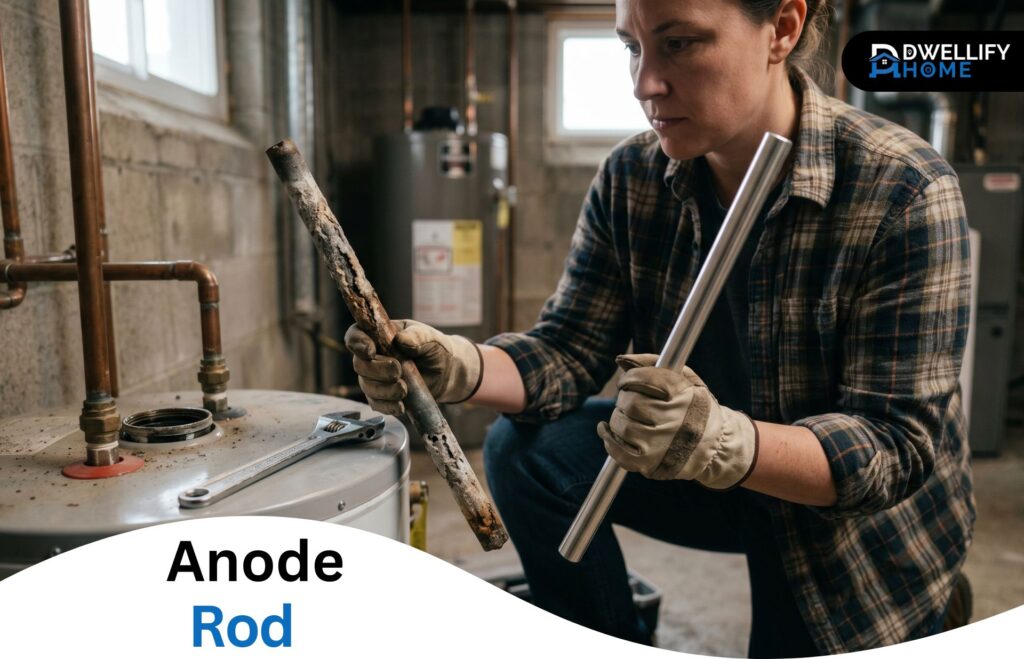
When you pull out a rod that needs replacing, it will be visibly depleted. The healthy rod is a solid cylinder. A rod that needs replacing is thin — under half an inch in diameter — or shows more than six inches of bare steel wire where the sacrificial material has already been consumed. If the entire rod is down to wire, or the surface is caked in hard calcium deposits that won’t chip off, replace it immediately.
Rotten Egg Smell from Hot Water
A sulfur or rotten egg smell coming specifically from hot water — not cold — is one of the clearest signs that something is off with your rod or your water chemistry. The smell comes from hydrogen sulfide gas produced when sulfur-reducing bacteria interact with certain anode materials, particularly magnesium.
Switching to a zinc-aluminum rod often resolves the odor. Raising the water heater temperature to 140°F for a period can also kill the bacteria, though be mindful of scald risk.
Rusty or Discolored Hot Water
An orange or brownish tint in hot water, especially when it’s most pronounced first thing in the morning, points to oxidation inside the tank. If the rod has been depleted for a while, the tank walls may already be corroding. This warrants immediate inspection — and if the tank itself is rusting, a new water heater may be the more practical path.
Rumbling, Popping, or Cracking Noises
Sediment builds up at the bottom of the tank as the anode rod degrades and minerals settle out of heated water. When water gets trapped under that sediment layer and heats up, it makes a rumbling or popping sound. In electric water heaters, this sediment can also coat the lower element and shorten its life. The noise is the tank’s way of telling you it’s been neglected.
Gel or Slime in Faucet Aerators
If you’re cleaning a clear or milky gel out of your faucet aerators and it keeps coming back, that’s often aluminum oxide — a byproduct of a corroding aluminum anode rod. It’s not dangerous, but it means the rod has been deteriorating for some time and has likely passed the replacement threshold.
How to Check Your Anode Rod
Checking the rod is a straightforward job, but one most homeowners have never done. Manufacturers recommend annual inspections; realistically, every two to three years is what most households need.
Tools You Will Need
- 1-1/16-inch socket wrench (this size fits virtually every residential water heater)
- A breaker bar or impact wrench for stubborn rods — standard socket wrenches often lack the torque
- WD-40 or a penetrating lubricant if the threads are corroded
- A garden hose for partial draining
- Work gloves
The most common reason homeowners give up mid-inspection is not having enough torque to break the rod free. An impact wrench — even an inexpensive one — makes this dramatically easier.
How to Replace an Anode Rod — Step by Step
Replacing an anode rod typically takes 30 to 45 minutes. You don’t need plumbing experience to do it, but you do need to follow the steps carefully.
Step 1 — Shut Off Power or Gas and Cold Water Supply
For an electric heater, switch it off at the circuit breaker. For a gas heater, turn the thermostat to the “pilot” setting. Then close the cold water inlet valve on top of the heater. Open a hot water faucet somewhere in the house to release pressure in the lines.
Step 2 — Drain a Few Gallons to Reduce Pressure
Connect a garden hose to the drain valve at the bottom of the tank. Open it and let two to four gallons out. You don’t need to fully drain the tank — just enough to drop the water level below the anode rod port and reduce pressure inside.
Step 3 — Locate and Remove the Old Rod
Find the hex head on top of the heater. If it’s covered by a plastic cap, remove it. Use your 1-1/16-inch socket to break the rod loose. Apply consistent, steady pressure. If the heater starts to move, have someone hold it steady — the weight of water in the tank usually keeps it in place on its own. Once loose, unscrew the rest by hand and pull the rod straight up and out.
Step 4 — Inspect What Came Out and Choose Your Replacement
Look at the rod you removed. How much material is left? Is it down to wire? Is it coated in calcium? Use this to inform how often you should be checking in the future. If the rod failed faster than expected, consider whether a powered rod makes sense going forward.
Step 5 — Wrap Threads with Teflon Tape and Install the New Rod
Apply two to three wraps of Teflon tape to the threaded end of the new rod. Thread it in by hand first, then tighten with the socket wrench. Snug is enough — overtightening can damage the threads on the tank port.
Step 6 — Refill the Tank, Restart, and Check for Leaks
Close the drain valve, remove the garden hose, and open the cold water supply valve. Let the tank fill — you’ll hear it — and check around the rod port for any drips. Once the tank is full and you’ve confirmed no leaks, restore power or relight the gas.
What If the Rod Is Stuck or Breaks During Removal?
Seized rods are common, especially in heaters that haven’t been serviced in years. Soak the hex head with WD-40 and give it 10 to 15 minutes to penetrate before trying again. An impact wrench dramatically increases your success rate. Apply force in short bursts rather than sustained pressure.
If the rod shears off during removal, the broken portion will fall to the bottom of the tank. This is a serious problem — that piece will bounce around inside, cracking the glass lining and accelerating tank failure. At that point, call a professional. It may also be the moment to honestly assess the heater’s age and condition before investing in further repairs.
No Space Above the Heater? Here’s What to Do
Standard anode rods need at least 44 inches of clearance above the water heater to be removed and installed. If your heater sits in a tight closet or against a low ceiling, a flexible anode rod — which bends at its linked joints — can be installed in much less space. If even that isn’t practical, a powered anode rod is often the cleanest solution, since it’s significantly shorter than a standard rod.
How to Choose the Right Anode Rod for Your Home
The material you choose should be driven by your water quality — not by what’s cheapest or what was already in the tank.
Match Your Rod to Your Water Type
- Hard water (high mineral content, common in city water): aluminum rod
- Soft water (naturally soft or artificially softened): magnesium rod
- Sulfur odor or rotten egg smell: zinc-aluminum rod
- Well water, aggressive water chemistry, or water softener household: consider a powered rod
If you’re unsure about your water type, a basic hardness test strip — available at hardware stores for a few dollars — gives you a working answer in minutes.
Sizing and Thread Compatibility
Anode rods are not universal, but they’re more interchangeable than most people think. The vast majority of residential water heaters use a standard 3/4-inch NPT thread. The key measurement to match is length — your replacement should be the same length as the original or slightly longer (so you can trim it if needed). Never install a shorter rod.
If you’re unsure of the right part, note your water heater’s brand and model number, then contact the manufacturer’s support line or check a trusted plumbing supply retailer.
Sacrificial Rod vs. Powered Rod — Which Is Worth It?
A traditional sacrificial rod costs $20–$50 and needs replacement every 3 to 5 years. Over 15 years, you’re looking at 3 to 5 replacements — plus labor if you’re hiring it out. A powered anode rod costs $150–$200 upfront and typically comes with a 20-year warranty. In areas with aggressive water chemistry, the powered option often costs less over time and removes the risk of forgetting a replacement cycle.
That said, for homes with average municipal water and easy access to the rod, a quality magnesium or aluminum rod and a regular inspection habit is a perfectly sound approach.
How Much Does Anode Rod Replacement Cost?
The part itself ranges from $20 to $50 for a standard sacrificial rod. Flexible rods run $30 to $70. Powered rods cost $150 to $300 for residential models.
If you hire a plumber, expect to pay $100 to $200 in labor on top of the part cost — more if the rod is seized or space is limited. Combined services (like pairing a rod replacement with a tank flush and element check) are often offered at a discount by water heater specialists, and that’s usually the smarter call anyway.
To put it in perspective: a new tank water heater runs $800 to $1,500 installed. Keeping the one you have healthy with a $50 part and some maintenance is one of the more straightforward ways to protect a home appliance investment.
Is Anode Rod Replacement Covered Under Warranty?
In nearly all cases, no. Major manufacturers — A.O. Smith, Bradford White, and Rheem among them — explicitly exclude anode rod deterioration from their warranty coverage because it’s classified as normal wear caused by water quality and usage. It’s not a manufacturing defect; it’s the rod doing exactly what it was designed to do.
The rare exceptions are rods that were missing from a new unit at the factory or installed incorrectly at the point of manufacture. In those cases, a warranty claim may be valid — but document everything and contact the manufacturer directly.
Anode Rod Maintenance — Keeping Your Water Heater Healthy Long-Term
The single best habit you can build is pairing your anode rod inspection with your annual tank flush. Flushing removes sediment from the bottom of the tank, and doing both jobs at the same time is efficient and keeps the heater in consistently good condition.
On electric water heaters, it’s also worth checking the heating elements when you’re already in there. A corroded rod often means sediment has been building up around the lower element too.
How to Test Your Water Hardness at Home
The simplest method is a pH or hardness test strip — you dip it in a water sample and compare the color result to the included chart. A neutral reading around 7 is ideal. Results outside that range, particularly on the hard or mineral-heavy side, are a signal to inspect your rod more frequently and potentially reconsider your rod material.
If your home is on well water, a proper water analysis from a certified lab gives you a much clearer picture. It’s worth doing at least once, especially if you’re dealing with recurring odor or sediment issues.
When to Call a Professional
Most anode rod replacements are genuinely DIY-friendly. But there are situations where calling a plumber is the right move.
If the rod is severely seized and your attempts to remove it are putting stress on the water lines or the tank itself, stop. Forcing a stuck rod on an older heater can crack a fitting or damage a connection that then becomes a much larger repair.
If your hot water is already running rusty and the heater is more than 10 years old, replacing just the rod may not be enough. Have a professional assess whether the tank wall itself has been compromised. Repairing a tank that’s already rusting from the inside is rarely worthwhile.
On direct vent models with non-removable rods, a professional can confirm whether water treatment is the better path forward, rather than having you spend money on an intervention that isn’t physically possible.
Frequently Asked Questions
How do you pronounce “anode rod”?
It’s pronounced ay-node rod — with the emphasis on the first syllable. The word comes from electrochemistry, where an anode is the positively charged electrode in an electrochemical cell.
Does a tankless water heater have an anode rod?
No. Tankless water heaters heat water on demand and don’t store it in a tank, so there’s no steel tank interior to protect. Anode rods are only found in traditional tank-style water heaters.
Can I remove the anode rod without replacing it?
No — and this is important. Removing the rod and leaving the port empty voids your warranty with virtually every major manufacturer and leaves the tank completely unprotected from corrosion. The tank can begin deteriorating within months. Always replace it immediately if you remove it.
How do I know which anode rod fits my water heater?
Note your water heater’s brand, model number, and tank size (in gallons). Most residential heaters use a standard 3/4-inch NPT threaded rod, so the main variable is length. You can find compatible parts on the manufacturer’s website, through a plumbing supply retailer, or on Amazon by searching your model number alongside “anode rod.”
Where is the best place to buy a replacement anode rod?
Hardware stores like Home Depot or Lowe’s carry a basic selection. For better variety — especially if you want a specific brand or a powered rod — plumbing supply retailers and Amazon offer broader options. If you need an exact OEM replacement, the manufacturer’s own parts website is the most reliable source.
What size socket do I need to remove an anode rod?
A 1-1/16-inch socket fits the hex head on nearly every residential water heater, regardless of brand. Pair it with a breaker bar or impact wrench, and removal becomes manageable even on rods that haven’t been touched in years.
Conclusion
The anode rod is not a glamorous part of home maintenance — it’s a metal stick most homeowners never think about until something goes wrong. But in terms of cost versus protection, it’s hard to argue with: a $30–$50 rod replaced every few years can realistically extend your water heater’s life by five to ten years, saving you from an $800 to $1,500 replacement you weren’t budgeting for.
The practical takeaway is straightforward. Know where your rod is. Inspect it every two to three years — more often if you have a water softener or well water. Match the material to your water type. And if you’re working with a tight space, aggressive water chemistry, or a heater that’s already on the older side, a powered rod is worth the conversation.
A water heater that’s properly maintained doesn’t announce itself. It just quietly does its job — hot water, every time, for years longer than it would have otherwise lasted.
Disclaimer
The content published on Dwellify Home is intended for general informational purposes only. While we aim to provide accurate and helpful guidance, individual results, water conditions, and home setups will vary. Always consult a licensed plumber or your water heater’s manufacturer documentation before undertaking repairs or replacements specific to your unit.